Tag Archives: 2010 congressional

MSNBC’s Matthews Compares Conservative Candidates to Suicide Bombers

“Being a suicide bomber is the new political role model,” Chris Matthews told his Friday “Hardball” audience. “Just kill everything, destroy everything, blow it up, nothing gets done. You’re dead, but who cares?” he added, referring to conservative Republicans running against Democrats in the 2010 midterms. The comment came at the end of a segment featuring Rep. Jim Moran (D-Va.) and Politico’s Jim VandeHei. Matthews had complained to the latter that the congressional minority Republicans were intent not merely on tinkering around the edges of the majority Democrats’ policy proposals but on “destroy[ing] the United States government every time it gets up in the morning” all to the applause of “its cheering section back home say[ing] good work, keep trying to destroy the government.” [MP3 audio available here; WMV video available here ] VandeHei didn’t agree with Matthews’s “destroy the government” rhetoric about the GOP, although he agreed that the GOP was intent on “destroying” policies that President Obama supports. For his part, the Politico writer argued that the political system as it stands now is just geared towards extreme partisanship because in part moderates had been “purged” from the GOP but also because “right now we have an entire system, we have a media system, we have a culture, we have technology that really rewards the incendiary, [that] rewards conflict.” Given Matthews’s hyperbolic invective about “The Rise of the New Right,”   VandeHei might unwittingly be on to something, at least when it comes to the incendiary media.

More:
MSNBC’s Matthews Compares Conservative Candidates to Suicide Bombers
NYT Reporter Desperately Searches for Signs of Economic Progress to Prevent Republican Victories

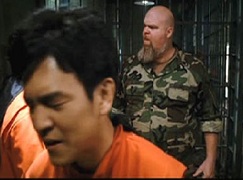
Please don’t let it be Big Bob! Please don’t let it be Big Bob! That fervent prayer by Harold of “Harold and Kumar Escape From Guantanamo Bay” as he desperately hopes that sound of the approaching footsteps don’t belong to a sadistic guard named Big Bob comes to mind when reading a New York Times article by Michael Luo . In Luo’s case he is hoping that the Republicans won’t gain significant victories in this November’s elections. He bases his glimmers of hope on what he perceives to be signs of economic progress. It isn’t a very strong peg upon which he hangs these hopes but it is pretty much all he has: The economy is slowly recovering but remains on its sickbed, and most signs still point to a rough cycle for the party. Political analysts expect Republicans to make gains — possibly significant ones — in Congress in November, threatening to retake the House and maybe even the Senate. But digging deeper, beyond the national numbers, reveals at least a few glimmers of hope for Democrats — still fairly distant and faint, but bright enough to get campaign strategists scanning the horizon and weighing the odds. Please don’t let it be Big Bob! Please don’t let it be Big Bob! That is because different parts of the country are recovering at different rates — and, in a bit of electoral good luck for the Democrats, some of the areas that are beginning to edge upward more quickly, like parts of Ohio, Pennsylvania and New York, happen to be in important battlegrounds for the House and the Senate.  Whew! So that means that Big Bob, uh, I mean electoral disaster won’t be arriving in November?  And here Luo sounds a bit too anxious in his ardent desire to find economic upticks to counter the big bad Republicans: A detailed examination of House and Senate seats in play, alongside state and local economic data compiled by Moody’s Analytics for The New York Times, yields some surprising bits of encouragement for Democrats but also adds color to the overall daunting picture confronting the party. At the very least, any such signs of hope are certain to affect the strategies being worked out now in campaigns.  As for the unemployment rate, eh, it should have no effect on the election results. Or so Luo hopes so don’t mention the year 1930 midterm elections results to him: While much attention has been paid to the nation’s stubbornly high unemployment rate, political scientists have found little correlation between that measure and midterm elections results. Instead, they have found more broad-based indicators, particularly real personal disposable per capita income, which measures the amount of money a household has after taxes and inflation, to be better gauges.  Another hope is that voters have short memories: Historically, political scientists have found that voters’ memories tend to be short. Larry M. Bartels, a political scientist at Princeton, has studied the impact of economic conditions on presidential elections and found that it is the second and third quarters of the election year that matter most.  And if the economy is still in the tank come November? Not to worry. Reality doesn’t really count. Only imaginary perceptions: In the end, however, the ultimate deciding factor will be voters’ perceptions — not how well the economy is actually doing, but how well voters believe it is doing.  In the end, Michael Luo still doesn’t sound all that confident about keeping the Republicans from big gains in November. Despite his brave front, one can still picture him with eyes squeezed shut as he hears the ominous economic reports approaching and fervently reciting the political equivalent of: Please don’t let it be Big Bob! Please don’t let it be Big Bob!

Go here to read the rest:
NYT Reporter Desperately Searches for Signs of Economic Progress to Prevent Republican Victories

Democracy, Yecch: Does NPR Really Want to Slam the ‘Tyranny of Constituency’?

Glenn Reynolds at Instapundit mocked the curious turn of phrase National Public Radio Senior Washington Editor Ron Elving used on his Watching Washington blog to defend a recent NPR survey showing dire straits for the Democrats in the fall. Beneath the surface, the NPR poll was all about the tyranny of constituency , the down and dirty of serving the folks back home. House districts (and states’ legislative districts) tend to be intricately drawn demarcations of the folks back home… That’s why the NPR survey, done by Democratic pollster Stan Greenberg and Republican counterpart Glen Bolger, focused on the 60 Democratic districts likeliest to be lost to Republicans this fall. The NPR survey also included ten marginal GOP districts that Obama won in 2008. What they found in these 70 districts was that respondents favored Republicans over Democrats, 49 to 41, and President Obama drew 40 percent approval and 54 percent disapproval. No wonder NPR-loving liberals were unhappy. Elving’s “tyranny” phrase was a reflection on Joe Barton’s apology to BP:   The NPR poll shows why individual House members wind up being more loyal to their own jigsaw piece of the national puzzle than to the national puzzle itself. Only their own micro-constituency can vote for them (or against them). And at the same time, the pressure on an individual member from a dominant industry or other interest within the district can be irresistible. That’s why Barton, the Texas Republican, thinks not only about suburban Dallas-Fort Worth voters but also about the oil and gas industry, which made him the No. 1 recipient of its campaign fund contributions in the House.  His wider message sounded more Gergenesque: that the “tyranny” of constituency prevents compromise, just as partisan gerrymandering has made elections less competitive and more ideologically polarized.  But the “tyranny” that most offends conservatives is that NPR can take our tax dollars and please their “constituency” of congressional liberals with an aggressive anti-conservative bias (right down to the website’s cartoons ).

Read the original here:
Democracy, Yecch: Does NPR Really Want to Slam the ‘Tyranny of Constituency’?

Networks Snoozing on Hoyer Suggesting Dems Won’t Vote to Continue Bush Tax Cuts for Middle Class

Between the ongoing Gulf oil spill and the McChrystal row, this story is bound to get put on the back burner, but it still deserves attention by the broadcast and cable news media. Yesterday I wrote about the Washington Post burying its story on House Majority Leader Steny Hoyer saying that congressional Democrats were not wedded to President Obama’s 2008 campaign pledge to not raise taxes on anyone earning less than $250,000 per year. Asked about those remarks at yesterday’s White House press briefing , Robert Gibbs said he had not seen the comments and would “be happy to look at and try to get a response after this [briefing].” Hours later, The Hill newspaper’s Alexander Bolton filed a story that noted it’s not just Hoyer who’s staking out this position : Democrats are looking at the possibility of raising taxes on families below the $250,000-a-year threshold promised by President Barack Obama during the election. The majority party on Capitol Hill does not feel bound by that pledge, saying the threshold for tax hikes will depend on several factors, such as the revenue differences between setting the threshold at $200,000 and setting it at $250,000. “You could go lower, too — why not $200,000?” said Sen. Dianne Feinstein (D-Calif.). “With the debt and deficit we have, you can’t make promises to people. This is a very serious situation.” Sen. Byron Dorgan (N.D.), chairman of the Senate Democratic Policy Committee, concurred, saying, “I don’t think there’s any magic in the number, whether it’s $250,000, $200,000 or $225,000. “The larger question is whether we’ll be able to extend the tax cuts for middle-income folks,” Dorgan said. “The answer, I expect, would be yes, but we don’t quite know how it all fits in the larger picture.” It’s certainly a compelling news story in a midterm election year. Thus far, however, the broadcast network morning shows and evening newscasts have ignored the story.

Read more from the original source:
Networks Snoozing on Hoyer Suggesting Dems Won’t Vote to Continue Bush Tax Cuts for Middle Class

NYT Reports Whitman’s 2007 ‘Shove’, Ignores Brown Calling Her Nazi Last Week

Americans learned something interesting about the priorities of the New York Times Tuesday: its editors believe a political candidate pushing an employee three years ago is more important than a candidate calling his campaign rival a Nazi last week. Such seems apparent from the Times’ choice to report  California Republican gubernatorial candidate Meg Whitman’s alleged employee shoving incident in 2007. By contrast, the Gray Lady has still not informed readers that Democrat gubernatorial candidate Jerry Brown last Tuesday likened Whitman to Nazi propagandist Joseph Goebbels. As NewsBusters reported Saturday, Brown said the following to KCBS radio’s Doug Sovern: Brown boasted about his legendary frugality. “I’ve only spent $200,000 so far. I have 20 million in the bank. I’m saving up for her.” It’s true – his stay-on-the-sidelines, bare-bones primary run cost him almost nothing, at least in California political terms. But he also fretted about the impact of all those eBay dollars in Whitman’s very deep pockets. “You know, by the time she’s done with me, two months from now, I’ll be a child-molesting…” He let the line trail off. “She’ll have people believing whatever she wants about me.” Then he went off on a riff I didn’t expect. “It’s like Goebbels,” referring to Hitler’s notorious Minister of Propaganda. “Goebbels invented this kind of propaganda. He took control of the whole world. She wants to be president. That’s her ambition, the first woman president. That’s what this is all about.”  Although a week has passed since this incident, and Brown has admitted having the conversation with Sovern, the Times has STILL not reported his remarks. Yet, as NewsBusters reported Tuesday, Whitman allegedly pushing an eBay employee THREE YEARS AGO — an incident that “no one else appears to have witnessed” — was something the Times devoted almost 1,000 words to citing exclusively unnamed sources:  In addition to noting that the incident involved has no identified witnesses, The Times report specifically tells us that the matter was settled through mediation, and that “the authorities were not involved.” Former eBay CEO Whitman has no criminal exposure. The report is a gratuitous, politically-motivated dredge-up of a long-forgotten matter. The Times’s Brad Stone and likely other reporters clearly put many hours of work into the Whitman report. In the process, he or they encouraged and ultimately convinced eBay employees to breach ethics and to violate confidentiality agreements. The incident’s alleged victim still works at eBay and has clearly moved on. Yes, everyone involved has likely moved on EXCEPT the Times which felt this three-year-old issue was important to share with its readers. Yet something that just happened last week involving Whitman — her being compared to a Nazi by Brown — is STILL not something Times editors feel readers should be aware of. On a related note, the Times also found Republican Senatorial candidate Carly Fiorina’s comments about Sen. Barbara Boxer’s (D-Calif.) hair quite newsworthy filing reports on the open mike quip Friday and Sunday. As such, a Republican allegedly pushing an employee three years ago or commenting about a campaign rival’s hair is more important to the Times than a Democrat calling his political foe a Nazi. Honestly, this is the kind of media bias one would expect in Cuba and Venezuela – NOT America. 

Go here to see the original:
NYT Reports Whitman’s 2007 ‘Shove’, Ignores Brown Calling Her Nazi Last Week

Networks Democratic Congressman’s Street Scuffle, But ABC Pounced on Catty Crack About Boxer’s Hair

None of the three broadcast evening newscasts had even a few seconds last night for video of Democratic Congressman Bob Etheridge physically grabbing and yelling at an unidentified student attempting to ask him whether he supports President Obama’s agenda. But last Thursday, after Republican senate candidate Carly Fiorina was caught making a flip remark about Democratic Senator Barbara Boxer’s hair, ABC’s World News ran a full report on that “caught on tape political moment.” Worth noting: Back on June 10, George Stephanopoulos was sitting in for Diane Sawyer. But last night, Sawyer was back in the anchor chair. In introducing last week’s report from correspondent Jonathan Karl, Stephanopoulos touted the Fiorina flap as “ the latest caught off guard, caught on tape, all too candid political moment.” The Etheridge scuffle would surely fit that same standard, but ABC’s World News had no time on Monday to mention that embarrassment for the Democrats. Fiorina’s campaign had previously been mentioned by World News in round-up pieces about this year’s elections, but Thursday’s item about her gaffe was the first report focused exclusively on her candidacy, a Nexis search reveals: FILL-IN ANCHOR GEORGE STEPHANOPOULOS: And now, to the latest caught off guard, caught on tape, all too candid political moment. Just hours after she became California’s Republican nominee for the Senate, Carly Fiorina forgot that for candidates, the camera is always hot. Here’s Jon Karl on an old lesson, learned again. CORRESPONDENT JONATHAN KARL: Year of the woman, maybe. MEG WHITMAN, GOP NOMINEE for CA GOVERNOR: What a great night. KARL: Year of the political outsider, undoubtedly. CARLY FIORINA, GOP NOMINEE for U.S. SENATE: Yeah, anyway, that’s what they said. KARL: But even if your name is Carly Fiorina and you’ve never run for office before, there’s one old rule that still applies: Beware of the open mike. FIORINA, SEARCHING FOR SOMETHING ON HER BLACKBERRY: I can’t find this thing. KARL: Still basking in her primary victory, Fiorina was waiting for an interview on KXTV in Sacramento when she started musing about her opponent’s hair style. FIORINA: Lauda (sp?) saw Barbara Boxer briefly on television this morning and said what everyone says, “God, what is that hair?” So, yesterday. KARL: But it happens. Even to political pros. Jesse Jackson, talking about cutting off a part of Barack Obama’s anatomy. [on screen: “I wanna cut his n_ts off.”] George W. Bush calling a reporter a CLIP OF GEORGE W. BUSH, 2000: (bleep). CLIP OF DICK CHENEY, 2000: Oh, yeah. Big time. KARL: Judging from Fiorina’s reaction when she realized the mic was on, that won’t be happening again. Jonathan Karl, ABC News, Washington. STEPHANOPOULOS: That lesson is burned in.

See the original post:
Networks Democratic Congressman’s Street Scuffle, But ABC Pounced on Catty Crack About Boxer’s Hair

CNBC’s Insana Rips Ron Paul: He ‘Doesn’t Even Have a Basic Understanding of Fundamental Economics’

This one was one that you just couldn’t let go – that libertarian champion and former Republican presidential candidate Rep. Ron Paul, Texas, doesn’t have a basic understanding of economics. That was the claim made by CNBC senior analyst and commentator Ron Insana on the June 14 broadcast of “Closing Bell.” At issue was a June 14 Washington Post article by Robert O’Hara and Dan Keating that suggested there was a conflict of interest in Paul’s investments and his policy stances, as in he is a proponent of the gold standard and other uses for the precious medal. ” Rep. Ron Paul is captivated by gold,” O’Hara and Keating wrote. “Over the past two decades, he has written books about the virtues of gold-backed currency. He has made uncounted speeches about the precious metal. He even took a leadership post on the House subcommittee that oversees the nation’s monetary policy, mints and gold medals.” O’Hara and Keating detailed just how extensive Paul’s investments are – valued at $1.7 million. “But his focus on gold goes beyond the theoretical,” they wrote. “In recent years, Paul (R-Tex.) has poured hundreds of thousands of his own dollars into stocks of some of the world’s largest gold-mining operations, according to a review of his financial disclosure forms by The Washington Post. In 2008, while advocating for the United States to reinstate a gold standard, he reported owning up to $1.5 million in shares of at least nine gold-production companies. In addition, he disclosed up to $200,000 in silver stocks. In all, those holdings represented close to half of his assets.” But according to Insana, who has had an on-again-off-again career at CNBC after a failed attempt to try his hand at running a hedge fund , took a shot at Paul’s investment strategy, claiming the Texas congressman was some sort of investing simpleton. “Listen, the Ron Paul stuff, you know, if it weren’t part of a conflict story would be funny because Ron Paul is one of the many elected representatives who we have that doesn’t even have a basic understanding of fundamental economics, let alone more complex issues and better ways to hedge against inflation than buying gold,” Insana said. “Gold is a complex instrument. You know, it speaks to a bigger point. He doesn’t even know what he’s doing.” As unsophisticated as Insana’s claim that Paul’s investment in gold is, assuming Paul had held this commodity going back to late 2008, he would be up over 50 percent with his investment, while the S&P 500 is down nearly 13 percent in the same time period.

Read the rest here:
CNBC’s Insana Rips Ron Paul: He ‘Doesn’t Even Have a Basic Understanding of Fundamental Economics’

Poll Finds Americans Think Dems Are Too Liberal, Undermining Media Meme

The legacy media love to paint steadfast conservatives as “far right” “ideologues” who are destroying the GOP’s “big tent” and “purging” moderates. The notion that the Republican Party has drifted too far to the right, however, is contradicted by a new Gallup poll showing that Americans are more concerned about Democrats’ fringe elements. About half (49%) of poll respondents told Gallup that they thought the Democratic Party is too far left. Forty-two percent said the GOP is too far right. The former number is the highest it has been since 1994, when Republicans picked up 54 seats in the House and eight in the Senate. Of course most journalists probably don’t share that sentiment–indeed, a number have bemoaned President Obama’s supposed refusal to move even further to the left. Since those journalists are well outside of the nation’s mainstream, center-right political outlook, they will inevitably see Republicans as too far right and Democrats as moderate and centrist. Hence we have Chris Matthews decrying the “frightening, almost Cambodia re-education camp going on in [the Republican] party, where they’re going around to people, sort of switching their minds around saying, if you’re not far right, you’re not right enough.” There is probably not much hope in showing Matthews the light, but this new Gallup poll should dispel theories such as Mark Halperin’s , that Republicans’ steadfast opposition to the president’s agenda is “unlikely to produce a majority against the administration.” In fact, as long as voters see the Democrats’ agenda as too far to the left, such opposition is likely to pay off in November. Ed Morrissey explains : First, it speaks to voter enthusiasm for Democratic candidates.  They won’t get the kind of turnout in 2010 that they did in 2008 when half of all Americans consider them the extreme.  Independents are the biggest problem; in 2008, when Democrats extended their control of Congress and took the White House, independents were narrowly split 43/40 in thinking that the Democratic Party ideological position was “about right.”  Now they have a 19-point deficit among independents, 33/52. They have even lost 10 points among Democrats for “about right” in the last two years, although that got evenly split between “too conservative” and “too liberal.” Second, Obama and Democratic leadership have already hinted that they want to argue in the midterms  that Republicans are the real extremists.  That argument would have worked, according to Gallup’s data, until Democrats started pushing ObamaCare through Congress.  At that point, a plurality of voters thought the GOP was too conservative as opposed to “about right,” 43/34.  That has shifted to 40/41, while Democrats have gone from a “too liberal/about right” split of 46/42 to 49/38 in the same period.  They’re not going to win a debate over extremism, not while rolling up debt like a college freshman with his first Visa card.

Go here to see the original:
Poll Finds Americans Think Dems Are Too Liberal, Undermining Media Meme

Still at It: David Frum Takes Shot at the Club for Growth

It’s called “Left, Right and Center,” which claims to be a “civilized yet provocative antidote to the screaming talking heads that dominate political debate.” But there’s not a whole lot of truth in advertising for KCRW Santa Monica’s radio program , which is also podcasted on the Internet. The show normally features Robert Scheer, editor of the left-wing investigative Web site Truthdig.com and a former Los Angeles Times columnist, representing the left. Matt Miller, a former Clintonista and senior fellow at the left-wing Center for American Progress represents the so-called center. And former Washington Times editorial page editor and visiting senior fellow at the Heritage Foundation usually represents the right. And for whatever reason, HuffPo editor Arianna Huffington is included to represent what they call the “independent progressive blogosphere,” as if that is somehow different from the “left.” For the June 11 edition of this show , both Blankley and Miller were away and replaced with David Frum, a recently terminated fellow at the American Enterprise Institute, representing the “right” and Lawrence O’Donnell, of MSNBC’s “Countdown with Keith Olbermann” fill-in fame, representing the “center.” And it was on the broadcast Frum used the platform to take a shot at the Club for Growth. “The Club for Growth is nicknamed amongst some Republicans, ‘The Club for Electing Democrats’ because what it does is it has all these primary challenges,” Frum said. “And either it bleeds existing incumbents or else it opens the way to the election, to the nomination of a less electable Republican and the loss of the district to the Democrats.” If that were indeed the case, should Club for Growth President and Pennsylvania Republican Senate candidate Pat Toomey be trailing his Democratic opponent Rep. Joe Sestek? That’s not the case according to three out of four polls posted on Real Clear Politics (the outlier poll being the Daily Kos’ poll). But Frum goes on to make another point – that the unions, by playing more of a role in particular campaigns, are straight out the Club for Growth playbook. “So it is fascinating to me for the unions to decide we’re going to be ‘The Club for Electing Republicans’ on the Democratic side,” he continued. “It is always worth remembering there is not symmetry here. The Republican base is actually bigger than the Democratic base. But a third of the country identifies as conservative, that’s not a majority.” And according to Frum, since the conservative base is larger, the $10 million big labor used in Arkansas in the Blanche Lincoln-Bill Halter race for the Democratic nomination was spent in vain. “But only a fifth of the country identifies as liberal,” Frum said. “That’s even farther from a majority. I think a lot of Democrats in a lot of places, who come October are going to be hungry for that $10 million that is not going to be there for them.”

View post:
Still at It: David Frum Takes Shot at the Club for Growth

Washington Post Tags Nikki Haley as a Former ‘Small-time Agitator’

When’s the last time a journalist referred to Barack Obama as a former “small-time agitator?” That’s exactly how the Washington Post described Republican Nikki Haley in a profile piece on Saturday. A headline for the article by political reporter Philip Rucker critiqued “ Nikki Haley goes from small-time agitator to credible candidate for S.C. governor.”   The piece on the conservative politician also offered this back-handed compliment: “ Haley is friendly, and funny in a generic way ; yet she keeps her politics from becoming too personal.” When describing the state legislator’s  crusade to force elected officials to publicly disclose their votes, Rucker cynically explained: There may have been more than an element of calculation in her effort. She traveled all over the state slamming fellow Republicans for their lack of transparency, and drawing plenty of attention to herself along the way. To be fair, the Post piece does offer some positive, humanizing details about Haley. Readers learn: She puts big decisions on hold for 24 hours, she said, “to take the emotion out of it.” Her inner circle includes only two campaign advisers and her husband, Michael, a full-time National Guardsman. She still handles many of the details of her schedule, sleeps just a few hours a night and clicks out torrents of e-mail on her BlackBerry at all hours. However, a Nexis search of Washington Post stories featuring Barack Obama and the phrase “small-time agitator” finds no matches. Perhaps if Haley had been a “community organizer,” she wouldn’t have received such cynical treatment. In contrast, as the MRC’s Ken Shepherd reported on Thursday, Rucker and Ann Gerhart offered a fawning 60 paragraph piece on liberal Supreme Court nominee Elena Kagan. The co-writers enthused, “She made her life the law and became consumed by it — and happily so, by all accounts.” The piece also highlighted Kagan’s love for poker and the opera. For more examples of the biased coverage Nikki Haley has recieved, see these NewBusters accounts . Rucker can be reached on Twitter here . 

See the original post:
Washington Post Tags Nikki Haley as a Former ‘Small-time Agitator’