Ah, supercuts. Sometimes done well, too often not, the art of the pop culture-mashing video meme rarely achieves such simple brilliance as it does in this version of Lionel Richie’s “Hello,” as pieced together from scraps of movie dialogue here and there. It’s like an alternate reality fever dream in which John Cusack’s Being John Malkovich puppeteer, Elvis, Neytiri, Tippi Hedren, Gandhi, and Borat (to name a few of the folks immortalized herein) come together to record a cover of the soul-searching 1984 slow-jam. Seriously — if all supercuts were this good, we’d never get anything done as a people. Hello, it is this you’re looking for! (groan) Hello from ant1mat3rie on Vimeo . “Hello” is credited to Matthijs Vlot , who also uploaded the inspired, breath-taking “ooh ahh” a few months ago. ooh aah from ant1mat3rie on Vimeo . Happy Martin Luther King Jr. Day, everyone!
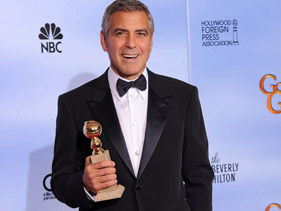
‘Descendants’ star calls out Pitt and Michael Fassbender in acceptance speech. By Kevin P. Sullivan George Clooney Photo: Robyn Peck/ Getty Images In a race that was considered to be a battle of the A-listers, George Clooney took home the Golden Globe for Best Actor in a Motion Picture – Drama for “The Descendants.” After an evening of joking about his celebrity best bud, George Clooney opened his acceptance speech by letting Brad Pitt know exactly what he thought of him. “I wanted to say it’s nice to see Brad, and it’s nice to be able to tell him not just what wonderful work he’s doing in two films this year,” Clooney said. “But what wonderful work he does in the rest of the world to the rest of the people.” Pitt, who was nominated for “Moneyball,” and Clooney emerged as the front-runners in the category soon after the nominees were announced last month, and their well-documented friendship came to dominate the conversation around the race. Earlier in the evening, Clooney borrowed the cane Pitt used throughout the evening, seemingly to poke fun at his friend. Clooney also acknowledged one of the actors he got to meet for the awards show, fellow nominee Michael Fassbender, and he took the opportunity to crack a joke about Fassbender’s revealing role in “Shame.” “I’d like to thank Michael Fassbender for taking over the frontal-nudity responsibility that I had,” Clooney said. “Michael, honestly, you can play golf like this with your hands behind your back. Go for it, man. Do it.” Toward the end of his acceptance speech, Clooney got a little more serious and thanked his co-stars and writer/director Alexander Payne. “Thank you very much to Alexander Payne, who makes wonderful films and is a great friend,” he said. Stick with MTV News all night for the 2012 Golden Globes winners, and don’t miss all the fashion from the Golden Globes red carpet ! Related Videos 2012 Golden Globes: Highlights From The Show Related Photos Golden Globes 2012 Press Room MTV Style | 2012 Golden Globes Red Carpet Photos
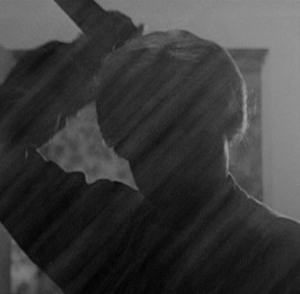
TCA events bring news that A&E is developing a prequel series to Alfred Hitchcock ‘s Psycho , to revolve around the early life of one Norman Bates and his beloved mother at the infamous Bates Motel. While intriguing, it prompts more than a few questions… like, who wants to watch teenage Norman devolve into filmdom’s most notorious creep on a weekly basis? What gives writer Anthony Cipriano the authority to explore Hitch’s iconic killer? And, most depressing of all to ponder — do people these days even care about Psycho anymore? Granted, the A&E audience is more sophisticated than your average Jersey Shore -obsessed dilettante, and Hitchcock has plenty of fans, even in the age of reality TV. In fact, the sordid melodramatics we’re used to seeing in mainstream television coupled with the elevated profile of dramas on cable TV might actually prepare audiences for such a series; it can’t be any more twisted than, say, American Horror Story , or as grisly as an episode of CSI . The idea of exploring a fictional character’s story in further detail is always intriguing, and often works in surprisingly great ways; see Wicked , for example, which imagined a tenacious but vulnerable humanity for The Wizard of Oz ‘s Wicked Witch, decades after L. Frank Baum wrote her. But there’s a degree to which, as with remakes and adaptations and sequels, it sometimes seems wise to leave good enough (or great, in Psycho’s case) alone. Psycho revealed just enough of Norman Bates’s demented interior to make that film a classic; do we need to see exactly what Mother did to young Norman to mess him up for life? Maybe we do, or maybe we already saw what comes of taking liberties with Hitchcock’s work, without Hitch: of the 1983 and 1986 Psycho sequels, the subsequent 1990 prequel, the abysmal made-for-TV spin-off, and Gus van Sant’s 1998 shot-for-shot remake, none have been especially good. What could help Cipriani’s Bates Motel to avoid repeating history? Take a gander at the unfortunate 1987 Lori Petty/Bud Cort/Jason Bateman pilot-turned-telefilm, also titled Bates Motel , and muse over the possibilities. • A&E Develops ‘Psycho’ Prequel Series: TCA [ Deadline ] Follow Jen Yamato on Twitter . Follow Movieline on Twitter .
This just in: “(Beverly Hills, Calif.) January 10, 2012 – Relativity Media announced today that it will promote the Bandito Brothers’ upcoming intense action-thriller Act of Valor , which stars an elite group of active-duty Navy SEALs in a fictionalized composite of actual events, during NBC’s nationally televised coverage of Super Bowl XLVI on February 5, 2012. Four 30-second unique Act of Valor commercials, featuring exclusive content, will run throughout the program including two spots that will air during the pre-game, one spot in game during the fourth quarter and one spot in the post-game show.” MUST CREDIT MOVIELINE. [Press release]
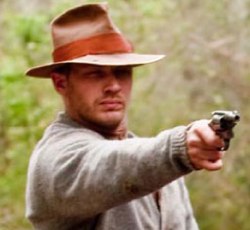
Oh , Harvey : “We have a star in Tom Hardy who’s completely anonymous right now. If you go to a line at the ArcLight nobody would know who he is. He’s going to be a huge movie star by August.” [ LAT ]
The New York Times reported Sunday that the Academy of Motion Picture Arts and Sciences’ documentary branch is tweaking its qualification rules once again, allowing only theatrical nonfiction feature films that have been reviewed by the NY or LA Times to be considered for Oscar nominations. Furthermore, voting on nominees will be expanded to the entire 166-member Documentary Branch (as opposed to individual committees), and the Academy as a whole can vote for Best Documentary, regardless of how or where members saw the nominated films. The revisions have prompted more than a little hand-wringing around the doc community — for no especially good reason, alas. Here’s why: 1. Films they’re seeking to block will still get through. In a year when the Doc Branch fielded an unprecedented volume of submissions (thanks entirely to the 2010 rule change that expanded the 2011 awards year to 16 months), the Academy wants to screen out docs conceived and produced primarily for television but which qualify for the Oscars with a one-week theatrical run in Manhattan and Los Angeles County. By requiring a newspaper review, said Academy COO Ric Robertson, the Oscars are likelier to reward “genuine theatrical” documentaries. Which would be fine — if it were true: The same HBO-produced docs that are presently, quietly four-walled at the Coliseum Cinemas in Washington Heights or the Playhouse 7 in Pasadena are just going to do the same old thing in slightly more upmarket venues. 2. The process has always favored bigger films. Michael Moore, who made his name putatively fighting on behalf of the little guy in the face of outsized institutional malevolence, apparently helped engineer the expanded voting-bloc change in what the NYT ‘s Michael Cieply termed an effort to recognize more “popular and culturally significant films.” Ha. It not clear what these films would be except for maybe things like Moore’s own Capitalism: A Love Story and certain high-profile oversights like Werner Herzog’s long-playing 3-D doc Cave of Forgotten Dreams — a theatrical nonfiction treat if ever there were one. But the reality is that despite the annual snub ritual known as the documentary short list , theatrically geared films released by well-known specialty distributors win the majority of Academy attention when it matters — in the nominations — and the lion’s share of Best Documentary Feature wins. Even Paradise Lost 3: Purgatory , arguably this year’s frontrunner and a perfect example of the type of made-for-TV doc the Academy would hope to deflect, is a product of the well-heeled HBO Documentary Films. 3. It’s still all about the awards-season resources. Moore also told Sasha Stone that, in effect, “the new rules effectively protect the smaller fish from being chased out because the big fish have more money to manipulate the broken system.” I’ll believe it when I see it. The new screener permission alone plays right into those larger interests’ hands — or rather, into their campaigners’ hands: Guys like Harvey Weinstein, for example, can now flex their Academy muscle across the entire voting body while independently distributed docs will still only advance as far as their grassroots word-of-mouth (and thus their seasonal Oscar publicist) takes them. Suggesting that a film’s awards cred relies on critical and theatrical integrity is like saying Mitt Romney will win the Republican presidential nomination based on values. Please. 4. The NY and LA Times already review virtually everything — and filmmakers can appeal being omitted. The most vocal opposition to the new rules invokes such films as the current short-lister Semper Fi: Always Faithful , which qualified via the International Documentary Association’s DocuWeek program and has no record of a review in either newspaper. Would it be barred from consideration in future years? Probably not: As Stone also notes, DocuWeek inclusion costs not much less than four-walling a theater and sending an e-mail to a couple editors, and in the off chance that that tack fails, filmmakers and producers can appeal directly to the Documentary Branch for consideration. Which actually might be a disadvantage for the movies, simply because… 5.The Documentary Branch has no taste. Nonfiction greats like Herzog or Steve James or Frederick Wiseman aren’t routinely overlooked because of some qualification quirks or because some TV-oriented doc usurped their spots on the short list. They’re snubbed because year after year, no single Academy voting bloc has proven its intellectual laziness and lack of judgment more assiduously than the Doc Branch. Expanding the actual Documentary Feature Oscar voting across the entire Academy only proves that the form’s practitioners have next to no faith in the branch’s members to either recognize “popular” documentaries (which isn’t even the branch’s job anyway) or defend the short-list selections and eventual nominees it does choose. If they really wanted change, they would just burn the place down, split the insurance money 166 ways, and outsource the Best Documentary voting to the Cinema Eye Honors or another reputable awards body. Until then? The more things change, the more they stay the same. Follow S.T. VanAirsdale on Twitter . Follow Movieline on Twitter .
This just in: Kim Novak, star of Alfred Hitchcock ‘s Vertigo , has a beef with Oscar front-runner The Artist and its use of Bernard Herrmann’s iconic love theme from the 1958 classic. Let’s just cut to the chase and let Novak’s words speak for themselves: “I want to report a rape… my body of work has been violated by The Artist .” Say what, Ms. Novak? Rape? Director Michel Hazanavicius might prefer the term “homage,” but potato, po-tah-to… perhaps some elaboration is in order. Novak’s personal missive, for which she composed a press release and took out a full-page trade ad, continues via Deadline : “This film took the Love Theme music from Vertigo and used the emotions it engenders as its own. Alfred Hitchcock and Jimmy Stewart can’t speak for themselves, but I can. It was our work that unconsciously or consciously evoked the memories and feelings to the audience that were used for the climax of The Artist .” “There was no reason for them to depend on Bernard Herrmann’s score from Vertigo to provide more drama. Vertigo ’s music was written during the filming. Hitchcock wanted the theme woven musically in the puzzle pieces of the storyline. Even though they did given Bernard Herrmann a small credit at the end, I believe this kind of filmmaking trick to be cheating. Shame on them!” “It is morally wrong of people in our industry to use and abuse famous pieces of work to gain attention and applause for other than what the original work was intended. It is essential that all artists safeguard our special bodies of work for posterity, with their individual identities intact and protected.” Novak has a point, to a point: Using a well-known piece from a beloved classic can, consciously or subconsciously, evoke the emotion earned by that reference film. But does that mean The Artist cheated by borrowing on the emotional associations its audience had for Vertigo ? And, as personally as that citation hit Novak, is it fair to reduce the cinematic equivalent of sampling in hip-hop to such a gross violation? And if Bing Crosby was still around, would he make the same claim for the use of “Pennies from Heaven?” Chime in, Movieliners. • Not Everyone Loves ‘The Artist’: Kim Novak Feels Violated By Use Of ‘Vertigo’ Score [Deadline]
Congrats of some fashion are in order to William Brent Bell, whose universally reviled yet spectacularly successful The Devil Inside has today yielded news of his not-very-anticipated follow-up. Written by David Cohen, The Vatican is said to be a “conspiracy-driven thriller that uses some found-footage techniques like The Devil Inside did”; Warner Bros. is reportedly fast-tracking the project. Good to know! I’ll ready the riot police . [ Deadline ]
John Mellencamp: It’s About You isn’t really about you, or me, or even about John Mellencamp, the Rock and Roll Hall of Famer who has built an enduring career with his eminently likable, real-person stage demeanor and his songs’ connection with the way regular people live. It’s About You is quite possibly mostly about the filmmaker, Kurt Markus, a commercial photographer who has shot portraits for publications including Vanity Fair, Rolling Stone and GQ , as well as ad campaigns for the likes of BMW and Armani. But that’s surprisingly OK: Mellencamp invited Markus and his son, Ian, to tag along, video camera in tow, to record his summer 2009 concert tour and to eavesdrop, visually and otherwise, on recording sessions for his 2010 album No Better Than This . Mellencamp even told Markus at the outset, somewhat cryptically, that the movie should be about Markus. And so It’s About You — whatever the heck it’s actually about – is in the end a kind of visual journal, a photographer’s way of seeing and responding to what’s around him. Those events and moments and glancing touches might include a group of musicians huddled around a single microphone in Memphis’s hallowed Sun Studios, or the flash of producer extraordinaire T. Bone Burnett’s cuff-links during another session, held in the same room where Robert Johnson cut a potent handful of songs in 1936. Markus accompanies the visuals with a voice-over narration that’s sometimes grating and other times startling in its perceptions. The result is a kind of homespun video scrapbook, bumpy seams and glue splotches and all; it’s flawed, but at least it feels handmade and human. Mellencamp could have faded away when he was still John Cougar Mellencamp, in the late 1980s, but somehow he’s managed to thrive as a modern rock’n’roll troubadour, standing tall and sturdy even alongside more massive luminaries like Bruce Springsteen and Bob Dylan. His low-key manner, as it’s revealed in It’s About You , is probably part of the key to his longevity: Even when he’s singing about boarded-up houses and busted American dreams, he never comes off as haranguing or overly morose – there’s always a glimmer of cautious optimism in his eyes. Markus captures that gleam both in the performance footage and in the more spontaneous recording sessions. Some of these sessions took place at the First African Baptist Church, in Savannah, Ga., which Markus tells us is the oldest black church in America. He also tells us about – though doesn’t show us – the bullet-size holes in the church’s floor, used to provide ventilation for the runaway slaves who were once harbored there. And we see Mellencamp and his then-wife, Elaine (the two have since split), donning white robes before they’re dunked in the church’s baptismal pool. There’s a kind of offhanded grace in the image. It’s not that Mellencamp and his wife aren’t taking the moment seriously; it just seems to be more of a piece with everyday living rather than some monumental event. This isn’t, strictly speaking, a concert film, and at one point Markus half-apologizes for not having a sound person along: He wanted to keep the whole thing as intimate as possible, and for that reason, he even refuses to set foot on Mellencamp’s tour bus. He states that he believes some moments, even on tour, should be kept private. But the real intimacy of It’s About You comes through in Markus’s footage of faded, semi-deserted Midwestern downtown streets, with their battered storefronts and rusty signage. Markus narrates some of this footage in a sort of numbed monotone. And just when you might be wishing that he’d shut up and let the images speak for themselves, he comes out with something that stops you cold. “These empty shells of better days are the biggest attraction America has going for it,” he says at one point, meaning that they’re visions of something truly American that persist even in the face of economic hardship and decay. His camera shows us deserted drive-thru restaurants and shuttered shops in sections of San Antonio, and he remarks that it’s as if a plague had wiped out a whole population, suddenly and thoroughly. “It’s a Texas Pompeii,” he says, observing how sadly beautiful it all is. As captured by Markus, Mellencamp, now 60, is looking a little weatherbeaten himself, but in a handsome, vital way — he shows no sign of going the way of those sad, forgotten downtowns. Still, they’re a big part of what he’s all about. Because, in the end, it really isn’t about him. Follow Stephanie Zacharek on Twitter . Follow Movieline on Twitter .
This just in from Nikki Finke: Paramount’s cheap wannabe found footage hit The Devil Inside — which drew reports of audible grumbles and boos as the credits rolled at sneak screenings in Los Angeles and New York last night — has already made back double its acquisition costs . ” The Devil Inside acquired for $1M opened with $2M midnights from 1,400 theaters. It goes wide into 2,300 theaters today,” Finke writes at Deadline, adding that “the genre film plays very young and very ethnic so it will probably be frontloaded.” Nice. Very young and very ethnic. If the pic turns into a Paranormal Activity -esque hit, you know who to blame. [ Deadline , @STYDnews , Moviefone ]