Tag Archives: afghan

VIDEO Veterans & Activists Rally for Wikileaks Whistleblower (CNN)

Veterans and anti-war activists from several groups organized a rally for Wikileaks whistleblower Private Bradley Manning yesterday in Quantico, VA. Manning is being held in solitary confinement in a military brig in Quantico. Medea Benjamin of Code Pink told CNN, “We are here to say that if, indeed, he was the whistle-blower, then we are proud of him. We as Americans want to expose the truth of what’s happening in both Iraq and Afghanistan and we think that it will hasten the day to bring the troops home. We want our troops protecting us here in the United States, not fighting in what we consider unwinnable, unnecessary wars.” Private Bradley Manning, a 22 year old intelligence analyst with the US Army, stands accused of disclosing a classified video of American troops shooting civilians from an Apache helicopter. New evidence links Manning to the Afghan War Logs posted on WikiLeaks this week. He faces up to 52 years in jail for his role in the leak. The whistleblower behind the Vietnam era’s Pentagon Papers, Daniel Ellsberg, has called Mr. Manning a “hero.” CODEPINK participated in the rally with a diverse group of activists and veterans. Groups who participated along with CODEPINK in the rally were: Courage to Resist, Iraq Veterans Against the War, Veterans for Peace, ANSWER, Virginia Catholic Worker, Gray Panthers, World Can’t Wait, and the National Lawyers Guild. A counter-rally was organized by protesters and is also featured in the CNN video. added by: pinkpanther

Karzai’s Push for Talks with Taliban Renews the Risk to Afghanistan’s Women

Karzai Push for Talks With Taliban Renews Risk to Afghan Women, Group Says By James Rupert – Jul 13, 2010 U.S.-backed efforts by President Hamid Karzai to reconcile with the Taliban and other Islamic militants threaten to reverse improvements in the lives and rights of Afghanistan’s women, Human Rights Watch said. The revival of Taliban control in southern and eastern Afghanistan has forced women to abandon jobs and social work, the New York-based advocacy organization said in a report today. Guerrillas have destroyed at least 456 girls schools, the Afghan human rights commission said in March. Interviews with Afghan women in Taliban-controlled regions show that “as the prospect of negotiations with the Taliban draws closer, many women fear that they may also pay a heavy price for peace,” Human Rights Watch said in its report. The Taliban’s renewed campaign against any public role for Afghan women has focused on Kandahar, Afghanistan’s second- largest city, which served as the Taliban’s headquarters during their rule in the 1990s. The Taliban last year claimed responsibility for shooting dead Sitara Achakzai, a women’s activist who served on the provincial legislative council. On April 13, a gunman in Kandahar ambushed and shot dead a 22-year-old woman named Hossai who worked as an aid worker with Development Alternatives Inc., a consulting firm based in the Washington suburb of Bethesda, Maryland. The following night, another woman aid worker in the south received an anonymous letter warning that she, too, would be killed if she did not stop working for her employer, an international organization, Human Rights Watch said. Sanctions Since January, Karzai has pushed for the lifting of UN sanctions on some Taliban leaders, curbs which freeze their assets abroad and prevent them from traveling, in a bid to pull them into peace negotiations. The U.S. special envoy for Afghanistan and Pakistan, Ambassador Richard Holbrooke, has supported a revision of the list of 137 Taliban leaders subjected to the sanctions. In March, Karzai’s administration held several days of direct talks with another militant insurgent group, the Hezb-i- Islami (Islamic Party) led by Gulbuddin Hekmatyar, which Human Rights Watch said “is also known for its repressive attitudes towards women.” Any insurgents who rejoin Afghanistan’s society and politics “must respect women’s rights,” U.S. Secretary of State Hillary Clinton said May 13 at a conference with Karzai in Washington. Afghan groups have criticized Karzai for surrendering women’s rights to win political support. In March 2009, he signed into law a bill that required women of the Muslim Shiite sect to submit to their husbands’ demands for sex and to restrictions on their movement outside the home. ‘Active Role’ Karzai’s efforts to reconcile with Taliban leaders “should not be seen as a zero sum process and women are fundamental to the future development of Afghanistan,” State Department spokesman Philip J. Crowley said in response to a reporter’s question yesterday. While Karzai included women as 20 percent of delegates at a national conference last month to plan a peace process, women have had little presence in the government bodies preparing peace feelers, the Afghanistan Independent Human Rights Commission said in March. Women “must not only be consulted” in preparing peace talks, “but must play an active role at the negotiating table,” the commission said. http://www.thedailygetup.com/wp-content/uploads/ai_images/44785AfghanWomen01.jpg added by: EthicalVegan

Open Thread: Corruption in Afghanistan Complicates US Mission

“Above a certain level, people are being very well protected,” one “senior U.S. official” told the Washington Post . Corruption and bad governance pose two of the largest problems for the American presence there. According to the Post, Top officials in President Hamid Karzai’s government have repeatedly derailed corruption investigations of politically connected Afghans, according to U.S. officials who have provided Afghanistan’s authorities with wiretapping technology and other assistance in efforts to crack down on endemic graft. In recent months, the U.S. officials said, Afghan prosecutors and investigators have been ordered to cross names off case files, prevent senior officials from being placed under arrest and disregard evidence against executives of a major financial firm suspected of helping the nation’s elite move millions of dollars overseas… For the Obama administration, the ability of Afghan investigators to crack down on corruption is crucial. If American voters see Karzai’s government as hopelessly corrupt, public support for the war could plunge. Corruption also fuels the Taliban insurgency and complicates efforts to persuade ordinary Afghans to side with leaders in Kabul.  What affect will or should this corruption have on the domestic policy debate over the Afghan war? Does it bolster arguments that the US needs to maintain a strong presence there, or those that contend the US cannot take the lead in securing the nation?

Original post:
Open Thread: Corruption in Afghanistan Complicates US Mission

‘Restrepo’: The War That Won’t End, By Kurt Loder

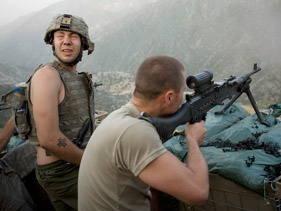
New combat doc raises question: Why are we in Afghanistan? Soldiers in Afghanistan in “Restrepo” Photo: National Geographic Channel Can there be an upside to war? Possibly. In “Restrepo,” a new documentary by veteran combat journalists Tim Hetherington and Sebastian Junger, we find ourselves on patrol with a company of U.S. soldiers in the Korengal Valley, one of the bloodiest corners of the ongoing Afghan conflict. It’s the spring of 2007, and the men have just weathered a heavy firefight. One of them emerges from it jacked-up and exultant. “That was fun!” he says. “You can’t get a better high. Once you get shot at … you can’t top that.” The film vividly captures the dust and blood and the sheer drudgery of war. The unit has been assigned to build a new forward outpost right up against the edge of Taliban territory. Build it from scratch with picks and shovels, while in the surrounding mountains, enemy fire is constant. The Taliban warriors come so close they can be heard talking to one another. But the American soldiers work straight through the night, and make a good start. They never complain. They christen the new base Restrepo Outpost, after a departed comrade, Juan “Doc” Restrepo, who recently took two bullets in the neck and bled out on the med-evac helicopter. They talk about Restrepo a lot, and we see footage of him goofing around on the flight that brought the men over here from a base in Italy. Like them, he was very young. Still sleepless, they set out on patrol. They pass through battered villages, stopping occasionally to interrogate suspicious-looking locals. (“You got pretty clean hands for a goat-herder.”) They meet with village elders and promise to “flood” the area with money and medical supplies if the villagers will only help fight the resurgent enemy. But the people caught in the middle of this conflict have defeat written on their faces. One man tells the company’s captain, through an interpreter, “If we let you know about Taliban, then we will get killed.” Alternatively, of course, this man could be Taliban. As was the case in the Vietnam War 40-odd years ago, in which the U.S. fought another indigenous enemy that didn’t wear uniforms, it’s virtually impossible to know. The company moves on. Intermittently, the crack of gunfire starts up, and the camera jostles wildly in keeping up with the GIs as they hit the ground and crawl through the dirt. One of them has been hit, shot dead. One of his friends briefly breaks down in tears. Another soldier tries to comfort him: “It was quick,” he says. The unit comes to another village. This one has been chewed up by missile fire from the Army attack helicopters whirling overhead. Five civilians have been killed, more wounded. Inside one house we see women, children, even a baby wet with blood. This is the face of collateral damage. Somewhere there’s a grand plan for this war, a political scenario devised by a regiment of office warriors back in Washington. But the soldiers here don’t talk about it. All they know is that there’s an enemy their country is fighting, and their job is to kill him. They’re tough and brave, and they’re good at it. They casually discuss the fact that they may well die here, but that’s not what concerns them most. What concerns them most is the possibility that one of their fellow soldiers may die — one of their pals, the only family they have in this hostile place. The movie follows this company through 2008, when the men completed their 15-month deployment and were being flown back to Italy. What we don’t see is the aftermath. This past April, having alienated the local populace, the Army withdrew the last of its troops from the Korengal Valley. Earlier this month, the Afghan conflict, which began directly after 9/11, became the longest war in U.S. history. More than a thousand U.S. soldiers have died in it. Last December, President Obama announced his intention to send 30,000 more troops to Afghanistan, bringing the total number of U.S. forces in-country to 100,000. But at the same time, he also announced that he’ll begin pulling them out again next year. The president has since wobbled on that commitment. Still, it’s hard to imagine the Taliban not feeling that victory in this long war is now mainly a waiting game. The directors, Hetherington and Junger, acknowledge that they are men of the political left. Apart from the editing decisions they’ve made, though, their documentary recalls, in a smaller way, the disturbing images that emerged out of Vietnam, and ultimately turned America against that war. “Restrepo” is the answer to a question that will surely continue being asked. Don’t miss Kurt Loder’s reviews of “Knight and Day” and “Dogtooth,” also new in theaters this week. Check out everything we’ve got on “Restrepo.” For breaking news, celebrity columns, humor and more — updated around the clock — visit MTVMoviesBlog.com .
View post:
‘Restrepo’: The War That Won’t End, By Kurt Loder

They Just Found $1 Trillion in Afghanistan

Afghanistan was thought to be a hardscrabble wasteland good for producing little more than opium, that is until a gang of American geologists working from old Soviet maps uncovered a variety of mineral deposits thought to be rich enough to radically alter our whole concept of Afghanistan and the war to control it. New York Times: The United States has discovered nearly $1 trillion in untapped mineral deposits in Afghanistan, far beyond any previously known reserves and enough to fundamentally alter the Afghan economy and perhaps the Afghan war itself, according to senior American government officials. The previously unknown deposits — including huge veins of iron, copper, cobalt, gold and critical industrial metals like lithium — are so big and include so many minerals that are essential to modern industry that Afghanistan could eventually be transformed into one of the most important mining centers in the world, the United States officials believe. Read more Related Entries June 13, 2010 Stealth Superpower: How Turkey Is Chasing China in Bid to Become the Next Big Thing June 13, 2010 Obama Wants $50 Billion For Teachers, Cops and Firemen

Read more from the original source:
They Just Found $1 Trillion in Afghanistan

Is Karzai Losing The Faith?

Rumors are swirling in Afghanistan that the country’s president, Hamid Karzai, is losing faith in the capacity for the West to defeat the Taliban, and some are even accusing Karzai of trying to strike his own deal with the Taliban and arch-rival Pakistan. The rumors follow a dramatic meeting between Karzai and the just-resigned intelligence chief and interior secretary, both of whom defected from the administration after claims that Karzai was unwilling to show interest in evidence proving the Talbian’s culpability in a rocket attack earlier this month. —JCL The New York Times: Two senior Afghan officials were showing President Hamid Karzai the evidence of the spectacular rocket attack on a nationwide peace conference earlier this month when Mr. Karzai told them that he believed the Taliban were not responsible. “The president did not show any interest in the evidence — none — he treated it like a piece of dirt,” said Amrullah Saleh, then the director of the Afghan intelligence service. Mr. Saleh declined to discuss Mr. Karzai’s reasoning in more detail. But a prominent Afghan with knowledge of the meeting, who spoke on condition of anonymity, said that Mr. Karzai suggested in the meeting that it might have been the Americans who carried it out. Minutes after the exchange, Mr. Saleh and the interior minister, Hanif Atmar, resigned — the most dramatic defection from Mr. Karzai’s government since he came to power nine years ago. Mr. Saleh and Mr. Atmar said they quit because Mr. Karzai made clear that he no longer considered them loyal. Read more Related Entries June 11, 2010 British PM: 2010 ‘Vital’ for Afghanistan June 9, 2010 Kandahar Test [A Cartoon From UAE]

The rest is here:
Is Karzai Losing The Faith?

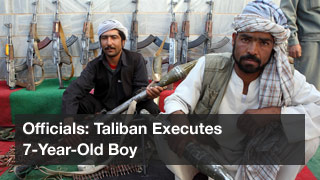
Officials: Taliban Executes 7-Year-Old Boy

According to Afghan authorities, suspected militants accused the boy of spying.

See original here:
Officials: Taliban Executes 7-Year-Old Boy

Taliban Attack Afghan Peace Conference

A meeting of Afghan officials hoping to forge a plan to negotiate a truce with the Taliban got off to an ominous start last week, as militants launched a spate of attacks and engaged in a lengthy gun battle with security forces nearby. added by: The_Global_Report

‘Eric Cartman’, Blackwater employee, Took Hundreds Of U.S. Weapons

A Senate investigation accuses the Army of turning a blind eye when a Blackwater subsidiary hired violent drug users to help train the Afghan army and declared “sidearms for everyone” even though employees weren't authorized to carry weapons. The inquiry by the Senate Armed Services Committee found that contractors for Paravant, the Blackwater subsidiary under investigation, also took hundreds of weapons intended for the Afghan National Police. On at least one occasion, someone signing for a weapons shipment used the name “Eric Cartman.” The Washington Independen http://washingtonindependent.com/77476/blackwater-the-senate-and-south-park added by: atomiclegion

Coalition troops storm a Taliban haven

KABUL, Afghanistan — American, Afghan and British troops occupied crucial positions across the Taliban stronghold of Marja on Saturday, encountering only sporadic fighting as they began the long and possibly bloody ordeal of house-to-house searches. American Marines exchanged gunfire with Taliban insurgents throughout the day, and discovered several homemade bombs and other weapons. One American serviceman was reported killed in Marja on Saturday, and a British servicemen as well, officials said in Kabul. Three American soldiers were killed in neighboring Kandahar Province when the vehicle they were riding in struck a large explosive buried in the road. American commanders said Saturday that the 6,000 American, Afghan and British troops who moved into the area earlier in the day had achieved every objective they had set for themselves. That included advancing into the city itself, seizing intersections, government buildings and one of the city’s two main bazaars in the center of town. Some military units held meetings with local Afghans, to reassure them and to ask for help in finding Taliban fighters and hidden bombs. Mohammed Dawood Ahmadi, a spokesman for Helmand Province’s governor, said Afghan and NATO forces had set up 11 posts across Marja and two in the neighboring town of Nad Ali. “We now occupy all the strategic points in the area,” he said. The invasion of Marja is the largest military operation of its kind since the American-backed war began eight years ago. The area, about 77 square miles of farmland, villages and irrigation canals, is believed to be the largest Taliban sanctuary inside Afghanistan. In the prelude to the attack, Afghan and Americans commanders said that the area contained hundreds of Taliban fighters, several hundred homemade bombs and a number of opium factories that the insurgents use to finance their operations. On the first full day of operations, much of the expected Taliban resistance failed to materialize. Afghan and NATO troops discovered some bombs, narcotics and weapons caches, but the fighting itself was relatively desultory. There was certainly none of the eyeball-to-eyeball fighting that typified the battle for Falluja in Iraq in 2004, to which the invasion of Marja had been compared. http://www.nytimes.com/2010/02/14/world/asia/14afghan.html?hp added by: current89