Tag Archives: america

Flashback: After Katrina, Sensationalistic Media Accounts Earned Press a D-Minus

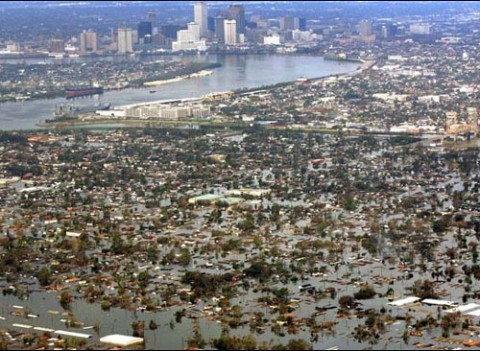
Five years ago on Sunday, Hurricane Katrina smashed into the Gulf coast, devastating much of the region, and most memorably New Orleans. Yesterday was an occasion to look back at what went wrong in the city, and hope that the same mistakes are not made again. One of the most notorious failures surrounding Katrina was the media’s coverage of the situation in New Orleans. One “well-known [television] anchor,” actor and filmmaker Harry Shearer recalled in an interview with Daily Finance’s Jeff Bercovici, claimed the “the emotional stories are more compelling for our audience.” Hence, the media mostly ignored the larger issues facing the city – survivors still stranded on rooftops, the reasons for the levy’s failures – in favor of more sensationalistic, occasionally outright false stories. Shearer gives the media’s coverage – with the notable exceptions of only a couple outlets – a D-minus. Shearer told Bercovici: The [New York] Times did okay. I think the rest of the press gets a D, and probably a D-minus for their efforts at patting themselves on the back about how well they did speaking truth to power. Anderson Cooper … giving a lecture to [Louisiana senator] Mary Landrieu, like that’s the person you need to lecture. It was grandstanding and showboating in place of telling a story — partly because they left. They left. Water leaves, story over. The [New Orleans] Times-Picayune won two Pulitzers for their work because they couldn’t leave. They lived there. They had to stay. In addition to the Times’s coverage, Shearer also praised the work of Michael Grunwald, who covered Katrina for Time and the Washington Post. But he went on to blast the press’s shallow approach to post-Katrina coverage, claiming that news consumers saw “lots of images of people destitute and unhappy but never [got] to find out why.” W. Joseph Campbell, communications professor at American University and author of “Getting it Wrong: Ten of the Greatest Misreported Stories in American Journalism” (hint: Katrina is one of the 10) agrees with Shearer. In the book, he wrote that post-Katrina media coverage “was in important respects flawed and exaggerated. On crucial details, journalists erred badly, and got it wrong.” They reported snipers firing at medical personnel. They reported that shots were fired at helicopters, halting evacuations from the Convention Center [in New Orleans]. They told of bodies being stacked there like cordwood. They reported roving gangs were preying on tourists and terrorizing the occupants of the Superdome, raping and killing. They said children were victims of sexual assault, that one seven-year-old was raped and her throat was slit. They reported that sharks were plying the flooded streets of New Orleans. Those reports were all wrong, and they contributed mightily to the public (mis)perception of the situation in New Orleans. At his blog, Media Myth Alert , Campbell added no single news organization committed all those errors. And not all those lapses were committed at the same time, although they were largely concentrated during the first days of September 2005. In any case, I write, the erroneous and over-the-top reporting “had the cumulative the effect of painting for America and the rest of the world a scene of surreal violence and terror, something straight out of Mad Max or Lord of the Flies.” Estimates of Katrina’s death toll in New Orleans also were wildly exaggerated. U.S. Senator David Vitter, a Louisiana Republican, said on September 2, 2005, that fatalities in the state could reach 10,000 or more. Vitter described his estimate as “only a guess,” but it was nonetheless taken up by the then-New Orleans mayor, Ray Nagin, and reported widely. In all, the death toll in Louisiana from Katrina was around 1,500. About the inaccurate estimates of fatalities, the Times of London said it had become clear by in mid-September 2005 “that 10,000 people could have died only if more than 90 per cent of them had locked themselves into their homes, chained themselves to heavy furniture and chosen to drown instead of going upstairs as the waters rose.” But the Times rationalized the flawed reporting, suggesting that it was inevitable: When “nature and the 24-hour news industry collide, hyperbole results.” A weak excuse, that. Besides, post-Katrina reporting from New Orleans was more than hyperbolic: It described apocalyptic horrors that the hurricane supposedly unleashed. “D-minus” is none too generous. As usual, the media adopted the role of the nation’s finger-pointers in New Orleans in Katrina’s aftermath, singling out a number of people and institutions they thought deserved blame. Ironically, of all the failings in the days after the hurricane hit, the media’s will inevitably be remembered as among the most grave.

See more here:
Flashback: After Katrina, Sensationalistic Media Accounts Earned Press a D-Minus

ABC’s Claiborne Presses MLK Niece to ‘Understand, At Least, How Some’ See Beck Rally as ‘Affront’ to Civil Rights Movement

On Saturday’s Good Morning America on ABC, during an interview with Dr. Alveda King – a niece of Dr. Martin Luther King Jr. known for her pro-life activism – substitute host Ron Claiborne challenged her to defend her participation in conservative talker Glenn Beck’s “Restoring Honor” rally in two out of the three questions he posed to her. The ABC host asked if she was “comfortable aligning yourself” with Beck – considered “inflammatory and divisive” by “many people.” After failing to get Dr. King to criticize the conservative talker, Claiborne seemed to appeal to her to “understand at least” why some agree with Democratic Congressman John Lewis’s assessment of the Beck rally as an “affront” to the Civil Rights Movement. Claiborne’s second and third questions: Many people call Glenn Beck’s political views and style inflammatory and divisive. Are you comfortable, are you comfortable aligning yourself with someone who once called President Obama a racist? Well, Congressman John Lewis, who, of course, stood beside your uncle 47 years ago and marched many times for civil rights, has said that Beck’s rally is an affront to what the Civil Rights Movement stood for. When you hear that kind of talk, can you understand, at least, how some people could interpret it that way? The interview with Dr. King came right after a report filed by correspondent Claire Shipman which, similarly to her report from Friday’s GMA , assigned such labels at “right-wing” and “controversial” to Beck, while the Reverend Al Sharpton’s own controversial history was not mentioned, nor was his liberal ideology. Below are complete transcripts of Shipman’s report and Claiborne’s interview with Dr. King from the Saturday, August 28, Good Morning America on ABC, with critical portions in bold : RON CLAIBORNE, IN OPENING TEASER : And rally uproar: Glenn Beck holds his controversial rally on the Washington Mall this morning. And there will be counterprotests by those who say he’s trying to hijack the legacy of Martin Luther King. … BIANNA GOLODRYGA: Turning to Washington, D.C., now, Glenn Beck says tens of thousands of people are going to join him at the Lincoln Memorial in just a few hours for his “Restoring Honor” rally. It’s already stirring up emotion and controversy on this anniversary of Martin Luther King’s “I Have a Dream” speech. Claire Shipman is in Washington, D.C., with more. Good morning, Claire. CLAIRE SHIPMAN: Good morning, Bianna. You know, the crowd here is already enormous, and a lot of the people have been here for hours. Some of them camped out overnight so they could get closer to the heart of Glenn Beck’s message today. But, as you mentioned, the debate over who should control, honor, mark this anniversary has been intense. The buses have been pulling out for days, from all over the country. Tea Party activists and Glenn Beck supporters are on their way to Washington, well aware that the day has multiple meanings. UNIDENTIFIED MAN: There’s a lot of us that have a dream now. And the dream is that government gets off our backs. SHIPMAN: Forty-seven years ago today, same place, on the steps of the Lincoln Memorial, Martin Luther King delivered the words still buried in our psyche. DR. MARTIN LUTHER KING, JR., CIVIL RIGHTS ACTIVIST: I have a dream. SHIPMAN: But this year is Glenn Beck’s rally for America’s honor, and it will feature Sarah Palin. And it’s meant to support American troops. CLIP OF AD: It’s time to restore America. GLENN BECK, FNC HOST: I believe in divine providence. SHIPMAN: The right-wing radio show host insists the timing was an oversight, but he seized on the King legacy as compatible with his message. BECK: We reclaim the Civil Rights Movement. REVEREND AL SHARPTON, CIVIL RIGHTS ACTIVIST: Sharpton, keeping it real. SHIPMAN: The Reverend Al Sharpton, among others, worries that their day and King’s legacy has been hijacked. SHARPTON, TO PODIUM: They’re having an anti-government march on a day that King came to appeal to government. You can’t have it both ways. SHIPMAN: He is planning a countermarch today. Beck himself seems intent on making it a day of toned-down rhetoric, suggesting to one reporter that he made a mistake when he made this controversial statement last year: BECK: This President has a deep-seeded hatred for white people or the white culture. SHIPMAN: He insists he intends to honor the memory of Dr. King. As one King follower put it, if all sides can channel Dr. King today, it will keep this commemoration at least in the spirit of the original. And so far, it does seem that everybody here this morning wants to honor that legacy, Ron. RON CLAIBORNE: All right. Thank you very much, Claire Shipman reporting from Washington. And joining me now, from just outside the Lincoln Memorial in Washington, D.C., is Dr. Alveda King. She is the, Dr. Martin Luther King, Jr.,’s niece. She’ll be speaking at the Glenn Beck rally that is starting later today. Welcome to the show. DR. ALVEDA KING, NIECE OF DR. MARTIN LUTHER KING, JR.: Well, thank you. Good morning. CLAIBORNE: Okay, good morning to you. Dr. King, why are you attending this rally, the Glenn Beck rally there in D.C. today? KING: I am attending this rally to help reclaim America. You know, when Glenn said he’s reclaiming the civil rights movement, I don’t need to be reclaimed. I am the civil rights movement. And so I’m joining Glenn to talk about faith, hope, charity, honor. Those are things that America needs to reclaim. Our children need to remember how to love each other, how to honor each other, their parents, God and their neighbors. So I agree with Glenn on all those principles. And for me, it’s principle over politics. And that’s why I’m here. My uncle talked about love. My uncle talked about faith, hope and charity. My uncle talked about honor. And I’m expecting to honor my uncle today. My daddy, Reverend A.D. King, my grandaddy, Martin Luther King, Sr., we’re a family of faith, hope and love. And that’s why I’m here today. CLAIBORNE: And Dr. Martin Luther King, as you said, also talked about bringing people together, healing racial divisions. Many people call Glenn Beck’s political views and style inflammatory and divisive. Are you comfortable, are you comfortable aligning yourself with someone who once called President Obama a racist? KING: Well, I’ve never called President Obama a racist. I love President Obama. I pray for him all the time. God loves President Obama. God loves Glenn. God loves you. And God loves me. And that’s the message I’m here for. And for me, it’s principle over politics. I talk to Glenn about that all the time. When Glenn says that there’s one human race, I agree with him. So we’re not here to divide. I’m about unity. And really, that’s why I’m here. And I want to honor my uncle today. CLAIBORNE: Well, Congressman John Lewis, who, of course, stood beside your uncle 47 years ago and marched many times for civil rights, has said that Beck’s rally is an affront to what the Civil Rights Movement stood for. When you hear that kind of talk, can you understand, at least, how some people could interpret it that way? KING: You know, my daddy, A. D. King, was on the Edmund Pettus Bridge with John Lewis. I marched and went to jail. I believe Congressman Lewis remembers that. My home in Birmingham, Alabama, was bombed. And so, I really remember that history. But right in the middle of that history, I remember my family talking about faith, hope, love. And we’ve got to honor each other. So I’m calling on the Congressman, Reverend Sharpton, I talked to him about that last night. I’m calling for everybody to remember that my uncle talked about bringing everybody together, not dividing. I tell Glenn that all the time. And we’re talking about the one human race that needs to be loved and honored. And we’re loving our neighbors as we love ourselves. CLAIBORNE: Okay. KING: That’s really what Glenn and I talk about. CLAIBORNE: Thank you very much, Alveda King, for joining us this morning. You’ll be at that rally, the Glenn Beck rally, later today. Bianna? GOLODRYDA: A lot of different voices there. CLAIBORNE: A lot of controversy. GOLODRYGA: Controversy. CLAIBORNE: Dueling rallies taking place there. GOLODRYGA: In the nation’s capital.

Continue reading here:
ABC’s Claiborne Presses MLK Niece to ‘Understand, At Least, How Some’ See Beck Rally as ‘Affront’ to Civil Rights Movement

Imam to FBI (2003): ‘U.S. Response to 9/11 Could Be Considered Jihad’

Defenders of controversial imam Feisal Abdul Rauf have been touting his past efforts in offering counterterrorism advice to the FBI as a way to illustrate his bridge-building intentions.  Much like other reports, they tend to gloss over the more controversial aspects of Rauf’s statements.  But, as is typical with the Ground Zero mosque imam, it can be demonstrated that he is frequently speaking with a forked tongue. There is no doubt that Rauf has made some questionable and incendiary comments regarding America and her role in the Muslim world.  Perhaps these statements fit the imam’s overall rhetoric involving U.S. complicity in the attacks of 9/11.  As does the following statement to the FBI , which is conveniently omitted from media reports defending Rauf. Bridge-building imam Feisal Abdul Rauf was giving a crash course in Islam for FBI agents in March of 2003 .  When asked to clarify such terminology as ‘jihad’ and ‘fatwa’, Rauf stated (emphasis mine throughout): “Jihad can mean holy war to extremists, but it means struggle to the average Muslim. Fatwah has been interpreted to mean a religious mandate approving violence, but is merely a recommendation by a religious leader.  Rauf noted that the U.S. response to the Sept. 11 attacks could be considered a jihad , and pointed out that a renowned Islamic scholar had issued a fatwah advising Muslims in the U.S. military it was okay to fight the Taliban in Afghanistan.” Well, wait a minute.  Which version of the word jihad is he referring to when he speaks of the U.S. response itself?  Is it the struggle he speaks of for the average Muslim, or is it the holy war?  Getting very little run in the media is an analysis of Rauf’s FBI days in the New York Post .  Contained within Paul Sperry’s column is a question of whether Rauf actually knows the definition of jihad, or if he simply presents things ambiguously to make things more difficult on the agents he is trying to teach.  While Rauf passes jihad off as nothing more than a struggle, Koranic scholar Abdullah Yusuf Ali disagrees, insisting that jihad ‘means advancing Islam, including by physically fighting Islam’s enemies.’ Sperry then questions, ‘If he (Rauf) believes jihad is really just an internal struggle, then why does he refuse to condemn Hamas? (Why, for that matter, did he in late 2001 suggest that “US policies were an accessory to the crime” of 9/11?).’ And speaking of the fatwa advising Muslims in the U.S. military that it was okay to fight the Taliban … The renowned Islamic scholar that Rauf is referring to is Sheik Yusuf al-Qaradawi.  In a New York Times article one month after 9/11, Rauf was quoted as saying: “This fatwa is very significant. Yusuf Qaradawi is probably the most well-known legal authority in the whole Muslim world today.” Question is, was that hollow fatwa (a hotwa as it were) more significant than Qaradawi’s proclamation on Al Jazeera two weeks earlier?  Qaradawi stated: “A Muslim is forbidden from entering into an alliance with a non-Muslim against another Muslim.”  He called on Muslims to “fight the American military if we can, and if we cannot, we should fight the U.S. economically and politically.” Qaradawi elaborated on that non-fatwa fatwa in 2004 when he said of American troops : “…all of the Americans in Iraq are combatants, there is no difference between civilians and soldiers , and one should fight them, since the American civilians came to Iraq in order to serve the occupation. The abduction and killing of Americans in Iraq is a [religious] obligation so as to cause them to leave Iraq immediately. The mutilation of corpses [however] is forbidden in Islam.” Abduction and killing is an obligation, but he draws the line at corpse mutilation.  Very classy. Perhaps the media should not be relying so heavily on the imam’s efforts within the FBI anyway.  Lest we forget, the FBI doesn’t exactly have a great track record in spotting red flags being raised by a radical imam.  Families of the victims at Fort Hood can attest to that.  In their defense, the FBI was constantly compromised by over-sensitivity training when it came to Muslims.  But when Nidal Hasan was chatting it up with Anwar al-Awlaki, they suspected it was nothing more than a simple case of psychiatric research. Is all this nothing more than parsing the double talk of a ‘moderate’ imam, or is it something more alarming? Rusty can be contacted through his website:  The Mental Recession .

Original post:
Imam to FBI (2003): ‘U.S. Response to 9/11 Could Be Considered Jihad’

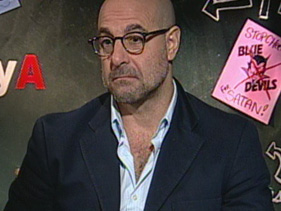
Stanley Tucci Says ‘Captain America’ ‘Design Is Stunning’

The actor says the film is shot beautifully. By Mawuse Ziegbe Stanley Tucci Photo: MTV News Marvel hero Captain America is known his unstoppable brawn so it’s a safe bet that moviegoers will check out a feast of out-of-this-world action scenes when “Captain America: The First Avenger” lands in theaters next summer. In addition to heart-stopping thrills, , who spent some of this summer filming the 2011 release, said that fans are in for a visually creative experience. “[Director] Joe Johnston is a wonderful guy and I love the way he’s shooting it, it’s really interesting, it’s beautiful-looking,” Tucci told MTV News. The actor seemed awed by Johnston’s approach. “There’s a real power to it and the design is stunning.” Tucci will portray Dr. Abraham Erskine, the lab wiz who develops the potent serum that endows Steve Rogers with super-human strength and effectively turns the weakling into Captain America. The Oscar-nominated star dished about the nuances of his character who, despite having developed the muscle-popping serum, is not just a crazed genius tinkering with chemicals. Tucci revealed that “he’s a combination of both” mad scientist and mild-mannered researcher. Tucci, who will be seen next in the high-school comedy “Easy A,” heads back to shooting “Captain America” in the fall. So far, the actor, who is known for diverse roles ranging from Julia Child’s doting husband in “Julie & Julia” to a mega-fierce fashion insider in “The Devil Wears Prada,” is relishing his time on the “Captain America” set. “So much fun,” Tucci gushed about filming. “I have to go back and … finish it in October but I was there for a few weeks in … end of July, August. It was great, a great experience.” The star chalked up his good times behind the scenes to his co-stars. “Chris [Evans, who plays Captain America] is great, he’s a wonderful guy,” Tucci said. “Dominic [Cooper] and Hayley [Atwell] and Tommy Lee Jones – it’s great people.” What are you looking forward to seeing in “Captain America: The First Avenger?” Let us know in the comments below! For breaking news and previews of the latest comic book movies — updated around the clock — visit

Read the original post:
Stanley Tucci Says ‘Captain America’ ‘Design Is Stunning’

‘Meet the Press’ Katrina Special: All Bush and Federal Government’s Fault

As the fifth anniversary of Hurricane Katrina slamming New Orleans nears, the folks at NBC offered viewers a “Meet the Press” special edition with a sadly predictable conclusion: the disaster was all George W. Bush and the federal government’s fault. The New Orleans mayor at the time was almost entirely ignored in this hour-long examination. The only mention of the state’s former governor was actually one of praise. Rather than offering one new compelling insight into the natural disaster that changed America, the invited guests all fed fill-in host Brian Williams the same old tired lines about racism and classism; despite numerous opportunities to delve into the decades of political corruption in the region that left the levees surrounding New Orleans in a dreadful state of disrepair, the subject was never broached. Instead, what ensued – given all the time and resources available to really do a groundbreaking exposé on this issue – was something all those involved should be tremendously embarrassed for. Frankly, that was clear right from the get go (partial video follows with partial transcript and commentary, full video and transcript here and here respectively): MR. BRIAN WILLIAMS: August 29th, 2005, Hurricane Katrina touches down on the Louisiana coast. The city’s levees fail, the next morning nearly 80 percent of New Orleans is under water. A botched government response, a poor local evacuation plan, thousands are left without food, water, shelter or safety, trapped for days as the city is looted and its people suffer.  Here’s the picture that was on the screen when Williams said “botched government response”: And that was just the beginning: WILLIAMS: Senator Landrieu, before I begin with you, I want to show you a piece of videotape of another member of your family. The–a long time ago, a newspaper columnist affectionately called the Landrieu family the “Cajun Camelot,” and that’s the last time there was, first of all, a white mayor in the city of New Orleans before the current mayor, your dad, Moon Landrieu. What was it, 1970 to ’78, a two-term mayor, former head of the Conference of Mayors, later secretary of Housing. Senator, have you searched your own soul and conscience to make sure–there was so much blame that went around after Katrina–that you bore none of it? How–have you sorted out just what it was that happened here? SEN. MARY LANDRIEU: (D-LA): Well, Brian, first of all, no elected official could say that they didn’t make mistakes. We all did. It was an extremely tough time. But I can say proudly that I helped to lead the effort to help the federal government respond more effectively. And that was all the discussion about Landrieu’s potential culpability as part of a strong political family in the region, as Williams had much bigger catfish to fry: MR. WILLIAMS: Now I want to ask you about one of the many promises made after Katrina. I want to roll in a piece of sound from President George W. Bush after Katrina, speaking not far from here in Jackson Square. (Videotape, September 15, 2005) PRES. GEORGE W. BUSH: And tonight I also offer this pledge of the American people: Throughout the area hit by the hurricane, we will do what it takes, we will stay as long as it takes to help citizens rebuild their communities and their lives. (End videotape) MR. WILLIAMS: Senator, you heard it. SEN. LANDRIEU: Yeah. Advertisement | ad info MR. WILLIAMS: Did it turn out to be hollow? Did it turn out… SEN. LANDRIEU: It was. MR. WILLIAMS: Do you think he was telling the truth then? SEN. LANDRIEU: Well, it, it turned out to be a hollow promise, and I’ll tell you why: Because the federal government didn’t stay and do everything they could. The federal government didn’t make it easy. They made it very, very difficult. Landrieu then went on to complain about how little money her region has received from the federal government since Katrina hit. She quoted astonishingly low numbers – in the low millions to be precise – without any challenge whatsoever from Williams about the billions of taypayer dollars that have been sent to this area since 2005.  All Williams had to do was cite figures from the Department of Homeland Security’s website to address the many billions of dollars authorized by Congress and former President Bush for Katrina relief in just the first twelve months after the storm made landfall. But that would have made Landrieu look like a liar. Potentially even more absurd, Williams didn’t ask her about last year’s Louisiana Purchase when she got $300 million for her state as a bribe from Sen. Harry Reid (D-Nev.) to change her vote in favor of healthcare reform. No, such inconvenient truths were unimportant to Williams who changed the subject to the BP oil spill: MR. WILLIAMS: Now, Senator, we should note that you were talking about wetlands before talking about wetlands was, was in vogue. And, perhaps, though, you can explain the very confusing relationship between Louisiana and oil as we look at the once-beautiful wetlands with that now characteristic oil line that’s to be found on all the grass. A lot of folks elsewhere in the country just assumed that the anger down here would come out of the oil spill, the fact that three months of oil is sitting out there in that water. A lot of folks assumed that the folks in Louisiana would be behind a stoppage until there could be a rule that if you can get oil a mile down, you should be able to stop it. What is the relationship between Louisianans, who love the great outdoors and have some of the great outdoors in all of the world, and the petroleum that comes out deep under the ground? SEN. LANDRIEU: Well, first of all, Brian, please know that people are very angry about that spill, and very disappointed in BP, and very disappointed in the subcontractors as well, and are just furious about the oil. We want to keep our waters clean. We’ve tried to keep our waters clean all these years. But we do have a strong relationship with the oil and gas industry, not just big oil, but independents and the thousands of small businesses that we built that we’re proud of that support that industry because the nation needs this oil. This nation consumes 20 million barrels of oil a day. It did the day before the Deep Horizon exploded, it does today. Now, we’re going to transition to cleaner fuels. And by the way, Louisiana is well positioned to be part of the energy future, not just our past. But that’s why people down here feel so strongly. We’ve been fishing in the same waters that we drill for oil. We’ve been navigating all of the commerce of–not only of this country, but of the world on those same waters. And yes, Brian, we recreate, we swim in those waters. And we believe with the right kind of balance in policy we can do it. So, yes, a pause was necessary. But a six-month moratorium has put a, a blanket of fear and anxiety, and it must be lifted as soon as possible. Might have been a nice time for Williams to bring up all the contributions Landrieu received from BP during the 2008 election cycle. That year, she received more from this oil company than any other member of Congress. But Williams wasn’t interested in challenging his guests:  MR. WILLIAMS: Mr. Mayor, was the administration slow off the dime when the spill happened? NEW ORLEANS MAYOR MITCH LANDRIEU: I don’t think so. They were down here pretty quickly. And, of course, this was a much different disaster than Katrina was. I can honestly say that they’ve been working very hard at it. This might have been a great time to reference a recent PPP poll about what Louisianans think about Bush’s job of handling Katrina versus Obama’s job with the oil spill (h/t NBer Gary Hall): Louisianans’ severe disapproval of Obama overall, 35-61, mirrors their disdain for his efforts in the cleanup, 32-61. George W. Bush’s handling of Hurricane Katrina, by contrast, is viewed barely negatively, 44-47; the response in June, 34-58, was more in line with Obama’s, 32-62. A full 54% now think Bush did a better job dealing with crisis than Obama, who gets the vote of only 33%. Unfortunately, Williams chose to ignore this as well, and decided to head back to Katrina: MR. WILLIAMS: How should Ray Nagin’s term as mayor be remembered, as history looks back on what happened here? MAYOR LANDRIEU: Well, that’s a, that’s a very hard thing for me to opine about, you know? MR. WILLIAMS: Try. MAYOR LANDRIEU: We’re going to let history–we’re going to let history take care of itself. I would say this. You have not seen me talk much about what happened during the storm. That was a cataclysmic event. Who knows how to judge people that went through those couple of days? I will say… MR. WILLIAMS: But you were in it, and now you have his old job. MAYOR LANDRIEU: Yeah. I don’t, I don’t think generally that it was well done. But I would say this, that subsequent to the storm, putting the city in a position to recover, as it were, I don’t think he did a good job. That’s why I ran against him the first time, and of course, it’s why I ran the second time. I really believe that this city can fix itself. But I will say this, just to put an exclamation point on President Bush’s statements a minute ago. There was huge damage, the damage was man-made. It was a result of the federal government’s negligence. And not withstanding all the incredible things that the people of America have done for us, we have not received enough money to repair the damage that was done. And when we do, we will be able to rebuild the city faster. Amazing. And that was all that was said about the mayor in the middle of this disaster. From there, Williams did an interview with actor Brad Pitt about his charitable efforts in the region, and then invited in some local celebrities that further pointed their fingers at Bush and the federal government: MR. WILLIAMS: …until we–until we recently aired our own documentary on MSNBC and NBC News, you told me you’d been in a dark radio studio on generators, you, you hadn’t seen a lot of the pictures. But now you, you think about this region so much, you’ve lived here so long, raised in the bayou south of here, four decades in New Orleans, looking back, what was it we witnessed here, what do you think went on those few days? GARLAND ROBINETTE, JOURNALIST AND RADIO HOST: To me, it was a Salvador Dali painting, it was just surreal. The United States of America couldn’t take care of itself. I’ve been to Banda Aceh, I’ve been all over the world with a company that I owned, and I’ve seen how we respond to disasters. And the very thought that for five days they couldn’t get here and do the job is just, to this day, is mind-boggling. MR. WILLIAMS: Is it too easy to throw a label on it, stamp it racism, classism? I once asked President George W. Bush on board Air Force One, I said, “Mr. President, if this had happened in Nantucket or New York or Chicago,” he interrupted me and said, “You can call me anything you want, but don’t call me a racist.” That was his response to that. What do you think was at work here? Shameful, but it was going to get worse: MR. WILLIAMS: I want to break that dull glaze by–and this is an essential part of this coverage, I believe, reminding people what it was like back then. Here is a clip from MEET THE PRESS the Sunday after Katrina that was beamed around the world. The president of Jefferson Parish, Aaron Broussard, pleading with Tim Russert and the authorities who might be watching television to send help. (Videotape, September 4, 2005) MR. AARON BROUSSARD: Nobody’s coming to get us. Nobody’s coming to get us. The secretary’s promised, everybody’s promised. They’ve had press conferences. I’m, I’m sick of the press conferences. For God sakes, shut up and send us somebody. (End videotape) MR. WILLIAMS: Aaron Broussard on live television. The research behind this special was astonishingly sub-standard; within days of Broussard’s appearance on “MTP,” it was exposed that he had lied about some of the things he told the late Tim Russert that day. Three weeks later, Russert grilled Broussard about how he had totally misrepresented the death of a colleague’s mother during his first appearance. Even worse, Broussard resigned as President of Jefferson Parish this past January in the midst of a federal corruption investigation.  Nice character witness there, Brian! But there was still more: MR. WILLIAMS: It’s yesterday, really, and it’s been five years. The children and relatives of the people at this table, I’m going to go ahead and guess, would not have gone a week without water or food because their dads, their dads’ companies would have found a way, as NBC News did, as NBC News did, to get us supplies in the central business district. They found us in Metairie in the parking lot of a used car dealer, and they made sure we had something to drink. What’s the difference? Why didn’t it matter to someone? Why wasn’t someone able to, to get supplies and get those folks out? WENDELL PIERCE, ACTOR: I think the thing that you have to remember is that we have to understand that the disaster lifted the veil of issues of race, of issues of class, not only in this city, but in the country. If we’re to move past it and truly be a part of this wonderful recovery that we’re feeling, we can’t look at it through rose-colored glasses. It is not an indictment of any one person or whatever, it’s an indictment of us all. We have to look at all of the issues that caused the fermentation of that poverty. One of the things that we can’t lose sight of is the fact that many New Orleanians heard that call from Garland Robinette on their transistors radios in the hinterlands of New Orleans, and we tried to make a Dunkirk run to that convention center–white, black, rich, poor–because they had the humanity within them when they saw those images and when they heard those voices cry out. This was an abject failure and incompetence of our government. No one’s feet have been held to the fire because of it. We can sit here and debate the pathology of what caused it–racism, classism, a lack of respect for New Orleans and this region. But does that matter if we don’t hold anyone accountable and if we forget the incompetence that was displayed during that week? We have to hold people accountable. If we’re not going to go back and hold those people accountable, make sure that we held–hold people accountable now as we move forward. And if we’re truly to move past this, we have to look at ourselves and see what is our contribution to this dysfunctional dynamic, and how can we change the paradigm, the dysfunction of class and racism, the dysfunction of education, which is the root cause of all of this. Amazing. After all, if you remove the passion from this issue and look at it from a purely logicial perspective, another conclusion has to be reached. As NewsBusters reported in March 2006, the folks at Popular Mechanics spent a great deal of time researching the aftermath of Hurricane Katrina, and their findings went quite contrary to the conventional wisdom both then and now: Hurricane Katrina was by far the largest-and fastest-rescue effort in U.S. history, with nearly 100,000 emergency personnel arriving on the scene within three days of the storm’s landfall. Dozens of National Guard and Coast Guard helicopters flew rescue operations that first day-some just 2 hours after Katrina hit the coast. Hoistless Army helicopters improvised rescues, carefully hovering on rooftops to pick up survivors. On the ground, ‘guardsmen had to chop their way through, moving trees and recreating roadways,’ says Jack Harrison of the National Guard. By the end of the week, 50,000 National Guard troops in the Gulf Coast region had saved 17,000 people; 4000 Coast Guard personnel saved more than 33,000. While the press focused on FEMA’s shortcomings, this broad array of local, state and national responders pulled off an extraordinary success-especially given the huge area devastated by the storm. Computer simulations of a Katrina-strength hurricane had estimated a worst-case-scenario death toll of more than 60,000 people in Louisiana. The actual number was 1077 in that state. Once again, these facts would have gotten in the way of Williams’ agenda on Sunday, and that of liberal historian Douglas Brinkley who actually said, “Governor Blanco, during Katrina, is the one who eventually got the buses to get those people out of the convention center. And she’s the one who got the Superdome refixed, but she’s also not given credit for that.” Imagine that. The governor that badly failed her citizens during this crisis demonstrating staggering levels of incompetence was finally mentioned in this hour-long special edition of “Meet the Press” only to be commended for her efforts. That should be all readers needed to know about the total lack of impartiality and balance presented to viewers this Sunday. As I stated at the onset, the folks involved in this propagandist piece of detritus should be ashamed and embarrassed for what they’ve produced. After five years, for one of the largest and most well-funded news organizations to be able to offer no new insights or facts behind this history-changing natural disaster than that it was all caused by Bush, the federal government, and racism is nothing less than disgraceful. If this was all NBC had to say on this issue, why not just put together clips of their hideous coverage from five years ago? And they wonder why people across the fruited plain continue to switch to other sources for their news. 

Here is the original post:
‘Meet the Press’ Katrina Special: All Bush and Federal Government’s Fault

Rupert Murdoch’s New York Post Twisting Words of Julian Assange’s Son Daniel Assange

Looks like producers for Dr. Phil and Montel might be waiting awhile if they think they have a celebrity dad-hating story in the making. Rupert Murdoch’s New York Post seemed to have obtained a scoop yesterday rising to the level of Dr. Evil/Scott Evil proportions, excerpting a FaceBook quote from Daniel Assange, 20, that appeared on its face to fuel the growing personal attacks against his father, embattled WikiLeaks founder and director, Julian Assange: WikiLeaks founder Julian Assange’s own son thinks he’s a nightmare when it comes to women. “That man does have a way of making a lot of female enemies,” Daniel Assange, 21, said about his embattled dad. Daniel made the Facebook posting after two Swedish women came forward with allegations that led to rape and molestation charges against his dad. Daniel also wondered about his father’s claim that the accusations were part of a Pentagon “smear campaign.” “Interesting to see whether this is the result of a government plot or personal grudges,” he wrote. But later on Friday, Daniel, under the moniker Somnidea on a website called The Sleepy Lammata lashed out at the newspaper, calling the story “godawful sensational tripe”: I’d just like to note here that the comments in question were very tongue-in-cheek and never intended to be made public like this, much less support the conclusions of the article. The NYP did not interview me or otherwise attain my consent in any way for their publication. I have much respect for my father and his cause, and these ridiculously ill-handled allegations of sexual abuse serve only to distract from the audacious awesomeness that he has actually done. added by: toyotabedzrock

The Billionaires Bankrolling the Tea Party

There’s just one element missing from these snapshots of America’s ostensibly spontaneous and leaderless populist uprising: the sugar daddies who are bankrolling it, and have been doing so since well before the “death panel” warm-up acts of last summer. Three heavy hitters rule. You’ve heard of one of them, Rupert Murdoch. The other two, the brothers David and Charles Koch, are even richer, with a combined wealth exceeded only by that of Bill Gates and Warren Buffett among Americans. But even those carrying the Kochs’ banner may not know who these brothers are. Their self-interested and at times radical agendas, like Murdoch’s, go well beyond, and sometimes counter to, the interests of those who serve as spear carriers in the political pageants hawked on Fox News. The country will be in for quite a ride should these potentates gain power, and given the recession-battered electorate’s unchecked anger and the Obama White House’s unfocused political strategy, they might. All three tycoons are the latest incarnation of what the historian Kim Phillips-Fein labeled “Invisible Hands” in her prescient 2009 book of that title: those corporate players who have financed the far right ever since the du Pont brothers spawned the American Liberty League in 1934 to bring down F.D.R. You can draw a straight line from the Liberty League’s crusade against the New Deal “socialism” of Social Security, the Securities and Exchange Commission and child labor laws to the John Birch Society-Barry Goldwater assault on J.F.K. and Medicare to the Koch-Murdoch-backed juggernaut against our “socialist” president. added by: Conniepae

Open Thread: Hurricane Katrina Five Years Later

Five year ago today, Hurricane Katrina slammed Louisiana and Mississippi forever changing America. In the midst of unthinkable devastation, the media coverage of this natural disaster was disgraceful. Despite almost immoral bungling by New Orleans’ mayor and Louisiana’s governor, as well as decades of corruption that left this city’s levee system in a state of shameful disrepair, President George W. Bush was made the culprit for the damage, the suffering, and the loss. Katrina largely signaled the end of the Bush presidency just eight months into his second term, and America’s press were largely to blame. How do you see this disaster five years later and how the media handled it? Was it an ominous precursor to the absolutely abysmal job so-called journalists did in covering the 2008 presidential election? What have we learned from this event about the power of the press, and what can be done about it?

More here:
Open Thread: Hurricane Katrina Five Years Later

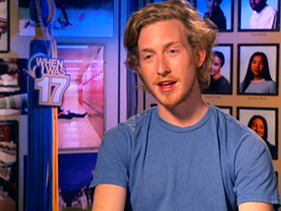
Asher Roth, Kendra Wilkinson, Kelly Osbourne Look Back, On ‘When I Was 17’

The stars reminisce about tattoos, cemetery scares and singing careers. By Dan Schenek Asher Roth appears on “When I Was 17” Photo: MTV News When Asher Roth was 17, he remembered being a car-less “white boy wannabe.” The lively artist developed a fan base while attending college with the help of social-networking websites, and arrived on the mainstream hip-hop scene with a slew of mixtapes. Almost overnight, he found himself with a record deal and a full studio album, Asleep in the Bread Aisle. “In high school, I ended up finding my home with kids who had one common interest, and that’s hip-hop music,” Roth said on the latest episode of “When I Was 17,” which premiered Saturday at 11 a.m. “We’d be carrying boom boxes around in our book bags like we were straight out of the ’80s,” Roth’s friend Brian recalled. “We started meeting regularly around school.” Before hanging with Hef, former “Girl Next Door” Kendra Wilkinson remembers eyeing her high school soccer coach. “Soccer was my love,” the California girl said. “I had a huge crush on my soccer coach. He was like the hottest thing to ever exist … I would totally flirt with him. I would wear shorter shorts than the other girls on purpose.” Holly Madison and Bridget Marquardt said Wilkinson would act like she didn’t know what she was doing on the soccer field to get more attention from the studly coach. “I loved just having my soccer coach just yelling at me. It turned me on,” Wilkinson said. Kendra also reminisces about how she was freaked out when seeing windmills turning with no wind and hearing a crying baby at a cemetery. On the show, MTV reality-show vet Kelly Osbourne also looks back at her time in an American school and her first tattoo experience. “For me, it’s really the idea of having a tattoo than actually having it because once you have it, you’re like, ‘alright, ugly.’ Kelly’s first impressions of the American school system were also unique. “In England, I just went to school,” she said. “In America, I had to figure out if I was a jock, a nerd, a cheerleader — there are social groups for everything.” “When I Was 17” airs Saturdays at 11 a.m. on MTV. Related Videos When I Was 17 | Ep. 17 | Kendra Wilkinson, Asher Roth, Kelly Osbourne Related Photos When I Was 17 | Kendra Wilkinson When I Was 17 | Asher Roth When I Was 17 | Ep. 17 | Celebrity Photo Flashback

See the original post:
Asher Roth, Kendra Wilkinson, Kelly Osbourne Look Back, On ‘When I Was 17’

Sharpton To Beck: Come On Fox News and Debate Ground Zero Mosque

Just moments after the conclusion of the Aug. 28 “Restoring Honor” rally in Washington, D.C., an olive branch, albeit a potentially double-edged one, was tossed between an unlikely couple very much on opposite sides of the political aisle.   To the surprise of those in attendance, the Rev. Al Sharpton has challenged Glenn Beck to come on Geraldo Rivera’s Fox News program and support the building of the Ground Zero Mosque. Appearing on “Geraldo At Large” after his own civil rights event in our nation’s capital, Sharpton told the host, ” Why don’t you, you’re here on Fox, invite Mr. Beck on the show to finish the speech? ” “He said we should all come together equal…how do we do that?” Later in the program, Sharpton raised the bet even further saying, “He made a great statement – he said after 9/11 we all came together. All Americans, all races, all religions – therefore Mr. Beck, will you say we should stop fighting the mosque? That’s where the rhetoric will hit the road” (partial transcript follows with commentary):  REV. AL SHARPTON: Let me make a proposition to you. Why don’t you, you’re here on Fox, invite Mr. Beck on the show to finish the speech? He said we should all come together equal. GERALDO RIVERA, HOST: I kind of scare you as an interrogator. SHARPTON: Mr. Beck, how do we do that? When you have unemployment disproportionate, that’s what we raised at the civil rights march, we have education disproportionate. How do we do that? RIVERA: Fair enough. SHARPTON: Every preacher tomorrow morning after church… RIVERA: I’m not going to lose Reverend Al’s point. Invite Glenn Beck and Sarah Palin on my show tomorrow morning. SHARPTON: …every preacher tomorrow morning at 11:00. RIVERA: Tomorrow night. ——————————— SHARPTON: He made a great statement – he said after 9/11 we all came together. All Americans, all races, all religions – therefore Mr. Beck, will you say we should stop fighting the mosque? That’s where the rhetoric will hit the road. DR. ALVEDA KING, PASTORAL ASSOCIATE FOR PRIESTS FOR LIFE, MARTIN LUTHER KING’S NIECE: We’re emphasizing that there’s one human race – not all races getting together, but human race. And we’re saying about rebuilding about rebuilding America and unity – it was just a marvelous time. One human race – doing what my Uncle Martin said – we have to learn to live together as brother and as sisters or perish as fools. So we need to rebuild America and we have to have unity to do that. Assume for a moment Sharpton’s not just trying to set Beck up: wouldn’t it be interesting if as a result of Saturday’s rally, a meeting of the minds could occur between these unlikely personalities that actually improves race relations in this country? And what finer place for it to happen than Fox News where both of the players are clearly at ease? That would surely drive all those in the mainstream media crazy.  Is such an eventuality possible or just a wee bit of post-rally Kumbaya? To quote the late Ed Hart, we will know in the fullness of time. 

More here:
Sharpton To Beck: Come On Fox News and Debate Ground Zero Mosque