Tag Archives: analysis

Evanescence Press Forward, Look Back In ‘What You Want’ Video

Gritty performance footage mix with dramatic New York scenes that illustrate the band’s history and future. By James Montgomery Evanescence Photo: Wind-up Records In late July, Evanescence — and fans — crammed into a sweltering Brooklyn warehouse to hammer out the video for “What You Want,” the first single off their much-anticipated new album (and, for anyone keeping score at home, their first video in almost four years). In between takes, frontwoman Amy Lee told MTV News that the clip, directed by longtime pro Meiert Avis (U2’s “Where the Streets Have No Name”), was meant to show “the history of the band.” They wanted it to evoke the times when Evanescence used to play in Little Rock’s “gritty, dirty club” Vino’s as well as the band’s more recent hiatus, which saw Lee and bassist Tim McCord relocate to New York City. On Tuesday (September 13), we finally got to see the final product, as “What You Want” premiered on the band’s official site . And boy, was Amy spot-on in her analysis. “Want” is most definitely a historical thing, capturing Evanescence’s early days, slogging it out in sweaty clubs. It also recalls the halcyon days of big-ticket rock videos, full of sweeping shots of the New York skyline, a dramatic scene in which Lee appears to leap off the Brooklyn Bridge and some claustrophobic, cathartic performance footage. It even has a striking ending, in which Lee and her bandmates disappear into the surf down at Coney Island, as the sun breaks over the horizon. Lee has said many times that “What You Want” is a definite departure for Evanescence , and that holds true in the case of both the song and the video. The tune definitely snarls more than most in their back catalog, and the video feels very much like a true band clip; it’s artfully autobiographical and, perhaps most notably, features all of Evanescence. So, “Want” is notable for several reasons, least among them the fact that it officially brings to end their hiatus from the world of music videos. It’s also important to realize that, for perhaps the first time in their rather tumultuous history, they’re unified and pressing on toward the future. By looking back. Related Videos Evanescence’s ‘What You Want’ Video Behind-The-Scenes MTV First: Evanescence Related Artists Evanescence

See original here:
Evanescence Press Forward, Look Back In ‘What You Want’ Video

UN General Assembly Votes To Allow Gays To Be Executed Without Cause | The New Civil Rights Movement

Gay, lesbian, bisexual, and transgender people were once again subject to the whims of homophobia and religious and cultural extremism this week, thanks to a United Nations vote that removed “sexual orientation” from a resolution that protects people from arbitrary executions. In other words, the UN General Assembly this week voted to allow LGBT people to be executed without cause. According to the International Gay and Lesbians Human Rights Commission, the UN General Assembly’s Third Committee on Social, Cultural and Humanitarian issues removed “sexual orientation” from a resolution addressing extrajudicial, summary or arbitrary executions this past week in a vote that was overwhelming represented by a majority of African, Middle East and Carribean nations. For a UN committee that addresses human rights questions that affect people all over the world, by removing protections for LGBT persons from a category of arbitrary executions, belies the objective and purpose of a committee whose focus this year is “on the examination of human rights questions,” according to its website. A number of LGBT human rights advocates were surprised by the decidedly lop-sided vote, including Mark Bromley, the chair of the Council on Global Equality, a Washington, D.C. based organization that brings together human rights organizations, LGBT groups, philanthropists and corporate leaders to ”encourage a clearer and stronger American voice on human rights concerns impacting LGBT communities around the world.” “I was very surprised by the vote,” said Bromley, who had been in contact with the United States Mission to the United Nations delegation all day Tuesday, who were trying to beat back efforts to strip sexual orientation from the resolution. But because the U.S. supports capital punishment, they usually abstain from voting on this resolution, thus they are in a weakened position with one arm tied behind their backs, according to Bromley. “But that said, the State Department did everything possible to beat back the efforts to repeal protections for LGBT persons,” he added. For further analysis into this story, read Tanya Domi’s latest piece at The New Civil Rights Movement, “UN Vote Allowing Gays To Be Executed Result Of Political, Religious Fundamentalism.” The U.K. gay rights and human rights campaigner Peter Tatchell said, “This is a shameful day in United Nations history. It gives a de facto green light to the on-going murder of LGBT people by homophobic regimes, death squads and vigilantes. They will take comfort from the fact that the UN does not endorse the protection of LGBT people against hate-motivated murder. “The UN vote is in direct defiance of the Universal Declaration of Human Rights, which guarantees equal treatment, non-discrimination and the right to life. What is the point of the UN if it refuses to uphold its own humanitarian values and declarations? “This vote is partly the result of a disturbing homophobic alliance between mostly African and Arab states, often inspired by religious fundamentalism. LGBT people in these countries frequently suffer severe persecution.” In an issued statement explaining the U.S. vote, a representative of the U.S. UN delegation said, At the outset, let me say that the United States strongly agrees with and appreciates the cosponsors’ efforts to retain language specifically condemning ESAs [extrajudicial, summary, or arbitrary executions] targeting vulnerable groups, particularly members of the LGBT community, and we were dismayed that this reference could not survive an unfriendly amendment. Bromley expressed great disappointment in losing all the Southern African countries on the vote, including Angola, Botswana, Mozambique, Nambia and South Africa, the latter, whose domestic laws and record on LGBT civil rights have held great regard throughout the world. Nonetheless, according to Bromley, from the days of former President Thabo Mbeki through present day leader Jacob Zuma, South Africa has been recalcitrant in its opposition to extending human rights to LGBT persons within international legal structures. Another region that unanimously supported the removal of sexual orientation from the resolution were the Carribean nations. Most noteworthy was the support from the Bahamas, Cuba, Haiti and Jamaica. Bromley indicated that the U.S. and human rights groups in the hemisphere have opportunities to forcefully advance LGBT rights through the Organization of American States (OAS) and Inter-American Commission on Human Rights. Brazil and Uruguay are international leaders on LGBT rights and can play a constructive role in bringing Carribean nations into the OAS fold on these issues, according to Bromley. Middle East countries that principally observe the Muslim religion and its practices, as well as countries whose politics are dominated by Christian fundamentalists, generally oppose LGBT and women’s rights at the UN. Even the United States has yet to ratify the Convention on the Elimination of Discrimination Against Women (CEDAW). Indeed, CEDAW has the most “reservations” filed by the most member states of any international human rights convention on record. A reservation is a statement made by a State which it purports to exclude or alter the legal effect of certain provisions of a treaty in their application. According to the Office of the UN High Commissioner of Human Rights, A reservation may enable a State to participate in a multilateral treaty in which it would otherwise be unable or unwilling to do so. States can make reservations to a treaty when they sign, ratify, accept, approve or accede to it. When a State makes a reservation upon signing, it must confirm the reservation upon ratification, acceptance or approval…a reservation cannot be contrary to the object and purpose of the treaty. As an LGBT activist or an observer of UN and international politics, it is important for interested persons to understand that religion and culture play a major role in persuading internal bodies to not extend certain human rights to LGBT persons and women on religious and cultural grounds. These dynamics have created an international debate between advocates of “cultural relativism“–those who assert primacy of cultural values over human rights and those who are “ universalists,” who believe rights trump cultural concerns. The United States Mission to the United Nations has an explanation of the U.S.’s vote. Editor’s note: Thanks to Andr

MSM Acknowledges Lisa Murkowski Lost Primary Because She’s Pro-Abortion But Thinks We’re Crazy

Even though liberal MSM types like Ron Elving , senior Washington editor at NPR , have a hard time understanding what’s going on, they are giving credit for Joe Miller’s Alaska GOP Senate primary (apparent) victory to pro-life voters. But the title and opening paragraph of Elving’s August 26 piece not so subtly tell us he thinks Alaskans have gone crazy… Elving, among others, still can’t fathom that pro-lifers now comprise the majority. Even if so, he thinks people who believe preborn humans shouldn’t be slaughtered for convenience and profit, and/or parents who want to know before their daughters abort (which was the ballot initiative that helped get voters out), wear tin hats. Nevertheless, he gave us credit: Which kind of AK Republican was most motivated for this primary? The answer appears to be the populist, evangelical, anti-abortion Republicans who are likely to identify with the movement known as the Tea Party . Murkowski [pictured right] had a vulnerability within her own party because she was a supporter of abortion rights in some cases . While abortion views are divided in AK as elsewhere, opposition to abortion is more concentrated in the Republican Party. And this week’s ballot featured a voter measure on requiring parental notification prior to an abortion for a minor. Murkowski endorsed the measure, but the anti-abortion activists who came out to vote for it may well have preferred Miller’s anti-abortion credentials overall . It was also this issue that influenced former AK Gov. Sarah Palin to switch her support from Murkowski to Miller…. [W]hen Miller later emerged as an anti-abortion champion aligned with the Tea Party and other Palin causes, the state’s most mediagenic citizen made her move. It didn’t hurt that Mike Huckabee , the former minister, governor and presidential candidate who also appears on Fox News , came to the state to campaign for Miller….   Politics and World News also gave the nod for Wilson’s (apparent) win to those who believe preborn babies shouldn’t be suctioned and chopped, nor should 12-yr-olds almost certainly impregnated under shady circumstances be secreted away for abortions without their parents knowing… as did the Anchorage Daily News … Note in ADN’s story how enthusiastically Miller supported Ballot Measure 2, in contrast to Murkowski’s tepid support, clearly trying to straddle the fence… The abortion issue may have cost embattled… Murkowski an untold number of votes Tuesday to Republican primary challenger Joe Miller , say anti-abortion activists. The ballot also included a sharply contested voter initiative generally requiring parents to be notified before their teen receives an abortion. Miller [pictured below left, with voters] came out strongly for Ballot Measure 2. “He told voters over and over again: Flip your ballot over, vote ‘yes on 2.’ Before you vote for me, vote ‘yes on 2.’ Ballot Measure 2 is much more important than this Senate race,” said Bernadette Wilson, campaign manager for Alaskans for Parental Rights, the “yes on 2” group. Murkowski never did the same, Wilson said. All the other statewide Republican candidates gave money to the effort. Murkowski didn’t, Wilson said. Supporters of the parental notification requirement noticed, she said. Murkowski’s campaign said the senator supported Measure 2 and went to 2 fundraisers for it. But her campaign lawyer advised that she couldn’t let Alaskans for Parental Rights use her name in its materials, because that would amount to an illegal campaign contribution to her, under federal election law, according to an e-mailed copy of the analysis. The initiative, which marked the first time Alaskans confronted an abortion issue at the polls, passed with 55 percent of the vote. In addition… AK Family Council asked candidates detailed questions on abortion and other social issues. Murkowski’s answers showed her to be pro-choice, while Miller was the opposite… The political group sent the answers to thousands of its supporters, as well as pastors and the media…. Murkowski’s record on abortion is complex . She has long said abortion decisions are between a woman and her doctor, and in her first appointed Senate term, she voted for a nonbinding “sense of the Senate” that supported Roe v. Wade . But she’s voted against federal funding for abortion, and supported a ban on late-term abortions…. Alaskans for Parental Rights never told its backers to vote for Miller, and didn’t work on his campaign, Wilson said. But it didn’t have to. Weeks ago, when her group first waved their “yes on 2” signs along the Seward Highway in Midtown, Miller drove past, then made a U-turn to join them, Wilson said. On Election Day, Miller waved one of their signs along with one of his own. “People who voted ‘yes’ on Ballot Measure 2 and people who voted for Joe Miller are of like mind,” Wilson said. “People kind of linked arms and came to the polls for both.” “There’s no doubt that Lisa Murkowski’s pro-abortion views had an influence on this election,” [council president Jim ] Minnery said. Of note is I learned about this MSM articles via Robin Marty at the pro-abort site RH Reality Check , who seemed to have no wind in her sails when reporting the AK pro-life phenomenon…. no excuses, no rationalization, even appearing to defend Murkowski as a supporter of Measure 2 by reposting her excuse for lack of overt support. [Bottom photo via the AP ]

Link:
MSM Acknowledges Lisa Murkowski Lost Primary Because She’s Pro-Abortion But Thinks We’re Crazy

AP Writers Package Months-Old Polling Data As Currently Relevant News

Memo to Alan Fram and Trevor Tompson of the Associated Press and two other writers who contributed to this report (“AP-GfK polls show Obama losing independents”): You should have taken the weekend off. When I saw a shorter, earlier version of the referenced AP report this morning, it didn’t mention when AP’s polling arm AP-GfK Roper had done their work. When I went to the polling home page and found that the most recent entries were from June 9-14, I figured I’d come back later and give the group time to post fresh underlying details. Little did I know that AP’s gaggle of writers were treating the June 9-14 “Poll Politics Topline” as fresh. It gets worse. It turns out that Fram, Tompson et al wasted about 875 words on a report based on polling data that gave equal weights to results from mid-June, mid-May, and mid-April. Considering the primary topic of discussion, independents’ take on the Obama presidency and performance of Congress, this AP report is laughably irrelevant — unless its primary purpose, especially given that earlier versions of the story didn’t identify when the polling took place, was to present data designed to make readers and listeners think that things are better than they really are right now for Democrats heading into the midterm elections. Here are selected paragraph from the bylined AP pair’s non-punctual piece : Independents who embraced President Barack Obama’s call for change in 2008 are ready for a shift again, and that’s worrisome news for Democrats. Only 32 percent of those citing no allegiance to either major party say they want Democrats to keep control of Congress in this November’s elections, according to combined results of recent Associated Press-GfK polls. That’s way down from the 52 percent of independents who backed Obama over Republican Sen. John McCain two years ago, and the 49 percent to 41 percent edge by which they preferred Democratic candidates for the House in that election, according to exit polls of voters. Independents voice especially strong concerns about the economy, with 9 in 10 calling it a top problem and no other issue coming close, the analysis of the AP-GfK polls shows. While Democrats and Republicans rank the economy the No. 1 problem in similar numbers, they are nearly as worried about their No. 2 issues, health care for Democrats and terrorism for Republicans. Ominously for Democrats, independents trust Republicans more on the economy by a modest but telling 42 percent to 36 percent. That’s bad news for the party that controls the White House and Congress at a time of near 10 percent unemployment and the slow economic recovery. … Both parties court independents for obvious reasons. Besides their sheer number – 4 in 10 describe themselves as independents in combined AP-GfK polling for April, May and June – they are a crucial swing group. To try winning them over, Republicans say they will contrast Obama’s campaign promises of change with the huge spending programs he’s approved. Democrats say they will warn independents that a GOP victory will revive that party’s efforts to cut taxes for the rich and transform Social Security into risky private investment accounts. … Independents trust Republicans far more than Democrats for handling national security, but give Democrats a 42 percent to 36 percent edge for dealing with health care – a potential sign that distrust over Obama’s signature issue is receding. Hope is not lost for Democrats. The AP-GfK polls show a narrow 44 percent to 41 percent overall preference for a Democratic Congress. The party is holding its 2008 edge among women and urban residents, and still splitting the vote of pivotal suburbanites and people earning $50,000 to $100,000. Let’s look at just a few relatively current data points from elsewhere relating to the Fram’s and Tompson’s topics: Trust on health care — The antiquated AP-GfK report cites a 49-39 average Democratic edge among all voters across April, May and June (at Page 26 of detailed report; not in AP’s story). A Rasmussen report based on late June polling data shows Republicans with a 51-40 edge. Even that was six weeks ago. Since then we have learned that Team Obama is arguing in court that ObamaCare’s health insurance purchase mandate is a tax after telling the country for months before the legislation’s passage that it wasn’t. There have also been instances where abortion coverage was found in high-risk pool plans in several states, which were only eliminated when the Department of Health and Human Services issued regulations doing so. This exercise proved, as if proof was really needed, that the pro-life Executive Order that supposedly won over the Stupak Stooges — er, the Stupak Six — was nothing but a charade. Trust on the economy — AP-GfK shows a 45-42 average Democratic advantage (again at Page 26 of detailed report). The same Rasmussen report noted previously is 48-39, advantage GOP . Given the wave of weak economic news in the past six weeks, it would notbe surprising to see that the Republican advantage here has increased since then. Preference in who controls Congress — AP-GfK cites a 44-41 Democratic edge. This question has been a virtual dead heat in a Wall Street Journal/NBC poll all year . The latest result based on August 5-9 polling showing a one-point Democratic lead. No AP poll would be complete without a bit of cooking. In this instance, the AP-GfK poll’s average Democratic ingredient outweighed the GOP’s by 44. Gallup’s most recent poll on the topic, admittedly a reversal from most of its results during the past several months, shows the GOP with a 2% edge in party affiliation, including “leaners.” It appears that AP-GfK polls on the topics presented every month. It would thus be reasonable to assume that it has data for July, and that in a few days it will have data for August. Thus, it’s odd that the wire service wouldn’t have simply waited a few days to give us fresher information. Or maybe someone has seen that info, and would prefer not to have to report it at all. Cross-posted at BizzyBlog.com .

See original here:
AP Writers Package Months-Old Polling Data As Currently Relevant News

Water Scarcity Facing 1/3 of US Counties

One out of three U.S. counties is facing a greater risk of water shortages by mid-century due to global warming, finds a new report by Tetra Tech for the Natural Resources Defense Council. For 412 of these counties the risk of water shortages will be “extremely high,” according to the report, a 14-fold increase from previous estimates. In the Great Plains and Southwest United States, water sustainability is at extreme risk finds the report, which is based on publicly available water use data from across the United States. “This analysis shows climate change will take a serious toll on water supplies throughout the country in the coming decades, with over one out of three U.S. counties facing greater risks of water shortages,” said Dan Lashof, director of the Climate Center at NRDC. “Water shortages can strangle economic development and agricultural production and affected communities.” “As a result,” he said, “cities and states will bear real and significant costs if Congress fails to take the steps necessary to slow down and reverse the warming trend.” Counties shown in dark red are at greatest risk of water shortage by 2050. (Map courtesy Tetra Tech) The report, issued Tuesday, finds that 14 states face an extreme or high risk to water sustainability, or are likely to see limitations on water availability as demand exceeds supply by 2050. These areas include parts of Arizona, Arkansas, California, Colorado, Florida, Idaho, Kansas, Mississippi, Montana, Nebraska, Nevada, New Mexico, Oklahoma, and Texas. Sujoy Roy, principal engineer and lead report author, Tetra Tech, said, “The goal of the analysis is to identify regions where potential stresses, and the need to do something about them, may be the greatest.” “We used publicly available data on current water withdrawals for different sectors of the economy, such as irrigation, cooling for power generation, and municipal supply, and estimated future demands using business-as-usual scenarios of growth,” Roy explained. “We then compared these future withdrawals to a measure of renewable water supply in 2050, based on a set of 16 global climate model projections of temperature and precipitation, to identify regions that may be stressed by water availability,” Roy said. “These future stresses are related to changes in precipitation as well as the likelihood of increased demand in some regions.” The report also is based on climate projections from a set of models used in recent Intergovernmental Panel on Climate Change work to evaluate withdrawals related to renewable water supply. Water withdrawal will grow by 25 percent in many areas of the United States, including the arid Arizona-New Mexico area, the populated areas in the South Atlantic region, Florida, the Mississippi River basin, and Washington, D.C. and surrounding regions, the analysis projects. added by: JanforGore

Salon Writer Wants More Abortion on TV

What does Salon think American TV needs more of? Abortion, and lots of it. In a July 20 “Broadsheet” article , Salon writer Mary Elizabeth Williams addressed Fox’s decision to release the highly controversial “Family Guy” abortion episode as a stand-alone DVD feature this September. Williams crassly compared the comedy show’s efforts to make money off a “Banned From TV” episode to “having an abortion and getting your baby too.” The episode’s controversy revolved around character Lois Griffin questioning whether to go through with a pregnancy as a surrogate mother for a couple who died in a car crash. Williams used the network’s move as a springboard for her real complaint: the lack of abortion on American airwaves. Williams called TV a “timid” medium for “barely” discussing abortion, saying it was “insane” that TV could introduce viewers to the Dharma Initiative in “Lost” but couldn’t confront the “legally acceptable procedure” of abortion. Aside from the “Family Guy” episode, Williams mentioned 10 shows that “managed to slip” abortion through to viewers but criticized their evasive treatment of reproductive choice, with the exception of “Friday Night Lights.” Not surprisingly, Williams joined the flock of media that praised “FNL,” noting how “encouraging” the show was in its inclusion of “sensitivity and mixed feelings” for abortion. Meanwhile, Williams disparaged the other shows for giving their characters a change of heart towards abortion. After mentioning abortion scenes on “Sex and the City” and “Felicity,” Williams mockingly portrayed the characters’ sudden pro-life decisions as “last-minute realization(s) of the magic of motherhood.”

Original post:
Salon Writer Wants More Abortion on TV

Time vs Politico: Halperin Rebukes VandeHei for Characterizing GOP Group as ‘Shadowy’

In the “secret” underworld of Republican fundraising, Karl Rove and Ed Gillespie use “cloaked” donor lists to “dig up dirt” on Democrats and funnel campaign contributions to Republican candidates. At least that’s the impression left by Politico’s Jim VandeHei. On the June 21 “Morning Joe,” Time magazine’s Mark Halperin challenged VandeHei’s characterization of American Crossroads GPS, a Republican political organization that finances issue ads designed to promote conservative positions on policy issues. “With all due respect to Jim and the folks at Politico, you know, they make this these shadowy donors, this shadowy group, I mean, these are citizens who, under the law, are able to give anonymously to a group like this and to fund political activity to help them win races,” complained Halperin. Highlighting the fact that American Crossroads, classified as a 501(c)4 nonprofit organization, is not required to disclose its donor list, the Politico piece lead Halperin, who is no champion of conservative causes , to conclude that VandeHei and his colleagues believe the Rove – Gillespie operation is a “shadowy” organization. Halperin also accused VandeHei of promoting a double standard: “I’m not sure if this were a Democratic group people would look at this as something sinister but rather an attempt to fight for what they believe in the marketplace of political ideas.” “I think there’s been a big push of late to try to get at least more disclosure of donors I think from both sides,” countered VandeHei. It’s hard to believe Politico’s executive editor would paint other 501(c)4 organizations like the Center for American Progress, MoveOn.org, or the Natural Resources Defense Council as clandestine operations. But when it comes to a non-profit organization run by prominent Republicans, Politico cast a menacing shadow over the organization. The transcript of the program can be found below: MSNBC Morning Joe July 21, 2010 8:23 A.M. E.S.T. WILLIE GEIST: With us now, Executive Editor of Politico, Jim VandeHei, he’s back with a look at the Playbook. Hey, Jim. JIM VANDEHEI, Politico executive editor: Hey, how you doing? GEIST: Good. Let’s pick up on something we were talking about earlier in the show and that’s Karl Rove, had been having trouble apparently raising cash from donors because they don’t want to get their names out there so he did something about it. VANDEHEI: Karl Rove, Ed Gillespie, some other prominent Republicans have put together a group they were trying to get a bunch money to run attack ads and go after Democrats. They weren’t having much luck because the way they set it up donors had to disclose their names. Now they’ve created a new organization that allows them to cloak the identity of donor names. Money is pouring in and they’re saying they’re going to put that money in to some dirt-digging against Democrats and also painting what’s happened in the Gulf as Obama’s Katrina. GEIST: Hey Mark Halperin, is this a new concept? Has Karl Rove tapped into a new idea here? We’re going to give him a mic too, it’ll be great. MARK HALPERIN, Time magazine: There are new groups based on this Supreme Court decision from January but I have to say, with all due respect to Jim and the folks at Politico, you know, they make this these shadowy donors, this shadowy group, I mean, these are citizens who, under the law, are able  to give anonymously to a group like this and to fund political activity to help them win races. I’m not sure if this were a Democratic group people would look at this as something sinister but rather an attempt to fight for what they believe in the marketplace of political ideas. VANDEHEI: I disagree with you, Mark. I think there was a tremendous amount of coverage back when George Soros and others were starting to do this for Democrats if you recall back in 2006, which helped them take back control of power and I think there’s been a big push of late to try to get at least more disclosure of donors I think from both sides. And there still exists this caveat in tax law – 501(c)3 or 4 – which allows you to do some of this activity anonymously. So I think certainly both sides do it. I think it’s most interesting right now for Republicans because they desperately need this infusion of cash to be able to win back the House and Senate because they’re suffering when it comes to money. HALPERIN: I agree, I just like to get under Jim’s skin when I can. VANDEHEI: You sound better when you didn’t have a mic, Mark. GEIST: The page and Politico in a smack down. Judge Buchanan would you like to render your ruling? Who’s right in this case? –Alex Fitzsimmons is a News Analysis intern at the Media Research Center. Click here to follow him on Twitter.

Follow this link:
Time vs Politico: Halperin Rebukes VandeHei for Characterizing GOP Group as ‘Shadowy’

This Can’t Be Good: BP Delays Pressure Tests and Stops Drilling Relief Well

Photo: BP Only Bad News on the Oil Spill Today After some good news in the past couple of days, BP is going back to what it has accustomed us to over the past few months: bad news. The first of these is that despite the fact that the cap has been fitted over the oil leak, the pressure tests to determine if the leak can be completely captured by this new ‘top hat’ will have to wait for “further analysis” (this was decided after a meeting with Steven Chu and his team of advisers). The second piece of bad n… Read the full story on TreeHugger

More:
This Can’t Be Good: BP Delays Pressure Tests and Stops Drilling Relief Well

A Frisking ‘Frenzy’ in NYC, But Only New York Times Reporters Seem to Care

Reporters Ray Rivera, Al Baker, and Janet Roberts combined on a front-page Monday New York Times story questioning the frequency of “stop-and-frisk” policing by the NYPD in high-crime sections of the Brownsville neighborhood in Brooklyn: ” A Few Blocks, 4 Years, 52,000 Police Stops .” The text box: “Frisk Tactic Draws Questions Where It Is Used Most.” It’s a quasi-followup to an overheated May 13 front-page Times story which focused more on the racial aspect of frisking: ” City Minorities More Likely To Be Frisked — Increase in Police Stops Fuels Intense Debate .” The shoe leather analysis of that story was performed by the hard-left Center for Constitutional Rights, which the Times identified only as “a nonprofit civil and human rights organization.” Monday’s story also relied on research from the unlabeled leftists of CCR. Yet the paper’s reporters seem more worried about the frisking “frenzy” than do the residents of the crime-ridden neighborhoods that were the alleged victims of excessive stops and searches. When night falls, police officers blanket some eight odd blocks of Brownsville, Brooklyn…The officers stop people they think might be carrying guns; they stop and question people who merely enter the public housing project buildings without a key; they ask for identification from, and run warrant checks on, young people halted for riding bicycles on the sidewalk. One night, 20 officers surrounded a man outside the Brownsville Houses after he would not let an officer smell the contents of his orange juice container. Between January 2006 and March 2010, the police made nearly 52,000 stops on these blocks and in these buildings, according to a New York Times analysis of data provided by the Police Department and two organizations, the Center for Constitutional Rights and the New York Civil Liberties Union. In each of those encounters, officers logged the names of those stopped — whether they were arrested or not — into a police database that the police say is valuable in helping solve future crimes. These encounters amounted to nearly one stop a year for every one of the 14,000 residents of these blocks. In some instances, people were stopped because the police said they fit the description of a suspect. But the data show that fewer than 9 percent of stops were made based on “fit description.” Far more — nearly 26,000 times — the police listed either “furtive movement,” a catch-all category that critics say can mean anything, or “other” as the only reason for the stop. Many of the stops, the data show, were driven by the police’s ability to enforce seemingly minor violations of rules governing who can come and go in the city’s public housing. …. There are, to be sure, plenty of reasons for the police to be out in force in this section of Brooklyn, and plenty of reasons for residents to want them there. Murders, shootings and drug dealing have historically made this one of the worst crime corridors in the city. The Times issues one sentence perilously similar to its infamously naive headline from 1997, which saw a paradox where there was none: ” Crime Keeps on Falling, But Prisons Keep on Filling .” As if the two trends are unrelated. But now, in an era of lower crime rates, both in this part of Brooklyn and across the city, questions are swirling over what is emerging as a central tool in the crime fight, one intended to give officers the power to engage anyone they reasonably suspect has committed a crime or is about to. Couldn’t one explanation for the “era of lower crime rates” be more assertive police work like stop-and-frisk? Certainly, some say that the New York Police Department has so far failed to convincingly link the explosion in the numbers of stops with crime suppression. And some, from academics to the residents of these streets in Brooklyn, believe the stops could have a corrosive effect, alienating young and old alike in a community that has long had a tenuous relationship with the police. …. To many residents here, care is exactly what is not being used. To them, the flood of young officers who roam the community each day are not equipped to make the subtle judgments required to tell one young man in low-hanging jeans concealing a weapon from another young man wearing similar clothes on his way to school. …. The data show the initiative is conducted aggressively, sometimes in what can seem like a frenzy. During one month — January 2007 — the police executed an average of 61 stops a day. The high number of stops in this part of Brooklyn can be explained in part by the fact that police can use violations of city Housing Authority rules to justify stops. For instance, the Housing Authority, which oversees public housing developments, forbids people from being in their buildings unless they live there or are visiting someone. …. Many residents say they philosophically embrace the police presence. They say they know too well how the violence around them — the drugs and gangs — can swallow up young people. Yet the day-to-day interactions with officers can seem so arbitrary that many residents say they often come away from encounters with officers feeling violated, degraded and resentful. Near the very end the Times allowed this detail, which put an additional damper on the significance of its prominent front-page journalism: The Times, for this article, interviewed 12 current or former officers who had worked in this part of Brooklyn in the last five years, and all defended the necessity of the stop-and-frisks.

Read more here:
A Frisking ‘Frenzy’ in NYC, But Only New York Times Reporters Seem to Care

NBC’s Chuck Todd Trumpets Flawed Election Poll, Parrots Democratic Talking Points

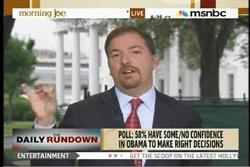
NBC Political Director Chuck Todd cherrypicked a recent Washington Post-ABC News poll to dismiss the possibility that Republicans will regain control of Congress in the November election. He did this despite evidence within the same poll that the political landscape in 2010 resembles 1994, when Republicans picked up 54 seats to take control of the House. On the July 13 “Morning Joe,” Todd emphasized the finding that 72 percent of the country has either “just some” or no confidence at all in the ability of congressional Republicans to “make the right decisions for the country’s future.” “This wild card about this election cycle which makes it different from ’06, which makes it different from ’94, is this issue of the public’s view of the Republican Party,” insisted Todd. The poll is misleading for a number of reasons, none of which Todd acknowledged. First, measuring public confidence in President Barack Obama, congressional Democrats, and congressional Republicans, the pollsters grouped respondents who reported “a great deal of confidence” with “a good amount,” and “just some” confidence with “none at all.” This aggregation resulted in a higher percentage of Americans expressing some or no confidence at all in Republicans than in Obama. But grouping “just some” respondents with “none at all” respondents does not make sense because expressing some confidence is much different from expressing “none at all.” If the pollsters had grouped those who reported “a good amount” of confidence with those who reported “just some” confidence, Republicans in Congress would have received 61 percent support, 14 points higher than Obama. Second, Todd’s insinuation that the public preferred congressional Republicans to congressional Democrats in 1994 but not in 2010 contradicts the same poll he cited to advance the argument that Republicans will not maximize their gains in November. As of July 11, 2010, voters prefer congressional Republicans 47 percent and congressional Democrats 46 percent, a negligible difference. By contrast, on August 8, 1994, 49 percent of the public preferred congressional Democrats while only 42 percent of the public preferred congressional Republicans, a seven point edge. In fact, the public preferred congressional Democrats over congressional Democrats in every Washington Post-ABC News poll taken through the November election. MSNBC host Joe Scarborough challenged Todd on the preference issue, asking, “Aren’t these off-year elections really just an opportunity for Americans to vote up or down for the most part on the party in power, the party that’s running Washington?” Todd, seemingly uninterested in demonstrable trends, insisted that the White House and Democrats are capable of turning the election into something other than a referendum on their liberal agenda. An obstinate Todd continued to rain on the GOP’s parade. “Joe, I think it’s the difference between picking up 25 or 30 seats and picking up 40 seats,” he insisted. NBC’s chief political junkie was all too eager to report the results of a poll forecasting sobering prospects for Republicans without scrutinizing the data or researching relevant historical trends. A transcript of the relevant portion of the segment can be found below: MSNBC Morning Joe July 13, 2010 7:24 A.M. E.S.T. JOE SCARBOROUGH: Hey Chuck, let me ask you something. Of course let’s put up the polls really quickly again from the Washington Post and then I’m going to follow it up with some news you say may not as good for Republicans. First of all, let’s look at the polls. Sixty-eight percent of Americans have little confidence in Democrats; Seventy-two percent, Republicans. Of course we talk about 58 percent, Barack Obama. Now let’s go to the four reasons why you say Republicans may not take back the House in the fall. You wrote about this yesterday and it’s very fascinating. You said the favorable ratings the same as the Democrats. And you are exactly right. In fact, in this case it’s even worse for Republicans than Democrats. But I guess the bigger question is – and I want to get Mark’s thoughts on this as well – aren’t these off-year elections really just an opportunity for Americans to vote up or down for the most part on the party in power, the party that’s running Washington? CHUCK TODD, MSNBC political director: Most of the time they are, and for many voters, this will be the case. This wild card about this election cycle which makes it different from ’06, which makes it different from ’94, is this issue of the public’s view of the Republican Party. And the reason you have to sit there and not ignore it is look at what the message the White House is trying to drive. Look at the message that Democratic candidates in congressional races are trying to drive, which is saying, “okay, you may be mad at us, but look at them.” And look, when you already have 70 percent of the public having a negative view, you can sell that story – you have a better chance of selling the story. SCARBOROUGH: Does that work when Democrats – it’s a monopoly though in Washington though. I guess that’s why it’s so much harder to sell. Listen in ’94 the Republicans actually had a plan. We haven’t seen that yet from this group of Republicans. I guess the bigger question, Chuck is, can you beat something with nothing?    TODD: Joe, I think it’s the difference between picking up 25 or 30 seats and picking up 40 seats and 10 seats in the Senate. Do you see what I’m saying? I think the difference between having a good election night and the majority is somehow starting to improve their favorable rating, and starting to go out there and saying, “we have a plan.” And right now they don’t have that and I think that’s what’s keeping them from getting the entire enchilada here. –Alex Fitzsimmons is a News Analysis intern at the Media Research Center. Click here to follow him on Twitter.

Here is the original post:
NBC’s Chuck Todd Trumpets Flawed Election Poll, Parrots Democratic Talking Points