Tag Archives: bailouts

Sanchez Admits He’s Wrong: White House Did Say Unemployment Wouldn’t Exceed 8% If Stimulus Passed

CNN’s Rick Sanchez took a very strong position about a White House promise on Monday only to have to backtrack and admit he was wrong 45 minutes later. During Monday’s “Rick’s List,” Sanchez challenged Republican National Committee communications director Doug Heye about his claim that the Obama administration said the unemployment rate wouldn’t exceed eight percent if Congress enacted the President’s stimulus bill. “Doug, who made that promise?” asked a defiant Sanchez. “I never recall hearing the President of the United — in fact, I recall the very first speech the President of the United States made after being sworn in and the very first thing he said to Americans was, expect unemployment to go into double digits.” The CNN host arrogantly continued, “I don’t think you’re right. Prove me wrong.” About 45 minutes later, Sanchez marvelously proved himself wrong (videos follow with transcripts and commentary): RICK SANCHEZ, HOST: Doug — Doug, let me bring you into that conversation. What’s your take on what Lindsey Graham said yesterday that seems to be getting a lot of attention? DOUG HEYE, DIRECTOR OF COMMUNICATIONS, REPUBLICAN NATIONAL COMMITTEE: Well, he’s absolutely right. You look at what we were promised from the stimulus bill — and now, apparently, we have another $50 billion stimulus package coming at us — we were promised that unemployment would be under 8 percent. And it just isn’t the case nationally. And, certainly, in a lot of states — take Nevada, for instance. SANCHEZ: Who — who made — who made — Doug, Doug, who — who — Doug, who made — Doug, who made that promise? I — I never recall hearing the President of the United — in fact, I recall the very first speech the President of the United States made after being sworn in and the very first thing he said to Americans was, expect unemployment to go into double digits. Those were his exact words. So, now you’re saying that the president promised Americans that unemployment would be below 8 percent? I just — I’m not — I don’t think you’re right. Prove me wrong. About 45 minutes later, just after the President finished his Labor Day speech in Milwaukee, Wisconsin, Sanchez proved himself wrong: SANCHEZ: Doug Heye is joining us once again, as is our own Jessica Yellin, who are going to be joining us on the other side of this. As we watch the president, by the way, it’s important to point out, and I mentioned a little while ago that he has his work cut out for him. I also mentioned before the president’s speech that — because Doug had mentioned, well, the White House had promised an unemployment rate of below eight percent. I asked him, had the president ever said that? Because the president had said you can almost guarantee double digits, though I’m not sure we got that as a nation, although a lot of states have seen double digit unemployment. You know what, Doug? I got the chart that you were referring to. It wasn’t the president. It wasn’t the vice president. It was Christina Romer. Come on over. Let’s show this to our viewers before we go to break. Put it in a box there if you want so we can continue to see the president. We’ll leave the president on one side, and I’ll show you this chart. See it right there? See the bold line? That’s the line that Christina Romer said — and there is eight percent — this is with the stimulus plan. She said we’d stay under eight percent. She said without stimulus we’d get up to nine percent. Obviously she was wrong. So, Doug, you were right, man. We’re going to come right back. This is “RICK’S LIST.” We’ll continue our conversations. Go ahead Doug. I’ll let you finish it out. Don’t brag now! DOUG HEYE, COMMUNICATIONS DIRECTOR, RNC: Barney Frank, Representative Barney Frank from Massachusetts said such a prediction, last month he said that was dumb. I tell you, it’s not often a Republican like myself agree with Barney Frank, but Barney Frank was right. SANCHEZ: That’s exactly what he said. You’re right. I read the quote while we were listening to the president, by the way. For the record, the chart Sanchez shared with his viewers comes from a January 9, 2009, report entitled “The Job Impact of the American Recovery and Reinvestment Plan” created by Romer and Jared Bernstein who is Vice President Biden’s chief economic adviser: As is clearly visible, this report graphically claimed that if stimulus was enacted, the White House believed unemployment would not exceed eight percent. As such, it is certainly noble that Sanchez discovered his own error and admitted it both to Heye and his viewers. However, it’s now twenty months since this projection was made, and it indeed has been an issue since the moment unemployment passed the eight percent mark. That Sanchez is just now discovering the administration made this claim is quite disturbing albeit not at all surprising.

Read more here:
Sanchez Admits He’s Wrong: White House Did Say Unemployment Wouldn’t Exceed 8% If Stimulus Passed

Open Thread: America Is Becoming The Soviet Union

For general discussion and debate. Possible talking point: America is becoming the Soviet Union! Is he right? 

See the rest here:
Open Thread: America Is Becoming The Soviet Union

NYT’s Herbert Rips Obama: He Should Have Exclusively Focused On Jobs

Are even the most liberal media members starting to realize the administration’s “Recovery Summer” campaign was a complete joke? Such appears to be the case for New York Times columnist Bob Herbert who on Saturday published a piece absolutely excoriating President Obama for not exclusively focusing on jobs after his inauguration last year: The Obama administration seems to be feeling sorry for itself. Robert Gibbs, the president’s press secretary, is perturbed that Mr. Obama is not getting more hosannas from liberals. Spare me. The country is a mess. The economy is horrendous, and millions of American families are running out of ammunition in their fight against destitution. Steadily increasing numbers of middle-class families, who never thought they’d be seeking charity, have been showing up at food pantries.   That was just the beginning: Mr. Obama’s problem – and the nation’s – is that in the midst of the terrible economic turmoil that the country was in when he took office, he did not make full employment, meaning job creation in both the short and the long term, the nation’s absolute highest priority. Herbert almost sounded like a conservative: We were going to spend staggering amounts of money in any event. There was every reason to use those enormous amounts of public dollars to leverage private capital, as well, for investment in projects and research that the country desperately needs and that would provide enormous benefits for many decades. Think of the returns the nation reaped from its investments in the interstate highway system, the Land Grant colleges, rural electrification, the Erie and Panama canals, the transcontinental railroad, the technology that led to the Internet, the Apollo program, the G.I. bill. Herbert crescendoed to a conclusion: President Obama missed his opportunity early last year to rally the public behind a call for shared sacrifice and a great national mission to rebuild the United States in a way that would create employment for millions and establish a gleaming new industrial platform for the great advances of the 21st century. It would have taken fire and imagination, but the public was poised to respond to bold leadership. Indeed it was, Mr. Herbert. The problem is the presidential candidate folks like you helped get elected had absolutely no leadership experience whatsoever. None. Zero. Zip. Despite this, Herbert and his ilk fell hook line and sinker for “Hope and Change” without any examination into the possibility the person they were backing could pull it off. Now, almost nineteen months in with unemployment at 9.5 percent and likely about to head higher, those that aided and abetted the clothesless candidate are beginning to finally question his abilities. If they had done so when an unqualified junior senator from Illinois first tossed his hat into the ring in February 2007, maybe our country would be in far better shape. Makes you wonder when enablers like Herbert will start apologizing to the nation for shamelessly assisting its downfall.   

Here is the original post:
NYT’s Herbert Rips Obama: He Should Have Exclusively Focused On Jobs

Bill Press: Obama’s Poll Numbers Down Because Americans Are Spoiled Children

Liberal talk radio host Bill Press says President Obama’s poll numbers are down because Americans are spoiled, impatient children that want everything solved yesterday. After describing to his listeners Tuesday all the fabulous accomplishments this president has made since taking office in January 2009, Press admonished the citizenry for giving the White House resident poor grades for his efforts. “I think this says more about the American people than it does about President Obama,” barked Press. “I think it just shows once again that the American people are spoiled” (audio follows with partial transcript and commentary): BILL PRESS: Basically, spoiled — as a people, we are too critical. We are too quick to rush to judgment, we are too negative, we are too impatient. Especially impatient. We want it all solved yesterday, and if you don’t, I don’t care who you are — get out of the way. And again, basically spoiled. To the point where it makes me wonder if it’s even possible to govern today. I gotta tell you, I don’t think Abraham Lincoln — who certainly didn’t get everything right the first time — could govern today. I’m not sure Franklin Roosevelt could govern today, the way we are again. Just about like spoiled children. And it’s Americans, and it’s the media, and if we don’t get instant gratification, then screw you is basically our attitude. Yes, America, you’re spoiled. We promised that if you elected us, things would get better for you. When you bought into our “Hope and Change” pitch, the unemployment rate was 6.6 percent. Now it’s 9.5 percent. On Election Day 2008, 7.3 million Americans were out of work. Now it’s 14.6 million. And the fact that this makes you unhappy means you’re spoiled and impatient. As Brian Maloney wrote Tuesday, “[O]nly ultra-partisan Democratic Party crony Bill Press could manage to blame voters for Obama’s failure to thrive.”  

Continue reading here:
Bill Press: Obama’s Poll Numbers Down Because Americans Are Spoiled Children

New Financial Regulations Create Diversity Czars for All Federal Financial Regulators

The financial regulations package recently passed by the House of Representatives would create a new diversity overseer at each of the major federal financial regulatory agencies, including the new ones created by the legislation itself. This new office, called the Office of Minority and Women Inclusion, would take over from any existing diversity or civil rights office already working at the agencies in question. It would also be responsible for making sure that each of the major federal financial regulators is hiring enough minorities and women, and contracting with enough minority-owned and women-owned businesses. However, each individual diversity czar is responsible for defining exactly how many minorities, women, and minority- and women-owned businesses are satisfactory. “[E]ach agency shall establish an Office of Minority and Women Inclusion that shall be responsible for all matters of the agency relating to diversity in management, employment, and business activities,” the legislation says. (The bill passed in the House on June 30; a Senate vote could occur as early as next week.)     In fact, each new diversity chief will be responsible for developing quota-like guidelines proscribing the ethnic and gender makeup of each regulator’s workforce, including upper management.   “Each Director shall develop standards for- (A) equal employment opportunity and the racial, ethnic, and gender diversity of the work-force and senior management of the agency,” it states.   These diversity offices will also be responsible for “assessing the diversity policies and practices of entities regulated by the agency.”   This means that in addition to monitoring every bank in the country, checking every financial institution in America to make sure they are not doing anything systemically risky, and trying to prevent another financial collapse, every federal financial regulator will also be counting the number of minority and female employees at banks and investment firms, big and small.   The proposed law would also mandate that federal financial regulators hire from certain types of minority- or women-only colleges and universities, advertise in minority- and women-focused publications, and partner with inner-city schools and other minority-focused organizations to hire or mentor more minorities and women.   The diversity offices will also be charged with enforcing the newly written diversity guidelines for each private sector company the regulator contracts with, meaning that they will be checking to ensure that each of the agency’s private contractors is following the agency’s diversity guidelines.   “The Director of each Office shall develop and implement standards and procedures to ensure, to the maximum extent possible, the fair inclusion and utilization of minorities, women, and minority-owned and women-owned businesses in all business and activities of the agency at all levels, including in procurement, insurance, and all types of contracts,” the bill states.   This provision is significant because some of the same federal regulators who must establish these diversity offices – Treasury and Federal Reserve – make heavy use of the private sector on a regular basis. They have also relied heavily on the private financial sector in their responses to the financial crisis.   For example, the Fed’s Term Asset-Backed Lending Facility (TALF) program, which backstopped the securitization market during the height of the financial crisis, was actually run with the help of Bank of New York Mellon, an institution regulated by the New York Fed.   The TALF program, along with other Fed lending programs, had to maintain a strict level of secrecy to protect the banks using the program from irrational runs on their businesses. Because the securitization market had essentially collapsed, TALF’s customers had to remain anonymous if the government was to avoid setting an arbitrary – rather than market – price for securitized debt.   Had the markets learned which financial institutions were using Fed lending programs like TALF, they would have known which securities the Fed was taking as collateral for a particular loan amount. With such information in the public domain, the government would have essentially been fixing the price of asset-backed securities, rather than letting supply and demand set the price in the normal way.   The new diversity office at the Fed – and other financial regulators – apparently would be empowered to dig into such sensitive relationships under the guise of diversity enforcement, possibly endangering the programs and hamstringing their effectiveness.   If one of the new diversity czars thinks a financial firm is not being diverse enough, he potentially could recommend that the regulator terminate the contract(s) the regulator has with that firm. Crossposted at NB sister site CNS News

Go here to read the rest:
New Financial Regulations Create Diversity Czars for All Federal Financial Regulators

Calls to ‘Rein in the Federal Government’ Are ‘Not Very Rational,’ Al Hunt Declares on ABC

“The side that talks about the need to rein in the federal government” is “not very rational,” yet “is winning” the debate over whether to pass another “stimulus” bill, Al Hunt regretted on Sunday’s This Week on ABC. The former Washington Bureau Chief for the Wall Street Journal, who’s Washington Editor for Bloomberg where he hosts Bloomberg TV’s Political Capital show, fretted over how “right now, that argument – that we have to rein in because the stimulus didn’t work — well, I think most economists would say the stimulus did work in the sense it would have been a lot worse if there hadn’t been one.” Hunt’s assessment came in reaction to an outnumbered Dan Senor, the lone voice on the panel against additional government spending to spur the economy and who warned of a Greece in our future. New York Times columnist Paul Krugman charged the 2009 stimulus bill wasn’t big enough and proposed that in the face of a likely $20 trillion debt in ten years, “whether we borrow another $500 billion now” is “really trivial,” Cynthia Tucker of the Atlanta Constitution yearned for a new “robust stimulus” and Jorge Ramos of Univision declared: “We need more government intervention.” Hunt ( columns ), however, took aim at the rationality of anyone opposed to massive additional government spending, as he expounded on the July 4 This Week: AL HUNT: I think the fundamental problem here, Jake [Tapper], and Dan [Senor] I think what you’re talking about is five, seven, ten years out, not right now. We can’t walk and chew gum at the same time. We ought to be dealing with long-term deficits in the long-term, and short-term stimulus, which this incredibly sluggish economy needs right now. The politics just are lousy, though Jake. I don’t know if it’s Republicans, if it’s conservative Democrats, but the side that talks about the need to rein in the federal government – this is not very rational, has really, is winning that debate. And when you talk to people about the stimulus, Paul [Krugman] may be right there should have been a bigger stimulus. Barack Obama thinks there should have been a bigger stimulus. The reason there wasn’t is you couldn’t get it through even a year ago. I mean, meet Ben Nelson, but- JAKE TAPPER: Or Susan Collins or Olympia Snowe or Arlen Specter. HUNT: But right now, that argument – that we have to rein in because the stimulus didn’t work — well, I think most economists would say the stimulus did work in the sense it would have been a lot worse if there hadn’t been one. But when people talk about the stimulus, they associate it with bank bailouts and auto bailouts which had nothing to do with this. From April: “ Bloomberg Editor Al Hunt Attacks Tea Partiers: ‘That’s Not America ‘”

Visit link:
Calls to ‘Rein in the Federal Government’ Are ‘Not Very Rational,’ Al Hunt Declares on ABC

Vintage Santelli – Rips Obama’s Keynesian-ish Policies: Why Does My Share Have to Pay for California’s Teachers?

This is one of those “I told you so” moments conservatives should really be out publicizing: The $787-billion stimulus passed early 2009 – it’s not working. And on CNBC’s June 25 broadcast of “The Call,” CME Group floor reporter Rick Santelli explained that all government spending is not created equal, and President Obama’s so-called stimulus spending was for government payrolls and not the infrastructure improvement is was sold to be . “Well, you know, it’s all about, in my opinion, definition and choice,” Santelli said. “Definition, I don’t disagree with our guest, Richard [DeKaser, president of Woodley Park Research ], about stimulus, but I haven’t seen any stimulus. I’ve seen a lot of spending. And in terms of choice, austerity isn’t something people are going to volunteer for. The creditors are going to force it on them. I think these issues are much different than we’re selling them. You know, we don’t have a new Hoover Dam. We don’t have a new electric grid. We paid a bunch of salaries and benefits and extension benefits, unemployment with a lot of that money that you save jobs because you paid teachers because states couldn’t afford it I don’t think any of that really falls under a definition of stimulus.” “The Call” co-host Larry Kudlow offered a more technical analysis of this Keynesian economic policy implemented by the Obama administration. He explained an International Monetary Fund study, analyzed by the Hoover Institute’s John Taylor , shows Keynesian policy doesn’t translate into the most efficient way to jumpstart a lagging economy. “The IMF has done a study that for every dollar of government spending, you only get 70 cents more in GDP, and after year two it goes to zero,” Kudlow said. “Now, I think we’re going to zero. No wonder our borrowing ratios are so high. When are we going to learn that this kind of stimulus isn’t even what Keynes argued for many years ago?” DeKaser, one of the segment’s panelists, argued that 70 cents of GDP growth was better than nothing, which Kudlow questioned. “You borrow a dollar to get 70 cents, and you lose 30 cents?” Kudlow said. “Boy, that sounds like a bad deal, my friend. I wouldn’t want you trading my account. I mean, the whole thing could go deeper into debt.” Santelli argued that even if one subscribes to the 70 cents per dollar economic growth figure theory as a positive, this government didn’t get it right in its approach. “I mean, the notion of stimulus is you want capital in the system, but when you have artificial stimulus, you give capital to the people that aren’t really creating an expansive employment scenario or creating something that’s actually positive for a society,” Santelli said. “What you end up doing is putting capital to businesses that on their own couldn’t get capital and that’s for a reason. The market didn’t allocate it because they didn’t deserve it.” CNBC senior economics reporter Steve Liesman questioned Santelli’s wisdom – that a bailout for certain government employees was good policy. “Rick, why is it artificial to keep teachers in the classroom and cops on the beat and firemen in the firehouses?” Liesman said. “To me that’s not artificial stimulus. That’s just good policy.” But that led to a vintage Santelli rant – why should taxpayers all over the country be held responsible for the woes of a local government brought on by its own irresponsibility. “Because that’s what people pay property taxes for, and if the state of California when the bubble was going on raised boatloads of property taxes, why should the value of somebody’s house make collecting garbage more expensive, running transportation more expensive? It doesn’t. They spent all the money. So, why does my share have to pay for their teachers?”

Read more:
Vintage Santelli – Rips Obama’s Keynesian-ish Policies: Why Does My Share Have to Pay for California’s Teachers?

CNBC’s Santelli Warns U.S. ‘Could End Up Worse than Japan’ Facing a Lost Decade

Fresh off his Tea Party cover story   in the June 24 Weekly Standard , CNBC’s Rick Santelli foresees what could be classified as an economic black hole for the United States of America. On the network’s June 24 broadcast of “Strategy Session,” the CME Group reporter explained how the country could be headed down the same path and face the economic calamity the Japanese faced in what is known as   the “lost decade.”   That period, from 1991-2000, was one which the Asian nation failed to grow economically despite countless efforts by the government to intervene. But as Santelli explained – the U.S. version of Japanese economic policies could result in Greek-style austerity measures. “The notion that we are turning into Japan has been something talked about on this floor for probably a year and a half,” Santelli said. “What changes though, is that it is now a toss up between Japan and Greece and trust me the eventual solutions or recommendations for avoiding the pitfalls of either are completely different strategies. A lot of Japanese say, ‘More Keynesian, more stimulus, spend, spend, spend, spend, spend.’ And the other side of the equation says, ‘Well then, you are going turn into Greece.’ Where does the truth lie? One thing I can tell you is, is that demographics are a big issue in this story as well. The Japanese have a demographic time bomb similar to the U.S. in terms of underfunded pensions and liabilities.” But according to “Strategy Session” anchor David Faber, the United States doesn’t face the same demographic obstacles as Japan, which has an aging population. “They also have a much older population,” Faber said. “I mean the fact is with our immigration patterns, with our birth patterns – we’re at a much better demographic point than they are, Rick – to be fair. You know, I hate to even use this but it’s true – they sell more adult diapers in that country than they do baby diapers. We don’t have that problem, thankfully.” However, as far monetary policy is concerned, the United States is positioned much differently than Japan because the world uses the dollar as a reserve currency. And that makes financing government debt much easier – but it also puts the United States in a potentially much more untenable position as well. “We could end up worse than Japan and I’ll tell you why,” Santelli said. “When Japan had their horrible decade and they were doing the sterilization and trying to print Yen, they were also issuing a pretty significant amount of debt but who was buying the Japanese debt? The Japanese. Now we have a reserve currency, so who’s buying our debt? Well, pretty much the rest of the world. People might say, ‘Well that’s a great thing, we could monetize it.’ And that’s where the trouble lies. Go to what Steve said – our government is a free-for-all of dumb ideas. And the fact is, if you have interest rates this low and a reserve currency, in a world that keeps wanting to eat in what turns out to be a cruddy cake – where does that leave us when we finally figure it out?

Go here to see the original:
CNBC’s Santelli Warns U.S. ‘Could End Up Worse than Japan’ Facing a Lost Decade

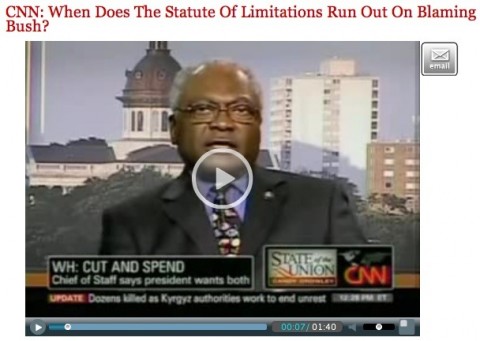
Clyburn, Boiled Down: We’ll Never Stop Blaming Bush

Real Clear Politics currently has a video highlighting statements by Democratic Congressman James Clyburn Jr. of South Carolina. It teases the video with a question asked by Candy Crowley of CNN. Once one sees the entire sequence, it’s clear that Clyburn really answered Crowley’s question before she even asked it. Here’s the full transcript of the vid, which begins after Indiana Republican Congressman Mike Pence had apparently made some points about how steps taken by the Obama administration to revive the economy to the point where it generates meaningful job growth aren’t working. Clyburn’s answer to when his party will stop blaming Bush is in bold: Clyburn: Uh, Congressman Spence, uh, Pence keeps talkin’ about, uh, the fact that, uh, we are, uh, failing in our approach. We all know exactly what this president inherited, and we will stop talkin’ about that inheritance, uh, when uh Congressman uh Pence and others stop talkin’ about takin’ us back uh to those failed policies. We’re trying to correct some things that we had absolutely nothin’ to do with, and the American people know that. And I would wish that all of us would get on board this in bipartisan approaches to tryin’ and get our economy stabilized, tryin’ to get our children educated, tryin’ to get workin’ men and women back to, uh, on their jobs, and look for the future, look to the future with — Crowley: Congressman? Clyburn: — a little more, uh compassion and bipartisanship. Crowley: Congressman, I think nobody disagrees with you on the goals. I think that one of the questions that’s cropping up now is, when does the statute of limitations run out on blaming the Bush administration and when is it on you all as the governing — really in the House and the Senate and the White House. When does the economy, uh, become your baby, so to speak? Clyburn: The economy is our baby. But let’s stop talkin’ about cuttin’ taxes, cuttin’ taxes, cuttin’ taxes. That simplistic approach to tryin’ to get this economy movin’ again, it’s what got us in this, uh-uh, position in the first place. We just had an across the board cut on 95% of workin’ men and women, they got an across the board tax cut. You all know that. Pence attempted to get in a word or two edgewise during Clyburn’s final two sentences and got nowhere, though Crowley got to him immediately after that. One can also hear Pence chuckling in the background as Crowley asks here “statute of limitations” question. “Congressman Pence and others” clearly have no plans to “stop talkin’ about takin’ us back to those failed policies” — policies that worked reasonably well from 2003 to 2007 , by the way, despite the sand-in-the-wheels impact of the Sarbanes Oxley law. Therefore, the short version of Clyburn’s answer to the question of when the Bush blame game will stop is, “When you guys shut up.” The one-word version is really, “Never.” As to Clyburn’s contention that “We’re trying to correct some things that we had absolutely nothin’ to do with,” it’s time to remind him and everyone else of the true origins of the housing and mortgage lending bubble. They have everything to do with government-sponsored, mortgage giants Fannie Mae and Freddie Mac, and nothing to do with George Bush, who tried — perhaps not hard enough, but genuinely tried — to stop the madness emanating from those two entities. The full scope of what these Democrat crony-controlled perpetrated on the nation didn’t become fully known until late last year. It wasn’t “only” lax credit standards, which would have been bad enough. Beyond that, as I noted on December 31 (last item at link; a column with a more complete treatment of the topic is here ), there was pervasively fraudulent loan packaging: … it’s hard to overstate the relevance of this paragraph from Peter J. Wallison in the Wall Street Journal , because it should end the debate over who is primarily responsible for the housing and mortgage-lending messes: “There is more to this ugly situation. New research by Edward Pinto, a former chief credit officer for Fannie Mae and a housing expert, has found that from the time Fannie and Freddie began buying risky loans as early as 1993, they routinely misrepresented the mortgages they were acquiring, reporting them as prime when they had characteristics that made them clearly subprime or Alt-A.” The two Democrat-crony government-sponsored enterprises created an artificial market for subprime mortgages by bilking investors for 15 years . If they hadn’t done this, subprimes would never have been able to expand to their mortally dangerous levels. Further, the victims of the misrepresentations logically would appear to include the rating agencies that some state attorneys general are going after as the supposed culprits. Sorry, Mr. Clyburn, your party and its cronies had everything to do with it. The only reason much of the American public doesn’t know this is because reporters like Candy Crowley haven’t educated themselves about what Fan and Fred really did, and therefore won’t challenge your full-of-baloney assertions. Or worse, they know and let it slide. Cross-posted at BizzyBlog.com .

Read the rest here:
Clyburn, Boiled Down: We’ll Never Stop Blaming Bush

Video: Bernanke Says There’s ‘Nothing on the Table at this Point’ to Tackle Fiscal Crisis

While appearing before Congress, Federal Reserve Chairman Ben Bernanke was asked by newly-elected Rep. Charles Djou (R-Hawaii) whether or not the federal government has a plan to tackle the continuing financial crisis. Check out his answer: Make sure you visit this post at the Eyeblast blog for more details and discussion on this video.

See more here:
Video: Bernanke Says There’s ‘Nothing on the Table at this Point’ to Tackle Fiscal Crisis