If you can afford this book, buy it.Since STARS WARS first came out, it’s produced an avalanche of licensed product taller than Jabba the Hut, including sumptuous art books. But this book, in size, towers above them all. A first-class example of book production, from its gorgeous tray case to the oversized book amply illustrated with blueprints and supportive text and photographs, this is the kind of book you’ll show off to your friends and neighbors, and leaf through with a look of amazement
This book is almost too awesome for me to put into words. I’ve long been a fan of the Legend of Zelda. It is not only my personal favorite video game series, but arguably the greatest series in video gaming, period. When this book released in Japan for Zelda’s 25 year anniversary, many hoped it would get translated and come to the States. Thankfully, our wish has been granted. This book is about as high-quality as they come. The opening letter from Shigeru Miyamoto sets a wonderful, celebrato
Nuns can be a little cray-cray too. Nun Faces 20 Years For Symbolic Break-In According to Raw Story An 83-year-old nun who broke into a Tennessee depleted uranium storage facility in 2012 and splashed human blood on several surfaces, exposing a massive security hole at the nation’s only facility used to store radioactive conventional munitions, was convicted Wednesday and faces a term of up to 20 years in prison. The only regret Sister Megan Rice shared with members of her jury on Wednesday was that she wished 70 years hadn’t passed before she took direct action, according to the BBC. She and two other peace activists, 64-year-old Michael Walli and 56-year-old Greg Boertje-Obed, were convicted of “invasion of a nuclear facility” in Oak Ridge, Tennessee, even though investigators admitted they did not get close to any actual nuclear material. The three activists are part of a group called “Transform Now Plowshares,” a reference to the book of Isaiah, which says, “They shall beat their swords into plowshares. They shall learn war no more.” All three face individual sentences of up to 20 years, along with a litany of fines. As they invaded the Y-12 National Security Complex at Oak Ridge, a perimeter fence was cut, several surfaces were spray-painted, banners were hung and activists read from the Bible. They also spread human blood on several surfaces, saying its use was symbolic, meant to remind people “of the horrific spilling of blood by nuclear weapons.” “The shortcomings in security at one of the most dangerous places on the planet have embarrassed a lot of people,” the activists’ attorney, Francis Lloyd, told members of the jury according to the BBC. “You’re looking at three scapegoats behind me.” Sister Rice has been arrested between 40 or 50 times committing acts of civil disobedience, according to The New York Times, including once in Nevada after she physically blocked a truck at a nuclear test site. “I believe we are all equally responsible to stop a known crime,” Sister Rice said from the witness stand, according to quotes published by her group. She called herself a “citizen of the world” and reportedly smiled as the verdict was read. Do you think she is a nut or hero?
Lindsay Lohan says she’s not a big drinker, has only done cocaine 4-5 times in her life and has never done LSD, heroin or anything you have to inject. She also swears she does not have a substance abuse problem and does not need rehab – which she finally checked into last week – for 90 days. In an interview with the Daily Mail (UK) , Lohan tells Piers Morgan that the media loves to make a huge deal out of nothing, mostly, and she’s great. “I don’t think I need to be on lockdown for three months. I don’t think that’s rehab,” the 26-year-old says. “I’ve been court-ordered to do it six times.” “I could write the book on rehab. Constantly sending me is pointless. The first few times I was court-ordered to rehab it was like a joke, like killing time.” “They just ask me the same old questions I’d answered before.” “I think there are other things I could do instead. The best thing they could do would be to make me go abroad to different countries and work with children.” Lindsay Lohan also claims that she hasn’t taken any drugs (besides her beloved Adderall) in a year and can give up drinking any time she darn well pleases. Other notable takeaways from the actress’ interview: The late Heath Ledger told her he gave up alcohol for a year so she took his advice when it comes to controlling her drinking … for better or worse. She’s taken cocaine “maybe 4 or 5 times in my life… I don’t like it. It reminds me of my dad. I took it 4-5 times from age 20-23 and got caught twice.” People may not believe her, but “It’s the truth. I’ve never taken heroin either, never injected myself with anything, never done LSD. Those things scare me.” She has however, done “pot, obviously. And ecstasy. I liked that better than the others (giggles). I didn’t drink on it, so I was just chilling.” She’s straight, not bisexual. Anyone believing any of this?
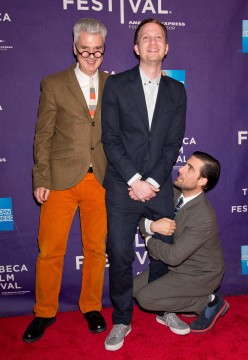
Teenage is as rebellious a film as the territory it covers. Based on punk author Jon Savage ‘s 2007 book Teenage: The Creation of Youth Culture 1875-1945 , Matt Wolf’s documentary eschews the talking heads and Chyroned dates that dominate the genre to immerse the moviegoer in a visually and aurally sumptuous history lesson. Wolf uses rare archival footage, period-piece recreations and a score by Deerhunter’s Bradford Cox to depict the evolution of teen culture via a number of influential and unconventional subcultures — swing kids, Boy Scouts, flappers, the German Wandervogel and even Nazi Youth — that coalesced from the late 19th century through the end of World War II. Understand them and today’s teens don’t seem so mystifying. I sat down with Wolf (he’s in the center of photo at left), Savage (he’s the one wearing orange pants) and the movie’s executive producer, actor Jason Schwartzman ( Moonrise Kingdom ) at the Tribeca Film Festival. Below is an edited version of our discussion: Movieline: Jason, how did you get to be the executive producer of Teenage ? Jason Schwartzman: When Matt’s movie about Arthur Russell came out, Wild Combination , I saw it multiple times in the course of a couple days, told everybody that I could possibly tell about it and showed it to one of my best friends Humberto Leon , who owns the fashion company Opening Ceremony . And when he saw that it was directed by Matt Wolf, he said, “Oh, Matt’s a really good friend of mine.” One thing led to another and Humberto connected Matt and I to make a short film for his store opening in Japan. We spent a lovely beautiful afternoon together in Toronto. It was just a beautiful day, and I felt instantly connected to Matt. I hope it’s okay that I say that. Matt Wolf: Please. Schwartzman: Does that make you feel uncomfortable? Wolf: No, I’m okay. Schwartzman: Too much pressure? After that, we started talking about books and music, and Matt said he was trying to make a documentary based on Jon Savage’s book Teenage . Being a fan of music and culture, I knew and loved Jon and was excited about this idea. And then a couple years later? Wolf: A year or two, I don’t know. Schwartzman: I reached out to Matt and said, “What’s going on with the movie? Is there anything I can try to do?” That began a process of getting the word out there and finding a way to finish the movie and make it happen. Movieline: You’ve taken a very unorthodox approach to making a non-fiction film. You call it “living collage.” Can you explain what you mean by that? Matt Wolf: When I read Jon’s book Teenage I didn’t just see it as source material. It helped me imagine a philosophy for the filmmaking. John is well known for his book on punk, England’s Dreaming , and in Teenage, he treated history in a punk way. Early on in our collaboration, he told me about something he observed in the 1970s: He saw these teenage punks wearing thrift clothes from the ‘30s, ‘40s and ‘50s and they would cut them up and reassemble them with safety pins into something new. He called that “living collage.” It really struck a chord with me and made me think, “Well what about living collage as a kind of filmmaking style, where we pick and choose these kind of documents and fragments from previous youth cultures and reassemble them into something that feels fresh and new.” And so living collage plays out visually in the way the film looks. In terms of the storytelling, the reason it probably feels unconventional is that, rather than telling the story with experts and historians, the film is told from the point of view of youth. And in John’s book, a huge basis of it is actual quotes from teenagers that are sourced from diaries and journalistic sources and books. And we kind of did a living collage of these quotes as well. You go so far as to not always identify who is talking. The moviegoer is essentially left to absorb what’s coming at him. Jon Savage: In an earlier edit we had lots of dates and times and Matt decided, and I thought it was a great idea, to actually take them out. Although it was good to have them, they were like the foundation. In any production, you have to start with a foundation and when the product is actually made, you don’t need [that foundation] any more. It’s not as if you need to explain Hitler Youth to a lot of people. It’s interesting that you say that because I thought the movie flowed like a piece of music — a punk symphony, you could say. Wolf: Yeah, that analogy makes sense to me, too. Music exists almost wall-to-wall through the film, and I perceive the voiceovers as being like lyrics. Very little of the archival footage we source has sound on it. . The voiceover is meant to provide a narrative foundation and to deepen the emotional impact of the film. It’s also meant to provide context in a personal way where it’s helpful. So kind of like lyrics in a song, you can just listen and hear it and have an emotional response to what you hear. Or that experience can be deepened by listening to the ideas in the lyrics. One of the first things I did when I started making this movie was to match archival footage to contemporary music that felt really transformational. It felt like a departure from how we normally see archival footage being used. How did you come to use Deer Hunter’s Bradford Cox to score the movie? Wolf: Bradford is my favorite contemporary musician, and we had actually corresponded as teenagers on an early blog that he ran. We reconnected over a music-themed film I made called Wild Combination years ago, and I approached him very early on in the process of Teenage to ask him if he’d like to score it. He wrote back saying, “Yes,” right away. But, like I said, the film is wall-to-wall music, and I’ve also included some pre-existing songs in the film as well. Savage: I gave Matt a hard drive. Wolf: Yeah, Jon gave me a lot of ideas for that music, too. I think our shared taste in music also was a helpful starting point. Jon, should someone who plans to see Teenage read your book before or after watching the movie? Savage: Whichever way, but, actually, I think the movie stands on its own. War plays an important role in this movie: On one hand, it’s responsible for the cross-pollination of teen cultures from around the world. On the other, it turns teens into adults very quickly. Wolf: It destroys them. At the beginning of this story, young people are perceived as a social problem. They need to be controlled. They’re sent to war and what happens to them in World War I is a kind of foundational trauma that creates teenage rebellion as we know it. It creates generational tension, and it drives the whole story. Then you have World War II, where young people are essentially sacrificed as cannon fodder by adults. But, at the same time, war stimulates the economy and enables teens to earn money and have a certain level of freedom. It’s as consumers that teenagers become the ultimate stakeholders in societies. War can lead to the destruction of their innocence, but it can also empower them with a certain level of freedom in terms of time and space and economics. War is the rear prism through which youth found their place in society. Savage: In our different ways, when I was doing the book and you were doing the film, we both fund the wartime stuff very hard. Wolf: Totally. I think the Hitler stuff is really intense. It’s at once totally intoxicating and absorbing. The reason Hitler and the Nazi experience for youth is a big part of the film is that Hitler both empowered and destroyed youth like no one else in history. In youth, he saw the potential to reimagine the world, but to very destructive and evil ends. It seems like every generation of adults laments how adventurous or promiscuous teens have become. But after watching this film, I wonder if that’s a myth. For instance, the German Wandervogel you depict from the late 19th and early 20th Centuries were quite free-spirited and daring. Savage: The cycle is the same, but the circumstances are different. Each generation has similar characteristics because it’s a physical and developmental stage of life that happens to everyone but within different societies and different context. I think there’s always a proportion of teens that are going to be rebels. There’s always a proportion that are going to be extremists and they’re always going to be the much larger proportion against whom the rebels and the extremists act: kids who just want to carry on and live life just like their parents did. Wolf: The focus of our film is these exceptional teenagers who are inventing new styles of communication, who are reimagining the future and the Wandervogel — this youth-led movement that’s incredibly liberated — is an example of that. Savage: Matt found extraordinary footage that hasn’t been seen. Schwartzman: I don’t believe that Wandervogel footage has ever been seen in a documentary. It comes from a museum for youth movements in Germany who do not typically license out their footage. When I look at pop stars like Justin Timberlake and Justin Bieber, I feel like we’ve entered a period of extended adolescence. Wolf: The starting point for me has always been, why is the culture obsessed with youth and where does this obsession come from? I do think that obsession has only intensified over time, but it’s hard to speculate about why that is. You mentioned the archetype of Justin Timberlake . In Teenage , we’re really finding the root and source of that, beginning with Rudolph Valentino, and with kids who fashioned their hair to look like him and who rioted at his funeral, and then progressing to Frank Sinatra , the first giant teen commercial pop star. Savage: Matt’s totally right. It has intensified because it’s become a huge industry. I’m much older than [Matt and Jason] and when I was a teenager it wasn’t this thing it is now. Since I was a young man, the whole area of pop culture and media has expanded exponentially. Wolf: Films that are about youth culture are usually focused on the now, and I thought it was a provocative strategy to make a film about youth that is based completely in the past — not even the recent past, the distant past. So it’s not working against the obsession with youth but it’s trying to attack the ideas and issue of youth culture in a totally different way. Instead of making a film about punks and hippies and skaters and Justin Bieber , it’s about flappers and jitterbugs. Schwartzman: He is making a movie about the punks and the skaters and Bieber. It’s called Teenage 2. That was going to be my next question. Would you consider making a Part 2? Wolf: Part of the reason Jon wrote the book in the style that he did is that, after the war, youth culture becomes this global phenomenon. The American model of the teen years spreads everywhere. It proliferates at such a rapid pace and is so gigantic that it’s probably not possible to explore the subject in a comprehensive way. Looking at this pre-history that led up to the creation of the teenager felt like the perfect way to explore the themes and ideas of youth culture in a deeper sense. So, to me, this film completes the idea. Schwartzman: He had planned to go to the ’60s but he ran out of computer space. Savage: If I was able to do a follow-up to the book — and I think it would actually make a good film — I would go from ’45 to say ’54. Elvis. But then it just gets insane. The level of data increases exponentially. Wolf: And then it becomes like a TV special or a textbook that doesn’t really go deep into much at all. After the war, it’s really difficult to not be just a greatest hits compilation. Watching Teenage left me with the distinct impression that if you had to choose the one medium that has had the most influence over youth culture, it would be music. Savage: Music is very, very important. Again, from a European prospective, America’s great gift to the world is black American music. I’m still in awe of it after listening to it for 50 years, and to me one of the high spots of the film is the section about Swing. My single favorite piece of footage is the Chicago Swing Jamboree with 200,000 kids going crazy in 1938. There’s an integrated audience, everybody is going nuts you see this black American guy with a bowler hat — and he’s pogoing. That said it all to me. Wolf: When I started making the film I thought it would be a deeper investigation of pop culture, but it ended up becoming much more political than I ever expected. I feel like the story of the German Swing Kids is the perfect synthesis of all the themes and the tension between politics and pop culture in the film. Here you have these kids who are like proto-punks: They have wild fashion, they dress very flamboyantly, they’re smuggling in music from America, and they’re doing it as a form of rebellion against the Nazi regime. They don’t perceive themselves as activists, but they’re doing it with great courage. It shows the political power of popular culture in a certain context. The film is also about the spread of American culture throughout the world and music facilitated that like nothing else. In the 1920’s, the British narrator says, “I got my hands on all the jazz records. My mum asked me why it was good and I said, ‘Because it comes from America.'” Savage: Swing looks to me like the proper birth of youth culture, certainly in a mass form, even more so than jazz in the ’20s. Wolf: The Chicago Swing Jamboree is so meaningful because you see these teenagers pioneering this new style of expression and dance. It has its own slang, its own music vocabulary. Savage: It’s own lifestyle. Wolf: And it spreads to become a mainstream phenomenon. What’s next for each of you guys? Wolf: I’m in the early stages of developing a bunch of projects. Jon and I are hoping to collaborate on a new film based on an unprecedented archive of gay life that this collector has. It’s a personal photography collection of early gay life. I’m also working on a documentary portrait of Hilary Knight , the illustrator of Eloise . Savage: I’m writing a new book about the year 1966 in pop culture and youth culture. Schwartzman: I just finished a film about the making of Mary Poppins . Sounds so dumb compared to what you guys just said. Follow Frank DiGiacomo on Twitter. Follow Movieline on Twitter.
Teenage is as rebellious a film as the territory it covers. Based on punk author Jon Savage ‘s 2007 book Teenage: The Creation of Youth Culture 1875-1945 , Matt Wolf’s documentary eschews the talking heads and Chyroned dates that dominate the genre to immerse the moviegoer in a visually and aurally sumptuous history lesson. Wolf uses rare archival footage, period-piece recreations and a score by Deerhunter’s Bradford Cox to depict the evolution of teen culture via a number of influential and unconventional subcultures — swing kids, Boy Scouts, flappers, the German Wandervogel and even Nazi Youth — that coalesced from the late 19th century through the end of World War II. Understand them and today’s teens don’t seem so mystifying. I sat down with Wolf (he’s in the center of photo at left), Savage (he’s the one wearing orange pants) and the movie’s executive producer, actor Jason Schwartzman ( Moonrise Kingdom ) at the Tribeca Film Festival. Below is an edited version of our discussion: Movieline: Jason, how did you get to be the executive producer of Teenage ? Jason Schwartzman: When Matt’s movie about Arthur Russell came out, Wild Combination , I saw it multiple times in the course of a couple days, told everybody that I could possibly tell about it and showed it to one of my best friends Humberto Leon , who owns the fashion company Opening Ceremony . And when he saw that it was directed by Matt Wolf, he said, “Oh, Matt’s a really good friend of mine.” One thing led to another and Humberto connected Matt and I to make a short film for his store opening in Japan. We spent a lovely beautiful afternoon together in Toronto. It was just a beautiful day, and I felt instantly connected to Matt. I hope it’s okay that I say that. Matt Wolf: Please. Schwartzman: Does that make you feel uncomfortable? Wolf: No, I’m okay. Schwartzman: Too much pressure? After that, we started talking about books and music, and Matt said he was trying to make a documentary based on Jon Savage’s book Teenage . Being a fan of music and culture, I knew and loved Jon and was excited about this idea. And then a couple years later? Wolf: A year or two, I don’t know. Schwartzman: I reached out to Matt and said, “What’s going on with the movie? Is there anything I can try to do?” That began a process of getting the word out there and finding a way to finish the movie and make it happen. Movieline: You’ve taken a very unorthodox approach to making a non-fiction film. You call it “living collage.” Can you explain what you mean by that? Matt Wolf: When I read Jon’s book Teenage I didn’t just see it as source material. It helped me imagine a philosophy for the filmmaking. John is well known for his book on punk, England’s Dreaming , and in Teenage, he treated history in a punk way. Early on in our collaboration, he told me about something he observed in the 1970s: He saw these teenage punks wearing thrift clothes from the ‘30s, ‘40s and ‘50s and they would cut them up and reassemble them with safety pins into something new. He called that “living collage.” It really struck a chord with me and made me think, “Well what about living collage as a kind of filmmaking style, where we pick and choose these kind of documents and fragments from previous youth cultures and reassemble them into something that feels fresh and new.” And so living collage plays out visually in the way the film looks. In terms of the storytelling, the reason it probably feels unconventional is that, rather than telling the story with experts and historians, the film is told from the point of view of youth. And in John’s book, a huge basis of it is actual quotes from teenagers that are sourced from diaries and journalistic sources and books. And we kind of did a living collage of these quotes as well. You go so far as to not always identify who is talking. The moviegoer is essentially left to absorb what’s coming at him. Jon Savage: In an earlier edit we had lots of dates and times and Matt decided, and I thought it was a great idea, to actually take them out. Although it was good to have them, they were like the foundation. In any production, you have to start with a foundation and when the product is actually made, you don’t need [that foundation] any more. It’s not as if you need to explain Hitler Youth to a lot of people. It’s interesting that you say that because I thought the movie flowed like a piece of music — a punk symphony, you could say. Wolf: Yeah, that analogy makes sense to me, too. Music exists almost wall-to-wall through the film, and I perceive the voiceovers as being like lyrics. Very little of the archival footage we source has sound on it. . The voiceover is meant to provide a narrative foundation and to deepen the emotional impact of the film. It’s also meant to provide context in a personal way where it’s helpful. So kind of like lyrics in a song, you can just listen and hear it and have an emotional response to what you hear. Or that experience can be deepened by listening to the ideas in the lyrics. One of the first things I did when I started making this movie was to match archival footage to contemporary music that felt really transformational. It felt like a departure from how we normally see archival footage being used. How did you come to use Deer Hunter’s Bradford Cox to score the movie? Wolf: Bradford is my favorite contemporary musician, and we had actually corresponded as teenagers on an early blog that he ran. We reconnected over a music-themed film I made called Wild Combination years ago, and I approached him very early on in the process of Teenage to ask him if he’d like to score it. He wrote back saying, “Yes,” right away. But, like I said, the film is wall-to-wall music, and I’ve also included some pre-existing songs in the film as well. Savage: I gave Matt a hard drive. Wolf: Yeah, Jon gave me a lot of ideas for that music, too. I think our shared taste in music also was a helpful starting point. Jon, should someone who plans to see Teenage read your book before or after watching the movie? Savage: Whichever way, but, actually, I think the movie stands on its own. War plays an important role in this movie: On one hand, it’s responsible for the cross-pollination of teen cultures from around the world. On the other, it turns teens into adults very quickly. Wolf: It destroys them. At the beginning of this story, young people are perceived as a social problem. They need to be controlled. They’re sent to war and what happens to them in World War I is a kind of foundational trauma that creates teenage rebellion as we know it. It creates generational tension, and it drives the whole story. Then you have World War II, where young people are essentially sacrificed as cannon fodder by adults. But, at the same time, war stimulates the economy and enables teens to earn money and have a certain level of freedom. It’s as consumers that teenagers become the ultimate stakeholders in societies. War can lead to the destruction of their innocence, but it can also empower them with a certain level of freedom in terms of time and space and economics. War is the rear prism through which youth found their place in society. Savage: In our different ways, when I was doing the book and you were doing the film, we both fund the wartime stuff very hard. Wolf: Totally. I think the Hitler stuff is really intense. It’s at once totally intoxicating and absorbing. The reason Hitler and the Nazi experience for youth is a big part of the film is that Hitler both empowered and destroyed youth like no one else in history. In youth, he saw the potential to reimagine the world, but to very destructive and evil ends. It seems like every generation of adults laments how adventurous or promiscuous teens have become. But after watching this film, I wonder if that’s a myth. For instance, the German Wandervogel you depict from the late 19th and early 20th Centuries were quite free-spirited and daring. Savage: The cycle is the same, but the circumstances are different. Each generation has similar characteristics because it’s a physical and developmental stage of life that happens to everyone but within different societies and different context. I think there’s always a proportion of teens that are going to be rebels. There’s always a proportion that are going to be extremists and they’re always going to be the much larger proportion against whom the rebels and the extremists act: kids who just want to carry on and live life just like their parents did. Wolf: The focus of our film is these exceptional teenagers who are inventing new styles of communication, who are reimagining the future and the Wandervogel — this youth-led movement that’s incredibly liberated — is an example of that. Savage: Matt found extraordinary footage that hasn’t been seen. Schwartzman: I don’t believe that Wandervogel footage has ever been seen in a documentary. It comes from a museum for youth movements in Germany who do not typically license out their footage. When I look at pop stars like Justin Timberlake and Justin Bieber, I feel like we’ve entered a period of extended adolescence. Wolf: The starting point for me has always been, why is the culture obsessed with youth and where does this obsession come from? I do think that obsession has only intensified over time, but it’s hard to speculate about why that is. You mentioned the archetype of Justin Timberlake . In Teenage , we’re really finding the root and source of that, beginning with Rudolph Valentino, and with kids who fashioned their hair to look like him and who rioted at his funeral, and then progressing to Frank Sinatra , the first giant teen commercial pop star. Savage: Matt’s totally right. It has intensified because it’s become a huge industry. I’m much older than [Matt and Jason] and when I was a teenager it wasn’t this thing it is now. Since I was a young man, the whole area of pop culture and media has expanded exponentially. Wolf: Films that are about youth culture are usually focused on the now, and I thought it was a provocative strategy to make a film about youth that is based completely in the past — not even the recent past, the distant past. So it’s not working against the obsession with youth but it’s trying to attack the ideas and issue of youth culture in a totally different way. Instead of making a film about punks and hippies and skaters and Justin Bieber , it’s about flappers and jitterbugs. Schwartzman: He is making a movie about the punks and the skaters and Bieber. It’s called Teenage 2. That was going to be my next question. Would you consider making a Part 2? Wolf: Part of the reason Jon wrote the book in the style that he did is that, after the war, youth culture becomes this global phenomenon. The American model of the teen years spreads everywhere. It proliferates at such a rapid pace and is so gigantic that it’s probably not possible to explore the subject in a comprehensive way. Looking at this pre-history that led up to the creation of the teenager felt like the perfect way to explore the themes and ideas of youth culture in a deeper sense. So, to me, this film completes the idea. Schwartzman: He had planned to go to the ’60s but he ran out of computer space. Savage: If I was able to do a follow-up to the book — and I think it would actually make a good film — I would go from ’45 to say ’54. Elvis. But then it just gets insane. The level of data increases exponentially. Wolf: And then it becomes like a TV special or a textbook that doesn’t really go deep into much at all. After the war, it’s really difficult to not be just a greatest hits compilation. Watching Teenage left me with the distinct impression that if you had to choose the one medium that has had the most influence over youth culture, it would be music. Savage: Music is very, very important. Again, from a European prospective, America’s great gift to the world is black American music. I’m still in awe of it after listening to it for 50 years, and to me one of the high spots of the film is the section about Swing. My single favorite piece of footage is the Chicago Swing Jamboree with 200,000 kids going crazy in 1938. There’s an integrated audience, everybody is going nuts you see this black American guy with a bowler hat — and he’s pogoing. That said it all to me. Wolf: When I started making the film I thought it would be a deeper investigation of pop culture, but it ended up becoming much more political than I ever expected. I feel like the story of the German Swing Kids is the perfect synthesis of all the themes and the tension between politics and pop culture in the film. Here you have these kids who are like proto-punks: They have wild fashion, they dress very flamboyantly, they’re smuggling in music from America, and they’re doing it as a form of rebellion against the Nazi regime. They don’t perceive themselves as activists, but they’re doing it with great courage. It shows the political power of popular culture in a certain context. The film is also about the spread of American culture throughout the world and music facilitated that like nothing else. In the 1920’s, the British narrator says, “I got my hands on all the jazz records. My mum asked me why it was good and I said, ‘Because it comes from America.'” Savage: Swing looks to me like the proper birth of youth culture, certainly in a mass form, even more so than jazz in the ’20s. Wolf: The Chicago Swing Jamboree is so meaningful because you see these teenagers pioneering this new style of expression and dance. It has its own slang, its own music vocabulary. Savage: It’s own lifestyle. Wolf: And it spreads to become a mainstream phenomenon. What’s next for each of you guys? Wolf: I’m in the early stages of developing a bunch of projects. Jon and I are hoping to collaborate on a new film based on an unprecedented archive of gay life that this collector has. It’s a personal photography collection of early gay life. I’m also working on a documentary portrait of Hilary Knight , the illustrator of Eloise . Savage: I’m writing a new book about the year 1966 in pop culture and youth culture. Schwartzman: I just finished a film about the making of Mary Poppins . Sounds so dumb compared to what you guys just said. Follow Frank DiGiacomo on Twitter. Follow Movieline on Twitter.
Guess there’s no reason to wonder what today is anymore… According to TMZ reports : It feels good … to be married to Tony! Toni! Toné! member D’wayne Wiggins … but only for a dozen years or so, at least according to his soon-to-be ex-wife. TMZ has learned … Michelle Lochin-Wiggins has filed for divorce from her husband of 12 years, and is seeking custody of their two teen boys, ages 17 and 14. In the docs, Michelle cites irreconcilable differences with the 50-year-old singer, who sang and played guitar for the ’90s R&B group. While her request for full legal and physical custody signals that all’s not well, she does plan to offer D’wayne visitation rights to the kids. Wonder if Michelle will hit D’Wayne up for some ali-mony, moni, moné? Image via Facebook
Oh boy…. Pilar Sanders Confirms Plans To Release Of Tell-All Book Former real-life football wife Pilar Sanders may have lost the battle for now to her ex NFL hubby Deion Sanders , but the war is definitely not over as far as she is concerned and she’s not going down without a fight. As the messy and drawn own divorce drama continues between Pilar and her soon-to-be ex , it has now been revealed that she’s planning to air out dirty-dog Deion in a new tell-all memoir to be aptly titled “Saving Sanders: The Pilar Sanders Untold Story.” via HipHollywood HipHollywood.com has learned exclusively that Pilar Sanders is planning to release a tell-all book about her life. The literary piece, tentatively titled, Saving Sanders: The Pilar Sanders Untold Story, is being co-written by Sanders’ longtime friend and publicist, Kali Bowyer. The book will detail what Pilar has described as her abusive marriage to NFL legend, Deion Sanders. While Deion has maintained that he never physically abused Pilar during their time together, the reality TV beauty is sticking by her story. “I want to be a mentor to other women who have been abused, by sharing my story, my struggles and letting them in, it will not only help heal myself but others experiencing the same trials and struggles as well,” she tells HH exclusively. “There are thousands of women fighting for their rights, their children and their own identity out there. We as women and mothers need to ban together to show support for injustice. I will continue my fight as long as I walk this earth, and with Jesus at my side all will prevail,” she proclaimed during our chat. Bowyer tells HH that the book will be the “true, uncut story about the abuse Pilar endured, how she built an empire with him, and how he cheated on her.” Oh boy. Just went it seemed that this entire situation couldn’t get any messier , Pilar sounds like she’s about to put dirty-dog Deion on full blast in the worst way possible. Hell hath no fury…
Barbie is the ultimate doll, so it makes sense that she’s dolled up. Hot. Always. No matter what she’s doing or wearing, the girl is a looker … but have you ever wondered what she looks like with no makeup? Artist Eddi Aguirre Cendejaz attempted to envision it , and wow: Sans blush, lipstick, mascara and fake eyelashes, Barbie without makeup has never before been seen … except maybe by Ken first thing in the morning. Assuming she sleeps over. We don’t know what their deal is. Our primary point: In an era where going au naturale is all the rage, should Mattel start selling Barbie dolls without makeup? Would she be as popular? We vote yes. Any pic of Kim Kardashian, Lady Gaga or Demi Lovato without makeup instantly gets tens of thousands of Likes on Facebook. Just saying.
Two days prior to its scheduled release, Selena Gomez’s “Come & Get It” leaked online yesterday – and its lyrics have fans wondering: Was this track penned with Justin Bieber in mind? The single is based around a love that Selena simply cannot quit, which follows talk that she has been torturing Bieber via constant calls and texts… despite the pair remaining split up. Give it a listen now: Selena Gomez – “Come & Get It” Among the haunting words sang by Selena: “Can’t stop because I love it, hate the way I love you.. this love ain’t finished yet …so baby whenever you’re ready… come and get it… “This love will be the death of me.” Your move, JB. The ball of confounding adolescent love is in your cute court.