Tag Archives: book

Matthews to Dem Candidate: I Hope Your Party Gets Organized and Wins This Thing!

It’s no secret that Chris Matthews once flirted with the idea of  running for Senate in Pennsylvania , but since he didn’t throw his hat into that race, the Hardball host, on Thursday night, did everything he could to help Joe Sestak beat Republican Pat Toomey, as he urged: “I hope your party gets organized up there, because the Democratic Party of Ed Rendell and you and all those other guys ought to get together with Brady and win this thing!” And even before Matthews invited viewers to “Meet Joe Sestak” in an interview segment, the MSNBCer began cheerleading for him in a preview as he teased: “Up next, Joe Sestak from my home state of Pennsylvania, he’s fighting hard, the good fight against Pat Toomey, the Club for Growther of the far right.” The following exchanges were aired on the September 2 edition of Hardball: CHRIS MATTHEWS: Congressman Joe Sestak pulled off a big upset back in May when he beat Arlen Specter, he had been senator forever in Pennsylvania, in that primary. Sestak may need another upset come November. He faces a tough political climate up there. Pat Toomey, the Club for Growther of the far right is averaging a six-point gain on him right now in the latest pollsters average poll. Congressman Sestak joins right now us now. You know Pennsylvania, as you know, I’m talking to an expert, it’s a purple state. It’s somewhere in the middle. It’s a John Wayne state. It’s not a far right or far left state. How come Toomey is doing well when he’s on the far right side? What is going on? Isn’t he a [Rick] Santorum type? … MATTHEWS: Let me ask you about the support from the establishment up there. You beat the heck out of these people. You took the money people in big Philly. You took the machine, such as it was, on that day, it could be more interested, I think, on general election day and you beat the heck out of them. You pulled the biggest upset. Are those guys still mad at you for beating, the underdog, for beating their guy Specter? JOE SESTAK: I’m told they’re all gonna be there. A lot of them are gone for pre-Labor Day. And they’re gonna be there right after Labor Day. Look, I’m not going to depend upon that. You know we raised close to $2 million in four weeks, right after the election. We’re out there working every day. But more than that, I am going to help leverage those centers of excellence. I also have over 25 offices open, 25,000 phone calls a day since 1 January. We’re gonna build a warfare coalition just like those 30 ships I had when I was a Navy admiral, doing the retaliatory strikes off Afghanistan, working together. But I also want you to know this Chris. I’m also focused on moderate Republicans and independents. I think when they find how extreme Congressman Toomey is, I mean if you liked Rick Santorum, you’re gonna love Pat Toomey. MATTHEWS: How is he extreme? Give me some examples! I know I asked about the steel industry a while ago and he said basically he’s a free marketer, “Let it rot! Don’t do anything. The government has no responsibility to save industries that are in trouble.” What’s your view and what’s wrong with his? SESTAK: Well let me tell you, in his book he calls it “creative destruction.” It’s okay that we have China subsidizing their exports because it’ll have creative destruction in America where people will be unemployed, but they’ll find a job somewhere else. You know zero, zero taxes for corporations where you don’t have to pay for it. Look when he was in Hong Kong, working for a Hong Kong billionaire, he actually worked on those currency swaps that helped China keep down over the years those, the, the value of, of the, the wan. And so we have, as someone who believes “benefit big business, benefit Wall Street and wealth might trickle down.” Look he actually believed, when he was on the Small Business committee, he slashed in half the small business budget. He voted against studies for women to find out why are they’re only getting two percent of all federal contracts supposed to go to small businesses? He just voted against that. Time after time, whether its education. Here’s Philadelphia, you talk about a challenge in Philadelphia? Only about 28 percent of African-American males are graduating from high school there. And Chris it’s only 33 percent of whites. And so I’m on the Education committee. This is about the common good. And he helped slash the education budget by $3 billion and voted against Pell Grants. He, what he did when he was president and this is the worst, I think. When he was president of Club for Growth — and I like Pat, I’ve had a beer with him — but when he was president of Club for Growth which John McCain called “a grab bag for the ultra rich,”when he was president he actually had as his principle mission purging the Republican Party of moderates and went after Senator Lincoln Chafee and others. MATTHEWS: I know. SESTAK: In my mind we don’t need an ideology, we need someone who is willing to work. MATTHEWS: Is he a right winger? Is he a right winger? Is he a right winger? SESTAK: He, he’s farther from the right wing. Yes he’s much, he’s extreme. Look… MATTHEWS: Okay let me ask you, let’s talk, let’s talk turkey, Admiral, Congressman. I mean you deserve both titles. You’ve earned them. Let me ask you this. Are you gonna get Bill Clinton in there? It seems to me that if you look at Southwestern Pennsylvania, if you look at anywhere in that state, among the African-American community, which has been hammered with unemployment. They, if they had the jobs that the Irish guys had, in the neighborhoods I grew up in today, they’d be unbelievably middle class. They’d be in such a great shape. Those jobs are gone, those steel jobs. Let me ask you. Are you gonna bring Bill Clinton in there? Because, it seems to me, he would be even better than the President, to help you in Pennsylvania? SESTAK: Yes. Yeah he’s already come in for Scranton. Great rally. Unfortunately I was down in Washington for the good business of voting for that EFNEP bill that Congressman Toomey opposed and would have had 12,000 Pennsylvanians… MATTHEWS: Well you gonna bring him back? SESTAK: …if we hadn’t passed it. Absolutely. Actually I was talking with them the other day and they just wanted to know what days. They tell me I’m their top priority and I’m gonna keep working on that. So, I hope to see him out there a lot. MATTHEWS: Well I hope your party, I hope your party gets organized up there, because the Democratic Party of Ed Rendell and you and all those other guys ought to get together with Brady and win this thing! Anyway, thank you Congressman Joe Sestak, running for Pennsylvania senator.

Excerpt from:
Matthews to Dem Candidate: I Hope Your Party Gets Organized and Wins This Thing!

Stunning First Set Pictures From Steven Spielberg’s War Horse Reveal Spielberg, Horse

After what seemed like an eternity directing Tintin , Steven Spielberg has returned to old-fashioned flesh-and-blood filmmaking. And as evidenced in these new photos dispatched from the set of his book adaptation War Horse , the movie is definitely about… a horse.

Read more:
Stunning First Set Pictures From Steven Spielberg’s War Horse Reveal Spielberg, Horse

WaPo’s Capehart Lauds Ken Mehlman By Comparing Him to a Recovered Segregationist

Former Republican National Committee chairman Ken Mehlman’s declaration that he is homosexual caused gay-left Washington Post editorialist Jonathan Capehart to embrace Mehlman…and compare him to the most hardline segregationist. Once again, in Sunday’s newspaper, racism and opposition to the sin of homosexuality were shamelessly equated on Mehlman’s “road to redemption” — but the Sunday edit left out Capehart’s praise for ex-conservative David Brock: Now that Mehlman has made his journey, I am happy that he has already started down the road of redemption. As Ambinder reports, Mehlman has been a de facto strategist for the American Foundation for Equal Rights . That’s the group behind the landmark lawsuit against California’s Proposition 8 banning same-sex marriage. He must keep at it if he is to overcome the deep resentment and distrust that now greets his coming out. It’s possible. Just look at George Wallace and David Brock. Wallace, the legendary Alabama politician, was a progressive who became a rabid segregationist in the 1960s. The dude was way on the wrong side of the civil rights movement at many of its pivotal moments. But when he ran for a final term as governor in 1982 he won with 90 percent of the African American vote . Wallace garnered that vote by spending years making amends — real and symbolic — and asking forgiveness. Brock also reconciled his antagonistic past. After being a significant cog in the “vast right wing conspiracy,” he wrote a 2002 biography that exposed his hidden homosexuality and his role in said conspiracy to take down the Clintons. Part of his redemption was creating in 2004 Media Matters the indispensable progressive website that now monitors the right wing misinformation machine he helped create. Mehlman is the highest-ranking Republican to come out of the closet. (Move over, Mary Cheney.) If he maintains his high-powered efforts to bring his party to the fight for marriage equality, gay men and lesbians will thank Mehlman for his help when same-sex marriage is legal in the United States. It’s not going to happen with Democrats alone, folks.

Originally posted here:
WaPo’s Capehart Lauds Ken Mehlman By Comparing Him to a Recovered Segregationist

Flashback: After Katrina, Sensationalistic Media Accounts Earned Press a D-Minus

Five years ago on Sunday, Hurricane Katrina smashed into the Gulf coast, devastating much of the region, and most memorably New Orleans. Yesterday was an occasion to look back at what went wrong in the city, and hope that the same mistakes are not made again. One of the most notorious failures surrounding Katrina was the media’s coverage of the situation in New Orleans. One “well-known [television] anchor,” actor and filmmaker Harry Shearer recalled in an interview with Daily Finance’s Jeff Bercovici, claimed the “the emotional stories are more compelling for our audience.” Hence, the media mostly ignored the larger issues facing the city – survivors still stranded on rooftops, the reasons for the levy’s failures – in favor of more sensationalistic, occasionally outright false stories. Shearer gives the media’s coverage – with the notable exceptions of only a couple outlets – a D-minus. Shearer told Bercovici: The [New York] Times did okay. I think the rest of the press gets a D, and probably a D-minus for their efforts at patting themselves on the back about how well they did speaking truth to power. Anderson Cooper … giving a lecture to [Louisiana senator] Mary Landrieu, like that’s the person you need to lecture. It was grandstanding and showboating in place of telling a story — partly because they left. They left. Water leaves, story over. The [New Orleans] Times-Picayune won two Pulitzers for their work because they couldn’t leave. They lived there. They had to stay. In addition to the Times’s coverage, Shearer also praised the work of Michael Grunwald, who covered Katrina for Time and the Washington Post. But he went on to blast the press’s shallow approach to post-Katrina coverage, claiming that news consumers saw “lots of images of people destitute and unhappy but never [got] to find out why.” W. Joseph Campbell, communications professor at American University and author of “Getting it Wrong: Ten of the Greatest Misreported Stories in American Journalism” (hint: Katrina is one of the 10) agrees with Shearer. In the book, he wrote that post-Katrina media coverage “was in important respects flawed and exaggerated. On crucial details, journalists erred badly, and got it wrong.” They reported snipers firing at medical personnel. They reported that shots were fired at helicopters, halting evacuations from the Convention Center [in New Orleans]. They told of bodies being stacked there like cordwood. They reported roving gangs were preying on tourists and terrorizing the occupants of the Superdome, raping and killing. They said children were victims of sexual assault, that one seven-year-old was raped and her throat was slit. They reported that sharks were plying the flooded streets of New Orleans. Those reports were all wrong, and they contributed mightily to the public (mis)perception of the situation in New Orleans. At his blog, Media Myth Alert , Campbell added no single news organization committed all those errors. And not all those lapses were committed at the same time, although they were largely concentrated during the first days of September 2005. In any case, I write, the erroneous and over-the-top reporting “had the cumulative the effect of painting for America and the rest of the world a scene of surreal violence and terror, something straight out of Mad Max or Lord of the Flies.” Estimates of Katrina’s death toll in New Orleans also were wildly exaggerated. U.S. Senator David Vitter, a Louisiana Republican, said on September 2, 2005, that fatalities in the state could reach 10,000 or more. Vitter described his estimate as “only a guess,” but it was nonetheless taken up by the then-New Orleans mayor, Ray Nagin, and reported widely. In all, the death toll in Louisiana from Katrina was around 1,500. About the inaccurate estimates of fatalities, the Times of London said it had become clear by in mid-September 2005 “that 10,000 people could have died only if more than 90 per cent of them had locked themselves into their homes, chained themselves to heavy furniture and chosen to drown instead of going upstairs as the waters rose.” But the Times rationalized the flawed reporting, suggesting that it was inevitable: When “nature and the 24-hour news industry collide, hyperbole results.” A weak excuse, that. Besides, post-Katrina reporting from New Orleans was more than hyperbolic: It described apocalyptic horrors that the hurricane supposedly unleashed. “D-minus” is none too generous. As usual, the media adopted the role of the nation’s finger-pointers in New Orleans in Katrina’s aftermath, singling out a number of people and institutions they thought deserved blame. Ironically, of all the failings in the days after the hurricane hit, the media’s will inevitably be remembered as among the most grave.

See more here:
Flashback: After Katrina, Sensationalistic Media Accounts Earned Press a D-Minus

‘Breaking Dawn’ Scribe Says She’s Wrestling With ‘Battle Scene’

‘It’s an enormous challenge to choreograph on the page,’ Melissa Rosenberg reveals from Emmys red carpet. By Kara Warner, with reporting by Jim Cantiello Melissa Rosenberg Photo: MTV News In the midst of Emmy mania Sunday night (August 29) — Dresses! Nominees! Celeb couples! — which predictably revolved around the world of TV, pre-show viewers got a pleasant surprise as “Twilight” screenwriter Melissa Rosenberg made her way down a very long red carpet at the Nokia Theatre in Los Angeles. Naturally, when MTV News caught up with the busy scribe, we had to press her for another update on the progress of the “Breaking Dawn” scripts . “They’re coming along,” Rosenberg said. “I just flew in last night from working with [‘Dawn’ director] Bill Condon, prepping the scripts. It’s a lot of work, I’m exhausted,” she added. Rosenberg also revealed that she’s between 75 and 80 percent finished with the two screenplays. “But we’re intent on making them the best scripts yet.” Regarding the biggest challenge she faces in finishing “Dawn,” parts 1 and 2, Rosenberg said it’s the climactic “battle scene” — in which the two opposing vampire groups face off in dramatic fashion at the end of the book — that’s proving to be her biggest obstacle, rather than the infamous “birth scene” . “The final battle sequence is a big challenge because it lasts 25 pages,” Rosenberg told us. “It’s almost an entire three-act story in and of itself. You have to track (kept all in one setting) hundreds of characters. It’s an enormous challenge to choreograph on the page and for Bill to choreograph on the stage.” Rosenberg went on to say that perfecting that scene is her “next big hurdle.” “I’ve written a couple of drafts [of the scene]; I haven’t gotten with Bill [to go over it] yet. That’s the next big hurdle to sit down with the stunt coordinator and create the ballet.” Check out everything we’ve got on “The Twilight Saga: Breaking Dawn – Part 1.” For young Hollywood news, fashion and “Twilight” updates around the clock, visit HollywoodCrush.MTV.com . Related Videos ‘Twilight’ Stars Talk ‘Breaking Dawn’ Related Photos 2010 Emmys Red Carpet Fashions

View original post here:
‘Breaking Dawn’ Scribe Says She’s Wrestling With ‘Battle Scene’

Asher Roth, Kendra Wilkinson, Kelly Osbourne Look Back, On ‘When I Was 17’

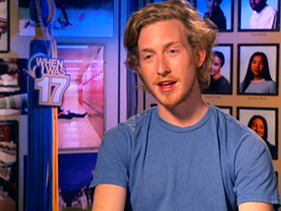
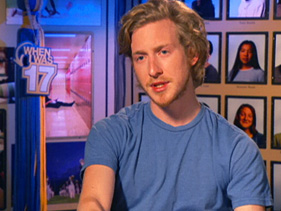
The stars reminisce about tattoos, cemetery scares and singing careers. By Dan Schenek Asher Roth appears on “When I Was 17” Photo: MTV News When Asher Roth was 17, he remembered being a car-less “white boy wannabe.” The lively artist developed a fan base while attending college with the help of social-networking websites, and arrived on the mainstream hip-hop scene with a slew of mixtapes. Almost overnight, he found himself with a record deal and a full studio album, Asleep in the Bread Aisle. “In high school, I ended up finding my home with kids who had one common interest, and that’s hip-hop music,” Roth said on the latest episode of “When I Was 17,” which premiered Saturday at 11 a.m. “We’d be carrying boom boxes around in our book bags like we were straight out of the ’80s,” Roth’s friend Brian recalled. “We started meeting regularly around school.” Before hanging with Hef, former “Girl Next Door” Kendra Wilkinson remembers eyeing her high school soccer coach. “Soccer was my love,” the California girl said. “I had a huge crush on my soccer coach. He was like the hottest thing to ever exist … I would totally flirt with him. I would wear shorter shorts than the other girls on purpose.” Holly Madison and Bridget Marquardt said Wilkinson would act like she didn’t know what she was doing on the soccer field to get more attention from the studly coach. “I loved just having my soccer coach just yelling at me. It turned me on,” Wilkinson said. Kendra also reminisces about how she was freaked out when seeing windmills turning with no wind and hearing a crying baby at a cemetery. On the show, MTV reality-show vet Kelly Osbourne also looks back at her time in an American school and her first tattoo experience. “For me, it’s really the idea of having a tattoo than actually having it because once you have it, you’re like, ‘alright, ugly.’ Kelly’s first impressions of the American school system were also unique. “In England, I just went to school,” she said. “In America, I had to figure out if I was a jock, a nerd, a cheerleader — there are social groups for everything.” “When I Was 17” airs Saturdays at 11 a.m. on MTV. Related Videos When I Was 17 | Ep. 17 | Kendra Wilkinson, Asher Roth, Kelly Osbourne Related Photos When I Was 17 | Kendra Wilkinson When I Was 17 | Asher Roth When I Was 17 | Ep. 17 | Celebrity Photo Flashback

See the original post:
Asher Roth, Kendra Wilkinson, Kelly Osbourne Look Back, On ‘When I Was 17’

Asher Roth Remembers ‘Suburban Threat’ Crew On ‘When I Was 17’

MC recalls hanging with fellow hip-hop heads on the latest episode, premiering Saturday at 11 a.m. By Mawuse Ziegbe Asher Roth appears on “When I Was 17” Photo: MTV News Asher Roth hit the hip-hop scene with a slew of mixtapes, which culminated with his cheeky 2009 debut LP Asleep in the Bread Aisle. His breakout single “I Love College,” an ode to the copious amounts of boozing and debauchery that comes with the pursuit of higher education, cemented his status as an inventive, fun-loving rap star. So it makes sense that he rocked a hip-hop career, because when Roth was 17, it was all about the music. “In high school, I ended up finding my home with kids who had one common interest, and that’s hip-hop music,” Roth says on the latest episode of “When I Was 17,” which premieres Saturday at 11 a.m. The episode also features teenage tales from former Playboy Playmate Kendra Wilkinson , who reminisces about putting the moves on her high school soccer coach, and Ozzy offspring Kelly Osbourne, who despite having spent many of her formative years on the MTV reality show “The Osbournes,” dishes about other memorable moments as a teen. Roth and his circle recall their shared love of hip-hop. “We’d be carrying boomboxes around in our book-bags like we were straight out of the ’80s,” says Roth’s homie Brian. “We started meeting regularly around school.” Roth reveals that in addition to a penchant for retro b-boy style, his crew went by an intimidating moniker: “We were called ‘Suburban Threat,’ ” Roth says. Even Roth’s mom can vouch for the crew’s intimidation factor. “They were boys from the suburbs, not boys from the ‘hood,” Roth’s mother says, before adding with a laugh, “And that could be threatening.” “When I Was 17” — this week featuring Kendra Wilkinson, Asher Roth and Kelly Osbourne — premieres Saturday at 11 a.m. on MTV. Related Videos Asher Roth And Kendra Wilkinson: When I Was 17 Ep. 17 Preview Related Photos When I Was 17 | Asher Roth When I Was 17 | Ep. 17 | Celebrity Photo Flashback

See the rest here:
Asher Roth Remembers ‘Suburban Threat’ Crew On ‘When I Was 17’

The Perfect HuffPo Entry: Liberal Condescension and Anti-Reagan Revisionism

Believe it or not, the Huffington Post has actually performed a public service. In publishing author Mark Juddery’s “ The 8 Most Overrated People In History: You’ll Never Believe Who Made The List,” the official blog of liberal Hollywood reminds us in one brief web slideshow how the left is both condescending and intellectually dishonest. Condescending because in repeating some (by now) well known corrections to famous stories Juddery seems to think he’s bringing the iconoclastic truth to the blinkered public. Intellectually dishonest because in running down President Ronald Reagan with a list of failings that might have been culled from any 1988 edition of The New York Times, he reminds us where many liberals really stood during the latter part of the Cold War, and how they stoutly refused to accept (Soviet) defeat. Juddery’s list of overrated people comes from his book, “The 50 Most Overrated Things in History.” It must be a real page-turner if it these shocking revelations are typical: there was no real King Arthur; in landing on Hispaniola, Columbus thought he’d reached India; there’s no record that Lady Godiva ever rode naked through Coventry. Anyone with a decent education and a minimal amount of common sense can only shrug and wonder who paid Juddery to write this. And anyone who has a nodding relationship with the History Channel probably knows that Thomas Edison was a sharp businessman (“classic Dickensian employer,” in Juddery’s words) who employed hundreds of researchers and scientists working in his name. Saving the best for last, Juddery dismisses the legacy of Ronald Reagan with nasty disdain. To call Reagan great, Juddery contends, is to “ignore the Iran-Contra scandal, the huge budget deficits, his environment ignorance, his do-nothing reaction to the looming AIDS epidemic, his courting of Saddam Hussein, and numerous other blunders.” As for ending the Cold War, Juddery rehashes the leftist caricatures of Reagan the dangerous war-monger. “[O]thers have suggested that Reagan’s arms build-up was a cunning ploy to bankrupt the USSR, which is a relief, because I always thought it was a cunning ploy to risk everyone’s life.” Reagan used embarrassing rhetoric like “evil empire” and “was very uncooperative in peace talks” with “the reformer Mikhail Gorbachev,” until “facing scandal and low approval ratings, he was willing to do anything – even something crazy like helping to save the world.” Luckily, Juddery’s Reagan shares more than hype with King Arthur, since neither of them were real.

Continue reading here:
The Perfect HuffPo Entry: Liberal Condescension and Anti-Reagan Revisionism

Wisconsin Newspaper Does Puff Piece on Ayers-Like Domestic Terrorist

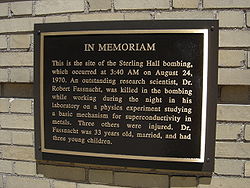
How does the Wisconsin State Journal remember the 40 year anniversary of a radical Ayers-like bombing on the UW-Madison campus?  By posting a little puff piece on one of the killers, of course. On August 24, 1970, Karleton Armstrong and three other men perpetrated the worst act of domestic terrorism prior to the Oklahoma City bombing, detonating a bomb-laden vehicle outside of Sterling Hall , causing extensive damage to 26 buildings, costing $2.1 million in property damage, injuring three, and killing graduate student Robert Fassnacht, a 33-year-old husband and father of three children. The contrast between an editorial published in the Journal 40 years ago, and the profile of the bombers published this past week, may serve as a case study in how the liberal media has transformed their coverage of domestic terrorists. Shortly after the attack, a Journal editorial ran hammering down their take on the matter.  According to the book, 50 Wisconsin Crimes of the Century , the Wisconsin State Journal called for officials to stop taking a neutral stance on student unrest: “They’ve been playing with murder for years.  Now they’ve achieved it…  The blood is on the hands of anyone who has encouraged them, anyone who has talked recklessly of ‘revolution’, anyone who has chided with mild disparagement the violence of extremists while hinting that the cause is right all the same.” Last week however, that same Wisconsin State Journal did a retrospective piece ( h/t Michelle Malkin ), profiling each of the bombers and how they were linked to such a tragic moment in history.  The profile on Karleton Armstrong strikes a surprisingly pacifist tone: “From his juice stand on Library Mall, Karleton Armstrong will hand you a strawberry smoothie and you might never know he was responsible for bombing Sterling Hall 40 years ago.  For the past 30 years, he has lived in Madison as a respectable businessman, the proprietor of Loose Juice, and before that, the popular sandwich shop Radical Rye.” The piece also includes a glowing statement from a friend of Armstrong: “Think of someone coming out of Waupun (prison) for such a major crime and deciding to live right in the cauldron where his family is, and remaking his life in such an admirable way.” If you can, please withhold your admiration for a man who also tried to detonate explosives by dropping them from a plane over an Army ammunition plant in 1969, a man who tried to plant explosives at an electric substation at that same plant, and a man who committed acts of arson on an ROTC facility and a Secret Service facility, and save it for the family man who did nothing more than go to work that fateful night in 1970, when others made a decision that took his life. Forgive and forget though, right Wisconsin State Journal?  The problem is that Armstrong hasn’t exactly expressed remorse for his actions.  Despite the new article claiming that he refuses interviews out of respect for the wife of the man that was murdered, this AP video shows that Armstrong is indeed talking, and that he still considers the bombing to have been ‘the right thing to do.’  In fact, he proudly declares how people come up to him at his juice stand saying, ‘Karl, so glad to meet you, and you really did the right thing.’ The editorial that ran four decades ago warns the University that, “If a great University is to redeem itself – if it is to survive as a proud and free institution – It no longer can take refuge in detached neutrality.” The Wisconsin State Journal would be wise to heed their own advice. Cross-posted at The Mental Recession .

Read the rest here:
Wisconsin Newspaper Does Puff Piece on Ayers-Like Domestic Terrorist

George Will Schools Robert Reich On Deficit Spending, FDR and Herbert Hoover

George Will on Sunday gave Robert Reich a much-needed history lesson about deficit spending and liberal myths concerning Franklin Delano Roosevelt and Herbert Hoover. As the Roundtable segment on ABC’s “This Week” moved to the current state of the economy, Reich predictably called for another stimulus package.  “You can’t even talk about stimulus because people say, ‘Oh, that would create a deficit and that would generate inflation,'” declared one of the Left’s favorite economists. Fortunately for those actually interested in facts, Will was there to offer viewers the truth (video follows with partial transcript and commentary):   ROBERT REICH: It’s not the summer of recovery. It’s the summer of our discontent. We are, by many measures, heading into a double-dip. But the fact is many Americans have not even gotten out of the first dip. And the interesting paradox here is that in this town, in Washington, you can’t talk about a second stimulus. You can’t even talk about stimulus because people say, “Oh, that would create a deficit and that would generate inflation.” But, in fact, the bond markets are not predicting inflation. The bond markets are worried more about deflation. The Treasury bill is now, the yield is what, something like 2.6 percent on a ten-year Treasury bill. Before we get to Will’s response, it must be noted that this so-called economic genius doesn’t know that T-bills only come in maturities of 3 months, six months, and one year. The Treasury auctions “notes” with maturities of two, five, and ten years, as well as “bonds” with a duration of 30. That Reich doesn’t know this is somewhat staggering, but I digress:  GEORGE WILL: Let’s talk about how bad it is, first of all. If, in the last five months, about 1.1 million people had not become so discouraged that is to have essentially dropped out of the job market, the real unemployment rate today, if they were still counted, would be 10.4 percent. So, too much use of the word Nazi, too much use of the world Herbert Hoover, my friend. You’re the one who’s consistently saying that the town today is full of people like Herbert Hoover who don’t want to spend money. REICH: Herbert Hoover is being exhumed, George. WILL: Let me tell you, Bob, per capita federal expenditures between 1929 when the stock market crashed and ’32 when Hoover had his last full year in office doubled. He was, he responded to the coming recession with a gusher of federal spending. It didn’t do a lick of good. In fairness, Will was exaggerating just a tad. Here are the real numbers according to a marvelous report on this subject from the Cato Institute: From 1929 to 1933, under President Hoover’s administration, real per capita federal expenditures (graphed in Figure 1), increased by 88 percent.   So, Will was a little aggressive. However, his point was still spectacular:   REICH: He didn’t, by the way, by the way, we can debate history, but by 1932, 1933, the major issue and major proposal on the table coming from Andrew Millen, his Secretary of the Treasury, was balancing the budget. And all we heard… WILL: In Forbes Field in Pittsburgh in a famous speech, FDR pledged to balance the budget. REICH: Yes, FDR was, was, he was also a deficit hawk. Well, he was a deficit hawk during his first presidential campaign, Bob. Democrats love to promise fiscal discipline while on the stump only to go back on such promises after they’re elected.  As Newsweek’s Jonathan Alter noted in his book “The Defining Moment: FDR’s Hundred Days and the Triumph of Hope” (page 131): At Pittsburgh’s Forbes Field in October [1932], FDR bid to neutralize the old guard fiscal conservatives. He blasted Hoover for “reckless and extravagant spending” in increasing government outlays by 50 percent, and for waiting too long before raising taxes to help balance the budget.  As such, quite contrary to the modern liberal myth that Hoover was a deficit hawk that was too tight on spending after the Depression began, he was actually blasted by candidate Roosevelt for being too loose with federal coffers. This is supported by the previously mentioned Cato report: Under President Roosevelt’s administration from 1933 to 1940, just before World War II, [real per capita federal spending] increased by only 74 percent [compared to Hoover’s 88 percent]. Although Hoover started from a lower base, in percentage terms expenditures under Hoover increased more in four years than during the next seven New Deal years.  As such, contrary to what liberals like Reich suggest, Hoover was actually a more profligate spender than Roosevelt. Of course, more importantly as Will noted, none of this spending did a lick to solve the Great Depression, for the economy only fully recovered as our nation geared up for World War II. With this in mind, Reich really ought to be more careful when he makes historical statements with George Will sitting next to him. On the other hand, it’s far more entertaining to see him get schooled this way on national television. 

Here is the original post:
George Will Schools Robert Reich On Deficit Spending, FDR and Herbert Hoover