Tag Archives: Breaking News

CBS’s Couric Dutifully Parrots Left-wing Center for American Progress Study

“The last day of school shouldn’t mean last call for lunch.” That’s how CBS’s Katie Couric melodramatically concluded her June 25 “Notebook” item on her CBSNews.com Couric & Co. blog. The “Evening News” anchor pointed to a report by the liberal Center for American Progress — without, of course, noting the group’s leftward bent — that found “that nearly 20 million children get free or reduced-price lunch at school. But only one in six of them will receive subsidized meals this summer.” Couric concluded from this that “[n]early one in four children is at risk for hunger” over the summer and called “essential” a bill before Congress to “improve access to summer meals.” Of course nowhere in her Notebook item did Couric weigh whether this might be a matter better left to state and local governments — especially when the federal government is drowning in red ink — or better yet, to parents themselves. After all, schools provide lunches and breakfasts during the school year for the sake of convenience of students and their parents, not because government has the moral responsibility to feed children. That’s obviously the job of parents and their failure to adequately do so is grounds for the involvement of local child protective services. Parental responsibility and restrained spending of taxpayer dollars are not high on Couric’s list of concerns, apparently. That’s a page from my notebook. 

See the article here:
CBS’s Couric Dutifully Parrots Left-wing Center for American Progress Study

Time’s Scherer Gratuitously Blogs About ‘Ten People Killed by Guns’ in Light of Supreme Court Ruling

Reacting to colleague Alex Altman’s brief, just-the-facts-styled Swampland blog post “SCOTUS Solidifies Gun Rights,” Time’s Michael Scherer responded a few hours later with the following post : Meanwhile, in Chicago, the source of the lawsuit decided today by the Supreme Court, ten people were killed by guns after 54 people were shot over the weekend. The victims included a baby girl, who suffered a neck graze wound at a midnight barbecue, early Monday morning. To read all the details, the Sun Times has the story . Something tells me Scherer’s observation isn’t that the Chicago gun ban has been a horrendous failure, especially given his attribution of violence in the brief blog post on the guns themselves — “ten people were killed by guns” — not the criminals who used them.

Read the original post:
Time’s Scherer Gratuitously Blogs About ‘Ten People Killed by Guns’ in Light of Supreme Court Ruling

Democrats and Double Standards at the NYT: ‘Respected Voice’ Robert Byrd vs. ‘Foe of Integration’ Strom Thurmond

The New York Times marked the death early Monday morning of veteran Democratic Sen. Robert Byrd of West Virginia, who served a record 51 years in the U.S. Senate, with an online obituary by former Times reporter Adam Clymer. While acknowledging Byrd’s Klan past and his pork-barrel prodigiousness, Clymer’s lead also emphasized Byrd’s proud fight as the keeper of Congressional prerogatives. The obituary headline was hagiographic: ” Robert Byrd, Respected Voice of the Senate, Dies at 92 .” While Clymer’s opening statement on Byrd wasn’t exactly laudatory, it did not match the paper’s hostile treatment of the passing of two veteran Republican senators accused of racial prejudice: Sen. Strom Thurmond of South Carolina and Sen. Jesse Helms of North Carolina. Clymer’s lead paragraph: Robert C. Byrd, who used his record tenure as a United States senator to fight for the primacy of the legislative branch of government and to build a modern West Virginia with vast amounts of federal money, died at about 3 a.m. Monday, his office said. He was 92. The bulk of Clymer’s obituary for Byrd may have been written some time ago, as is customary. Clymer retired from the Times in 2003, after a career of bashing President Bush and prominent conservatives , while defending old-guard Democrats like Sen. Ted Kennedy. Clymer acknowledged what he called Byrd’s changing perspective, moving from conservative to liberal over the years, and in the 16th paragraph brought up Byrd’s membership in the Ku Klux Klan in the 1940s and his filibuster of the 1964 Civil Rights Act. Mr. Byrd’s perspective on the world changed over the years. He filibustered against the 1964 Civil Rights Act and supported the Vietnam War only to come to back civil rights measures and criticize the Iraq war. Rating his voting record in 1964, Americans for Democratic Action, the liberal lobbying group, found that his views and the organization’s were aligned only 16 percent of the time. In 2005, he got an A.D.A. rating of 95. Mr. Byrd’s political life could be traced to his early involvement with the Ku Klux Klan, an association that almost thwarted his career and clouded it intermittently for years afterward. …. Mr. Byrd insisted that his klavern had never conducted white-supremacist marches or engaged in racial violence. He said in his autobiography that he had joined the Klan because he shared its anti-Communist creed and wanted to be associated with the leading people in his part of West Virginia. He conceded, however, that he also “reflected the fears and prejudices” of the time. After noting criticism from watchdog groups over Byrd’s reputation as the “king of pork,” Clymer followed up: West Virginians were grateful for the help. Senator John D. Rockefeller IV, Democrat of West Virginia and the state’s junior senator since 1985, said Mr. Byrd had meant “everything, everything” to the state. Mr. Byrd knew, he said, that “before you can make life better, you have to have a road to get in there, and you have to have a sewerage system and all those things, and he has done that for most of the state.” Bob Wise, a Democrat who was West Virginia’s governor from 2001 to 2005, once said that what Mr. Byrd had done for education — “the emphasis on reading and literacy” — mattered even more than roads. And Clymer’s dubious observation that Byrd “was never a particularly partisan Democrat” would surprise many familiar with Byrd’s non-stop excoriation of Bush over the Iraq War. Byrd authored a 2004 book titled “Losing America: Confronting a Reckless and Arrogant Presidency.” Clymer mentions the book but leaves off the provocative subtitle, simply calling it “Losing America.” He was never a particularly partisan Democrat . President Richard M. Nixon briefly considered him for a Supreme Court appointment. Mr. Dole recalled an occasion when Mr. Byrd gave him advice on a difficult parliamentary question; the help enabled Mr. Dole to overcome Mr. Byrd on a particular bill. In contrast is the Times’s treatment of veteran Republican Sen. Jesse Helms of North Carolina, who died on Independence Day 2008. The headline: ” Jesse Helms, Unyielding Beacon of Conservatism, Is Dead at 86 .” Steven Holmes’s obituary for Helms began: Jesse Helms, the former North Carolina senator whose courtly manner and mossy drawl barely masked a hard-edged conservatism that opposed civil rights, gay rights, foreign aid and modern art, died early Friday. He was 86. Clymer’s Byrd obituary didn’t mention that Byrd, like Helms, voted on a measure to bar the National Endowment for the Arts of funding “obscene” or “indecent” work. Clymer also wrote the obituary for centennial Republican Sen. Strom Thurmond, who died on June 26, 2003. Like Byrd, Thurmond was a former segregationist (he made his mark as the States’ Rights Candidate in 1948 and became a Republican in 1964) who later reconciled with blacks and became proficient in earning pork for his state. The Times’s headline the following day left no room for doubt: ” Strom Thurmond, Foe of Integration, Dies at 100 ,” although Clymer’s lead sentence didn’t mention race. (Hat tip Mark Finkelstein of NewsBusters .)

See the article here:
Democrats and Double Standards at the NYT: ‘Respected Voice’ Robert Byrd vs. ‘Foe of Integration’ Strom Thurmond

Robert Redford: Obama Should Use Gulf Spill to Push ‘Decent Energy Policy’

Robert Redford, one of the most popular and succesful actors of our age, has joined with other entertainers, including Sir Paul McCartney and Rosie O’Donnell in encouraging the Obama administration to actively politicize the Gulf crisis and use it to push through on energy policy. In an interview with ExtraTV, Redford said that Obama should “Grab this moment in history and get a decent energy policy.” He also said “Here’s a moment in our history where he [Obama] should grab leadership and run with it.” He said that “We blew it in the late seventies,” referring to laws like the National Energy Act, National Energy Conservation Policy Act and the Energy Policy and Conservation Act made in the wake of the OPEC embargo and the Three Mile Island nuclear disaster. Redford has long combined his interest in liberal and environmentalist politics with his career as an actor and film maker, producing The Motorcycle Diaries, based on the memoir by Che Guevara and contributing money to Democratic candidates 58 percent of the time. He added that the government needs to start planning for the end of oil and sustainable energy now. Apparently, the failure of the plans from the 70’s does not phase his faith in the ability of the government to plan energy policy. He did say that BP is responsible for the spill and the government needs to make them pay. Meanwhile, unlike McCartney, O’Donnell and Redford who urge political action, Kevin Costner has funded the development of machines which can aid tremendously in the clean up, using centrifuges to separate up to 99 percent of oil from water, despite prohibitive federal regulations preventing them from being developed. Costner has contributed money to Al Gore’s past campaigns and campaigned for Obama in Colorado. At least one celebrity is doing something useful regarding the spill.

Excerpt from:
Robert Redford: Obama Should Use Gulf Spill to Push ‘Decent Energy Policy’

David Weigel Affair Reveals Just How Isolated Media Left Is from Conservatives

One emerging narrative from the tale of Dave Weigel’s resignation is the extent to which the journalistic left is insulated from opposing views. The two institutions involved, JournoList and the Washington Post, are exemplars of liberal epistemic closure . Ezra Klein’s now-defunct email list provided a forum for journalists to collaborate, as long as they were, in his words , “nonpartisan to liberal, center to left.” No conservatives allowed. The Washington Post, meanwhile, hired Weigel, perhaps two notches left of center, to cover the right, while relying on Klein, a full eight notches left, to cover the liberal movement. The scarcity of conservative views both on JournoList and in the Post demonstrate the insularity of political conversation among legacy media players. They apply intense scrutiny to conservatives, and fail in the most basic measures of introspection. That is one element of the whole situation that Weigel’s defenders seem to be missing: the issue is not his personal political views, per se, but rather the Post’s failure to provide balance in its blog-based political coverage. There is nothing inherently wrong with assigning someone hostile to certain views to cover a movement espousing those views. Indeed, that can be a very healthy way to challenge preconceived notions and political orthodoxy where it otherwise would be taken for granted. As Byron York wrote at the Washington Examiner’s Beltway Confidential blog, There’s little doubt that the most interesting coverage of events on the left and right generally comes from journalists on the other side. Much of the time, the right sees things happening on the left, and connects them, in a way that the left doesn’t see, and the left sees things happening on the right, and connects them, in a way that the right doesn’t see. In opinion journalism, it’s a good thing to have each side examining the other. The Post doesn’t seem to understand that, even though it has jumped into opinion journalism with both feet. The paper hired a bunch of people from the left-wing blogosphere — Ezra Klein, Greg Sargent, Garance Franke-Ruta, and, for a short time, Weigel — who often write about the right, even though Weigel was the only one specifically assigned to it. But they haven’t hired any conservative to write about the left. It’s the worst kind of one-sidedness. Sure, Weigel could arguably serve a valuable journalistic function by scrutinizing the right more, perhaps, than a conservative would. But the Post did not do the same for the left. Klein is a rank and file liberal. So if the rationale for Weigel’s employment was that it is healthy to assign political reporters to cover movements they do not agree with or belong to, perhaps the Post should re-hire Weigel, fire Klein, and replace the latter with someone who is demonstrably hostile to, or at the very least openly skeptical of, the political left. Klein himself seems not to realize just how insular his own political conversations are. In his post-Weigel-resignation piece on his WaPo blog (linked above), he wrote that JournoList was meant to be An insulated space where the lure of a smart, ongoing conversation would encourage journalists, policy experts and assorted other observers to share their insights with one another. The eventual irony of the list was that it came to be viewed as a secretive conspiracy, when in fact it was always a fractious and freewheeling conversation meant to open the closed relationship between a reporter and his source to a wider audience. Klein extrapolates a “secretive conspiracy” from what is really just a secretive conversation among the center-left. No one is claiming a conspiracy – the use of the term is probably meant to discredit those skeptical of a forum where liberal journalists collaborate on the latest stories. That Klein calls JournoList “a fractious and freewheeling conversation” demonstrates his epistemic closure. He considers “fractious and freewheeling” a conversation that necessarily included nobody that openly espoused a conservative position as his or her own. Klein openly discusses his decision to exclude conservatives from the list, precisely so it would not devolve into a “debate society.” Could there have been significant disagreement among even the liberal members of JournoList? Undoubtedly there was. But Klein made a concerted effort to exclude conservative voices. How can such a list possibly claim to be adequately informing its members on the political goings on of the nation while excluding and entire school of American political thought? Media liberals seems to be trotting happily down this path of epistemic closure. Reporters continue to cover the right, as NewsBusters contributor Dan Gainor put it in discussing Weigel, as if they were “visiting a zoo.” Or, as New York Times editor Bill Kellor put it, “We wanted to understand them.” Yes, who are these strange creatures who call themselves conservatives?

Read more here:
David Weigel Affair Reveals Just How Isolated Media Left Is from Conservatives

Networks Defend ‘Consensus Builder’ Kagan; Downplay Military Recruiter Ban

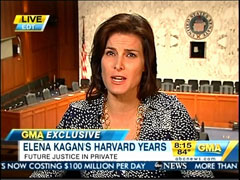
The Monday morning shows on CBS, ABC, and NBC all worked to portray President Obama’s Supreme Court nominee Elena Kagan as a moderate and open-minded legal scholar, downplaying her liberal views. All three network programs also minimized her controversial decision to ban military recruiters on campus while Dean of Harvard Law School. On CBS’s Early Show, legal correspondent Jan Crawford touted Kagan as “an intellectual heavyweight and consensus builder.” Crawford noted how Republicans had “several lines of attack” against Kagan and would “try to paint her as a liberal activist.” Crawford herself recently described Kagan as having “stood shoulder to shoulder with the liberal left.” On ABC’s Good Morning America, correspondent Claire Shipman did a fawning segment on Kagan in the 8AM ET hour, describing the former Dean as “intellectual” and “full of personal charm” during her tenure at Harvard. Shipman claimed that Kagan had “a determination to be open-minded,” despite banning military recruiters from the university’s campus over the ‘Don’t Ask, Don’t Tell’ policy. On that issue, Shipman explained that despite Kagan’s decision being unpopular “among student military vets…. Iraq War veteran Kurt White says they were won over by Kagan’s persistent outreach , another example of her political skills.” Shipman failed to mention that White would be testifying on Kagan’s behalf during the confirmation hearings. Shipman went so far to portray Kagan as open-minded that she touted how “though her political views are quite different than his, she honored conservative justice Antonin Scalia at the law school a few years ago, calling him a great justice.” Shipman even argued: ” It’s an openness to all voices that worries some liberals, but colleagues argue Kagan’s style is just what the Court needs.” NBC’s Today did not provide quite as strong a defense of Kagan, but a report by legal correspondent Pete Williams did feature a soundbite from Kagan supporter and SCOTUS blog founder Tom Goldstein declaring: “Elena Kagan isn’t a political partisan.” Williams, like Shipman, attempted to downplay the military recruiter ban: “Republicans also accuse Kagan of treating the military unfairly when she was dean of Harvard Law….But student military veterans say she made them feel welcome at Harvard and praised them for their service, even though she strongly opposed the policy on gays in the military.”   Here is a full transcript of Shipman’s June 28 segment on Good Morning America: 8:15AM GEORGE STEPHANOPOULOS: Supreme Court nominee Elena Kagan is preparing to take the stand for Senate confirmation hearings this afternoon, and they’re meant to tease out the nominee’s judicial philosophy. Well for some clues, Claire Shipman talked to some people who knew Kagan during the most substantial legal job of her career, the first woman dean of Harvard Law School. CLAIRE SHIPMAN, ABC correspondent: Good morning, George, well that’s right. We decided to look for clues at Harvard Law School where she had a very distinctive style. She was only there for six years, made a large number of changes. She was intellectual, yes, but also full of personal charm, say colleagues, and a determination to be open-minded. It’s an institution usually resistant to change, some might say an immovable object, until it was confronted with the irresistible force of Dean Elena Kagan. ELENA KAGAN: This is a wonderful time, and it’s so good to be with you. LAURENCE TRIBE, Harvard Law professor: I’ve watched Harvard Law School go through lots of transitions, but there has never been anything like Elena Kagan. MARTHA MINOW, Harvard Law dean: She was going to turn over every stone at this institution and figure out a way to make it better. SHIPMAN: She thinks big. MINOW: She thinks big. SHIPMAN: But she was savvy enough at times to start small, offering perks like free coffee for students. Then bigger battles, fighting to hire more conservative professors like John Manning.   JOHN MANNING, Harvard Law professor: She felt that her job as dean was to foster an atmosphere in which all sorts of ideas would be presented. SHIPMAN: And selling a total curriculum overhaul, the first in a hundred years. KAGAN: For the most part, a first year curriculum now looks like what it looks like back in 1880. SHIPMAN: Some say her meteoric rise is impressive, but also suggests a calculating careerism. Two of her best friends, roommates at law school, say she’s just always just reveled in the work. JOHN BARRETT, friend of Kagan: A visual that I have, a memory, is her sitting at her desk with a cigarette and a pen and a book and a little desk lamp, and she could kind of grind it out for a long time. UNIDENTIFIED FRIEND OF KAGAN: I think what was clear was that she really loved the law, and reading about it, and thinking about it, and talking about it. SHIPMAN: Her time as dean wasn’t without controversy. She decided to renew a ban keeping military recruiters from using the career services office because of opposition to the “Don’t Ask, Don’t Tell” policy. Support was high on campus, but not among student military vets. KURT WHITE, Harvard Law student: It didn’t seem like banning military recruiters from the law school campus was going to be something that was likely to lead to a change in this law. SHIPMAN: Still, Iraq War veteran Kurt White says they were won over by Kagan’s persistent outreach, another example of her political skills. WHITE: It was really her showing her appreciation for the military and being very supportive of us. SHIPMAN: And though her political views are quite different than his, she honored conservative justice Antonin Scalia at the law school a few years ago, calling him a great justice. MANNING: She as dean was able to recognize his accomplishments and celebrate them without reservation. SHIPMAN: It’s an openness to all voices that worries some liberals, but colleagues argue Kagan’s style is just what the Court needs. TRIBE: I think that her ability to find common ground, bring people along, see long-term implications, will make a very large impact on the Court. SHIPMAN: It’s certainly a good place to start hearings as a potential liberal justice when you have the support of a conservative justice, like justice Scalia. George, but of course the hearings will still be heated, they’ll look at that military recruitment issue, and also try to pin her down specifically on how she might rule on some controversial issues. STEPHANOPOULOS: That’s right, and in an election year, likely to get a lot of no votes as well. Okay Claire Shipman, thanks very much.
Read more from the original source:
Networks Defend ‘Consensus Builder’ Kagan; Downplay Military Recruiter Ban

Open Thread: Corruption in Afghanistan Complicates US Mission

“Above a certain level, people are being very well protected,” one “senior U.S. official” told the Washington Post . Corruption and bad governance pose two of the largest problems for the American presence there. According to the Post, Top officials in President Hamid Karzai’s government have repeatedly derailed corruption investigations of politically connected Afghans, according to U.S. officials who have provided Afghanistan’s authorities with wiretapping technology and other assistance in efforts to crack down on endemic graft. In recent months, the U.S. officials said, Afghan prosecutors and investigators have been ordered to cross names off case files, prevent senior officials from being placed under arrest and disregard evidence against executives of a major financial firm suspected of helping the nation’s elite move millions of dollars overseas… For the Obama administration, the ability of Afghan investigators to crack down on corruption is crucial. If American voters see Karzai’s government as hopelessly corrupt, public support for the war could plunge. Corruption also fuels the Taliban insurgency and complicates efforts to persuade ordinary Afghans to side with leaders in Kabul.  What affect will or should this corruption have on the domestic policy debate over the Afghan war? Does it bolster arguments that the US needs to maintain a strong presence there, or those that contend the US cannot take the lead in securing the nation?

Original post:
Open Thread: Corruption in Afghanistan Complicates US Mission

Barnicle Can’t Bring Himself To Mention Byrd’s Klan Past

When Republican Sen. Strom Thurmond died, the MSM was quick to stress his segregationist past. The New York Times ran the headline ” Strom Thurmond, Foe of Integration, Dies at 100 ,” leaving readers to imagine the South Carolinian had remained an advocate of segregation.  The very first line of USA Today’s story described Thurmond as “the nation’s most prominent segregationist.”   Strange how the MSM can suddenly become reticent about mentioning someone’s segregationist past when the late politician in question is a Democrat.  On Morning Joe today, Mark Halperin and Mike Barnicle used elliptical language worthy of a State Department dispatch to avoid mentioning that Byrd had been a member and leader of the Ku Klux Klan. H/t NB reader Ray R. View video here . MARK HALPERIN: A lot’s happened in America and the world and he was an eyewitness to it, spanning a lot of generations not just as a witness but as a participant.  Early in his career a much different man than he ended his career and his life. . . . . MIKE BARNICLE: He was a very interesting man whose life covered so many events, 1958–elected to the Senate.  But I mean, just the transformation in Robert Byrd over the years , it was very interesting to watch.  I know, I’m sure you do Mark, I’m sure you do Joe, know people in public life, United States Senators, who had, you know, some objections to some of Sen. Byrd’s views years ago and saw him grow into his role as he served “You know, some objections to some of Sen. Byrd’s views.”  Right. Like this one.   But of course Mike is a man of such delicate sensibilities that he would never mention just what he had in mind—at least when the recently departed is a Dem.

The rest is here:
Barnicle Can’t Bring Himself To Mention Byrd’s Klan Past

WaPo Applauds Obama for Not Choosing ‘Outspoken Liberals’ for Supreme Court

On the day confirmation hearings begin for Obama Supreme Court nominee Elena Kagan, The Washington Post stresses on the front page that Kagan has been an “elusive GOP target.” The Post website summarized: “Republicans have struggled to find a compelling line of attack to take against the Supreme Court nominee. But their efforts have largely failed.” When Republicans nominate a Supreme Court justice, it’s the liberal media that aids their favorite activists in creating “compelling lines of attack.” But when Democrats do it, the journalists not only skip over the attacks, they also praise the Democrats for their political skills. Post reporters Anne Kornblut and Paul Kane suggested that the oil spill and the McChrystal hubbub have pushed Kagan out of attention, but also lauded the “skilled operatives” of Team Obama:   But it is also a measure of how skilled operatives have become at managing the process — and choosing nominees who are notable in part for their political blandness….  In part, the attention has been muted because Obama has not chosen outspoken liberals in either of his first two opportunities to influence the makeup of the court. Kagan, who would replace Justice John Paul Stevens, would not tilt the court’s ideological balance. So the stakes are lower than if she had been picked to replace a conservative, participants on both sides said. She is also an especially elusive target: a politically savvy operator who has no record of judicial rulings and has spent much of her career carefully positioning herself for the next step. Who else is elusive to the Post? Conservative activists, who are nowhere to be found in the Kornblut-Kane story — unlike a liberal lobbyist for People for the American Way. (Sen. Jeff Sessions is the only opposition figure quoted.) This claim, that Kagan and Sonia Sotomayor are baronesses of “blandness,” too “elusive” to be identified as liberals, is simply bizarre. To say that Sotomayor’s lobbying at left-wing Latino organizations or Kagan’s clerking for ultraliberal Justice Thurgood Marshall isn’t identifiably liberal is counter-factual. For contrast, please see The Washington Post’s front page story on Bush Supreme Court nominee Samuel Alito on the first day of his confirmation hearings on January 9, 2006. He was a staunch Reaganite. The story relentlessly repeated how conservative he was. “Blandness” was not on the menu. Reporters Jo Becker and Dale Russakoff began:  The captains of the Reagan revolution at the Justice Department had two big concerns about a bookish new recruit named Samuel A. Alito Jr., who arrived in 1981: his blank slate as a conservative activist and his pedigree from a perceived bastion of legal liberalism. “I wouldn’t let most people from Yale Law School wash my car, let alone write my briefs,” said Michael A. Carvin, a political deputy at the department. Six years later, the revolutionaries saw Alito as one of them, tapping him to become U.S. attorney in New Jersey in 1987 and eventually, they hoped, a judge. Speaking on a New Jersey public affairs television program, the young prosecutor showcased the philosophy that had won the confidence of his Washington mentors. Asked his opinion of President Ronald Reagan’s nomination of Robert H. Bork to the Supreme Court, Alito gave a ringing defense of the conservative icon he said had been “unjustifiably rejected” by the Senate in one of the most ideologically polarizing nomination battles in decades. There weren’t any professional liberal activists in the piece — other than the Post reporters themselves.

More here:
WaPo Applauds Obama for Not Choosing ‘Outspoken Liberals’ for Supreme Court

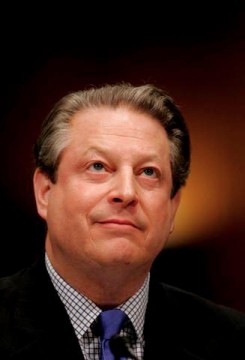
Al Gore’s Current TV Is Struggling

Andrew Wallenstein at The Hollywood Reporter  suggests more than Al Gore’s marriage is crumbling. Gore’s cable channel Current TV is facing a dramatic makeover with an injection of MTV executives. Wallenstein tried to sugarcoat the inconvenient truths: For all the brilliance he has displayed grasping the meteorological dynamics governing the globe, Gore has miscalculated those of a slightly less complex world: the TV business. The radical ambitions he brought to the environment didn’t pan out the same way in cable; the television will not be revolutionized. Gore tried to sell off Current to his Google pals for half a billion dollars, but that didn’t take. So they’re taking the content away from small-d democracy and toward the persistent formula of other youth-culture channels, loaded with young-skewing documentaries and “reality” TV: For much of the past year, Current TV has been quietly undergoing an overhaul that will change just about everything but the struggling channel’s name. Current declined comment for this story. It’s a revitalization project Gore & Co. embarked on after exhausting a more lucrative possibility: selling the channel. Current’s founding partner, Joel Hyatt, spent much of 2009 shopping the network with a price tag that wildly overestimated the company’s worth, confirmed sources at several conglomerates. Current even had extensive sale talks as far back as 2007 with Google, where Gore serves as a senior advisor. Now the focus has shifted to fixing Current, perhaps with an eye toward a sale down the road. Last July, Hyatt was replaced as CEO by Mark Rosenthal, the former MTV Networks COO who is rebuilding the channel in the traditional mold Gore avowed to avoid, only to suffer the consequences. Rosenthal has brought in a crew of colleagues from his MTVN days including an unlikely ringer: Brian Graden, the programming genius who masterminded hit series from “South Park” to “The Osbournes,” before leaving last year. He’s on retainer as a consultant. Graden helped found the gay channel Logo and expressed joy last year at bringing documentaries to MTV with titles like “I’m Changing My Sex” and “I Work In the Sex Industry.” So here’s where the format change comes in: Forget bite-sized clips created by anonymous viewers; the new Current will consist of full-length series from the usual suspects in unscripted production who are getting the word that Current is open for business…. Several senior MTVN colleagues were brought in as consultants to engineer the turnaround including Hank Close, formerly president of ad sales. Several more key full-time hires have been made as well. But original programming is at the heart of any successful cable network, and for that he’s turned to Graden, who’s known for his knack for hits. Graden and Current make for an unusual combination. A network that has devoted significant time to serious topics ranging from AIDS in Africa to New Age spirituality is in the hands of Graden, who didn’t exactly win Peabodys for shows often criticized for corrupting America’s youth. Graden did not respond to an email seeking comment. The MTV infusion at Current is ironic considering the channel is essentially facing the same fundamental problem MTV confronted so successfully in the 1990s: a TV schedule comprised of multi-minute clips is far less advertising-friendly than the half-hours that ensure viewer tune-in isn’t so erratic. In other words, MTV “so successfully in the 1990s” dumped all the music videos in favor of “The Real World” ad infinitum, et cetera. [HT: Dan Isett]

The rest is here:
Al Gore’s Current TV Is Struggling