The world of professional soccer football futball sports is about to get far less handsome. David Beckham has announced that he is retiring at the end of this season. “I’m thankful to PSG for giving me the opportunity to continue but I feel now is the right time to finish my career, playing at the highest level,” Beckham said in a statement. The Paris Saint-Germain midfielder has also played for Manchester United, Real Madrid and the Los Angeles Galaxy, winning league titles in four countries overall. “If you had told me as a young boy I would have played for and won trophies with my boyhood club Manchester United, proudly captained and played for my country over one hundred times and lined up for some of the biggest clubs in the world, I would have told you it was a fantasy. I’m fortunate to have realized those dreams,” Beckham said. Beckham owns the British record for making 115 appearances with the national team. It’s unclear exactly what he’ll do when his playing days are done, but it’s safe to assume more David Beckham underwear ads are on the way. Concluded the attractive baller: “I want to thank all my teammates, the great managers that I had the pleasure of learning from. I also want to thank the fans who have all supported me and given me the strength to succeed.”
Dzhokhar Tsarnaev has a growing fan base on Tumblr apparently. Up until last week, “One Direction Infection” was a Tumblr blog created and maintained by an eighth grader devoted to the British boy band heart throbs. Now, it’s devoted to the Boston Marathon bombing suspect. Jahar, as Dzhokhar Tsarnaev’s friends and Twitter followers call him, has amassed a pretty huge following for a man charged with terrorism and WMD use . He has his own hashtag, #FreeJahar, on Twitter, while thousands of Tumblr and Facebook fans closely follow his case and discuss his “innocence.” Beyond the boilerplate Boston bombing conspiracy theories that claim he’s the fall guy or the whole thing is a hoax, there are other reasons for his appeal. “I do believe he is very cute, but that’s not the reason I’m involved in this movement,” the aforementioned 1D turned Free Jahar Tumblr owner told Gawker . “I am in this because I don’t believe its right to put a totally innocent person in jail for the rest of his/her life or even death penalty. I don’t care who it is, it just isn’t fair.” By any measure, #FreeJahar is a bizarre expansion of “fandom” culture – rabid communities of admirers, usually young women, that organize themselves online. Exchanging photos, fan art and writing, their near-undefinable flood of emotion and desire is palpable. In this case, it can also be political and viral. For the most part, #FreeJahar believers’ Tumblr pages are image-heavy and mock the “perception” of Dzhokhar Tsarnaev as a terrorist or criminal. They are conspiratorial (“If you believe the official story regarding Boston, I don’t know what to tell you”), yet, in the majority of cases, blatantly juvenile. It’s hard to tell exactly how many people believe in Tsarnaev’s innocence, or how strongly. But there’s no doubt that the “movement” is growing fast. On Tumblr, there are a dozen or so dedicated #FreeJahar blogs, and scores of allies and sympathizers who “like” and “reblog” their posts loyally. On Twitter, Tsarnaev’s friends, many of whom have embraced #FreeJahar, have thousands of followers, while pro-Jahar Facebook pages are heavily “Liked.” It’s hard to say what possesses someone to become involved in such activity, but the Jahar loyalists aren’t alone. James Holmes has online fans too. Seriously.
The deaths keep coming in the red-band trailer for Eli Roth ‘s earthquake gorefest Aftershock . I count seven distinct deaths in this clip, which is just shy of two minutes, but with all the lootin’ and a stabbin’ going on in the background, I’m clearly being conservative. Roth gets to preside over his own frightfest, too. He’s front and center in this video as Gringo, a sensitive-sounding guy who just wants to meet a nice girl at an underground Chilean disco. Alas, as the old Nazareth song goes, ” Love Hurts .” Here’s my tally of the grisly deaths (and one amputation) that take place in the trailer. I left out the very last scene because, no matter how bad things look, it’s no fait accompli. *Death by nightclub speaker *Death by cement pillar *Amputation by falling shelving unit *Death by immolation *Death by falling concrete slab *Death by Ax *Decapitation by speeding truck Can anyone out there tell me whether that large crucifix that falls over in the movie has an actual human body nailed to it? I’ve paused it a few times, and I think it’s just a life-size facsimile of Jesus, but I’m not entirely sure. That would up the body count to eight. If The Earthquake Doesn’t Kill You… Follow Frank DiGiacomo on Twitter. Follow Movieline on Twitter.
It’s hard to reconcile, considering the degree to which adolescents now dominate popular culture, but the idea of the teenager is a uniquely 20th-century invention, born out of advances in psychological theory, changes in child-labor laws and a boom in leisure-time activities for the under-20 set. A feat of both editing and blurring-of-the-edges nonfiction technique, Matt Wolf ’s mesmerizing, scrapbook-style Teenage conveys the transition in how the world perceived this emerging in-between stage via a series of first-person portraits of exceptional individuals set amid a whirlwind of vintage footage. Ironically, the demo in question seems least likely to appreciate the pic’s arty, innovative approach. The conventional thinking goes that until roughly World War II, society and scientists alike thought of life as two distinct stages, divided between children and adults. The former were patronized and sheltered up to a certain point, then shuffled off to work in factories at a young age. In the introduction to his paradigm-shifting book, Teenage: The Creation of Youth Culture , Jon Savage , who collaborated with Wolf on this film, reveals that his initial research into the subject began as background for a possible television series, suggesting that he always intended a multimedia approach to the topic. Eschewing the traditional TV documentary style, Wolf innovates a radically different format for the material, blending archival artifacts with invented elements to create an intimate, far more personal history of the emerging demographic across the four decades between 1904 and 1945, when Elliot E. Cohen published his young person’s manifesto, “ A Teen-Age Bill of Rights ,” in the New York Times . Though much of the footage has a stock newsreel feel, Teenage is clearly intended to suggest a home movie record of its era. To that end, Wolf interweaves staged, retro-styled scenes of various characters to foster the illusion of a candid look at various youthful cliques of the time, ranging from London’s Bright Young People to the anti-Hitler “Edelweiss Pirates.” Pic’s most obvious innovation is the absence of a dry, all-encompassing narrator, replaced by four voiceover actors hired to read excerpts from journal entries of the period (embellished with original dialogue designed to match elements from the filmmakers’ research). Jena Malone performs an early-century American girl, Ben Whishaw represents the British youth, Jessie Usher captures the unease of African-American teens and Julia Hummer plays a German fraulein whose lines were excerpted from Melita Maschmann’s chilling Nazi-era memoir, Account Rendered — each directed to sound distractingly contemporary. When combined with the vintage (or vintage-styled) visuals, these recitations produce an almost Terrence Malick -like effect, contrasting personal impressions with the more objective, journalistic imagery presented onscreen. As a work of sociological history, Teenage withholds too much context to be of use, overemphasizing the European side of what it calls “an American invention.” As a thought experiment, however, it is uniquely crafted to inspire auds to muse on how the experience of adolescence must have felt at a time cusp-of-modern moment when engaged and driven young people wanted to play a more proactive role in their world. Nearly the entire history of cinema — much of it targeted at consumers in this very age range — retroactively applies our relatively recent understanding of teenagers as a distinct developmental stage to its young characters, and Teenage suggests how famous historical and literary figures (from Marie Antoinette to Romeo and Juliet) might have actually been perceived in their time. Still, 77 minutes is hardly adequate to cover the breadth of the four decades in question, and the film alternates between elegant transitions and confusing stretches as it tries to address everything from promiscuous, free-wheeling American flappers and “victory girls” to the ultra-organized, hyper-disciplined Boy Scouts and Hitler Youth. More on Teenage : INTERVIEW: ‘Teenage’ Filmmakers Matt Wolf & Jon Savage Make A Doc That Swings Follow Movieline on Twitter.
One of my favorite busty British hotties Rhian Sugden showed off her talents for Loaded this month, and they got her to reenact Basic Instinct , which isn’t that original and is a little overplayed, but I’ll take it I guess. Still, if you’re not gonna go all the way with the reenactment, what’s the point? Everybody knows Sharon Stone didn’t become famous just for sitting cross-legged in a chair.
When it comes to busty British hotties, Holly Peers may not get as much attention as models like Lucy Pinder or Keeley Hazell , but there’s no doubt that those funbags of hers can stack up with anybody’s. In fact, I’d like to see Holly and Lucy and Keeley and all the rest of the British models get together and have a good old fashioned measuring contest. I don’t care who wins, I’d just like to see it. » view all 13 photos
When it comes to busty British hotties, Holly Peers may not get as much attention as models like Lucy Pinder or Keeley Hazell , but there’s no doubt that those funbags of hers can stack up with anybody’s. In fact, I’d like to see Holly and Lucy and Keeley and all the rest of the British models get together and have a good old fashioned measuring contest. I don’t care who wins, I’d just like to see it. » view all 13 photos
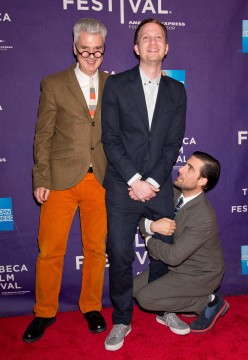
Teenage is as rebellious a film as the territory it covers. Based on punk author Jon Savage ‘s 2007 book Teenage: The Creation of Youth Culture 1875-1945 , Matt Wolf’s documentary eschews the talking heads and Chyroned dates that dominate the genre to immerse the moviegoer in a visually and aurally sumptuous history lesson. Wolf uses rare archival footage, period-piece recreations and a score by Deerhunter’s Bradford Cox to depict the evolution of teen culture via a number of influential and unconventional subcultures — swing kids, Boy Scouts, flappers, the German Wandervogel and even Nazi Youth — that coalesced from the late 19th century through the end of World War II. Understand them and today’s teens don’t seem so mystifying. I sat down with Wolf (he’s in the center of photo at left), Savage (he’s the one wearing orange pants) and the movie’s executive producer, actor Jason Schwartzman ( Moonrise Kingdom ) at the Tribeca Film Festival. Below is an edited version of our discussion: Movieline: Jason, how did you get to be the executive producer of Teenage ? Jason Schwartzman: When Matt’s movie about Arthur Russell came out, Wild Combination , I saw it multiple times in the course of a couple days, told everybody that I could possibly tell about it and showed it to one of my best friends Humberto Leon , who owns the fashion company Opening Ceremony . And when he saw that it was directed by Matt Wolf, he said, “Oh, Matt’s a really good friend of mine.” One thing led to another and Humberto connected Matt and I to make a short film for his store opening in Japan. We spent a lovely beautiful afternoon together in Toronto. It was just a beautiful day, and I felt instantly connected to Matt. I hope it’s okay that I say that. Matt Wolf: Please. Schwartzman: Does that make you feel uncomfortable? Wolf: No, I’m okay. Schwartzman: Too much pressure? After that, we started talking about books and music, and Matt said he was trying to make a documentary based on Jon Savage’s book Teenage . Being a fan of music and culture, I knew and loved Jon and was excited about this idea. And then a couple years later? Wolf: A year or two, I don’t know. Schwartzman: I reached out to Matt and said, “What’s going on with the movie? Is there anything I can try to do?” That began a process of getting the word out there and finding a way to finish the movie and make it happen. Movieline: You’ve taken a very unorthodox approach to making a non-fiction film. You call it “living collage.” Can you explain what you mean by that? Matt Wolf: When I read Jon’s book Teenage I didn’t just see it as source material. It helped me imagine a philosophy for the filmmaking. John is well known for his book on punk, England’s Dreaming , and in Teenage, he treated history in a punk way. Early on in our collaboration, he told me about something he observed in the 1970s: He saw these teenage punks wearing thrift clothes from the ‘30s, ‘40s and ‘50s and they would cut them up and reassemble them with safety pins into something new. He called that “living collage.” It really struck a chord with me and made me think, “Well what about living collage as a kind of filmmaking style, where we pick and choose these kind of documents and fragments from previous youth cultures and reassemble them into something that feels fresh and new.” And so living collage plays out visually in the way the film looks. In terms of the storytelling, the reason it probably feels unconventional is that, rather than telling the story with experts and historians, the film is told from the point of view of youth. And in John’s book, a huge basis of it is actual quotes from teenagers that are sourced from diaries and journalistic sources and books. And we kind of did a living collage of these quotes as well. You go so far as to not always identify who is talking. The moviegoer is essentially left to absorb what’s coming at him. Jon Savage: In an earlier edit we had lots of dates and times and Matt decided, and I thought it was a great idea, to actually take them out. Although it was good to have them, they were like the foundation. In any production, you have to start with a foundation and when the product is actually made, you don’t need [that foundation] any more. It’s not as if you need to explain Hitler Youth to a lot of people. It’s interesting that you say that because I thought the movie flowed like a piece of music — a punk symphony, you could say. Wolf: Yeah, that analogy makes sense to me, too. Music exists almost wall-to-wall through the film, and I perceive the voiceovers as being like lyrics. Very little of the archival footage we source has sound on it. . The voiceover is meant to provide a narrative foundation and to deepen the emotional impact of the film. It’s also meant to provide context in a personal way where it’s helpful. So kind of like lyrics in a song, you can just listen and hear it and have an emotional response to what you hear. Or that experience can be deepened by listening to the ideas in the lyrics. One of the first things I did when I started making this movie was to match archival footage to contemporary music that felt really transformational. It felt like a departure from how we normally see archival footage being used. How did you come to use Deer Hunter’s Bradford Cox to score the movie? Wolf: Bradford is my favorite contemporary musician, and we had actually corresponded as teenagers on an early blog that he ran. We reconnected over a music-themed film I made called Wild Combination years ago, and I approached him very early on in the process of Teenage to ask him if he’d like to score it. He wrote back saying, “Yes,” right away. But, like I said, the film is wall-to-wall music, and I’ve also included some pre-existing songs in the film as well. Savage: I gave Matt a hard drive. Wolf: Yeah, Jon gave me a lot of ideas for that music, too. I think our shared taste in music also was a helpful starting point. Jon, should someone who plans to see Teenage read your book before or after watching the movie? Savage: Whichever way, but, actually, I think the movie stands on its own. War plays an important role in this movie: On one hand, it’s responsible for the cross-pollination of teen cultures from around the world. On the other, it turns teens into adults very quickly. Wolf: It destroys them. At the beginning of this story, young people are perceived as a social problem. They need to be controlled. They’re sent to war and what happens to them in World War I is a kind of foundational trauma that creates teenage rebellion as we know it. It creates generational tension, and it drives the whole story. Then you have World War II, where young people are essentially sacrificed as cannon fodder by adults. But, at the same time, war stimulates the economy and enables teens to earn money and have a certain level of freedom. It’s as consumers that teenagers become the ultimate stakeholders in societies. War can lead to the destruction of their innocence, but it can also empower them with a certain level of freedom in terms of time and space and economics. War is the rear prism through which youth found their place in society. Savage: In our different ways, when I was doing the book and you were doing the film, we both fund the wartime stuff very hard. Wolf: Totally. I think the Hitler stuff is really intense. It’s at once totally intoxicating and absorbing. The reason Hitler and the Nazi experience for youth is a big part of the film is that Hitler both empowered and destroyed youth like no one else in history. In youth, he saw the potential to reimagine the world, but to very destructive and evil ends. It seems like every generation of adults laments how adventurous or promiscuous teens have become. But after watching this film, I wonder if that’s a myth. For instance, the German Wandervogel you depict from the late 19th and early 20th Centuries were quite free-spirited and daring. Savage: The cycle is the same, but the circumstances are different. Each generation has similar characteristics because it’s a physical and developmental stage of life that happens to everyone but within different societies and different context. I think there’s always a proportion of teens that are going to be rebels. There’s always a proportion that are going to be extremists and they’re always going to be the much larger proportion against whom the rebels and the extremists act: kids who just want to carry on and live life just like their parents did. Wolf: The focus of our film is these exceptional teenagers who are inventing new styles of communication, who are reimagining the future and the Wandervogel — this youth-led movement that’s incredibly liberated — is an example of that. Savage: Matt found extraordinary footage that hasn’t been seen. Schwartzman: I don’t believe that Wandervogel footage has ever been seen in a documentary. It comes from a museum for youth movements in Germany who do not typically license out their footage. When I look at pop stars like Justin Timberlake and Justin Bieber, I feel like we’ve entered a period of extended adolescence. Wolf: The starting point for me has always been, why is the culture obsessed with youth and where does this obsession come from? I do think that obsession has only intensified over time, but it’s hard to speculate about why that is. You mentioned the archetype of Justin Timberlake . In Teenage , we’re really finding the root and source of that, beginning with Rudolph Valentino, and with kids who fashioned their hair to look like him and who rioted at his funeral, and then progressing to Frank Sinatra , the first giant teen commercial pop star. Savage: Matt’s totally right. It has intensified because it’s become a huge industry. I’m much older than [Matt and Jason] and when I was a teenager it wasn’t this thing it is now. Since I was a young man, the whole area of pop culture and media has expanded exponentially. Wolf: Films that are about youth culture are usually focused on the now, and I thought it was a provocative strategy to make a film about youth that is based completely in the past — not even the recent past, the distant past. So it’s not working against the obsession with youth but it’s trying to attack the ideas and issue of youth culture in a totally different way. Instead of making a film about punks and hippies and skaters and Justin Bieber , it’s about flappers and jitterbugs. Schwartzman: He is making a movie about the punks and the skaters and Bieber. It’s called Teenage 2. That was going to be my next question. Would you consider making a Part 2? Wolf: Part of the reason Jon wrote the book in the style that he did is that, after the war, youth culture becomes this global phenomenon. The American model of the teen years spreads everywhere. It proliferates at such a rapid pace and is so gigantic that it’s probably not possible to explore the subject in a comprehensive way. Looking at this pre-history that led up to the creation of the teenager felt like the perfect way to explore the themes and ideas of youth culture in a deeper sense. So, to me, this film completes the idea. Schwartzman: He had planned to go to the ’60s but he ran out of computer space. Savage: If I was able to do a follow-up to the book — and I think it would actually make a good film — I would go from ’45 to say ’54. Elvis. But then it just gets insane. The level of data increases exponentially. Wolf: And then it becomes like a TV special or a textbook that doesn’t really go deep into much at all. After the war, it’s really difficult to not be just a greatest hits compilation. Watching Teenage left me with the distinct impression that if you had to choose the one medium that has had the most influence over youth culture, it would be music. Savage: Music is very, very important. Again, from a European prospective, America’s great gift to the world is black American music. I’m still in awe of it after listening to it for 50 years, and to me one of the high spots of the film is the section about Swing. My single favorite piece of footage is the Chicago Swing Jamboree with 200,000 kids going crazy in 1938. There’s an integrated audience, everybody is going nuts you see this black American guy with a bowler hat — and he’s pogoing. That said it all to me. Wolf: When I started making the film I thought it would be a deeper investigation of pop culture, but it ended up becoming much more political than I ever expected. I feel like the story of the German Swing Kids is the perfect synthesis of all the themes and the tension between politics and pop culture in the film. Here you have these kids who are like proto-punks: They have wild fashion, they dress very flamboyantly, they’re smuggling in music from America, and they’re doing it as a form of rebellion against the Nazi regime. They don’t perceive themselves as activists, but they’re doing it with great courage. It shows the political power of popular culture in a certain context. The film is also about the spread of American culture throughout the world and music facilitated that like nothing else. In the 1920’s, the British narrator says, “I got my hands on all the jazz records. My mum asked me why it was good and I said, ‘Because it comes from America.'” Savage: Swing looks to me like the proper birth of youth culture, certainly in a mass form, even more so than jazz in the ’20s. Wolf: The Chicago Swing Jamboree is so meaningful because you see these teenagers pioneering this new style of expression and dance. It has its own slang, its own music vocabulary. Savage: It’s own lifestyle. Wolf: And it spreads to become a mainstream phenomenon. What’s next for each of you guys? Wolf: I’m in the early stages of developing a bunch of projects. Jon and I are hoping to collaborate on a new film based on an unprecedented archive of gay life that this collector has. It’s a personal photography collection of early gay life. I’m also working on a documentary portrait of Hilary Knight , the illustrator of Eloise . Savage: I’m writing a new book about the year 1966 in pop culture and youth culture. Schwartzman: I just finished a film about the making of Mary Poppins . Sounds so dumb compared to what you guys just said. Follow Frank DiGiacomo on Twitter. Follow Movieline on Twitter.
Teenage is as rebellious a film as the territory it covers. Based on punk author Jon Savage ‘s 2007 book Teenage: The Creation of Youth Culture 1875-1945 , Matt Wolf’s documentary eschews the talking heads and Chyroned dates that dominate the genre to immerse the moviegoer in a visually and aurally sumptuous history lesson. Wolf uses rare archival footage, period-piece recreations and a score by Deerhunter’s Bradford Cox to depict the evolution of teen culture via a number of influential and unconventional subcultures — swing kids, Boy Scouts, flappers, the German Wandervogel and even Nazi Youth — that coalesced from the late 19th century through the end of World War II. Understand them and today’s teens don’t seem so mystifying. I sat down with Wolf (he’s in the center of photo at left), Savage (he’s the one wearing orange pants) and the movie’s executive producer, actor Jason Schwartzman ( Moonrise Kingdom ) at the Tribeca Film Festival. Below is an edited version of our discussion: Movieline: Jason, how did you get to be the executive producer of Teenage ? Jason Schwartzman: When Matt’s movie about Arthur Russell came out, Wild Combination , I saw it multiple times in the course of a couple days, told everybody that I could possibly tell about it and showed it to one of my best friends Humberto Leon , who owns the fashion company Opening Ceremony . And when he saw that it was directed by Matt Wolf, he said, “Oh, Matt’s a really good friend of mine.” One thing led to another and Humberto connected Matt and I to make a short film for his store opening in Japan. We spent a lovely beautiful afternoon together in Toronto. It was just a beautiful day, and I felt instantly connected to Matt. I hope it’s okay that I say that. Matt Wolf: Please. Schwartzman: Does that make you feel uncomfortable? Wolf: No, I’m okay. Schwartzman: Too much pressure? After that, we started talking about books and music, and Matt said he was trying to make a documentary based on Jon Savage’s book Teenage . Being a fan of music and culture, I knew and loved Jon and was excited about this idea. And then a couple years later? Wolf: A year or two, I don’t know. Schwartzman: I reached out to Matt and said, “What’s going on with the movie? Is there anything I can try to do?” That began a process of getting the word out there and finding a way to finish the movie and make it happen. Movieline: You’ve taken a very unorthodox approach to making a non-fiction film. You call it “living collage.” Can you explain what you mean by that? Matt Wolf: When I read Jon’s book Teenage I didn’t just see it as source material. It helped me imagine a philosophy for the filmmaking. John is well known for his book on punk, England’s Dreaming , and in Teenage, he treated history in a punk way. Early on in our collaboration, he told me about something he observed in the 1970s: He saw these teenage punks wearing thrift clothes from the ‘30s, ‘40s and ‘50s and they would cut them up and reassemble them with safety pins into something new. He called that “living collage.” It really struck a chord with me and made me think, “Well what about living collage as a kind of filmmaking style, where we pick and choose these kind of documents and fragments from previous youth cultures and reassemble them into something that feels fresh and new.” And so living collage plays out visually in the way the film looks. In terms of the storytelling, the reason it probably feels unconventional is that, rather than telling the story with experts and historians, the film is told from the point of view of youth. And in John’s book, a huge basis of it is actual quotes from teenagers that are sourced from diaries and journalistic sources and books. And we kind of did a living collage of these quotes as well. You go so far as to not always identify who is talking. The moviegoer is essentially left to absorb what’s coming at him. Jon Savage: In an earlier edit we had lots of dates and times and Matt decided, and I thought it was a great idea, to actually take them out. Although it was good to have them, they were like the foundation. In any production, you have to start with a foundation and when the product is actually made, you don’t need [that foundation] any more. It’s not as if you need to explain Hitler Youth to a lot of people. It’s interesting that you say that because I thought the movie flowed like a piece of music — a punk symphony, you could say. Wolf: Yeah, that analogy makes sense to me, too. Music exists almost wall-to-wall through the film, and I perceive the voiceovers as being like lyrics. Very little of the archival footage we source has sound on it. . The voiceover is meant to provide a narrative foundation and to deepen the emotional impact of the film. It’s also meant to provide context in a personal way where it’s helpful. So kind of like lyrics in a song, you can just listen and hear it and have an emotional response to what you hear. Or that experience can be deepened by listening to the ideas in the lyrics. One of the first things I did when I started making this movie was to match archival footage to contemporary music that felt really transformational. It felt like a departure from how we normally see archival footage being used. How did you come to use Deer Hunter’s Bradford Cox to score the movie? Wolf: Bradford is my favorite contemporary musician, and we had actually corresponded as teenagers on an early blog that he ran. We reconnected over a music-themed film I made called Wild Combination years ago, and I approached him very early on in the process of Teenage to ask him if he’d like to score it. He wrote back saying, “Yes,” right away. But, like I said, the film is wall-to-wall music, and I’ve also included some pre-existing songs in the film as well. Savage: I gave Matt a hard drive. Wolf: Yeah, Jon gave me a lot of ideas for that music, too. I think our shared taste in music also was a helpful starting point. Jon, should someone who plans to see Teenage read your book before or after watching the movie? Savage: Whichever way, but, actually, I think the movie stands on its own. War plays an important role in this movie: On one hand, it’s responsible for the cross-pollination of teen cultures from around the world. On the other, it turns teens into adults very quickly. Wolf: It destroys them. At the beginning of this story, young people are perceived as a social problem. They need to be controlled. They’re sent to war and what happens to them in World War I is a kind of foundational trauma that creates teenage rebellion as we know it. It creates generational tension, and it drives the whole story. Then you have World War II, where young people are essentially sacrificed as cannon fodder by adults. But, at the same time, war stimulates the economy and enables teens to earn money and have a certain level of freedom. It’s as consumers that teenagers become the ultimate stakeholders in societies. War can lead to the destruction of their innocence, but it can also empower them with a certain level of freedom in terms of time and space and economics. War is the rear prism through which youth found their place in society. Savage: In our different ways, when I was doing the book and you were doing the film, we both fund the wartime stuff very hard. Wolf: Totally. I think the Hitler stuff is really intense. It’s at once totally intoxicating and absorbing. The reason Hitler and the Nazi experience for youth is a big part of the film is that Hitler both empowered and destroyed youth like no one else in history. In youth, he saw the potential to reimagine the world, but to very destructive and evil ends. It seems like every generation of adults laments how adventurous or promiscuous teens have become. But after watching this film, I wonder if that’s a myth. For instance, the German Wandervogel you depict from the late 19th and early 20th Centuries were quite free-spirited and daring. Savage: The cycle is the same, but the circumstances are different. Each generation has similar characteristics because it’s a physical and developmental stage of life that happens to everyone but within different societies and different context. I think there’s always a proportion of teens that are going to be rebels. There’s always a proportion that are going to be extremists and they’re always going to be the much larger proportion against whom the rebels and the extremists act: kids who just want to carry on and live life just like their parents did. Wolf: The focus of our film is these exceptional teenagers who are inventing new styles of communication, who are reimagining the future and the Wandervogel — this youth-led movement that’s incredibly liberated — is an example of that. Savage: Matt found extraordinary footage that hasn’t been seen. Schwartzman: I don’t believe that Wandervogel footage has ever been seen in a documentary. It comes from a museum for youth movements in Germany who do not typically license out their footage. When I look at pop stars like Justin Timberlake and Justin Bieber, I feel like we’ve entered a period of extended adolescence. Wolf: The starting point for me has always been, why is the culture obsessed with youth and where does this obsession come from? I do think that obsession has only intensified over time, but it’s hard to speculate about why that is. You mentioned the archetype of Justin Timberlake . In Teenage , we’re really finding the root and source of that, beginning with Rudolph Valentino, and with kids who fashioned their hair to look like him and who rioted at his funeral, and then progressing to Frank Sinatra , the first giant teen commercial pop star. Savage: Matt’s totally right. It has intensified because it’s become a huge industry. I’m much older than [Matt and Jason] and when I was a teenager it wasn’t this thing it is now. Since I was a young man, the whole area of pop culture and media has expanded exponentially. Wolf: Films that are about youth culture are usually focused on the now, and I thought it was a provocative strategy to make a film about youth that is based completely in the past — not even the recent past, the distant past. So it’s not working against the obsession with youth but it’s trying to attack the ideas and issue of youth culture in a totally different way. Instead of making a film about punks and hippies and skaters and Justin Bieber , it’s about flappers and jitterbugs. Schwartzman: He is making a movie about the punks and the skaters and Bieber. It’s called Teenage 2. That was going to be my next question. Would you consider making a Part 2? Wolf: Part of the reason Jon wrote the book in the style that he did is that, after the war, youth culture becomes this global phenomenon. The American model of the teen years spreads everywhere. It proliferates at such a rapid pace and is so gigantic that it’s probably not possible to explore the subject in a comprehensive way. Looking at this pre-history that led up to the creation of the teenager felt like the perfect way to explore the themes and ideas of youth culture in a deeper sense. So, to me, this film completes the idea. Schwartzman: He had planned to go to the ’60s but he ran out of computer space. Savage: If I was able to do a follow-up to the book — and I think it would actually make a good film — I would go from ’45 to say ’54. Elvis. But then it just gets insane. The level of data increases exponentially. Wolf: And then it becomes like a TV special or a textbook that doesn’t really go deep into much at all. After the war, it’s really difficult to not be just a greatest hits compilation. Watching Teenage left me with the distinct impression that if you had to choose the one medium that has had the most influence over youth culture, it would be music. Savage: Music is very, very important. Again, from a European prospective, America’s great gift to the world is black American music. I’m still in awe of it after listening to it for 50 years, and to me one of the high spots of the film is the section about Swing. My single favorite piece of footage is the Chicago Swing Jamboree with 200,000 kids going crazy in 1938. There’s an integrated audience, everybody is going nuts you see this black American guy with a bowler hat — and he’s pogoing. That said it all to me. Wolf: When I started making the film I thought it would be a deeper investigation of pop culture, but it ended up becoming much more political than I ever expected. I feel like the story of the German Swing Kids is the perfect synthesis of all the themes and the tension between politics and pop culture in the film. Here you have these kids who are like proto-punks: They have wild fashion, they dress very flamboyantly, they’re smuggling in music from America, and they’re doing it as a form of rebellion against the Nazi regime. They don’t perceive themselves as activists, but they’re doing it with great courage. It shows the political power of popular culture in a certain context. The film is also about the spread of American culture throughout the world and music facilitated that like nothing else. In the 1920’s, the British narrator says, “I got my hands on all the jazz records. My mum asked me why it was good and I said, ‘Because it comes from America.'” Savage: Swing looks to me like the proper birth of youth culture, certainly in a mass form, even more so than jazz in the ’20s. Wolf: The Chicago Swing Jamboree is so meaningful because you see these teenagers pioneering this new style of expression and dance. It has its own slang, its own music vocabulary. Savage: It’s own lifestyle. Wolf: And it spreads to become a mainstream phenomenon. What’s next for each of you guys? Wolf: I’m in the early stages of developing a bunch of projects. Jon and I are hoping to collaborate on a new film based on an unprecedented archive of gay life that this collector has. It’s a personal photography collection of early gay life. I’m also working on a documentary portrait of Hilary Knight , the illustrator of Eloise . Savage: I’m writing a new book about the year 1966 in pop culture and youth culture. Schwartzman: I just finished a film about the making of Mary Poppins . Sounds so dumb compared to what you guys just said. Follow Frank DiGiacomo on Twitter. Follow Movieline on Twitter.
Since Paz de la Huerta has been suspiciously silent on the nudity promotion front recently, we need a new source of skinspiration, another fearless ing