With Deadline reporting that Ivan Reitman is expected to begin filming a Ghostbusters reboot next summer, sans Bill Murray , and Dan Aykroyd saying that he and Harold Ramis will hand over the original crew’s Proton Packs to a new generation, it’s time to start dreamcasting a new team of spectre battlers. Famous Monsters of Filmland , cites an August appearance by Aykroyd on comedian Dennis Miller’s radio show in which the O.G. (Original Ghostbuster) explains that Tropic Thunder screenwriter Etan Cohen has written a great script from a story by The Office writers Lee Eisenberg and Gene Stupnitsky in which a blind-in-one-eye Dr. Ray Stantz (Aykroyd) and a rather portly Dr. Egon Spengler — “who’s too large to get into the harness” — decide to recruit a new team of Ghostbusters. According to the site, Aykroyd is looking for “three guys and one young woman” to pick up the mantle, which is sure to have a lot of agents working the phones for their actor clients. In 2009, I interviewed Ramis for a Vanity Fair.com piece I did on the Ghostbusters video game and he told me a similar story. He and Aykroyd, who wrote the first two Ghostbusters scripts, were consulting with Eisenberg and Stupnitsky on the third, and he told me that the idea was that the original slime-fighting crew were going to be ‘the mentors, the emeritus Ghostbusters” and pass the torch to “a new set of actors that can actually carry the franchise forward without wearing girdles and fake hair.” At the time, Ramis told me that his Year One, co-star Michael Cera was a “huge fan” of Murray’s Venkman character and that he’d learned from a third party that Cera carried “a Ghostbusters wallet.” All these years, I still like the idea of Cera joining a new Ghostbusters crew that would also include Seth Rogen, Christopher Mintz-Plasse, Jay Pharoah from Saturday Night Live and Madeleine Martin from Californication . Now tell me which actors you’d like to see christened the new Ghostbusters. Pick four actors you’d like to see cast in the reboot. You don’t have to follow Aykroyd’s “three guys and one woman” comment as a guideline, but it would be nice. If you don’t see your choices in the poll below, leave it in the comments section, and if I think they’re plausible, I’ll add them to the list of potential candidates. Take Our Poll Follow Frank DiGiacomo on Twitter. Follow Movieline on Twitter.
After spending six years playing hero on ABC’s LOST , Matthew Fox crossed over to the dark side for role in the James Patterson adaptation Alex Cross , in which he plays a master assassin named Picasso whose perverse precision and meticulous skill make him a deadly foil to Detroit cop/psychological profiler ( Tyler Perry ). [ Read Movieline’s review of Alex Cross ] In addition to training for months to develop the sinewy, lethal physique of his ruthless character (who sports the actor’s own semi-recent array of body tattoos, which make quite an impression in the film’s opening MMA fight scene), Fox underwent an unusually severe emotional preparation for the isolating role, partly by design and partly due to overlapping schedules with World War Z which required him to fly back and forth for a period of time filming two movies at once. As a result, Fox and co-star Tyler Perry barely interacted with one another on the Alex Cross set, save for when they came face to face for the film’s fight scenes. (Director Rob Cohen would deliver Fox’s and Perry’s lines to the other during the majority of their characters’ telephone conversations.) Subsequently, Fox told Movieline, he only felt like he really got to know Perry the day they reunited with Cohen and their cast mates in Los Angeles to speak with press: “I felt like I was really looking at Tyler with my eyes, and he was looking at me with his eyes, and we were friends who’d been through this kind of crazy experience together.” Fox spoke further with Movieline about the emotionally taxing job of playing Picasso, one of the darkest and most unhinged villains of the year, how much of the cold-blooded killer’s severe nature lives inside of him (and how he shook him off), and what compelled him to stay so busy following the end of the long-running LOST . You filmed World War Z and Alex Cross at the same time, then started Peter Webber’s Emperor just three months later. Why pack it in so much? When you find the things you want to be a part of, you want to be a part of them. You get to the point, for me anyway, where once you click over to a certain point you’re like, I have to do this, and I felt that way about both World War Z and Alex Cross . I was bummed that there was so much overlap just because of how crazy it was going to be to travel. But it didn’t end up being too bad, it was doable. Picasso is such a clearly strenuous character to play. There’s so much energy coming out of you off the screen in every scene. That must have taken such effort to even prepare mentally for, but how exhaustive was it to add the travel back and forth and switching out of Alex Cross into your World War Z character? It was, and I had moments where I was a little like, oh my god. But I don’t know – I kind of enjoy that kind of intense load. I think I get excited by it and inspired by it. I’m not going to lie to you, I was very excited when I was done with both of those projects and got to go home and be with my family again and not get on an airplane again for a while. But both of the experiences were amazing. The World War Z experience with Marc Forster and the whole crew over there, that whole cast, and the kids in that movie, and Brad [Pitt] and Mireille [Enos], everybody – it was just great. And then the Alex Cross experience, my experience with Rob [Cohen], was one of the best I’ve ever had. Our collaboration on this guy and how much I felt like he was in it with me – how much he had my back in the whole thing. It was a very lonely role to play. It seems fairly emotionally isolating, to live in the mind of this guy. Yeah, it was. I mean, the character of Picasso creates that for himself. He’s the most supremely arrogant person and holds himself above everyone, so he creates that emotional isolation. So to walk in that and try to figure that out… but I always felt like Rob was right there with me. Rob explained that while filming, you and Tyler actually didn’t interact very much on set, including the telephone conversations your characters share, mostly due to scheduling. At what point do you feel you actually got to know Tyler? Right downstairs after the press conference when we hugged each other and we both were a year away from the characters we were playing, and the circumstances, and those two guys and how they were trying to kill each other. That was the very first time I felt like we’ve both hung out in a moment when were getting to know each other. I felt like I was really looking at Tyler with my eyes, and he was looking at me with his eyes, and we were friends who’d been through this kind of crazy experience together. That seems quite unusual, no? I’ve never been part of a story where my entire interaction with another actor was onscreen, moments where we’re trying to kill each other. I’ve never had that experience. It kind of makes sense to me that it turned out that way, but if I ever went and did another film where it was a villain vs. hero, I would wonder if there was a way to do it and still have moments in between when we just hang out and talk about our families. But I kind of think on some level sometimes it’s necessary to do it like we did it. Many folks have drawn the conclusion that you following your years playing Jack Shephard on LOST with a villainous role like Picasso might have been out of a desire for extreme change, but is that how you feel about that decision now? I’ll put it to you this way: I never, ever think about the things that I get involved with on a macro means-to-an-ends scale. Never. So am I happy that it worked out that way? Yeah, I think it’s pretty cool. But it was purely motivated by an inside-out thing. I love Rob, I met Rob, and I felt like we “got” each other. Him offering me this opportunity that I knew was going to require an enormous amount and be really challenging and require me to figure out so many things – I’m scared shitless, I’m not sure I can pull it off – that’s a good reason to want to do this. Now looking at it objectively I can see that coming off of a six-year television show, and I haven’t been in anything since then, and this being the first film coming out after that, it’s cool that it’s such a change. When you look at the characters you’ve played throughout your career, do you see yourself in every one of them – and if so, what does that say about Picasso? Is there a hidden darkness inside of you that this enabled you to tap into? [Laughs] I think that there’s a hidden darkness in all of us! I’m a big fan of the book The Heart of Darkness , and the notion that we are much more in the areas of gray than we are either a good person or a bad person. We all have the capacity for potentially very dark things, and we all have the capacity for incredible hope and compassion and goodness to each other. I think that’s the more challenging way to look at us as a species, because it requires you to actually make those choices. So yes – to answer your question directly, I think there’s a lot of me in everything I play. I hope. That’s important; I think all actors, to a certain degree, bring parts of themselves to every role that they’re playing, and my own taste is when they bring a lot, and they’re not hiding behind the thing that they’re playing but actually are revealing the thing that they’re playing. So, yes – are there parts of me that are Picasso? Am I capable of doing those things? I mean, no. I’m not that person. I am a parent of two children that I love more than anything in the universe along with my partner in crime, my wife, and I’m really a very gentle and warm person. But I do believe that we all have a capacity for those things, and that’s what you have to do as an actor – find those things and exaggerate them and use them to try to create this illusion. While you were living in the skin of Picasso, during the shoot, would you find you took him home with you at night? Are you an easy person to live with during times like these? I would say I’m not a tremendously easy person to live with. I think I’m very aware of that, though, so I do my very best. I’m just one of those people, that – and I’ve worked with people in both camps, people who can emotionally just shine in front of a camera and the minute they say “Cut” they’re like, “Let’s grab a Coke!” And then there are people that I’ve worked with who, to bring that emotional intensity to the screen it bleeds over for a while. I’m definitely of the latter camp, but I’m also very aware of that. And so is [wife] Margherita. So it’s just one of those things; it takes me a little while for the emotional stuff to bleed out, and then I’m good. If you’re conscious of it and are aware of it, I think it’s fine. Read more on Alex Cross here. Follow Jen Yamato on Twitter . Follow Movieline on Twitter .
After spending six years playing hero on ABC’s LOST , Matthew Fox crossed over to the dark side for role in the James Patterson adaptation Alex Cross , in which he plays a master assassin named Picasso whose perverse precision and meticulous skill make him a deadly foil to Detroit cop/psychological profiler ( Tyler Perry ). [ Read Movieline’s review of Alex Cross ] In addition to training for months to develop the sinewy, lethal physique of his ruthless character (who sports the actor’s own semi-recent array of body tattoos, which make quite an impression in the film’s opening MMA fight scene), Fox underwent an unusually severe emotional preparation for the isolating role, partly by design and partly due to overlapping schedules with World War Z which required him to fly back and forth for a period of time filming two movies at once. As a result, Fox and co-star Tyler Perry barely interacted with one another on the Alex Cross set, save for when they came face to face for the film’s fight scenes. (Director Rob Cohen would deliver Fox’s and Perry’s lines to the other during the majority of their characters’ telephone conversations.) Subsequently, Fox told Movieline, he only felt like he really got to know Perry the day they reunited with Cohen and their cast mates in Los Angeles to speak with press: “I felt like I was really looking at Tyler with my eyes, and he was looking at me with his eyes, and we were friends who’d been through this kind of crazy experience together.” Fox spoke further with Movieline about the emotionally taxing job of playing Picasso, one of the darkest and most unhinged villains of the year, how much of the cold-blooded killer’s severe nature lives inside of him (and how he shook him off), and what compelled him to stay so busy following the end of the long-running LOST . You filmed World War Z and Alex Cross at the same time, then started Peter Webber’s Emperor just three months later. Why pack it in so much? When you find the things you want to be a part of, you want to be a part of them. You get to the point, for me anyway, where once you click over to a certain point you’re like, I have to do this, and I felt that way about both World War Z and Alex Cross . I was bummed that there was so much overlap just because of how crazy it was going to be to travel. But it didn’t end up being too bad, it was doable. Picasso is such a clearly strenuous character to play. There’s so much energy coming out of you off the screen in every scene. That must have taken such effort to even prepare mentally for, but how exhaustive was it to add the travel back and forth and switching out of Alex Cross into your World War Z character? It was, and I had moments where I was a little like, oh my god. But I don’t know – I kind of enjoy that kind of intense load. I think I get excited by it and inspired by it. I’m not going to lie to you, I was very excited when I was done with both of those projects and got to go home and be with my family again and not get on an airplane again for a while. But both of the experiences were amazing. The World War Z experience with Marc Forster and the whole crew over there, that whole cast, and the kids in that movie, and Brad [Pitt] and Mireille [Enos], everybody – it was just great. And then the Alex Cross experience, my experience with Rob [Cohen], was one of the best I’ve ever had. Our collaboration on this guy and how much I felt like he was in it with me – how much he had my back in the whole thing. It was a very lonely role to play. It seems fairly emotionally isolating, to live in the mind of this guy. Yeah, it was. I mean, the character of Picasso creates that for himself. He’s the most supremely arrogant person and holds himself above everyone, so he creates that emotional isolation. So to walk in that and try to figure that out… but I always felt like Rob was right there with me. Rob explained that while filming, you and Tyler actually didn’t interact very much on set, including the telephone conversations your characters share, mostly due to scheduling. At what point do you feel you actually got to know Tyler? Right downstairs after the press conference when we hugged each other and we both were a year away from the characters we were playing, and the circumstances, and those two guys and how they were trying to kill each other. That was the very first time I felt like we’ve both hung out in a moment when were getting to know each other. I felt like I was really looking at Tyler with my eyes, and he was looking at me with his eyes, and we were friends who’d been through this kind of crazy experience together. That seems quite unusual, no? I’ve never been part of a story where my entire interaction with another actor was onscreen, moments where we’re trying to kill each other. I’ve never had that experience. It kind of makes sense to me that it turned out that way, but if I ever went and did another film where it was a villain vs. hero, I would wonder if there was a way to do it and still have moments in between when we just hang out and talk about our families. But I kind of think on some level sometimes it’s necessary to do it like we did it. Many folks have drawn the conclusion that you following your years playing Jack Shephard on LOST with a villainous role like Picasso might have been out of a desire for extreme change, but is that how you feel about that decision now? I’ll put it to you this way: I never, ever think about the things that I get involved with on a macro means-to-an-ends scale. Never. So am I happy that it worked out that way? Yeah, I think it’s pretty cool. But it was purely motivated by an inside-out thing. I love Rob, I met Rob, and I felt like we “got” each other. Him offering me this opportunity that I knew was going to require an enormous amount and be really challenging and require me to figure out so many things – I’m scared shitless, I’m not sure I can pull it off – that’s a good reason to want to do this. Now looking at it objectively I can see that coming off of a six-year television show, and I haven’t been in anything since then, and this being the first film coming out after that, it’s cool that it’s such a change. When you look at the characters you’ve played throughout your career, do you see yourself in every one of them – and if so, what does that say about Picasso? Is there a hidden darkness inside of you that this enabled you to tap into? [Laughs] I think that there’s a hidden darkness in all of us! I’m a big fan of the book The Heart of Darkness , and the notion that we are much more in the areas of gray than we are either a good person or a bad person. We all have the capacity for potentially very dark things, and we all have the capacity for incredible hope and compassion and goodness to each other. I think that’s the more challenging way to look at us as a species, because it requires you to actually make those choices. So yes – to answer your question directly, I think there’s a lot of me in everything I play. I hope. That’s important; I think all actors, to a certain degree, bring parts of themselves to every role that they’re playing, and my own taste is when they bring a lot, and they’re not hiding behind the thing that they’re playing but actually are revealing the thing that they’re playing. So, yes – are there parts of me that are Picasso? Am I capable of doing those things? I mean, no. I’m not that person. I am a parent of two children that I love more than anything in the universe along with my partner in crime, my wife, and I’m really a very gentle and warm person. But I do believe that we all have a capacity for those things, and that’s what you have to do as an actor – find those things and exaggerate them and use them to try to create this illusion. While you were living in the skin of Picasso, during the shoot, would you find you took him home with you at night? Are you an easy person to live with during times like these? I would say I’m not a tremendously easy person to live with. I think I’m very aware of that, though, so I do my very best. I’m just one of those people, that – and I’ve worked with people in both camps, people who can emotionally just shine in front of a camera and the minute they say “Cut” they’re like, “Let’s grab a Coke!” And then there are people that I’ve worked with who, to bring that emotional intensity to the screen it bleeds over for a while. I’m definitely of the latter camp, but I’m also very aware of that. And so is [wife] Margherita. So it’s just one of those things; it takes me a little while for the emotional stuff to bleed out, and then I’m good. If you’re conscious of it and are aware of it, I think it’s fine. Read more on Alex Cross here. Follow Jen Yamato on Twitter . Follow Movieline on Twitter .
Because the Paranormal Activity movies are defined by their structure rather than by a visible monster or recurring lead characters or surroundings, it’s the filmmaking that ends up having to evolve and change to set each new installment apart rather than, say, the mythology. You’re got the limited location, the slow burn, the surveillance gear, the demonic hijinks — it’s what’s done with these elements that distinguishes one film from the next, a fact that makes the franchise interesting technically even if its versions of things that go bump in the night don’t do much for you. [ Read Movieline’s interview with Paranormal Activity producer Jason Blum ] I have to admit, they’ve managed to grow on me. The ingenuity required to work within the restraints of this dictated form of spookiness while coming up with new scares makes for some clever uses of space, timing and the way things are arranged in the frame. The original Paranormal Activity laid out the minimalist rules, while the second and weakest of the bunch upped the camera set-up to a full home security system. The third, which brought in Catfish directors Henry Joost and Ariel Schulman , jumped back to the late ’80s and older tech, including one ingenious bit of DIY on the part of the main character in which a camcorder mounted on the base of a rotating fan panned back and forth between the open kitchen and dining room of the haunted house. Joost and Schulman have returned for this fourth installment , which brings things closer to the present day and chooses for its weapons webcams, smartphones and an only mildly product placement-y Xbox Kinect. While, as in all of the installments, the filming doesn’t entirely make sense — there are inevitably scenes in which no rational person would continue holding up a camera — Paranormal Activity 4 ‘s killer shot is the surprisingly affective and familiar one of a person looking directly into a laptop while video chatting. Teenage Alex (the Taylor Momsen-esque Kathryn Newton) likes to shoot herself and her family with her phone and to Skype with her goofy boyfriend Ben (Matt Shively). Whether she’s leaning over it in bed or carrying it with her through the house while talking, her use of the built-in webcam represents a mundane but constant vulnerability — her attention is on the screen, but we’re aware of all the space behind her and the things happening in it. Alex and her six-year-old brother Wyatt (Aiden Lovekamp) live in Henderson, Nevada. When something happens to the single mom who lives across the street, her creepy son Robbie (Brady Allen), who’s about Wyatt’s age, comes to stay with them until she’s out of the hospital. Their parents are going through a rocky patch in their marriage and are therefore too busy to pay much mind to the increasingly strange goings-on in the house following Robbie’s arrival, but Alex is very aware and gets Ben to rig up all the laptops to automatically record in her room, in Wyatt’s, in the kitchen and in the living room. And before you know it, “Night #1” is flashing on screen, things slowly start to go to hell and we begin to get hints at how what we’re seeing ties into the earlier films. Nothing that disturbing ever happens in the Paranormal Activity s, which is part of the franchise’s appeal — it crafts its frights out of its everyday suburban trappings, from doors creaking open or slamming shut by themselves to household items crashing down from places they shouldn’t be, or moving by themselves. The Kinect, while promising, does end up being a bit of a disappointment — the infra-red tracking dots illuminate the room and, inevitably, the occasional supernatural being within it when the lights are off, but the effect is more novel than creepy, like a demon-tracking disco ball. The film is heavily reliant on jump scares, but its best moments are the ones before them, when the tension builds without the benefit of escalating music to queue you in to the approaching shock. Instead, there’s that high-pitched sound, like a monitor left running, a fitting signal of trouble considering the way the technology used by the characters to document their lives so frequently outlives them. Many of the elements in Paranormal Activity 4 are familiar — the spooky children talking to the not-so-imaginary imaginary friend from Paranormal Activity 3 , the words on the door from Paranormal Activity 2 , and even Katie (Katie Featherston) from the original make an appearance. But while the film breaks no new ground, it does manage the giggly shocks that make this franchise so much fun to see with a rowdy midnight movie crowd. The fact that there’s so little space for an explanation for what’s happening — though we get more hints of witchy organizations and rituals here — has given the franchise an unexpected vitality. Who needs to delve into the stultifying details of who’s possessed by what and why? Like the diabolic force bedeviling the characters as they sleep, these things are better and more effective when left vague. Read more on Paranormal Activity 4 . Follow Alison Willmore on Twitter . Follow Movieline on Twitter .
Premium Rush is about speed. So let’s not pussyfoot around and get right to the action. The action flik, which led this week’s box-office newcomers with a reported $6.5 million take, features Joseph Gordon-Levitt as Wilee, a bike messenger being pursued through the streets of New York City on his brake-less “fixie” — fixed-gear — rig. Among those chasing Wilee is corrupt detective Bobby Monday, played by Michael Shannon , who is hell-bent on intercepting the package that Wilee is carrying. In advance of the film’s release, Movieline sat down with director and co-writer David Koepp and his writing partner John Kamps ( Ghost Town ) to talk about writing a white-knuckle action movie without killing anyone and how cyclists are the most responsible travelers on the street. Why did Premium Rush need to be told? David Koepp: It needed to be told because John and I have seven children between us and they’ve got to go to school. [Laughs] I had had this idea kicking around in my head for a while because I live here and see cyclists. I wanted to do a chase movie on bikes, which I hadn’t seen. You follow the idea , and see how long it lasts. I realized at a certain point, Well, I’ve had this idea in my head for a while now. The only way to get it out of there is to just do it. So, for peace of mind, this had to become a film. Did you write this script with Michael Shannon and Joseph Gordon-Levitt in mind? DK: No, we always try to keep the characters the characters at first. Did either of them surprise you in terms of their performances? DK: I was pleasantly surprised by Joe’s fearlessness. Not because I’d heard he was a pussy or something — because, just to be able to be willing to put yourself on a bike in a lot of traffic and in that kind of danger, while acting, is really courageous. So, I was pleased and surprised by how much he wanted to do and how aggressively he was willing to do it. And, Shannon — you’re surprised every day by his performance because it comes out of this Michael Shannon place that only he has. And you just think, I never would have thought to deliver that line that way. That’s fascinating. What are the pros and cons of directing versus screenwriting? DK: I’ll make it succinct. With directing, you have tons of control. But, you have tons of control, which means you have tons of decisions to make and you have to be there. And you have to have an incredible level of input and your life doesn’t really belong to you so much. With screenwriting, you get a lot more quiet. You go to an office every day. Maybe you work with a collaborator. That’s nice. It’s a life that’s in here [pointing to his head]. I like to mix it up. You get crazy being in the room alone for too long and you certainly get crazy directing on the streets of New York. What was it like, logistically, to be filming people on bikes on the streets of New York City? I feel like few filmmakers have approached anything like this. DK : It was one of the most logistically difficult movies of the last 20 years. And I’m not overstating, because it’s not cars; it’s people exposed to cars. But they’re moving at car speed. And, because so much of the action was on the street, we needed total street closures. The city went out of its way to be accommodating. The cops were great. And it still was a mess because people, surprisingly, don’t like to have streets closed. [Laughs] You largely avoided CGI and relied on human stunts, yes? DK: That was important. This movie was about what human beings can do–not about what computers can do. I mean, clearly there’s some computer stuff: like when he’s picturing what would happen if he went to the right and he ends up getting hit by three cars and run over by a truck. Clearly, that wasn’t a person. Everybody knows it’s a joke. So, I’d say 95-96 percent of it is really people doing that. I read about Joseph going through the back of a cab and getting 31 stitches. DK: Yeah, a guy with diplomat plates cut into our shooting lanes right in front of him. Joe had to swerve to avoid him and ended up going through the back of a taxi. It was really scary. There were lots of crashes, but his was the worst. Of course, he’s the star, so he’s got to have the worst crash and get the most stitches. [Laughs] Our biggest fear [while] writing it was: Fuck, I hope somebody doesn’t get killed on this movie. Ya know? Absolutely. So, what was the motive behind Joseph’s character paying little regard to the welfare of other people on the road? DK: I don’t think he’s really out of line. I would say that the most responsible people on the street are cyclists. They may not obey all the rules, but they stay out of the way really well if you just leave ’em alone. Cars are second, because drivers are notoriously distracted. They feel safe inside their bubble and they’re often texting and that’s no good. And then the worst &mdash: the scum of the streets — are pedestrians. We’re awful because we don’t follow logical patterns. We’re definitely texting. Nobody’s looking where they’re going. Nobody . And they make irrational decisions, like in crosswalks. And that’s not good. How does this compare to L.A. traffic? John Kamps : It’s very different. With pedestrians, it’s like: You have the audacity to walk? DK: I think it’s legal to hit them. JK : Pedestrians are completely on the defensive in L.A. because people are flying down the street at 60 miles an hour. So, it’s not like someone’s going to stop and honk at you. They’re going to take you out. DK: There’s a pedestrian attitude in New York, which is, if you’re crossing the street and you cut in front of a car and you don’t look at the car, he has to stop. That’s just not really coherent. What was behind your decision to use a visual mapping element in this film to show where the characters are in relation to each other? DK: When John and I were writing it, we were saying, We want to know where everybody is, exactly, and at what time and how far [Joseph Gordon-Levitt’s character Wilee] has got to go and how he’s going to get there. JK: A lot of the action you see doesn’t make sense geographically. It’s like, he’s on the building. Now he’s over there on the car. You have no idea what his goal is, how he’s getting from point A to point B. DK: Then, you’re editing it. And you think, Well, let’s see. We should move the bathroom scene up a little. And you can’t. You can’t move anything, because you’ve gone to great pains to say who’s where when. So, we cursed the script many times in the edit room. How long did Premium Rush take to shoot? DK: Fifty-one days — with about 30 days of second-unit shooting, concurrent. The wardrobe never changes. How many red shirts do they you through? DK: Dozens! To get the right red shirt was a big deal. That’s the other thing about a movie in contained time: you’re a one-wardrobe movie. You have to really fall in love with what people are wearing. What did you think of The Amazing Spiderman given your involvement in the first iteration? DK: I think they did a great job. It’s hard to do something new that’s just been done, and I thought that they came up with a tone and a look that I hadn’t seen or expected. Great performances. I felt like it was sort of old school—the way the high-school scenes played out and the relationship between Peter and Gwen. It seemed very… DK: John Hughes? Yeah. Nell Alk is an arts and entertainment writer and reporter based in New York City. Her work has been featured in The Wall Street Journal , Manhattan Magazine, Z!NK Magazine and on InterviewMagazine.com, PaperMag.com and RollingStone.com, among others. Learn more about her here. Follow Nell Alk on Twitter. Follow Movieline on Twitter.
Alright, let’s get the obvious out of the way. What does this game remind you of? What other game had themed levels based on the characters, or the worlds from which they came, within the game? You guessed it. Super Smash Brothers. Except this game has Kratos, a Helghan soldier, Sweet Tooth, and the hardest Broadcasting platform : YouTube Source : PS3Blog.net Discovery Date : 05/06/2012 03:27 Number of articles : 2
Alright, let’s get the obvious out of the way. What does this game remind you of? What other game had themed levels based on the characters, or the worlds from which they came, within the game? You guessed it. Super Smash Brothers. Except this game has Kratos, a Helghan soldier, Sweet Tooth, and the hardest Broadcasting platform : YouTube Source : PS3Blog.net Discovery Date : 05/06/2012 03:27 Number of articles : 2
A week and a half after its world premiere kicked off the 65th Cannes Film Festival, Wes Anderson’s Moonrise Kingdom arrives Stateside this weekend in limited release. Starring Edward Norton, Bruce Willis, Bill Murray, Tilda Swinton, Frances McDormand, Jason Schwartzman and Bob Balaban, acting novices Jared Gilman and Kara Hayward steal the show kids on the cusp of their teens who fall in love on an island off New England in 1965. To stay together, the couple make a pact to make a dash for the wilderness, but the authorities are on their trail. Movieline caught up with Anderson, who gave his insight on young love, how he cast two newcomers in the lead roles, not rehearsing a first kiss and why he wishes Moonrise Kingdom had been like his adolescence. You’ve worked with Bill Murray and Jason Schwartzman before, while Edward Norton, Frances McDormand and Bruce Willis are new to Wes Anderson movies. What made you decide which characters they should play in this film? Yes, yes, Bill I’ve worked with so many times. If I can convince him to be in a movie, it always makes me happy. I liked the idea of him and Frances McDormand together. I thought that they seemed like they’d have great chemistry, you know? She’s great. And Edward Norton, I had this feeling he could be like somebody in a Norman Rockwell painting. Bruce Willis, I thought that it would be nice to use his persona a bit, and the character is itself sort of unlike what he usually is [in his roles], but he’s still a policeman. And Tilda Swinton is someone who I have loved since the very beginning of her career in movies, and so this was my chance to have her. I also thought she seemed like she could be Deborah Kerr or something in this part. Did Norman Rockwell inform your aesthetic for Moonrise Kingdom ? Yes, sort of. I mean, I guess I didn’t spend a lot of time looking at Norman Rockwell pictures, but I had this feeling about the world of scouting. There are a lot of Norman Rockwell scouting images. You mentioned that this film isn’t autobiographical, but you said something along the lines that it’s what you wish your adolescence had been like. Can you elaborate a bit? I think it was just sort of… Well, someone asked me if the movie was a fantasy, and yeah. I think that’s right. I think that’s exactly what it is. So, it’s an autobiography about something that didn’t happen. Why did you decide to go with newcomers to acting for the main two roles of the children who fall in love? Well, I didn’t make a conscious decision about it. I just sort of said, “Well, let’s see what happens.” It wasn’t like there was some kid out there who I specifically wanted for this, but I said “Let’s look at everybody.” And these ended up being the ones who just seemed right for the characters. Did you have an image in your mind of what you wanted the kids personas to be like? Perhaps a nerdish or alpha-male or anything that fit an image in your mind about the kids? Not really. I knew the Sam character would need to be an outsider and that Suzie would need express an anger. The kid in the Scout troop who is sort of the bully of the group, his name is Redford. And I thought that he needs to look like [Robert] Redford. But many of the other kids could have been anyone. How did you work with the kids in helping them to get to know their characters? I rehearsed for a long time. By doing that a lot they really got to know the script and to feel comfortable with their characters. Whatever happened [along the way] if there were distractions going on around them, they’d still be able to do their scenes — they wouldn’t be thrown off. I read that there was one particular scene, however, that you purposely didn’t want (Jared Gilman) and (Kara Hayward) to rehearse. They hadn’t met before this film. They’d never had their first kiss – literally in their lives [as well]. So I decided to put that aside and we made that our last scene filming. We didn’t want to think about it too much and let it just happen naturally even if it was awkward, you know? That’s OK. Do you think children have a certain wisdom that is somehow lost as they get older? Well, I think they have — or often have — a certain clarity. They often know what they want. They don’t have wisdom, but have a purity with how they express themselves and how they proceed that can be an advantage — a big advantage. In Moonrise Kingdom , they’re not really making great decisions but they do know what they want. And for all the adults around them, it’s much more murky territory. I think sometimes having wisdom makes things more confusing. If you start to say, “I can picture what the other guy feels about this,” and then you might say, “Man, I’m not so sure if I’m right. And do I want what I want and how am I going to feel when this happens?” In the past I’ve been through this, and kids aren’t thinking like that. These kids, I don’t think they have given much thought to what their next step will be. They know the one step they’re going to take now, but they don’t really necessarily know the two steps. Discussing your film with someone, that person said he thought there were symbols in Moonrise Kingdom that perhaps signified a new direction for you – or that you are perhaps gearing up to move into a new direction vs the style you’ve developed in your previous work. Is there any truth to that? The thing is for me, I don’t really see what my MO is. But I know that every time I start on a movie I feel like I’m doing something different. I mean, I feel like [perhaps] now I’m in India doing a movie on a train about two brothers, and then I’m doing an animated movie with little puppets and you know, and then I made a movie in America for the first time in 10 years and it’s about first love. And for me this movie is different — it has its own MO. I am certainly aware that there are links between my movies, and I have a kind of something that is consistent and people can recognize these things. But really, for me, that’s like my handwriting and it’s not something that I contemplate so much. It’s just my sort of own way that I developed, how I feel I can do movies. I would doubt that a movie I’m making contains a suggestion of what I’m going to do next or contains a deliberate statement or link to anything else I’ve ever done before. So tell me about the time period in Moonrise Kingdom . You picked 1965, but could this have taken place in 1995 or 2005? I think it might have, yeah. But I picked that time because, you know, I think it feels like a more innocent time. And then these kids are going to be 18 in five or so years and they’ll be living in a very different world. Yeah, yes. How have you found audiences approach your films on this side of the Atlantic vs the U.S.? An audience is really a whole bunch of different people who are wanting something different. But I know you can observe different things. I would relate French moviegoers close to Canadian moviegoers. They have a particularly avid sort of old-fashioned approach to movies in which they go to often. There’s this public belief and respect for movies that I Iove and I share. In America, everything is sort of faster and much bigger. The machine of promotion for films is giant, so there’s a different energy to it. But in places like New York, you can go to the Walter Reade Theatre or Film Forum and they’re also filled with movie lovers. Read more of Movieline’s Cannes 2012 coverage here .
Say it ain’t so! Word on the street is that the two actors who once had top billing on “The Game” have been let go: According to a well placed source, HipHollywood.com has learned exclusively that Tia Mowry and Pooch Hall will NOT return to BET’s highest rated show, The Game. It will be interesting to see how the show moves forward from here because their characters Derwin and Melaie are central to The Game’s plot. Our source also added that both are very busy right now, Hall is working on another project, while Mowry is still filming her Style network reality show. The hope is that the two actors will have a chance to come back and end their storyline, but for now all we know is that they won’t be back for season 6. It almost like these two realized BET turned sugar to isht again and left on their own accord. Source
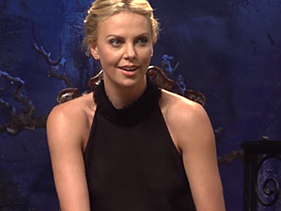
‘I screamed so much at people, I tore a stomach muscle,’ she says during ‘MTV First: Snow White and the Huntsman.’ By Kara Warner, with reporting by Josh HorowitzKara Warner, with reporting by Josh Horowitz Charlize Theron Photo: MTV News If there is one thing you should have learned while watching “MTV First: Snow White and the Huntsman” on Tuesday night, it’s that Oscar-winning thespian Charlize Theron is not only extremely talented and beautiful, but she just seems like a lot of fun, no matter what she’s doing or talking about. Case in point: When Theron was posed a question via Twitter about how much fun she had “diva-ing out” and playing “a bitch for a change,” via her role as Evil Queen Ravenna in “Snow White and the Huntsman.” “What do you mean, ‘for a change’?” she joked. “God, yeah. That’s the tricky thing of the movie: Finding that line that you can walk where you’re not going into camp-ville and you’re also not going into ‘please take me serious Marlon Brando acting-ville.’ I did enjoy just screaming at people,” Theron admitted. “I screamed so much at people, I tore a stomach muscle, which I had never heard of that before. “And then off-set, you can joke about it, because you’re in these costumes. I felt like I was being so high-maintenance: ‘It hurts, oh gosh, I can’t walk to craft service,’ ” she fake-whined. “You become a big pain in the ass. I mean, I’m saying it was the costume. but it really wasn’t. That’s how I behaved.” In addition to channeling her inner diva, Theron said she enjoyed exploring the fantastical elements involved in making a fairy tale. “Of course you have this luxury to then throw back to the fairy tale,” she said. “It’s really huge in scale. This film is epic and big and the characters, what we tried to do was ground it and give it weight and reality, but there is a small part of this film that has to celebrate the fantastical of it.” Stick with MTV News as we roll out more from our exclusive interview with the cast of “Snow White and the Huntsman”! Check out everything we’ve got on “Snow White and the Huntsman.” For breaking news, celebrity columns, humor and more — updated around the clock — visit MTVMoviesBlog.com . Related Photos Snow White And The Huntsman