Tag Archives: climate-change

A Different Conservative View on Climate Change: It’s Happening

One of 52,400 Google images critical of Al Gore and Climate Change The one time I met Jonathan Kay he was rude and arrogant, and he often comes off that way in his column in the National Post. But unlike the Posties in the back pages who are rabid climate change deniers, Kay makes a lot of sense in his article Global-warming deniers are a liability to the conservative cause. Like many of us at TreeHugger, he despairs about how the climate change issue has become politicized into a left/right split, but he … Read the full story on TreeHugger

View post:
A Different Conservative View on Climate Change: It’s Happening

Global Warming Doomsday Vault Deposit Trip Emits 24,300+ Pounds of Carbon

Some red hot chili peppers are on tour, and they’re emitting a lot of greenhouse gases. But it’s not the California rock band emitting carbon on a worldwide concert tour; it’s seeds from chili peppers traveling to the “doomsday” vault in Norway. A bipartisan congressional delegation visited the Svalbard Global Seed Vault July 11 as a side trip during the 19 th Annual Session of the Organization for Security and Cooperation in Europe Parliamentary Assembly. Sens. Ben Cardin, D-Md ., and Dick Durbin, D-Ill., among others, delivered New World chili pepper seeds to the vault, a “fail-safe back-up plan to protect the existing world food supplies from destruction in the event of a large-scale catastrophe.” “As we manage the impact of climate change and other natural and man-made disasters around the world, the seed vault in Svalbard will be the safety deposit box that ensures we can keep that food supply intact,” Cardin said in a statement. Cardin, a member of the Senate Environment and Public Works Committee, is outspoken about environmental issues ranging from green jobs to clean energy . Despite Cardin’s positions, his trip to Norway left a giant carbon footprint – bigger than the footprint left in an entire year by the average American. According to carbon management organization TerraPass.com , the seven-member delegation generated more than 24,300 pounds of carbon just by flying round-trip from Washington, D.C., to Oslo, Norway. That doesn’t account for other travel associated with the trip. According to Climate Crisis , a website affiliated with Al Gore’s “An Inconvenient Truth,” the average person generates 15,000 pounds of carbon dioxide a year. Cardin’s delegation generated about 1.5 times as much carbon dioxide just in traveling as the average person generates in an entire year. Durbin, the Senate Democrats’ second in command, has also championed climate change legislation, going as far as calling climate change a “national security threat” with his Global Climate Change Security Oversight Act , introduced in 2007: “For years, too many of us have viewed global warming as simply an environmental or economic issue. We now need to consider it as a security concern.” Despite other climate-conscious liberals hypocritically leaving giant carbon footprints , the media continue to treat it as water under the bridge, which in this case, isn’t as good as the hit Red Hot Chili Peppers song.  

Go here to read the rest:
Global Warming Doomsday Vault Deposit Trip Emits 24,300+ Pounds of Carbon

Newsweek Shocker: ‘The Environment is No Longer a Surefire Political Winner’

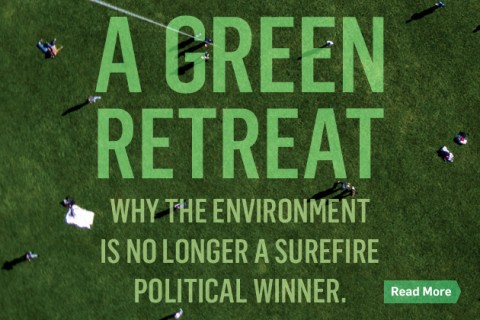
After pushing manmade global warming for years, the folks at Newsweek appear to be cooling on the idea. Prominently placed at the front page of the magazine’s website Monday was a large, overhead picture of what appeared to be a golf fairway or park with the following headline in green: A Green Retreat: Why the Environment is No Longer a Surefire Political Winner Even more surprising was the contents (h/t Climate Depot ): Following two of the harshest winters on record in the Northern Hemisphere-not to mention an epic economic crisis-voters no longer consider global warming a priority. Just 42 percent of Germans now worry about climate change, down from 62 percent in 2006. In Australia, only 53 percent still consider it a pressing issue, down from 75 percent in 2007. Americans rank climate change dead last of 21 problems that concern them most, according to a January Pew poll. Last month Canada’s Prime Minister Stephen Harper, blasting climate change as a “sideshow” to global economic issues, canceled the meeting of environment ministers that has preceded the G8 or G20 summit every year but one since 1994. Merkel has slashed green-development aid in the latest round of budget cuts, while in Washington, Barack Obama seems to have cooled on his plan to cap emissions. In perhaps the most striking momentum reversal for environmental politicians, last month Rudd became the first leader to be destroyed by his green policies. Flip-flopping over planned emissions cuts as the opposition exploited Australian voters’ flagging support for climate measures, he was finally ousted by party rebels.  After discussing some of the politics involved at local levels around the globe, author Stefan Theil started pointing out the really inconvenient truths Nobel Laureate Al Gore has hidden from his followers:  Increasingly, the whole concept of radical, top-down global targets is coming under scrutiny as citizens and governments face tougher choices over costs and benefits. Green policies can be popular when they mean subsidizing renewable fuels or going after unpopular power companies, but can quickly hit a wall when they force lifestyle change, such as less driving and fewer swimming pools-fears Rudd’s opponents have exploited. Policies that push trendy green fuels also cost much more than other options, such as replacing dirty coal with cleaner gas or emissions-free nuclear power. Some schemes, such as America’s corn ethanol and Europe’s biodiesel made from rapeseed, have virtually zero net emissions savings, but any petroleum they displace is quickly bought up by China. Even in the ideal case that the United Nations’ goal of 80 percent emissions reduction by 2050 is technologically and politically feasible, economists disagree widely on whether the cost of the current set of policies, such as carbon caps and green-fuel subsidies, is justified by the avoided damage from warmer temperatures.  But here’s what should really grab the attention of those that either believe this myth or are still on the fence: In many ways, green projects have become just another flavor of grubby interest politics. Biofuels have become a new label for old-style agricultural subsidies that funnel some $20 billion annually to landowners with little effect on emissions (only Brazilian sugar-cane ethanol produces any significant savings; America’s corn ethanol and Europe’s biodiesel do not). Germany’s solar subsidies, a signature project in the country’s battle against climate change, are perhaps the most wasteful green scheme on earth, producing a mere 0.25 percent of the country’s energy at a cost to consumers of as much as $125 billion. A leading member of Merkel’s Christian Democrats in the German Parliament says there is growing unease both in his party and in the Bundestag “about the scary monster we’ve created that is sucking up ever larger amounts of money for a negligible effect.” With green politics losing its moral high ground, there is a growing realization that climate change is just one policy priority among many that compete for limited resources and attention. That means, first, that climate politics will likely fall off its pedestal of being the Western world’s overarching priority. Second, the new sobriety could give more space to a third stream of climate politics between those who see warming as an unmitigated catastrophe that must be stopped at any cost, and those who reject global warming as a hoax. A new climate realism would more carefully weigh the costs and benefits of emissions controls, and look at other options beyond the current set of targets. The new debate will be more pragmatic and include a broader mix of policies. That might include a shift of subsidies into research and development, as many climate economists have argued. It would also include greater efforts to adapt society to a warmer climate, rather than focusing only on stopping the warming process in its tracks. Those that have been following this debate from a grander perspective than what is typically presented by global warming-obsessed media know that climate realists have been saying this for years. Sociologists and economists from around the world have argued that moneys currently being devoted to try to “stop this problem” could be far better spent in ways that would more greatly impact citizens on every continent.  But as Theil pointed out: That idea has so far figured little in the debate, largely because mainstream environmentalists fear it will distract from their push for CO2 cutbacks. Yet adaptation may offer equally valid and much less expensive choices than cutting back on emissions. Imagine that: man could adapt to a changing environment more cheaply than trying — likely with little to no success! — to prevent the change: In other words, some of the money spent on current policies that often have only limited efficacy might be better spent on other measures, including protection against the worst effects of warming. What’s more, current economic worries are a reminder that every dollar spent on solar cells or biodiesel is a dollar less for education and other budget priorities. Truly shocking stuff, especially from a magazine that as Tom Nelson points out published a cover story almost exactly three years ago entitled “Global Warming Deniers: A Well-funded Machine.” So why the change of heart? Was it evidence that the weather really isn’t cooperating with the desires and computer model-driven predictions of the alarmists? Did last year’s ClimateGate scandal, despite the relative lack of press it got here in the states, open up some eyes as to the modus operandi and the deviousness of those spreading the myth? Did revelations concerning misreporting and truly bad science employed by Intergovernmental Panel on Climate Change contributors weaken the resolve of believers? Or was it all the controversy surrounding the Green Messiah Al Gore’s new home purchase in Montecito quickly followed by a separation from his wife and allegations of a four-year-old sex scandal? Or is it merely a consequence of a struggling economy and a federal government trying to figure out ways to finance all its current commitments without the additional burden of environmental spending? Whatever the reason or combination thereof, Americans should hope that this isn’t just a brief moment of sanity, and that Newsweek isn’t going to quickly reverse course once someone wakes up Monday morning and realizes what’s been so prominently placed at the front page of its website. 
Read the original here:
Newsweek Shocker: ‘The Environment is No Longer a Surefire Political Winner’


UN’s IPCC Tells Scientists To ‘Keep A Distance From The Media’

The United Nations Intergovernmental Panel On Climate Change has instructed all 831 researchers contributing to the organization’s next round of assessments to “keep a distance from the media.” Such was disseminated in a July 5 letter from IPCC chairman Rajendra Pachauri which has already garnered some criticism from folks on both sides of the anthropogenic global warming debate. Even the New York Times’ Andrew Revkin expressed disgust with this revelation Saturday:   I know a number of supervising authors of the forthcoming reports are eager to revise policies and stress openness. There’s plenty of advice on the way from committees reviewing the panel’s practices. I also understand the reflexes involved here, particularly given how some media overplayed claims that the climate panel had erred in parts of its 2007 assessment. But any instinct to pull back after being burned by the news process is mistaken, to my mind. As I explained to a roomful of researchers at the National Academy of Sciences last year, in a world of expanding communication options and shrinking specialized media, scientists and their institutions need to help foster clear and open communication more than ever. Clampdowns on press access almost always backfire. Indeed. Supporting this view was IPCC contributor Edward R. Carr, an associate professor of geography at the University of South Carolina who wrote Friday: Part of the problem for the IPCC is a perceived lack of openness – that something is going on behind closed doors that cannot be trusted. This, in the end, was at the heart of the “climategate” circus – a recent report has exonerated all of the scientists implicated, but some people still believe that there is something sinister going on. There is an easy solution to this – complete openness. I’ve worked on global assessments before, and the science is sound. I’ve been quite critical of the way in which one of the reports was framed (download “Applying DPSIR to Sustainable Development” here), but the science is solid and the conclusions are more refined than ever. Showing people how this process works, and what we do exactly, would go a long way toward getting everyone on the same page with regard to global environmental change, and how we might best address it. So I was dismayed this morning to receive a letter, quite formally titled “Letter No.7004-10/IPCC/AR5 from Dr Pachauri, Chaiman of the IPCC”, that might set such transparency back. While the majority of the letter is a very nice congratulations on being selected as part of the IPCC, the third paragraph is completely misguided: “I would also like to emphasize that enhanced media interest in the work of the IPCC would probably subject you to queries about your work and the IPCC. My sincere advice would be that you keep a distance from the media and should any questions be asked about the Working Group with which you are associated, please direct such media questions to the Co-chairs of your Working Group and for any questions regarding the IPCC to the secretariat of the IPCC.” This “bunker mentality” will do nothing for the public image of the IPCC. The members of my working group are among the finest minds in the world. We are capable of speaking to the press about what we do without the help of minders or gatekeepers. I hope my colleagues feel the same way, and the IPCC sees the light . . . For an organization that has suffered a tremendous loss of credibility in the past twelve months, any attempt to shelter this process from complete sunshine would be totally misguided. The international community’s belief in AGW has been plummeting thanks to numerous missteps by those promoting the theory. With Global Warmingist-in-Chief Al Gore now in the middle of a divorce and a sex scandal, his contributions to helping publicize AR-5 could end up being limited. Regardless of recent findings largely in support of ClimateGate scientists — the realist community never expected anything other than this as these folks weren’t about to rule against their own! — America’s media have seemed largely detached from this debate in current months. Witness the relative lack of global warming hysteria this past week as temperatures in the northeast broke records. With this in mind, if the IPCC wants the normally compliant press to assist it in making its case when AR-5 is published in 2013, it had better do everything possible to make journalists a part of the process. Failing this, you could end up with far less media support for whatever is published. In the end, this could be the best thing for this debate AND the planet, for without the press banging the AGW drum, climate alarmists are going to have a very difficult time selling their gloom and doom. That is not to say realists should hope for a media blackout. As science has always been on the side of those not buying into Gore’s favorite money-making scheme, full disclosure and openness are in everyone’s best interest. 

More here:
UN’s IPCC Tells Scientists To ‘Keep A Distance From The Media’

Yes, the Climate Change ‘Hockey Stick’ Still Stands

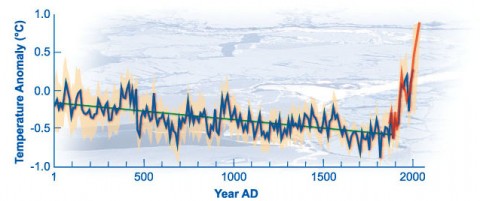
This Graph is Right On Michael Mann was one of the scientists at the center of the so-called ‘Climate Gate’ controversy, and as the author of the famous ‘hockey stick’ graph (the one above, displaying clearly that the temperatures we’re currently experiencing are anomalous, and hotter than the last 2,000 years) is a favorite target of climate denier attacks. Well, guess what folks — finally, an Investigative Committee of faculty charged with determining the strength and quality of Mann’s research, and whether he had engaged in any wrongdoing, has passed down its long-awaited decision. And yes, Mann has been co… Read the full story on TreeHugger

Visit link:
Yes, the Climate Change ‘Hockey Stick’ Still Stands

Report: Forests Key to the Future of Clean Water

Photo via Chi King A new report by the US Forest Service shows that forests play a vital role in protecting watersheds from the impacts of climate change. After two years of research, Water, Climate Change, and Forests: Watershed Stewardship for a Changing Climate shows that ecosystems that have healthy watersheds can sustain changes and keep ecosystems functioning, especially if they’re from forested areas. So, protecting forests means protecting future water supplies…. Read the full story on TreeHugger

See the rest here:
Report: Forests Key to the Future of Clean Water

Proof of Climate Change: Republican Political Glacier Shows Signs Of Melting In Pennsylvania

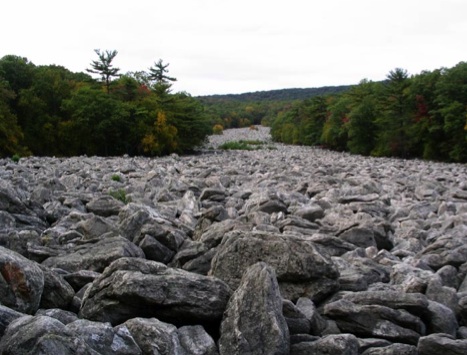
Blue Rocks Glacial Deposit, Berks Co. PA. Image credit: Bridge & Tunnel Club This headline from Patriot News (PennLive.com) tells the tale succinctly: “Republican state lawmaker calls for party to ‘lead on environmental issues'” A headline like that has the feel of a political gusher tipped open by the BP debacle . It’s reminiscent of when Republican President Richard Nixon, having seen… Read the full story on TreeHugger

See the rest here:
Proof of Climate Change: Republican Political Glacier Shows Signs Of Melting In Pennsylvania

Great Lakes Compact leaves the door open to privitization

The Great Lakes Compact while being touted by the parties involved as a good start, leaves holes in it that are actually big enough to unravel it. Leaving the door open to private companies to privitize its water means that the Great Lakes Compact is a document that must be open to more scrutiny in the wake of climate change, water shortages, population increases, and interboundary disputes. This water is a public trust, not a commodity. James Olsen in this interview lays these concerns out. added by: JanforGore

US Navy Vice Admiral: Climate Change is a Threat Multiplier (Video)

Photo via Nature Blog By now, it’s become quite clear that climate change presents a number of threats to life on Earth. So while manipulative politicians and skeptical media outlets continue to voice dissent, institutions like the US military are already in the process of planning, with the aid of climate scientists, how to cope with global war… Read the full story on TreeHugger

Read more:
US Navy Vice Admiral: Climate Change is a Threat Multiplier (Video)

Australia’s New Prime Minister on Climate Change

Photo: Herald Sun As we alluded to earlier , in a very historic day, Australia has a new Prime Minister. In her first speech as the nation’s 27th Prime Minister, and first female in the role, Julia Gillard, had a few things to say about climate change: “It is my intention to lead a Government that does more to harness the wind and the sun and the new e… Read the full story on TreeHugger

Originally posted here:
Australia’s New Prime Minister on Climate Change