Tag Archives: congress

FNC Notices Americans More Positive Toward Tea Party Than Toward Pelosi or Reid

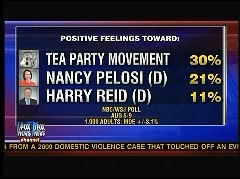
In FNC’s “Grapevine” segment Thursday night, Shannon Bream highlighted a finding in the latest NBC News/Wall Street Journal poll which NBC’s Chuck Todd failed to point out in emphasizing the public’s disgust with Democrats, Republicans and the Tea Party. Bream observed:  A new poll suggests Americans have more positive feelings for the Tea Party movement than for either of the Democratic leaders in Congress. The NBC/Wall Street Journal survey finds 30 percent have a favorable view of the Tea Party movement, compared to House Speaker Nancy Pelosi’s 21 percent and Senate Majority Leader Harry Reid’s 11 percent. The evening before, on Wednesday’s NBC Nightly News, Todd declared: “It’s an unhappy America” where “the Democrats hit a record high in their negative rating – 44 percent” while “the Republicans are doing even worse – 46 percent of the country has a negative view of the Republican Party” and “even the Tea Party – which has actually enjoyed a little bit of a renaissance over the last six months – 34 percent now have a negative view. Just 30 percent have a positive view.” The next morning (Thursday) on the Today show, Todd repeated: “Democrats hit an all-new high in their negative rating. Republicans have even a higher negative rating. The Tea Party, which had enjoyed a positive rating for awhile, now they have a negative rating.” More in Geoffrey Dickens’ post: “ NBC’s Todd Proclaims If GOP Wins in November It’s Still ‘A Bad Election Night for All of Washington .” More of Todd’s poll summary on the August 11 NBC Nightly News, transcript provided by the MRC’s Brad Wilmouth for Todd’s look at evaluations of the parties: CHUCK TODD: It’s an unhappy America. Look, they don’t like the Democrats. The Democrats hit a record high in their negative rating – 44 percent. Just 33 percent have a positive rating on them. The Republicans are doing even worse – 46 percent of the country has a negative view of the Republican Party; 24 percent has a positive view. Even the Tea Party – which has actually enjoyed a little bit of a renaissance over the last six months – 34 percent now have a negative view. Just 30 percent have a positive view. What does this mean for the fall campaign? Right now, voters are sort of in a hold-your-nose moment. They’re sort of split decision – 43 percent want Democrats to keep control; 42 percent want Republicans to take control. But, among voters who have the highest interest in the November elections, this is where Republicans have a potential big advantage – 50 percent of high-interest voters want Republicans to take control of Congress, and just 39 percent would like to see the Democrats keep control. But, again, it’s an unhappy America. And this election, right now, could turn out being a hold-your-nose election when you go into that ballot box. Bream’s “Grapevine” item on the August 12 Special Report with Bret Baier where she was filling in for Baier: A new poll suggests Americans have more positive feelings for the Tea Party movement than for either of the Democratic leaders in Congress. The NBC/Wall Street Journal survey finds 30 percent have a favorable view of the Tea Party movement, compared to House Speaker Nancy Pelosi’s 21 percent and Senate Majority Leader Harry Reid’s 11 percent. 33 percent of those surveyed have had a positive attitude toward the Democratic Party compared to just 24 percent for Republicans. Congress’ overall job score even worse: 21 percent approved compared to a whopping 72 percent who disapprove.

Originally posted here:
FNC Notices Americans More Positive Toward Tea Party Than Toward Pelosi or Reid

ABC and NBC Refuse to Identify Corrupt Rostenkowski as a Democrat

Dan Rostenkowski (?-Ill), 1928-2010. Reporting the passing of Dan Rostenkowski, the ABC and NBC anchors on Wednesday night managed to gently note his ignominious departure from public life while also including a humanizing anecdote about his life (NBC: He “went back to live in the same house he grew up in in Chicago’s north side,” ABC: “In 1985, he famously asked Americans fed up with the tax system to write him”), but neither identified him as a Democrat. Nor did any on-screen graphic mark his party. In contrast, filling in as anchor of the CBS Evening News, Erica Hill managed to accurately describe the late Congressman as “a product of Chicago’s Democratic political machine.” Handling the anchor duties on ABC’s World News, George Stephanopoulos, a Democratic House staff member when Rostenkowski was at the zenith of his power, announced: We have a high profile political death to note tonight. Dan Rostenkowski was steeped in Chicago politics from the start. Elected to Congress at the age of 30, he served there 36 years, 13 of them as Chairman of the powerful Ways and Means Committee before a scandal that saw him serve time on fraud charges. In 1985, he famously asked Americans fed up with the tax system to write him. Viewers than saw a clip of Rostenkowski: “Even if you can’t spell Rostenkowski, put down what they used to call my father and grandfather, Rosty. Just address it to R-O-S-T-Y, Washington, DC.” Stephanopoulos finished: “Dan Rostenkowski was 82.” Over on the NBC Nightly News, fill-in anchor Ann Curry read this short item: Dan Rostenkowski, once one of the most powerful lawmakers in Washington, died today. He rose to become Chairman of the House Ways and Means Committee, but ended up at the center of the House Post Office scandal and was voted out of office in 1994. He spent 15 months in prison, then went back to live in the same house he grew up in in Chicago’s north side. Dan Rostenkowski was 82 years old. The Washington press corps had affection for Rostenkowski and his liberal policies. Here are representative flashbacks to three articles in the MRC’s MediaWatch newsletter: From the June 1994 MediaWatch : Rostenkowski’s Free Ride Media Mourn 17-Count Indictment as Tragedy for the Country Some reporters treated House Ways and Means Chairman Dan Rostenkowski’s 17-count indictment on embezzlement and jury tampering not as an outrage, but as a tragedy. On NBC’s Today May 25, Tim Russert declared: “It’s sad. It’s not something people are gloating over because the fact is, Bryant, Congressman Rostenkowski came here as a political hack from Chicago and turned into a very formidable national legislator.” NBC reporter Lisa Myers added: “It’s a big loss for the President, it’s a big loss for the Congress, and I think it’s a big loss for the country.” On ABC’s Good Morning America the next day, co-host Charles Gibson pleaded the chairman’s case: “What’s involved here is perhaps, what, some $50,000 in stamps and some phantom jobs for friends?…. Here, though, is a guy who passes bills or is shepherding bills worth billions of dollars risking his career for small amounts, or you think, amounts significant enough that there’s real corruption here?” Despite the unfolding of the House Post Office scandal since early 1992 and an ongoing Justice Department investigation of Rostenkowski, reporters have failed to ask him about it. CBS Face the Nation host Bob Schieffer interviewed him twice in 1993. On February 7, he asked only one question: “Mr. Chairman, I’d be remiss if I did not ask you… you’ve been investigated by a U.S. Attorney now for I don’t know how many months, can you tell us if you’ve been given any indication if that is about to conclude?” On May 16, he asked nothing about it. Today’s Bryant Gumbel interviewed Rosty twice in 1993, May 17 and August 15. He also asked nothing about the investigation. On the day after Rosty won a primary election in March of this year, Gumbel asked only about the campaign and nothing about the charges. On June 27, 1993, Rostenkowski appeared on Meet the Press, but no one asked about his ethics. The only NBC exception came on the September 28, 1993 Today, when Stone Phillips asked: “You have had your own legal troubles of late, subject of an investigation into the House Post Office scandal. How much of a distraction is that for you and how much will it continue to be?” On May 18, 12 days after the news leaked that prosecutors planned to indict Rostenkowski, Tom Brokaw interviewed him on the NBC Nightly News but failed to ask anything about it. In the more than two years before the indictment leak, the Big Three networks aired only 22 stories on Rostenkowski’s possible crimes. In the first two months of 1988, the Big Three networks did 26 stories on Ed Meese’s connection to an Iraqi pipeline deal. Meese was never indicted. From the August 1995 MediaWatch : A Tale of Two Schieffers Worrying About Rosty, Not Newt On February 7, 1993, Rep. Dan Rostenkowski (D-Ill.) appeared on CBS’s Face the Nation. A very apologetic Bob Schieffer waited until the end of the interview to slip in a tepid question about an ongoing ethics investigation: “I’d be remiss if I did not ask you, your office has been investigated, you’ve been investigated by a U.S. Attorney now for I don’t know how many months. Can you tell us if you’ve been given any indication if that is about to conclude and do you feel in any way if that’s going to impede your authority to work on these economic problems?” On the July 9, 1995 Face the Nation, Schieffer and U.S. News & World Report Senior Writer Gloria Borger fired four questions at Speaker Newt Gingrich about his ethics. This year Schieffer lacked the “when can we get on with business” tone. While he was concerned that a long investigation into Rostenkowski may have impeded his authority, with Gingrich it smelled of a cover-up: “Maybe this sounds as an odd question, but, you know, until the ethics committee announced on Friday that they were indeed going to call you and Rupert Murdoch, there had been charges, most of them from Democrats, that the whole thing was being, been dragged out. That the ethics committee had taken no testimony under oath, that they had subpoenaed no documents. Eric Engberg of CBS had reported that they hadn’t even gotten a briefing from any relevant agencies. Do you think the ethics committee has been dragging its feet on this? And would you like to tell them to speed up to at least clear up all of this?”      From the May 1996 MediaWatch : Rosty Dearest On April 9, former Illinois Congressman and Ways and Means Committee boss Dan Rostenkowski pled guilty to two felony counts of corruption while in Congress. The night of and morning after the plea, the Big Three networks read anchor-briefs on his conviction. Time, U.S. News and World Report, and Newsweek also kept the conviction to tiny one- or two-paragraph blurbs in their April 22 editions (although  Newsweek broke the plea story the week before). ABC’s Cokie Roberts was the only network reporter to address the story. On the April 14 This Week, Roberts hurled a softball to Rosty about his good intentions. She recalled that in 1992 she asked him, “‘Why are you running for re-election when you could just go home and have this money.’ You said ‘I want to get healthcare done, I want to hang that scalp on my wall.’ Here it is four years later, you’ve spent $2 million in legal fees, you’re about to go to jail and health care isn’t done. What are you feeling?”

Follow this link:
ABC and NBC Refuse to Identify Corrupt Rostenkowski as a Democrat

CBS: Charlie Rangel Made ‘Emotional and Raw Defense’ on House Floor

In a sympathetic story devoid of critics on Tuesday’s CBS Evening News, correspondent Wyatt Andrews described Congressman Charles Rangel’s rant over being charged with numerous ethics violations this way: “In an emotional and raw defense against 13 ethics charges, Charles Rangel mixed small doses of contrition…into a speech of political defiance.” Andrews’s report featured only sound bites of Rangel’s speech that afternoon on the House floor, no critics of the New York Congressman from either party were included. Andrews did explain that Rangel was in “serious trouble” and detailed the charges: “Rangel is charged with not reporting his income on a beach villa in the Dominican Republic, his taxable gains on a condo in Florida. Not reporting several large investment accounts and with raising money for his Rangel Center at the City College in New York from dozens of companies needing favors from his committee.” Continuing to report on Rangel’s bombastic address, Andrews observed: “…this was real-world drama. A man who had clawed his way to the peak of political power now shocked to find himself deserted by so many friends.” Andrews concluded: “Many Democrats…hoped that Rangel would actually take one for the team and quit before his ethics problem became their election issue. But Rangel called that kind of thinking unfair to him and even asked at one point in his speech, ‘what about me?'” Here is a full transcript of the August 10 segment: 6:34PM ET KATIE COURIC: Now to another 40-year veteran of Capitol Hill, Democratic Congressman Charles Rangel of New York forced out as chairman of the Ways and Means Committee and now facing a House ethics trial and possible expulsion. Wyatt Andrews tells us Rangel took to the floor of the House today to defend himself. CHARLES RANGEL: Are you going to expel me from this body? WYATT ANDREWS: In an emotional and raw defense against 13 ethics charges, Charles Rangel mixed small doses of contrition- RANGEL: I apologize for any embarrassment that I’ve caused. ANDREWS: -into a speech of political defiance. RANGEL: Fire your best shot in getting rid of me. ANDREWS: And to any Democrat, starting with the President, who hoped that Rangel would resign to avoid an embarrassing ethics trial just before the election: RANGEL: Don’t leave me swinging in the wind until November. I deserve and demand the right to be heard. ANDREWS: Rangel said he wants a trial and isn’t going anywhere. RANGEL: Hey, if I was you, I may want me to go away, too. I am not going away! I am here! ANDREWS: But he is also in serious trouble. Rangel is charged with not reporting his income on a beach villa in the Dominican Republic, his taxable gains on a condo in Florida. Not reporting several large investment accounts and with raising money for his Rangel Center at the City College in New York from dozens of companies needing favors from his committee. RANGEL: I apologize. ANDREWS: Despite his apology for breaking House rules, he minimized most of the charges as technical. RANGEL: There has to be a penalty for grabbing the wrong stationery. ANDREWS: But not criminal. RANGEL: It may be stupid, it may be negligent, but it’s not corrupt. ANDREWS: On the House floor itself, this was real-world drama. A man who had clawed his way to the peak of political power now shocked to find himself deserted by so many friends. RANGEL: But for God’s sake, just don’t believe that I don’t have feelings, that I don’t have pride. ANDREWS: Many Democrats who are facing tough reelection campaigns thought that – hoped that Rangel would actually take one for the team and quit before his ethics problem became their election issue. But Rangel called that kind of thinking unfair to him and even asked at one point in his speech, ‘what about me?’ Katie. COURIC: Wyatt Andrews on Capitol Hill. Wyatt, thank you.

See original here:
CBS: Charlie Rangel Made ‘Emotional and Raw Defense’ on House Floor

Top Obama Adviser Valerie Jarrett, Vanity Fair Editor Pine for Days of ‘Responsible’ Media

Vanity Fair’s national editor Todd Purdum has a long piece in the most recent issue (in the print edition only, as far as I can tell) bemoaning what he argues are the new and unique challenges facing the Obama administration, including the state of the news media. Purdum’s opinions on the state of the news business boil down to a call for the press’s continuing political uniformity. He offers a quote from White House adviser Valerie Jarrett that also captures the author’s opinions on the issue. Purdum writes: Obama’s senior adviser Valerie Jarrett looks back wistfully to a time when credible people could put a stamp of reliability on information and opinion: “Walter Cronkite would get on and say the truth, and people believed the media,” she says. Today, no single media figure or outlet has that power to end debate, and in pursuit of “objectivity,” most honest news outlets draw the line at saying flatly that something or other is untrue, even when it plainly is. Purdum’s and Jarrett’s statements are comprised of one part revisionist nostalgia, and one part liberal elitism. “Objectivity” was never really present. What they’re longing for is the reliable white-collar liberalism of the 20th century news media. The uniformity of political views among the media and governing elite feeds a longing for an era of objectivity that was never really there. Jarrett’s comment about Cronkite – and Purdum’s endorsement of that comment – demonstrate the insularity of the elite liberal worldview. Cronkite was hardly the paragon of “objectivity” that so many journalists and academics make him out to be. As NewsBusters has documented, Cronkite had an agenda, and occasionally used his massive soapbox to promote it. His occasional activism included, FBI files recently revealed , aiding Vietnam war protesters – hardly a sign of political objectivity for the man who, according to media lore, set in motion events that turned public support against the war effort. Purdum seems aggravated that journalists “draw the line at saying flatly that something or other is untrue, even when it plainly is.” If Cronkite is a model of journalistic objectivity, yet famously opined against the war effort, it stands to reason that he believes what Cronkite was reporting (that the war was not winnable) was simple fact. But as we now know, Cronkite was not weighing in from a position of objectivity. He was politically inclined to oppose the war, as demonstrated by his aid to protestors. So what Purdum is advocating in waxing nostalgic about Cronkite is in fact journalistic activism – injecting political opinion into ostensibly “straight-news” reporting. That Purdum is also concerned about the liberal elite’s loss of control over the news cycle – that he longs for a “responsible” party to “control” the news – demonstrates that he is only comfortable with the Legacy Media having the power to use their pulpit to weigh in on political issues. Purdum obviously considers some facts to be “plainly” correct, and therefore worthy of an on-air opinion or two. But surely Cronkite thought his view of the futility of the Vietnam war was “correct.” His longing for Cronkite’s era of journalism has nothing to do with contemporary citizen-reporters expressing opinions. It has to do with them expressing the wrong opinions. He and Jarrett, given the chance, would return the United States to a media environment in which a small group of liberal elites retained a strangle-hold on the news cycle and used it to promote the correct opinions. And who has the correct opinions? Why the 20th century New York/DC media gatekeepers, of course. Purdum writes that “the capacity to assert, allege, and comment is now infinite, and subject to little responsible control.” This is where the element of liberal elitism comes in: Purdum is concerned that modern media gatekeepers have not satisfied the prerequisites for traditional purveyors of information. Increasing numbers do not have Ivy League degrees, did not attend journalism school, and have not been privy to the upper-middle class, urbane lifestyle that pervaded and defined the 20th century newsroom. “Responsible control” in this context means control wielded by professionals who have the proper credentials, and share the homogenous values and experiences of the intelligentsia. Purdum and his ilk are concerned that the great unwashed masses are gaining influence over the national dialogue. In fact, those masses can define the conversation. And that, by Purdum’s account, is the problem. A single blogger can upload an iPhone video of a congressman saying something stupid, the Drudge Report can pick it up, and almost instantaneously the entire country can be talking about it. All without aid from traditional media outlets! It’s a frightening loss of control for those who dominated the news cycle for so long – and determined what was and was not news. Journalists have always been keen on telling Americans that the Republic could not survive without the media elite. That’s a convenient position for people with such power. Now that they stand to lose that power, it’s full court press on their respective soapboxes to convince Americans that they, the traditionally-defined media, are needed. Hence, Purdum’s dire tone. Is journalism-by-the-masses less polished? Certainly. Does it spell the downfall of traditional news outlets? Maybe. Would the demise of a news cycle dominated by individuals with a uniform worldview and the consequent homogeneity of their left-of-center politics be a total disaster for the nation and its government? Only if you’re a member of that declining elite. Purdum clearly is, and worries that the “wrong” opinions are making inroads into the national political dialogue through new media, talk radio, and the Fox News Channel. The latter, by Purdum’s account, “is waging a fiercely partisan war against the administration.” The partisanship, though, is nothing new. What is new, and Purdum fairly notes this fact, is the omnipresence of an unprecedentedly large number of opinions, many of them very strong, some of them hostile. Writes Purdum: The world is so constantly with us that the White House press office no longer even tries to hold a daily morning “gaggle,” when beat reporters used to ask press secretaries about the expected news of the day, because it will almost certainly be overtaken by events. Under the 20th century, Old Media conception of the news cycle, the White House did not need to respond to events in real time. Barring some major event, it could hold one press briefing every 24 hours covering the day’s events, and providing comment for the following day’s print edition or the evening news broadcast. The proliferation of citizen journalism demands that official respond to more people, and face questions of a broader nature and variety. In that sense, it does not change the essential nature of the news cycle, but only broadens it. But the “hyperkinetic” news cycle, as Purdum dubs it, changes the means by which officials must respond to reporters and handle information. There are changes to which governing officials and reporters must adapt. Purdum is wrong to wish for a return to the 20th century model, where the opinions of elites were more worthy than those of the “the masses.” A diversity of opinions among the gatekeepers of information enhances, not diminishes, the national dialogue. That is a change all Americans should welcome.

Visit link:
Top Obama Adviser Valerie Jarrett, Vanity Fair Editor Pine for Days of ‘Responsible’ Media

The Strange Case of Charles ‘Paulson Put a Gun to All Their Heads’ Gasparino

Earlier today, NB’s Lachlan Markey covered Bill O’Reilly’s interview with the Fox Business Channel’s Charles Gasparino. In that interview, Gasparino confirmed what the New York Post reported in April of last year, namely that  “GE Execs Encouraged CNBC Staff to Go Easy on Obama.” The suits at GE, including Chairman Jeff Inmelt, had a clear motivation for encouraging their reporters to lighten up, namely that “General Electric at the time was hoping to profit handsomely from policies that would benefit a few companies, including GE, at the expense of the majority of the economy”– specifically cap and trade. But speaking of motivation: What about former CNBCer Gasparino’s? The easy answer would be that sometime in the past two years he has seen the light and realizes his past reporting at CNBC was lacking in fairness and balance. Despite his move to Fox, there’s reason to doubt that. In October 2008, Gasparino and CNBC’s Dylan Ratigan smirked their way through their report on what has turned out in retrospect to have been the event that marked the official beginning of Washington’s financial tyranny (“arbitrary or unrestrained exercise of power; despotic abuse of authority”) over the banking system. That tyranny has largely been codified into law in the recently passed and laughably misnamed “Financial Services Reform” legislation. On October 14, 2008, less than two weeks after Congress passed legislation creating the Troubled Assets Relief Program (TARP) with the supposed intent of using the money to buy up specific “toxic assets,” mostly subprime mortgages, Treasury Secretary Hank Paulson radically shifted course, forcing the nation’s largest banks to take TARP money directly (i.e., to accept government “investment”) regardless of whether they wanted it or believe they needed it. What follows is a transcript containing most of the early portion of what Ratigan and Gasparino reported before going to other talking heads for their comments (video is still here at CNBC, and must be seen to fully appreciate the conversation’s smarmy arrogance, especially with Gasparino; bolds are mine): Ratigan: Well we all know that obscene amounts of risk (were) taken inside of the banking system, leaving some banks crippled, some banks frozen, and other banks with huge opportunities. Uh, many of the banks didn’t want to be tainted with the government bailout funds because they didn’t want to be mistaken for a fool when they actually felt that they were the smart one that didn’t do it. Well Hank Paulson said “The heck with that.” He stuck all of them with some of the bailout money. And he said “Listen, we’re going to reset the clock here and move forward.” Charlie, how are the banks that felt they basically didn’t commit the crime, as it were, of excess or reckless risk, uh, respond to the fact that even they will be stuck with this capital? Charlie Gasparino: Well y’know they were all kind of stupid to some extent ….. ….. the Treasury Secretary Hank Paulson put all these egos in the room, and basically put guns to their heads, forcing them to take the money to bolster the banking system. Some of the firms say they didn’t want the cash, but it’s pretty clear that all of them did need to take the cash, given the continued upheaval in the banking system that crushed shares last week of Morgan as well as Goldman Sachs and just about everybody else. So this is essentially, uh, Dylan, a case where, y’know, you can deny you have any problems. Even the best-capitalized banks have problems. They own this stuff. And Paulson at one point said, “Listen, if you don’t want it, it doesn’t matter, gun to your head, you gotta take it.” Ratigan: Yeah, whether you think you’re sick or not, you’re taking the medicine. Gasparino: Because you’re sick anyway. Ratigan: Exactly. Part of my reax at the time: It was very unsettling to see the two CNBC reporters basically smile and smirk their way through the opening segment of the clip, with what I saw as an air of insufferable “we know it all” arrogance. … This “bailout” was originally advertised as being targeted towards troubled loan situations, principally mortgages. Instead, Paulson, Bernanke, and Bush have turned it into a de facto, no good deed goes unpunished (i.e., responsible lending) tool for partial nationalization. How many Congresspersons, or presidential candidates, thought this was what they were voting for, or that this is what the people wanted? Commenter dscott’s reax at the time : Something is up because this is not how a government official acts in a Democracy. “Something” was up all right. We should never forget that the congressmen and senators from both parties, including each party’s presidential candidate, voted TARP into existence despite the intense opposition of the vast majority of Americans, thereby allowing a loophole-laden law to open the door to what has since transpired. Then, less than two weeks later, virtually everyone just stood around while tyranny took its first sweeping steps. Charles Gasparino thought it was sort of funny at the time, as if the financial system’s private players were getting a richly deserved comeuppance. That attitude is consistent with the theme of his most recent book, and of the one that will be released shortly. In November of last year, Gasparino’s ” The Sellout ” was subtitled “How Three Decades of Wall Street Greed and Government Mismanagement Destroyed the Global Financial System.” Given what we have learned about the frauds by design known as Fannie Mae and Freddie Mac in the two years since they went into government conservatorship, it’s more than a little odd that he would mention Wall Street first. Gasparino is releasing a book in October whose title is, “Bought and Paid For: The Unholy Alliance Between Barack Obama and Wall Street.” The book’s tagline: “A top reporter exposes the deep ties between the Obama administration and the big banks that are bankrupting our country.” I’m sure there’s no shortage of material. But fundamentally, Charles, how could it be that Wall Street perpetrated this mess with just a bit of cooperation from and co-opting of Uncle Sam, when it’s Fan and Fred who led the way in compromising prudent lending standards, and it’s Fan and Fred who lied about the underlying quality of their securitized mortgages for about 15 years to the tune of hundreds of billions and perhaps trillions of dollars, doing damage that Wall Street couldn’t hope to do even at its most malicious? Someone –maybe Bill O’Reilly — should ask Gasparino if he still thinks Wall Street is the primary culprit. He clearly did at crunch time in October 2008. Cross-posted in longer form at BizzyBlog.com .  

Read the original here:
The Strange Case of Charles ‘Paulson Put a Gun to All Their Heads’ Gasparino

Tony Blankley Destroys Ed Schultz in Debate About Clinton and Gingrich

MSNBC’s Ed Schultz on Monday absolutely got his head handed to him in a debate with syndicated columnist Tony Blankley. Clearly underestimating his opponent, Schultz rudely introduced the subject of a Republican proposal to not have the Congress come back for a lame duck session after November’s elections by saying, “No one knows better about shutting down Congress than someone who was right there working for Newt Gingrich when it happened before.” Not letting this stand, Blankley gave the “Ed Show” host a much-needed history lesson (video follows with transcript and commentary):   ED SCHULTZ, HOST: The GOP wants to work three weeks in four months. Got that? While railing about wasteful government spending with a straight face. I don’t know how they do it. It’s absolutely stunning. No one knows better about shutting down Congress than someone who was right there working for Newt Gingrich when it happened before. Tony Blankley was press secretary to the Speaker and he’s now a syndicated columnist. Tony, do you think, good to have you with us tonight. TONY BLANKLEY: Good to be here. SCHULTZ: You bet. Do you think it plays to the sensibilities of Americans to suggest a plan that, gosh, the Congress would only be in session to do something for the American people several weeks out of the next four months? BLANKLEY: Well, first of all, I’ve got to correct the record as I expected I would. Newt did not close down the government in ’95. The Republican Congress passed two bills and the President Clinton decided to veto them because he didn’t like what was in the bill, which was funding plus requiring to balance the budget in seven years. And by the way, if you dispute it, I do have in my hot little hands the transcript from Nightline of the night the government closed down with Cokie Roberts and President Clinton agreeing that he vetoed the bill. So, putting that aside, we didn’t want to close down the government. We wanted to balance the budget. For the record, here is that ABC “Nightline” transcript from November 13, 1995: COKIE ROBERTS, HOST: [voice-over] A political impasse over the budget- Pres. BILL CLINTON: I would be wrong to permit these kind of pressure tactics. Rep. NEWT GINGRICH: It’s very sad to see the President choose this political game. COKIE ROBERTS: [voice-over] -and federal services hang in the balance. Tonight, as the clock strikes 12:00, the government shuts down. ANNOUNCER: This is ABC News Nightline. Substituting for Ted Koppel and reporting from Washington, Cokie Roberts. COKIE ROBERTS: It’s after midnight in Washington, so the government must be closed, right? Well, technically right, but this is Washington, after all, and nothing is quite that simple. After casting his threatened vetoes, President Clinton and congressional leaders met tonight, trying to fix the mess they had made, but the meeting broke up not long ago, with only the promise to meet again tomorrow. Each side is trying to score political points in this budget drama without getting blamed for chaos. ‘Protector of Medicare’ is President Clinton’s chosen role, and he refused to sign the bill to keep the government going because it required Medicare recipients to pay more for some premiums than they currently expect to. Republicans playing ‘protectors of the purse,’ but both sides are worried that voters will see them as game-playing politicians, and an ABC News/Washington Post poll released tonight shows that’s exactly what voters do think. Nine times in the past 14 years, the government’s officially run out of money. Four times it’s actually shut down. This is becoming a well-worn script. But the poll also shows that Republicans get more of the blame for a possible shutdown; 46 percent say they’re at fault, 27 percent blame the President. Those numbers serve as a backdrop to the events of this very long day. Nightline correspondent Michel McQueen has our report. RADIO ANNOUNCER: Federal shutdown, will it happen? Stay tuned for instant updates. MICHEL McQUEEN, ABC News: [voice-over] As the sun rose, so did the volume in a divided Washington. Vice Pres. AL GORE: [NBC] They have not done their job. Now they’re trying to make an end run around the Constitution, around the normal procedures. Rep. ROBERT LIVINGSTON, (R), Chairman, Appropriations Committee: We’ve done a lot to work our way toward the President. He has not done thing toward coming toward us. MICHEL McQUEEN: [voice-over] Eight-thirty A.M., President Clinton vetoed the first of two bills at issue in the budget crisis, one that would raise the federal debt limit and require a balanced budget in seven years. Pres. BILL CLINTON: It would allow the United States to pay its debts for another month, but only at a price too high for the American people to pay. MICHEL McQUEEN: [voice-over] And as federal workers headed to the office, the confrontation over the other bill – providing money to keep the government operating temporarily – cast a shadow over the workday. 1st FEDERAL WORKER: I think it’s nonsense. I’m involved in personnel, so I’m the one who’s going to be going to my office to type up furlough letters, including to myself. 2nd FEDERAL WORKER: Reality is that the Congress and the President have to get together and come to terms on exactly, you know, what needs to be done to ensure that there isn’t a shutdown. Pres. BILL CLINTON: Thank you. MICHEL McQUEEN: [voice-over] Mid-morning. In a duel to seize the moral high ground, the President and House Speaker Newt Gingrich delivered speeches to friendly audiences. Pres. BILL CLINTON: As long as they insist on plunging ahead with a budget that violates our values, in a process that is characterized more by pressure than constitutional practice, I will fight it. I am fighting it today, I will fight it tomorrow, I will fight it next week, and next month. Rep. NEWT GINGRICH: We can balance the budget, we can save the Medicare trust fund, we can reform the welfare system if we can have an honest dialogue among ourselves as a people. MICHEL McQUEEN: [voice-over] At the Senate, the first sign of movement. Republican budget leader Pete Domenici offered a compromise to freeze Medicare premiums at their current level. Sen. PETE DOMENICI: Now, of late, and I don’t know whether this is acceptable across the board, but I’ve at least discussed, after talking with my staff, I’ve discussed with the Republican leader here and with others that perhaps the solution is to freeze that at $46.10. MICHEL McQUEEN: But at noon, despite the glimmer of progress, all signs still point to a government shutdown, with no clue about how long it will last, or what the long-term impact might be. And although Washington has seen these shutdowns before, nearly everyone agrees that this one is different. NORMAN ORNSTEIN, American Enterprise Institute: It has the potential of a serious disruption, and an historic change. You have a Republican Congress, especially a Republican House, bound and determined not to compromise and to push its vision of the budget and of the role of the federal government down the throat of the President of the United States, and you have a president saying, ‘I draw the line in the dust, and I won’t let this happen.’ HELEN THOMAS, United Press International: You always had the sense that it was very- it would be resolved very soon. There seems to be a different mood this time around, a real- there’s a real division of philosophy, I think, of government. It’s- it’s, I think, a real crisis. MICHEL McQUEEN: [voice-over] The real crisis for federal workers, like these in a Social Security office in Kansas City, was the fear of losing a paycheck. 3rd FEDERAL WORKER: When we go on furlough, then that means immediately we have no income, and even if it was just us, it would be one thing, but we have a child to take care of. MICHEL McQUEEN: [voice-over] And at this national park in Ventura County, California, rangers were preparing for limited operation. NATIONAL PARK RANGER: The areas will be closed off to the public, but we will maintain patrols of the area and maintain a patrol staff for emergency medical services, protection of the resource, and search and rescue operations. MICHEL McQUEEN: [voice-over] Back in Washington, twice as many people as usual showed up at the passport office, fearing the office would soon close. Two-thirty P.M. Presidential spokesman Mike McCurry threw cold water on a proposed compromise on Medicare and on the Congress’s overall approach to funding. MIKE McCURRY: The President is very concerned about 60 percent funding level. He has made that clear repeatedly in the statements he’s made the last two days, and that just is an unacceptable [crosstalk]. REPORTER: So that’s a veto. That means a veto, correct? MIKE McCURRY: It’s unacceptable. MICHEL McQUEEN: [voice-over] And with the White House unwilling to compromise, senators said they also were not interested, and that they would send the President their original funding bill. They pointedly noted they would remain on the job. Sen. BOB DOLE: We’re prepared to act up until midnight, or after, if necessary, to prevent a shutdown of the federal government. MICHEL McQUEEN: [voice-over] And the blame game continued. Rep. NEWT GINGRICH: We want the country to understand that the only way the government will close tomorrow is, it is President Clinton is determined to close it. MICHEL McQUEEN: [voice-over] And shortly before 9:00 P.M., congressional leaders reached out. Rep. NEWT GINGRICH: We want to go down and talk with the President about how to keep the government open, and to try to have a discussion about how we will get to a balanced budget and keep the government open, and the- he said no preconditions, and we said no preconditions. MICHEL McQUEEN: [voice-over] It was the Republicans who asked the President for the meeting, and while the phone call got them an invitation to the White House, it could not save their funding bill. Within the hour, the President issued a veto, his second of the day, guaranteeing a government shutdown at midnight.  Got that? Just as Blankley said, the shutdown was indeed caused by Clinton’s vetoes. Not surprisingly, the facts weren’t getting in the way of Schultz’s point: SCHULTZ: Well, let me, so you don’t have history revisionism going on here, Tony, the fact is is that it was Newt Gingrich who made the decision based on the action of President Clinton that okay, that’s it, we’re just going to shut her down. The President was not advocating shutting down the Congress. Is that correct? BLANKLEY: That is not, that is not true. Newt passed, we passed, we passed the bill with the money and the debt limit raise which is what was required. By the way, I have a Congressional Research Service study that says the same thing. Republicans passed the bill. The President vetoed it. For the record, here’s what that CRS study said: The most recent shutdowns occurred in FY1996. There were two during the early part of the fiscal year. The first, November 14-19, 1995, resulted in the furlough of an estimated 800,000 federal employees. It was caused by the expiration of a continuing funding resolution (P.L. 104-31) agreed to on September 30, 1995, and by President Clinton’s veto of a second continuing resolution and a debt limit extension bill. Schultz still wasn’t giving up: SCHULTZ: Was, was… BLANKLEY: That’s the record! SCHULTZ: I don’t want to spend too much time on history… BLANKLEY: I know! SCHULTZ: …but the fact is President Clinton was not advocating shutting down the Congress… BLANKLEY: And neither, and neither were the Republicans. SCHULTZ: …nor does he have the power to do that. BLANKLEY: He did by, by vetoing the bill. SCHULTZ: Oh, okay, Because he didn’t play ball the way you guys wanted to… BLANKLEY: Exactly. SCHULTZ: …that’s how you interpret it. BLANKLEY: There was a real argument to be had and you could haggle over it. We wanted cuts in medicare spending, he didn’t. But the fact is we, we passed the legislation that would keep the government open. He vetoed it because he didn’t like the other provisions that were in it. Indeed, and no matter how much folks like Schultz want to blame that government shutdown on Gingrich and the Republican Congress, it was in fact Clinton that forced it with his vetoes. Not accepting defeat graciously, Schultz foolishly came back for more, and once again got destroyed by the astonishingly more knowledgable Blankley: SCHULTZ: Okay, so the next point is this. How did the next election go for the Republicans after that? BLANKLEY: We held onto the House for another ten years. SCHULTZ: And how many seats did you lose? BLANKLEY: ’95 to 2006 before we lost it. Talk about walking into a gunfight with a knife. For the record, despite Clinton’s re-election in 1996, he had absolutely no coat-tail that year as the Republicans did surprisingly well in the Congressional balloting losing only six seats in the House while gaining two in the Senate. As such, on this subject, Schultz was once again all wet. Of course, there’s a much larger issue here. The media are realizing that this November is going to be very bad for the Democrats they support, and they’re pulling out all the stops to lessen the damage. This of includes revising history much as Schultz attempted here to blame everything that has gone wrong in this country – even a government shutdown fifteen years ago – on the GOP. Beyond this, as Gingrich is rumored to be a presidential candidate in 2012, there’s a new movement by so-called journalists to tarnish his record irrespective of the facts. In this instance, the paltry number of people watching fortunately had Blankley there to correct the record. Sadly, on this shill network, that is rarely the case. Bravo, Tony! Bravo!

More:
Tony Blankley Destroys Ed Schultz in Debate About Clinton and Gingrich

Today on Planet 100: Top 5 Endangered Sharks (Video)

Follow this link:
Today on Planet 100: Top 5 Endangered Sharks (Video)

Sloppy Reporting as Symbol Of Why Getting Climate Legislation Passed Has Been So Tough

photo: Jason Kuffer via flickr Referring to the newly-formed iceberg four times the size of Manhattan which broke from Greenland over the weekend, John Rudolf over at the New York Times writes, in a piece titled Iceberg as a Metaphor for Inaction , 
”Despite the scientific uncertainty, Mr Markey used the image of the ice island as a logjam of Republican opposition to climate change legislation… Read the full story on TreeHugger

Read more:
Sloppy Reporting as Symbol Of Why Getting Climate Legislation Passed Has Been So Tough

Samuelson: Higher Taxes Inhibit Having Children, Will Destroy Economy

As media predictably pound the table for Congress to allow the Bush tax cuts to expire, an interesting analysis by Washington Post contributor Robert J. Samuelson should raise a caution flag. Higher taxes inhibit couples from having children which in other developed nations has led to longterm economic paralysis. In a western civilization that got drunk on entitlement programs in the previous century, population growth is essential as all of these schemes have a Ponzi component to them: they only work if you continually have new people entering the system to pay for those collecting benefits. As Samuelson outlined in the Post Monday, our federal income tax structure is quite at odds with our best interests as a nation: For a middle-class husband-wife family (average pretax income in 2009: $76,250), spending per child is about $12,000 a year. Assuming modest annual inflation (2.8 percent), the report estimates that the family’s spending on a child born in 2009 would total $286,050 by age 17. A two-child family would cost about $600,000. All these estimates may be understated because they do not include college costs. With those numbers in mind, here’s the bad news: Our society does not — despite rhetoric to the contrary — put much value on raising children. Present budget policies punish parents, who are taxed heavily to support the elderly. Meanwhile, tax breaks for children are modest. If deficit reduction aggravates these biases, more Americans may choose not to have children or to have fewer children. Down that path lies economic decline. Societies that cannot replace their populations discourage investment and innovation. They have stagnant or shrinking markets for goods and services. With older populations, they resist change. For a country to stabilize its population — discounting immigration — women must have an average of about two children. That’s a “fertility rate” of two. Many countries with struggling economies are well below that. Japan’s fertility rate is 1.2. Italy’s is 1.3, as is Spain’s. These countries are having about one child for every two adults. As Samuelson noted, most recent figures from 2007 show our replacement rate at 2.1 children per woman. That means without immigration – legal or otherwise – our population is just barely growing. Without such growth, programs like Social Security and Medicare are doomed for bankruptcy as the rise in payers into the system can’t keep pace with the growth in recipients. Japan is already experiencing this as its population recently began shrinking due to low birth rates, and the economic ramifications are obvious. Most of Europe is projected to see its population decline in the next two decades making the economies of an entire continent unstable: By some studies, the safety nets for retirees have reduced fertility rates by 0.5 children in the United States and almost 1.0 in Western Europe, reports economist Robert Stein in the journal National Affairs. Similarly, some couples don’t have children because they don’t want to sacrifice their lifestyles to the time and expense of a family. Indeed. And despite claims by the left and their media minions, the Bush tax cuts were a great benefit to parents with lower tax rates at each marginal bracket, an easing of the marriage penalty, and an increase in the child tax credit. Add it all up, and allowing these changes to expire will represent a huge tax increase to existing families as well as a financial disincentive for couples to have more kids. As Samuelson noted, this is a recipe for disaster: We need to avoid Western Europe’s mix of high taxes, low birth rates and feeble economic growth. Young Americans already face a bleak labor market that cannot instill confidence about having children. Piling on higher taxes won’t help. “If higher taxes make it more expensive to raise children,” says demographer Nicholas Eberstadt of the American Enterprise Institute, “people will think more about having another child.” That seems common sense, despite the multiple influences on becoming parents. Of course, Samuelson understands that something needs to be done about our exploding budget deficits, but concludes, “Parents ought to be shielded from the steepest increases” in taxes. Although this seems logical, the current administration and the Party it represents don’t seem to get that. Consider that likely the hardest hit by ObamaCare will be families as they simply have more individuals to insure, and the rising healthcare costs associated with this absurd scheme will clearly add to recurring monthly expenses. On top of this, if the Democrats get their way and cap and trade eventually passes, the rise in energy bills will be frightening to couples with children. All this comes at a time when people are scared about their jobs (if they have one), scared about the future, and have seen retirement savings in their investment accounts as well as home equity plummet or stagnate in the past decade. Now throw a significant tax hike in the mix, and maybe a lot of couples are going to decide they just can’t afford to have another child or any children at all. If this happens, America’s longterm economic prosperity is doomed.

Read more from the original source:
Samuelson: Higher Taxes Inhibit Having Children, Will Destroy Economy

WaPo Wonders: How Can You Spend a Trillion Dollars with ‘Tangible Results’ and Be Doubted?

The front page of Saturday’s Washington Post carried an article by Shailagh Murray from Ohio’s 13th congressional district, just west of Cleveland. The dominant theme was two-term Rep. Betty Sutton’s whining that her GOP opponent Ted Ganley, a car dealer, benefited from Cash for Clunkers but now bashes it. The Post wondered about why Democrats get so little credit for the “stimulus,” and Murray’s central question was this: How can nearly $1 trillion flush through the U.S. economy, with tangible results, and still leave voters dubious? [“Flushed” is a good verb for this.] Some blame Obama and Democratic leaders in Congress for failing to set clear and realistic expectations… It proved difficult to keep track of all that spending, and the White House and Democratic leaders had a hard time showing how it was contributing to the recovery. “The branding and marketing was done very poorly,” said Alan Blinder, a Princeton University economist who supported the stimulus. “When you spend that much money, there should be more recognition.” About $2 billion of the stimulus money flowed to Sutton’s Ohio District. The funds are paying for 628 projects, making it one of the largest concentrations of federal spending in the Midwest. But when you look at the “tangible” Sutton results that the Post lists, even if you were local, you’d wonder if this is the “smart” way to create jobs — as opposed to pleasing a list of constituent groups: The list includes $400 million to replace the decrepit I nner Belt Bridge in suburban Cleveland and $25 million to expand a BASF Catalysts lithium-ion battery plant in Elyria. The Akron Urban League received $2 million to expand broadband Internet service to 3,500 users, creating 13 jobs. The town of Lorain secured $15,390 to retrofit seven school buses with pollution-control gear, and the Ohio Department of Transportation won a $2,500 grant to buy spare parts for the Brunswick municipal fleet. And the Car Allowance Rebate System, better known as Cash for Clunkers, lured customers into auto showrooms, staving off layoffs at the local Ford factory and its suppliers. Here’s how Murray began her Saturday article, complete with Mean GOP overtones: Republican House candidate Tom Ganley sold more than 800 cars last summer through the “Cash for Clunkers” government rebate program. But does Uncle Sam get a thank you? “Let’s talk about Cash for Clunkers,” the voluble millionaire, who owns the largest auto dealership group in Ohio, told a group of voters here recently. “It created a 30-day surge in auto sales. After it ended, there was no business. It was like the faucet was shut off.” As the nation struggled through a painful recession, the Democratic-led Congress rushed through nearly $1 trillion in spending and tax cuts, aiming to jump-start business investment, keep state and local governments afloat and put people to work, if only temporarily. Most economists say the nationwide stimulus effort has generally paid off, although they differ on how much. But the cash infusion appears to have done little to restore public confidence either in the federal government or in the Democratic Party. The stimulus may have created or saved up to 3.6 million jobs, as the White House contends, but the jobless rate in Ohio still hovers at a crippling 10.4 percent. That has left Democrats such as Ganley’s opponent, Rep. Betty Sutton, trying to convince voters that the stimulus made a bad situation somewhat less bad. Doesn’t exactly pop off a bumper sticker. And she ended by bashing Ganley as a hypocrite:  Even Cash for Clunkers is difficult to measure empirically. Ganley is a critic, but some of his competitors are big fans. “It jump-started the entire industry, and it couldn’t have come at a more opportune time,” said Alan Spitzer, chief executive of Spitzer Auto Group, who urged Sutton to push the rebate program and whose 23 dealerships sold about 1,000 cars through Cash for Clunkers. Joseph Lee, plant manager of the Avon Lake Ford plant, said the steady decline in production, which forced 200 layoffs in 2009, started to level off when Cash for Clunkers took effect. That was true even though his plant makes gas-guzzling Econoline vans, not the compact cars that were selling best. “All I know is my plant was shutting down week after week. And then we weren’t.” A year ago, even Ganley had a rosier assessment of the program. He told the Cleveland Plain Dealer that it “certainly primed the pump,” although he complained about its execution. “It’s a little duplicitous,” Spitzer said of Ganley’s reversal. “This program woke up the market. It was an unqualified success.” [Image of Sutton from the conservative site www.bettysutton2010.com ]

Go here to read the rest:
WaPo Wonders: How Can You Spend a Trillion Dollars with ‘Tangible Results’ and Be Doubted?