Tag Archives: conservative

Ron Paul: Mosque opposition ‘all about hate and Islamaphobia’

While I’m no fan of Ron Paul’s politics, I confess I do admire the man’s willingness to speak truth to power, even on the many occasions when his version of the truth directly contradicts my own. On the proposed Manhattan mosque, he doesn’t disappoint: Is the controversy over building a mosque near Ground Zero a grand distraction or a grand opportunity? Or is it, once again, grandiose demagoguery? It has been said, “Nero fiddled while Rome burned.” Are we not overly preoccupied with this controversy, now being used in various ways by grandstanding politicians? It looks to me like the politicians are “fiddling while the economy burns.” The debate should have provided the conservative defenders of property rights with a perfect example of how the right to own property also protects the 1st Amendment rights of assembly and religion by supporting the building of the mosque. Instead, we hear lip service given to the property rights position while demanding that the need to be “sensitive” requires an all-out assault on the building of a mosque, several blocks from “ground zero.” Just think of what might (not) have happened if the whole issue had been ignored and the national debate stuck with war, peace, and prosperity. There certainly would have been a lot less emotionalism on both sides. The fact that so much attention has been given the mosque debate raises the question of just why and driven by whom? In my opinion it has come from the neo-conservatives who demand continual war in the Middle East and Central Asia and are compelled to constantly justify it. They never miss a chance to use hatred toward Muslims to rally support for the ill conceived preventative wars. A select quote from soldiers in Afghanistan and Iraq expressing concern over the mosque is pure propaganda and an affront to their bravery and sacrifice. The claim that we are in the Middle East to protect our liberties is misleading. To continue this charade, millions of Muslims are indicted and we are obligated to rescue them from their religious and political leaders. And we’re supposed to believe that abusing our liberties here at home and pursuing unconstitutional wars overseas will solve our problems. The nineteen suicide bombers didn’t come from Iraq, Afghanistan, Pakistan or Iran. Fifteen came from our ally Saudi Arabia, a country that harbors strong American resentment, yet we invade and occupy Iraq where no al Qaeda existed prior to 9/11. Many fellow conservatives say they understand the property rights and 1st Amendment issues and don’t want a legal ban on building the mosque. They just want everybody to be “sensitive” and force, through public pressure, cancellation of the mosque construction. This sentiment seems to confirm that Islam itself is to be made the issue, and radical religious Islamic views were the only reasons for 9/11. If it became known that 9/11 resulted in part from a desire to retaliate against what many Muslims saw as American aggression and occupation, the need to demonize Islam would be difficult if not impossible. There is no doubt that a small portion of radical, angry Islamists do want to kill us but the question remains, what exactly motivates this hatred? If Islam is further discredited by making the building of the mosque the issue, then the false justification for our wars in the Middle East will continue to be acceptable. The justification to ban the mosque is no more rational than banning a soccer field in the same place because all the suicide bombers loved to play soccer. Conservatives are once again, unfortunately, failing to defend private property rights, a policy we claim to cherish. In addition conservatives missed a chance to challenge the hypocrisy of the left which now claims they defend property rights of Muslims, yet rarely if ever, the property rights of American private businesses. Defending the controversial use of property should be no more difficult than defending the 1st Amendment principle of defending controversial speech. But many conservatives and liberals do not want to diminish the hatred for Islam, the driving emotion that keeps us in the wars in the Middle East and Central Asia. It is repeatedly said that 64% of the people, after listening to the political demagogues, don’t want the mosque to be built. What would we do if 75% of the people insist that no more Catholic churches be built in New York City? The point being is that majorities can become oppressors of minority rights as well as individual dictators. Statistics of support (are) irrelevant when it comes to the purpose of government in a free society — protecting liberty. The outcry over the building of the mosque, near ground zero, implies that Islam alone was responsible for the 9/11 attacks. According to those who are condemning the building of the mosque, the nineteen suicide terrorists on 9/11 spoke for all Muslims. This is like blaming all Christians for the wars of aggression and occupation because some Christians supported the neo-conservative’s aggressive wars. The House Speaker is now treading on a slippery slope by demanding a congressional investigation to find out just who is funding the mosque — a bold rejection of property rights, 1st Amendment rights, and the Rule of Law — in order to look tough against Islam. This is all about hate and Islamaphobia. We now have an epidemic of “sunshine patriots” on both the right and the left who are all for freedom, as long as there’s no controversy and nobody is offended. Political demagoguery rules when truth and liberty are ignored. http://blogs.ajc.com/jay-bookman-blog/2010/08/23/ron-paul-mosque-opposition-all-… added by: unimatrix0
CBS ‘Early Show’: Can Obama Fix ‘Image Problem’ and Bring Back ‘Campaign Magic’?

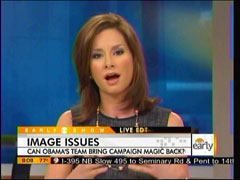
Opening Saturday’s CBS Early Show, co-host Chris Wragge proclaimed: “Image Problem: The President is on vacation and under fire. From the jobless numbers to the Mosque mess – why is the man with the soaring rhetoric having such a hard time getting his message across?” The headline on screen during the later segment read: “Image Issues; Can Obama’s Team Bring Campaign Magic Back?” Introducing the segment, co-host Rebecca Jarvis referred to “conservative critics” taking issue with President Obama’s vacation time on Martha’s Vineyard. In a report that followed, White House correspondent Chip Reid made sure to parrot administration talking points on the matter: “White House advisers stress that this is a working vacation with numerous daily briefings….White House officials say they’re confident the American people understand that with such a high-pressure job, a President needs and deserves some time to unwind and recharge.” Reid also compared Obama’s time-off with that of his predecessor: “By the end of this trip, President Obama will have taken 9 vacations and visited Camp David 14 times for a total of 80 vacation days since he took office. But at the same point in his first term, President Bush had taken far more time away – 14 trips to his Ranch in Texas and 40 to Camp David. The total, 225 days.” During Obama’s earlier trip to Maine, Reid made the same comparison. Following Reid’s report, Jarvis spoke with conservative radio talk show host Amy Holmes and Jennifer Palmieri of the liberal Center for American Progress. Beginning with Holmes, Jarvis wondered about the President’s “image problem”: “…the President has received some criticism here for the types of vacations he’s been taking….Why do you think the White House is having such a tough time shaping its image right now?” Turning to Palmieri, Jarvis cited various low poll numbers for Obama and raised the possibility of replacing White House staff: “The team from Chicago that put this man in office, Jennifer, does that team need to be replaced at this point in time with the approval so low?” Palmieri dismissed the idea, but Jarvis went back to Holmes and asked: “Why do you think they were able to stay so on point throughout the campaign and now it looks like the administration is really missing the mark?” Holmes replied in part: “President Obama has weighed into such a wide diverse range of issues, most recently the Ground Zero Mosque, that he has muddled his own message about what is it he’s really trying to accomplish.” In her final question to Palmieri, Jarvis pressed: “Why isn’t the Obama administration keeping the focus number one on the jobs picture in this country?” Here is a full transcript of the August 21 segment: 8:00AM TEASE CHRIS WRAGGE: Image Problem: The President is on vacation and under fire. From the jobless numbers to the Mosque mess – why is the man with the soaring rhetoric having such a hard time getting his message across? 8:06AM SEGMENT REBECCA JARVIS: Now to President Obama on vacation for the third time this summer. This is a ten day get away and the others were much shorter but his conservative critics say the trip is sending the wrong message. CBS News chief White House correspondent Chip Reid is traveling with the President in Martha’s Vineyard, Massachusetts. Beautiful scene behind you, Chip, good morning. CHIP REID: It sure is, Rebecca. In fact, critics are saying that the President is spending too much time in places like this, creating an image that’s inappropriate for these difficult economic times. [ON-SCREEN HEADLINE: Image Issues; Is the President Struggling to Stay On Message?]   President Obama in casual clothes browsed at a bookstore on the first full day of his ten-day stay in Martha’s Vineyard. Later, he went off to play golf. But White House advisers stress that this is a working vacation with numerous daily briefings. JOHN BRENNAN [ASSISTANT TO THE PRESIDENT FOR COUNTERTERRORISM & HOMELAND SECURITY]: There are a number of issues that the President is following very, very closely and expects to be kept informed about developments on those issues. REID: The President has come under fire from some conservatives for his vacations this summer, first to Bar Harbor, Maine, last weekend to the Gulf, and for the First Lady’s trip to Spain. Critics say his attention should be on the dire economy and the plight of average Americans. RUSH LIMBAUGH: Yes, he’s been working so hard, he’s tamed the economy, he’s tamed Iraq and the oil spill’s fixed. He plugged the hole and now he gets to go to Martha’s Vineyard. REID: By the end of this trip, President Obama will have taken 9 vacations and visited Camp David 14 times for a total of 80 vacation days since he took office. But at the same point in his first term, President Bush had taken far more time away – 14 trips to his Ranch in Texas and 40 to Camp David. The total, 225 days. Presidents, though, are never truly on vacation. Crises often arise. For example, the Christmas day bomber tried to strike while President Obama was vacationing in Hawaii. And for President Bush, Hurricane Katrina struck the Gulf during a long stay at his Ranch. White House officials say they’re confident the American people understand that with such a high-pressure job, a President needs and deserves some time to unwind and recharge, Rebecca. JARVIS: Thank you, Chip Reid. CBS News’s Chip Reid. So why has it become so hard for the man who ran such a disciplined campaign for President to control his message now and his image in the White House? Joining us is independent conservative Amy Holmes, co-host of America’s Morning News, and Jennifer Palmieri of the Center for American Progress Action Fund, a liberal think tank. Jennifer and Amy, great to see both of you this morning. Thanks for being with us. AMY HOLMES: Good morning. JENNIFER PALMIERI: Good morning. [ON-SCREEN HEADLINE: Image Issues; Can Obama’s Team Bring Campaign Magic Back?]                  JARVIS: And, Amy, let’s start out with you, because obviously the President has received some criticism here for the types of vacations he’s been taking, he spent a day visiting the Gulf and now he’s spending ten days in Martha’s Vineyard. His wife, Michelle, visited Spain in the midst of this economic crisis. Why do you think the White House is having such a tough time shaping its image right now? HOLMES: Well, they’re having a tough time because they’re having a tough economic time. But count me among the conservatives that does not begrudge our Presidents their vacations. In fact, I wish politicians spent more time outside of the beltway, less time in Washington, and being really in touch with the American people. Martha’s Vineyard, maybe not exactly in touch, maybe he should be in a camper, I’d like to see that. But, I’m not one of the people that’s actually attacking the President on taking some downtime. JARVIS: A lot of people, though, however are thinking that the President is falling short, his approval ratings have dropped this last week, Jennifer. Across the board, we saw a number of approval ratings that were particularly weak, the Associated Press, 49%, Time, 46%, the Gallup poll, only 42% approve of the President. The team from Chicago that put this man in office, Jennifer, does that team need to be replaced at this point in time with the approval so low? PALMIERI: No, I don’t – I think that the – that the team from Chicago has been dealt a very difficult hand and they’re doing just fine. But the – President Obama’s approval ratings are certainly lower than they have been in the past, but is worth noting that they’re higher than President Clinton’s approval ratings were in 1994 at the same time and even higher than President Reagan’s approval ratings were in 1982 at this same time. And the – I think the Reagan and the Obama situation are sort of – are good comparisons, because Reagan, also, had inherited a very difficult economy. And, you know, the Presidents had a lot of legislative victories, but the White House understands very clearly that you don’t get points from the American people just for legislative victories. They want to see results. And the uncomfortable truth that the White House is wrestling with is that a lot of these policies that they’ve enacted take time for people to see results in their everyday lives and I think, you know, the economy used to shed 600,000 jobs a month when Obama took office. Their adding jobs now each month, not as many as they’d like, but the economy is slowly recovering. But, they understand that there’s a frustration that exists until people see these changes really take effect and that’s just going to take some time. JARVIS: Amy, why do you think they were able to stay so on point throughout the campaign and now it looks like the administration is really missing the mark? HOLMES: Well, there’s a big difference between campaigning and governing and when you’re campaigning, you can stay on message with that close team from Chicago, you know, hope and change. But once you get into government, you’re actually dealing with this – panap- JARVIS: Panoply. HOLMES: This huge array – panoply, thank you – this huge array of issues. And where I think I might disagree with Jennifer in terms of the Obama-Reagan comparison, is that Obama came in with much higher approval. So his fall-off, the drop-off has been much more dramatic than what Ronald Reagan faced and I think also President Obama has weighed into such a wide diverse range of issues, most recently the Ground Zero Mosque, that he has muddled his own message about what is it he’s really trying to accomplish. So we can also look at his policies, even Barney Frank, the liberal from Massachusetts, said that it was quote-unquote ‘dumb’ of this administration to promise that their stimulus bill would keep unemployment below 8%, we’re at 9.5. So he see – the Democratic Party itself is sort of like shooting within the circle when it comes to their own message and this President and they have advisers telling them this fall run, do not walk, away from President Obama. JARVIS: Jennifer, isn’t everybody in this country worried about jobs, why isn’t the Obama administration keeping the focus number one on the jobs picture in this country? PALMIERI: Well, I think that when you see when the President gets out in the country, as he does probably a couple of days a week, that is what he’s – that is what he’s talking about. And they have taken a lot of steps in the beginning of the administration to stabilize the economy and I think that the reason why you don’t see his approval ratings falling off worse is because people understand that he did bring us back from the brink of a depression. And they also understand, and the polling reflects this, that it takes more than 18 months to get out of as a big of a hole as we did have in economy. So I think that people are frustrated but they do understand that why this is so difficult for the President to get out of. JARVIS: Jennifer Palmieri, Amy Holmes, thanks so much to both of you for being with us. PALMIERI: Thank you, Rebecca. HOLMES: Thank you.

See more here:
CBS ‘Early Show’: Can Obama Fix ‘Image Problem’ and Bring Back ‘Campaign Magic’?

Meet the Press: Dick Armey Slams Alan Greenspan’s View of Bush Tax Cuts

David Gregory on Sunday finally got an answer to his question about extending the Bush tax cuts, but it certainly wasn’t what he was expecting. For those that have been watching “Meet the Press” this month, the host has been grilling his conservative guests about this issue ever since former Federal Reserve Chairman Alan Greenspan told him on August 1 that tax cuts don’t pay for themselves. Having badgered Senate Minority Leader Mitch McConnell (R-Ky.) about this earlier in the program with no success, Gregory broached the subject with former House Majority Leader Dick Armey in a subsequent segment. With a hanging curveball coming into his wheelhouse, Armey whacked a long drive that still hasn’t landed (video follows with transcript and commentary): DAVID GREGORY, HOST: I want to, I want to address the tax debate . And what you hear from Republican leaders is an unwillingness to pay the bill as you move forward to extend the Bush tax cuts . FORMER REPRESENTATIVE DICK ARMEY (R): Not at all. MR. GREGORY: Is that wrong? You heard Alan Greenspan say that it’s borrowed money … REP. ARMEY: No. Right. MR. GREGORY: …and that they do not pay for themselves. REP. ARMEY: Where has Alan Greenspan been? John — I, I was a young undergraduate watching all my faculty celebrate the genius of John F. Kennedy as he taught us you cut taxes , revenues increase. Reagan cut taxes , revenue doubled. What — the first, most important, critical thing for the American economy is to cut the size of the federal government. This is a big, fat, sloppy, inefficient, obstructionist, Porky Pig that’s standing in the way of economic progress for the American people. It is counterproductive. It’s an extra weight. It is — and it needs to be cut or this economy can’t carry the weight. This is no thinking… D’oh! Now, that’s the way to hit a hanging curveball! With the crowd still on its feet, Gregory turned to his liberal guest for her view:  MR. GREGORY: This is the argument. GOV. JENNIFER GRANHOLM (D-MICHIGAN): Just quickly — this is the argument, and it’s a 20th century argument, it’s not a 21st century argument. When we’re competing in a global economy , the government has to partner with the private sector to create jobs. If you just slash spending, you slash the investments in the things that are going to move our economy forward, we miss out. Just very quickly, last year, the vice president came to Michigan , said we were going to get all these battery grants; we created — we have 16 companies now in Michigan just in the past year because we partnered with the private sector creating 62,000 jobs. Strategic investment with the private sector is what works in the 20th century. Actually, Granholm was playing rather fast and loose with the facts. As MLive.com reported on July 27 in an article titled “Experts Warn ‘Battery Bubble’ Could Burst Michigan’s Dreams”: Michigan and the federal government have placed a multibillion dollar bet that advanced batteries and electric vehicles will someday power the state and national economies. But experts at a National Academy of Sciences conference on the future of batteries, held here Monday, said the bet could go bust if consumers don’t buy those vehicles. And no one knows if they will. The Obama administration last year allocated $2.3 billion in stimulus funds to help develop the nascent advanced battery industry. More than half of that money — $1.35 billion — was awarded to Michigan companies and organizations. Much of the money is being spent on research and development, and on the manufacturing of advanced batteries. Michigan has supplemented that with lucrative tax credits for companies manufacturing cells and battery packs in the state. And those 62,000 jobs Granholm said were already created? Gov. Jennifer Granholm said the state expects to create 62,000 new battery jobs in Michigan over the next 10 years. Ah. So, with unemployment currently at 13.1 percent in her state, these are jobs Granholm hopes will be created in the next ten years. But that’s not what she told Gregory on Sunday. Sadly, he let her get away with it, although he did ask a good follow-up question:  MR. GREGORY: But should the Democrats be raising taxes on the wealthiest Americans during a recession? Understanding her previous faux pas concerning jobs “created,” listen to her answer:  GOV. GRANHOLM: It’s — the question is, should the tax cuts expire for the wealthiest 2 percent so that we can make the investments that will grow jobs? Yes. That’s the most effective way of creating job growth. The CBO has said that cutting taxes for the wealthiest 2 percent is the most ineffective way of creating job growth. Yep. The most effective way of creating jobs is to tax employers so the government can get the money rather than employees. Of course, what folks like Granholm and the current White House resident do is then claim they “saved” or “created” jobs regardless of any real impact to payrolls or unemployment. Pretty neat, huh?  Fortunately, Armey was having none of this:  REP. ARMEY: I’ll give you, I’ll give you anywhere from — a minimum of $2 trillion to a possible $8 trillion worth of real stimulus of the economy from the private sector if we can just relieve the private sector that’s sitting on its cash from the fear that this administration ‘s going to screw up the future of this economy. Let them understand this administration ‘s going to stand down from any new cockamamy ideas and not raise taxes and take away the return on an investment, and they’ll put that cash to work in America. MR. GREGORY: I’m going to make that the last word.  So am I. 

Read the rest here:
Meet the Press: Dick Armey Slams Alan Greenspan’s View of Bush Tax Cuts

YouTube – China’s Present/Future Military Technology

This video features many advanced/prototype military technologies. China is now thinking smart and is trying to develop smart weapons like UAVs with the help from its great ally Russia and other countries. If China's UAV is succesful and goes in production…casualties would be lowered…. This video shows : Advanced Guided Missiles Prototypes of UAV's China's Future Generation Fighter Jet, The Stealth J-XX fighter… http://www.youtube.com/watch?v=KXRa5IGmVto&NR=1 added by: DogBoy

ACTA bill unconstitutional?

[What is ACTA?] The Anti-Counterfeiting Trade Agreement (also known as ACTA) raises significant concerns for consumer privacy, civil liberties, innovation, the free flow of information on the Internet, commerce, and developing countries' ability to choose policy options that best suit them. Doesn't the Constitution say a warrant is needed to search my computer? It does! But because ACTA is a treaty, it circumvents the Constitution and takes away our rights! Internet service providers (ISPs) will be forced to monitor what you do online and report to the government anything that is seen as suspicious. How are they going to pay for this? They aren't; instead they will raise our Internet bills. tl;dr rich d-bags around the world are going to take our right to internet privacy and control our browsing, taking money from us in the process, via an international treaty ******************** [Why should I care?] Throughout your life, the internets have helped you in many ways. Many a lonely Friday night have you used the internet to type away your problems. When you think about it, you can't imagine what your life would be like without the internet. Well, too bad. ACTA's about to destroy your human rights. They're going to end piracy, but go against the constitution in the process. This means it's time to say bye bye to your right to privacy. So, why should you be worried about ACTA? -It allows them to censor the internet. -It allows them to search your iPods and computers randomly without giving a reason. -It allows them to confiscate your iPods and computers without giving a reason -It allows them to monitor what you do online -It allows them to block websites deemed “unacceptable”, without limit -It will ban p2p technology, like uTorrent -It will allow ISPs to PERMANENTLY Ban you from using the internet, without a trial. -It will allow arrests based on the content you search. -In a nutshell, they're basically taking your freedom and raping it hard. Our internets will be controlled and monitored, bent to the will of the rich corporations. Think about everything the internet has done for you. Are you going to stick up for it? Are you going to stop these greedy bastards from getting their way? Defend the internet, defend your rights, and fight back, don't be a pussy and just sit there saying it'll never get passed. Take action! ******************** [What can I do to help?] Well, we've got some good news. With enough help from awesome people like you, we have a chance of stopping this treaty from going into play. Currently, our strategy is to bring as much publicity to the ACTA as possible. Keep in mind that ACTA is not a bill. It's a secretive treaty that nobody is supposed to know about in the first place. ACTA's advantage is the fact that the general public is oblivious of it. They know what they're doing is unconstitutional, so they are forced to hide it. Why else would it be so secretive? Why is it that all we know is whatever leaked information we can get our hands on? If it's as innocent as they're trying to make themselves out to be, then they would make everything public. This is why we need to take away one of their primary defenses, and reveal ACTA to the public for what it really is. So how, you may ask, can we go about doing this? Well, it's as obvious as you think it is. Tell your friends, spread the word, and do what you can to bring all the publicity you can to ACTA. Below are some fliers that you can print out. http://ifm-store.deviantart.com/gallery/# /d2tndwq http://ifm-store.deviantart.com/gallery/# /d2tne2q http://ifm-store.deviantart.com/gallery/# /d2tne45 http://ifm-store.deviantart.com/gallery/# /d2tneo5 There are some other ways you can help prevent ACTA, listed below. -Sign an anti-ACTA petition ( http://bit.ly/bQeWeO ) -Email the news press about it. ( http://bit.ly/bSUcHH ) *Be sure to write a thoughtful email, point out ACTA's disregards of the constitution, provide ample information, and use good grammar -Find your congressman [Americans] ( http://bit.ly/4ACu1w ) -Find your senator [Americans] ( http://bit.ly/3UAs ) -Find your labour MP [Britons] ( http://bit.ly/aDoyoe ) -Find your conservative MP [Britons] ( http://bit.ly/PwuQl ) -Find your MP [Canadians] ( http://bit.ly/d2f2cm ) -Find your MP [New Zealand] ( http://bit.ly/9XHvzW ) added by: Andre_Rosario

Glenn Beck: ‘Rick Sanchez Is The Dumbest Man Ever On Television’

Glenn Beck on Thursday told his radio audience that CNN’s Rick Sanchez is the dumbest man ever on television. As NewsBusters has been chronicling the bumblings and stumblings of Sanchez for quite some time, we’re certainly not going to take the other side of this debate. Even if we tried, it would be difficult for the conservative talker highlighted many of this genius’s missteps that we’ve also shared with our readers recently (video follows with transcript and clips of related miscues, h/t The Right Scoop ): GLENN BECK, HOST: The Rick Sanchez who I honestly don’t know how the man ties his own shoes. I’m sure he has slip ones. Rick Sanchez, quite possibly the dumbest man on television, and that’s saying something because there’s some dumb people in television. But Rick Sanchez I think has to be the dumbest man in television. A guy who doesn’t understand that a volcano can happen in a cold place like Iceland. (Begin audiotape) RICK SANCHEZ, CNN: I was just asking Chad, how can you get a volcano in Iceland? Isn’t it too when you think of a volcano, you think of, like, Hawaii and long words like that. You don’t think of Iceland. You think it’s too cold to have a volcano there. (End audiotape) BECK: Long words like Hawaii. (Begin audiotape) SANCHEZ: It’s too cold to have a volcano there. (End audiotape) BECK: Too cold to have a volcano there. And besides, when you think of volcanoes, you think of long words like Hawaii. STU BURGUIERE: Which are shorter than Iceland. BECK: What a dope. This guy’s the dumbest man ever on television. PAT GRAY: I don’t know how you can say that. BECK: You don’t know? GRAY: I don’t. I don’t know how you BECK: That’s the only example I have. GRAY: Well, there might be others, but… (Begin audiotape) SANCHEZ: 3:00. Thanks so much, Wolf, appreciate it. Look forward to seeing you. Good job on the Situation Room today, as I’m sure you will do. Up next, ad lib, a tease, that’s what it says right here. (End audiotape) BECK: What a dope. GRAY: But I mean, you couldn’t find anything else. BECK: No. (Begin audiotape) SCIENTIST: Down here we had this big drop. This is about a 9 meter drop. SANCHEZ: Nine meter drop? SCIENTIST: Nine meters. SANCHEZ: What does that mean? SCIENTIST: Well, it means that the ocean waves are doing something, that we’re seeing some changes. It’s been going down and SANCHEZ: By the way, nine meters in English is? (End audiotape) GRAY: Still nine meters, Rick, it’s still nine meters. BECK: Still nine meters. And meters is English. GRAY: (Laughing). BECK: What a dope. GRAY: I love it. BECK: Anyway, so here’s his here’s his latest. “If you start going into who’s giving money, you gotta go to Rome and start asking where’s the money going into Rome.” What? And you have to go to the Mormons and ask, what are they doing with their money?” No, I don’t know if you get this, Rick. The Catholic church and no renegade part of the Catholic church is flying planes into building. GRAY: Yeah, but remember that group, that band of marauding Mormons? Remember them? BECK: They were really… GRAY: Remember them? BECK: Holy cow, yeah. GRAY: Remember they continued to scream that they would do it again, too? BECK: Yeah. GRAY: Remember that? BECK: And they were like, yi, yi, yi, yi, yi, no coffee! Oh, that was great! GRAY: Threaten Starbucks? Oh, my gosh. BECK: Well, they threatened never to walk into a Starbucks because there was really nothing well, the hot cocoa is pretty good. So this Mormon goes in there. But anyway, that’s a whole different story. You are onto something, Rick. You are onto something. And when I think of Catholics and Mormons, I normally think of really… bigger words like decent. GRAY: Or Jew. BECK: (Laughing). Long words like that.

See original here:
Glenn Beck: ‘Rick Sanchez Is The Dumbest Man Ever On Television’

Andrea Mitchell Lauds President Obama for Supporting Ground Zero Mosque; Questions Why He Changed His Tone Afterward

Not only did MSNBC anchor Andrea Mitchell hail President Obama’s support of the Ground Zero mosque as “politically courageous,” but she seemed disappointed when, on the next day, he walked back his comments a bit. On both her Monday and Tuesday MSNBC news hours, Mitchell seemed to emphasize that Obama once again kowtowed to the conservative media on an issue he was originally on the right side of. Mitchell told Chuck Todd that Obama’s remarks at the iftar dinner in support of the mosque were “politically courageous, in terms of domestic politics.” She then asked why Obama then changed his tone the next day. She used the “politically courageous” phrase again, later on the show. Chuck Todd, meanwhile, labeled the story as one “that was basically a creation of the conservative blogosphere in many ways.” “They amplified it nationally,” Todd complained of the conservative media. “It was a local story happening in New York, and then it got amplified by some conservative opinion leaders, including Newt Gingrich and Sarah Palin, and they seemed to allow themselves to be forced to wade in on the debate.” On her Tuesday news hour, Mitchell remarked to a guest that Obama was “on-text” Friday night. When she asked guest Karen Finney how the President got on everyone’s wrong side over the issue, Finney answered that Obama had gone “off-text, so that’s never a good thing as we know.” Mitchell then responded that Obama was “on-text Friday night.” Mitchell also tried to throw water on the intensity of the conservative argument, when she argued that the Ground Zero site might not be so sacred – because three strip clubs already exist in the area. “And one more question about that hallowed site,” Mitchell asked at the end of the segment. “There are strip joints and tatoo parlors, and, I mean, this site is within two blocks, or two blocks away from Ground Zero. But aside from Ground Zero, this is New York. This is downtown New York. There are a lot of less-than-hallowed locations in the retail community there.”    A partial transcript of the two segments is as follows: ANDREA MITCHELL REPORTS 8/16/10 1:00 p.m. EDT 1:01 p.m. ANDREA MITCHELL: Chuck, take us back to the Iftar dinner Friday night. The President made a statement and drew a lot of praise for at least taking a stand that was politically courageous, in terms of domestic politics. Why then did he seem to change the tone, if not the actual words of his endorsement the next day? (…) 1:04 p.m. CHUCK TODD: So it does come across as sort of this idea that he threw something out there to let anybody who wanted to interpret it a specific way, they could. And then, of course, that clarifying statement just added to the confusion and then extended this story. And that’s where they realized – I think that’s why you had Bill Burton, by the way, later that afternoon saying “Hey look, where the President was – he was not clarifying anything, that there is consistency here, because I think they didn’t like this idea that it looked like he was backing away.” ANDREA MITCHELL: Because then he fails to get praise – I mean he’s basically put himself in a position if he was clarifying it, then he’s angered everybody. He doesn’t get any credit, even for being politically courageous. (…) CHUCK TODD: And yet, this is a story that was basically a creation of the conservative blogosphere in many ways. They amplified it nationally. It was a local story happening in New York, and then it got amplified by some conservative opinion leaders, including Newt Gingrich and Sarah Palin, and they seemed to allow themselves to be forced to wade in on the debate. So you do have to wonder on what they say about the media and how they react to it sometimes are two different things. (…) 1:06 p.m. ANDREA MITCHELL: You are one Republican who has initally supported – even before the President got into this – you were saying it was the right thing to say, and the wrong thing for Republicans to say. Yet fellow Republicans like Newt Gingrich, for instance, said folks who want to build this mosque who are really radical Islamists, who want to triumphally prove they can build a mosque where 3,000 Americans were killed by radical Islamists. Those folks don’t have any interest in reaching out to the community. They’re trying to make a case about supremacy. He even used the term “Nazi” to describe the analogy of, you know, we don’t let Nazis and we don’t let the Japanese build in Pearl Harbor. I mean,  he sort of all over the place. We had Sarah Palin tweeting about the President, and she said that we all know that they have the right to do it, but should they? This is not above your pay grade, Mr. President. What are Republicans doing in making – they’re playing politics with the majority base, which is against the Ground Zero location. But what are they doing long-term? (…) 1:09 p.m. ANDREA MITCHELL: And one more question about that hallowed site. There are strip joints and tatoo parlors, and, I mean, this site is within two blocks, or two blocks away from Ground Zero. But aside from Ground Zero, this is New York. This is downtown New York.. There are a lot of less-than-hallowed locations in the retail community there. ANDREA MITCHELL REPORTS 8/17/10 1:46 p.m. ANDREA MITCHELL: Karen, how did the President manage to get on the wrong side of everyone’s position? You know, as I understand it, I guess he went off-text, so that’s never a good thing as we know. MITCHELL: He was on-text on Friday night.

Read the original here:
Andrea Mitchell Lauds President Obama for Supporting Ground Zero Mosque; Questions Why He Changed His Tone Afterward

N.Y. Times: Obama’s Mosque Tolerance Upsets Those Who Want a ‘White and Largely Christian’ America

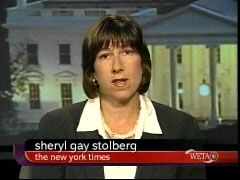
As President Obama struggled to step back from what the New York Times called a “strong defense” of the Ground Zero Mosque proposal, Times reporter Sheryl Gay Stolberg felt the president’s pain in a Sunday “Political Memo” article , arguing that his shifting stands on the issue betray that this debate “is riskier for him than for his predecessors.” Stolberg wrote this is because his enemies want to live in a white, Christian-dominated country: From the moment he took the oath of office, using his entire name, Barack Hussein Obama, as he swore to protect and defend the Constitution, Mr. Obama has personified the hopes of many Americans about tolerance and inclusion. He has devoted himself to reaching out to the Muslim world, vowing, as he did in Cairo last year, “a new beginning.” But his “new beginning” has aroused nervousness in some, especially those who disagree with his counterterrorism policies, or those more comfortable with a vision of America as a white and largely Christian nation , and not the pluralistic melting pot Mr. Obama represents. It’s riskier for Obama because people perceived the last president as staunchly Christian, unlike Obama, the president who often golfs on Sunday and claims a few e-mails of religious quotations on his BlackBerry qualifies as quality religion time: Mr. Obama’s predecessor, George W. Bush, also held annual Ramadan celebrations and frequently took pains to draw a distinction between Al Qaeda and Islam, as Mr. Obama did Friday night. But Mr. Obama, unlike Mr. Bush, has been accused of being a closet Muslim (he is Christian) and faced attacks from the right that he is soft on terrorists. She did follow up by letting former Dennis Hastert aide John Feehery suggest it was “a blunder,” and noted “Few national Democrats rushed” to his defense. She also found that in Florida, Democrat gubernatorial candidate Alex Sink distanced himself from it, while former Republican Gov. Charlie Crist supported Obama. In a front-page article in Saturday’s paper , before Obama backed off his “strong defense” of the mosque proposal, Stolberg found: “Aides to Mr. Obama say privately that he has always felt strongly about the proposed community center and mosque, but the White House did not want to weigh in until local authorities made a decision on the proposal, planned for two blocks from the site of the Sept. 11 attack on the World Trade Center.” He “always felt strongly,” and then backed off within hours. In the Saturday story, Stolberg included critiques from Republican Rick Lazio, but also disappointment from a radical-left Muslim voice: Mr. Obama ran for office promising to improve relations with the Muslim world, by taking steps like closing the detention center at Guantánamo Bay, Cuba, and more generally reaching out. In a speech in Cairo last year, he vowed “a new beginning.” But Ali Abunimah, an Arab-American journalist and author, said the president has since left many Muslims disappointed. “There has been no follow-through; Guantánamo is still open and so forth, so all you have left for him to show is in the symbolic field,” Mr. Abunimah said, adding that it was imperative for Mr. Obama to “stand up to Islamophobia.” Stolberg did not explain that Ali Abunimah is a co-founder of the website Electronic Intifada , where he has argued that Hamas and Hezbollah are hardly terrorist groups: Nothing could be easier in the present atmosphere than to accuse anyone who calls for recognition of and dialogue with Hamas, Hizballah and other Islamist movements of being closet supporters of reactionary “extremism” or naive fellow travelers of “terrorists.” This tactic is not surprising coming from neoconservatives and Zionists. What is novel is to see it expressed in supposedly progressive quarters… Hamas and Hizballah emerged in the context of brutal Israeli invasions and military occupations. Their popular support and legitimacy have increased as they demonstrated their ability to present a credible veto on the unrestrained exercise of Israeli power where state actors, international bodies, the peace process industry and secular nationalist resistance movements notably failed. If the Times thinks President Obama really needs to make sure he’s better respected by bloggers at Electronic Intifada, then perhaps they’re not understanding why the conservative blogosphere is alarmed, and it’s not trying to limit tolerance to “white and largely Christian” America.

See the article here:
N.Y. Times: Obama’s Mosque Tolerance Upsets Those Who Want a ‘White and Largely Christian’ America

Social Security: Government ‘Ponzi’ Scheme Turns 75 with $41 Billion Shortfall

This is a historic year for the largest government program: Social Security, which turns 75 in just a few days. The program is also running a deficit for the first time since 1983, and ahead of estimates. Initially, Social Security was created to provide supplemental income to elderly and disabled people who could not work, and was signed into law by President Franklin D. Roosevelt Aug. 14, 1935. Social Security is in the red six years earlier than forecasted, and for the first time since 1983 (the last time the program was “fixed”). Downplaying the significance of the problem, The New York Times reported March 24, that the program is facing a “small” $29 billion shortfall this year because the high 9.5 percent unemployment rate is cutting into payroll tax collections that fund the program’s benefits. Oh, and because there isn’t actually a trust fund with all the money previously collected by people paying into the system. Problems are mounting for the Social Security program which essentially is a government-created “Ponzi scheme.” It was a boon for the earliest entrants to the program like Ida May Fuller. She was the recipient of the first monthly retirement check, in 1940, and continued to collect until her death in 1975. Fuller worked only three years under the system: paying in $24.75 in taxes. By the time of her death she had collected a total of $22,888.92 according to the Social Security Administration. In 2010, the public is skeptical that they will get anything back from the system they pay into with each paycheck. A USA Today/Gallup poll found that three-fourths of people between 18 and 34 years of age don’t expect to get a Social Security check. Yet the news media have opposed much needed reform recently by ignoring or downplaying the problems with Social Security, and during the Bush years by attacking conservative reform proposals. They have allowed liberals to attack conservatives for wanting to make changes to the program, editorialized that Social Security will be just fine and practically ignored the failure of the program’s trustees to provide its annual report on time this year. The three broadcast networks have done little reporting on the postponement – even though the trustees are delaying bad news during an election year. The president’s debt commission is also looking into entitlements like Social Security to come up with policy solutions, but those won’t be announced until December – conveniently after the election. Every year the trustees of Social Security are required to publish their annual analysis by April 1. CATO Institute’s Jagadeesh Gokhale and Mark J. Warshawsky pointed this out in Forbes on July 12, 2010. “This year, however, the trustees have postponed its release indefinitely.” Why does that matter? Because, according to that article “The program’s financial condition continues to remain hidden from public view.” The trustees’ report was finally released Aug. 5, but when The New York Times announced its findings there was no mention that the report was four months late.The Times’ story also hyped the solvency of Medicare (something seriously in question), while admitting that Social Security is in the red. Nor did it point out that the shortfall had grown to a projection of $41 billion this year, $12 billion more than the Times had reported in March. Still, the Times quickly reassured the public it was “not a cause for panic,” according to Social Security commissioner Michael J. Astrue. The Times quoted the report, Social Security trustees, Treasury Secretary Tim Geithner and the co-chair of a liberal coalition, but not a single conservative voice. A Times editorial predictably spun the report by saying, “Social Security is holding up even in the face of a weak economy.” USA Today supplied its view on Social Security in an editorial Aug. 9. “[H]ere’s something Americans can cross off their be-very-afraid list: whether Social Security will be around so they can worry about all those other threats in relative financial comfort.” According to the liberal media, the problems facing Social Security are “easily fixable.” USA Today argued that it is only necessary to “economize elsewhere,” but that Washington doesn’t like to do that. CNN Money’s senior writer Jeanne Sahadi also said that fixing Social Security “should be a snap.” Sahadi’s solutions were not new: increase the retirement age, reduce growth in benefit levels and raising the cap on how much of wages is subject to the payroll tax. But she didn’t point out how politically difficult those solutions actually are, or the mainstream media’s past attacks on reform proposals. When President Bush attempted to tackle Social Security reform , the five major networks (ABC, CBS, NBC, CNN and FOX) aired twice as many left-leaning stories as right-leaning. Despite the media spin, “urgent reform is necessary” said Nicola Moore of The Heritage Foundation. Moore pointed out that Social Security has a $7.9 trillion shortfall “which means the program would require $7.9 trillion in cash  today! – to afford its promises.” Kathryn Nix, also of Heritage, wrote in June that “the early arrival of the need for a Social Security bailout should serve as a severe reminder to the Obama Administration that entitlement reform is needed now.” MSNBC Host Portrays Conservative Attempt at Reform as Attack on Middle Class According to at least one leftie pundit on MSNBC, attempts toward reform are actually attacks on the middle class in disguise. That’s what Keith Olbermann said on Aug. 9. “Republicans are tipping their hand somewhat about where they would get the money to pay for more tax cuts from the rich. Take it from the middle class. And make Americans work longer before they can retire,” Olbermann declared on his program. He cited Republican leader John Boehner’s comments about raising the retirement age to 70. Boehner has offered that possibility in June as one solution to make Social Security solvent, not , as Olbermann suggested, simply a way to “pay for more tax cuts from the rich.” Olbermann showed video of NBC’s David Gregory trying to force Boehner to say that he “favors” raising the retirement age. The MSNBC talking head didn’t bother to inform his viewers that the government is already paying out more for Social Security than it is taking in and will only get worse without intervention. The ‘Trust Fund’ Myth, a ‘Ponzi Scheme’ Despite the use of the phrase “trust fund” by politicians and journalists, to describe Social Security, the government has been spending that money and replacing it with Treasury bonds (IOUs) for years. A Nexis search for Social Security and trust fund found 68 newspaper stories at just four major newspapers in the past year. News articles such as the Aug. 6, USA Today story about Medicare and Social Security mentioned the “trust fund” as if it were a pile of money that “won’t run dry” until 2037. But Los Angeles Times business columnist Michael Hiltzik took it much further than the average news story. Hiltzik attacked those concerned with Social Security’s fiscal viability Aug. 8. In a piece entitled, “Myth of Social Security shortfall,” he said that the shortfall would be “covered” by “interest on the Treasury bonds in the Social Security trust fund.” Hiltzik further defended the notion of those bonds being “real money,” and lashed out at those “trying to bamboozle Americans into thinking Social Security is insolvent.” But it isn’t real “money,” any more than a person swapping debt by paying one credit card with another is paying with money. Unless revenue comes in that can cover the debts, the person is in trouble. CATO’s Michael Cannon criticized the Aug. 9, New York Times editorial on Social Security for claiming the program can still “pay full benefits until 2037” and current attention to the red ink does not “endanger benefits, because any shortfall can be covered by the trust fund.” Cannon reacted: “No. It. Can’t. Because there are no funds in the Social Security ‘trust fund’.” He characterized the entire idea as “an institutionalized, ritualized lie.”. One that news outlets continued to promote. Back in 2009, Mark Brandly , a professor of economics and adjunct scholar of the Ludwig von Mises Institute, explained how the system works and why it is deteriorating. Social Security is a “pay-as-you-go system,” he said. “[T]he government takes your money and gives it to Social Security recipients. In order to get workers to accept this system, the government promises to take other people’s money and give it to you when you retire.” Essentially, Brandly said it is a huge Ponzi scheme . Surprisingly, CNBC’s Jim Cramer who “loves” Social Security, completely agreed with the Ponzi characterization. In 2008, the ‘Mad Money’ host ranted that the Bernard Madoff $50 billion scam was not the “largest Ponzi scheme ever,” as some had been calling it. “We know the truth about Ponzi schemes,” Cramer said. ” We all know the name of the biggest Ponzi scheme in history and it’s not even illegal. In fact, it is run by the U.S. government. And the name of it – well they call it Social Security.” Cramer explained that by its very definition, Social Security was such a scheme: “In a Ponzi scheme, investors get the returns from the money paid in by subsequent investors and eventually the whole thing falls apart. The last people to invest get hosed. In Social Security, a program I love, workers pay for the benefits of current retirees and hope someday future workers will pay for their benefits – it’s all a Ponzi scheme.” Yet, even reporters who admit that the “trust fund” is a joke, continue to use the phrase instead of criticizing the politicians who perpetrate the myth that Social Security is solvent. Brandly also wrote that the system can only remain sound if “a lot of people die before collecting” check, and if there are more people paying in that collecting. But as more people were paying in the Social Security Administration (SSA) ran a “surplus,” but as government often does – it borrowed from itself leaving IOUs in the so-called “trust fund.” The program is in trouble for that very reason, and because people are living longer and the baby boomers are about to retire, leaving far fewer younger workers paying into the system. According to The CPA Online , Social Security paid out only to retiring individuals 65 and older beginning in 1942. Between 1937 and 1942, it paid out in lump sum to individuals retiring. Benefits did not extend to dependents and survivors until 1939. In 1935, when the program was created average life expectancy was below 65 years of age: 59.9 for men and 63.9 for women . Even by 1942, life expectancy was much lower than today (64.7 for men, 67.9 for women). The projected life expectancy for 2010 is 75.7 for men and 80.8 for women. Currently, people can begin collecting full benefits at age 66, or collect at a permanently lower rate beginning at age 62 or a higher rate if they wait until age 70. But the mainstream media attitude seems to be – don’t worry, it will all work out. Even the USA Today maintained optimism in an editorial that admitted (unlike its earlier news story) the fund is “just IOUs.” They still argued that it would politically impossible to ” renege ” on benefits for retiring Americans. Attacks on Private Accounts The network news media has historically provided a skewed perspective on Social Security and reform proposals. A three – part Business & Media Institute Special Report in 2005, when reform was a hot topic, found a left-ward tilt in Social Security stories twice as often as a conservative slant. That study, Biased Accounts, examined 125 stories on the five major networks and discovered that 44 percent of stories were slanted to the left, compared to 22 percent in the conservative direction. The remaining stories were neutral. Those findings might have looked drastically different if President Bush had not made a concerted effort stumping for Social Security reform. The president’s appearances and statements on the issue accounted for almost one-fourth of the conservative talking points in the study. One of the most popular talking points about Social Security was the liberal idea that personal accounts lead to “risky” stock investments. The argument that the conservative plan and/or the stock market were “risky” came up 53 times. Trish Regan even set her Feb. 5, 2005, “CBS Evening News” report against the backdrop of Reno, Nev., a popular gambling destination. Unsurprisingly, local worker Maureen Fager said about personal accounts, “This is Reno, Nevada. I know a gamble when I see it.” The financial planner they took her to, David Yeske, even claimed that humans aren’t cut out to deal with such matters though that is how he makes his living. “The human brain has been wired for social interactions, not analyzing numbers,” Yeske said. That same report also misstated the age of retirement for Fager and a 27-year-old worker. It was unclear whether Yeske or the reporter was making the mistake.

‘Face the Nation’: Supreme Court Upholding Same-sex Marriage ‘Enormous Stretch’

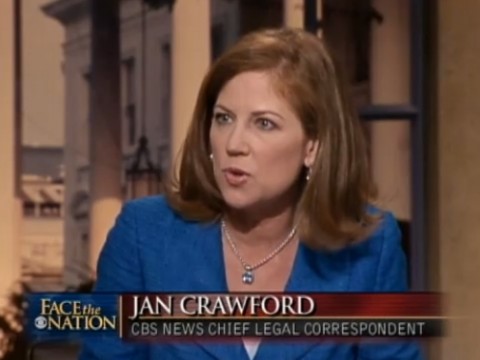
Analysts that spend their time critiquing the media normally don’t have very good things to say about what they observe these days, but the final segment of Sunday’s “Face the Nation” on CBS was a marvelous exception. Substitute host John Dickerson invited on the network’s chief legal correspondent Jan Crawford and the Washington Post’s Dan Balz for a refreshingly open and honest discussion of two pivotal legal issues facing our nation: a judge’s decision to overturn California’s controversial Proposition 8 which banned same-sex marriages, and; whether or not the 14th Amendment should be revised to address illegal immigration. What ensued was a tremendously informative seven minute report about these two issues without any cheer-leading or accusatory finger-pointing: Crawford gave the facts about both legal matters as she saw them; Balz addressed the political ramifications for both parties as well as the White House, and; Dickerson asked great questions to keep the conversation moving. With that as pretext, sit back and watch – or read if you’re so inclined – the way these kinds of issues should be discussed on a television news program (video follows with transcript and commentary):  JOHN DICKERSON, HOST: We’re back with more on same-sex marriage with Dan Balz of the Washington Post, and our chief legal correspondent Jan Crawford. Jan, I want to start with you. And the question I asked David Boies. This is a big leap for the Supreme Court when it finally gets there, isn’t it? JAN CRAWFORD (CBS News Chief Legal Correspondent): Well, David Boies said it was not. But clearly it is. I mean they are asking the Supreme Court to set aside, essentially, the laws of forty-four states. So that is an enormous stretch. Now, of course, the Supreme Court has taken up issues of gay rights in the past. Justice Kennedy, the key swing vote in 2003, said that states could not criminalize homosexual sex in the privacy of your bedroom. So– but that is an entirely different matter than saying there’s a federal constitutional right to– to same-sex marriage. JOHN DICKERSON: In this case, Judge Walker, quoted Anthony Kennedy fifteen times or so. It was a letter to him. Wasn’t it? And is that going to work writing directly to Kennedy, basically, trying to use his own words to say hey, you’ve go to vote with me. JAN CRAWFORD: No. I mean clearly this decision was written with an eye on appeal. And it’s going to be appealed all the way up to the Supreme Court. The court is so narrowly divided right now in these key social issues, you know, you’ve got your four liberals, your four conservatives and then that man in the middle, Anthony Kennedy, who is kind of like this, you know, human jump ball. And what they are asking Justice Kennedy to do, in this case, is not only, I mean, he’s got to grab the ball, take it down the court, slam it in the basket, and shatter the backboard. I mean this is something that Anthony Kennedy doesn’t do. He’s a very cautious justice. He doesn’t like to get ahead. Like I said, the same-sex ruling that he wrote in 2003, that struck down laws that criminalized homosexual sex. No one was enforcing these laws. This would change the law of the nation. They would be so far ahead of public opinion and that is why this case was controversial from the beginning. Remember, the traditional gay rights groups did not want David Boies and his conservative counterpart, Ted Olsen, to file this case because they think the Supreme Court is not ready. They wanted to see more states pass laws allowing same-sex marriage and then take it to the court and not put that onus and that pressure on the Supreme Court. And I would not be so confident if I were David Boies. JOHN DICKERSON: Dan, let’s talk about the politics of this. It does seem like from the Republican side, you know, George Bush when a Massachusetts Supreme Court ruled on– in favor of same-sex marriage, immediately he came out with a constitutional amendment to ban it. This time pretty quiet from Republicans. DAN BALZ (Washington Post): Yes. And I think that– there’s a good reason for that. In 2004, the Republicans needed to do everything they could to motivate their base. Their base this year is highly motivated. They don’t need to do more to crank up the anger, the energy that’s there on the right. The second, I think, and more important reason, is they have very good issues to deal with in this midterm–the economy, the size and scope of government, debt and deficit. Those are issues that unify their entire coalition and also reach out to independents to introduce in a significant and loud way same-sex marriage would threaten to pull away from that– pull that coalition apart. JOHN DICKERSON: Distract. Okay. If it’s going to keep the Republicans quiet on this issue, what about the Democrats? How do they handle this? DAN BALZ: Well, the Democrats are equally conflicted or– or quiet on this. Because while much of the Democratic base favors same-sex marriage, the truth is most elected officials including President Obama are opposed to it. And so, there is conflict within their base. They don’t want to really get into this at this point and stir things up. The President has stayed away from this issue for the most part, as have most other Democrats. So I don’t think you’re– going to see Democrats trying to leap to make this into an issue in the fall. Even in– even in some districts. I think where this will play is in some conservative districts in some red states. Individual Republicans will use it, particularly, through micro-targeting. They will reach to voters not with broad messaging but by direct mail or phone calls things like that. JOHN DICKERSON (overlapping): That’s it. Go on. JAN CRAWFORD: And– keep in mind, though, too. I mean, this is the first ruling by one federal judge and it’s going to be appealed. This case is going to get to the Supreme Court pretty close to 2012. So, you know whether or not it’s an issue in this year’s midterm or not it’s going to be an issue in the presidential election. DAN BALZ (overlapping): I think that’s right. And I think– JAN CRAWFORD: And President Obama is going to have to s– I mean, what does he do? DAN BALZ: And– and I think, as you said, the question is public opinion is changing on this, and fairly dramatically over the last four or five years. But it’s not at the point where there’s majority opinion in a majority of the states in favor of same-sex marriage. The court may end up ruling on this long before public opinion reaches to the conclusion a majority favors same-sex marriage. JOHN DICKERSON: Jan, I want to ask you about another legal issue. The same-sex case is about the 14th Amendment. There’s also been some Republicans talking about the 14th Amendment in another context, in terms of this automatic birthright citizenship in the United States. What’s happening on that front? JAN CRAWFORD: Well, I had about an hour-long talk about this actually on Friday with Senator Lindsey Graham. And this is really kind of one component of what he sees and is pushing is some broader immigration reform. And it– he believes that it is a real problem that people are coming to this country illegally, having babies, and then they’re automatically U.S. citizens. And then they kind of piggy-back, the parents can piggy-back on those kids to stay here in this country illegally. He has all these figures. There’s been a fifty-three-percent increase in births to foreign people, who’ve come here to have their babies in the last four years alone. So, this is a way he wants to look at the 14th Amendment and say maybe it’s time for us to rethink that. Remember the 14th Amendment which is sacrosanct I think to– to so many people was passed to give citizenship rights to the freed slaves. Because obviously the Southern States weren’t going to be doing that unless the federal government stepped in. So he’s saying it’s time to rethink this. When we’re really looking at immigration reform as part of a broader package, securing the borders, giving a path to citizenship for the twelve million people who are here legally now, having some kind of worker ID card, and then also stopping this practice where people can come here illegally or not, have children here, and those children be U.S. citizens. JOHN DICKERSON: Dan, this is an issue, Republicans want to talk about as opposed to the same-sex marriage. DAN BALZ: Absolutely. I mean I think what you’re seeing is that almost all of the elements of the immigration debate that are being discussed now, public opinion tends to be on the side of where the Republicans stand. The Arizona Immigration Law–there are a lot of Democrats particularly, in the west, who are very unhappy that Justice Department and the President decided to step in on that case, feeling that this was a moment that they didn’t want to get into an issue like that that the administration needed to stay focused on the economy. The 14th Amendment issue is another one. I mean we are a long way away from any serious legislating on immigration reform. It died this year. It will– it may come back next year, but we’re a long way away from that. Nonetheless, this discussion is lively right now. And it is helping the Republicans. JOHN DICKERSON: Okay. Dan Balz, thanks so much. We’re going to have to go, Jan. thanks. Bravo, folks. This really was one of the most interesting and informative segments concerning these two issues I saw all week. If television news outlets reported like this more often, I wouldn’t have much to write about. 

See the article here:
‘Face the Nation’: Supreme Court Upholding Same-sex Marriage ‘Enormous Stretch’