Tag Archives: countries

Massive 8.9-Magnitude Quake Hits Japan 7th Largest In History

Go here to read the rest:

The epicenter was 373 kilometers (231 miles) away from the capital, Tokyo, the United States Geological Survey said. But residents there felt the tremors. The quake rattled buildings and toppled cars off bridges and into waters underneath. Waves of debris flowed like lava across farmland, pushing boats, houses and trailers toward highways. In Tokyo, crowds gathered in the streets and tried to reach relatives via cell phone. Scenes inside office buildings showed papers strewn all over the floor and people clinging onto seats and desks. Such a large earthquake at such a shallow depth creates a lot of energy, said Shenza Chen of the U.S. Geological Survey. It caused a power outage in about 4 million homes in Tokyo and surrounding areas. A tsunami in the Pacific was moving closer to other shorelines in other countries, said CNN meteorologist Ivan Cabrera. It triggered tsunami warnings for various countries, including Japan and Russia, the National Weather Service said. “Earthquakes of this size are known to generate tsunamis potentially dangerous to coasts outside the source region,” it said. “Based on all available data a tsunami may have been generated by this earthquake that could be destructive on coastal areas even far from the epicenter.” The quake was the latest in a series in the region this week. Early Thursday, an earthquake with a preliminary magnitude of 6.3 struck off the coast of Honshu. A day earlier, a 7.2-magnitude earthquake struck off of Honshu, the country’s meteorological agency said. The largest recorded quake took place in Chile on May 22, 1960, with a magnitude of 9.5, the USGS said.

Massive 8.9-Magnitude Quake Hits Japan 7th Largest In History

Kush Chronic-les: Does The Ganja Lead To Early Schizophrenia???

These scientists nowadays will try to convince you that everything you eat, smell, and drink is going to do something crazy to you. Many studies have linked marijuana use with early onset of psychosis. The question is, does smoking marijuana cause earlier psychosis? A new review of 83 studies involving more than 22,000 participants seeks an answer. The meta-analysis found that people who smoked marijuana developed psychotic disorders an average 2.7 years earlier than people who did not use cannabis. But the review also found that people who used any illegal drug suffered psychosis two years earlier than non-users, not a large difference. While alcohol use was not associated with early onset, the studies reviewed could not rule out the influence of cigarette smoking, which is a common habit of people with psychotic disorders and those who smoke marijuana. In many of the countries from which the data was gathered, in fact, cannabis is typically smoked mixed with tobacco. The researchers argue that cigarette smoking—unlike marijuana— does not worsen hallucinations or paranoia in patients with schizophrenia, so they believe that tobacco does not account for earlier onset. Led by Mathew Large of the University of New South Wales in Australia, the authors of the new research review also focused on other factors that may have contributed to the association between pot smoking and early psychosis in previous studies. For instance, it’s known that men are both more likely to take drugs and to develop psychosis at an earlier age than women, and the preponderance of men in past studies might have contributed to the connections found. It’s also known that young people, including those who have schizophrenia, are more likely to smoke pot than older folks, so previous studies that put upper age limits on their participants could have overstated the marijuana-psychosis link. But based on the meta-analysis, researchers found that the link persisted independently of these factors. In the paper, published in the Archives of General Psychiatry, they conclude that their results “provide evidence for a relationship between cannabis use and earlier onset of psychotic illness and they support the hypothesis that cannabis use plays a causal role in the development of psychosis in some patients.” We’re not sure that the kush makes you crazy, but we definitely know some folks that are crazy for the kush ! Does the fear of going crazy make you want to quit smoking the piff?? Source

Read the rest here:
Kush Chronic-les: Does The Ganja Lead To Early Schizophrenia???

Mubarak’s Going to Saudi Arabia, CIA-Funded Forecasters Say

http://www.youtube.com/v/bLWWFi5LiAQ

Link:

Hosni Mubarak’s 30-year rule of Egypt is probably coming to an end, and that means he’ll likely leave Egypt right after he leaves power. (Dictators don’t usually stick around the countries they dictated.) So where would Mubarak flee? One data mining company, backed by the investment arms of Google and the CIA, has an educated Broadcasting platform : YouTube Source : Wired: Danger Room Discovery Date : 31/01/2011 23:26 Number of articles : 2

Mubarak’s Going to Saudi Arabia, CIA-Funded Forecasters Say

Dutch Anti-Piracy Group, With MPAA’s Help, Able To Grab 29 US-Hosted Domains… With No Trial Or Notice

Now that the US government appears to be endorsing the idea of simply seizing domain names without notice( http://www.techdirt.com/articles/20101128/15302012021/who-needs-coica-when-homel… ) to the proprietors of those domains, it appears that others are doing the same as well. TorrentFreak reports that the Dutch anti-piracy group, BREIN, with help from the MPAA, has been able to get 29 different domain names — all hosted in the US — to point to BREIN's homepage instead( http://torrentfreak.com/mpaa-shuts-down-29-bittorrent-and-nzb-sites-101215/ ). The owners of those domains were apparently given no notice and no recourse. It sounds like most of the sites did not host any content but linked to potentially infringing content. Whether or not you believe that simply linking to potentially infringing content should be against the law, we're seeing yet another example of the simple lack of due process and how this may impact other areas. If BREIN can get US domains shut down, what's to stop other countries from doing the same thing? China doesn't like reporting by an American site about China? What's to stop it from trying to “seize” that domain? Even if we grant the idea that many of these domains were engaged in or encouraging unauthorized copying of works covered by copyright, why should BREIN and the MPAA simply get to shut them down without any sort of trial? http://torrentfreak.com/mpaa-shuts-down-29-bittorrent-and-nzb-sites-101215/ Update: TorrentFreak requested a list of the affected domains from BREIN and received this response from Tim Kuik. “No that would amount to free PR for the sites that intend to continue their unlawful activities at another hosting provider. These are not large sites and we want to keep it that way.” In response to a question about how the sites were taken offline: “The sites were taken down by the hosting provider,” said Kuik. http://www.techdirt.com/articles/20101215/11300412292/dutch-anti-piracy-group-wi… added by: toyotabedzrock

Wikileaks Threatens America’s Imperial Ambitions – Release of Docs Cuts Them Down to Size

Vladimir Putin says that America is one to lecture others about “Democracy”. In a report from RT news this report about the response from Putin over American criticism of his country. In another report, one leaked document has led to a firestorm as Moscow now demands an explanation for revelations that a planned covert action was planned by the US towards Russia. Could it be that these documents are going to cut short America's Imperial Ambitions as the public in other countries begin to see that America is about corporate corruption and money and greed and projection of power, America will loose a major part of their credibility and ability to project that power…even though they have such massive military spending in comparison to the other state actors in the world. The pressure exerted by America seeking to remain the world's sole hegemonic power is that it forces all the allies to consider teaming up to form another alliance. The whole secrecy of international policy or foreign policy in the US is what propels the corruption of corporate power and for a long time it has served as a way for the US to brand “America” like a product and sell the “idea” to the people of the world that it is the “shinning city on the hill that will bring justice to mankind….etc”, but people weigh this in their minds against what they actually see what America does and now the revelations of corporate influence in the wars in Africa, its amazing that people can't see that Wikileaks serves a higher purpose, regardless of what you think about the media image of Julian Assange. This information that gets released can serve as a great equalizer and ensure that no one country has the power to dominate the entire world, for such to allow such a power to exist threatens the entire human race. We know for a fact that most of these government “professional managers” are there to fill their own pockets and that corruption is at the highest levels and trickles down all the way to its underbelly. Most average people who get their information from Mainstream Media Outlets don't get the real story but the censored story that makes America always look like the hero of the story, regardless of the scandal that surrounds individuals that get caught doing the dirty work. http://rt.com/politics/putin-cow-wikileaks/ The wiki revelations are taking over the job the fourth estate was always intended to do, uncover the corruption and blow the whistle. But once the fourth estate became all about profit, then the master it served changed, from the people to the stockholders. I would be interested to hear about what you think about these ideas… added by: jubal

"Miami Rice": The business of disaster in Haiti

“As we file this article, Port-au-Prince is thick with the smoke of burning tires and with gunfire. Towns throughout the country, along with the national airport, are shut down due to demonstrations. Many are angry over the government’s announcement on Tuesday night of which two presidential candidates made the run-offs: Jude C

Could the Wikileaks Scandal Lead to New Virtual Currency?

It's not an exaggeration to say that the recent Wikileaks scandal has shaken the Internet to its core. Regardless of where you stand on the debate, various services have simply refused to handle Wikileaks' business–everything from domain-name providers to payment services–and this has led to many questioning how robust the Internet actually is. Hackers have already stated their aim to create their own DNS system, which will bypass officialdom. This uses peer-to-peer technology to get around the problem, a favorite of hackers because it's impossible to regulate. But how about an entire currency based on peer-to-peer technology? That's what's on offer from Bitcoin, a decentralized virtual currency that could either be the best idea since they figured out how to slice bread, or just another hacker's daydream. As the Wikileaks debacle continues, it's being increasingly discussed in various sections of the Web as a possible solution to the PayPal online payments monopoly. Bitcoin is the creation of Japanese programmer Satoshi Nakamoto, and is a real, actual currency through which you can buy services and goods, right now. If you don't believe me, take a look at the Trade section of the Bitcoin website. Newcomers can earn Bitcoins by downloading the Bitcoin client software and running computationally intensive tasks on their computer. In other words, the longer your computer is left running the Bitcoin client program, the more Bitcoins you'll incur. It runs in the background, and is polite to other software so you shouldn't realize it's there. According to the FAQ, the current rate of earning Bitcoins is about 50 every three weeks. Bitcoins gain their value simply by the fact people are prepared to accept them as payment for services and goods. This sounds weak but this is not entirely dissimilar in nature to the major Fiat currencies such as the Dollar, Euro and Sterling. The only reason we're prepared to accept our wage in dollars is the fact that we know that shops and service providers across the United States (and other countries) are prepared to let us spend it. You can amass additional Bitcoins just like you can earn real-life currency–by offering services or goods and accepting Bitcoins as payment. Doing so will increase the integrity of the Bitcoin system–something which, as a potentially Bitcoin wealthy person, it's in your interest to do. Virtual currencies aren't a new idea, of course. Those with long memories will remember Beenz.com and Flooz.com, denizens of the dot.com boom that fell flat on their faces as the new century got underway. Additionally, some online games offer their own currency system that have virtual exchange rates for real money. However, Bitcoin differs because there's no central bank or other kind of controlling interest. It's entirely decentralized. Bitcoins are transferred between individuals or businesses by specifying their Bitcoin address. Transactions travel through the peer-to-peer network created by those who are running the Bitcoin client software. There's no single point of weakness. Nobody can stop the Bitcoin system or censor it, short of turning off the entire Internet. If Wikileaks had requested Bitcoins then they would have received their donations without a second thought. Of course, you should make of that what you will. You might also want to ponder the fact that practically anybody in any country can send and receive Bitcoins in an entirely unpoliced way. Should your business be looking to accept Bitcoins? That depends on how valuable you think they are, of course, and that's going to depend on what you can get for the Bitcoins you accumulate–in terms of goods and services that can be bought for Bitcoins. The current Bitcoin-to-dollar exchange rate appears to be about 20 cents, and you can trade currencies courtesy of the various sites that let users both buy and sell Bitcoins. However, purely as an intriguing idea that might indicate a possible future in an Internet heavily regulated by government, Bitcoins are worth taking a look at. Keir Thomas has been writing about computing since the last century, and more recently has written several best-selling books. You can learn more about him at http://keirthomas.com and his Twitter feed is @keirthomas. added by: ras_menelik

Could the Wikileaks Scandal Lead to New Virtual Currency?

It's not an exaggeration to say that the recent Wikileaks scandal has shaken the Internet to its core. Regardless of where you stand on the debate, various services have simply refused to handle Wikileaks' business–everything from domain-name providers to payment services–and this has led to many questioning how robust the Internet actually is. Hackers have already stated their aim to create their own DNS system, which will bypass officialdom. This uses peer-to-peer technology to get around the problem, a favorite of hackers because it's impossible to regulate. But how about an entire currency based on peer-to-peer technology? That's what's on offer from Bitcoin, a decentralized virtual currency that could either be the best idea since they figured out how to slice bread, or just another hacker's daydream. As the Wikileaks debacle continues, it's being increasingly discussed in various sections of the Web as a possible solution to the PayPal online payments monopoly. Bitcoin is the creation of Japanese programmer Satoshi Nakamoto, and is a real, actual currency through which you can buy services and goods, right now. If you don't believe me, take a look at the Trade section of the Bitcoin website. Newcomers can earn Bitcoins by downloading the Bitcoin client software and running computationally intensive tasks on their computer. In other words, the longer your computer is left running the Bitcoin client program, the more Bitcoins you'll incur. It runs in the background, and is polite to other software so you shouldn't realize it's there. According to the FAQ, the current rate of earning Bitcoins is about 50 every three weeks. Bitcoins gain their value simply by the fact people are prepared to accept them as payment for services and goods. This sounds weak but this is not entirely dissimilar in nature to the major Fiat currencies such as the Dollar, Euro and Sterling. The only reason we're prepared to accept our wage in dollars is the fact that we know that shops and service providers across the United States (and other countries) are prepared to let us spend it. You can amass additional Bitcoins just like you can earn real-life currency–by offering services or goods and accepting Bitcoins as payment. Doing so will increase the integrity of the Bitcoin system–something which, as a potentially Bitcoin wealthy person, it's in your interest to do. Virtual currencies aren't a new idea, of course. Those with long memories will remember Beenz.com and Flooz.com, denizens of the dot.com boom that fell flat on their faces as the new century got underway. Additionally, some online games offer their own currency system that have virtual exchange rates for real money. However, Bitcoin differs because there's no central bank or other kind of controlling interest. It's entirely decentralized. Bitcoins are transferred between individuals or businesses by specifying their Bitcoin address. Transactions travel through the peer-to-peer network created by those who are running the Bitcoin client software. There's no single point of weakness. Nobody can stop the Bitcoin system or censor it, short of turning off the entire Internet. If Wikileaks had requested Bitcoins then they would have received their donations without a second thought. Of course, you should make of that what you will. You might also want to ponder the fact that practically anybody in any country can send and receive Bitcoins in an entirely unpoliced way. Should your business be looking to accept Bitcoins? That depends on how valuable you think they are, of course, and that's going to depend on what you can get for the Bitcoins you accumulate–in terms of goods and services that can be bought for Bitcoins. The current Bitcoin-to-dollar exchange rate appears to be about 20 cents, and you can trade currencies courtesy of the various sites that let users both buy and sell Bitcoins. However, purely as an intriguing idea that might indicate a possible future in an Internet heavily regulated by government, Bitcoins are worth taking a look at. Keir Thomas has been writing about computing since the last century, and more recently has written several best-selling books. You can learn more about him at http://keirthomas.com and his Twitter feed is @keirthomas. added by: ras_menelik

FIFA 2022 World Cup location

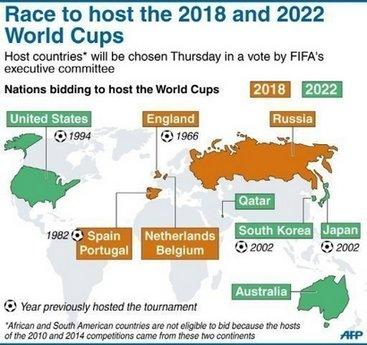
A map locating the countries bidding to host the 2018 (orange) and 2022 (green) World Cups. The 2018 race has seen England, Russia and Spain-Portugal vying for supremacy in an increasingly acrimonious bidding war. The favourites for the 2022 tournament are the United States, Australia and Qatar, with Japan and South Korea seen as rank outsiders. America’s final pitch to host to the 2022 World Cup was left to a former president and an Oscar-winning actor, who talked of diversity and outlined an

Read this article:
FIFA 2022 World Cup location

Court orders removal of genetically engineered sugar beet seed crop; finds government and Monsanto rushed to illegally plant herbicide resistant crop

Today Federal District Judge Jeffrey S. White issued a preliminary injunction ordering the immediate destruction of hundreds of acres of genetically engineered (GE) sugar beet seedlings planted in September after finding the seedlings had been planted in violation of federal law. http://www.centerforfoodsafety.org/wp-content/uploads/2010/11/SBII-ORDER-grantin… The ruling comes in a lawsuit filed by Earthjustice and Center for Food Safety on behalf of a coalition of farmers, consumers, and conservation groups. The lawsuit was filed on September 9, shortly after the U.S. Department of Agriculture (USDA) revealed it had allowed the seedlings to be planted. The court outlined the many ways in which GE sugar beets could harm the environment and consumers, noting that containment efforts were insufficient and past contamination incidents were “too numerous” to allow the illegal crop to remain in the ground. In his court order, Judge White noted, “farmers and consumers would likely suffer harm from cross-contamination” between GE sugar beets and non-GE crops. He continued, “the legality of Defendants’ conduct does not even appear to be a close question,” noting that the government and Monsanto tried to circumvent his prior ruling, which made GE sugar beets illegal. Paul Achitoff of Earthjustice, lead counsel for the plaintiffs, said, “USDA thumbed its nose at the judicial system and the public by allowing this crop to be grown without any environmental review. Herbicide resistant crops just like this have been shown to result in more toxic chemicals in our soil and water. USDA has shown no regard for the environmental laws, and we're pleased that Judge White ordered the appropriate response.” Plaintiff Center for Food Safety's Senior Staff Attorney George Kimbrell said, “Today’s decision is a seminal victory for farmers and the environment and a vindication of the rule of law. The public interest has prevailed over USDA's repeated efforts to implement the unlawful demands of the biotech industry.” The plaintiffs—The Center for Food Safety, Organic Seed Alliance, High Mowing Organic Seeds, and the Sierra Club—had immediately sought a court order to halt the planting. On September 28 Judge White ruled that USDA's Animal and Plant Health Inspection Service (APHIS) had violated the National Environmental Policy Act (NEPA) by allowing the plantings without analyzing the potential environmental, health, and socioeconomic impacts of growing GE sugar beets. udge White heard testimony from the parties during a three-day hearing in November before issuing today’s ruling. Monsanto created Roundup Ready crops to withstand its Roundup herbicide (with the active ingredient glyphosate), which it then sells to farmers together with its patented seed, for which it charges farmers a substantial “technology fee.” Earlier this year, the Department of Justice announced it had opened a formal investigation into possible anticompetitive practices in Monsanto’s use of such patented crops. Growing previous Roundup Ready crops such as soy, cotton, and corn have led to greater use of herbicides. It also has led to the spread of herbicide resistant weeds on millions of acres throughout the United States and other countries where such crops are grown, and contamination of conventional and organic crops, which has been costly to U.S. farmers. There is also evidence that such herbicide-resistant crops may be more susceptible to serious plant diseases. In an earlier case the court ruled that USDA had violated NEPA by allowing the crop to be commercialized without first preparing an Environmental Impact Statement (EIS). In August the court made any future planting and sale unlawful until USDA complies with federal law. (USDA has said it expects to complete an EIS in spring 2012.) But almost immediately after the ruling, USDA issued permits allowing companies to plant seedlings to produce seed for future Roundup Ready sugar beet crops, even though the crops are still illegal to grow, and no EIS has been prepared. The seed growers rushed to plant the seed crop in Oregon and Arizona, apparently hoping to outrun the legal action to stop it. In this latest case, USDA argued that the seedlings were separate from the rest of the sugar beet crop cycle and had no impact by themselves, but Judge White rejected this. He found that the law requires USDA to analyze the impacts of not only the seedlings, but the rest of the Roundup Ready sugar beet production process as well, before any part of that process can begin. cont. added by: JanforGore