Tag Archives: countries

My Own Personal Beauty Matrix

Why Do You Do This? The question that I've been asked the most lately is “why do you do this?”. {This meaning spending so much time writing, researching, interviewing people and talking about non-toxic choices in organic beauty products.} That's a fair question and one that got me thinking about the deeper answer. The obvious answers are health, the environment, our future. But the truth is, the answer is a bit more complicated. There is no fat paycheck arriving in my mailbox each week that keeps my fingers tapping these keys. In fact, I don't know if I'll ever make any significant income from this (but if I do, that would be icing on the organic cake and help me get the message out loud and proud!). According to Active ingredients used in cosmetics: safety survey (2008) “Ingredients are used in cosmetics to give them specific properties. Certain ingredients, so called active ingredients, may produce pharmacological or toxic effects under certain conditions. Cosmetic products containing such ingredients may pose a health risk both because of their potential toxicity and because they may mask underlying serious diseases and consequently cause a dangerous delay in diagnosis and treatment.” My Own Personal Matrix By now, I think we've all at least heard of the movie Matrix with Keanu Reeves and Laurence Fishburn. I've only ever seen the first movie where the Matrix is introduced. You know that famous scene where Fishburn's character is offering Keanu the choice of taking a little pill that would change everything forever, or taking another pill that would return him to pleasant life as he knew it. Fishburn's character makes sure Keanu understands that once he takes the “truth revealing” pill, there is no going back to daily life and that he will “never see anything the same way again.” When Neo, Reeve's characeter asks, “What is the Matrix?”, Fishburne answers…”The matrix is the world that has been pulled over your eyes that protects you from the truth!” This is the line..this is the one line runs through my mind each time I see an add for Loreal, Revlon and any other mainstream cosmetics line. Each time one of these ads promises to plump, make something glow, or beautify women all over the world, I feel as if they are hoping that their target audience has not taken the other pill…the one where they don't to see the actual truth….they don't READ THE LABEL and learn about it. makeup1.jpg What Is The Truth? The truth is something that can be very personal and relative to each individual. I think we all, as humans love to believe that the government, FDA and the companies actually creating beauty products share a common truth have the greater good for humanity and health in mind. “They wouldn't create something that would hurt us!”, and “Isn't it FDA approved?” are the most common lines of thinking when it comes to extent of the reflecting on possible toxins in our beauty regimen. Since I chose to take the ‘Matrix exposing pill' I haven't been able to see the world in quite the same way. After spending over a decade working in and managing beauty salons I knew intuitively and physically that the smells were not good for us. I just didn't know how bad they were. How Bad Are They…Really? We all like to think that the FDA is there to protect us and put strict guidelines in place to force companies to only use ingredients that have been thoroughly tested. The truth is, those guidelines are not as strong as they should be. One glaring example of the lack of control is a simple comparison of known toxic ingredients including lead and talc (a relative of asbestos) banned from use in the United States versus Europe. According to the Environmental Working Group “…unlike for drugs and food additives, FDA has no authority to require that cosmetics be tested for safety before they are sold. An industry-funded panel (the CIR), not a government health agency, reviews the safety of cosmetic ingredients in the U.S. Our research shows that this largely self-regulated industry routinely fails to adhere to their own safety panel's advice or to heed the health warnings inherent in cosmetic safety standards set in other countries. More than 750 personal care products sold in the U.S. violate industry safety standards or cosmetic safety standards in other industrialized countries.” But I Thought We Were Worth It? Did you know that Europe has tested and banned over 1200 ingredients for use in cosmetics. Let's compare that to the FDA who has banned around 10!!! The truth is that FDA will only get involved in a situation if the product has been known to cause obvious harm to a person. The problem with this outlook is that most toxins have a slow trickle affect on a person. You may notice a rash or dry skin or hair and not even relate it to the product you are using. What Can I DO? You do have options. The organic cosmetics market has more than tripled over the last 5 years. The products are actually good, very good. You don't have to go naked and barefoot to go green anymore. You can be your gorgeous self and still use beauty products that are not causing harm. Here is a resource that can help in wading through the beauty aisle – www.cosmeticsdatabase.com . Here you can look up the safety rating of products as well as individual ingredients. This isn't just about looking good, it's about living a long healthy life not filled with illness and disease. Learn more about my story at http://TheEcoDiva.com added by: Elena_Lipson

Ditching Ethanol Subsidy Not Only Will Save US $6 Billion, But Won’t Hurt Domestic Production

photo: Kevin Dooley Two new pieces in NRDC ‘s Switchboard blog remind us that the debate over corn ethanol subsidies is alive and well; and illustrate, through two new reports, the benefits of ditching Federal support altogether. The first, from the Congressional Budget Office , details how much money eliminating the Volumetric Ethanol Excise Tax Credit; the second, from

Continued here:
Ditching Ethanol Subsidy Not Only Will Save US $6 Billion, But Won’t Hurt Domestic Production

9 Countries Have Recorded Hottest-Ever Temps This Year

Image via Climate Progress/NOAA As we’ve been reporting, 2010 is shaping up to be the hottest year on record. So far, the globe has seen its hottest spring , hottest April, hottest June , hottest January-June , in addition to breaking other records. So… Read the full story on TreeHugger

Go here to read the rest:
9 Countries Have Recorded Hottest-Ever Temps This Year

Shauna Sand in her Whore Bikini of the Day

I love how Shauna Sand and her dead vagina have the ability to hire these boy toys from other countries, who I guess she finds through an agency, who she carts around and films sex tapes with, in order to make some money and keep her career a a tacky, trashy, stripper looking whore alive…. I don’t understand how anyone who isn’t gay could stick their dick inside her deflated testicle bag looking vagina….Seriously, shit looks dryer than a fucking asshole, and I can pretty assure you that it smells a lot worse than one….It’s on some roadkill kick that could turn a motherfucker off pussy for life, even if it was paying a nice weekly salary to keep you around… If you want to see her dead vagina in action.. Click This Link I do know she’s a bad influence on her kids..she has a 10 or 11 year old daughter and I guess shit can go either way…cuz most girls who are sluts come from repressed households…or households where daddy uses his dick inappropriately on them when they sleep, but I’m not sure what happens when girls come from homes where the mom dresses and acts like this pig, cuz usually when I see strippers in their home setting, the kids have already been taken away by the state…. So we are either gonna get a Shauna Sand the next generation in a few years, or bitch is going to end up being the first lady president of the USA to compensate for her mother’s embarrassment, but either way, she’s gonna have issues some dude is gonna get to fuck the shit out of… Here she is being fake tits, fake hair, fake skin, stupid shoes, decent body, dead vagina hiding in her bikini. Here she is in a costume change… Here is her sex tape Pics via Bauer

Here is the original post:
Shauna Sand in her Whore Bikini of the Day

Ratigan Gets ‘Raw’: Says America Didn’t End Slavery, Just Outsourced It to China

Leave it to Dylan Ratigan, one of the star personalities at MSNBC who seems to be constantly looking for a reason to be angry. On his July 12 show, Ratigan posed his view on how trade between China and the United States operates. According to Ratigan, importing products where labor costs are significantly lower is akin to slavery. He specifically named Foxconn, a company that manufactures iPhones and iPads for Apple (NASDAQ: AAPL ). (h/t @KenShepherd ) “Do you want to get raw?” Ratigan said. “Let’s say that the American people happily, logically apathetic are perfectly happy basically with a slave culture of illegals and outsourced slaves in China making iPhones at Foxconn and that for as much as we talk about the liberation of the slaves and we like to pat ourselves on the back for the Civil War – got a big statue of Abe Lincoln. All we’ve really done is alter the color of some our slaves and moved them to other countries. Is that too extreme on my part, Matt?” What Ratigan doesn’t realize or isn’t willing to concede is that the industrialization of China hasn’t just made it possible for Americans to have cheap products or American corporations to make more money, but it has rescued the nation from poverty and propelled to China to a global power and could be a model for other nations . And as for Ratigan’s Foxconn example, the Associated Press reported the technology company is acknowledging its labor issues . But he still referred to their employees as “a slave.” “I think if you ask the kids making iPhones for Americans at Foxconn in China at a nice profit margin for an American corporation, they might think they’re more like a slave ,” Ratigan said.

See the article here:
Ratigan Gets ‘Raw’: Says America Didn’t End Slavery, Just Outsourced It to China

European Top Court Tells Monsanto It Can’t Abuse Patent Law To Stop Import Of Argentinian Soymeal

Seed giant Monsanto is a case study in how abusing patent laws can create serious anti-competitive results. Monsanto, of course, patented various genetically modified seeds, and then aggressively used patent laws around the world to make it so that it was effectively impossible to do much without having to pay Monsanto. The US Supreme Court made things even worse a few years back by saying that Monsanto's patents were infringed upon when farmers hung onto seeds from this year's crop to plant next year (a very common practice in farming). Last week, the US Supreme Court again helped out Monsanto by ruling (mostly) in its favor in another case concerning Monsanto seeds. However, the company is starting to see a lot more problems with its aggressive stance around the world. This week, the European Court of Justice smacked down Monsanto over its attempt to bar the import of Argentinian soymeal. Apparently Monsanto had failed to get a patent on its famous Roundup Ready soybeans in Argentina (which now dominate the market), and dealt with it by blocking the import of such soybeans to other countries. Argentinian producers figured that if they couldn't sell soybeans directly, they could process it into soymeal and sell that. Monsanto claimed that because the soymeal came from soybeans that would be patented in Europe, the soymeal was also infringing. The court disagreed. That the court disagreed wasn't a huge surprise. The court had more or less made that clear a few months ago. Because of that, Monsanto tried to duck an important ruling against it by settling the dispute and withdrawing the original patent complaint. The European Court seemed to decide it wasn't going to let Monsanto off that easily. Even with the complaint withdrawn, the Court still went ahead with the judgment, making the point clear. Separately, some governments are now kicking off investigations into Monsanto's advertising statements about the very same Roundup Ready soybeans. Combine all of that and Monsanto also reported dreadful earnings, with a 45% profit drop. Once again, we're seeing what happens when you live off of artificial monopolies. They can make you rich in the short term, but they're no trick to building sustainable businesses. What the government gives in the form of monopoly rights, it can also take away. added by: JanforGore

U.S. Limiting Corporate Nuclear Liability

Even as President Obama is insisting that BP pay for all the damage caused by its oil spill, his administration is leaning on the Indian government to render its citizens unable to claim damages from U.S. power-plant suppliers in the event of a nuclear accident. Before U.S. companies enter India's burgeoning nuclear-power market, the U.S. government is pushing for legislation limiting their liability. “The passing of the bill by Indian parliament would mean a win-win situation for both the countries, generating employment as well as giving India abundant clean energy,” U.S. Ambassador Timothy J. Roemer said. Clean is a curious word to use in this context, given that the bill is necessitated by the potentially catastrophic filthiness of nuclear power. The bill in question would indemnify foreign suppliers and make India's domestic operators responsible for the costs of nuclear disasters — though only up to a point. Domestic operators' liabilities are to be capped at about $110 million, after which the Indian government would be responsible. If damages exceed $460 million, the victims would be on their own. The Chernobyl disaster is estimated to have cost more than $250 billion. In the event of such a catastrophe, India's liability bill would put almost the entire burden on victims and taxpayers, giving suppliers and operators less incentive to ensure safety. To be sure, indemnifying suppliers and capping the liability of operators are the international norms, or else few companies would be in the nuclear business. The Price-Anderson Act, which regulates liability for nuclear accidents in the United States, also channels costs to operators and caps them at $11 billion (to be shared by the industry as a whole). That is a considerable sum, though it's arguably inadequate in light of the staggering potential costs of a nuclear calamity. Nevertheless, the law allows victims to sue for additional damages. Indians, by contrast, stand to lose this right under the proposed nuclear-liability law. Arguments over India's nuclear bill have been particularly passionate because of memories of the night in December 1984 when clouds of poison gas escaped from a Union Carbide pesticide factory in Bhopal, in central India. At least 15,000 people have died as a result, and more than 100,000 have suffered permanent impairment. At the time, the Indian government estimated damages at $3.3 billion, and today, given extensive long-term effects that no one foresaw, they would be reckoned as far greater. But Union Carbide paid a settlement of only $470 million. Circumstantial evidence suggests the Reagan administration prevailed upon Indian leaders to go easy on Union Carbide. Story continues http://www.commondreams.org/view/2010/06/28-5 added by: Stoneyroad

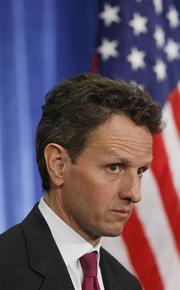
Geithner Miscasts the 1930s at the G-20 Summit; AP’s Aversa Lets Him Get Away With It

Treasury Secretary Tim Geithner is admonishing the leaders of other countries attending the G-20 summit in Toronto to keep spending like there’s no tomorrow, because if they spend like there’s no tomorrow, there will still be a tomorrow. But in the gospel according to Geithner, if they don’t spend like there’s no tomorrow, there really won’t be a tomorrow. With such blubbery logic, is it any wonder that America’s stature with the rest of the world is plummeting? Earlier this evening, Brent Baker at NewsBusters pointed to an ABC report warning that a second recession might be on the horizon if the G20 nations don’t follow the spend-spend-spend recommendations of the Obama administration. In his attempt to convince the rest of the world of the folly of being fiscally responsible, Geithner has invoked a supposed “lesson” from the 1930s. Back in mid-May, I happened to stumble on the fundamental untruth of his assertion, and will demonstrate it shortly. The Associated Press’s Jeannine Aversa let Geithner’s contention pass without challenge in her Saturday report on the summit. Here are the three relevant paragraphs from her report: Asked if the global economy could slip back into another “double dip” recession, Geithner said the answer to that question hinges on decisions made by world leaders. “It is within the capacity of the people who are going to be in those rooms together in the next few days to avoid that outcome,” he said. One of the mistakes made in the 1930s was that countries pulled back their recovery efforts too soon, prolonging the Great Depression, he said. Geithner said the United States doesn’t want to see that happen again. “What we want to do is continue to emphasize that we are going to avoid that mistake,” he said. “It’s only been a year since the world economy stopped collapsing … it will take some time to heal.” What follows is a chart showing U.S. spending and GDP from 1923 to 1940, with a partial list of unemployment rates from roughly the same time frame immediately to its right: Hoover began the federal spending ramp-up in 1931 and 1932, but Franklin Delano Roosevelt and his New Deal took spending as a percentage of gross domestic product (GDP) to the 9, well over double the level of the Coolidge years. He kept it there until 1940, after which pre-war and wartime spending kicked in. Despite all of what FDR did and tried, unemployment stayed persistently and unacceptably high. The gospel according to Geithner, as well as hard-core Keynesians like Paul Krugman at the New York Times, would tell us that FDR held up his end of the bargain by keeping the spending spigots open during the eight years that ended in 1940, and that it was the Europeans pulling back who prolonged the recession (Krugman even believes that FDR didn’t spend enough). One would therefore expect that folks living in countries that didn’t hold up their end of the spend-spend-spend bargain during that decade must have endured even more hardships than U.S. citizens did. The trouble is, as I discovered quite by accident on May 13, is that this isn’t at all what happened. In a Wall Street Journal column , Daniel Henninger quoted an eminent European economist who had passed away less than two years earlier. In the process of making a point that Henninger used about the mediocre performance of Europe during the 1990s, this historian also, when seen in the context of the graphics just presented, also made a huge point about the Europe of the 1930s: Angus Maddison, the eminent European historian of world economic development who died days before Europe’s debt crisis, wrote in 2001: “The most disturbing aspect of West European performance since 1973 has been the staggering rise in unemployment. In 1994-8 the average level was nearly 11% of the labor force. This is higher than the depressed years of the 1930s.” Whoa. Maddison’s assertion leads to these key factoids and points: Europe’s unemployment during the 1930s seldom if ever topped 11%. U.S. unemployment during the 1930s was always above Europe’s level by a few points; another source I found indicates that U.S. unemployment at one point dropped to about 12% in 1937 , but the point still stands. Europe’s “failure” to spend as Geithner thinks it should have during the 1930s doesn’t seem to have hurt it nearly as much as FDR’s insistence on continued spending hurt us. If there’s a lesson here, it’s that, absent contrary evidence, Tim Geithner is wrong and the Europeans of the 1930s were right. It would also seem that Europe’s renewed intent to rein in government spending is a wiser course than the spend-spend-spend strategy of the Obama administration (how serious the European countries are about restraining spending remains to be seen; if Europe tries to solve its problem primarily with tax increases, all bets are off). Jeannine Aversa’s relay of Geithner’s more than likely false assertion about the 1930s deserved much more skepticism that it received. Cross-posted at BizzyBlog.com .

More here:
Geithner Miscasts the 1930s at the G-20 Summit; AP’s Aversa Lets Him Get Away With It

U.S. and Brazil Lead Google’s Top 10 Censorship List. It is news to me, what about you?

U.S. and Brazil lead Google’s Top 10 Censorship List. Yes, you read that right. Brazil and the U.S. are the respective #1 and #2 on Google’s Top 10 Censorship List. China is hardly the world’s only Internet censor. According to information released April 20, 2010 which excludes China and several other countries, Brazil and the US lead the world in the number of requests for user data and for the removal of content. Keep an Eye on Big Brother To find more information reports about government requests for information and content removal, you can contact government independent organizations such as Chilling Effects and the Open Net Initiative. http://idaconcpts.com/2010/04/22/u-s-and-brazil-lead-googles-top-10-censorship-l… =rss&utm_medium=rss&utm_campaign=u-s-and-brazil-lead-googles-top-10-censorship-list added by: MotherForTruth

Forced to Cut Back, One Die-Hard Bacon Lover Learns to See the Merit in a Bit of Moderation

Photo by lisatozzi via Flickr. In my social group of foreigners living in Istanbul , the high price of pork products — unpopular eats in a predominantly Muslim country — is a constant lament. But in the countries we hail from, according to the creators of a hard-hitting recent documentary, bacon , sau… Read the full story on TreeHugger

Read this article:
Forced to Cut Back, One Die-Hard Bacon Lover Learns to See the Merit in a Bit of Moderation