Tag Archives: data

TSA Terrorizes 4 Year old in Leg Braces – Makes him Walk without Them

“The stupidity is breathtaking.” added by: JonRaymond

Possibly over Three Thousand Miscarriages: CDC Still Lying about H1N1 Vaccine Safety

(NaturalNews) In a shocking report, the National Coalition of Organized Women (NCOW) presented data in September from two different sources demonstrating that the 2009/10 H1N1 vaccines contributed to as many as 3,587 cases of miscarriage and still deaths. Despite having the data, the CDC (Centers for Disease Control and Prevention) has continued to assure pregnant women, a prime vaccine target group, and vaccine providers that the vaccine presents no risk for pregnant women. NCOW used data from their own survey of pregnant women aged 17-45 years and the Vaccine Adverse Event Reporting System (VAERS), including updates through July 11, to estimate the true number of miscarriages and stillbirths following an H1N1 flu vaccination in the U.S. NCOW estimated the number of miscarriages and stillbirths due to the H1N1 vaccine during the 2009/10-flu season to be 1,588, but they also noted that the figure was an average and that the number of miscarriages and stillbirths could have been as high as 3,587. http://arch1design.com/blog/latest_environmental_health_news/possibly-over-three… added by: heroinandcornflakes

Have we found the universe that existed before the Big Bang?

The current cosmological census is that the universe began 13.7 billion years ago with the Big Bang. But a legendary physicist says he's found the first evidence of an eternal, cyclic cosmos. The Big Bang model holds that everything that now comprises the universe was once concentrated in a single point of near-infinite density. Before this singularity exploded and the universe began, there was absolutely nothing – indeed, it's not clear whether one can even use the term “before” in reference to a pre-Big-Bang cosmos, as time itself may not have existed yet. In the current model, the universe began with the Big Bang, underwent cosmic inflation for a fraction of a second, then settled into the much more gradual expansion that is still going on, and likely will end with the universe as an infinitely expanded, featureless cosmos. Sir Roger Penrose, one of the most renowned physicists of the last fifty years, takes issue with this view. He points out that the universe was apparently born in a very low state of entropy, meaning a very high degree of order initially existed, and this is what made the complex matter we see all around us (and are composed of) possible in the first place. His objection is that the Big Bang model can't explain why such a low entropy state existed, and he believes he has a solution – that the universe is just one of many in a cyclical chain, with each Big Bang starting up a new universe in place of the one before. How does this help? Well, Penrose posits the end of each universe will involve a return to low entropy. This is because black holes suck in all the matter, energy, and information they encounter, which works to remove entropy from our universe. (Where that entropy might go is another question entirely.) The universe's continued expansion into eventual nothingness causes the black holes themselves to evaporate, which ultimately leaves the universe in a highly ordered state once again, ready to contract into another singularity and set off the next Big Bang. As alternative theories go, it's not without its merits, but there's no evidence to support it…until now. He says he's found evidence for his ideas in the cosmic microwave background, the microwave radiation that permeates the universe and was thought to have formed 300,000 years after the Big Bang, providing a record of the universe at that far distant time. Penrose and his colleague Vahe Gurzadyan have discovered clear concentric circles within the data, which suggests regions of the radiation have much smaller temperature ranges than elsewhere. So what does that mean? Penrose believes these circles are windows into the previous universe, spherical ripples left behind by the gravitational effects of colliding black holes in the previous universe. He also says these circles don't work well at all in the current inflationary model, which holds all temperature variations in the CMB should be truly random. Here's where the fun begins. If the circles are really there and are really doing what Penrose says they're doing, then he's managed to overthrow the standard inflationary model. But there's a long way to go between where we are now and that point, assuming it ever happens. The inflationary model has become the consensus for a good reason – it's the best explanation we've got for the universe we have now – and so cosmologists will examine any results that appear to disprove it very critically. There are also a couple key assumptions in Penrose's theory, particularly that all particles will lose their mass towards the end of the universe. Right now, we don't know whether that will actually happen – in particular, there's no proof that electrons ever decay. http://io9.com/5694701/does-cosmic-background-radiation-reveal-the-universe-befo… added by: pjacobs51

NBC Reporter Warns Global Warming Now Endangering the Walrus

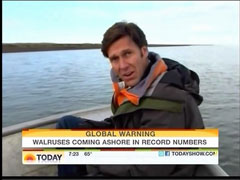
It seems like every few years there’s a new mascot for Team Global Warming. First it was the polar bear, then the Arctic fox and now it’s the walrus’s turn. On Monday’s Today show, Lee Cowan traveled to Point Lay, Alaska to report on how shrinking ice sheets are leaving walruses stranded, in between their feedings, adding: “Much like the polar bear, they can’t swim forever.” In fact it didn’t take long for Cowan to bring up the dreaded specter of global warming as he aired a soundbite of a local tribal president worrying: “I always thought the Arctic would be cold, but scientists tell us that there’s global warming going on.” Cowan even used another local resident to suggest that if something wasn’t done soon, that in 10 years “we won’t have any” animals. The following is a full transcript of the segment as it was aired on the September 20 Today show: ANN CURRY: Now to an extraordinary wildlife event taking place in northwest Alaska. Tens of thousands of Pacific walrus have crowded onto a beach near a remote village. And biologists think it is because the sea ice melted early, leaving the animals no other place to rest. NBC’s Lee Cowan is in Point Lay, Alaska with more on this story. Lee, good morning. [On screen headline: “Global Warning, Walruses Coming Ashore In Record Numbers”] LEE COWAN: Good morning, Ann. We’re about 300 miles above the Arctic Circle this morning and this is where the walrus has gathered, some 20,000 of them, at one point, over the course of the summer. And Ann, scientists are saying that this is a gathering that is so large and so unusual that scientists are now worried about the walruses’ safety. It’s the end of summer along the north slope of Alaska and in the tiny Inupiaq village of Point Lay, they wait for the ice to return. The tundra is usually already frozen by now, with snow on the ground and slush ice forming along the Chuckhi Sea. But instead, children are playing in the lagoon, barefoot, innocently oblivious to what it all may mean. LEO FERRARA, TRIBAL PRESIDENT: I always thought the Arctic would be cold but scientists tell us that there’s global warming going on. COWAN: Do you believe them? FERRARA: Yeah I believe them. COWAN: Leo Ferrara, the tribal president here, doesn’t mind that the bone-chilling 80-below winter temperatures are taking their time getting here, but he’s worried about the villages most recent resident, who need the ice to survive. COWAN LOOKING THROUGH BINOCULARS: Oh you can see them in the water. FERRARA: There you go. COWAN: The Pacific walrus, who normally rest on ice sheets floating out in the sea, have instead hauled out by the thousands at Point Lay to nap, unable to find refuge even on a small piece of sea ice. The scientists say most of it, has melted early. MARK SERREZE, NATIONAL SNOW ICE DATA CENTER: What this is telling us is that there is continuing pattern of sea ice loss in the Arctic. We may be looking at summers with no sea ice at all, or little to speak of in 20 or perhaps 30 years. COWAN: In fact a new report this month shows it’s the third lowest Arctic sea level in over 30 years. Walruses need that ice to rest on in between feeding, much like the polar bear, they can’t swim forever. ANTHONY FISCHBACH, U.S. GEOLOGICAL SURVEY: We suspect this is going to cost walruses more to make a living, when they have to commute from a coastal resting spot out to the foraging grounds, than it would cost them simply to roll of the ice and feed directly beneath them. COWAN: But that’s not the only worry. With upwards of 20,000 crammed so tightly together, easily startled mothers can often stampede, crushing newborn calves as they hurtle toward the water to safety. BILL TRACEY, POINT LAY FIRE CHIEF: Anything can spook them from a polar bear, a brown bear, a dog, a man, a boat going by, an airplane going over. COWAN: Bill Tracey is Point Lay’s fire chief. Last year he says, not far away, more than 100 walruses trampled each other to death. So until the ice comes back, strict limits are now in place. This is about as close as we can legally get to the walruses without disturbing them. From this point forward, the only people allowed in are researchers. There’s even a no fly zone over the beach, something residents here are happy to see. SOPHIE HENRY: What we have now, we have to protect what’s there, because maybe in the next 10 years we won’t have any. COWAN: A way after life for this village, a way life for the walrus, both trying to adapt to an Arctic changing faster than many expected. HENRY: The whales, the walrus, the Belugas, you know they, they live with the ice. And if it, if that all is gone, does that mean all the animals are gone too? CURRY: NBC’s Lee Cowan.

See the rest here:
NBC Reporter Warns Global Warming Now Endangering the Walrus

Why Alcohol Is Good For You

It's one of those medical anomalies that nobody can really explain: Longitudinal studies have consistently shown that people who don't consume any alcohol at all tend to die before people who do. At first glance, this makes little sense. Why would ingesting a psychoactive toxin that increases our risk of cancer, dementia and liver disease lengthen our lifespan? Well, the anomaly has just gotten more anomalous: A new study, published in the journal Alcoholism: Clinical and Experimental Research, followed 1,824 participants between the ages of 55 and 65. Once again, the researchers found that abstaining from alcohol increases the risk of dying, even when you exclude former alcoholics who have now quit. (The thinking is that ex-drinkers might distort the data, since they've already pickled their organs.) While 69 percent of the abstainers died during the twenty-year time span of the study, only 41 percent of moderate drinks passed away. (Moderate drinkers were also 23 percent less likely to die than light drinkers.) But here's the really weird data point: Heavy drinkers also live longer than abstainers. (Only 61 percent of heavy drinkers died during the study.) In other words, consuming disturbingly large amounts of alcohol seems to be better than drinking none at all. added by: 02yamahaR1

From The Gulf Stream To The Bloodstream – The Video BP Doesn’t Want You to See

From the YouTube page: Several volatile hydrocarbons found in crude oil were detected in the blood of several residents from the Orange Beach, AL area. Among the hydrocarbons tested, several were detected at abnormally high levels including ethylbenzene, xylene, hexane. These individuals were not directly involved in BP's clean-up operations, nor had they been exposed to any industrial environment where the presence of these compounds would be of concern. Therefore, it can be assumed that residents living near the Gulf of Mexico shoreline are at risk of exposure to aerosolized VOC's moving inland from the Deepwater Horizon oil spill. The blood test performed on these individuals is called the Volatile Solvents Profile (Metametrix.com). The test can be obtained and administered by any physician with the ability to perform a simple blood draw. The test will be shipped to a laboratory for analysis and returned to your doctor for interpretation and treatment. The Gulf of Mexico is facing a significant threat to human health, which needs to be documented in a stringent and concrete manner. A multitude of symptoms have been reported ranging from subtle to severe; these include skin rashes and infections, upper respiratory burning, congestion and cough, headaches, nausea, vomiting, and neurological symptoms such as short-term loss of memory and coordination. Please report symptoms to the Project Gulf Impact health line: (504) 814-0283 Project Gulf Impact is currently raising funds to provide further testing to residents who cannot afford the associated costs. To provide assistance please donate at ProjectGulfImpact.org/donate. To send information or inquire on this effort please email ProjectGulfImpact@gmail.com . ~~~ http://theintelhub.com/2010/09/05/from-the-gulf-stream-to-the-bloodstream/ When Is Enough, Enough? For nearly five months, the BP oil disaster has consumed the minds of millions of people worldwide. In addition to the horrific impacts that the crude oil and chemical dispersants have daily on the environment and the economy, a fatal threat has quietly slipped by the public’s proverbial radar. The harm dealt by this silent enemy is beginning to creep into the lives of those living and working in the Gulf. The problem has been lurking in the Gulf since the first days of the BP oil spill and now has the potential ignite a disaster unlike any this country has ever seen. The test results can been seen here: ■Blood Test Results ■Blood Test Results Who is this masked bandit? What is this mysterious force that has the potential to outpace the spill’s catastrophic events thus far? Though it may sound like a simple answer, (and it is not easy to swallow) the truth is that this tragedy is silent, and if you live in the Gulf, it is most likely affecting you right now as you read this. What is it? Your health may be in extreme jeopardy due to the toxic effects of the dispersant Corexit and volatile organic compo unds (VOCs) from crude oil inundating the air. Through recent studies conducted under the combined efforts of Michelle Nix of Gulf Coast Oil Spill Volunteers, Jo Billups and Karen Harvill of Sassafrass, Dr. Robert Naman, Project Gulf Impact, medical professionals, and the brave Gulf residents who have agreed to be tested, the toxic health effects of the poisons in the air and in the sea have been documented for the first time. The results? This stands to become one of the greatest health tragedies The United States has ever seen. If this is such a powerful threat, why has it gone so under reported for so long? Why is mainstream media ignoring these potentially large-scale health problems? The scenario’s biggest problem is the scenario itself. Perpetrated by a corporation, the influx of relief that would ordinarily stream in after most acts of God has quietly gone elsewhere. Why is this killer so silent? Why have we not heard much about the disastrous health effects of this oil and dispersant in the air? Why are everyday citizens not catching on to what gargantuan health problems are coming in the not-so-distant future, affecting everyone, even the journalists who should be reporting on it? The answer may seem strange, and it is complex, however the biggest problem facing this mounting horrific scenario is… the BP oil spill was not a hurricane. The oil spill disaster in the Gulf of Mexico will go down in history as one of the biggest catastrophes this planet has ever seen. Books are already being written on how much we didn’t know. The cover up and the lies that led this country into the health crisis we are about to face will be documented in years to come. Acts of God, like hurricanes, are fast and furious, the damage is immediate. This, on the other hand, is a slow death. With a hurricane, we know the death toll, the devastation right away. We see the bodies, the houses underwater, and the numbers of dollars lost in real-time as all of the data floods the national spotlight in the aftermath of the disaster. With disasters like Hurricane Katrina, our heartstrings are tugged as we witness cities underwater, mothers crying out for their children, and the newly homeless wandering the streets. We are used to hurricanes. We have evacuation routes. Whether they function or not, we have plans in place for disasters like these. No such plan exists for the victims of an oil spill. Instinctively, we are aware of floods, fires, earthquakes, hurricanes, tornadoes, and other “over the counter” disasters. Most of us have never suffered an oil spill, much less have any notion of what to do in the event of one. The problem we are facing now transcends most disasters this nation has suffered in the last century. The oil spill, and our ensuing response, has created a darker and deadlier aftermath that will persist for decades. The difference is between a swift and lethal blow verses lingering end-stage cancer. Like the first stage of cancer, which often goes long-undetected, this aftermath is a slow, deadly creep. We are entering stage one of the Gulf residents’ proverbial “cancer”. What BP, Thad Allen, The Federal Government, and The EPA Don’t Want You To Know The residents of the Gulf of Mexico are entering a crisis whose scope cannot be calculated. Several symptoms have been reported, from subtle to severe: skin rashes and infections, upper respiratory burning, congestion and cough, headaches, nausea, vomiting, and neurological symptoms including short-term memory loss and coordination problems. These health problems, if acknowledged at all, are mis-diagnosed, buried, and mis-attributed. Amidst a vacuum created by the unwillingness of federal, state, and private sector medical organizations to address the growing health problems, independent, privately-funded groups like Gulf Coast Oil Spill Volunteers (GCOSV), Sassafrass, and Project Gulf Impact have taken matters into their own hands. Patterns are emerging. (con't in comments) added by: samantha420

TIME: Rising Unemployment Rate Is Good News

The following headline appeared at Time.com shortly after the release of Friday’s jobs report: What’s Good About Rising Unemployment What should jump out at the eagle-eyed reader is that headline didn’t end with a question mark. Time senior writer Stephen Gandel was actually making the case that the rising unemployment rate was good news. Watch just how far a liberal media member is willing to go today to make economic data look favorable for the Party currently in power, and imagine the unlikelihood of such a thing happening if a Republican was in the White House (h/t Rusty Weiss ): The unemployment rate, probably the most famous of economic gauges, may actually be a very bad indicator of how healthy the economy is. The unemployment rate peaked in late 2009 at just above 10% and has been mostly falling ever since. But the hiring numbers, or less firing numbers, have only been improving recently. So what was going on? The unemployment rate tracks not just how many people have jobs, but how many people are looking for jobs. And, up until August, the number of people looking for jobs was dropping rapidly. Really? And just how did Gandel reach that conclusion? Here is the Bureau of Labor Statistics’ table of folks 16 and over currently out of the labor force but wanting a job now: As is plainly visible, the number of folks out of the labor force but wanting work has been fluctuating between 5.61 million and 6.31 million since last August. It did experience a large drop in May, but has pretty much been rising since and is now basically where it was in April and January. As such, claiming that “up until August, the number of people looking for jobs was dropping rapidly” is utter nonsense not supported by the data. In fact, this number is basically right back to where it was last September. With that in mind, let’s continue: When people give up looking for work, essentially giving up on the economy, that indicates a really bad drop in confidence, something a recovery feeds on. So the reason the unemployment rate was rising has less to do with more people getting jobs, and more to do with fewer people looking. Is this really a senior writer?  Let’s walk through that last sentence again: “So the reason the unemployment rate was rising has less to do with more people getting jobs…” Huh? The unemployment rate is a simple arithmetic equation whereby the number of people unemployed is divided by the number of people considered part of the labor force.  Using data just released Friday, there are currently 14.86 million people considered unemployed. The labor force is 154.11 million. This produces an unemployment rate of 9.64 percent. Now, when people get jobs, the number considered unemployed declines reducing the numerator and therefore decreasing the unemployment rate. As such, to claim rising unemployment has less to do with more people getting jobs makes absolutely no sense. On the other hand, the final part of that sentence “and more to do with fewer people looking” needs to be addressed. “Discouraged workers” – those out of the labor force but wanting a job – can have a huge impact on the unemployment rate. The way these numbers are calculated, you are only considered unemployed and part of the labor force if you’re actively looking for work. As such, when folks give up their search, it reduces the number of unemployed and the labor force by an equal amount. Once again going back to simple arithmetic, a decrease in the numerator and denominator by an equal amount results in a lower ratio. 2 divided by 3 equals .67; 1 divided by 2 equals .5. With this in mind, the unemployment rate can decline simply by discouraged job seekers ending their search. This has happened a number of times in the past few years. Conversely, discouraged workers re-entering the labor force can cause the unemployment rate to rise. An increase in the numerator and denominator by equal amounts produces a higher result. Gandel claimed this is what happened last month: According to today’s report, 550,000 people entered the workforce in August. That’s a huge jump of new people looking for work, either because they haven’t worked before or because they decided that this was the month to get back off the couch and start looking. With that many people entering the workforce, the fact that the unemployment number only rose 0.1% is quite a good thing. In fact, more than half of those people who began looking for work in August, or 290,000, landed a job in August.  I agree that this this could be good news, but not necessarily for the same reason. To make the case that the big jump in the labor force in August was even partially due to discouraged workers starting to look for work again goes against the data as the number of people out of the labor force and wanting work now increased by 86,000. It goes without saying that if this huge increase in the labor force was caused by discouraged workers re-entering it, the number of discouraged workers wanting work should have declined. But that’s not what happened. Instead, it appears the August data might have been confounded by seasonalities and the associated adjustments. As employment watchers are painfully aware, there are seasonal changes in the jobs market that make for wild shifts in the numbers depending on the month. The summer is a particularly volatile period with teachers out of work, students taking part-time jobs, and graduates getting full-time positions. To smooth out the data, the Labor Department makes adjustments to the raw figures each month; the headline numbers are always “seasonally adjusted.” However, these manipulations at times present a peculiar picture of the labor market. As Gandel correctly pointed out: It is possible that coming at the end of the summer an uptick in people looking for work is not as positive as it appears. This is the time of year, after two hot months, when recent graduates start to actually think about their future and send out resumes. And you can image many other out of work people deciding to take off looking for a job in the summer. In August, with the summer ending, some of those people started looking again in earnest. Exactly. As such, the uptick in the labor force might have had little to do with discouraged workers beginning a new search as he suggested earlier.  In fact, the unadjusted data actually showed a 600,000 decline in the labor force as well as an almost 400,000 decrease in the number of people unemployed. This means the August data could easily be confounded by seasonalities and their related adjustments thereby offering a fuzzy picture about what any of this means going forward. This is not to say Friday’s report wasn’t better than expected. Over the past couple of weeks, signs had been pointing to a much worse economic conditions leading analysts to ratchet down their estimates for these numbers. As a result, what the BLS released Friday was certainly better than the gloomiest predictions out there. But, calling this clearly mixed bag “good news” should be left to the administration and the Party currently controlling Congress and not so depicted by a so-called journalist.   This seems especially true given that these exact same numbers would certainly not have been reported with such optimism when George W. Bush was in the White House. Or have you forgotten the media’s favorite economic term during his presidency “jobless recovery?”

Read more:
TIME: Rising Unemployment Rate Is Good News

The Salt of the Earth – Struggle of People Who Became Immigrants Because America Took Their Land

Salt of the Earth – Herbert Biberman (1954) Pel

ISRAEL’S PRE-ELECTION ATTEMPT TO DEFLECT A NEW 9/11 INVESTIGATION By Gordon Duff STAFF WRITER/Senior Editor

Nila Sagadevan is an aeronautical engineer and a pilot. There are some who maintain that the mythical 9/11 hijackers, although proven to be too incompetent to fly a little Cessna 172, had acquired the impressive skills that enabled them to fly airliners by training in flight simulators. What follows is an attempt to bury this myth once and for all, because I’ve heard this ludicrous explanation bandied about, ad nauseam, on the Internet and the TV networks—invariably by people who know nothing substantive about flight simulators, flying, or even airplanes. A common misconception non-pilots have about simulators is how “easy” it is to operate them. They are indeed relatively easy to operate if the objective is to make a few lazy turns and frolic about in the “open sky”. But if the intent is to execute any kind of a maneuver with even the least bit of precision, the task immediately becomes quite daunting. And if the aim is to navigate to a specific geographic location hundreds of miles away while flying at over 500 MPH, 30,000 feet above the ground the challenges become virtually impossible for an untrained pilot. And this, precisely, is what the four hijacker pilots who could not fly a Cessna around an airport by themselves are alleged to have accomplished in multi-ton, high-speed commercial jets on 9/11. For a person not conversant with the practical complexities of pilotage, a modern flight simulator could present a terribly confusing and disorienting experience. These complex training devices are not even remotely similar to the video games one sees in amusement arcades, or even the software versions available for home computers. In order to operate a modern flight simulator with any level of skill, one has to not only be a decent pilot to begin with, but also a skilled instrument-rated one to boot — and be thoroughly familiar with the actual aircraft type the simulator represents, since the cockpit layouts vary between aircraft. The only flight domains where an arcade/PC-type game would even begin to approach the degree of visual realism of a modern professional flight simulator would be during the take-off and landing phases. During these phases, of course, one clearly sees the bright runway lights stretched out ahead, and even peripherally sees images of buildings, etc. moving past. Take-offs—even landings, to a certain degree—are relatively “easy”, because the pilot has visual reference cues that exist “outside” the cockpit. But once you’ve rotated, climbed out, and reached cruising altitude in a simulator (or real airplane), and find yourself en route to some distant destination (using sophisticated electronic navigation techniques), the situation changes drastically: the pilot loses virtually all external visual reference cues, and is left entirely at the mercy of an array of complex flight and navigation instruments to provide situational cues (altitude, heading, speed, attitude, etc.) In the case of a Boeing 757 or 767, the pilot would be faced with an EFIS (Electronic Flight Instrumentation System) panel comprised of six large multi-mode LCDs interspersed with clusters of assorted “hard” instruments. These displays process the raw aircraft system and flight data into an integrated picture of the aircraft situation, position and progress, not only in horizontal and vertical dimensions, but also with regard to time and speed as well. When flying “blind”, I.e., with no ground reference cues, it takes a highly skilled pilot to interpret, and then apply, this data intelligently. If one cannot translate this information quickly, precisely and accurately (and it takes an instrument-rated pilot to do so), one would have ZERO SITUATIONAL AWARENESS. I.e., the pilot wouldn’t have a clue where s/he was in relation to the earth. Flight under such conditions is referred to as “IFR”, or Instrument Flight Rules. And IFR Rule #1: Never take your eyes off your instruments, because that’s all you have! The corollary to Rule #1: If you can’t read the instruments in a quick, smooth, disciplined, scan, you’re as good as dead. Accident records from around the world are replete with reports of any number of good pilots — I.e., professional instrument-rated pilots — who ‘bought the farm’ because they ‘lost it’ while flying in IFR conditions. Let me place this in the context of the 9/11 hijacker-pilots. These men were repeatedly deemed incompetent to solo a simple Cessna-172 — an elementary exercise that involves flying this little trainer once around the patch on a sunny day. A student’s first solo flight involves a simple circuit: take-off, followed by four gentle left turns ending with a landing back on the runway. This is as basic as flying can possibly get. Not one of the hijackers was deemed fit to perform this most elementary exercise by himself. When professional airline pilots, the majority trained by the United States Air Force, were asked to recreate the New York 9/11 attack in a flight simulator, two thirds failed entirely. None could duplicate the Pentagon attack at all. This is what the pilots had to say: “Regarding your comments on flight simulators, several of my colleagues and I have tried to simulate the ‘hijacker’s’ final approach maneuvers into the towers on our company 767 simulator. We tried repeated tight, steeply banked 180 turns at 500 mph followed by a fast rollout and lineup with a tall building. More than two-thirds of those who attempted the maneuver failed to make a ‘hit’. How these rookies who couldn’t fly a trainer pulled this off is beyond comprehension.” .Much more at the link…… http://canadiansforpalestine.ning.com/profiles/blogs/israels-preelection-attempt… added by: treewolf39

New Study Shakes Up Scientists’ View of California’s San Andreas Earthquake Risk

Study shakes up scientists' view of San Andreas earthquake risk Researchers find major quakes on the southern section, on average, every 88 years — three times as often as previously thought. It's the strongest evidence yet that we're overdue for a massive quake. San Andreas fault study Photo: Sarah Robinson, 23, a graduate student at Arizona State University, runs along a trench at the Bidart Fan sector of the San Andreas fault in June 2009. She is on a team of geologists trying to construct a history of earthquakes on the San Andreas fault by reading lines of sediment in the earth. (Ricardo DeAratanha / Los Angeles Times / June 1, 2009) ___ By Rong-Gong Lin II, Los Angeles Times August 21, 2010 Southern California is long overdue for a major earthquake along the San Andreas fault, according to a landmark study of historic seismic activity released Friday. The study, produced after several years of field studies in the Carrizo Plain area about 100 miles northwest of Los Angeles, found that earthquakes along the San Andreas fault have occurred far more often than previously believed. For years, scientists have said major earthquakes occurred every 250 to 450 years along this part of the San Andreas. The new study found big temblors on the fault every 88 years, on average. The last massive earthquake on that part of the fault was in 1857, leading scientists to warn that another such temblor is likely in Southern California. “The next earthquake could be sooner than later,” said Lisa Grant Ludwig, a UC Irvine earthquake expert and co-author of the study, which was published online in the journal Geology. “It was thought that we weren't at risk of having another large one any time soon. Well, now, it might be ready to rupture.” Other seismic experts described the revelation as a major change in the way they think about earthquake risks along the southern San Andreas fault. Thomas Jordan, director of the Southern California Earthquake Center, said the fault is “locked and loaded. It's been a long time since an earthquake has occurred on that fault — over 150 years.” To reach the new conclusion, scientists dug trenches deep into the Carrizo Plain. They used carbon dating and sophisticated imaging technology known as lidar to find signs of earth movements. They were able to detect earthquakes dating back to the 15th century, creating a far more complete record than had previously been known. The research found that earlier examinations of the San Andreas had badly undercounted the number of major earthquakes. Those were based on observations made in the 1970s when scientists used measuring tape to look for evidence of past earthquakes. “Now we have better techniques,” Grant Ludwig said. “We can see there's actually more earthquakes.” Scientists now estimate that earthquakes occurred on that section of the fault in 1417, 1462, 1565, 1614 and 1713. The finding adds weight to the view of many seismologists that the San Andreas has been in a quiet period and that a major rupture is possible. A 2009 study, which Grant Ludwig also participated in, suggested that the San Andreas was overdue for a rupture. But Friday's report offers a much more grim estimate of how frequently quakes have occurred on that segment of the fault. The San Andreas fault is considered one of the most dangerous in Southern California, partly because it is so long that its southern section is capable of producing a temblor as large as magnitude 8.1. By contrast, earthquake experts consider 1994's destructive 6.7-magnitude Northridge quake, which occurred on a different fault, to be a medium-sized quake. The San Andreas is a sleeping giant. It's hard to imagine the power of a huge quake on the southern section because the last one occurred more than a century ago when the area was sparsely populated. Just 4,000 people lived in Los Angeles at the time. The 1857 temblor, with an estimated magnitude of 7.9, is known as the Fort Tejon quake, but that's a bit of a misnomer because it is thought to have started farther north, way up in Parkfield in Monterey County. The quake then barreled south on the San Andreas for about 200 miles, through Fort Tejon near the northern edge of what is now Los Angeles County, then east toward the Cajon Pass in San Bernardino County, near what is now the 15 Freeway. The quake was so powerful that the soil liquefied, causing trees as far away as Stockton to sink. Trees were also uprooted west of Fort Tejon. The shaking lasted 1 to 3 minutes. The study was conducted by scientists at UC Irvine and Arizona State University. As preliminary data went out for peer review, other earthquake scientists immediately took note. The U.S. Geological Survey was so concerned that it dispatched its own team of investigators to the Carrizo Plain to look over the initial findings and review the evidence in the trenches. “These investigators really were challenged by their scientific peers,” said Ken Hudnut, a geophysicist at the U.S. Geological Survey. “And they made it through. They ran the gantlet and came through with a really solid paper.” Hudnut said the “Big One” wouldn't compare to most quakes Californians have endured. Such a large quake on the San Andreas, generally above a magnitude 7, would send enormous V-shape energy waves spreading out from the fault. If the earthquake energy hit the Los Angeles Basin, the soft sediment underneath it could actually amplify the waves, making the shaking worse. Hudnut said the study offers both “bad news and good news,” noting that it also concluded future earthquakes along that section of the San Andreas could be smaller than the 1857 quake. “It's not the kind of news that ought to make people crawl into the fetal position. Rather, it's the kind of information that ought to once remind people about basic earthquake preparedness,” Hudnut said. Grant Ludwig said her research should motivate people to prepare. “If you're waiting for someone to tell you when we're close to the next San Andreas earthquake, just look at the data,” she said. “If we look at the only data we have, it's not very comforting. I'm preparing for that possibility.” added by: EthicalVegan