Tag Archives: deficit

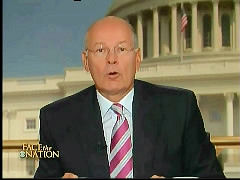
CBS’s Harry Smith on Face the Nation: No Time to ‘Continue Cutting Taxes,’ So ‘What About, Say, Something Like a New WPA?’

Filling in for Bob Schieffer as host of Face the Nation , Early Show co-host Harry Smith brought his liberal sensibilities to the Sunday show, pressing his economic panel to agree the Bush tax cuts should not be extended, the stimulus was too small and so another would be wise – even suggesting a return to an FDR-era government make-work jobs program: “What about, say, something like a new WPA?”   Presuming the pre-2003 levels are the real rates, Smith questioned Gretchen Morganson of the New York Times: “Is now the time to continue cutting taxes if there is this overwhelming deficit out there?” He soon cued up White House economic adviser Laura Tyson to agree with his premise: “Should the Bush tax cuts stay in place for the middle class but be rescinded for the top wage earners?” Turning back to Morganson, Smith showed exasperation with public opposition to government spending programs as he wondered if the stimulus wasn’t big enough: I want to go back to the stimulus because as so many of these Congress folks are going back out of their districts and people complain about the size of government, they’re complaining about the deficit, they’re complaining about TARP and who knows what all else. As we’re standing here looking at it right now, just if you can step away, was the stimulus big enough? Morganson afirmed “the stimulus was not big enough” and Smith next pushed Mark Zandi, of Moody’s Analytics: “There are plenty of economists out there, Mark Zandi, who say what’s needed is is a second stimulus. Could those words cross your lips?” After Zandi’s reply, Smith arrived at his Works Progress Administration idea: All right. Laura Tyson, what about a more significant stimulus, beyond the things, these, you know, a block here, a block here, a block here, but another say couple hundred billion dollars, what about say something like a new WPA? Tyson used that as a cue to advocate more “infrastructure” spending. The CBSNews.com posting summarizing the program reflected Smith’s agenda, “ Economists: Second Economic Stimulus Needed .” From the Sunday, September 5 Face the Nation on CBS, picking up a few minutes into the segment: HARRY SMITH: Gretchen, let me ask you this. This whole idea of the President talking about moving in the right direction, wanting to pick up the pace. Is there a pre-dominant idea of what it is that is hindering the economy from catching fire? GRETCHEN MORGANSON, NEW YORK TIMES: Definitely. It is debt. We had a debt binge the likes that we have hardly ever seen before. Frankly, Harry, it just takes a long, long time to get that out of the system. We’re still really working down the debt that homeowners took on. And it’s a difficult and really excruciating process. You can’t do it overnight. SMITH: Which brings up the whole idea, Gretchen, of this debate: Is now the time to continue cutting taxes if there is this overwhelming deficit out there? MORGANSON: Well, I think what you have to worry about immediately is job creation and let’s just forget about the deficit for the moment because when you have the unemployment rate where it is now and you have incomes really being stretched, I think that that is the key to any kind of activity and economic activity by consumers is an enormous part of our economy. That is really why we are in such dire straits. SMITH: Which is maybe one of the ideas that has to be in play is do we have the wrong model to begin with? I want to get back to that in a second. First, though, I want to talk about the Bush tax cuts which are due to expire in January. Laura Tyson, should the Bush tax cuts stay in place for the middle class but be rescinded for the top wage earners? LAURA TYSON: I think that is the right thing to do… …. SMITH, TO MARK ZANDI: Because you hear small business owners say if those tax cuts come back, I’m not going to hire a single person. I mean, that’s anecdotal, but is that really the predominant feeling among small businessmen? …. SMITH: Gretchen Morganson, I want to go back to the stimulus because as so many of these Congress folks are going back out of their districts and people complain about the size of government, they’re complaining about the deficit, they’re complaining about TARP and who knows what all else. As we’re standing here looking at it right now, just if you can step away, was the stimulus big enough? MORGANSON: The stimulus was not big enough… SMITH: One of the things you write so much about for the Times is the housing market. One of the other ideas that’s out this this week is this notion of giving people whose homes are underwater, mortgage holders whose homes are underwater, the opportunity to get out. People who are paying their mortgages, but to get out from underwater and basically handing the federal government the bill. In the short term, or even in the long term, Gretchen, does that seem like a viable option? And oh, by the way, we should say the government’s efforts on some of these levels have not been particularly good in the last two years. MORGANSON: That’s right. I mean, I think that the devil is in the details. The HAMP program has been a big disappointment. That was the helping homeowners, the initial program that treasury put out there. It’s been very disappointing. I think these matters are so complicated with so many different people and debt, second loans, first loans, it’s really very complex. And I just don’t see how it’s going to provide immediate help, the kind that we really need. SMITH: So is it time — it’s crazy to even talk about — but there are plenty of economists out there, Mark Zandi, who say what’s needed is is a second stimulus. Could those words cross your lips? MARK ZANDI: Well, we are talking about other stimulus, right? I mean, An r&d tax credit, payroll tax holiday. Job tax credit. All these things are different forms of stimulus. In fact, the federal government has provided a couple hundred billions dollars in additional stimulus beyond the recovery act stimulus that we put in place a year-and-a-half ago. We are doing that. In my view the recovery needs more help. It would be prudent, I think, to provide some additional help through some of the things that we’re talking about. SMITH: All right. Laura Tyson, what about a more significant stimulus, beyond the things,  these, you know, a block here, a block here, a block here, but another say couple hundred billion dollars, what about, say, something like a new WPA? LAURA TYSON: Well I believe that we should look at infrastructure because we know before the recession, before the great recession, we know that we were vastly underspending on the nation’s infrastructure. You can sort of, therefore, start with the notion that infrastructure spending is terrific in two ways. It creates demand right away when you go out and get the project start and get the worker started. It also creates the ability to grow and be productive in the future. SMITH: Although Japan tried that and they don’t have a lot to show for it.
See the original post here:
CBS’s Harry Smith on Face the Nation: No Time to ‘Continue Cutting Taxes,’ So ‘What About, Say, Something Like a New WPA?’

Senate Passes $600 Million Border Bill!

In the briefest of sessions and without the slightest bit of the usual acromony in the Senate chamber these days, members unanimously approved a $600 million border enhancement bill Thursday (8/12/2010) that increases the boots on the ground at the US border with Mexico. 1000 more Border Patrol Agents and 250 Customs and Border Protection Officers, as well as the deployment of unmanned surveillance drones. Sen. Chuck Schumer (D-NY) was the Bill's author, with help from Sen. Ben Cardin (D-MD). The Bill itself is not without some controversy, however, despite it's overwelming Congressional approval. The Bill now heads to the Presidents desk for his signature. added by: thetrimsmith

Stewart Exposes GOP Hypocrisy: Extending Bush Tax Cuts Won’t Lower Deficit (VIDEO)

Last night on “The Daily Show” Jon Stewart took on Republicans for their dramatic words about the deficit and simultaneous defense of the Bush tax cuts. While conservative pundits refer to the deficit as “crushing” and dangerous to our “children and grandchildren,” Stewart worried that the GOP doesn't understand what's causing the deficit they fear so much in the first place. “Do they not realize that the tax cuts strengthen the deficit monster that's going to eat our babies?” According to Fareed Zakaria, letting the Bush tax cuts expire at the end of this year would reduce the deficit by 30%. Still, conservatives such as John McCain and John Boehner argue that we should extend the tax cuts and not raise taxes. Amazed at how two opposing ideas can exist on the same party platform, Stewart asked, “how exactly can you be for deficit reduction and extending tax cuts?” before airing a clip wherein Sarah Palin argues for both in the same sentence. Other conservatives argued that the money the government earns in taxes isn't the same as the money they spend, so the tax cuts will not affect the deficit. To this, Stewart responded with the famous “F**k you, pay me” scene from “Goodfellas.” “The deficit doesn't care where [the money] comes from,” Stewart said. added by: TimALoftis

NBC’s Andrea Mitchell Hits Democrat From the Left on Bush Tax Cuts

On the Wednesday edition of her self-titled MSNBC show, Andrea Mitchell actually hit a Democratic Senator from the left on tax cuts. Democratic Indiana Senator Evan Bayh appeared on Andrea Mitchell Reports to offer his support to extending the Bush tax cuts as a way to stimulate the economy but a skeptical Mitchell pressed: “Senator, given the deficit and the wealth of the upper class, and the fact that they sit on their money and put it into savings, why give them this tax break?” Bayh went on to tell the NBC correspondent that raising taxes “will lower consumer demand at a time we want people putting more money into the economy” and pointed out “the people you’re referring to, in those upper brackets, are the ones that make decision about hiring and making investments.” The undeterred Mitchell responded with the Obama administration line that “you should extend the tax cuts for the middle class but not for people making more than $250,000 a year.” Bayh, delivering a basic economics lesson, reminded Mitchell that while “middle class taxpayers are using the extra money to pay down debt, credit card bills, mortgages, things like that…It’s the people in the upper brackets who continue to spend at a higher rate, propping up consumer demand” and insisted “If we want people to hire more individuals, if we want them to make business investments, raising burdens on them probably doesn’t improve their optimism, confidence and discourages rather than encourages them to do those kinds of things.” However, Bayh did relent when he offered to Mitchell that eventually the tax rates “are probably going to have to go up but it ought to be as part of a comprehensive deficit reduction package.” The following exchange was aired on the August 4 edition of MSNBC’s Andrea Mitchell Reports: ANDREA MITCHELL: July’s official unemployment numbers due out Friday but an independent study says that the U.S. economy added only 42,000 private sector jobs last month. That is sluggish. That sluggish growth and the overall weak economy has Republicans and even some Democrats rallying against letting any of the Bush tax cuts expire, including the ones for the upper class. And joining us now Democratic Senator Evan Bayh, one of those Democrats that serves on the Banking and Small Business committees . Senator, given the deficit and the wealth of the upper class, and the fact that they sit on their money and put it into savings, why give them this tax break? SEN. EVAN BAYH: Well, a couple of things, Andrea. First, as you noted, the economy is very weak right now. And raising taxes will lower consumer demand at a time we want people putting more money into the economy. Secondly, the people you’re referring to, in those upper brackets, are the ones that make decisions about hiring and about making investments. We want them to do more of that, and so raising burdens on them during a time like this is just not the right thing to do. Now once the economy has a head of momentum under it, a self-sustaining recovery, we’re adding jobs, not the forty-some thousand you mentioned, but more than 100,000 – 200,000 every month then we can pivot and look at deficit reduction. Because in the long run I share that, the concern about that. But right now we want to emphasize growth and getting the economy moving and then pivot and get the deficit down. MITCHELL: Well what do you say to the White House and their position is that you should extend the tax cuts for the middle class but not for people making more than $250,000 a year. BAYH: Well, a couple of things. There’s some evidence that’s come out recently that middle class taxpayers are using the extra money to pay down debt, credit card bills, mortgages, things like that. That’s a good thing to do but it doesn’t stimulate the economy. It’s the people in the upper brackets who continue to spend at a higher rate, propping up consumer demand. And then there’s the point that I mentioned. If we want people to hire more individuals, if we want them to make business investments, raising burdens on them probably doesn’t improve their optimism, confidence and discourages rather than encourages them to do those kinds of things. And the final point that I make, Andrea is, eventually those rates are probably going to have to go up but it ought to be as part of a comprehensive deficit reduction package combined with spending enforceable spending restraint. To just go out and raise taxes with no spending restraint, particularly during a recession, it’s just not the right time to do that. MITCHELL: Well at this stage, as you’re leaving the Senate. You don’t have to worry about the political fallout in, in the midterm elections, but are your colleagues going to go along, your Democratic colleagues, go along with extending the tax breaks for the, for the rich? BAYH: No, the vast majority of them won’t. I suspect that there will be three or four or five of us who have qualms about that. But I won’t identify the member but someone who you would quickly recognize as a very liberal member of the caucus yesterday was speaking up about she happened to believe that raising taxes on anyone making less than $8 million a year, at this moment, was not the right thing to do. So even some of the more liberal MITCHELL: Eight million?! BAYH: No, no $1 million. I’m sorry, $1 million. MITCHELL: Okay. BAYH: I should enunciate more clearly. $1 million a year was not the right thing to do. So this debate has a ways to go. We need to do two things in sequence. Number one, err on the side of more stimulus for the economy, getting it moving. That means not raising taxes right now when it’s very sluggish as you pointed out. And then a real focus on deficit reduction starting with spending restraint. And then if we have to raise revenue, which in all likelihood we probably will, focusing on the people who are in the position to help us do that best but not now. MITCHELL: Evan Bayh from the Senate. Thank you very much.

Read the original here:
NBC’s Andrea Mitchell Hits Democrat From the Left on Bush Tax Cuts

CBO Notes YTD Deficit Tops $1 Trillion; Reality Is Much Worse

On Wednesday, the Congressional Budget Office released its Monthly Budget Review for June . It estimated that June’s deficit was “only” $69 billion, down from $94 billion last year, and that the deficit through nine months of the current fiscal year is $1.005 trillion, down from last year’s $1.087 trillion. June’s single-month improvement — or more properly stated, its less disastrous result — is probably legitimate, because collections have picked up a bit. But, as I noted in April (at NewsBusters ; at BizzyBlog ), the reported year-over-year deficit reduction, such as it is, has nothing to do with anything resembling control of government spending. What follows was my explanation at the time, which still holds, and which you will more than likely not see in any media coverage of the government’s financial situation when the Treasury Department releases its official monthly statement next week (also see the chart below the jump which shows what the deficit really is after adjustment): Most of the general public believes that the government is reporting its results on a cash basis, i.e., that “receipts” means “money that came in” and that “outlays” means “disbursements.” Until early last year, with one very small exception, that was the case. But that’s so pre-Obama. Since Treasury converted TARP and other bailout programs (with the exceptions of Fannie Mae and Freddie Mac) to Net Present Value accounting last year, this is how things roll: When the government “lends or invests” in banks and auto companies, the monies disbursed are treated as “investments,” and are included in “outlays.” Assuming no impairment in value or collectability, there are no receipts when the original amounts “invested” are repaid. Interest or dividends received are treated as “receipts” (euphemistically called “transfers from the Federal Reserve” by our oh-so-transparent Treasury). But if it looks like some of the “invested” funds won’t be repaid, the government will write down the value of those investments to what it thinks will be repaid. If it overestimates the impairment, it revalues its investments upward, and reduces reported “outlays.” This is what happened in March, to the tune of $115 billion. In essence, what happened is that the administration pushed as much “bad news” (asset writedowns) as it could into last year’s financial reporting, since last year was going to be a disaster no matter what. But since they overdid it with the writedowns last year (“Gosh, how did that happen?”), they can make this year look better than it really has been. With that explanation as background, here is a comparison of what CBO presented with what things really look like when the $115 billion above is put in its proper place, i.e., last year (changed line items are in red boxes): Real spending is over 6% higher than last year’s already ridiculous total. The adjusted deficit after putting the accounting estimate described above where it belongs, has increased by over 15%. This will be important to remember, because if the Obama administration continues to suffer from its “Recovery Summer” delusion, you can expect to hear the President and his apparatchiks claim that they are already starting to reduct the deficit, and their statist-compliant establishment media buds to relay the “news” without skepticism. The truth is that they’re reducing nothing — except, the longer their fiscal mismanagement goes on, our capacity to respond to their continually building disaster. Cross-posted at BizzyBlog.com .

Read the original:
CBO Notes YTD Deficit Tops $1 Trillion; Reality Is Much Worse

Santelli’s Simple Answer to Deficit: ‘Stop Spending, Stop Spending, Stop Spending!’

If it were only that simple – that is the way CNBC’s Rick Santelli would have it. On CNBC’s June 28 “Squawk Box,” CNBC’s senior economics reporter Steve Liesman vigorously defended the need for higher tax rates as a measure to cut federal deficits. Others argued that government revenues would increase if tax rates were lower because it would stimulate growth. (h/t Real Clear Politics Video ) “Let me get this straight – all you guys want to cut taxes en route to bringing down the deficit?” Liesman asked. But according to Santelli, it has nothing to do with taxes, but the role of government in the economy. “No, I didn’t say anything about taxes, Steve,” Santelli shouted. “I want the government to stop spending! Stop spending, stop spending, stop spending, stop spending! That’s what we want, stop spending!” Liesman continued his defense of higher taxes, arguing they wouldn’t “pay for themselves,” but Santelli followed up with a suggestion for Liesman. “I just keep saying what the data show,” Liesman said. “The data show tax cuts don’t pay for themselves.” “You wouldn’t know data if it bit you on the nose,” Santelli, the CME Group reporter, said. “Go read some Austrian economists instead of the funny pages.” And Santelli suggested Liesman try a change of venue to get a better understanding of economics. “Go back to Russia where you understand the state and the citizen,” Santelli said. However, “Squawk Box” co-host Becky Quick said the government is occasionally needed to step and she alluded to the near financial collapse and ultimate passage of TARP in 2008. “I’m on Steve’s side on this,” Quick said. “There are times when the government has to step in. I think probably what happened two years ago was the time.” But that has caused a political backlash, demonstrated by European nations and their lack of willingness to employ government-spending policies. “Yes they did and a couple of trillion of dollars later they’re [the federal government] done because the taxpayers are the people voting and they’re done, Steve,” Santelli said. “Talk all you want, they’re done. Merkel’s done. Europe’s done because the voting electorate has said their done.” Liesman stuck to his line of reasoning argued the deficit was directly correlated to the economy and not as much as the amount government spending. “I don’t even care, Steve. Our deficit is too big and we need to knuckle under and we need to live too prudently, prudently,” Santelli fired back.

Read the original post:
Santelli’s Simple Answer to Deficit: ‘Stop Spending, Stop Spending, Stop Spending!’

Congressional Budget Office releases its analysis of health care bill.

Comprehensive health care reform will cost the federal government $940 billion over a ten-year period, but will increase revenue and cut other costs by a greater amount, leading to a reduction of $130 billion in the federal deficit over the same period, according to an analysis by the Congressional Budget Office, a Democratic source tells HuffPost. It will cut the deficit by $1.2 trillion over the next ten years. The source said it also extends Medicare’s solvency by at least 9 years and reduces the rate of its growth by 1.4 percent, while closing the doughnut hole for seniors, meaning there will no longer be a gap in coverage of medication. The CBO also estimated it would extend coverage to 32 million additional people. The CBO score is the last piece House Speaker Nancy Pelosi (D-Calif.) was waiting on before putting the puzzle together on the House floor. A contingent of Blue Dogs has been holding out support, insisting that the bill be fully paid for and not increase the deficit. The numbers give a major boost to Pelosi and her leadership team, which can now begin the whip count in earnest and can specifically point to the cost savings. (You can read more of this article on the Huffington Post .) Personally I am impressed that the bill does as much as it does.