Tag Archives: definition

What would a truly progressive society look like?

In thinking about the “what is a progressive?” issue, I realized that it might help to ask the question a slightly different way: what would a genuinely progressive society look like? Maybe I can better understand what it means to be progressive in 2010 if I reverse-engineer the definition from a vision of the future where things work the way they ought to. added by: hoosierdaddy

NewsBusters Sparks PolitiFact Examination of Bill Clinton Remark

A NewsBusters article about misstatements made by former President Bill Clinton on “Meet the Press” sparked a fact-checking examination by the St. Petersburg Times’ PolitiFact. As reported Sunday, Clinton bragged to host David Gregory that his administration had “paid down the debt for four years, paid down $600 billion on the national debt.” This of course was quite incorrect as the debt didn’t decline one year while Clinton was in the White House and actually increased by $394 billion in the four years in question. PolitiFact staff writer Lou Jacobson contacted a number folks on this issue including me to reach what I consider a “politically correct” conclusion : It depends on what the definition of “national debt” is. There are actually a few ways of tabulating the debt. One is public debt, which includes all debt borrowed by the federal government and held by investors through Treasury notes and other securities. Another is gross federal debt, which includes public debt plus debt held by the government. The most notable forms of debt held by the government are the trust funds for Social Security and Medicare, money which is owed to beneficiaries in the future. The Office of Management and Budget estimates that the public debt will reach $9.3 trillion by the end of fiscal year 2010. Add in the $4.5 trillion in debt held by the government, and you come up with a gross federal debt of $13.8 trillion. Now let’s look at Clinton’s tenure. Using the public debt figures, we see that the debt rose year by year during the first four fiscal years of Clinton’s stewardship, then fell during each of the following four fiscal years, from a 1997 peak to a 2001 trough. So using this measurement, Clinton is correct that “we paid down the debt for four years,” though he did overestimate the amount that was paid down when he said it was $600 billion. The actual amount was $452 billion — which was equal to about 12 percent of the existing public debt in 1997. But what about gross federal debt? On this score, NewsBusters is correct: In each fiscal year from 1993 to 2001, the gross federal debt increased, because the increase in money in government trust funds exceeded the annual decreases in the federal budget deficit. So by one of these measures, Clinton is correct, and by another, he’s wrong. After citing a number of economists on either side of the aisle, PF quoted one of my e-mail messages concerning the subject: “If the public debt during those years was bought with other debt — meaning by the Social Security trust and the Federal Reserve — we didn’t actually pay down any debt, did we? If you take out an equity line of credit on your home to pay off your car loan, your debt didn’t decrease. Furthermore, if you take out an equity line of credit to pay off your car loan and buy a boat, it would be deceitful on your part to say you reduced your debt, right? This is what happened those four years: We did retire some debt held by the public, but we did so by increasing debt held by the government and the (Federal Reserve). That’s not retiring debt. That’s just shifting it from one lender to another.” Despite this seemingly incontravertible logic, PF concluded: We see merit in using both public debt and gross debt, so we are reluctant to declare that Clinton is definitively right or definitively wrong in citing statistics supported by the public debt figure. Clinton’s phrasing — talking about “the debt” and “the national debt” — strikes us as vague enough to refer to either the public debt or the gross federal debt. So we are left with a statement that’s correct using one measurement and incorrect using another measurement. In addition, Clinton overestimated by about 25 percent the dollar amount by which the public debt declined from its peak during his term, though he also correctly characterized the changes in the debt under Republican presidents. So on balance, we rule Clinton’s statement Half True. As readers likely predict, I feel Clinton’s statement should have gotten either a “False” or a “Pants on Fire.” Looking at exclusively public debt would be like a lender only considering your mortgage balance in determining your credit-worthiness while completely ignoring your car loans and your credit cards.  Don’t you wish that were the case? The reality is the Treasury includes moneys owed to Social Security and Medicare in its gross debt figures because they are part of our nation’s total debt. Even the National Debt Clock tabulates gross federal debt and not just what is held by the public. In this instance as it pertains to Clinton’s claim, here are the pertinent facts. Debt held by the public did decline by $452 billion from the end of FY 97 to the end of FY 01. However, the amount held by government accounts – which mostly means Social Security and Medicare trusts – increased by $853 billion. Yet the surpluses in Social Security and Medicare only totalled $534 billion. This means these trust accounts purchased $319 billion more Treasury paper those four years than their actual surplus. That represents most of the $394 billion increase in gross federal debt during this period. Remember, we were told at the time that this debt buyback was as a result of the surpluses. Quite the contrary, what happened was debt held by the public was largely converted into debt owned by the Social Security and Medicare trusts as well as the Federal Reserve.  As our budgets are “unified,” it is therefore ludicrous to only look at public debt when referring to what the nation owes. Let me explain. Since 1969, we calculate what’s called “unified” budgets meaning they include receipts and expenditures associated with Social Security and Medicare. When the Clinton administration was reporting budget surpluses from 1998 on, and the CBO was projecting “surpluses as far as the eye can see,” they were including projected surpluses in Social Security and Medicare. Without these “trust fund” surpluses, we actually showed what’s called “on-budget” deficits in FY 98 and FY 01. In fact, in the four years that we showed unified budget surpluses of a combined $559 billion, fully $534 billion of that came from surpluses in Social Security and Medicare. Our actual “on-budget” surplus those four years was only $25 billion, a far cry from what was advertised and celebrated. With this in mind, if we’re going to report budget figures that include Social Security and Medicare surpluses – and even brag about our performance – we should certainly include what we owe these programs when we talk about national debt. Failing this is allowing political figures to have their cake and eat it too.  Something else to consider is media outlets look at the gross debt and not just what’s held by the public. When the gross debt past the $13 trillion mark earlier this year, these were some of the headlines: ABCNews.com reported on May 26, “National Debt Soars Past $13 Trillion”     Bloomberg.com reported on May 26, “U.S.’s $13 Trillion Debt Poised to Overtake GDP”  CBSNews.com reported on June 2, “National Debt Tops $13 Trillion for First Time” Once again, please recall that Clinton said “national debt.” As such, it appears our friends at PolitiFact were being generous in their ruling, at least in my opinion. That said, Jacobson was tremendously cordial in his e-mail discussion with me, and appears to have done a nice job of soliticiting varied opinions for this piece. Also of note, and in case your assumption was that this group always defends anyone named Clinton, this is not the case. Mr. Clinton has had twelve of his previous comments examined by PF resulting in four “Trues,” three “Half Trues,” one “Barely True,” two “Falses” and two “Pants on Fires.” Maybe this means that the next time the gang at PF is led to examine someone’s statements as a result of something I wrote, I’m going to need to plead my case a little better. To quote the late Ed Hart, we will know in the fullness of time.

Read the original here:
NewsBusters Sparks PolitiFact Examination of Bill Clinton Remark

Jon Bon Jovi Stomachs the Hamptons

Filed under: Jon Bon Jovi , Paparazzi Photo , Hot Bodies New Jersey native Jon Bon Jovi showed off his fit 48-year-old abs on the beach in the Hamptons this weekend. Jon is the definition of rock … and no rolls. Read more

Read more here:
Jon Bon Jovi Stomachs the Hamptons

Petraeus Uses a Word the President Won’t Use to Describe Goal in Afghanistan

The first six words (bolded by me) of Deb Riechmann’s report from Kabul, Afghanistan for the Associated Press are refreshing: “We are in this to win,” Gen. David Petraeus said as he took the reins of an Afghan war effort troubled by waning support, an emboldened enemy, government corruption and a looming commitment to withdraw troops – even with no sign of violence easing. It would have been even more refreshing if Riechmann, who obviously felt compelled to tick off as many of the reasons Petraeus and the troops he leads may not meet the goal as quickly as possible, would have reminded readers that Petraeus’s boss, President Barack Obama, has been decidedly allergic to using the words “win” and “victory” in Afghanistan since his inauguration. One of her later paragraphs presented a perfect opportunity to remind readers of the president’s aversion. She passed; she shouldn’t have. Petraeus, thankfully, feels no need to hold back, as noted later in Reichmann’s report (bolds are mine): … “We are engaged in a contest of wills,” Petraeus said Sunday as he accepted the command of U.S. and NATO forces before several hundred U.S., coalition and Afghan officials who gathered on a grassy area outside NATO headquarters in Kabul. … “In answer, we must demonstrate to the people and to the Taliban that Afghan and international forces are here to safeguard the Afghan people, and that we are in this to win,” Petraeus said on the Fourth of July, U.S. Independence Day. Continual discussion about President Barack Obama’s desire to start withdrawing U.S. forces in July 2011 has blurred the definition of what would constitute victory. That coupled with the abrupt firing of Petraeus’ predecessor, a move that laid bare a rift between civilian and military efforts in the country, has created at least the perception that the NATO mission needs to be righted. … June was the deadliest month for the allied force since the war began, with 102 U.S. and international troops killed. … “After years of war, we have arrived at a critical moment,” Petraeus said. “We must demonstrate to the Afghan people – and to the world – that al-Qaida and its network of extremist allies will not be allowed to once again establish sanctuaries in Afghanistan from which they can launch attacks on the Afghan people and on freedom-loving nations around the world.” Petraeus suggested he would refine – or at least review – the implementation of rules under which NATO soldiers fight, including curbs on the use of airpower and heavy weapons if civilians are at risk, “to determine where refinements might be needed.” In a March 27, 2009 address at the Council on Foreign Relations, President Obama outlined a “Strategy for Afghanistan and Pakistan.” The words “win” and “victory” or synonyms of those words do not appear. The closest he got was a promise “to disrupt, dismantle, and defeat al Qaeda in Pakistan and Afghanistan, and to prevent their return to either country in the future.” Later, he said “to the terrorists who oppose us, my message is the same: we will defeat you.” Maybe that suffices for some, but then there was this incident, four months later, as reported by the Associated Press : President Barack Obama says he’s uncomfortable using the word “victory” to describe the United States’ goal in Afghanistan. He says the U.S. fight there is against broader terrorism and not a nation. … When Obama delivered a speech in March about his strategy on Afghanistan and Pakistan, he did not use the word “victory.” Obama spoke with ABC’s “Nightline” while traveling to Ohio and Illinois. A lengthier report at Fox News included this nugget:  “We’re not dealing with nation states at this point. We’re concerned with Al Qaeda and the Taliban, Al Qaeda’s allies,” he (Obama) said. “So when you have a non-state actor, a shadowy operation like Al Qaeda, our goal is to make sure they can’t attack the United States.” The only sure way to “to make sure they can’t attack the United States” is to kill or capture as many of their members as possible until the rest surrender or disband and permanently give up their terrorist ways — in other words, to win (i.e., achieve v-v-v-v … victory in) the unconventional war we are fighting against them. Rhetorical reluctance aside, one can only hope that President Obama will let General Petraeus do what must be done to win, even if he (Obama) will probably never acknowledge it when it occurs — just as he has never acknowledged the victory in Iraq (Petraeus, as shown here , more than likely has). Cross-posted at BizzyBlog.com .

Read the rest here:
Petraeus Uses a Word the President Won’t Use to Describe Goal in Afghanistan

Is the U.S. a Fascist Police-State?

With yesterday’s Holder v. Humanitarian Law Project decision (No. 08-1498, also 09-89) of the Supreme Court, coupled with last week’s Arar v. Ashcroft denial of certiorari (No. 09-923), the case for claiming that the U.S. is a fascist police-state just got a whole lot stronger. First of all, what is a “fascist police-state”? A police-state uses the law as a mechanism to control any challenges to its power by the citizenry, rather than as a mechanism to insure a civil society among the individuals. The state decides the laws, is the sole arbiter of the law, and can selectively (and capriciously) decide to enforce the law to the benefit or detriment of one individual or group or another. In a police-state, the citizens are “free” only so long as their actions remain within the confines of the law as dictated by the state. If the individual’s claims of rights or freedoms conflict with the state, or if the individual acts in ways deemed detrimental to the state, then the state will repress the citizenry, by force if necessary. (And in the end, it’s always necessary.) What’s key to the definition of a police-state is the lack of redress: If there is no justice system which can compel the state to cede to the citizenry, then there is a police-state. If there exists apro forma justice system, but which in practice is unavailable to the ordinary citizen because of systemic obstacles (for instance, cost or bureaucratic hindrance), or which against all logic or reason consistently finds in favor of the state—even in the most egregious and obviously contradictory cases—then that pro forma judiciary system is nothing but a sham: A tool of the state’s repression against its citizens. Consider the Soviet court system the classic example. A police-state is not necessarily a dictatorship. On the contrary, it can even take the form of a representative democracy. A police-state is not defined by its leadership structure, but rather, by its self-protection against the individual. A definition of “fascism” is tougher to come by—it’s almost as tough to come up with as a definition of “pornography”. The sloppy definition is simply totalitarianism of the Right, “communism” being the sloppy definition of totalitarianism of the Left. But that doesn’t help much. For our purposes, I think we should use the syndicalist-corporatist definition as practiced by Mussolini: Society as a collection of corporate and union interests, where the state is one more competing interest among many, albeit the most powerful of them all, and thus as a virtue of its size and power, taking precedence over all other factions. In other words, society is a “street-gang” model that I discussed before. The individual has power only as derived from his belonging to a particular faction or group—individuals do not have inherent worth, value or standing. Now then! Having gotten that out of the way, where were we?… Continued at: http://www.prisonplanet.com/is-the-u-s-a-fascist-police-state.html added by: Dagum

While Networks Ignore Obama Golf Outing, CNN Humorist Gets Story Right

CNN correspondent Jeanne Moos has a penchant for quirky, off-beat reporting, but what happens when the eccentric newswoman gives a more accurate picture of important events than the serious journalists? While media outlets relentlessly denounced BP CEO Tony Hayward for taking Saturday off to participate in a yacht race, they mostly glossed over or completely ignored President Barack Obama’s Saturday golf outing with Vice President Joe Biden. It was left to CNN’s resident humorist to connect the dots. “It’s the yachting versus golf smack down, round one,” declared Moos. “BP’s CEO gets pummeled for taking a day off to watch his yacht race…CBS White House correspondent Mark Knoller says already President Obama has played 39 rounds of golf, compared to the 24 George Bush played his entire presidency.” Moos’s evenhanded coverage of Obama’s and Hayward’s weekend misadventures contrasted markedly with reports filed by network news correspondents. ABC’s Sharyn Alfonsi covered the outrage surrounding Hayward’s yachting, but ignored criticism of Obama’s golfing. CBS anchor Charles Osgood parroted White House Chief of Staff Rahm Emanuel’s derision of Hayward, but failed to present an Obama critic. The grown-up journalists might have selfishly ignored Obama’s 39th round of golf since taking office, but as Moos reported, at least the children shared both sides of the story. “My mom doesn’t take breaks like every two months,” proclaimed one child. “You don’t really need to take a break every two months to go see a yacht race.” “President Obama? I’m not sure he should actually be golfing right now,” argued another. The transcript of the segment can be found below: CNN American Morning 6/22/10 6:54 a.m. KIRAN CHETRY, co-host: 54 Minutes past the hour. Time now for the most news in the morning with Jeanne. BP’s CEO did manage to find cleaner waters over the weekend and many said it was a major PR fail for the company. JOHN ROBERTS, co-host: But many critics are saying that the president can’t say anything about it until he puts down the golf clubs. Here’s Jeanne. JEANNE MOOS, CNN correspondent: It’s the yachting versus golf smack down, round one. BP’s CEO gets pummeled for taking a day off to watch his yacht race. JOY BEHAR, co-host of “The View”: How dare he just take off. Sen. RICHARD SHELBY (R-Ala): The height of stupidity. UNIDENTIFIED MAN: How do you spell fool? MOOS: But before you could spell it – BP’s CEO – President Obama’s golfing came under attack. DANA PERINO, former George W. Bush press secretary: Almost five hours on the golf course with Biden. ELIZABETH HASSELBECK, co-host of “The View”: And it shouldn’t have been eight times between the spill and now. MOOS: Actually, seven times. CBS White House correspondent Mark Knoller says already President Obama has played 39 rounds of golf, compared to the 24 George Bush played his entire presidency, including some that got into a Michael Moore film. Former President GEORGE W. BUSH: Stop these terrorist killers. Thank you. Now watch this drive. MOOS: And while some equate president Obama’s golf to Tony Hayward’s yachting – two different men, two different jobs, one management style – the president’s defenders note a big difference. UNIDENTIFIED MAN: That’s the thing, he didn’t create that mess that is there. What do they want the man to do? Put a wetsuit on and go down and fix that pipe? MOOS: Meanwhile, Politico pondered the really important question, why is Tony Hayward’s yacht names “Bob”? Wondering if it has anything to do with the Bill Murray movie, “What About Bob?” Sailor so scared he has to be lashed to the mast. Now Tony Hayward is being lashed. UNIDENTIFIED WOMAN: I really think it was a disgrace. MOOS: On the other hand, surprisingly it was the first day off he’s had in two months. UNIDENTIFIED MAN: I really don’t care. UNIDENTIFIED MAN: Too bad. Look what he did. UNIDENTIFIED MAN: Every day of his life is a day off. UNIDENTIFIED MAN: I think he’s probably due for a little down time. MOOS: But downtime on the water can be a downer. Remember when presidential candidate John Kerry went wind surfing and it ended up in an attack ad. ANNOUNCER: Whichever way the wind blows. MOOS: BP’s CEO is being mocked in an animation by a Taiwanese tabloid website. He sits on the beach sending out a drink to a guy drowning in oil, from the mouths of babes. UNIDENTIFIED CHILD: My mom doesn’t take breaks like every two months. You don’t really need to take a break every two months to go see a yacht race. UNIDENTIFIED CHILD: In the two hours it takes to golf or to go yachting, another 1,000 to 10,000 tons of oil could leak out. UNIDENTIFIED CHILD: President Obama? I’m not sure he should actually be golfing right now. MOOS: Just plug the darn hole, Mr. president. Jeanne Moos, CNN, New York. –Alex Fitzsimmons is a News Analysis intern at the Media Research Center. Click here to follow him on Twitter.

See the article here:
While Networks Ignore Obama Golf Outing, CNN Humorist Gets Story Right

MSNBC’s Rachel Maddow Dismisses ‘Fake’ ‘Platitudes’ of Conservative Mount Vernon Statement

Liberal MSNBC host Rachel Maddow on Monday mocked the Mount Vernon Statement, a conservative declaration of principles as ” a grandiose fake-parchmenty-looking thing .” The anchor first described the document as endorsing “the rule of law, and individual liberty, and opposing tyranny in the world, and the defense of family, neighborhood, community and faith.” [Audio available here .] Maddow then dismissed, “In other words, such generic ‘I love my mama’ platitudes that even a pinko-Commie-liberal-elite-infidel like me would be happy signing on to all but one paragraph of the whole Mount Vernon Statement.” (At one point, Maddow appeared to be mimicking the tone and voice of the late William F. Buckley.) The left-wing host didn’t explain which paragraph she objected to, perhaps it was the one about “limited government” or “market solutions.” However, if it has caught the ire of MSNBC, conservatives might want to learn more about it. To view the entire document, go here . To see prominent conservatives, including MRC President Brent Bozell, read the Mount Vernon Statement, see a previous NewsBusters blog. A transcript of the segment, which aired at 9:05pm EDT on June 21, follows: RACHEL MADDOW: Republicans have made a bunch of efforts in the last year to nail down exactly what it is they want to tell the American people they stand for. Remember the pizza party that Eric Cantor and Mitt Romney hosted last year? That was supposed to be the kickoff for the Republican Party`s new National Council for a New America. The plan was for Republicans to travel around the country, soliciting ideas from average Americans. Eric Cantor pulled the plug on that big idea last month after holding just one pizza event in the whole year, one little pizza party. And then there was this idea-soliciting effort from House Republicans – Americaspeakingout.com, an online forum for Americans to provide new ideas for the Republican Party platform. As the Associated Press noted this weekend, that effort is also not bearing much fruit for Republicans. If you go to the “Liberty and Freedom” page, for example, right now, you can see that the top suggested ideas are “Please protect my right to play poker,” and “Eliminate `don`t ask, don`t tell.`” Also, “Keep the Republicans out of our bedrooms” and “Ban handguns” and “Drop the idea that we`re a Christian country.” You think the Republican Party is ready to run with those ideas? From Americaspeakingout.com, their big ideas generator? Then there was You Cut, the House Republican project to let the American people literally set the legislative agenda for Republicans. People would vote online on what federal spending programs should be cut, and then House Republicans would propose those cuts, thereby slashing federal spending by 0.017 percent. The anti-spending Cato Institute here ridiculing House Republican for their effort to exchange their own initiative, their own leadership, for a meaningless social media gimmick. Then there was the Mount Vernon Statement, a grandiose fake-parchmenty-looking thing that conservatives signed on to as their statement of Constitutional conservatism for the 21st century, endorsing things like the rule of law, and individual liberty, and opposing tyranny in the world, and the defense of family, neighborhood, community and faith. In other words, such generic “I love my mama” platitudes that even a pinko-Commie-liberal-elite-infidel like me would be happy signing on to all but one paragraph of the whole Mount Vernon Statement. And if I fit into your definition of conservative, your definition of conservative is probably broken. It`s one thing to have the luxury to work out your principles in the abstract, to have your pizza parties and your parchmenty statements that talk about loving America and hating foreign aid or whatever. It`s all well and good until what you want government to do actually gets put to the test, like say when a giant, totally unforeseen catastrophe happens, like what is happening right now in the Gulf — the biggest environmental disaster ever in our country, plainly and inarguably caused by an oil company screwing up. It`s exposed deep rifts and deep disagreements among conservatives, among Republicans, about what to do and why.

Read more here:
MSNBC’s Rachel Maddow Dismisses ‘Fake’ ‘Platitudes’ of Conservative Mount Vernon Statement

Perez Hilton to Face Child Porn Charges?

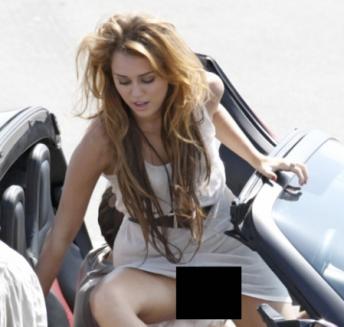
Perez Hilton – he of Carrie Prejean bashing fame – may be staring in the face of child porn charges in the near future.  You may recall that Hilton served as judge in the 2009 Miss America competition, and asked Prejean her view of same-sex marriage. When Prejean offered an honest answer voicing her belief that marriage should be between a man and a woman, Hilton expressed his displeasure by taking to the internet and bashing Prejean as a ‘dumb b****’.  Seems Perez has graduated from name-calling tantrums, and an accomplished career as a verminous outer of gay celebrities, and turned his attention to a developing career in child porn . Ben Shapiro over at Big Hollywood reports: “He (Hilton) linked via his Twitter account to a picture of rising Madonna wannabe Miley Cyrus climbing out of a car in a short skirt and no underwear.  In the picture, which has been removed, Cyrus’ genitals are allegedly clearly visible.” Of course, now that the heat is on, Perez has taken to back-pedaling , claiming the photo was a fake.  In a statement on his blog, Hilton said, “”Do you think I’m stupid enough to post a photo of Miley if she’s not wearing any underwear down there?” That’s what we in the business call a rhetorical question.  Britney Spears’ up skirt photos think he’s crossed the line. Hilton has made a career out of vulgar displays of stupidity, including well, Salon explains it a little better. The ‘fake’ claim comes only after Hilton had already commented on the controversy, in which he clearly offers no apology.    According to Entertainment Weekly , Hilton stated: “I think now it’s okay for Miley to be a little sexier.  Because she’s almost 18, you know, so it’s okay for Miley to show her boobs and expand, uh, her horizons.” After developing the ‘fake photo’ defense, Hilton said, “Sure I like to be controversial, but I don’t want to go to jail.” Problem being, he might still be in some hot water even if the image was Photoshopped.  In an interview with Salon , criminal defense attorney Jeffrey Douglas explains: “Under the law, that is still a crime and it is punishable just the same,” says Douglas.  “For instance, if you were to take the face of an 8-year-old and put that picture on the nude body of even an identifiable, fully developed adult porn star, it is child-porn punishable identical to if you took a photo of the actual child.” Douglas continues: “We’re not talking about a misdemeanor,” he said.  “You don’t have to know what the definition of the law is; all you have to do is knowingly distribute the photograph.”  He added that it was “suicidal for him to do this”. Of course the real question is, if Prejean is a ‘dumb bitch’ for what she did, what does knowingly distributing a nude photo of an underage girl make you? – Send comments or tips to rustyweiss@verizon.net . Please join me on Facebook.  Photo Credit:  Getty/Frazer Harrison

Read more:
Perez Hilton to Face Child Porn Charges?

Perez Hilton Offers Proof of Underwear-Clad Miley Cyrus

Earlier today, Miley Cyrus sent a message to the world: I am not a slut . Now, Perez Hilton has a message of his own: I am not a distributor of child pornography! The latter statement is needed because the self-absorbed, immature celebrity gossip blogger has been accused of Tweeting an uncensored photo of Miley’s crotch. In an insincere, lame video on his website today, Perez said: “Do you think I’m stupid enough to post a photo of Miley if she’s not wearing any underwear down there? No! Sure I like to seem controversial, but I don’t want to go to jail.” He then published the following circled photo, which depicts Miley in the same outfit as she wore in the original, scandalous picture (below, left) and supposedly proves she was wearing underwear all along: None of this changes the fact that Hilton is an absolute tool. He offers nothing interesting or creative on his blog, relying on such pathetic gimmicks as upskirt shots and penis drawings to get attention. At this point, there’s no real chance of Perez receiving any legal punishment, although a Los Angeles criminal defense attorney told Salon.com that it was “suicidal” for the blogger to distribute the image. “We’re not talking about a misdemeanor,” Jeffrey Douglas said. “You don’t have to know what the definition of the law is; all you have to do is knowingly distribute the photograph.” If you’re curious about the definition of douche bag, by the way, don’t bother opening up a dictionary. Just find a photo of Perez Hilton.

Original post:
Perez Hilton Offers Proof of Underwear-Clad Miley Cyrus

Hemp for Victory!

This past week, hemp advocates and aficionados nationwide engaged in educational and awareness building exercises during their annual “Hemp History Week”. The aim was to enlighten the public's perception of hemp by demonstrating its versatility in several facets of everyday life and drawing attention to its pivotal role in American agriculture up until the mid-20th century. Before hemp can be understood in its contemporary context, a stroll down memory lane may refresh the reader on this critical crop. While the history of hemp and humans goes all the way back to the Neolithic Revolution ~10-12,000 years ago, for brevity's sake, the focus of this reminiscence will remain on hemp's history in the New World. Hemp helped propel European explorers to America's shores by providing tough and durable sails and rope for riggings on long, trans-Atlantic voyages. The climate proved suitable, and in 1564, King Philip II of Spain proclaimed that hemp be cultivated in his New World possessions, ranging from the tip of Tierra del Fuego to the Willamette Valley. Hemp was instrumental in securing the continuity of the English colonies. With the memory of numerous colonial failures fresh in mind, particularly the “Lost Colony” of Roanoke Island, colonists in Virginia became the first to make the planting of hemp mandatory in 1619; not only could hemp fibers be used to sew cloth but the seeds could be consumed for a much needed source of protein, carbohydrates, essential fatty acids, and minerals including calcium and iron. As Virginia flourished, other colonies took notice and began implementing their own hemp mandates, and, collectively, the colonies continued to thrive with hemp providing a safety net to fall upon during inclement seasons. The Founding Fathers of the United States of America saw good promise in hemp and some even farmed it themselves. Thomas Jefferson and George Washington both grew hemp, and Benjamin Franklin owned one of America's first paper mills that produced durable and long-lasting hemp paper that was to play a crucial role in the founding of a new nation. Jefferson penned the Declaration of Independence on hemp paper, and other Founding documents written on hemp include Thomas Paine's “Common Sense”, the Articles of Confederation, the Federalist (and Anti-Federalist) Papers, and the United States Constitution. Hemp's prominence waned in the 19th century. The invention of steam turbines and diesel engines along with the widespread favor for Manila rope fiber eliminated hemp from the high seas. Advances in agricultural technologies, techniques, and crop variants practically eliminated concerns of climate-driven crop failures or Malthusian catastrophes. As average incomes increased and America's middle class grew, so too rose the demand for clothing of finer quality fiber. By the 20th century, hemp's use in everyday life was in steady decline and preserved only by the most steadfast of farmers who continued to see it as insurance during hard times. Hemp in America met its demise in the “zero tolerance, one-size-fits-all” Marihuana Tax Act of 1937. This act was a blanket ban on the cannabis plant, presumably because its psychotropic attribute, tetrahydrocannabinol (THC), was becoming responsible for a tremendous wave of violence sweeping across the country. Hemp was lumped into this Act because it contains trace amounts of THC. However, if one were not to become entangled by yellow journalism and instead ask “Cui bono?”, one need look no further than media mogul William Randolph Hearst and the DuPont Company. Hearst, like any good crony capitalist of America's Gilded Age, profited from the government's ban on cannabis because of his considerable interests in the timber industry that fueled his paper mills and printing presses. The hemp ban also helped DuPont, which had patented nylon two years prior as a replacement for Asian silk and hemp products. The biggest beneficiary of all, however, was the US government, as it enjoyed expanded powers of regulation and taxation that would eventually lead to the infamous “War on Drugs”. Hemp enjoyed a brief comeback during World War II. Strict war rationing diverted many essential materials to the war effort; shortages became the natural result of this central planning. Hemp was officially enlisted by the US government in 1942 following the release of Hemp for Victory, in which farmers were educated on hemp's multitudinous uses and encouraged to grow it en masse. Despite its service during a time of national need, hemp, like many American veterans, was cast aside and again put under ban in 1955. The likely beneficiary this time was the burgeoning petrochemical industry, led by none other than DuPont. Hemp, a crop that has, without question, benefited the US and seen it through thick and thin, has not graced America's fertile soils for over half a century. In that time, America ceded its dominance in hemp cultivation to the Soviet Union, which produced the most hemp from 1950-1980. It was not until the 1990's that some industrialized countries began to loosen restrictions and allow the cultivation of hemp again, including Australia, Germany, France, Italy, Great Britain, and Canada. Today, America stands as the only industrialized country that does not allow the cultivation of hemp; by contrast, North Korea, arguably one of the most sheltered, underdeveloped, and authoritarian regimes on the planet, allows the cultivation of hemp. Hemp has also suffered from neglect in the cannabis re-legalization movement. Despite it being, by far, the easiest sell to the American public due to its non-intoxicity, it has fallen to the wayside in favor of medical cannabis and decriminalization measures. Since hemp's inclusion in the definition of “marijuana” in the Controlled Substances Act of 1970, thirteen states have decriminalized simple cannabis possession and fourteen have allowed medical cannabis for seriously/terminally ill patients; only five states (North Dakota, Montana, West Virginia, Vermont, and Oregon) have removed laws banning hemp cultivation provided a license is granted to the farmer by the Federal Drug Enforcement Administration (DEA). The number of licenses issued by the DEA as of this writing: zero. What is hemp's hope for a brighter future in the sun? Legislation currently introduced in Congress (House Resolution 1866: Industrial Hemp Farming Act of 2009) by Representative Ron Paul (R-Texas) has sat idle and is unlikely to see any action before the end of the 111th Congressional term. The States, on the other hand, can reclaim their sovereign right to an intrastate hemp economy any time they like. Hemp's salvation, barring Federal clemency, is in the 10th Amendment to the US Constitution, and a State's willingness to interpose on behalf of its farmers…. Continued at : http://www.campaignforliberty.com/article.php?view=891 added by: Dagum