Tag Archives: director

Hate It Or Love It?!?! Pennsylvania Governor Suing NCAA Over Penn State Sanctions

For the love of football , and saving face, PA Governor Tom Corbett has vowed to fight the NCAA’s sanctions against Penn State . According to CNN , he’s blasting the FBI report that was made earlier this year too: Pennsylvania Gov. Tom Corbett announced plans Wednesday to file an anti-trust lawsuit against the NCAA over its sanctions against Penn State University following the Jerry Sandusky child abuse scandal. Last July, the NCAA levied unprecedented sanctions against the university, including a fine of $60 million. It also stripped 14 seasons of football victories from late head coach Joe Paterno. “These sanctions did not punish Sandusky,” or those who allegedly helped cover up his repeated abuse of disadvantaged children, said Corbett at a news conference in State College. He said they instead affect past and current students who were not part of the scandal. “I cannot and will not let it happen without a fight,” said Corbett, adding that the Sandusky case was a criminal matter and not a violation of NCAA rules. Corbett also called a university-funded review of the scandal led by former FBI Director Louis Freeh an incomplete report. Freeh’s 267-page review was released in July and blamed former university president Graham Spanier, Paterno, suspended Athletic Director Tim Curley, and ex-Vice President Gary Schultz for allegedly taking part in a cover-up to avoid bad publicity. The scandal led to Spanier’s ouster and shocked the nation after Freeh’s team concluded that the school’s top administrators had “empowered” Sandusky, the former defensive coordinator for the football team, to continue his abuse. The NCAA said in a statement Wednesday it was disappointed by the governor’s action. “Not only does this forthcoming lawsuit appear to be without merit, it is an affront to all of the victims in this tragedy — lives that were destroyed by the criminal actions of Jerry Sandusky,” said Donald M. Remy, NCAA executive vice president and general counsel. “While the innocence that was stolen can never be restored, Penn State has accepted the consequences for its role and the role of its employees and is moving forward. Today’s announcement by the governor is a setback to the university’s efforts.” Penn State also issued a statement Wednesday saying it remained “committed to full compliance with the Consent Decree, the Athletics Integrity Agreement and, as appropriate, the implementation of the Freeh report recommendations.” The fine is expected to be paid over five years and will fund an endowment with a mission of fighting child abuse and supporting victims. Pennsylvania’s U.S. House delegation objects to the NCAA’s plans to spend only 25% of those funds within the state. The delegation wants the association to spend all of the $60 million in Pennsylvania, according to a November letter to the NCAA. “While we fully support the stated purpose of the endowment, we believe its funds should be used solely for programs and organizations within the Commonwealth of Pennsylvania, where a need exists for the creation of prevention programs for abused children,” the letter stated. Sandusky, 68, was convicted last June on 45 counts of child abuse, ranging from corruption of minors to involuntary deviate intercourse, which were laid out in graphic testimony by his accusers over the course of the less-than-two-week trial. In October, he was sentenced to 30 to 60 years in prison, meaning he’ll likely die behind bars. SMH. The NCAA’s sanctions were most definitely harsh, but then again, so was the corruption that took place for years. Do you think the Governor should take a seat and not dig this sh*t up again?? Images via tumblr

More:
Hate It Or Love It?!?! Pennsylvania Governor Suing NCAA Over Penn State Sanctions

The Time Joel Silver Destroyed A $5K Couch During The Filming Of ‘Die Hard’

We all know producers can be a bunch of real, ah, prickly people. They kind of have to be, since their job, so long as it’s their actual job and not just a title given to them because they invested a couple of mil into the production, is to make sure everything goes smoothly, the film stays within budget, and the money isn’t wasted on limos when it could be wasted instead on expensive CG effects that look completely dated within 3 years*. As a result, these guys tend to be blunt as hell and not afraid to hurt some mothaf*ckin’ feelings when they rolling deep through the movie hood , as it were. Take Joel Silver , the famously take-no-prisoners producer of the Lethal Weapon and Die Hard films.** Screenwriter Doug Richardson, the guy who Wrote Die Hard 2: Die Harder , and Bad Boys , has shared a story from the making of Die Hard over on his official site , and it’s a most triumphant example of producer due diligence at the expense of expensive furniture you’ll ever hear. Remember the scene in Die Hard when the roof of Nakatomi Plaza explodes, and the penthouse lobby and fountain area is completely trashed? You might have noticed there’s an expensive looking couch in that scene; You might have also noticed that it appears to survive the initial explosion, only to show up seconds later completely aflame. There’s a reason for that — the couch wasn’t just expensive looking , it actually cost $5,000 back in 1988 which in today’s money is about 5 trillion dollars.*** Apparently, the scene drew cheers and high fives from everyone on the crew after they pulled it off during the shoot; except for Silver that is, whose eagle-eyed penny-pinching powers detected something odd, or as Richardson puts it, “possible sabotage.”  To set the scene for what happens next, you might want to find a copy of Who Framed Roger Rabbit  and check out Silver’s blustery cameo as the director of the Baby Herman cartoon. Joel called for the entire crew to assemble on the nearly-demolished set, gathering the mob around a gorgeous, leather Roche-Bobois sofa.  Estimated value, five thousand dollars.  The couch, despite the conflagration that they’d all just witnessed, was in showroom condition.  Untouched by destructive fire, explosives, or water. “I wanna know,” Joel shouted, “Who just ruined my shot!” You see, Joel had been around more than a few movie sets.  He knew how things worked.  He understood how the occasional underhanded crew member operated.  In this case, he suspected that one crew member had paid off another crew member on the special effects crew to make certain that the five-thousand-dollar sofa survived the wreckage. “Somebody on this crew,” announced Joel, “Decided to furnish their home at the expense of the movie.” Can you blame them though? I mean, this was the ’80s, and we didn’t have Ikea to make giant couches affordable yet. With that, Joel produced a bottle of lighter fluid, doused the expensive sofa in accelerant, and tossed a match to it.  The lesson ended as the couch erupted in flame.  The set was cleared again.  And camera operators were ordered to “roll film.” Five grand must seem a trivial sum for a movie with a $28-million budget, but damned if you can’t respect someone for making sure every dollar spent on the movie ended up onscreen. I just wonder if he hummed “Ode To Joy” while torching some lowly grip’s living-room dreams. No word from Richardson if similar hijinks happened during the making of Die Hard 2. Probably not, I mean, how many times can the same thing happen to the same guy? * I kid, I kid! ** And a jillion others of course. He helped Walter Hill get The Warriors and Streets of Fire made! *** I’m guessing this is the case based on the way people are freaking out about raising the minimum wage. [ Source: Movies.com ] Ross Lincoln is a LA-based freelance writer from Oklahoma with an unhealthy obsession with comics, movies, video games, ancient history, Gore Vidal, and wine. Follow Ross Lincoln Twitter.  Follow Movieline on Twitter .

See more here:
The Time Joel Silver Destroyed A $5K Couch During The Filming Of ‘Die Hard’

Django Unchained Review: There Will Definitely Be Blood

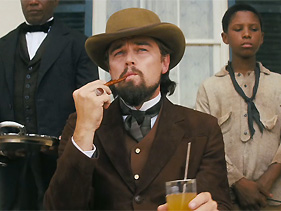
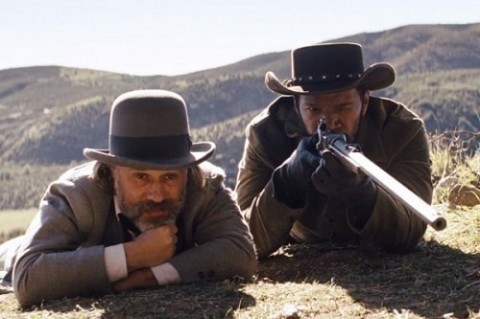
Django Unchained may be receiving attention for its excessive use of the N-Word , and the body count in this Quentin Tarantino thriller may be as high as anything the director has ever helmed, but neither of those issues gets to the heart of the film: Two men, one friendship and the way Christoph Waltz was pretty much born to recite words written by Tarantino. Waltz portrays Dr. King Shulz, essentially the same character that earned him an Oscar in Inglourious Basterds . He’s a loquacious, laid back killer who smiles through the most tense situations. Tarantino penned the part for Waltz, and the best parts of the 166-minute movie feature Shulz simply talking: to residents of a town after he kills their sheriff; to Foxx’s slave-turned-bounty-hunter, Django; to Leonardo DiCaprio’s evil plantation owner. Waltz brings Tarantino terrific dialogue to entertaining life. And Foxx is also strong, evolving from a quiet slave to “the fastest draw in the South,” obliterating foes along the way and tracking down his wife (Kerry Washington), who has been purchased by DiCaprio’s Calvin Candle. The movie is Tarantino through and through, from the unusual combination of history and absurdity… to the drawn out scenes (one involving a group of white men complaining about the holes in their KKK-like hoods)… to his need to violently murder almost everyone on screen. Due to the latter point, the film is about 30 minutes too long. Without giving anything away, it easily could have ended around the time of a certain handshake, but Tarantino just can’t resist. He had to up the body count, he had to use up all his red dye budget. Indeed, the closing handful of scenes are cartoon-like in their violence. They’re just examples of Tarantino having fun with fake bullets and slow motion and shredded corpses. But these aren’t the difficult ones to watch. There’s one moment where a man is torn apart by dogs that even Michael Vick from a few years ago would have trouble watching. Overall? Django Unchained is exactly what anyone familiar with Tarantino’s work would expect. It may push the boundaries of good taste at times, and it definitely runs longer than necessary, but it’s a fun two-plus hours. You’re in for impressive visuals, unique characters and a series of fantastic exchanges between great actors. Sound off now with your take and visit Movie Fanatic for another Django Unchained review .

Visit link:
Django Unchained Review: There Will Definitely Be Blood

Inside The Music Of ‘Django Unchained’

Director Quentin Tarantino explains his foray into original music with John Legend, Rick Ross. By Amy Wilkinson, with reporting by Josh Horowitz Leonardo DiCaprio in “Django Unchained” Photo: Weinstein Company

See the article here:
Inside The Music Of ‘Django Unchained’

Oscar Index: Critics Have ‘Amour’ For ‘Zero Dark Thirty’ & ‘The Master,’ But Who’s ‘Les Miserables’ This Christmas?

Academy ballots were mailed out last week to 5,586 voting members, the most significant news on the Oscar front. Not that it was a quiet week in Lake Globesbegone. The New York Times ’ critics A.O. Scott and Manohla Dargis both named Amour 2012’s best film, as did the Los Angeles Times ’ Kenneth Turan. The AP triumvirate of Christy Lemire, David Germain and Jake Coyle anointed Argo , Moonrise Kingdom and Amour , respectively. The flyover states also weighed in: The Kansas City Film Critics Circle named The Master best film, while the Chicago and Austin Film Critics Associations went with Zero Dark Thirty . The Southeastern Film Critics Association backed Argo , as did the Nevada, St. Louis and Florida Film Critics. The criticspalooza that is the Village Voice Top 10 poll (86 – count ‘em) named The Master best film, while The Atlantic ’s lone Christopher Orr picked Zero Dark Thirty . Put them together and what have you got? Mostly Oscar pundits still gobsmacked that Nicole Kidman got a Best Supporting nomination from the Screen Actor’s Guild and the Hollywood Foreign Press. The Voice ’s Michael Musto pondered whether she could be one of a handful of actors to have earned nominations for Oscar and a Razzie for the same performance . In the immortal words of Max Bialystock, “Worlds have turned on such thoughts.” From here on, those little intangibles that John Gavin so rhapsodically preached to Maureen O’Hara about in Miracle on 34th Street (Merry Christmas, by the way) come in to play. Will Academy members filling out their ballots be influenced by Reese Witherspoon’s open letter to The Impossible ’s Naomi Watts (“Not since Meryl Streep’s performance in Sophie’s Choice …) in Entertainment Weekly , moved by Hugh Jackman welling up during his recent “60 Minutes” interview, or swayed by journeyman character actor Ann Dowd’s plucky self-financed campaign to distribute screeners of her career pinnacle performance in Compliance ? Let’s go to the Gold Linings Playbook to see how the Oscar field shifted last week. And Academy Members: Complete your ballots before the Jan. 3 deadline, lest you fall off the Oscar cliff. Best Picture To paraphrase Oscar Wilde, the only thing better than being nominated for a SAG award or Golden Globe is not being nominated. That may be the case for Beasts of the Southern Wild , whose non-union production was deemed ineligible for Screen Actors Guild consideration. It was also snubbed by the Hollywood Foreign Press. Now everyone’s talking about the beauty of the Beast and the producers are rekindling adoration for the art house darling with stepped-up promotion. Zero Dark Thirty and Lincoln remain Best Picture front-runners, but while the former continues to be preoccupied with answering a rising tide of critics (“Senators condemn Zero Dark Thirty torture,” reported USA Today ) all the latter has to do is look presidential (“ Lincoln aims to enlighten as it entertains,” praised a Los Angeles Times feature). Argo , too, is assured a Best Picture nomination, and while Zero Dark Thirty is getting critics awards buzz (as well as detractor’s brickbats), Argo , to its credit, has built up enormous good will. It’s a rousing, real-life “America, f*** yeah” that Hollywood could still rally around. Django Unchained ’s stock with critics continued to rise last week, although Spike Lee set off a Twitter firestorm Saturday when he said that slavery was a holocaust, “not a Sergio Leone spaghetti western” and that he would “honor” his ancestors by not seeing the film. The Drudge Report splashed an incendiary headline across its home page regarding the film’s prodigious use of the “n-word.” It also remains to be seen how the film’s graphic violence will play with audiences in the wake of the incomprehensible tragedy in Connecticut. 1. Lincoln 2. Zero Dark Thirty 3. Argo 4. Silver Linings Playbook 5. Les Miserables 6. Django Unchained 7. Life of Pi 8. Best Exotic Marigold Hotel 9. Beasts of the Southern Wild 10. Moonrise Kingdom Ones to watch: Amour, The Dark Knight Rises, The Impossible, The Master, Skyfall Best Director Sure, the Golden Globes are Hollywood’ most reliable punchline (except maybe for Rob Schneider), but Gold Derby gives them their props as “one of the most reliable Oscar crystal balls.” That doesn’t bode well for Les Miserables director Tom Hooper, who was snubbed, leaving wiggle room for David O. Russell, but Quentin Tarantino is, as ever, the wild card. Like Spielberg, his name alone has a Hitchcockian mass appeal and recognition. As he observed in his recent Playboy interview, “I was actually quite proud when I read that Django is one of the most anticipated movies coming out this year. It’s a black Western. Where’s the anticipation coming from? I guess a lot of it is me. That’s pretty f***ing awesome.” 1. Steven Spielberg ( Lincoln ) 2. Kathryn Bigelow ( Zero Dark Thirty ) 3. Ben Affleck ( Argo ) 4. Ang Lee ( Life of Pi ) 5. David O. Russell ( Silver Linings Playbook ) Ones to watch: Paul Thomas Anderson ( The Master ), Michael Haneke ( Amour ), Tom Hooper ( Les Miserables ), Quentin Tarantino ( Django Unchained )

Continued here:
Oscar Index: Critics Have ‘Amour’ For ‘Zero Dark Thirty’ & ‘The Master,’ But Who’s ‘Les Miserables’ This Christmas?

Maya Vs. Carrie − Comparing The Feminism of ‘Zero Dark Thirty’ & ‘Homeland’

Do you remember when J.J. Abrams ‘  ABC series  Alias was the greatest female spy story of its time? Premiering in 2001, just weeks after the 9/11 terrorist attacks, it starred an apple-cheeked newcomer with just the right combination of hardness and softness. For five seasons and through hundreds of costume changes — does the CIA really spend thousands of dollars on neon wigs? — Sydney Bristow ( Jennifer Garner ) showed the world that a female spy could be just as clever, alluring, and badass as James Bond , even on a TV budget. Since the premiere of Showtime’s spy thriller,  Homeland , last year, however, Sydney has been retroactively exposed as Spy Barbie, a product of the girl-power fad of the 1990s. Homeland and the upcoming film,  Zero Dark Thirty , which chronicles the decade-long manhunt for Osama bin Laden, make a more serious case for feminism — or a more serious kind of feminism — by pulling their female CIA-agent protagonists from the field and eschewing gold-lamé bikinis for sensible pantsuits. The ‘Zero Dark Thirty’ ‘Homeland’ Comparison Zero Dark Thirty ’s Maya ( Jessica Chastain) and Homeland ’s Carrie Mathison ( Claire Danes) are certainly cut from the same cotton-polyester blend cloth. They’re both young, willowy, fair-haired women hell-bent on finding a man: Maya is after bin Laden and Carrie after Abu Nazir, OBL’s fictional counterpart. They’re no-nonsense women with passion and indignation to spare, and more often than not, the smartest person in the room. They’re frequently the only women in a man’s world, but they’re not the type to make a big deal about it. Their hunches are usually ignored by exasperated higher-ups, but that has less to do with their gender than political convenience and grandstanding. Zero Dark Thirty and Homeland ’s rejection of honeypots in favor of intelligence analysts is instrumental in the reception of the film and the TV show as feminist works. That rejection reflects changing demographics within the espionage community, where female superstar data-crunchers are quickly becoming the norm. Both Maya and Carrie are famously based on real-life women in CIA.. The head of the spy bureau’s Al-Qaeda tracking team recently stated , “If I could have put out a sign on the door [after 9/11] that said ‘No men need apply,’ I would have done it.” But what’s most interesting about the feminisms — that’s feminism with an ‘s’ — of ZDT and Homeland are their different, but equally compelling, approaches to female heroism. The feminism in ZDT follows the “anything a man can do, I can do better” school of thought. It’s impossible not to project that attitude onto ZDT director Kathryn Bigelow , whose filmography strongly suggests a “guys’ girl,” and who received the first-ever Best Director Oscar awarded to a woman for making a macho military movie,  The Hurt Locker . It’s difficult not to see Bigelow’s brand of feminism in Chastain’s Maya. Girlish ponytail and pouty lips aside, Chastain’s Maya  is essentially a gender-neutral character.  When she’s asked about her thoughts on office romance, her response is the closest she ever gets to femininity: “I’m not that girl that fucks.” In other words, the sexless, workaholic Maya briefly dons the mean-girl mask to define herself against all those other “girls” who men might see as sexual partners, instead of colleagues. In a later scene, she takes credit for her discovery of bin Laden’s hideout in a room full of military brass by declaring, “I’m the motherfucker that found this place.” With that short statement, Maya draws attention to her gender by pointedly not drawing attention to it. Anyone can be a motherfucker, man or woman — just like anyone can find bin Laden. Like Zero Dark Thirty , Homeland is rarely about Carrie’s gender. But the character begs to be read as a fervent defense of female hysteria and hyper-emotionality. It’s not PMS that makes Carrie a puppet to her emotions, but her bipolar disorder, a condition that’s spottily and sporadically treated in the show’s first season. Even after a bout of electro-convulsive therapy and a regular regimen of lithium to stabilize her mood swings, Carrie isn’t balanced enough for spycraft. When she helps capture Nicholas Brody (Damian Lewis), the ex-P.O.W. she alone — and correctly — believed to be a terrorist (and whom she later has an affair with), she screams, “I LOVED YOU!” at him while her embarrassed colleagues handcuff and cart him away. But the reason  Homeland is a feminist — rather than misogynist — show, even with a caricature of female emotional instability at its center, is that it transforms a trait that has traditionally been used to denigrate women into a professional advantage. This isn’t the kind of gender-neutral feminism that congratulates female CEOs for shattering the glass ceiling. Rather, it questions the value of gender-neutrality and asks why women should want things that men have designated as desirable. Why should a little girl crash toy trucks together, for example, when playing with dolls will improve her verbal and empathy skills more quickly? Or in the case of Homeland , why should Carrie’s emotional instability be counted against her when it’s her perilous leaps of logic and mania-induced zealotry that enables her to see what nobody else can ? Even her ill-advised affair with Brody, fueled by loneliness and uncontrollable desire, helps her collect evidence of his extremism. The different approaches to feminism that Homeland and ZDT  embody   prove that there isn’t just one correct approach to gender equity: women (and progressive men) can have their feminism both ways. Now if only we could get a female CIA director, or even just a movie about one, already. Bonus note: Do Homeland and Zero Dark Thirty pass the Bechdel test ? Although the central cast of Homeland is basically Claire Danes and a bunch of dudes, it passes with flying colors. ZDT is a bit more complicated. Maya and a female colleague (Jennifer Ehle) discuss work a lot, but work for them is killing and torturing a bunch of men. It doesn’t pass on technical grounds, but it does in spirit. Whether the banner of feminism should be used to ignore, soften, or justify the brutality of torture, well, that’s a discussion for another day . Inkoo Kang is a film critic and investigative journalist in Boston. She has been published in Salon, Indiewire, Boxoffice, Yahoo! Movies, Pop Matters, Screen Junkies, and MuckRock. Her great dream in life is to direct a remake of  All About Eve  with an all-dog cast.” I Follow Inkoo Kang on Twitter. Follow Movieline on Twitter. 

Read the original:
Maya Vs. Carrie − Comparing The Feminism of ‘Zero Dark Thirty’ & ‘Homeland’

Maya Vs. Carrie − Comparing The Feminism of ‘Zero Dark Thirty’ & ‘Homeland’

Do you remember when J.J. Abrams ‘  ABC series  Alias was the greatest female spy story of its time? Premiering in 2001, just weeks after the 9/11 terrorist attacks, it starred an apple-cheeked newcomer with just the right combination of hardness and softness. For five seasons and through hundreds of costume changes — does the CIA really spend thousands of dollars on neon wigs? — Sydney Bristow ( Jennifer Garner ) showed the world that a female spy could be just as clever, alluring, and badass as James Bond , even on a TV budget. Since the premiere of Showtime’s spy thriller,  Homeland , last year, however, Sydney has been retroactively exposed as Spy Barbie, a product of the girl-power fad of the 1990s. Homeland and the upcoming film,  Zero Dark Thirty , which chronicles the decade-long manhunt for Osama bin Laden, make a more serious case for feminism — or a more serious kind of feminism — by pulling their female CIA-agent protagonists from the field and eschewing gold-lamé bikinis for sensible pantsuits. The ‘Zero Dark Thirty’ ‘Homeland’ Comparison Zero Dark Thirty ’s Maya ( Jessica Chastain) and Homeland ’s Carrie Mathison ( Claire Danes) are certainly cut from the same cotton-polyester blend cloth. They’re both young, willowy, fair-haired women hell-bent on finding a man: Maya is after bin Laden and Carrie after Abu Nazir, OBL’s fictional counterpart. They’re no-nonsense women with passion and indignation to spare, and more often than not, the smartest person in the room. They’re frequently the only women in a man’s world, but they’re not the type to make a big deal about it. Their hunches are usually ignored by exasperated higher-ups, but that has less to do with their gender than political convenience and grandstanding. Zero Dark Thirty and Homeland ’s rejection of honeypots in favor of intelligence analysts is instrumental in the reception of the film and the TV show as feminist works. That rejection reflects changing demographics within the espionage community, where female superstar data-crunchers are quickly becoming the norm. Both Maya and Carrie are famously based on real-life women in CIA.. The head of the spy bureau’s Al-Qaeda tracking team recently stated , “If I could have put out a sign on the door [after 9/11] that said ‘No men need apply,’ I would have done it.” But what’s most interesting about the feminisms — that’s feminism with an ‘s’ — of ZDT and Homeland are their different, but equally compelling, approaches to female heroism. The feminism in ZDT follows the “anything a man can do, I can do better” school of thought. It’s impossible not to project that attitude onto ZDT director Kathryn Bigelow , whose filmography strongly suggests a “guys’ girl,” and who received the first-ever Best Director Oscar awarded to a woman for making a macho military movie,  The Hurt Locker . It’s difficult not to see Bigelow’s brand of feminism in Chastain’s Maya. Girlish ponytail and pouty lips aside, Chastain’s Maya  is essentially a gender-neutral character.  When she’s asked about her thoughts on office romance, her response is the closest she ever gets to femininity: “I’m not that girl that fucks.” In other words, the sexless, workaholic Maya briefly dons the mean-girl mask to define herself against all those other “girls” who men might see as sexual partners, instead of colleagues. In a later scene, she takes credit for her discovery of bin Laden’s hideout in a room full of military brass by declaring, “I’m the motherfucker that found this place.” With that short statement, Maya draws attention to her gender by pointedly not drawing attention to it. Anyone can be a motherfucker, man or woman — just like anyone can find bin Laden. Like Zero Dark Thirty , Homeland is rarely about Carrie’s gender. But the character begs to be read as a fervent defense of female hysteria and hyper-emotionality. It’s not PMS that makes Carrie a puppet to her emotions, but her bipolar disorder, a condition that’s spottily and sporadically treated in the show’s first season. Even after a bout of electro-convulsive therapy and a regular regimen of lithium to stabilize her mood swings, Carrie isn’t balanced enough for spycraft. When she helps capture Nicholas Brody (Damian Lewis), the ex-P.O.W. she alone — and correctly — believed to be a terrorist (and whom she later has an affair with), she screams, “I LOVED YOU!” at him while her embarrassed colleagues handcuff and cart him away. But the reason  Homeland is a feminist — rather than misogynist — show, even with a caricature of female emotional instability at its center, is that it transforms a trait that has traditionally been used to denigrate women into a professional advantage. This isn’t the kind of gender-neutral feminism that congratulates female CEOs for shattering the glass ceiling. Rather, it questions the value of gender-neutrality and asks why women should want things that men have designated as desirable. Why should a little girl crash toy trucks together, for example, when playing with dolls will improve her verbal and empathy skills more quickly? Or in the case of Homeland , why should Carrie’s emotional instability be counted against her when it’s her perilous leaps of logic and mania-induced zealotry that enables her to see what nobody else can ? Even her ill-advised affair with Brody, fueled by loneliness and uncontrollable desire, helps her collect evidence of his extremism. The different approaches to feminism that Homeland and ZDT  embody   prove that there isn’t just one correct approach to gender equity: women (and progressive men) can have their feminism both ways. Now if only we could get a female CIA director, or even just a movie about one, already. Bonus note: Do Homeland and Zero Dark Thirty pass the Bechdel test ? Although the central cast of Homeland is basically Claire Danes and a bunch of dudes, it passes with flying colors. ZDT is a bit more complicated. Maya and a female colleague (Jennifer Ehle) discuss work a lot, but work for them is killing and torturing a bunch of men. It doesn’t pass on technical grounds, but it does in spirit. Whether the banner of feminism should be used to ignore, soften, or justify the brutality of torture, well, that’s a discussion for another day . Inkoo Kang is a film critic and investigative journalist in Boston. She has been published in Salon, Indiewire, Boxoffice, Yahoo! Movies, Pop Matters, Screen Junkies, and MuckRock. Her great dream in life is to direct a remake of  All About Eve  with an all-dog cast.” I Follow Inkoo Kang on Twitter. Follow Movieline on Twitter. 

Read this article:
Maya Vs. Carrie − Comparing The Feminism of ‘Zero Dark Thirty’ & ‘Homeland’

REVIEW: Bloody Hilarious & Hilariously Bloody ‘Django Unchained’ Is Tarantino’s First Real Love Story

The “D” is silent, though the name of Django Unchained ‘s eponymous gunslinger sounds like a retaliatory whip across the face of white slaveholders, offering an immensely satisfying taste of antebellum empowerment packaged as spaghetti-Western homage. Christened after a coffin-toting Sergio Corbucci character who metes out bloody justice below the Mason-Dixon line, Django joins a too-short list of slaves-turned-heroes in American cinema, as this zeitgeist-shaping romp cleverly upgrades the mysterious Man in Black archetype to a formidable Black Man. Once again, Quentin Tarantino rides to the Weinsteins’ rescue, delivering a bloody hilarious (and hilariously bloody) Christmas counter-programmer, which Sony will unleash abroad. After Inglourious Basterds and Kill Bill , it would be reasonable to assume that Django Unchained is yet another of Tarantino’s elaborate revenge fantasies, when in fact, the film represents the writer-director’s first real love story (not counting his Badlands -inspired screenplays for True Romance and Natural Born Killers ). At its core is a slave marriage between Django (Jamie Foxx) and Hildi (Kerry Washington), torn asunder after the couple attempt to escape a spiteful plantation owner (Bruce Dern, blink and you miss him). Brutally whipped and then resold to separate bidders on the Greenville, Miss., auction block, Django and his bride — whose outrageous full name, Broomhilda von Shaft, blends epic German legend with the greatest of blaxploitation heroes — possess a love too great to be shackled by slavery. But getting even with Dern’s character doesn’t feature on Django’s agenda. After settling the score with his former overseers early in the film, he cares only about reuniting with his wife. Django Unchained could also qualify as a buddy movie — an odd twist, considering that Corbucci’s original Django was a loner (as played by Franco Nero, who cameos in this film). Liberally reinventing a character bastardized in more than 30 unofficial sequels, Tarantino pairs this new black Django with a bounty hunter named Dr. King Schultz ( Christoph Waltz ). Posing as a dentist, Waltz’s charming figure first emerges in the dead of night driving an absurd-looking carriage with a giant tooth bobbing on top — the first indication of how funny the film is going to be. As in Basterds , Waltz’s genteel manner masks a startling capacity for ruthlessness. This time, however, he’s undeniably one of the good guys. Though he tracks and kills men for a living, the doctor is fundamentally fair, shooting only when provoked or justified. Happening upon Django’s chain gang, Schultz offers to buy the slave from his redneck escorts. When they decline, he leaves the traders for dead and liberates their “property,” enlisting Django in his bounty-hunting business. Tarantino’s on sensitive turf here, and he knows it, using these early scenes not only to establish the cruelty shown toward slaves in the South, but also to deliver the same sort of revisionist comeuppance Jewish soldiers took upon Hitler in his last picture. Ironically, as a well-read and clearly more enlightened German, Schultz is disapproving of Americans’ claims to racial superiority, which positions him as the story’s moral conscience. When the time comes, he will accompany Django to Candyland, the plantation where Hildi now resides under the thumb of the unctuous Calvin Candie ( Leonardo DiCaprio ). But the film seems to be in no hurry to get there, focusing on Django’s most unusual education — killing white men — for the first 90 minutes of the director’s longest feature yet. Tarantino freely quotes from his favorite stylistic sources, whether oaters or otherwise, featuring lightning-quick zooms, an insert of unpicked cotton drenched in blood and a shot of Django riding into town framed through a hangman’s noose. Early on, Foxx appears to be following Waltz’s lead, but once the snow melts on the bounty-hunting subplot (an extended homage to Corbucci’s The Great Silence ), all traces of subservience disappear and Foxx steps forth, guiding this triumphant folk hero through a stunning transformation. True to its spaghetti-Western roots, the pic reveals most of its stoic hero’s unspoken motivations through garishly colored flashbacks, though Tarantino and editor Fred Raskin (stepping in for the late Sally Menke) seem to realize that limited glimpses of such white-on-black sadism go a long way. Filmmakers who choose to portray this shameful chapter of America’s past bear a certain responsibility not to sanitize it. But here, even as it lays the groundwork for “Django’s” vengeance, dwelling on such brutality can verge on exploitation. To wit, the film problematically features no fewer than 109 instances of the “N word,” most of them deployed either for laughs or alliteration. While good taste doesn’t necessarily apply, comedy seems to be the key that distinguishes Django Unchained from a risible film like Mandingo . Both take a certain horror-pleasure in watching bare-chested black men wrestle to the death — the sick sport at which Candie prides himself an expert — but what better way to inoculate the power of a Klan rally than by turning it into a Mel Brooks routine, reducing bigots to buffoons as they argue about their ill-fitting white hoods? Using rap and other cheeky music cues to similar effect, the script repeatedly finds ways to use the characters’ racism against them, most ingeniously in its somewhat protracted second half. According to Schultz, if he and Django were to show up at Candyland and offer to buy Hildi directly, they’d be laughed off the plantation, so they hatch a plan to pose as men looking to buy a mandingo fighter. But there’s a flaw to their logic, since the direct-request approach worked fine with Don Johnson’s “Big Daddy” earlier, it allows the film to explore the complex caste system among slaves. There are two things Tarantino, as a director, has virtually perfected — staging Mexican standoffs and spinning dialogue for delayed gratification — and expert examples of both await at Candyland. Seductively revealing a dark side auds have never seen before, DiCaprio plays Candie as a self-entitled brat, spewing the character’s white-supremacy theories through tobacco-stained teeth. Like a Southern despot, he surrounds himself with menacing cohorts, none more dangerous than old Stephen (Samuel L. Jackson), who runs the affairs of Candie’s household and represents a form of toxic black-on-black rivalry still smoldering in American culture today. Gorgeously lit and lensed by Robert Richardson against authentic American landscapes (as opposed to the Italian soil Corbucci used), the film pays breathtaking respect not just to Tarantino’s many cinematic influences, but to the country itself, envisioning a way out of the slavery mess it depicts. In sheer formal terms, Django Unchained is rich enough to reward multiple viewings, while thematics will make this thorny “southern” — as the director aptly dubs it — perhaps his most closely studied work. Of particular interest will be Tarantino’s two cameos, one delivered with an Australian accent, and the other alongside Jonah Hill in the “baghead” scene. MORE ON DJANGO UNCHAINED : THE MOVIELINE REVIEW: Tarantino’s Django Unchained A Bloody But Bloated Affair Follow Movieline on Twitter.

Go here to see the original:
REVIEW: Bloody Hilarious & Hilariously Bloody ‘Django Unchained’ Is Tarantino’s First Real Love Story

Tina Fey And Amy Poehler Pimp Out The Golden Globes

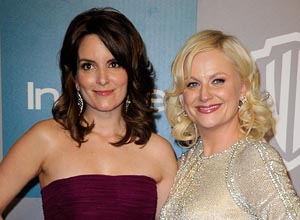
Tina Fey and Amy Poehler are not only co-hosts of the 70th Golden Globes this year, they’re also competitors. Both were nominated for Best Actress in a Television Musical or Comedy, with Fey duking it out with her counterpart for 30 Rock , while Poehler is up for the award for Park and Recreation . [ Related: Golden Globes Unveil 70th Edition Nominees ] But while the co-hosts won’t conceivably know the results until the envelope opens at the ceremony on January 13th, the pair are busy working together in the lead-up to the big event, and no doubt re-calling those good ol’ Saturday Night Live days. In this promo for the Globes, the duo are dressed in matching golden sparkly dresses and they both dish out cheesy Brit(ish) accents (until they don’t). Maybe they’re commenting on the resurgence of British-speak in Hollywood films reminiscent of the very early “golden days” of Hollywood? Who knows, but here’s a funny look at what may bode well for the Globes telecast after the New Year. [ Source: Huffington Post ]

Read the original here:
Tina Fey And Amy Poehler Pimp Out The Golden Globes

Oscar Index: ‘Zero Dark Thirty’ Caught In The Cross-Hairs

The Oscar Index’s head is spinning. What critics organization didn’t announce their nominees or award-winners this week? On Thursday it was the Golden Globes , on Wednesday the SAGs , and Monday the AFI and BFCA. The Boston, Detroit, Las Vegas, Los Angeles , Phoenix, San Diego, St. Louis and Washington critics associations also weighed in with their picks. But critics don’t vote for the Academy Awards, so much of this will have little bearing on who will be nominated for an Academy Award; not Lincoln ’s seven Golden Globe nominations, not Dwight Henry’s Best Supporting Actor win from the Los Angeles Film Critics Association for Beasts of the Southern Wild , and not the Washington D.C. Film Critics Association’s pick of Zero Dark Thirty as the year’s best film. By splitting its acting categories into drama and musical-comedy, the Golden Globes muddle the view of the fields , but they do afford some Oscar dark-horses like Richard Gere some necessary exposure to keep their chances alive. Meanwhile, the Screen Actors Guild Awards do matter as an Oscar precursor, as do perhaps some preemptive strikes at a probable Oscar frontrunner. But how big a target is Zero Dark Thirty ? We got a pretty good idea this week. Let’s go to the Gold Lining Playbook. Best Picture Zero Dark Thirty might have sustained some damage this week in the wake of several newspaper pieces that charge the film with being pro-torture and questioning the character of the real-life inspiration for the CIA analyst portrayed in the film by Jessica Chastain . A New York Times Op-Ed piece provocatively opened, “I’m betting that Dick Cheney will love the new movie Zero Dark Thirty ,” Greg Miller in the Washington Post wrote that the real-life operative, who remains undercover, “was passed over for a promotion that many in the CIA thought would be impossible to withhold from some who played such a key role in one of the most successful operations in agency history.” A New Yorker profile of director Kathryn Bigelow questions whether the film’s waterboarding scene takes dramatic liberties with the true story. The timing of these stories is suspect. If past Oscar campaigning has taught us anything, one has to ask at this early stage: Just how far will Harvey Weinstein go to win Oscars for Silver Linings Playbook ? which did receive a Screen Actor’s Guild’s ensemble nomination, a Best Picture equivalent. Best Exotic Marigold Hotel ’s SAG ensemble nomination could boost the film’s chances for a Best Picture nomination. Its distinguished British cast (classy) and pure escapism would seem irresistible to the typical Oscar voter, which the Los Angeles Times last year found was 94 percent Caucasian and a median age of 62. The Dark Knight Rises and so perhaps its Best Picture hopes after being named among the year’s 10 best films by the American Film Institute. Amends for The Dark Knight ? That The Master was not noticed by the SAG for its powerhouse ensemble is testament to the once presumed frontrunner’s fading buzz, while the omission of the critically praised Beasts of the Southern Wild was due to its SAG ineligibility. Likewise, the shutout of Quentin Tarantino ’s wildly anticipated Django Unchained might be a simple matter of screeners not being available in time for voters, theorizes Awards Daily ’s Sasha Stone. And with its five Golden Globe nominations, including Best Picture, Django could join the Oscar Best Picture race. 1. Lincoln 2. Zero Dark Thirty 3. Silver Linings Playbook 4. Les Miserables 5. Argo 6. Beasts of the Southern Wild 7. Life of Pi 8. Best Exotic Marigold Hotel 9. The Sessions 10. Django Unchained Ones to watch: The Dark Knight Rises, The Impossible, The Master, Moonrise Kingdom, Skyfall Best Director It’s doubtful that the potshots at Zero Dark Thirty will be enough to keep Bigelow out of the running. The director and screenwriter Mark Boal returned fire against agenda-driven critics. “This movie has been and will continue to be put in political boxes,” Boal told The Wrap this week. “Before we even wrote it, some people said it was an Obama campaign commercial, which was preposterous. And now it’s pro-torture, which is preposterous.” That leaves a slot for David O’Russell , Ang Lee , or late entrant Quentin Tarantino, who received his inevitable Golden Globe nomination Thursday. Pundits still give Lee an edge. The Golden Globes’ surprise snub of Tom Hooper is another indication that this field is anything but set. The Director’s Guild nominations, a reliable Oscar precursor, will be announced on Jan. 8, two days prior to the Academy. 1. Steven Spielberg ( Lincoln ) 2. Kathryn Bigelow ( Zero Dark Thirty ) 3. Ben Affleck ( Argo ) 4. Ang Lee ( Life of Pi ) 5. Tom Hooper (Les Miserables) Ones to watch: Paul Thomas Anderson ( The Master ), Michael Haneke ( Amour ), David O. Russell ( Silver Linings Playbook ), Quentin Tarantino ( Django Unchained ) Next: Best Actor & Actress

The rest is here:
Oscar Index: ‘Zero Dark Thirty’ Caught In The Cross-Hairs