Before IMAX became a way to boost action sequences — Tom Cruise dangling from the tallest building in the world, the Joker’s gang rappelling down from a Gotham City high-rise to rob a bank — the outsized format was primarily the domain of nature films like To the Arctic 3D , which aim to dazzle with large-scale shots of mountains and dolphins and Australia and other impressive-looking things. Forty minutes long and narrated by Meryl Streep , To the Arctic uses spoonfuls of cuteness — featuring walruses and caribou, though polar bears are its primary animal stars — to make its fairly grim environmental message go down a little easier. Directed by Greg MacGillivray, an old hand at IMAX docs, To the Arctic tries to balance out its underlying sense of global warming alarm with spectacular imagery and footage of the far north ecosystem at work. Of course, even when it comes to the most roly poly of polar bear cubs, life at the top of the world isn’t easy, and while the film discreetly leaves the majority of the process of hunting and gobbling down seals off screen, it does include some potentially troubling sequences involving the food sources the male bears turn to when desperate. Polar bears aren’t easy to film — a segment about how would-be cinematographers camouflage remote-controlled cameras in order to get closer shots of the animals shows one bear breaking a device like an enraged celebrity attacking a paparazzo. So when the filmmakers find a family of bears and are able to stick with them for several days, they end up catching a chase across the ice. It’s a mother polar bear and her two cubs who are the heart of To the Arctic , the trio traveling across the diminishing sea ice as the mother searches for food for her offspring in the lean summer months when hunting is more difficult. Survival isn’t a certainty — earlier footage shows a mother swimming for nine days and hundreds of miles in search of meat, her cub not surviving the journey. But in the case of these bears, their most dangerous enemy turns out to be males of their own species, who will eat cubs when they can’t find seals to nosh on. The mother anxiously herds her children across the ice floes, always on the lookout for other bears, though despite her caution one finds them and tries to track them down. (Parents with children and sensitive stoners planning on seeing the film can rest assured there are no scenes of violent polar bear cannibalism.) To the Arctic flutters from place to place, peering in at some Inuit hunters and researchers who dive beneath the ice, then traveling with a pair of scientists tracking caribou migrations before pausing to watch walruses loll in the sun and then jumping to a ship departing from Svalbard. The only thematic ties beyond a shared region are the environmental threats being posed by global warming, which is making it harder to polar bears and walruses to hunt and is wreaking havoc on the caribou migration patterns. The film is marked by a few jarring stylistic touches, like a score that wavers between dramatic instrumentals and Paul McCartney songs (“Mr. Bellamy,” “I’m Carrying” and “Little Willow”) and opening credits that explode into shards of ice that fly at you — narrated by Meryl Streep BOOM! Streep offers her voiceover with nary a sly twinkle, even when delivering lines about the “frisky dance of the northern lights” or urging that “we can help keep the Arctic white.” But it’s the visuals you’re here to see, and they look great on the massive screen in three dimensions, especially in helicopter shots that whirl past waterfalls cascading off of glaciers or travel over the fantastic tundra like there’s an army of orcs to be discovered just over the next bluff. 3-D and IMAX may no longer be new, but in moments like those, they can still summon a sense of awe. Follow Alison Willmore on Twitter . Follow Movieline on Twitter .
Chimpanzees are the putative subject of Chimpanzee , another in a line of Disney documentaries with big, blunt titles ( Oceans , Earth , Nature ) and very specific stories to tell. This time out, narrator Tim Allen tells us, our tale promises “drama, sadness, and joy in a world you and I may never set eyes on.” That world is the Ivory Coast rainforest, and we’re pretty much looking at it just then, but it becomes clear early on in the beauteous but outrageously martial Chimpanzee that things might not be what they seem. Because although our eyes tell us that the Ivory Coast is filled with wondrous life forms (my favorite might be the time-lapse sequence of a day-glo fungus), this world feels a lot like our own, where babies are nurtured by their moms, everyone has a name, and every happily functioning community has a mortal enemy one copse over. The center of Chimpanzee is Oscar, a just-born chimp with much to learn and about ten years to learn it. Oscar’s coo-factor was helpfully confirmed by the woman beside me, who turned to her young daughter and let out a helpless “awww” every time Oscar did something adorable, which is often, or every time Tim Allen said something shameless (“He may not be the most popular boy with everyone,” goes one such line, “but his mother’s love is something he can count on”), which is slightly less often. An early monkey business montage set to pop music sets a tone calibrated to charm children and their moms, but then Chimpanzee takes its subjects to war, and things get kind of weird. Freddy is the alpha male in Oscar’s group of a few dozen chimps, and we are told there is another gang not far away led by an aging don named Scar. Well, “gang” is one of the words used to describe them. The others are: mob, forces, rivals, ranks, enemy, team, and troops. Scar and his whatever you want to call them really got the short end of this combat narrative: According to the uncredited script, those other apes are greedy heathens who have hoovered up all the food in their territory and are mounting an “invasion” in order to continue feeding their insatiable lust for… nuts. Poor sweet Oscar and his doting mother are in danger, although the monkey they help tear to shreds in a coordinated attack might tell you that the group’s survival skills are pretty sharp. Inter-chimp and territorial fighting are facts of nature, but the extreme anthropomorphism of Chimpanzee makes what is natural feel bizarre. Excitedly setting up good guys and bad guys seems more about reinforcing our world than exploring theirs. Calling their work nature filmmaking rather than documentary, directors Alastair Fothergill and Mark Linfield had a story and specific shots in mind when they set out on what turned out to be a four-year shoot. Their access to the chimps has the hidden world feeling of the best nature films, but rather than observational the human presence feels invasive. For a nature film Chimpanzee cuts too many corners in the name of entertainment. Although Jane Goodall, a consultant on the film, has claimed that Oscar’s mother was killed by a leopard, in the film her disappearance is clearly connected to an attack by Scar and his goons. But our team starts looking pretty shabby as well: In the wake of her death the rest of the chimps turn their back on little orphaned Oscar, leaving him to starve and shunning him when he comes near. Then the extraordinary plot twist advertised at the beginning of the film takes shape, and there is a brief respite from all the military metaphor as Oscar and his new and unlikely adoptive parent bond. Many of the images speak for themselves, to the extent that with a little more creative editing and narrative restraint Chimpanzee could work as a silent film. Oscar learns how to crack nuts and chew fruit, and long shots of a handful of apes moving stealthily across the forest floor having a chilling, forbidding beauty. The few times when Allen does keep quiet, ironically, are the only times you really want him to chime in – say to explain the soufflé-topped mushrooms that crumple in a puff of amber dust when so much as a droplet of water hits them. There are only a few glimpses of life beyond the chimp family, but each one is mesmerizing and elusive, perhaps as they should be. Soon enough we’re back to the battle royale, when “Scar attacks,” “final pushes” are begun, “Freddy’s team can’t escape,” and “there can only be one victor.” I hope it doesn’t spoil anything to say that “teamwork beats brute force,” although the distinction between the two looked pretty thin to me. Anyway, the chimps fade from soldiers back into cartoon figures who seem to dance to our music, casting an impenetrable eye at the camera as we clap for more. Follow Michelle Orange on Twitter . Follow Movieline on Twitter .
Making its North American premiere next week at Tribeca , director Chris Kenneally’s digital-cinema study Side By Side has quite a bit going for it: There’s co-producer Keanu Reeves, narrating and leading interviews with an extraordinary range of filmmakers including Christopher Nolan, George Lucas, James Cameron, Martin Scorsese, David Fincher, Steven Soderbergh, Lars von Trier and numerous others. There’s great technical insight from Oscar-winning cinematographers like Vittorio Storaro, Wally Pfister, Anthony Dod Mantle and Dion Beebe. There’s scene-stealers like Joel Schumacher and shooter Geoff Boyle, who encapsulates the digital age with his trenchant summary, “We’re fucked.” But among all the experts, insights and disclosures herein, there’s one appearance in particular that makes Side by Side worth a look: The Wachowskis. While they’ve made seemingly random news posing for photos with Arianna Huffington and others, I can’t even find the last instance of a bona fide interview with Andy and Lana Wachowski. Roger Ebert talked to them a bit in 2008 , but for a real chat about their work or style, you’d probably have to go back to their Matrix days , when Lana was still Larry and they hadn’t yet settled completely behind their cloak of personal, professional and creative privacy. But there they are onscreen, filling Reeves and Kenneally in regarding the advancement of digital filmmaking and its influence on the Matrix and Speed Racer . And that’s not all. “The delivery system of cinema is going to change, and that’s almost kind of more exciting in a way for me, beside the actual cameras,” Lana says. “This very ancient system of putting a can of film on a truck, driving it to a city, unloading it — that’s being replaced.” And as for the social-media influence on filmgoing, Andy weighs in with his support: “In some way, the virtual experience is more rewarding, because there’s an actual dialogue going on.” There’s more, which you can see either at Tribeca (where Side by Side premieres Apr. 24 ) or when the film arrives in theaters and on VOD this August. All of which leads to the question: How did Kenneally and Reeves even get the two to agree to a sit-down with them? Kenneally sent the back story in a statement to Movieline: We are very fortunate and grateful for all the amazing people who shared their time, insights and knowledge with us for our documentary Side by Side . We were especially fortunate to have been able to interview the Wachowskis since they rarely do interviews. Andy and Lana have had a very successful and close relationship with Keanu, and I believe the reason they agreed to the interview was because of this friendship. The Wachowskis continue to create groundbreaking movies and they are truly pioneers in the use of digital technology. The images they were able to create in the Matrix Trilogy and on Speed Racer pushed the limits of filmmaking art and technology. There are beautiful shots in those films that had never been conceived of before. The Wachowskis were very busy working on their next film Cloud Atlas , which they are directing along with Tom Tykwer, in Berlin, Germany, but they found a few free hours for us one afternoon. Keanu, our producer Justin Szlasa and I flew to Berlin, set up our cameras quickly and got an amazing, insightful and at times hilarious interview. The Wachowskis had a unique, intelligent perspective on image creation, digital technology, editing, archival and couldn’t have been nicer or more welcoming to us. One of the highlights of the Side by Side journey for me was seeing Lana and Andy in the audience at our screening at the Berlin Film Festival. I had the chance to speak to them afterword. They were really happy for us and had a lot of kind words to say about Side by Side . Fantastic. Of course there are plenty of other interviewees and perspectives to catch in Side by Side ; learn more about the film and check out a few clips at its Tribeca Film Festival page . Read all of Movieline’s Tribeca 2012 coverage here . Follow S.T. VanAirsdale on Twitter . Follow Movieline on Twitter .
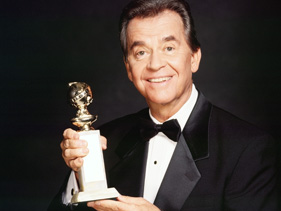
The television pioneer’s legacy was honored in several films, including ‘Grease’ and ‘Hairspray.’ By Kevin P. Sullivan Dick Clark at the 1999 Golden Globe Awards Photo: Chris Haston/ Getty Images Dick Clark, who died early Wednesday morning (April 18) from a heart attack at the age of 82, was a television pioneer. But Clark’s influence reached far beyond “American Bandstand” and onto the silver screen as well. His legacy was honored, imitated and questioned in many films throughout his lifetime. Here are five of Dick Clark’s most memorable movie moments. The Golden Globe Awards For years, Dick Clark Productions produced the yearly awards show for film and television. The Globes, awarded by the Hollywood Foreign Press Association, were seen as the earliest indication of which films would win at the Academy Awards. Clark worked as an announcer for the ceremony and would occasionally appear backstage. “Confessions of a Dangerous Mind” Clark appeared in the interview segments of George Clooney’s directorial debut, “Confessions of a Dangerous Mind,” a supposed biography of game-show producer Chuck Barris. The two TV legends worked at ABC during the same period. Clark was working on “American Bandstand” while Barris worked as a standards-and-practices executive. “Grease” Since the debut of perhaps Clarks’ most iconic work with “American Bandstand,” films have featured similar dance programs as either homage or parody. The film version of “Grease” featured a dance contest and a similar format called “National Bandstand.” “Hairspray” Similarly in another John Travolta film, “The Corny Collins Shows” riffed on the television staple. In that film, James Marsden played a show host named Corny Collins, who hosted a “Bandstand”-type show that feature a segregated cast of teen dancers. “Bowling for Columbine” Michael Moore targeted Clark for his documentary on gun violence. In “Bowling for Columbine,” Moore sought an interview with Clark because the son of an employee at one of Clark’s restaurants killed a classmate. Moore connected the poor working conditions and the low pay at Clark’s restaurant to some of the factors behind the shooting. Related Photos Dick Clark: A Pop-Culture Icon
‘My fans are always up for supporting a great cause,’ Bieber says in a statement about his support of the documentary. By Kara Warner Justin Bieber Photo: Kevin Winter/ Getty Images On the heels of the very successful release of his new single “Boyfriend,” teen phenom Justin Bieber is lending his star power and the song “Born to Be Somebody” to a very worthy cause: the TV ad campaign for “Bully.” The Weinstein Company announced Monday (April 9) that the Bieber-backed TV spot, which debuted on Fandango , will begin airing all over the U.S. ahead of the film’s PG-13 release this Friday. “My fans are always up for supporting a great cause. It’s one of the things I’m most proud of as an entertainer,” Bieber said in statement of his decision to be involved with the documentary. “I hope they see ‘Bully’ with their friends and help start the conversation so we can end bullying.” The highly publicized documentary, which depicts the often-disastrous results of school bullying, originally received an R rating by the MPAA, which inspired 17-year-old Katy Butler to start a viral petition that received over 500,000 signatures , including Bieber, Ellen DeGeneres, Johnny Depp and Demi Lovato. MTV’s own Vinny Guadagino from “The Jersey Shore” also got involved via the anti-bullying campaign the Bully Project tied into the promotion of the film. The campaign is a partnership between GLAAD and the Weinstein Company designed to spread awareness about bullying and to give people opportunities to add their name in support. For breaking news, celebrity columns, humor and more — updated around the clock — visit MTVMoviesBlog.com . Related Artists Justin Bieber
It’s hard to believe it’s been 13 years since Jason Biggs first made sweet, sweet love to that apple pie, but with this week’s American Reunion the gang is back, three sequels and four subpar spin-off movies later, to catch up and wax nostalgic about the good old days. Marinate on where all those years went while you catch up with the American Pie gang in Movieline’s Then and Now gallery and inevitably decide — as we all do on occasion while wine-drunk, yearbook in hand — which among them aged the best over the years. The whole gang is back in American Reunion , which sees the return of Biggs, Alyson Hannigan, Chris Klein , Mena Suvari , Shannon Elizabeth , Thomas Ian Nicholas , Seann William Scott , Tara Reid , Natasha Lyonne , Eugene Levy, Jennifer Coolidge, and yes, The Shermanator. More than a decade after their first outing I’d say the entire American Pie cast is looking good. Especially you, Eugene Levy . Rrrawr. Click to launch the time warp to 1999 gallery!
Legendary auteurs, they’re just like us! When iconic filmmaker Ingmar Bergman passed away in 2007, he left behind one of the greatest bodies of work known to cinema — and a vast, meticulously catalogued VHS collection, the subject of the upcoming Swedish documentary Bergman’s Video . Among his tapes, somewhere between the Bunuel and the Tarkovsky: Jurassic Park , Ghostbusters , and The Blues Brothers , which at least partially explains the ghosts and Jake/Elwood-esque sibling dynamic in Fanny and Alexander . The dinosaurs, not so much. [ Cineuropa via Movie City News ]
You don’t need me to explain to you how Harvey Weinstein is half huckster-genius and half megalomaniac witch doctor (even though I have, again and again and again ). Find all the evidence you need in Thursday’s announcement that Bully — the “controversial” documentary chronicling America’s bullying epidemic — would finally receive the PG-13 rating it so conspicuously sought from the MPAA. The best part: It won’t even have to trim the offending scene at the heart of all the publicity to date. Surprise! Suckers. The MPAA won’t even insist on the customary 90-day window between R- and PG-13-rated versions. Great! No one will ever accuse them of making it up as they go along ever again ! From a Weinstein Company press release: The Weinstein Company aided by the guidance and consultation from attorneys David Boies and Ted Olson, announced today that the MPAA has lowered the R rating, given for some language, for BULLY to a PG-13 in time for the film’s April 13th expansion to 55 markets. The scene that has been at the forefront of the battle with the MPAA, the intense scene in the film that shows teen Alex Libby being bullied and harassed on a bus, has been left fully intact and unedited. BULLY director Lee Hirsch felt editing the scene was not an option, and subsequently refused to do so, since it is too important to the truth and integrity behind the film. Also a victory is the exception the MPAA made by allowing the film to be released with the new rating before 90 days, which is the length of time their policy states a film must wait to be in theaters after a rating change to avoid confusion or inconvenience for moviegoers. This decision by the MPAA is a huge victory for the parents, educators, lawmakers, and most importantly, children, everywhere who have been fighting for months for the appropriate PG-13 rating without cutting some of the most sensitive moments. Three uses of the ‘F word’ were removed from other scenes, which ultimately persuaded the MPAA to lower the rating. Hirsch made the documentary with the intent to give an uncensored, real-life portrayal of what 13 million children suffer through every year. The new rating, which came about with the great support from MPAA Chairman Chris Dodd, grants the schools, organizations and cities all around the country who are lined up and ready to screen BULLY, including the National Education Association and the Cincinnati School District, the opportunity to share this educational tool with their children. Of course, the latter organizations always had that option , but what good is accepting parental permission slips without the prospect of getting the full ticket price as a result? Sigh. I know this is a “Forget it, Jake, it’s Chinatown” moment if ever there was one, but to come to work every day and see so many otherwise smart, savvy and skeptical industry observers and pundits just pass along such cynical, craven marketing spin for months without ever communicating Harvey’s obvious calculations to their readers — to treat the Bully ratings saga as a legitimate cause — is a just a total failure. It’s a total embarrassment . Taking nothing away from the film or the consequences of bullying, what kind of a complacent creep do you have to be to smilingly shovel so much of these people’s bullshit? Or to keep taking the MPAA at its grotesque face value? Or to accept some bullied teenager(s) carrying the banner for a movie on behalf of the most notorious bully of the modern Hollywood era? Or to pull a paycheck every day for publicizing such bald-faced lies? Puke. Anyway, the entertainment industrial complex wins again. Whatever. So much for Good Friday. [via Deadline ] Follow S.T. VanAirsdale on Twitter . Follow Movieline on Twitter .
How do you come to the rescue of the millions of children who need someone — anyone — to do what they can’t: get their bullies off their backs? Director Lee Hirsch has sounded a call to action with his new documentary Bully , which exposes bullying from the front lines. Opening today, the film follows several kids and families struggling to stop the taunting and violence. Hirsch captures the frustration and helplessness among not only the victims but also their parents, who have lost trust in our modern school system. There’s Alex, 12, who seems convinced his bullies are his friends; Ja’Meya, 14, locked up after brandishing a gun on the bus where she faced her tormenters; and Kelby, 16, whose whole family retreated into isolation after she came out as a lesbian. Also profiled are the families of a teenager, Tyler, and an 11-year-old, Ty, whose bullying-related suicides devastated their communities and served as a wake-up call. If the film is taken to heart, it should be among the catalysts for changing the “kids will be kids” mentality among some educators and other authority figures. On a micro level, parents who participated in the film are speaking out in their communities and persuading kids to protect one another. Hirsch is working on getting his movie into schools, where it can have more influence. After a whiplash-inducing saga over its MPAA rating, initially an R for strong language, Bully will be released unrated in New York and Los Angeles before expanding to other cities on April 13. Hirsch spoke to Movieline about the movement that has grown out of his project, the newly famous Bully kids, and whether minors will go to the theater to see the film. When were you made aware of the rampant bullying going on in schools these days, and what led to your decision to make a documentary about it? The drive to make the documentary film is that I was bullied as a kid, so it’s very much a piece of my narrative. You know it’s bad, and I had talked about it over the years with people and sort of sensed that it’s a problem greater than my own. I didn’t really understand until we saw the extent to which people were affected by this, to the millionth. It’s funny you ask that because I feel like I dish out these statistics as if I’ve know them forever, but actually there was a process of discovering how big this really was. Then you start doing the math and thinking, if 13 million kids get bullied a year, and you start adding that up from generation to generation, there’s a lot of folks that have this narrative, that have a story, when it comes to bullying. So all those things came together when we started getting into it. Now it’s been three years that I’ve been working on this. It’s interesting you asked me that, I hadn’t thought about that. Did you have any problem getting kids or parents to participate in the film? No, not at all. We shot so many more stories than we were able to include in the final version of the film. We had people reaching out to us. We reached out to a lot of families. It was so different, because we filmed kids like Kelby, where they were outwardly looking for somebody to hear their story and share their outrage, and then Alex, who we very much stumbled upon while being allowed to film inside this school and see how adults and folks were handling certain situations. I wasn’t surprised by the willingness of people, because I remember that feeling of wishing someone would listen to me. I thought it was really brave of Ty’s friend to admit that he’d been a bully at one time. I wondered if you considered putting more kids in the film who shared that side of the story. I had. I think ultimately the narrative of this film is it tells the story of families that are on the victim side, and so you just settle into a world where you’re seeing what they see, as they see it and they deal with it. Ultimately it became less about, “what are the arguments on this side and that side, and what’s this position and that position,” or a full, drawn-out exploration of the psychology of bullying, but rather it became about telling five stories. We didn’t even know how many stories we were going to tell as we shot it. We were just looking to tell stories that allowed you to walk in the shoes of the kids and families who were dealing with this. Now that the Weinstein Company is releasing the film unrated, how do you imagine kids seeing the movie? Do you think they’ll be going to the theater or seeing it in school? We still have school districts reaching out to us every day. We’re in discussions for how to facilitate that. We have a goal of a million kids seeing the film. On their own and with groups. Within their schools and with organizations. Engaging on our website, bullyproject.com , and participating in the movement. We want to have real engagement. That’s the goal now. I think we want to be able to support viewers after they see the film with how they can be involved, how to make a difference. How to do anything from stand up and how to make that meaningful and supportive, to how parents navigate the school system when they’re advocating on behalf of their kids. I think that’s a long-winded answer to say that yes, I really do think that kids are going to come see this film. I think we owe a lot of that to Katy Butler for inspiring hundreds of thousands of teens to sign this petition , and it’s also thanks to so many of the celebrities who have spoken out for the film. It’s exciting. You’re talking to me the day before it opens. I can’t wait to see what happens. Have you seen any positive changes in schools since you started the project? In Alex’s school? In any school, or in any aspect of it, actually. Have you seen anything positive happen as a result of just making the film and building the website? I feel like, how do you measure half a million signatures and people sharing their stories? I think that’s impact. How do you measure the thousands of people that have written on our wall? People are supporting each other and writing to each other and building a community that feels like it’s turning into a movement. I feel that the film has already had impact in ways that I couldn’t have dreamed. I think that already the conversations are rich and deep that people are having about bullying at their schools, about what the climate and culture are like in their community. I think that those conversations are happening, and that’s change, that’s transformation. It’s very exciting. Do you have any plans to do follow-ups with the kids from your film? I don’t have time to do a follow-up film of any kind, but I am in touch with all of the families on a regular basis. Certainly Alex and his family, in particular, and we see them all the time, with Kelby and her family. They come to screenings. They’re doing press. Alex went and argued before the MPAA with Harvey Weinstein. These families are like my second family now. They mean the world to me, and it’s been awesome to get to spend a year with them. Other people are putting cameras in front of them, but it’s not me. I wonder if years down the road we’ll hear from them. I think there would always be an interest in hearing how they’re doing. The families are going to have to make a decision about whether they want this press to continue. For them, boy, this was unexpected, right? I had a sense that maybe we would do some press. It’s been extraordinary for me. I couldn’t have seen this, but for them, it’s been a confusing and extraordinary ride. We just give them as much support as we humanly can. I’ll always be in their lives, and I feel that in my film work I always develop strong bonds with the people that end up in my films, my subjects. It always matters that they see the film and that they’re part of the process and that that relationship stays strong. That comes through in the film. I’m so proud of them — in particular, because I see them so often, Kelby and Alex — because they’ve become advocates. People are writing me and saying, “Can you please send this to Alex? He’s my hero.” It’s incredible. It’s harder for the families that have lost kids. That’s … I … I think about them a lot because they have suffered such an ultimate loss. And they’ve embarked on a new path of advocating for kids and inspiring kids. They’ve been incredible advocates. I’ve seen that a lot with families of kids who have committed suicide that’s been linked to bullying. Can you imagine that sense of injustice that they feel? No. No, you can’t. I can’t either. They’re so engaged, and they’re such powerful advocates. I see many of these families doing such powerful work out in the world. Bully opens today in New York and Los Angeles, with additional cities to come on April 13. Read Stephanie Zacharek’s review here . [Photo: Getty Images]
Weinstein Co. is releasing the documentary on bullying unrated in a protest against an R. By Gil Kaufman A Scene from “Bully” Actors, singers, politicians, educators and high school kids have been protesting the R rating given to the anti-bullying documentary “Bully, but the ratings board would not budge. So, instead of folding, frequently outspoken Weinstein Co. co-founder Harvey Weinstein has decided to release the film unrated. “The small amount of language in the film that’s responsible for the R rating is there because it’s real,” director Lee Hirsch said of the multiple f-bombs that landed the film its restricted rating, according to The Hollywood Reporter . “It’s what the children who are victims of bullying face on most days. All of our supporters see that, and we’re grateful for the support we’ve received across the board. I know the kids will come, so it’s up to the theaters to let them in.” The film depicts the painful results of school bullying and follows several families who’ve been impacted by bullying. But because it was given an R rating, it cannot be screened in middle and high schools. Weinstein began a public appeal of the rating last month, making the case that it would freeze out the very teens and others under 18 who most need to hear its powerful message. The rating war inspired 17-year-old Katy Butler to start a viral petition to get the decision changed. Not only did her movement win her a GLAAD Media Awards over the weekend, but it also drew nearly