Tag Archives: economic

A “Lil Positivity”: What Bad Economy? Blacks And Young Americans Remain Positive Despite Our Nations Struggles

Is the “American Dream” dead? Despite hard times Black America is willing to do whatever it takes to keep their head above water in a struggling economy. “Due to today’s struggling economy, many young people are less inclined to believe in the “American Dream” than their parents and grandparents. “More than 4 in 10 predict it will be tougher to raise a family and afford the lifestyle they want,” according to a poll conducted by an Associate Press-Viacom poll of Americans aged 18 to 24. But this has not prevented African Americans or whites from feeling hopeful that they will be able to adapt and cope with their circumstances. “Social Security may not even exist when I’m older. Health insurance is going up. Everything just costs more,” said Ashley Yates, a nursing student at San Francisco State University. But students like her are not shaken by the dismal economy. 90 percent of the 1,104 participants surveyed actually believe that they will find a career that will bring them happiness. Young adults are willing to take on second jobs to supplement their incomes to make up for low salaries and there is a trend of optimism. More students and young professionals are determined to better their individual circumstances even if they believe that the general population will not be able to accomplish their goals. “Even if it never gets better permanently, we’ll adjust to whatever it is,” said Preus, 22, a linguistics and cognitive science grad from Cornell University who plans to pursue her passion for science in graduate school. A Washington Post-Kaiser Family Foundation-Harvard University poll discovered the economic crisis within the last few years has eliminated nearly a fifth of Americans’ net worth. African Americans and Hispanics were more likely to be left broke, jobless and concerned that they lack the skills needed to gain profitable careers. But they also remained the most hopeful that they would eventually be able to prosper. AOL BlackVoices also reported that black teens were more optimistic about their economic futures compared to the general population. Seventy percent of black students ages 15 to 18 thought their standard of living would be better than their parents, compared with just 36 percent of white students, according to a Hamilton College poll. In contrast, white baby boomers were not as hopeful. “I think things are going to get worse before they get better. A lot of people are going to have to buckle down because we’ve got a generation now that doesn’t work,” said David Still, 54, a married, white father of two who works as an electrician in Sumter, S.C. Studies have speculated that the rise in optimism among blacks is due to the election of President Barack Obama despite the history of oppression and strife in America. Perhaps a generation where more students have seen traditional pathways to economic success feel they are more inclined to create their own road to accomplish their goals. “A lot of stuff in the news is telling everyone that they can’t, that the economy is crumbling and there’s no room for anyone to do anything,” said 23-year-old Lucas Ward. “But I’m watching that being disproven every day.” We will prosper! Why do you think young Blacks have a more optimistic attitude toward the future than older white Americans? Have older generations helped to instill a healthy attitude toward struggle? Or are we just being naive? Source
Go here to see the original:
A “Lil Positivity”: What Bad Economy? Blacks And Young Americans Remain Positive Despite Our Nations Struggles

‘Atlas Shrugged’ Trailer

http://www.youtube.com/v/5Njv4uVQHyY

Read the rest here:

Think back to the biggest development disasters of 2010. High on the list without a doubt, and perhaps topping the list, was Atlas Shrugged. In development for years, by 2009 the Ayn Rand novel was riding a newfound wave of popularity thanks to the economic collapse of late 2008, and also to a sense of post-Obama malaise within the conservative right. There was a point where it seemed like the book… Broadcasting platform : YouTube Source : /Film Discovery Date : 12/02/2011 01:51 Number of articles : 2

‘Atlas Shrugged’ Trailer

President Obama is neither weak nor stupid… nor a progressive

Nobody forced President Obama to escalate the war in Afghanistan. Nobody forced him to expand oil drilling in the Arctic rather than make the case that we need an emergency effort to end our addiction to all fossil fuels. Nobody forced him to have his Department of Justice ignore the Bush administration's criminality. Nobody forced him to continue secret renditions or a policy of denying suspected terrorists the human right of due process. Nobody forced him to order his DOJ to appeal court rulings that would have ended Don't Ask Don't Tell. Nobody forced him to open a discussion about the deficit which even puts Social Security and Medicare on the table when the economy desperately needed and needs more Keynesian stimulus. Nobody forced him to keep on Bush's Defense Secretary. Nobody forced him to hire a neoliberal economic team and ignore the traditional liberal economists who had been almost alone in predicting the economic collapse. None of these moves was forced on him by the Republicans or the Conservadems or the Blue Dogs. http://www.dailykos.com/storyonly/2010/12/5/925119/-President-Obama-is-neither-w… added by: uppityprogressive

2010 Cyber Monday Deals Extends The Shopping Fever

When the month of November started, the shopping deals have become unstoppable. Despite the economic crisis around, people seemed to have saved a lot for this awesome event. November sale includes Thanksgiving, Black Friday, and Cyber Monday sale. These sales comprise the long weekend of shopping, shopping and shopping. After Thanksgiving party, some are camping 2010 Cyber Monday Deals Extends The Shopping Fever is a post from: Daily World Buzz Continue reading

Al Gore: I Was Wrong About Ethanol

Photo: World Economic Forum , Flickr, CC Corn ethanol has turned out to be a bad idea — there’s little disagreement about that , especially in environmental circles. For starters, it’s an incredibly inefficient fuel source, consuming tons of water to produce… Read the full story on TreeHugger

Original post:
Al Gore: I Was Wrong About Ethanol

Michelle Obama’s Burden and the Obamas’ Hard Hearts

It’s tough being the wife of the most powerful man in the world, just ask Michelle Obama. Carla Bruni, who seemed to reveal her distaste for the First Lady in previous pictures, reveals Michelle’s whiny comments in her recent book [Aside: why is a sitting world leader’s spouse writing a tell-all? What tawdriness.] Anyway,  here’s what was allegedly said: Michelle Obama thinks being America’s First Lady is ‘hell’, Carla Bruni reveals today in a wildly indiscreet book. Miss Bruni divulges that Mrs Obama replied when asked about her position as the U.S. president’s wife: ‘Don’t ask! It’s hell. I can’t stand it!’ Details of the private conversation, which took place at the White House during an official visit by Nicolas Sarkozy last March, emerged in Carla And The Ambitious, a book written in collaboration with Miss Bruni. Well, of course the job is difficult-prepared meals, jet-setting, specially designed clothes, lecturing the American people on eating apples is exhausting work. Also, it’s awful. Not out-of-a-job awful. Not repo awful. Not foreclosure awful. Not hungry awful. But, yeah, being First Lady is awful. Michelle Obama and that husband of her’s just don’t quite cast an empathetic image, do they? NPR kvetches about this problem : Is President Obama too rational to be likable? Obama comes across as so self-contained that his personality almost seems like a bubble around him – perhaps even more so than the bubble that surrounds any president, thanks to the Secret Service and all the trappings of the White House. “Obama’s analytic style of decision-making and his unwillingness to show emotion makes it hard for people to relate to him,” says Stephen J. Wayne, a government professor at Georgetown University. If a president is in power during hard times, his relative likability won’t matter so much as his overall job performance. But every president gets judged to a greater or lesser degree according to his personality. Perhaps no president would be doing well in the polls with unemployment near double digits throughout his term. But Obama’s inability to connect on an emotional level with many people has been an additional drag on his approval ratings. Oh yes. It’s the President’s cerebral nonchalance that’s making connection so difficult. How about this idea: Michelle and Barack Obama just don’t care. When an entitled person feels perpetually ripped off, they tend to feel less empathy for those they perceive as ripping them off. So, that lack of empathy; that attitude of being put-upon? That’s genuine no matter how the lib press wants to  rationalize  it away. Stories like these, from  the Politico  help nothing: The White House is fighting back against claims its offshore drilling moratorium will cause dramatic job loses along the Gulf Coast with a new report that says most jobs aren’t gone forever. Only 8,000 to 12,000 jobs will be lost along the Gulf Coast , and most will return once deepwater drilling resumes, says the report to be presented to a Senate panel Thursday. That’s right. ONLY 12,000 families will face the desperation of a lost livelihood and face the stress and strain of keeping their homes during this economic crisis. ONLY. Do the Obamas not grasp the gravity of the economic situation in America today? Do they not grasp their enormous educational, cultural and social privilege long before they ever lucked into the presidency? Or, are they so brainwashed by their own imagined persecution complex that they simply cannot see their remarkable lives for what they are: lucky and fortunate. Michelle Obama is not burdened. The woman doesn’t know from burden. And Barack Obama is not mis-perceived by the American people. They are seeing his cold nature for what it is: hard hearted. No amount of fawning press can obscure what is becoming more obvious. UPDATED: Michelle Obama’s office denies Carla Bruni’s revelation .

Visit link:
Michelle Obama’s Burden and the Obamas’ Hard Hearts

Joe Klein & Matthews Link Anti-Muslim ‘Attitude’ to ‘Deranged Muslim’ Violence, Small-Town Whites Miss ‘Ethnic Purity’ of Past

On Sunday’s syndicated Chris Matthews show, during a discussion of a poll reporting that a majority of self-described Republicans expressed a negative view of Islam, as Time magazine’s Joe Klein recounted incidents of recent violence in America by Muslim extremists, host Matthews asked if “this [anti-Muslim] attitude against them” was to blame for “stirring them up,” leading Klein to agree that anti-Muslim attitudes played a role: JOE KLEIN, TIME MAGAZINE: You’ve had over the last year, two or three major incidents of deranged Muslims, the Army doctor down at Fort Hood, the Times Square bomber, who were Americans, American citizens. CHRIS MATTHEWS: And what’s stirring them up? This attitude against them? KLEIN: Yeah. But I also think that there’s a small minority of Muslims in the world who believe this extremist philosophy. After Matthews questioned whether opposition to the Ground Zero mosque and “apocalyptic talk by people like Glenn Beck” exist because the President is black, Klein painted small-town white Americans as resentful that modern America no longer has the “ethnic purity” of the past, with Matthews responding, “Well said.”: KLEIN: A good part of the anxiety that’s going on in small-town white America isn’t just the plain old black and white stuff of the past. It’s the fact that South Asians are moving in and running the local motel or … there are a lot of Latinos about who are moving into these areas, that their grandchildren are coming out as gay or intermarrying. The purity of, the “ethnic purity,” to coin a phrase, that they grew up with no longer exists, and I think that that in addition to the economic – real, real, economic problems… MATTHEWS: Well said. I think that is the change, the whole change in the world they live in is something. Below is a transcript of the relevant portion of the Sunday, August 29, syndicated Chris Matthews Show: CHRIS MATTHEWS: Let’s talk about the mosque in New York. We’ve got a poll out here, an amazing poll that came out this week: 54 percent of Republicans say they have an unfavorable view of Islam – the religion, not Arab politics, not terrorists, no subset, the billion Islamic people in the world, they don’t like. Serious business here. KATTY KAY, BBC: I think that this has gone beyond the mosque. MATTHEWS: These are Republicans. KAY: That this is now, the conversation that has followed the mosque has almost become a bigger problem in and of itself, and the tone of that conversation. One of the advantages that America has always had is that you have one of the most assimilated, moderate Muslim populations in the Western world, and that has played to your advantage. The risk here is that incidents like a taxi driver, a Muslim taxi driver getting stabbed in New York- MATTHEWS: By a probably deranged person. Let’s be fair. KAY: It is deranged people in Holland who shoot Muslims, you know, in the streets. That is (INAUDIBLE) JOE KLEIN, TIME MAGAZINE: Yeah, but there are, but, you know, you’ve had over the last year, two or three major incidents of deranged Muslims, the Army doctor down at Fort Hood, the Times Square bomber, who were Americans, American citizens. MATTHEWS: And what’s stirring them up? KLEIN: Well, I think that- MATTHEWS: This attitude against them? KLEIN: Yeah. But I also think that there’s a small minority of Muslims in the world who believe this extremist philosophy. KAY: But the risk for America is if you start putting all of those extremists in with all of Muslims. And that’s what’s being blurred here. … MATTHEWS: Is it based on the fact that we have an African-American President? If we had a President- KLEIN: No. MATTHEWS: -like Hillary Clinton right now, would we have the same level of apocalyptic talk by people like Glenn Beck, the same attitude towards this mosque which is a couple blocks away from the World Trade Center on a row of buildings? KLEIN: First of all, we have a mixed race President who has a middle name “Hussein.” And a good part of the anxiety that’s going on in small-town white America isn’t just the plain old black and white stuff of the past. It’s the fact that South Asians are moving in and running the local motel or, you know, I don’t want to deal in those sorts of cliches, but there are a lot of Latinos about who are moving into these areas that their grandchildren are coming out as gay or intermarrying. The purity of, the “ethnic purity,” to coin a phrase, that they grew up with no longer exists, and I think that that in addition to the economic – real, real, economic problems – (INAUDIBLE) MATTHEWS: Well said. I think that is the change, the whole change in the world they live in is something.

See more here:
Joe Klein & Matthews Link Anti-Muslim ‘Attitude’ to ‘Deranged Muslim’ Violence, Small-Town Whites Miss ‘Ethnic Purity’ of Past

How Convenient: CBS Asks Pro-Stimulus Economist to Rate the Stimulus

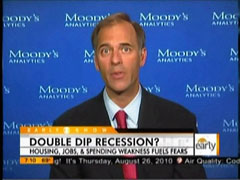
As the Obama administration’s “Recovery Summer” crumbles, CBS’s Early Show on Thursday noted how the poor economic data has made many Americans deeply pessimistic about the future, with 37% saying that the economy “is in permanent decline.” So does that mean Obama’s $862 billion stimulus is a failure? Not according to economist Mark Zandi, who was interviewed by co-host Erica Hill. Zandi asserted that “the recession ended about a year ago, in large part because of the stimulus efforts,” and the current sluggishness was because “the stimulus is now fading,” and thus “the benefit to growth is winding down.” Of course, Zandi has been a consistent enthusiast for the stimulus, as far back as early 2009, a fact which was not disclosed today. “We need stimulus,” Zandi championed on the January 28, 2009 Early Show. “It’s about preserving jobs.” After President Obama signed the behemoth spending bill, Zandi was back on the February 18, 2009 Early Show: “It`s a reasonably good plan….The fact that policymakers are working really hard here, I think, is a reason for some optimism.” Viewers might have benefitted if CBS had paired Zandi with an economist who sees the data differently (for example, the Heritage Foundation’s Brian Riedl put out a good report last week on why rampant federal spending risks destroying the economy). On the flip side, Zandi did argue against the Obama administration’s scheme to raise taxes in January, saying that while it would be “reasonable” to do so in later years, the economic recovery is now too “fragile” to withstand such an action. Here’s more of how the August 26 Early Show covered the economy: # Report from correspondent Rebecca Jarvis, headline: “Economic Woes” REBECCA JARVIS: From housing to jobs to the health of the U.S. consumer, the latest economic data has slowed significantly, and it’s having an impact on how Americans feel about the recovery. According to the most recent CBS News poll, over one-third of Americans, or 37%, think the decline is here to stay. # Interview with Mark Zandi ERICA HILL: There’s so much focus on the Obama administration, on what was done on the stimulus package. How much of what we’re seeing in the economy right now is a direct result of the administration’s policies and of the stimulus? MARK ZANDI: Well, it is related. I think it’s fair to say the recession ended about a year ago, in large part because of the stimulus efforts. I don’t think it’s any coincidence that the recession ended as the stimulus provided its maximum benefit to the economy. But, the stimulus is now fading — the housing tax credits being part of that stimulus, as an example — and so the impetus to growth, the benefit to growth is winding down, and that’s one of the reasons why the economy is slowing. HILL: So, would that be a case then, as you see the economy slowing, to extend those Bush tax cuts which we’re hearing so much about, and which has really become important as we move forward to the elections in November? ZANDI: Yeah, good point. I mean, I don’t think it would be wise to raise taxes for anyone in 2011 when the economic recovery is so fragile. Now, the President has proposed raising tax rates back to where they were [in the Clinton years] for people who make over $250,000 a year on a joint basis — that’s a very wealthy group, about three percent of the population. I think that’s reasonable, but only in 2012, 13, 14 — when the economy’s off and running. I wouldn’t do it in 2011 when the recovery is so weak.

Read the original here:
How Convenient: CBS Asks Pro-Stimulus Economist to Rate the Stimulus

The New Push for a Global Currency

You surely didn’t think that the governing elites would let this economic crisis pass without pushing some cockamamie scheme for control. Well, here is the cloud no bigger than a man’s hand, a revival of a 60-year-old idea of a global paper currency to fix what ails us. The IMF study that calls for this is by Reza Moghadam of the Strategy, Policy, and Review Department, “in collaboration with the Finance, Legal, Monetary and Capital Markets, Research and Statistics Departments, and consultation with the Area Departments.” In other words, this paper shouldn’t be ignored. It’s a long-term plan, but the plan has the unmistakable stamp of Keynes: “A global currency, bancor, issued by a global central bank would be designed as a stable store of value that is not tied exclusively to the conditions of any particular economy…. The global central bank could serve as a lender of last resort, providing needed systemic liquidity in the event of adverse shocks and more automatically than at present.” The term bancor comes from Keynes directly. He proposed this idea following World War II, but it was rejected mostly for nationalistic reasons. Instead we got a monetary system based on the dollar, which was in turn tied to gold. In other words, we got a phony gold standard that was destined to collapse as gold reserve imbalances became unsustainable, as they did by the late 1960s. What replaced it is our global paper money system of floating exchange rates. But the elites never give in, never give up. The proposal for a global currency and global central bank is again making the rounds. What problem is being addressed? What is so desperately wrong with the world that the IMF is floating the idea of a world currency? In a word, the problem is hoarding. The IMF is really annoyed that “in recent years, international reserve accumulation has accelerated rapidly, reaching 13 percent of global GDP in 2009 — a threefold increase over ten years.” You see, monetary policy isn’t supposed to work this way. In their ideal world, the central bank releases reserves and these reserves are lent out, leading to a boom in consumption and investment and thereby global happiness forever (never mind the hyperinflation that goes along with it). But there is a problem. The current system is nationally based and so the economic conditions of one country turn out to have an influence on the borrowing and lending markets. Without borrowers and lenders, the money gets stuck in the system…. Continued at: http://www.campaignforliberty.com/article.php?view=1049 added by: Dagum

The Real Redistribution of Wealth

Wealthy Are Cashing in Huge, While Workers' Salaries Keep Shrinking Times are tough for workers in the U.S. where a recession has a stranglehold on much of the economy, but life is perfectly rosy for those at the top. The riches of the wealthiest North Americans grew by double digits in 2009, primarily from interest their money earned when it was invested in the stock market and elsewhere, according to a report by the Boston Consulting Group. Millionaires in the U.S. and Canada saw their wealth increase 15 percent in 2009, to a total of 4.6 trillion dollars, the report found. Worldwide, 11 million – or less than 1 percent of all households – were millionaires in 2009. They owned about 38 percent of the world's wealth or 111 trillion dollars, up from about 36 percent in 2008, according to Boston Consulting Group. About 4.7 million millionaires live in the U.S., four percent of the population and more than anywhere else in the world. Japan, China, Britain and Germany followed the U.S. in the number of millionaires. Their fortune is a stark contrast to the lives of more than 15 million people in the U.S. who are unemployed and searching for work, and the eight million more who are just getting by with a part-time job, according to the U.S. Bureau of Labor Statistics. More than two million more people were working prior to the recession but have now dropped out of the labour force. Apart from the newly unemployed, about 39 million people in the U.S. are chronically poor and do not have enough food to eat, according to the U.S. Census and U.S. Department of Agriculture. “The nation's jobs crisis is so catastrophic that, unless Congress acts on the scale of the New Deal, millions of Americans will experience extremely long periods of unemployment for many years ahead,” Lawrence Mishel, president of the Economic Policy Institute, told a panel of the Committee on Ways and Means recently. Not so for millionaires and the uber-rich. The uber-rich, those with more than 30 million dollars, are on the rebound. They spent more money in 2009 on fancy cars, yachts and jets compared to 2008, according to a study by Merrill Lynch-Capgemini. They bought fine art, expensive jewelry, gems and antiques, items that are likely to increase in value over time, so they can sell them later and make more money. The recession isn't hitting those at the top as it has workers. In fact, many wealthy people benefited from the stock market's ups and downs, said Mike Lapham, director of the Responsible Wealth Project at United for a Fair Economy, an NGO in Boston. story continues http://www.alternet.org/economy/147492/wealthy_are_cashing_in_huge%2C_while_work… added by: Stoneyroad