Tag Archives: economy

CBS: Americans Support Dem Economic Policies, Just Upset With Incumbents

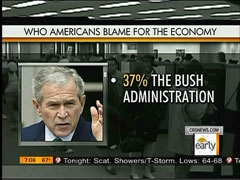
While acknowledging bad news for Democrats in the latest CBS News/New York Times poll on Thursday’s CBS Early Show, White House correspondent Bill Plante worked to find a silver lining: “But when it comes to who’s at fault for the rotten economy there’s a disconnect. 37% say the Bush administration is most to blame. Only 5% blame the Obama administration.” Following Plante’s report, fill-in co-host Erica Hill spoke with political analyst John Dickerson and wondered: “37% of those in the poll said that fault for the bad economy lays with the Bush administration. 5% said it lays with the Obama administration. Does that mean that this Democratic message is getting through?” Dickerson explained: “People don’t blame the Obama administration and they also, in our poll, believe the Democrats have the better policies to deal with the economy and, also, they believe the Democratic position on tax cuts. Nevertheless, they want to throw out the people who are in power and the problem is there are just more Democrats in power.” One finding that was not highlighted was the fact that 53% of registered voters in the poll were in favor of smaller government providing fewer services.   Here is a full transcript of the September 16 segment: 7:00AM ET TEASE: ERICA HILL: The President’s problems. President Obama looks to rally his party before the midterm elections but faces a battle from the GOP over the economy and tax cuts. This as his approval ratings continue to sag, according to the latest CBS News poll. 7:05AM ET SEGMENT: HILL: We want to take a look now at politics and the problems facing President Obama. The latest CBS News/New York Times poll finds the President’s approval rating is now just 45%. And with an election coming, he is trying, of course, to turn that around. CBS News senior White House correspondent Bill Plante has the latest for us this morning. Bill, good morning. BILL PLANTE: Good morning, Erica. And his disapproval rating is 47%, so it’s an almost an even split. And with Congress back in session and things looking pretty bleak for the Democrats in November, the President went on the attack against Senate Republicans, whom he blames for holding up things that could – bills that could help the economy. [ON-SCREEN HEADLINE: Problems For The President; New CBS News Poll Shows Approval At Just 45%] BARACK OBAMA: We don’t have time for any more games. I understand there’s an election coming up. But, the American people didn’t send us here to just think about our jobs. They sent us here to think about theirs. PLANTE: The President has no bigger problem than the still sluggish economic outlook. In a CBS News/New York Times poll, 51% disapprove of his handling of the economy. Only 35% of Americans think Mr. Obama has made progress in fixing the economy. And 53% say he has no clear plan for creating jobs. But when it comes to who’s at fault for the rotten economy there’s a disconnect. 37% say the Bush administration is most to blame. Only 5% blame the Obama administration. And dissatisfaction with the performance of both Republicans and Democrats now drives 54% of people to say the country needs a third political party. At the top of the President’s agenda to help the economy, passing an extension of the Bush-era tax cuts for the middle class. Mr. Obama came to the Rose Garden following a cabinet meeting and attacked Republican leaders for not acting. OBAMA: They want to hold these middle class tax cuts hostage until they get an additional tax cut for the wealthiest 2% of Americans. We simply can’t afford that. PLANTE: Of course, the White House is not deaf to poll results like these, in fact their own internal polling shows much the same thing. So you can expect the President to continue the campaign-style rhetoric in the months leading up to the election, trying to connect his message to the public. Erica. HILL: Bill Plante at the White House this morning. Bill, thanks. Joining us now CBS News political analyst John Dickerson, who’s also in Washington this morning. John, good morning. Some really fascinating things to pull from this latest poll, including the fact that Americans really believe Congress isn’t performing well with their elected job. The approval rating really dipping for members of Congress. Clearly Americans are saying lawmakers need to step up here. JOHN DICKERSON: That’s right, Erica. I mean, the public does not like Congress at all and one of the interesting findings in the poll was there used to be a view where people would say that while they don’t like the institution of Congress but they like their local congressman or congresswoman. In our poll, it turns out that that’s not really so much the case anymore. HILL: They’re also, and Bill touched on this, but 54% of the country saying that this country needs a third political party. The Republican Party got a little bit of a wake-up call after the primaries, most recently, of course, Tuesday. But, in other ones that have come before that, who right now is seen as the face of the Republican Party? DICKERSON: Well, the wake-up call is under – is a matter of debate in the Republican Party right now. Some people think it was a wonderful wake-up call for insurgent populace, others think it was a big problem, electing people who can’t win in the general election but in our poll a huge number of people say there is no leader – above 60% say there is no leader to the Republican Party and that means Democrats, in their effort to tar the Republican Party, can try to find someone, make them the leader of the party. And they’ll choose, of course, the most unappealing character they can find. HILL: Both sides clearly have some calls for concern heading into November. How is that going to translate, though, when it comes to likely voters? DICKERSON: Likely voters are angry about the economy, they want something done. They don’t like either party and they are likely to just want to throw the ones who are in power out, and that hurts the Democrats the most. HILL: In terms of the economy, it’s interesting. Because the message from the Democrats, from the Obama administration, has been this is all sort of coming over from the Bush administration. 37% of those in the poll said that fault for the bad economy lays with the Bush administration. 5% said it lays with the Obama administration. Does that mean that this Democratic message is getting through? DICKERSON: No, it means there’s a disconnect in the polls. People don’t blame the Obama administration and they also, in our poll, believe the Democrats have the better policies to deal with the economy and, also, they believe the Democratic position on tax cuts. Nevertheless, they want to throw out the people who are in power and the problem is there are just more Democrats in power. HILL: Well, it certainly gives us a lot to talk about coming up on November. John Dickerson, great to have you here. Thanks. DICKERSON: Thanks.
The rest is here:
CBS: Americans Support Dem Economic Policies, Just Upset With Incumbents

With Tax Hikes Coming, Cable News Uses ‘Tax Cut’ Phrasing 13 Times as Much

The largest tax hikes in history get closer every day, and the focus of the news cycle is finally on taxes . Tax cuts , that is. After portraying Obama as a tax cutter when he took office, journalists have recently been talking about the Bush tax cuts, whose expiration will amount to a huge tax increase on Americans. But most stories have failed to explain that the pending expiration will raise taxes on many people, including investors, small business owners and families, during an economic slowdown. While cable primetime shows criticized conservatives for wanting to “cut taxes” for the wealthy, a morning appearance by Senate Minority Leader Mitch McConnell was one of the few that put the debate in perspective of tax hikes. McConnell appeared on MSNBC’s “Daily Rundown” Sept. 14 and said, “This [Bush tax cuts] has been tax policy for 10 years now. This is not about tax cuts, this is about raising taxes in the middle of a recession.” According to Americans for Tax Reform, many tax increases are on the way. On Jan. 1, 2011, personal income taxes will rise, the “marriage penalty” will return, the child tax credit will be chopped in half, the “death tax” will return and capital gains and dividend tax rates will jump. But that is the opposite of the way the mainstream media have been telling the story. Primetime cable shows on MSNBC, CNN and Fox News Channel have focused on the fight over “tax cuts” more than 13 times as often as they discussed it in terms of tax hikes. On weekday evenings between Sept. 6 and Sept. 13, 27 of those primetime cable shows framed the debate around tax cuts, compared to just two that spoke solely in terms of tax increases. An additional 12 shows presented both tax cut and tax increase phrasing. FNC was the most balanced with nine of its primetime programs using both terms to cover the story. But MSNBC coverage was full of liberal talking points and spin. Keith Olbermann distorted the facts entirely on “Countdown” Sept. 13, claiming that “the gripping detail is this: Democrats want to cut everyone’s taxes, Republicans want to cut taxes on every dollar earned above a quarter-million.” That misrepresented the position of Republicans including McConnell, who told MSNBC the next day that “We should not be raising taxes on anyone during a recession.” McConnell said he is unwilling to raise taxes on anyone, even the wealthy. Obama’s so-called compromise solution has met resistance even from some Democrats , who agree with Republicans that that raising taxes on anyone in a bad economy is a bad idea. Former White House budget director Peter Orszag wrote a column calling for his own kind of compromise: extend the cuts for two years, then scrap them all. But the president insists he does not want to extend the tax cuts for top income earners. Obama campaigned on repealing the Bush Tax cuts for the “rich” setting the bar for wealth at $250,000 for families, $200,000 for individuals. The White House has mentioned extending those tax cuts for people making less, but also wants to spend more money on ” clean energy ” and infrastructure.   According to Jeffrey Miron of Cato Institute, the Bush tax cuts that are set to expire worked because they made the market more efficient . Writing specifically of dividend and capital gains taxes, Miron noted, “These taxes appear to hit wealthy capitalists, but in reality they fall partly on consumers via higher prices, and on workers, via lower demands for their services when corporations shut down or move overseas. So low taxation of dividends and capital gains helps both low and high income taxpayers.” White House Given Face Time on Broadcast Morning Shows, Boehner Gets None MSNBC and CNN weren’t the only ones spinning the tax cut/hike debate from the left. Rep. John Boehner created a political controversy after he said on “Face the Nation,” “If the only option I have is to vote for some of those tax reductions, I’ll vote for it.” Boehner had said he would “fight” against raising taxes on anyone, but his apparent compromise was fodder for journalists (and cheap shots from MSNBC about his “trademark tan”). All three broadcast network morning shows highlighted Boehner’s remarks Sept. 13 as they discussed Obama’s “compromise” bill, and they all made sure to give the Obama administration time to plead their case, while failing to interview Boehner. White House press secretary Robert Gibbs was interviewed live on “The Early Show,” “Today” and “Good Morning America” following segments about the political fight over taxes. The shows aired a snippet of Boehner’s “Face the Nation” interview, but didn’t bring him on to elaborate or defend himself against left-wing attacks. In contrast, Gibbs was given 10 minutes and 55 seconds that morning to present Obama’s views and attack Boehner. Gibbs told CBS the U.S. shouldn’t “borrow” $700 billion to extend tax cuts “for folks quite frankly, that weren’t asking for them and don’t particularly need them.” On Sept. 8, Obama had accused Republicans and Boehner specifically of holding tax cuts “hostage .” In the same speech he called for Republicans to stop blocking the Senate’s small business bill, which he supports. One reason for conservative opposition of the small business bill is disagreement over a $30 billion Treasury-run ” lending facility ” for small businesses. The Hill reported on Aug. 31, that Small Business & Entrepreneurship Council President Karen Kerrigan has said the bill will not address the problems such businesses are facing . “The concerns and needs of most business owners go much deeper, and this legislation does not address broader issues related to taxes, regulations and excessive spending which threaten to aggravate currently poor economic conditions,” Kerrigan said. “At the end of the day, proposed tax hikes along with legislation and regulatory initiatives in the pipeline will drive business costs higher and drain more private capital from our economy.” Kerrigan specifically cited the expiring Bush-era tax cuts which will increase taxes on small businesses as one of the reasons for “stalled” small business expansion. Cannot ‘Afford’ Top 2-3 Percent Cuts? Obama’s primary argument has been that the U.S. cannot “afford” to extend the tax cuts to the rich. Many in the news media have echoed that claim, and perpetuated the liberal argument that tax cuts are a “cost.” That argument is one of five common ways the media spin tax stories in a liberal direction. Calling tax cuts a “cost” assumes that all money belongs to the government, rather than to the taxpayers who have worked hard for it. Olbermann pushed that liberal theme Sept. 13 when he blasted Boehner saying: “[He] wants to increase that deficit by $700 billion over ten years by extending those Bush tax cuts on income over a quarter-million.” MSNBC’s Savannah Guthrie also promoted that viewpoint in her interview with McConnell Sept. 13. Guthrie pressed McConnell to admit that tax cuts would increase the deficit. “You don’t dispute that it would require more debt for these tax cuts? You don’t dispute that?” Guthrie asked the senator. CNN’s Ali Velshi claimed tax cuts aren’t “free” and that extending the Bush tax cuts to the top 3 percent of earners would cost ” between 650 and 700 billion dollars. Extending it for the rest of us is going to cost a lot more, possibly $3 trillion.” The media have long attacked the tax cuts claiming that they were responsible for the deficit, instead of criticizing government spending. Conservatives argue that government spending is the real problem in Washington. According to Stephen Moore’s book “The End of Prosperity,” the 2003 tax cuts generated a huge increase in federal tax receipts. A $785 billion increase between 2004 and 2007, Ryan Dwyer told The Washington Times. That was after Bush had slashed dividend and capital gains rates to 15 percent in 2003. The economy also bounced back, according to Dwyer: “In three years, $15 trillion of new wealth was created. The U.S. economy added 8 million new jobs from mid-2003 to early 2007, and the median household increased its wealth by $20,000 in real terms.” Similarly, under President Ronald Reagan’s tax cuts federal revenues grew rapidly ( 33 percent cumulative growth ) according to a Congressional Economic Update from 1995. Instead of arguing that the U.S. can’t afford to cut taxes, Cato Institute Director of Tax Policy Chris Edwards argued that the U.S. can’t afford not to. He wrote that the average top tax rate for the top 30 OECD (Organisation for Economic Co-operation and Development) nations has fallen by 5 percentage points since 2000. So if the top rate tax cuts are not extended the U.S. will have the tenth highest rate among the 30 countries jeopardizing the nation’s competitiveness. Like this article? Then sign up for our newsletter, The Balance Sheet .

Read the original here:
With Tax Hikes Coming, Cable News Uses ‘Tax Cut’ Phrasing 13 Times as Much

AP, Crutsinger Publish Three Clear Falsehoods in August Report on Deficit

I tried to find a nicer way to put it in the headline. But I can’t. At the Associated Press, Economics Writer Martin Crutsinger’s apparent plug-and-play report less than an hour after the issuance of Uncle Sam’s August Monthly Treasury Statement on Monday (his item is time-stamped at 2:56 p.m., which follows the Treasury Department’s 2:00 p.m. release by less than an hour) contains three obviously false statements that a news organization which really subscribes to its own ” Statement of News Values and Principles ” would retract and/or correct. The specific AP standard in question is whether it has violated its promise not to “knowingly introduce false information into material intended for publication or broadcast.” The only conceivable excuse at this point is that Crutsinger and his employer don’t realize what they have done. The three falsehoods involved are not arcane or open to interpretation. Rather, they are significant obvious, irrefutable, and in need of correction. What follows are the three statements, the first of which contradicts itself in the report’s own subsequent sentence: 1. ” Deficits of $1 trillion in a single year had never happened until two years ago. The $1.4 trillion deficit in 2009 was more than three times the size of the previous record-holder, a $454.8 billion deficit recorded in 2008.” The fiscal year that ended on September 30, 2008 was “two years ago.” The reported deficit that year was $454.8 billion, as reported. $454.8 billion is less than $1 trillion. There was not a $1 trillion deficit “two years ago.” 2009 was one year ago. That’s the year the deficit first topped $1 trillion for the first time. There is no way to twist the meaning of the bolded statement above to make it true, because it’s false. Is this breathtaking carelessness, or an indicator that AP is bent on assigning any and all economic blame to the previous administration? 2. “Through August, government revenues totaled $1.92 trillion, 1.6 percent higher than a year ago, reflecting small increases in government tax collections compared to 2009. ” Tax collections have not increased, as shown in the following graphics: The first graphic comes from Page 2 of the Monthly Treasury Statement, and identifies the major sources of federal receipts. The second contains the August 2010 detail of “Miscellaneous Receipts” obtained from “Page 5(2)” of this year’s Statement, and compares it to the related year-to-date detail found in the August 2009 Monthly Treasury Statement (there is a $235 million difference between the two reported “Miscellaneous Receipts” amounts that is not relevant to this post). The third boils things down, and proves that tax collections have declined. Even if one dubiously considers every line except “Deposits of Earning by Federal Reserve” to be “taxes,” those Federal Reserve Deposits are not. Don’t take my word for it. Here is how the Congressional Budget Office described these deposits in its Monthly Budget Review last week: In case the AP and Martin Crutsinger need to be reminded: “Profits” are not “taxes.” Thus, as seen in the final graphic above, deposits from the Fed must be excluded when comparing year-over-year tax collections. When one does that, the result is that tax collections are down from a year ago by over $9.5 billion, or about 0.5%. Crutsinger’s statement that the overall increase in federal receipts “reflect(s) small increases in government tax collections compared to 2009″ is false. 3. ” Spending has totaled $3.18 trillion, down 2.5 percent from the same period a year ago.” Yes, reported “outlays” — a contrived term the government uses as a proxy for “spending” (but is not the same thing) — are down. But Crutsinger wrote that “spending” is down. The definition of “spending,” taken from the word ” spend ,” involves “pay(ing) out, disburs(ing), or expend(ing) funds.” As described back in April (at NewsBusters ; at BizzyBlog ) after it occurred in March, Uncle Sam’s reported “outlays” were reduced by means of a $115 billion non-cash entry to reflect the government’s revised estimate that it will ultimately lose less on its Troubled Asset Relief Program “investments” than originally thought. This entry did not involve “spending,” nor did the extra identical amount incorrectly added to “outlays” last year. As I wrote in April: In essence what happened is that the administration pushed as much “bad news” (asset writedowns) as it could into last year’s (i.e., fiscal 2009’s) financial reporting, since last year was going to be a disaster no matter what. But since they overdid it with the writedowns last year (”Gosh, how did that happen?”), they can make this year (fiscal 2010) look better than it really has been. Good old Martin played along by calling it “dramatic.” As noted, Crutsinger and AP should know about this $115 billion item. After all, the AP reporter discussed it in his April report on the March Monthly Treasury Statement. After appropriately adjusting for the non-cash item, “spending” (the word Crutsinger chose to use) has not totaled $3.18 trillion; it has really been $3.29 trillion. Last year’s “spending” wasn’t the $3.26 trillion shown in Table 3 of August 2010’s Monthly Treasury Statement; it was $3.15 trillion. “Spending” is not “down 2.5 percent from the same period a year ago,” as the AP reporter claimed. “Spending” is up by $.14 trillion ($3.29 tril – $3.15 tril). That’s a 4.4% increase ($.14 tril divided by $3.15 tril). Since “spending” means what the dictionary says it means, Crutsinger’s statement about federal “spending” is false. As seen in the graphic at this link , which shows Monthly Treasury Statement data comparing 2010 and 2009 spending in all major functional areas, spending is up in the large majority of them. The following is supposed to represent what the Associated Press does when it commits errors of fact in its reporting: CORRECTIONS/CORRECTIVES: Staffers must notify supervisory editors as soon as possible of errors or potential errors, whether in their work or that of a colleague. Every effort should be made to contact the staffer and his or her supervisor before a correction is moved. When we’re wrong, we must say so as soon as possible. When we make a correction in the current cycle, we point out the error and its fix in the editor’s note. A correction must always be labeled a correction in the editor’s note. We do not use euphemisms such as “recasts,” “fixes,” “clarifies” or “changes” when correcting a factual error. A corrective corrects a mistake from a previous cycle. The AP asks papers or broadcasters that used the erroneous information to use the corrective, too. For corrections on live, online stories, we overwrite the previous version. We send separate corrective stories online as warranted. The three demonstrably false statements described here have misled and will continue to mislead readers and other news consumers into erroneously believing that trillion-dollar deficits go back to 2008; that fiscal year-to-date tax collections are greater than last year; and that federal “spending” in 2010 is down from 2009. AP has “introduced false information into material intended for publication or broadcast” — something it says it won’t “knowingly” do. Your move, guys and gals. You know what you should do. Will you do it? If you choose to do nothing, could you guys at least spare us the sanctimony and remove your “Statement of News Values and Principles” web page? Cross-posted at BizzyBlog.com .

More:
AP, Crutsinger Publish Three Clear Falsehoods in August Report on Deficit

CNN’s Velshi Against Tax Cuts, Denies There’s Been a ‘Surge’ in Spending

CNN’s Ali Velshi leaned against extending the Bush tax cuts during a commentary on Tuesday’s Newsroom, warning that it ” may not be a brilliant idea ,” and spouted the liberal talking point that tax cuts are a costly matter. Velshi also misleadingly stated that ” we have not seen a huge surge in spending .” The anchor devoted his regular “XYZ” segment at the end of the 2 pm Eastern hour to the tax issue. He began by outlining how “President Obama wants to extend the Bush-era tax cuts that apply to the middle class, or households earning less than $250,000 a year…and that sounds like a great thing.” He then continued with his argument about the “cost” of cutting taxes: “But let me put this into perspective. First, it’s not free. Extending the tax breaks to the top 3 percent of earners would cost between 650 and 700 billion dollars. Extending it for the rest of us is going to cost a lot more, possibly $3 trillion . Everyone wants to pay less in taxes, but in an economy with a debt like America’s, that may not be a brilliant idea .” Velshi is making the common liberal assumption that the tax revenue belongs to the federal government, even before it is taken away from the employed. Despite this, he added that “arguments that it [tax cuts] will grind the economy to the halt may not hold much water either. Our tax rates are relatively low, and we have not seen a huge surge in spending .” There actually has been such a “huge surge” in spending. Brian Riedl of The Heritage Foundation noted in a June 1, 2010 report that “spending and deficits continuing to grow at a pace not seen since World War II. Washington will spend $30,543 per household in 2010— $5,000 per household more than just two years ago ….Since 2000, spending has grown across the board. Entitlement spending has reached a record 14 percent of GDP. Discretionary spending has expanded 79 percent faster than inflation as a result of large defense and domestic spending hikes.” Velshi completely omitted the possible strategy of lowering spending during his commentary. In fact, he has endorsed raises in spending. On February 17, 2010 , he commemorated the one-year anniversary of Obama’s “stimulus” spending with a cake, and gushed over its focus on “green energy” during a August 24 segment . Later in his commentary, Velshi seemed to endorse the concept of raising taxes: VELSHI: It seems obvious that if you’re concerned about the economy, you’ll vote for someone who wants to cut taxes, the deficit, and the debt. But those things don’t go hand in hand. Wanting to bring down the debt and deficit- well, higher taxes may be the most immediate way to do that because those dollars go directly into government coffers. Cutting taxes is a roundabout way of doing it . You cut taxes, people and businesses have more money to spend, and theoretically, they spend that money in ways that either create jobs or increase domestic demand, which creates jobs. But that assumes that those people have enough faith in the economy that they won’t just pocket their tax savings. The anchor closed the segment by repeating his opposition to tax cuts: “Who can you fault for wanting to pay lower taxes? But just don’t be fooled into thinking that you- if you are the average American- are going to be paying less of anything .” Actually, if the Congress and President Obama somehow let the Bush tax cuts expire, it means that everyone, including the middle and lower classes, will experience higher income taxes . Even after making this statement, Velshi hinted that this was the case: “The victory for you might be the existing Bush tax cuts being extended.” The full transcript of Ali Velshi’s commentary from Tuesday’s Newsroom: VELSHI: Time now for the ‘XYZ’ of it. As things stand, President Obama wants to extend the Bush-era tax cuts that apply to the middle class, or households earning less than $250,000 a year. That means about 97 percent of Americans would continue to get the breaks, and that sounds like a great thing. But let me put this into perspective. First, it’s not free. Extending the tax breaks to the top 3 percent of earners would cost between 650 and 700 billion dollars. Extending it for the rest of us is going to cost a lot more, possibly $3 trillion. Everyone wants to pay less in taxes, but in an economy with a debt like America’s, that may not be a brilliant idea. Arguments that it will grind the economy to the halt may not hold much water either. Our tax rates are relatively low, and we have not seen a huge surge in spending. I say this because American voters need to come to terms with this issue. It seems obvious that if you’re concerned about the economy, you’ll vote for someone who wants to cut taxes, the deficit, and the debt. But those things don’t go hand in hand. Wanting to bring down the debt and deficit- well, higher taxes may be the most immediate way to do that because those dollars go directly into government coffers. Cutting taxes is a roundabout way of doing it. You cut taxes, people and businesses have more money to spend, and theoretically, they spend that money in ways that either create jobs or increase domestic demand, which creates jobs. But that assumes that those people have enough faith in the economy that they won’t just pocket their tax savings. I say this so you can make an informed decision at the voting booth. Who can you fault for wanting to pay lower taxes? But just don’t be fooled into thinking that you- if you are the average American- are going to be paying less of anything. The victory for you might be the existing Bush tax cuts being extended. Lower taxes are not feasibly in our future- at least, not until this economy really picks up.

More:
CNN’s Velshi Against Tax Cuts, Denies There’s Been a ‘Surge’ in Spending

Brooks: ‘Tragedy’ If Republicans Reject More Government, Higher Taxes

If a RINO is a Republican In Name Only, let’s coin a new acronym for David Brooks: RINYTO: Republican In New York Times Only.  For only in the Gray Lady’s bailiwick could Brooks be considered much of a Republican. Take his current column in the Times.  Brooks warns Republicans on the verge of regaining power that it would be nothing short of a “tragedy” if they were to oppose . . . more government and higher taxes. Excerpt [emphasis added]: If the current Republican Party regards every new bit of government action as a step on the road to serfdom , then the party will be taking this long, mainstream American tradition and exiling it from the G.O.P. That will be a political tragedy. There are millions of voters who, while alarmed by the Democrats’ lavish spending, still look to government to play some positive role. They fled the G.O.P. after the government shutdown of 1995, and they would do so again. It would be a fiscal tragedy. Over the next decade there will have to be spending cuts and tax increases. If Republicans decide that even the smallest tax increases put us on the road to serfdom , then there will never be a deal, and the country will careen toward bankruptcy. Brooks apparently believes we don’t have enough government and that taxes are too low.  I’d say that makes him a Republican only in the rarefied air of 8th Ave. between 40th & 41st streets.

See the original post:
Brooks: ‘Tragedy’ If Republicans Reject More Government, Higher Taxes

Meredith Vieira to GOP Young Guns: What’s So Good About Tax Cuts?

NBC’s Meredith Vieira, on Tuesday’s Today show, demonstrated just how out of touch she is on the Tea Party and the economy as she questioned GOP House members, “Are you worried about the influence of the Tea Party?” and even doubted the positive effect tax cuts can have on creating jobs as she questioned: “What’s so good about them?” [ audio available here ] On to promote their new book Young Guns: A New Generation of Conservative Leaders, Republican Congressmen Eric Cantor, Paul Ryan and Kevin McCarthy were on hand to school the Today anchor, with Cantor having to explain to Vieira that “the last thing you want to do in an economy like this with 9.6 percent unemployment is have a big tax increase on small businesses,” as seen in the following exchange: VIEIRA: One of the key issues also heading into the midterm elections, is this expiration of the tax cuts, Bush’s tax cuts. Over the weekend, your leader I guess, your boss, Minority Leader John Boehner said that he would support tax cuts for just middle income earners, if that was his only option. Yesterday he took that back, he did an about-face. Why? CANTOR: I think sort of fundamental to everyone right now watching this show, whether it’s a working mom, a small business owner, or an investor, I think none of, none of those type of people, no American really thinks that raising taxes is a good idea, especially in a recession. And I think that’s what John Boehner was trying to say. And the Republican position has always been and will be – we don’t believe there ought to be tax hikes. And so I do think, Meredith, you’re right. That’s going to be a critical issue over the next several weeks, as we go back to Washington today. VIEIRA: And yet these tax cuts have been in existence for quite a while, these Bush tax cuts. If they were designed to stimulate the economy and to create jobs, they didn’t succeed. So what’s so good about them? The following is the full interview as it was aired on the September 14 Today show: MEREDITH VIEIRA: Speaking of the House, Republican Congressman Eric Cantor of Virginia is the House Minority Whip, Kevin McCarthy of California is Deputy Whip and Paul Ryan of Wisconsin is the ranking member on the House Budget committee. And together, they have written a new book, Young Guns: A New Generation of Conservative Leaders. Gentlemen, good morning to all of you.  [On screen headline: “‘Young Guns’ New Generation Of Conservative Leaders”] REP. PAUL RYAN: Good morning. REP. ERIC CANTOR: Good morning. VIEIRA: Before I get to the book, I want to talk about the Delaware primary. You have Mike Castle, the moderate versus Christine O’Donnell, the Tea Party candidate whose views, as Kelly just pointed out, on social issues may not sit well with swing voters. Castle has said if O’Donnell wins today, this primary, then the Republicans will lose the seat in November. Eric, do you agree with that? CANTOR: Meredith, what’s going on now across the country is obviously people are very upset with Washington. They’re tired of politicians who made promises that they just can’t keep. And so we’re, we’re seeing across the country some very active primaries. And, you know, what we have done here is we’ve gotten together a couple of years ago and we put together an effort in search of candidates who could actually respond to that very issue. VIEIRA: But do you agree with Castle? That if O’Donnell wins and, I’ll ask you this, well, that, that in fact, the Republicans will lose the seat? RYAN: No, not necessarily so. I think things are shifting in politics these days. The, the conventional wisdom in politics is not going to be what’s going to happen in 2010. So I would not necessarily say that, that the seat is gone. It’s probably going to be more challenging, more competitive. But Delaware voters, voters all over America are really upset with the fiscal direction of this c ountry. VIEIRA : Are, are you as, who are not members of the Tea Party, worried about the influence of the Tea Party? REP. KEVIN MCCARTHY: No. You look what’s happening here is, the Tea Party is organically grown. It’s individuals getting out, frustrated with where this country is going, not seeing solutions out of Washington. It’s a real challenge for anybody who’s an incumbent. So that’s a tough part for Republicans in a primary. Come November, it’s gonna be a very difficult part for the majority party, the Democrats. That’s why the House is even in play. It brings intensity for individuals to turn out. VIEIRA: And in this book you talk about the failings of the Republican Party- RYAN: That’s right. VIEIRA: -the reason why they lost control of the House. So is that part of the reason why you’re in the situation that you are right now? MCCARTHY: Yes. We were fired in 2006. And part of what this is about, Young Guns, is finding candidates that will run on ideas and actually solve problems using the conservative beliefs. And I think that’s a fundamental difference you’ll find in this election. VIEIRA: One of the key issues also heading into the midterm elections, is this expiration of the tax cuts, Bush’s tax cuts. Over the weekend, your leader I guess, your boss, Minority Leader John Boehner said that he would support tax cuts for just middle income earners, if that was his only option. Yesterday he took that back, he did an about-face. Why? CANTOR: I think sort of fundamental to everyone right now watching this show, whether it’s a working mom, a small business owner, or an investor, I think none of, none of those type of people, no American really thinks that raising taxes is a good idea, especially in a recession. And I think that’s what John Boehner was trying to say. And the Republican position has always been and will be – we don’t believe there ought to be tax hikes. And so I do think, Meredith, you’re right. That’s going to be a critical issue over the next several weeks, as we go back to Washington today. VIEIRA: And yet these tax cuts have been in existence for quite a while, these Bush tax cuts. If they were designed to stimulate the economy and to create jobs, they didn’t succeed. So what’s so good about them? CANTOR: Well Meredith, first of all, remember half of all small business income will have a huge tax increase in January, 70 percent of our jobs come from small businesses. So the last thing you want to do in an economy like this with 9.6 percent unemployment is have a big tax increase on small businesses which is the engine of job creation in America. That is not good policy. The problem with this January tax increase is it’s followed up by another tax increase in 2013. So we think the fiscal direction of this Congress, of this country is in the wrong way. That’s part of the reason we wrote this book, is to say look, when we were in the majority last time, we didn’t do things right. We need to own up for that. And we want to have a fiscally conservative majority, if we’re given the opportunity to lead, and that is the whole point. Raising taxes in this kind of economy is a bad idea. VIEIRA: Kevin, let me ask you, 49 way days away from the election, if you look at the polling, Republicans, a generic ballot against Democrats hold about seven-point advantage. And that’s without any grand plan like the Contract with America back in 1994. In fact, a lot of people see you, continue to see you as the party of no. So was it good enough, this time around, just to say no, we’re not Democrats. Is that good enough to win? MCCARTHY: No, it’s not. And we’ve had a lot of ideas out there. I mean we produced our own stimulus that focused on private sector jobs, where they went out and produced one on public, where it costs a trillion dollars with interest, Keynesian view. You ask the American public, more people today believe Elvis Presley is alive than the stimulus created jobs. But you’re gonna find, in less than two weeks, we will come out with a full new agenda that lays out things that we can do right now, to create jobs, cut the spending and reform the culture of Washington itself. VIEIRA: Well congratulations on the book, by the way, Young Guns. How old are you guys? (Laughter) CANTOR: Listen, we want, we want to take the opportunity to do the promotion here. Thank you, thank you for that. So- VIEIRA: Answer? Not answered. Congressman Eric Cantor, Kevin McCarthy and Paul Ryan. Thank you all.

Continue reading here:
Meredith Vieira to GOP Young Guns: What’s So Good About Tax Cuts?

WaPo Covers Obama Garden Party, Omits Attendee’s Firm Received Loans from Obama Administration

Yesterday President Obama held court with a receptive suburban liberal audience in a backyard in Northern Virginia. Covering the story, the Washington Post assigned the article front-page real estate in the September 14 Metro section . While Theresa Vargas and Nia-Malika Henderson  noted that the group was a “partisan audience of about 30 people” which was ridiculed by Republican detractors as a “garden party,” the Post staffers failed to note a crucial piece of information regarding one Larry Poltavtsev, the CEO of Target Labs “a green-information technology firm based in Vienna [Virginia].” Poltavtsev was quoted heartily endorsing President Obama, gushing, “He really understands the needs of small business.” What’s more, that quote was emblazoned above the front-page picture accompanying the story. But while Henderson and Vargas noted that Poltavtsev had asked Obama “about easing lending for small businesses,” they failed to note that his firm has already benefited from a loan backed by Obama administration. As TheHill.com’s Gautham Nagesh reported yesterday morning: President Obama will meet with members of Northern Virginia’s technology community Monday as part of an event to discuss the state of the economy with small-business owners. Target Labs employs 51 people, 11 of whom were hired last year and 12 who have been added since July as a result of a loan backed by the Small Business Administration. Target Labs is hiring for five positions and hopes to add 15 more by the end of year, provided the firm has access to the needed capital. Another deficiency in the Post’s reporting is the way it characterized Target Labs as a “green-information technology firm,” labeling that brings to mind a firm that is working on developing alternative energy or implementing energy conservation strategies. In truth, Target Labs appears to be your garden variety e-commerce/database management/tech consulting firm that buys carbon offsets to pat itself on the back as a “green” company. Here’s the relevant portion of a October 2008 press release from the Target Labs website: Target Labs, Inc. has become the only IT Services provider in the Greater DC area to provide IT software development and networking resources with no carbon footprint. As a Green IT company, Target Labs has offset 100% of their electrical power consumption, and 100% of their employee’s carbon footprint, Further, they will be offsetting all Carbon emissions associated with any employees who commute to client work site locations. This effort will help their clients who are already undertaking many Green IT initiatives. Target Labs will be providing clients with Carbon Offset certification for all employees. Target Labs is providing this green benefit to their clients at no additional cost. According to Larry Poltavtsev, CEO, “We had been looking for ways to do our part to help reduce our Carbon Footprint. Thanks to Got Green Energy, we were able to take steps to become a sustainable business, and help our clients achieve their green IT goals. Got Green Energy not only helped us understand and offset our Carbon Footprint, they also helped communicate the change to our employees, and even designed a new logo for us. We are very proud of our efforts to reduce our environmental impact, and that of our employees.

Link:
WaPo Covers Obama Garden Party, Omits Attendee’s Firm Received Loans from Obama Administration

GOP Strategist Schools Ed Schultz and Former Air America Host

Republican strategist Ron Christie on Monday demonstrated why Keith Olbermann is smart to not have conservatives on his program, for most MSNBC hosts are just not up to the challenge. Appearing on the “Ed Show” to address some comments Newt Gingrich recently made about President Obama, Christie refuted former Air America host Jack Rice’s contention that Gingrich was being racist. “I disagree with what he had to say this past weekend, but to suggest that the former Speaker of the House is trying to say, ‘Oh the President of the United States is black and and I’m white’ I think is so far out of bounds and so untrue,” scolded Christie. “This has to stop.”  Minutes later, when the host asked his Republican guest what the “con” was that Gingrich accused Obama of perpetrating on the American people, Christie hit the ball so far out of the park that by the end of the segment, his liberal antagonists were left laughing in astonishment (video follows with transcript and commentary):   JACK RICE, FORMER AIR AMERICA HOST: You don`t have to be a racist and disagree with this president, but when you start bringing up the question of him being born in Mombassa, Kenya, again and again and again, when all of the facts are clear, it seems to me, there`s only one reason that you would do that, it`s synonymous with racism, it just is. RON CHRISTIE, REPUBLICAN STRATEGIST: I totally disagree with you. Look, I`ve known Speaker Gingrich for almost 20 years now. I know him to be a man of character and principle. I disagreed with what he say this past weekend, but to suggest that the former Speaker of the House is trying to say, oh the President of the United States is black and I’m white, I think is so far out of bounds and so untrue. This has to stop. You could disagree with the man on policy. (CROSSTALK) ED SCHULTZ, HOST: I`m curious. CHRISTIE: But has to stop. SCHULTZ: Gentlemen, I`m curious, Newt Gingrich calls President Obama a conman in an interview with “The National Review.” He says, “This is a person who is fundamentally out of touch with how the world works, who happened to have played a wonderful con, as a result, which he is now president.” What con? What are we talking about — what`s he talking about here, Ron? CHRISTIE: Well, the President of the United States said that he was going to change the tone of Washington and he was going to bring civility back. We’re at the most polarized I think we`ve been in the country. The President said that his stimulus package. SCHULTZ: That`s his fault? That`s President Obama`s fault. CHRISTIE: Yes, actually, I do think that it`s President Obama`s fault. SCHULTZ: Is that before or after the health care meeting? Come on now, Ron, you`re being a little tough on the president. He has reached out time and time again. CHRISTIE: Let me answer your question, Ed. SCHULTZ: All right, all right. CHRISTIE: The fact of the matter is a President of the United States can change the tone, the way that leaders on both sides of the aisle deal with civic disagreements. I think if you look at President Bush and what we did with No Child Left Behind, he brought Ted Kennedy, a very liberal former senator. He brought George Miller, a former liberal congressman. (CROSSTALK) SCHULTZ: I got what you`re saying. So, how should President Obama have responded to Senator DeMint`s comment over a year ago that if this is his waterloo, if we could break him? How was the president supposed to — he should have cut off all of the olive branches right there and he didn`t, you know. CHRISTIE: I would have ignored it. SCHULTZ: You would have ignored it but it was said on the right, Ron. It was said on the right, no doubt about it. CHRISTIE: So what, Ed? So, what? SCHULTZ: Are you talking about a dialogue in Washington? I want to know, where is the con? Where was the con? What was the big con that was committed by President Obama?  And you`re saying. CHRISTIE: The big con was perpetuated — Jack, let me say one thing. RICE: Yes. CHRISTIE: The big con that was perpetuated was this President and his economic team, unemployment when he came on office was 6.7 percent. He said, if he spent nearly a trillion dollars, he`ll keep it beneath eight percent, now it`s at 9.6 percent. That is a con, that`s disingenuous. SCHULTZ: That`s not a con. That`s a mis-projection. And the Bush people did it all of the time and you know it. Jack, you got final comment. RICE: Yes, you`re absolutely right. At the end of the day, you turned around and blame President Obama for this. Was it his fault too that people were marching up and down in Washington with pictures of President Obama, with mustaches? That was his problem too, that was his fault? CHRISTIE: They did it to Bush. RICE: Yes, he is the one who changed all this. CHRISTIE: Well, all I have to say is both sides need to cut it out. He`s an American citizen. Let`s finally get to work for the American people. That`s what we elected these people to do. SCHULTZ: All right. Let`s talk about the Pelosi ad. Here it is, this is her opponent putting up an ad claiming that she`s a wicked witch. Here it is. (BEGIN VIDEO CLIP) ANNOUNCER: I wish there was a political party they could vote for with a. UNIDENTIFIED MAN: More courage. UNIDENTIFIED GIRL: I don`t care about political parties. I just want a home that isn`t blown away by debt. UNIDENTIFIED WOMAN: Hello, my pretty. I will say you from those evil republicans. But first, pay $18,000 for my downtown office and go into massive debt. The Wall Street bailouts and here are my monkeys to make you pay for it all. UNIDENTIFIED MAN: Step back, everyone. UNIDENTIFIED WOMAN: Oh, I`m melting. UNIDENTIFIED GIRL: Thank you for saving us, who are you? UNIDENTIFIED MAN: I`m John Dennis, I`m running for Congress. (END VIDEO CLIP) SCHULTZ: Jack Rice, your thoughts on that. RICE: Thank you for saving us. Yes that`s right, it was President Obama`s fault that he didn`t change the tone in Washington. Yes, this is reminiscent of what we have seen in the past. Again, this is that standard personality attack, a character attack that we`ve seen, rather than saying OK, let`s dig down to the facts. Now if that`s what we`re talking about, notice that this ad does none of that. Instead, it goes back to the things we heard before and I guess they`re pulling them out again because the midterms are here and that`s what they do. SCHULTZ: Ron is that ad demeaning to women? CHRISTIE: Oh, I don`t think that ad is demeaning to women. I just think it`s kind of dumb. I mean, it`s funny but I think that you should be campaigning for what you are for rather for what you`re against. You should be laying out a positive vision. SCHULTZ: Wait a second. That`s what the republicans have been doing for the last three years is basically saying no. CHRISTIE: Give me a break. I`m so tired of all the effigies that President Bush that were burned. That we never heard about anything from the left. They did it to Dick Cheney, they did it to Dr. Condoleezza Rice. I`m saying, the president of the United States needs to lead by example. His going around in Ohio and saying, people threat him like a dog. That`s not presidential. People want to hear the president talk in very confident tones and he sounds like a very thin-skinned individual. SCHULTZ: Ron, you`re amazing, sir. CHRISTIE: I`m sorry. He is. (LAUGHTER) SCHULTZ: You definitely got it down, Ron. I`ll give you credit.   Marvelously played, Mr. Christie. In fairness to Schultz, unlike the cowardly Olbermann, he does bring on conservative guests. Christie is a frequent contributor to the “Ed Show,” and is normally an oasis in the middle of a liberal desert.  Maybe if all the MSNBC hosts were required to have at least one conservative guest on each evening, the network’s ratings would improve. On the other hand, as Christie demonstrated, all it takes is one intelligent, right-thinking person on the set to expose the fallacies being conveyed by most of the anchors on this pathetic network. 

Read the original here:
GOP Strategist Schools Ed Schultz and Former Air America Host

NYT’s Deadpan Howler: ‘Lawmakers Were Apparently Unaware’ of New ObamaCare 1099 Requirements

New York Times reporter Robert Pear ought to consider moonlighting as a stand-up comic in the tradition of Steven Wright . Wright’s deadpan delivery is legendary. Pear’s deadpan lines in his article about the immense paperwork burden heading the economy’s way in the form of requiring IRS 1099 forms to be issued to each and every person paid $600 or more during the course of a calendar year for any and all goods provided or services rendered are remarkable. Of course, if Pear chooses to get on stage with his act he’ll have to come up with a more humorous topic. The nightmare that could be visited upon American business and really the American economy is pretty stunning — and don’t for a minute think that individuals with hobbies that break even or possibly lose money every year and don’t ordinarily bother to file tax returns for their activities (because they aren’t required to) aren’t going to be affected. What follows are a few of the choice one-liners found in Pear’s September 11 article (“Many Push for Repeal of Tax Provision in Health Law”) that appeared in the paper’s Sunday print edition on Page A25: The reporting requirement is expected to lead to a significant amount of revenue — $17 billion over 10 years — to help pay for the expansion of coverage and other health initiatives. I told you this guy Pear is a laugh riot. He actually expects readers to believe that businesses will spent untold millions on forms, postage, and handling of literally hundreds of millions and possibly billions of 1099 forms but will, even though these costs are fully deductible, still have to fork over $1.7 billion more every year in personal and corporate income taxes. In reality, where Pear, the Times, and Washington’s lawmakers clearly don’t live, the amount collected after considering the effect of the extra costs imposed will necessarily be much less, and could conceivably be a big fat zero. (the 1099 reporting provision) drew little attention at the time — it was one of more than 15 revenue-raising measures in the bill — and many lawmakers were apparently unaware of it when they voted for final passage of the legislation. Wow, is this guy a master of understatement or what? Surely a reporter of Mr. Pear’s pedigree will recall that Nancy Pelosi infamously said just weeks before the bill’s final passage that “… we have to pass the bill so that you can find out what is in it.” Robert Pear, New York Times reporter extraordinaire, know that “many lawmakers were apparently unaware of it when they voted for final passage” because they were directly unaware of anything in the bill. Why? Because they never read it, period. Pear had help with the final howler I’ll cite from Nina Olson, national taxpayer advocate at the IRS, whom the New York Times reporter should consider taking on as a standup sidekick: “The I.R.S. will face challenges making productive use of this new volume of information reports,” Ms. Olson said. “Challenges?” Shoot, they’ll have to rent hundreds of thousands of square feet of office space just to accommodate the tidal wave of incoming paper, find a server farm to store the data that comes in electronically, and employ and army of people to enter the data and sift through it. Seriously, the fact that Congress even has to engage in the exercise of repeal shows how derelict those who voted for ObamaCare sight unseen really were. That’s not funny, and that the topic deserved a more informative treatment by the Times should be, well ap-Pear-ent. A related post is at BizzyBlog.com .

Link:
NYT’s Deadpan Howler: ‘Lawmakers Were Apparently Unaware’ of New ObamaCare 1099 Requirements

Mark Shields: Obama Created More Jobs In 2010 Than Bush Did In Eight Years

Mark Shields on Friday demonstrated just how far a liberal media member is willing to go to support President Obama and the Democrat Party. Appearing on PBS’s “Inside Washington,” Shields actually made the case that despite a 9.6 percent unemployment rate, and growing fears of a double dip recession, Americans should be uplifted by the fact that more private sector jobs have been created this year than during the entire Bush administration. Showing just how adept he is at repeating Democrat talking points, Shields even said this with a straight face (video follows with transcript and commentary):  MARK SHIELDS: I think the President’s task right now is compared to the situation the nation is comparable to a subway train that has stopped suddenly between two scheduled stops and the lights go out. And what the American people are looking for just as the passengers on that train are looking for is a voice that comes on and says, “This is what happened, this is what’s being done about it, and this when we are going to get out.” And, I mean, just the simple fact that more jobs in the private sector have been created in this year, 2010, this terrible year, then were created in the eight years of George W. Bush’s administration is something to think about and to mention. To paraphrase Hillary Clinton, any American buying this nonsense would have to have a willing suspension of disbelief. After all, when Obama took over the White House, the unemployment rate was 7.7 percent. There are now almost three million more Americans out of work than when the 44th President was sworn in. As for the private sector, it has shed over 3 million workers since January 2009. Does Shields really believe the 763,000 employees added to such payrolls in the past eight months is something to brag about given that with population and labor force growth, the economy has to produce at least 150,000 jobs a month just to keep the unemployment rate from rising? Or is it necessary for the most highly-skilled liberal shills to ignore such facts when they’re inconvenient? 

Read more:
Mark Shields: Obama Created More Jobs In 2010 Than Bush Did In Eight Years