The adaptation process is always a tricky one, but Oliver Stone had to make some especially tough choices in editing his big-screen version of Don Winslow’s Savages – and as a result, scenes with Uma Thurman , one of his cast’s biggest names, were left on the cutting room floor. Paring down the book to tell the tale of two Southern California weed growers ( Taylor Kitsch, Aaron Johnson ) going commando to get their kidnapped girlfriend ( Blake Lively ) back from the Mexican cartel, Stone (who adapted Winslow’s novel with Shane Salerno and the author) had to leave certain material out; at a rambling two-plus hour run time, it’s already crowded with languid scenes and a deep line-up of characters. Thurman joined the cast last year and shot scenes playing the Laguna Beach-dwelling mother of Lively’s rich hippie girl O (short for Ophelia). The character, a frequently absent multiple divorcee, is mentioned in the final cut but ultimately was snipped out in the name of ruthless editing. (There goes that Pulp Fiction Travolta reunion.) “Oh we cut a lot; the book is one hundred and twenty scenes. I think we only in a movie have 30 scenes to play,” Stone told journalists in Los Angeles of the sections of the novel whittled down and excised in the adaptation process. “We had to make decisions in script, we made decisions in the editing, we had to consolidate so much and there’s so many things different in the movie than the book, you have to read the book to understand that.” “We have some good deleted scenes that you’ll see one day that are fun, but they had to go,” he continued. Also apparently left on the cutting room floor are scenes of Benicio del Toro as cartel thug Lado at home with his family, including Mia Maestro as his wife – humanizing relationships that del Toro’s Lado mentions but aren’t seen in the film. So perhaps an eventual Savages extended cut/DVD/Blu-ray release will insert Thurman’s scenes back in; Lively says their scenes together help explain why O is the pot-smoking, perhaps reckless free spirit that she is. “Her mom is off with her eight different husbands,” she said. “It’s a shame that you will miss that, in the movie. It was really beautiful stuff with Uma Thurman, and I think it really told a lot more of how a girl could end up this way. She’s the modern girl. Divorces are so much more common now than they were. Love is very untraditional, and these are three people who don’t have a family, creating a family within each other.” Savages is in theaters today. Follow Jen Yamato on Twitter . Follow Movieline on Twitter .
FREE DOWNLOAD mp3searchy.com Felt like rapping, shout out to Tom Schuster for the editing http://www.youtube.com/v/962hw_tqsrQ?version=3&f=videos&app=youtube_gdata Read the rest here: Chris Brown ft Justin Bieber – Ladies Love Me cover by Josh Brennan (Remix)
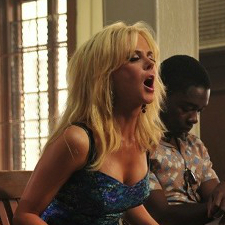
A flurry of new images recently hit offering a sweaty, revealing look at Lee Daniels ‘ Precious follow-up, the ’60s-set adaptation The Paperboy — so how’s about a round of Caption This! After the jump, help Movieline caption this startling image of Nicole Kidman as the sensual woman at the center of this dark Southern potboiler, here seen having what I can only imagine is quite a moment while sandwiched between Zac Efron , Matthew McConaughey , and David Oyelowo. Based on Pete Dexter’s 1995 novel, The Paperboy follows newspaper reporter Ward James (McConaughey) and his brother Jack (Efron) as they’re tapped to investigate and exonerate death row inmate Hillary Van Wetter ( John Cusack ) accused of murdering a local sheriff. Kidman’s Charlotte Bless is a New Orleans woman in love with Wetter — and as you can see here, this is not exactly the Nicole Kidman we’re used to seeing. (Sofia Vergara was previously attached to play the role; the film is set to debut at Cannes.) Is Kidman having a When Harry Met Sally … moment? Will the real housewives of the world take fashion cues from her next season? Caption away, Movieliners! [ Kinopiosk via The Playlist ]
Are the Central Park Five the next West Memphis Three? The teenagers wrongfully convicted in the vicious 1989 rape and beating of jogger Tricia Meili — and only released after the actual attacker came forward in 2002 — will be showcased in a forthcoming Ken Burns documentary entitled, appropriately enough, The Central Park Five . And while the film was funded in part by Burns’s longtime patrons at PBS, the two-time Oscar nominee and four-time Emmy winner (who co-directed the project with his daughter Sarah Burns and son-in-law David McMahon) is taking the film to Cannes next month with the hope of finding a theatrical distributor: “We want to do it [theatrically] because the running time makes it manageable, and there’s something urgent about it,” he told TV Guide this week. This sounds… familiar? At least a little familiar, anyway: Directors Joe Berlinger and Bruce Sinofsky made the festival rounds last year with their HBO-produced documentary Paradise Lost 3: Purgatory , another chronicle of miscarried justice made right-ish with the release — if not the exoneration — of wrongly convicted “West Memphis 3” murder suspects Damien Echols, Jessie Misskelley and Jason Baldwin. After arranging a qualifying run for Oscar consideration (and helping prompt Academy rule changes ), the film went on to lose this year’s Best Documentary Feature to the stirring football doc Undefeated . That theoretically cleared a path for the Peter Jackson-produced WM3 doc West of Memphis , recently acquired by Sony Pictures Classics , to cruise to the front of the preliminary 2013 Oscar pack. Meanwhile, Burns and Co. have cited some canny timing of their own: The Central Park Five’s wrongful conviction lawsuits brought against New York City, which plaintiffs Antron McCray, Kevin Richardson, Raymond Santana, Kharey Wise and Yusef Salaam are expected to finally bring to court in “the next year or two,” according to TV Guide’s Gregg Goldstein : One of the main financiers, PBS, has tentative plans to air the doc next year, but is open to a 2014 broadcast depending on its theatrical rollout. “We’d hope for some kind of harmonic convergence, where this story could be spread on the eve of the trial and potentially affect the outcome,” says McMahon, a producer/writer on Burns’ 2010 PBS doc Baseball: The Tenth Inning . “It would seem only fair, given that media coverage affected the outcome of the original trial.” The idea for the film came in 2006, two years after Sarah Burns began writing her May 2011 book, The Central Park Five: A Chronicle of a City Wilding . When production began three years ago, it was planned as a feature produced by the trio and directed solely by Ken Burns. “In the end, those ultimate decisions made in the editing room were all of ours, so it became clear we should all be directors of the film,” says Sarah Burns, who’s been involved with the case for nine years. She met two of the men during a college internship at a law firm and also wrote her undergraduate thesis on the case. The film marks the 29-year-old’s first effort on any documentary, McMahon’s first helming duties, and has several distinctions from a typical “Ken Burns film.” Goldstein explains those distinctions in his piece, but for our own radically speculative purposes, is there any more distinct difference than Oscar-readiness? Burns hasn’t earned a nomination since 1986, when he shared a nod for his Statue of Liberty centennial doc, and if a guy like Harvey Weinstein — the Oscar-doc incumbent who might as well kiss his awards chances for Bully goodbye — can get a hold of this, there’s no telling what the 2013 race might look like. Just throwing it out there… [ TV Guide ]
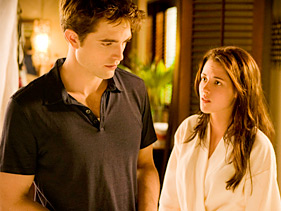
‘Rob and Kristen will be there too, to pop in those gold contacts one last time,’ director Bill Condon posts on Facebook. By Jocelyn Vena Robert Pattinson and Kristen Stewart in “Twilight: Breaking Dawn – Part 1” Photo: Summit Entertainment Just when “Twilight Saga” fans thought it was over, “Breaking Dawn – Part 2” director Bill Condon has confirmed that the cast will have to head back up to Canada one more time to put the finishing touches on the November release. Condon took to the movie’s official Facebook page on Saturday to confirm that he’s hard at work on the final film in the franchise, including a bit more shooting. “Greetings from Los Angeles, where we’re hard at work on ‘Breaking Dawn, Part Two.’ It’s truly crazy to think that it’s been a year since we wrapped production in Vancouver , since for those of us in the editing room the work has never stopped. A film is a lot like a puzzle, with each piece — each shot, no matter how brief — needing to fit exactly with the ones around it,” he wrote in the post. “Our ‘Part Two’ puzzle is finally coming into full view, and in a few weeks we’ll be heading back north to pick up some additional shots — the last tiny missing pieces. We’re not shooting any new scenes or dialogue, just some technical work with some of our cast and stunt actors.” He added that for the re-shoots, the film’s lead couple, Robert Pattinson and Kristen Stewart , will be back to help complete the movie. “I am really looking forward to being back on set with some of the friends I’ve made on my ‘Twilight’ journey, like the great Guillermo Navarro, our cinematographer, and his crew. And yes, Rob and Kristen will be there too, to pop in those gold contacts one last time. … “I’m excited to report that before too long we’ll have another trailer for you to decode,” he teased. “And wait until you see the first posters — they’re unlike any ‘Twilight’ images you’ve seen before. And then November 16th will be upon us and the final film will be yours!” Check out everything we’ve got on “The Twilight Saga: Breaking Dawn – Part 2.” For young Hollywood news, fashion and “Twilight” updates around the clock, visit HollywoodCrush.MTV.com . Related Videos ‘Twilight: Breaking Dawn – Part 2’ Teaser Trailer Best ‘Breaking Dawn’ Interviews Of 2011 Related Photos ‘Breaking Dawn’ Stars Sparkle At U.K. Premiere
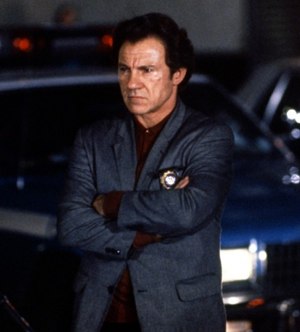
I met Abel Ferrara in a café on Mulberry Street. In an hour’s time, he didn’t once take his seat. The filmmaker makes a couple of phone calls, goes to the bathroom twice, shows me the new Web series that he’s developing with Vice TV on, and points me to two different articles about his movies. Unkempt and energetic, the Bronx-born director of such New York notorieties as Ms. 45 , King of New York , Bad Lieutenant , The Funeral and this week’s 4:44 Last Day on Earth is exactly what you’d imagine he’d be like if he were one of his movie’s characters. In a way, he is. 4:44 features Willem Dafoe and Shanyn Leigh as a couple spending their last hours together before the world ends. They’re each in their own separate but related worlds: she paints and listens to Buddhist philosophy while he talks to friends via Skype and decides if he should end two years of sobriety by getting high one last time. The loose nature of 4:44 ’s scenario speaks to the Cassavetes-inspired, improv-oriented nature of Ferrara’s dramas, which are often collaborative processes between actor and filmmaker. This is especially characteristic of Ferrara’s working relationship with Dafoe. “If Willem wasn’t going to play it,” Ferrara told me, “I don’t think I would have wrote the script.” The film marks Ferrara and Dafoe’s third film together, coming after 1998’s New Rose Hotel and the 2007 ensemble piece Go Go Tales (which itself almost became a series on HBO). But more importantly, 4:44 further refines a working relationship that involves Dafoe co-creating not only his character, but also the scenes that, as Ferrara tells it, the actor is “comfortable with, that he believes in, that he understands.” “[We have] confidence with each other that comes from working together,” Ferrara continued. “I wrote the character so that the character I wrote is something he can play. And then, to create a stage for him, a place where he’s going to act, a set, which is a place that’s going to be conducive for him to do his best work. There’s nothing throwing him off…” Paradoxically or not, Ferrara then interrupted himself to perform one of a seemingly Herculean list of multi-tasks. Ultimately, performance is key to Ferrara’s movies because his characters are always performing for each other. They change in almost every scene they’re in, keeping the films that contain them endlessly revelatory, even shocking. Take Bad Lieutenant , which this year celebrates its 20th anniversary of Harvey Keitel’s searing work as a sex-, drug- and gambling-addicted cop seeking both vengeance and kicks as he pursues the men who sexually assaulted a nun. His detour into depravity culminates in an infamous scene where he pulls over two young women, making them simulate giving him oral sex while he masturbates. It’s the type of blunt-force intimacy that has preoccupied Ferrara all the way through 4:44 but arguably reached its flashpoint with the NC-17 Lieutenant . Two decades on, the 60-year-old director looks back on the controversy with similarly matter-of-fact zeal. “It had to be unrated,” he said. “It had to be rated X. It was the opposite: it couldn’t be rated R. We had to be what Hollywood couldn’t be. It was reverse censorship.” Not that he minds the continuing existence of an R-rated version necessitated by such once-powerful video chains as Blockbuster: “That’s just a joke; I’m not counting on anybody watching that.” The editing process is just another way Ferrara fulfills his all-encompassing role as director-cum-emcee. From early conception — “A script is not a piece of literature,” he explained, “it’s a process” — to post-production, Ferrara officiates over his films the way Ray Ruby, Dafoe’s hero from Go Go Tales , presides over his embattled burlesque dominion. He works with regular collaborators like cinematographer Ken Kelsch and production designer Frank DeCurtis to give his actors a proper setting. Then, led by their maestro, they all perform in front of and behind the camera together. But collaboration shouldn’t be mistaken for compromise, that ever-present threat to the natures of complex characters like Keitel’s Lieutenant and Dafoe’s Cisco and even to Ferrara’s singular vision itself. “There’s no such thing as a non-final cut director,” Ferrara said, R-rated Bad Lieutenant notwithstanding. “If you don’t have final cut, you’re not a director. There’s no point making a film. Citizen Kane is a masterpiece, but if I go into the editing room for three hours, I can change Citizen Kane .” Meanwhile, the endlessly moving Ferrara has more important projects than Citizen Kane to worry about: His own, including a planned take on the Dominique Strauss-Kahn case starring Gerard Depardieu — about which the filmmaker wishes to remain tight-lipped. “It takes six months to shoot a film,” he said. “We’re [always] perfecting what we’re doing.” Read Stephanie Zacharek’s review of 4:44 Last Day on Earth here . Simon Abrams is a NY-based freelance film critic whose work has been featured in outlets like The Village Voice, Time Out New York, Vulture and Esquire. Additionally, some people like his writing, which he collects at Extended Cut . [Top photo: Getty Images]
‘I was so happy how it came together,’ actor tells MTV News. By Kara Warner, with reporting by Josh Horowitz Josh Hutcherson Photo: MTV News In addition to obsessing over our own reactions to finally seeing “The Hunger Games,” we’ve been enjoying collecting the initial reactions from the castmembers themselves, whose pre-screening thoughts ranged from anxiety to excitement. When MTV News caught up with Josh Hutcherson recently, we asked him what goes through his mind any time he screens a movie he worked on. “Honestly, I just hope it doesn’t suck. That’s my mentality when I go in to watch one of my movies,” Hutcherson said with a self-deprecating smile. “I hope I don’t get bored watching it, and I didn’t watching this. I was so happy how it came together. It really, to me, was kind of the most interesting way this story could be told. The way Gary [Ross] captured the essence of the story and the characters, cinematically, is incredible.” Hutcherson went on to say that the one thing that surprised him most was not any of the actors’ performances but the music backing them. “I think the score, to me, was one of the most surprising things,” he revealed. “I think it’s really interesting. And some of the editing choices that were made were so cool and different and nothing I’d ever seen before. Like, in the scene when Jennifer is stung by the Tracker Jackers. That kind of cool editing thing. It really kind of blew my mind.” But did it blow his mind enough to also evoke emotion via his tear ducts? Did Hutcherson shed any tears while watching the big-screen adaptation of Suzanne Collins’ best-seller? “Inside I did. I held it in,” he said, before adding that he’s not at all afraid to let the waterworks flow during movies, particularly those that star Cameron Diaz and Abigail Breslin. “When I saw ‘My Sister’s Keeper,’ I openly wept the entire movie, and I feel comfortable saying that.” Check out everything we’ve got on “The Hunger Games.” For young Hollywood news, fashion and “Twilight” updates around the clock, visit HollywoodCrush.MTV.com . Related Videos MTV Rough Cut: Josh Hutcherson MTV Rough Cut: ‘The Hunger Games’ Related Photos ‘Hunger Games’ Cast Hits NYC The Hunger Games
Meryl Streep and Jean Dujardin won us over, while Bret McKenzie made a critical omission during his acceptance. By Kevin P. Sullivan Meryl Streep wins at the 84th Annual Academy Awards Photo: Kevin Winter/ Getty Images One of the most essential parts of any Oscar night is the speeches. If you win, your job is only halfway done. Now you have to get up onstage in front of a billion people and practice your public speaking. Some are heartfelt, some are funny, and some will go down in history — for better or worse. With so much of the ceremony dedicated to acceptance speeches, it’s important to look back and decide who owned the night and who fell on their face. Here are our best and worst speeches of the 2012 Academy Awards: Best Octavia Spencer for Best Supporting Actress For as predictable as Spencer’s win for Best Supporting Actress was, her speech ended the long road to Oscar night in style. She went with the time-tested acceptance-speech traditions of emotion and honesty. Plus, she thanked the state of Alabama, the only state to get a shout-out during the night. Meryl Streep for Best Actress It came as a big surprise, and no one knew that better than Streep. Her “whatever” attitude almost had us forget the upset win over Viola Davis. It may not have been the most just outcome, but at the very least we got a funny speech instead. Christopher Plummer for Best Supporting Actor As the oldest person to ever win an acting Oscar, Plummer outdid most everyone younger than him and delivered one of the most memorable speeches of the night. It was class all the way for Plummer, who sincerely thanked his wife, daughter and co-star Ewan McGregor. He joked that, in his mother’s womb, “I was already rehearsing my Academy acceptance speech, but it was so long ago, mercifully for you, I’ve forgotten it.” Alexander Payne, Nat Faxon and Jim Rash for Best Adapted Screenplay You have to admit that Angelina Jolie was standing a little oddly, with her right leg out of the high slit in her dress, as she read the names of the nominees. Jim Rash, known for his role on “Community,” also took note and mimicked the strange posture after he won the award for his work on the “Descendants” screenplay. Jean Dujardin for Best Actor A good way to score points as a Frenchman winning an Academy Award in America is to open your speech with, “I love your country!” Dujardin read the rest of his speech to help with his English, but it was the outburst in French at the end of his acceptance that really won us over. Worst Bret McKenzie for Best Song Listen, Bret. We love you, and we’re so happy you won. But there would be no Muppets movie without Jason Segel. He may not have written any of the songs, but he co-wrote the film, put his name on the line and sang “Man or Muppet,” the winning song. At the very least, you should have given the man a simple “thanks.” Kirk Baxter and Angus Wall for Best Editing It’s understandable that you were caught off guard — “The Girl With the Dragon Tattoo” didn’t get a whole lot of nominations — but you need to be a little more prepared than you were. You’re still expected to give a speech. You won just a year ago, so you have enough experience with this kind of thing. Mark Coulier and J. Roy Helland for Best Makeup It’s OK if you write your speech down before you head onto the stage to accept your award. It’s even OK if you read your speech directly from the cards you wrote them on. But please make sure that the speech is a good one if you’re going to do so. The MTV Movies team has the 2012 Oscars covered! Keep it locked at MTV.com all night and beyond for updates on the night’s big winners and the best red-carpet fashion . Join the live conversation by tweeting @MTVNews with the hashtag #Oscars. Related Videos Oscars 2012: The Main Show Oscars 2012: Show Highlights Related Photos Oscars 2012: Winners Oscars 2012: The Main Show Oscars 2012: Parties
Safe House is a twisted claw of a movie, a picture so visually ugly that, to borrow a line from Moms Mabley, it hurt my feelings. Let’s forget, for a moment, about the sub-sub-sub- Training Day plot, in which a wily old-coot operative played by Denzel Washington simultaneously annoys and educates spring-chicken CIA agent Ryan Reynolds. The plot mechanics don’t matter much. What does matter is the inexplicable horror of how lousy this film looks. Movies aren’t strictly a visual medium — they’re too complicated for that — but there’s something wrong when the only thing you can think of while watching a picture is, “Damn! My eyes!” Where to lay the blame? It’s hard to say, but let me unwrap these gauze bandages and I’ll try. The director of Safe House is Swedish-born director Daniel Espinosa, who made a 2010 crime caper called Easy Money . Are the horrors of Safe House completely his fault? Probably not. The script, by David Guggenheim, seems serviceable enough, if generic: Washington’s character, a fugitive smoothie named Tobin Frost, is brought in by the CIA for questioning and a little waterboarding. It’s all in a day’s work, right? Frost has info the organization desperately wants. Of course, other people want it, too: The joint where Frost has been locked up is suddenly overrun by Middle Eastern-looking baddies, who try to kill him. Poor Matt Weston, Reynolds’ character, has been entrusted to watch Frost and needs to spirit him away to safety, thus giving Frost many opportunities to chuckle derisively at the antics of this plucky little greenhorn. Meanwhile, somewhere at CIA headquarters, a bunch of people in suits — played by Sam Shepard, Brendan Gleeson and Vera Farmiga, among others — call up info on Frost on big computer screens, loudly reciting Important Facts about this Very Dangerous Man. Through it all, Frost and Weston have to run around. A lot. They also have to shoot people. A lot. And they also get shot at. A lot. All of these things are standard in contemporary action thrillers — by themselves, they’re not enough to make or break a picture. Washington and Reynolds don’t seem to give particularly bad performances — in fact, they run around, shoot people and get shot at with actorly proficiency. The problem is, it’s just so hard to look at them. Like many features these days, Safe House was shot with a handheld camera. But while smart filmmakers have learned to chill out with the camera jiggling, the Safe House cameras are partying like it’s 2009: This isn’t just shaky-cam, it’s super -shaky-cam. The camera moves back and forth, up and down, just because it can. Craving a bunch of wholly unnecessary circular pans? Safe House has ’em! The tonal palette consists mostly of ochre yellows and greeny grays — cataract colors. And the editing is razor-sharp, meticulous and rapid-fire — so razor-sharp, meticulous and rapid-fire that you can’t really see anything. It’s like eating vegetables that have been sliced so thin they barely exist. Safe House is, I guess, pretty violent, from what you can actually see: There’s some ewky business in which flesh is stabbed with a shard of glass. Yet despite the presence of this sort of brutality, the picture has no pulse. It’s so crappy looking it anesthetizes you — the story it’s trying to tell dissolves away to vapor. So who’s holding the bag for this stinkbomb? The cinematographer, Oliver Wood, has shot plenty of other movies that look perfectly fine, including Surrogates and Fantastic Four , as well, as perhaps most tellingly, the Bourne movies. The editing is by Richard Pearson, who cut The Bourne Supremacy , as well as other cogent features like Quantum of Solace and United 93 . Moviegoers are divided, of course, on the way the Bourne movies have been shot and edited: For some, they’re too crazy, too disconnected, too frenetic. I think they generally work, coasting on their sheer peripatetic energy — but it’s possible their time has passed. It’s also possible that Safe House , while borrowing its style from the Bourne movies, is simply missing some key ingredient: What if every shot were held just one or two seconds longer? What if the camera jiggle was controlled even by just a few centimeters at the top, bottom and sides of the frame? What if the colors didn’t look as if they’d been run through the washer and dryer on the extra-hot setting, every day for three months straight? Then, maybe, it would be possible to look at Safe House directly without having to immediately remedy the experience with two Tylenol. Extra-strength. And throw in some Codeine, too. Please. Follow Stephanie Zacharek on Twitter . Follow Movieline on Twitter .
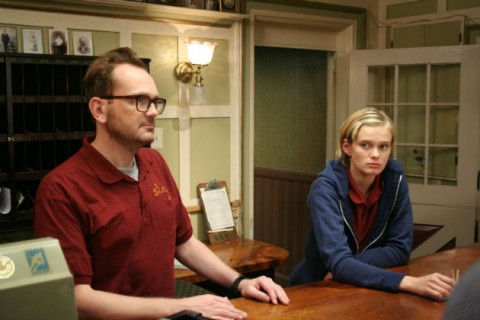
Every performer must pay their dues, but with this week’s old school-flavored ghost pic The Innkeepers character actor Pat Healy cashes in over a decade of memorable supporting turns and guest spots for the spotlight at an auspicious moment in his career. Having popped up in a number of great films over the years ( Magnolia ! Ghost World ! Rescue Dawn !) Healy stars with Sara Paxton in the Ti West film as a sardonic desk clerk at the Yankee Pedlar Inn, where spooky happenings are afoot; meanwhile, Healy also earned writing credits on the award-winning In Treatment and recently took Sundance by storm with Craig Zobel’s controversial Compliance . And to think: It all began with the one-two punch of My Best Friend’s Wedding and Home Alone 3 … I want to start out by asking you something of great importance: Why is there no Wikipedia page for Pat Healy the actor? I don’t know! There’s one for Pat Healy – The MMA fighter? Yes, do you know of him? Pat “Bam Bam” Healy! There’s a competitive hurler with your name as well. I didn’t know that – that sounds like a vomiter. There’s a local newsman, there’s a New York Times… Are you acutely aware of these other Pat Healys in the world? I had become, since There’s Something About Mary in 1998, with Matt Dillon’s character. I was like, ‘I thought I was the only one!’ And for a long time, this might still be true because a lot of those guys are Patricks, I was the first Google one. Bam Bam might be surpassing me now, MMA is very popular. Did you somehow cross the Farrelly Brothers, years ago? No, the guy who works for them who was like a line producer guy and I think is a writer or director now too, in some way, because I remember he was making a movie at one point and I started getting calls from people like, ‘Hey, comin’ in to see you next week!’ And I was like, ‘I don’t know what the hell you’re talking about…’ But yeah, no one started one. I guess I am maybe not the greatest self-promoter, I’m getting more comfortable with it now. I’m not a reluctant star or anything like that, but maybe I was naïve early on about how all this stuff works, with publicists and all that kind of stuff. And you’re not anymore? I feel like now I’m doing the things I want to do because my career as a screenwriter is affording me to not have to just be a guest star on every dumb crime procedural show on TV. I can do the things I want to do which are the more interesting things, like working with Ti [West] or working with Craig Zobel again. Those are more significant roles in better films. I might make more money in the short term having a few scenes in Pearl Harbor and the residuals are good, but nobody’s offering me other jobs off of that, whereas this community of people, we all know each other or know of each other and know each other’s work. How did you get together with Ti for this film? Innkeepers came about because Ti and I were at the LA Film Festival in 2007, met briefly – he was there with Trigger Man , I was there with Great World of Sound , Craig’s movie. He saw it, and I was a huge fan of House of the Devil ; I’d just seen it and I got a call from Amy Seimetz, our mutual friend, and she said ‘He wants to use you in a movie.’ I was ready to say yes without ever reading it, but then I read it and it was great, it was a great part and everything. So it works out that way. It’s just better for me now, I can afford to do these films and I enjoy the work – and people end up seeing what I can actually do, as opposed to saying ‘He was in that.’ If it leads to more jobs in the long term, it’s a better living for me. What was your plan in the beginning when you started acting? When I was a kid, when I was a real little kid, my family were always into movies and one of my older brothers, Jim – he’s two years older than me – he and I were just into movies and seeing everything we could see, watching everything on television, getting all the books and all that kind of stuff. Interestingly enough, we both have the jobs we wanted as little kids: I’m making films and he’s in film restoration. He ran the George Eastman Archive for a long time in Rochester, New York and now runs the Cinematheque at UW Madison. He loves watching them and showing them and talking about them and I love making them. So I came into this loving movies, and acting was something I knew how to do from an early age, just being a ham and being a performer, doing theater; that was sort of my way in. Doing some professional theater opened the door in Chicago, where I’m from, to commercials, and movies came through town, TV shows… Speaking of which, can we talk about Home Alone 3 ? [Laughs] Home Alone 3 is my first real movie! I was hired on My Best Friend’s Wedding , that Julia Roberts movie, and I was actually hired to be in the opening scene of that movie as this waiter and I was in make-up and costume and everything, and they just rewrote the scene as we did it and never shot me. But I got my SAG card and I think maybe six months later I got [ Home Alone 3 ], which if you haven’t seen it… all the little kids have seen that one on video a million times and it’s a perennial residual earner because kids like it and it’s on at the holidays. I played the FBI agent who was behind the guy who had all the lines, but I think they kind of forgot about me for a while because I was on hold, which they never do now because they watch the budget so tightly, but I made a lot of money off of it because I was on hold for about five weeks even though I only shot five days on it. And residuals are based on the time you worked on it, so the residuals have stayed really good. You mentioned the creative community that brought you in touch with Ti, and in recent years maybe more than ever I’ve noticed all these ties between indie filmmakers in this community. Yeah, it’s really different now. I think the movement in a way sort of started in this current incarnation through David Gordon Green , who I met through my brother in 2000 after George Washington had premiered in Berlin; he fostered a real sort of community spirit. Certainly all those people he went to school with, like Danny McBride , Jody Hill, Paul Schneider and now Jeff Nichols – all these people are doing great things, and encouraged people like Joe Swanberg. And all the satellite people from Joe, who is somebody who’s just going out there and making this stuff on his own, doing a lot… Joe and Ti and Sophia Takal and Larry Levine, Andrew Bujalski, Bob Byington, there’s a whole Austin contingent – we all know each other, too, and even people like Michael Shannon , who is my friend, who I started in theater with in Chicago with, is working with Jeff a lot. Craig [Zobel] also went to school at North Carolina School of the Arts. In my mind, as someone who was around a little bit before that, it seemed to spur a new DIY movement and a sense of community because David is an extremely loyal person and all of those people have gotten opportunities, including myself, because of him. I think that his films as well as his spirit and his generosity have inspired this new generation. People bring up mumblecore and I think a lot of people can point to George Washington as the first movie in that genre, if you can include it – it’s certainly bigger and more ambitious. But there’s a real sense of community, especially at the festivals when you’re there and seeing each other. That’s frankly where a lot of the work comes from, too. People meet and decide to work on something together, or somebody sees someone in something… It’s intriguing to watch those connections interweave from the outside, watching this community grow with each project. Yeah – and somebody like Robert Longstreet, who David Green saw in a small movie called Ding-a-ling-Less many years ago, and David put Robert in a movie and he met all these people, and then last year Robert was in like 10 movies at Sundance! So it is great, and it’s also not just real young people, either. It’s people of all ages, like some of the actors in Compliance like Ann Dowd, a woman in her fifties who’s done a lot of theater work and she’s just staggeringly brilliant in the movie. I know a lot of people are going to see that and want to work with her. You saw that thing sort of happen with Melissa Leo a few years ago, and those are all people who are working but they go to these independent movies because they get to show what they can do, really, and really spread their wings. Then all of a sudden Hollywood comes calling once they either do a television series or do a good part in an independent movie. In this, in Innkeepers , and in Compliance and Great World of Sound , I get to show what I can do and people can see it and it comes back to me. So I love what’s going on now. It’s cool and I think it’s coming out of both social and economic factors, but it’s fostering a lot of great activity and a lot of production. With Innkeepers , it seems like the entire process of making this was very condensed. Why did you initially respond to the material? I loved House of the Devil and was just ready to do whatever. [ The Innkeepers ] was a horror movie but it had a really good central relationship in it, and there were some different colors to get to play – certainly a lightness in the character, I like that dry sense of humor and sensibility. You’re exceptionally good at that, actually. I think it’s my natural rhythm and I think maybe Ti saw that as much personally as he did in any work that I’ve done, with the exception of Great World of Sound which is heavier and more serious. But that comes naturally to me. I certainly liked the heartbreak of that character, the unrequited love aspect. Even the tragedy in his failings is utterly amusing. And the fact that it is very tragic and heartbreaking to play, and to sit in the audience and it’s very funny… because it’s that comedy of uncomfortability, like Albert Brooks or Ricky Gervais – that really reality-based ‘I’m so uncomfortable I have to laugh…’ I like that about it a lot, and I like that the scares and the tension came from the building of the relationships so that you actually care about these people. There are so many movies where in the third act it’s like where everything’s flying this way and that and you’re like, ‘Okay, that happened.’ Filming Innkeepers you all actually lived in the hotel, on top of which you and Sara Paxton only met right before shooting, yet you managed to strike a really great chemistry together. It was taking a big risk – it was like a 17-day shoot, living, working, and eating in the hotel, a weird place, and we met the day before. I knew very little about her, I think I saw Last House on the Left and that’s a much different part so I wasn’t really sure what to expect. She’s just a really buoyant, funny, fun, lovely person so my guard went down pretty quickly. Luckily the two of us really liked each other, and the movie’s pretty much shot in sequence so we just developed that relationship. But I think a lot of credit can go to Ti for creating that environment; it was cool to be in that weird environment in the hotel itself, and to be in the camp-like atmosphere of all living together, screwing around and joking and all that stuff. Ti recently wrote an open letter imploring people to pay to see and support small indie films, which made a lot of sense. Yeah, some people were surprised that that is the reality of things. Somebody I know had recently pirated an indie movie… Did you shame them? I did, and they gave me crap because it wasn’t playing anywhere near them and they really wanted to see it. I just thought, well, it didn’t make any money — maybe you couldn’t have seen it when it came out, but you can see it on Netflix or rent it or whatever. It’s not like I get a dollar if you watch it; I don’t get anything, really, though I might in the long run if it makes a lot of money on DVD. But like [Ti] said, the reason they keep making dumb movies is because we keep paying to see them, and then we don’t pay for the other ones. I feel like people know you even if they don’t realize they know you because of some of those bigger movies you were in, like Magnolia , Rescue Dawn , Ghost World . How do you look back on those films now? Even though I wasn’t in a position to choose what I wanted to do, I was fortunate enough to be working with people like Paul Thomas Anderson in Magnolia . That was something that was really exciting to me, I’d loved Boogie Nights and all that stuff. At that time – and I didn’t know what I had because I was 26 years old or something, and the sad thing is when I think about it he’s only a year older than me – but I think that I just naturally ended up in those things. I was a fan of Dan Clowes’s comics and Terry Zwigoff, who made Crumb , so I think I ended up in Ghost World because unconsciously my drive to be in those things made me work hard to get them. Or working with Herzog on Rescue Dawn … Did you just put a little something extra into those auditions? I guess I just really cared about those things, and there are so many that I don’t, and I get some of those too. But something like a Western with Andrew Dominik and Brad Pitt and all those people in Jesse James , I really want to do that. But I’m not conscious of it so there must be something that gets me into those rather than the other ones. There are actors’ careers that are built on parts I didn’t get. Now I think I’m a little older, and I’m writing and certainly making a living at that, and I can be a little pickier to a certain degree – though I can always use more money. But now I’m being cast in things I would choose to do, you know? Now that you’re screenwriting and directing, do you feel like you’ve picked up advice or lessons from the various auteurs you’ve worked with? All of them. Without a doubt. The main thing that I would say about all these people – Anderson, or Herzog, or Zwigoff, or Zobel, or Ti West – is a sense of leadership, a real devotion by their cast and crew, because of the kind of people they are. They’re not only masters who know what they’re doing, but they’re really great at revving you up. You like them and they really like and respect you and you feel support and freedom to do your best. That’s such a great quality in a director; you are the captain of a ship. You have to do your homework like you do as an actor, be prepared and show up and know what you’re going to do, but that’s the commonality among the people that I’ve worked with that do great things – they really know how to be leaders and to rally the troops. Were you not surprised, then, when Werner Herzog saved Joaquin Phoenix from that car crash? Nothing Werner does shocks me! He’s a really remarkable guy, and I think some of his life is cinema. He crafts these moments and certainly makes sure people know about them. But I just saw his most recent documentary, Into the Abyss , which is great, and he introduced it. Even the way he came out and framed the movie for the audience, sort of directing how people see the movie, really enhanced my enjoyment of that movie so much, so he’s even a master in that way. As is Paul Anderson too; he controls every aspect of it through the publicity and marketing and everything. So by this token, would you say Ti West has something in common with, say, Michael Bay? I mean, he might tell you that. [Smiles] But as with these guys, or with Kubrick or Polanski or Hitchcock – Ti’s really exacting, he writes and meticulously casts it, he shoots it and knows exactly how he wants it to look, and then he spends so much time in the editing, which he does himself. He’s meticulous and exacting in post with Jeff Grace, the composer, and Graham Reznick, the sound designer – and then going to the theater and making sure the specs are right, going through the poster design and all that stuff. That’s him. I think if you really want to see your vision through to the end… Terry Malick does that too, you’re sending note to the theater telling them how loud it should be played and all that stuff. It’s tiring, thankless work – but it matters to them, you know? Given all of this, what sort of writer/director do you want to be – what kind of projects do you see yourself creating? The things that I’ve written are dramatic but they all have an inherently bent sensibility to them, an offbeat humor that’s not broad but is sort of unusual. It’s sort of the way that I see things, I think. If I were to compare myself to someone, contemporary people like Alexander Payne comes to mind, or Hal Ashby or Michael Ritchie – those sort of satirical looks at everyday life. But I’m a kid of the ‘80s and ‘90s too, and I love the big action movies too. So those strange conventions find their way into some of the things I write, too. I just hope that whatever it is, and I know that whatever it is, I will be an auteur. I can’t do anything – I can’t do a performance on a crappy TV show, or write a script, or write a Tweet, that isn’t inherently me. I couldn’t if I tried, and if I did it’s like cardboard, it stinks, it’s bland. I’ve tried. It’s trusting what’s there, and whatever I end up making, good or bad, it’ll be a true expression of who I am. It’s taken me a long time to get to that place, but I feel like I’m in that place. For more with the makers of The Innkeepers check out the Movieline Interviews with Ti West and Sara Paxton . The Innkeepers is in select theaters this Friday. Follow Jen Yamato on Twitter . Follow Movieline on Twitter .