Tag Archives: european

The first image of the entire universe!

The first image of the entire universe taken from Europe's Planck telescope has been published. Researchers say it is a remarkable dataset that will help them understand better how the Universe came to look the way it does now. The picture is the first full-sky image from Europe's Planck telescope which was sent into space last year to survey the “oldest light” in the cosmos. It took the 600m-euro observatory just over six months to assemble the map. “It's a spectacular picture; it's a thing of beauty,” Dr Jan Tauber, the European Space Agency's (Esa) Planck project scientist, – BBC. http://www.telegraph.co.uk/science/space/7872190/Planck-telescope-reveals-univer… added by: sarahmatilda

From BT cotton to GM salmon: Unnatural Selection

This stunning European documentary available for the first time in the US reveals the consequences of GMOs worldwide from BT cotton, BT canola, GM pigs, to GM salmon, which threatens natural species in the wild. It shows how unnecessary and profit driven this technology is, and how it is interfering in the natural processes of this planet. When you play master of the universe without respect for the nature you are interfering in, the end result cannot be good. added by: JanforGore

‘Doomsday Ark’ to be Housed on the Moon

If the human species should be destroyed on Earth, our future may reside on the Moon if plans.being drawn up for a “Doomsday ark” on the moon by the European Space Agency are carried through. The Ark will contain the essentials of life and human civilization, to be activated in the event of earth being devastated by a giant asteroid or nuclear war. The construction of a lunar information bank, discussed at a conference in Strasbourg last month, would provide survivors on Earth with a remote-access toolkit to rebuild the human race. A basic version of the ark would contain hard discs holding information such as DNA sequences and instructions for metal smelting or planting crops. It would be buried in a vault just under the lunar surface and transmitters would send the data to heavily protected receivers on earth. if no receivers survived, the ark would continue transmitting the information until new ones could be built. The vault could later be extended to include natural material including microbes, animal embryos and plant seeds and even cultural relics such as surplus items from museum stores. As a first step to discovering whether living organisms could survive, European Space Agency scientists are hoping to experiment with growing tulips on the moon within the next decade. The first flowers – tulips or arabidopsis, a plant widely used in research – could be grown in 2012 or 2015 according to Bernard Foing, chief scientist at the agency’s research department. Tulips are ideal because they can be frozen, transported long distances and grown with little nourishment. Combined with algae, an enclosed artificial atmosphere and chemically enhanced lunar soil, they could form the basis of an ecosystem. The first experiments would be carried out in transparent biospheres containing a mix of gases to mimic the earth’s atmosphere. Carbon dioxide given off by the decomposing plants would be mopped up by the algae, which would generate oxygen through photosynthesis. The databank would initially be run by robots and linked to earth by radio transmissions. Scientists hope to put a manned station on the moon before the end of the century. The databank would need to be buried under rock to protect it from the extreme temperatures, radiation and vacuum on the moon. It would be run partly on solar power. The scientists envisage placing the first experimental databank on the moon no later than 2020 and it could have a lifespan of 30 years. The full archive would be launched by 2035. The information would be held in Arabic, Chinese, English, French, Russian and Spanish and would be linked by transmitter to 4,000 “Earth repositories” that would provide shelter, food, a water supply for survivors http://www.dailygalaxy.com/my_weblog/2010/07/doomsday-ark-to-be-housed-on-the-mo… added by: pjacobs51

German Government Proposes Eco-tax on Air Travel

Image: Lufthansa A380 Everyone knows by now that the European member states have started a belt-tightening kick. Germany’s Chancellor Merkel has presented an austerity plan that includes an eco-tax on air travel. And the air is already heating up: airlines claim the tax is a body-blow, too close on the heels of losses related to the volcanic ash . Advocates hope for new revenues of 1 billion euros from the eco-tax on air travel. The opposition claims t… Read the full story on TreeHugger

Continued here:
German Government Proposes Eco-tax on Air Travel

Drake Postpones Away From Home Tour’s European Leg

The Toronto MC says he made ‘difficult decision,’ but must tend to his ailing mother. By Jayson Rodriguez Drake Photo: Getty Images Drake announced on Thursday (July 1) that he’ll postpone the European leg of his Away From Home Tour , set to begin Friday, to tend to his ailing mother, who has been battling an arthritic condition and an illness that affects her entire body, often leaving her unusually fatigued. The rapper released a statement explaining the last-minute decision to his fans. “Despite my best hopes, it is apparent that my mother will need surgery earlier than anticipated,” Drake said. “In light of this news, I have made the difficult decision to cancel my European tour in order to support her during her recovery, just as she supported me through the years. I cannot thank my European fans enough and look forward to performing abroad soon. I ask everyone to please respect my family’s privacy during this time.” The Toronto lyricist has postponed shows in Paris, Amsterdam and London; the shows will be rescheduled for November 2010. A number of his European appearances, however, were festival appearances that Drake will no longer make. The So Far Gone star will resume his tour on July 16 for the Canadian leg, which includes dates in Montreal, Calgary and Vancouver. In the MTV documentary “Drake: Better Than Good Enough,” the rapper opens up, abeit briefly, about his mother’s illness. “My mom is sick,” he says in one scene. “So that scares me a lot. She’s been the most supportive person I’ve ever had in my life — the only person that loves me unconditionally, really. I know a lot of people love me and I love a lot of people. But to love somebody unconditionally is different.” Related Videos ‘Drake: Better Than Good Enough’ Related Photos Drake’s Style: From A To Drizzy Related Artists Drake

More:
Drake Postpones Away From Home Tour’s European Leg

Media Defend Obama’s Call for More Spending, Despite G-20 ‘Rift’

In the wake of a European debt crisis, the recent G-20 meeting in Toronto revealed the intention of many European nations to begin dramatically tightening their fiscal belts. The world leaders agreed to cut deficits in half by 2013 and “start to stabilize their debt-to-output ratios by 2016,” according to Bloomberg Businessweek. That goal conflicted with President Barack Obama’s wishes. During the economic summit, he ” urged continued spending to support growth .” Overall, the news media have been supportive of the Obama’s spending requests, a trend some continued in reports about the summit. An “American Morning” segment painted a flattering picture of Obama at the G-20 summit by ignoring the “rift” between Obama’s push for more stimulus and Europe’s desire to slash budgets. Christine Romans made it sound as if everyone came to an agreement. John Roberts introduced Romans segment saying, “The G-20 summit final communiqué was issued yesterday with a big nod toward both deficit reduction and continuing stimulus and you’ve got to wonder how do you have both.” Romans replied that the group was “saying that they can do both. In the very near term keep the stimulus going, but longer term they have to look to cutting deficits.” In contrast, CBS “Evening News” declared that Obama “for the most part did not succeed” at convincing European leaders to agree to more spending. ABC “World News Sunday” reported that Obama had “lost an argument,” but sided with his calls for greater spending by warning that “some economists say that (budget cutting) could plunge the world into a second recession.” While other economists “say” that stimulus is not the answer, “World News” didn’t include any of those voices and had only one economist on that night to support additional spending. Liberal New York Times columnist and Nobel Prize winner Paul Krugman went even further than “World News” in an attempt to scare up support for more spending. Krugman’s June 28 column warned that the economy is in the beginning stages of a ” third depression ,” and austerity would push us into one. His claims were promoted by the fill-in host of “The Ed Show” on MSNBC and his guest, left-wing economist Dean Baker, on June 28. Few people in the news media have challenged such calls for government spending, but some people on the financial network CNBC have supplied other views. CNBC’s Larry Kudlow and Steve Forbes debunked Krugman’s claim on June 28. Kudlow said, “But Steve, the so-called spending cuts or tax increases or deficit reduction hasn’t happened yet. In the last two years, we’ve had gargantuan spending and ultra-easy money, which is what Professor Krugman has been advocating the whole time. And he still thinks we’re in a depression. So I need to ask you, maybe his policies are what threaten the depression.” Forbes agreed and replied, “It’s like the old physicians who continue to bleed the patient and wonder why the patient isn’t getting better and then bleeds the patient even more.” Forbes argued that the U.S. needs spending cuts, tax cuts (or at least maintaining tax rates) and the stabilization of the dollar. CNBC’s Rick Santelli had a much different recipe for economic recovery than Krugman, shouting on June 28, “I want the government to stop spending! Stop spending, stop spending, stop spending, stop spending! That’s what we want, stop spending!” After a heated debate with CNBC’s Steve Liesman, Santelli declared: “Our deficit is too big and we need to knuckle under and we need to live too prudently, prudently.” Obama Wants to Spend Now, Pay Later Obama urged countries at the G-20 summit to continue spending, but CBS “Morning News” reported June 28 that “even before the summit, President Obama says he intended to slash deficit spending in half by 2012.” That would be an enormous challenge since the federal deficit is projected to reach $1.6 trillion this year, according to Reuters. ” I’m serious about it ,” Obama said at a G-20 news conference. Reuters reported that Obama’s special deficit commission will make recommendations Dec. 1, after the 2010 congressional elections. “I’m doing it because I said I was going to do it,” Obama said. “People should learn that lesson about me, because next year, when I start presenting some very difficult choices to the country, I hope some of these folks who are hollering about deficits and debt step up, because I’m calling their bluff.” Ryan Ellis, tax policy director for Americans for Tax Reform, pointed out the timing of Obama’s “difficult choices.” Ellis told the Business & Media Institute, “Why isn’t he proposing these ‘very difficult choices’ now, before the election? Is he afraid that his tax increases (which are all he could be talking about) would be unpopular?” Another tax expert, Andrew Moylan of the National Taxpayers Union, told BMI “‘Difficult choices’ is thinly veiled code for massive tax hikes that would be necessary to pay for Washington’s unconscionable spending spree.” Moylan said he thought “we’re likely to see proposals to eliminate at least some of the 2001 and 2003 tax cuts (in all likelihood, raising the top rate back to 39.6 percent, reinstating a death tax of something like 45 percent, and eliminating the lower capital gains and dividends tax rate of 15 percent).” And that’s “on top of the myriad other tax hike proposals,” Democrats have suggested like an energy tax and financial transaction tax, Moylan said. What sort of impact would those tax hikes have on an economic recovery? Moylan told BMI no tax hikes improve economic growth so “we can say with confidence that those tax hikes would make the recovery slower than it might otherwise be.” Media Embraced Obama’s Spendy Ways, Blamed Deficit on Bush Obama has spent like no other since he became president. In 2010, he submitted the largest federal budget ever at a whopping $3.8 trillion. To put this in perspective: Obama is proposing a budget $700 billion larger than big spender Pres. George W. Bush’s last budget. It’s twice the size of Pres. Bill Clinton’s last budget of $1.9 trillion, who was credited with generating a budget surplus. Despite that “staggering” budget, at the time broadcast networks managed to paint Obama as a fiscal conservative and deficit slasher. The news media, with few exceptions, promoted Congress and Obama’s spending spree by favorably reporting the $ 787 billion stimulus , the auto bailout , the Cash for Clunkers program and rarely asking how it would all be paid for down the road. Now that government stimulus is unpopular with Americans, the networks barely reported Obama’s request for $50 billion to bail out state and local governments. Sen. Bob Casey, D-Pa., is also asking for $165 billion to bail out labor union pensions. Journalists have used multiple tactics to shift blame away from Obama’s spendthrift ways. In some cases, reports have simply ignored massive deficits. Others have agreed that Obama needed to spend in order to fix the economy, despite the deficits that would be incurred. Still others have repeated the White House’s own claim that the previous administration is to blame for the huge debt. On Oct. 8, 2009, CBS “Evening News” ignored the fact that the federal deficit had risen to $1.4 trillion , three times what it was one year earlier. But on Oct. 7, 2008, under President George W. Bush, Katie Couric made sure to mention the “record federal deficit” had tripled from the prior year. In 2010, after Obama submitted the largest federal budget in history, with a projected deficit of $1.6 trillion, the networks showed their support. NBC’s Savannah Guthrie portrayed all the excess spending as a way to get the economy back on track saying: “He’s asking for $100 billion to spur job growth – things like tax cuts for small business, tax breaks to increase wages – and he’s doing this knowing that it will drive up the deficit, certainly even more in the short term. But all economists agree the real way to get a chunk out of the deficit is to increase hiring.” Guthrie was highlighting only a tiny fraction of the overall budget and failed to criticize the administration for not finding ways to cut more waste. Taking a slightly different tack to express support, CBS’s Bill Plante agreed with the president’s spending priorities on Feb. 1, 2010, saying Obama “needs’ to spend right now. “He needs to spend more money in the short-term to create jobs, but he desperately needs to spend a lot less over the long-term,” Plante said on “The Early Show.” Stories also followed Obama’s lead in blaming his predecessor for the huge deficit. Many reporters pointed their fingers at the Bush administration, including ABC’s David Muir. His Feb. 1 “World News” report nearly copied Obama’s budget announcement right down to the blame on “previous administrations.” Muir pinned the record deficits on President Bush’s tax cuts and war spending when he answered the question: “How did we get here?” His timeline of the expanding federal deficit began with an image of Bush signing a bill and the words “Tax relief for America.” This has long been the claim of the national news media. While Bush was certainly responsible for helping balloon the federal deficit, ATR’s Ellis told the Business & Media Institute the tax cuts weren’t the problem, overspending was. Like Muir, CNN’s Fareed Zakaria demonstrated his economic ignorance by claiming that the Bush tax cuts were “the single largest part of the black hole that is the federal budget deficit.” But the facts don’t bear out Zakaria’s claim. According to Ellis, tax revenues were higher than the average when Bush took office, but fell before the tax cuts because of the dot-com bust and the 2001 recession. “Federal tax revenues are much more dependent on the economy than they are on tax policy. Tax revenues ROSE as a percent of the economy in the years after the BTC (Bush Tax Cuts) became law. They only fell again when the economy imploded,” Ellis explained.

Here is the original post:
Media Defend Obama’s Call for More Spending, Despite G-20 ‘Rift’

Ask Pablo: Waste Incineration, Good Or Bad?

Image Source: The Author Dear Pablo: My city wants to build a waste incineration plant. Should I be concerned? The “nimby” crowd is already against it, but could there be benefits? Today the word “incineration” means much more than just burning trash in a corner of the back yard. Incineration with energy recovery has become the waste disposal method of choice in several European countries where it is actually classified as a Renewable Energy Source, making it eligible for tax credits. Even in the United States electricity generation… Read the full story on TreeHugger

Read more here:
Ask Pablo: Waste Incineration, Good Or Bad?

Burned Little 3-Year-Old Girl a Symbol of Roma Hate… and Hope | Czech Republic

Watch more about the Roma's plight on CNN International World's Untold Stories on June 26 at 1630 GMT, and June 27 at 1100 GMT, 1830 GMT. Vitkov, Czech Republic (CNN) — Natalka Kudrikova is a bright-eyed, three-year-old girl recovering from the severe burns she suffered when far-right extremists threw a Molotov cocktail into her home. Her family and authorities say she was targeted because they are Roma, or gypsies. Natalka lost 80 percent of her skin, two fingers (a third was later amputated) and spent months lying in an induced coma following the attack last year in Vitkov, in the Czech Republic. She is still recuperating after 14 major surgeries. In May, Natalka returned to Ostrava Hospital for rehabilitation sessions so that one day she may be able to get around without support. “I'd rather not take her back to the hospital,” said her mother, Anna Sivakova, “but if she must return, my dream is that she learns how to walk without any help.” The very next day, four young men accused of attacking Natalka, filed into Ostrava District Court to hear the indictment: a racially motivated attempted murder. According to the prosecutor, the attack was planned for the 120th anniversary of Adolf Hitler's birth. Court experts confirmed swastikas and other Nazi memorabilia were found in the defendants' homes. In court, Ivo Muller and Vaclav Cojocaru described their coordinated Molotov cocktail attack. Their only excuse — they said they thought they were attacking an empty storehouse of stolen goods. Under cross-examination, Muller and Cojocaru admitted attending anti-Roma demonstrations organized by right wing extremists. The other defendants, Jaromir Lukes and David Vaculik, did not take the stand. Lukes is accused of being the ringleader, a claim his defense counsel strongly denies although he concedes Lukes drove the getaway car. His lawyer also vehemently denies there was any racial motivation to the attack. An anti-fascist website published a photo of Lukes walking next to the leader of the far-right Workers' Party. Another photo showed Vaculik wearing the armband of the Workers' Party, the public face of the Czech far right. The leader of the now banned Workers' Party, Tomas Vandas, denied any involvement. “Yes, we may have used those people as organizers of our public meetings but how could we know they would commit a crime?” said Vandas. “I hope Natalka gets better soon,” he added. Miroslav Mares, from Masaryk University in Brno, is the leading academic specialist on Czech extremist groups. He thinks it's unlikely that the Workers' Party was directly involved in the arson attack, but he says they were responsible “for inflaming anti-Roma sentiment.” “Maybe some youngsters from the neo-Nazi scene said to themselves, 'If the whole population is against Romas we are justified in carrying out such attacks,'” he said. And surveys do show anti-Roma sentiment is widespread. The European Union EURoma website says Czech Romas endure extremely high unemployment rates, low educational standards, isolation, and the prejudices of the majority population. “In regions with high unemployment and poor social conditions, the rise of extremism is popular with unemployed young men but we can see more and more women on the neo-Nazi scene,” Marek said. Lucie Slegrova, 20, is a flag-waving militant of the now renamed Workers' Social Justice Party. She denies her party is inspired by Hitler's Nazi ideology. Instead, she says, they follow their own nationalist ideas. “The Czech Republic should be for people who know how to behave. If the gypsies don't want to follow the rules, they're free to leave,” she said. Only one percent of Czech voters supported the Workers' Social Justice Party in the last elections, but Czech Prime Minister Jan Fischer worries that 7 percent of Czech students voted for the far-right party, according to an unofficial nationwide poll. “A lot of people are frustrated with politicians, and have troubles due to the crisis and recession. My message to them is please think it over and don't believe these very bad prophets,” Fischer said. The far-right movement has made bigger gains in neighboring Hungary where 17 percent of voters chose the Jobbik party in the last elections. Violence has been much worse as well. In the last two years, nine Roma have been killed in Hungary in unprovoked night-time attacks, according to the European Roma Rights Centre (ERRC). Roma bashing also became an issue in the Slovakian election campaign. The far right Slovak National Party commissioned billboards showing a dark-skinned man with tattoos and an inflammatory message: “Vote SNS so we don't feed those who don't want to work.” In eastern Slovakia many Roma live in segregated communities like the village of Ostrovany where municipal authorities spent some $16,000 to build a wall separating the Roma from their white neighbors, because of fears of “alleged Roma crime,” said Stanislav Daniel from ERRC. “To me the wall is a symbol of segregation because public finances were used to target a stereotype, not what's real,” Daniel said. The wall separates a tidy town from a rural slum. Roma, living right next to the wall, have no sewage or garbage collection and there's just one tap with drinking water for dozens of families. Back in the Czech Republic, Natalka's father, Pavel Kudrik, has chosen to stay in the region and rebuild a comfortable home for his wife and four daughters. After police asserted that Natalka's family were victims of a racist attack, many Czechs opened their wallets and their hearts. Prime Minister Fischer's wife and son spearheaded a nationwide campaign to help them — a move that led to the Fischer family having full-time police protection after they received anonymous death threats. But the current climate is not the only reason Fischer wants to clamp down on right wing extremism. Everyone in his family died in the Holocaust except for his father and grandmother. “Sixty-five years after WWII, the societal memory is getting weak,” he said. And Roma activists complain that recognition of their sacrifices under the Nazis has never been properly acknowledged. Half-a-million Roma perished in what they call the “Devouring” — Hitler's campaign to eliminate them as a people. Last May, several hundred Czech Roma gathered at a memorial for the victims of the Lety concentration camp. Hundreds of Czech Roma children died there and are buried nearby in a mass grave. Jan Vrba is one of the camp's last survivors. He was born there. His sister perished there. “What happened in Vitkov made me cry”, said Jan. “Little Natalka reminded me of my sister who died in this camp.” added by: EthicalVegan

Moment of Truth: Oliver Stone on Gonzo Docmaking and ‘Good Guy’ Hugo Chávez

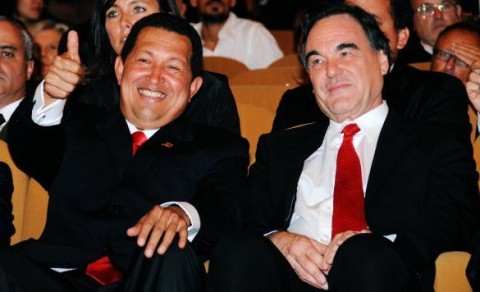
Welcome back to Moment of Truth, Movieline’s spotlight on the best in nonfiction cinema. Today we hear from director Oliver Stone about his new documentary South of the Border , which opens tomorrow in limited release. For all the political heat Oliver Stone has withstood (and will continue to withstand) over the years, no one can really call the guy a slacker. Take his latest doc South of the Border , which Stone filmed and edited during the course of making two narrative features and a 10-hour documentary he’s still working on. The concept was simple enough, even while the implications were more than a little complex: Introduce the leaders of seven Latin American countries to U.S. and European audiences who, for too long, have received the wrong idea about them from the media. Does it work? That’s up to you.

Link:
Moment of Truth: Oliver Stone on Gonzo Docmaking and ‘Good Guy’ Hugo Chávez

‘New Blink-182 Music Is On The Way,’ Mark Hoppus Promises

Bassist also apologized for confusion over a new track being premiered. By James Montgomery Mark Hoppus Photo: Christopher Polk/ WireImage Monday’s “exciting” Blink-182 news turned out to be an announcement that the group will headline KROQ’s Epicenter festival in September, (link so on Tuesday, Mark Hoppus decided to up the ante, taking to his blog to break a genuinely exciting bit of news. “Blink-182 is full-steam ahead!” Hoppus wrote. “In June and July we will be at the rehearsal spot, getting ready for the European tour this summer, and writing new songs. When the European tour is finished, we head back and play ONE SHOW in Southern California. Then that is IT for live shows for the rest of 2010. Why? Because we’ll be in the studio