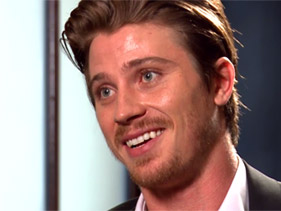
‘You want people to laugh about it when you watch the film, how brave it is and how carefree one can be,’ he tells MTV News. By Kevin P. Sullivan, with reporting by Josh Horowitz Garrett Hedlund Photo: MTV News
If late NWA member Eazy-E doesn’t already have his angel wings — you know, the ones that have remote-controlled Uzis grafted onto the feathers — he earned them on Friday. That’s when Resident Evil franchise star Milla Jovovich appeared on Los Angeles public radio station KCRW’s Guest DJ Project and rapped some of lyrics to the hip-hop artist’s “Nobody Move” by way of explaining how the track helped her break free of her strict upbringing and, as we all know, become the badass beauty she is today. Check out her performance after the jump. Jovovich included “Nobody Move” on her Guest DJ Project set list, explaining that the song “definitely changed my world. In a great way, actually, because I had been raised by a very strict Eastern European family and this was sort of my call for freedom.” Jovovich explained that at 9 years old, she was already working “and my mom always had so much control, and pretty much through Eazy-E, and that kind of like freedom, that I found to wear baggy jeans and big t-shirts and baseball caps and just act like ‘yeah, whatever.’” Here’s a recording of her rap performance: Jovovich turns out to have excellent taste in music too: She included Orchestra Baobab’s “Dee Moo Woor” and the Cocteau Twins “Blue Bell Knoll” among on her set list as well. You can download her full set here. Follow Frank DiGiacomo on Twitter. Follow Movieline on Twitter.
Making his first press appearance since that headline-grabbing Republican National Convention speech , Clint Eastwood laughed off his rambling, off-the-cuff missive to an invisible Obama. “It didn’t get the response I wanted,” joked the 82 year-old actor and filmmaker at a press conference for his upcoming baseball flick Trouble With The Curve , “because I was hoping they’d nominate me.” Eastwood’s been around the block long enough in the film (and politics) game to acquit himself well with charming self-deprecation. But as the line of questioning briefly veered from his turn as an aging MLB scout to his now-infamous rambling RNC appearance (which he discussed with hometown paper The Carmel Pine Cone the other week ), audible groans seemed to come from the direction of the publicists in the room. Unperturbed, Eastwood explained what he’d been trying to convey when he improvised an exchange with an empty chair on the RNC stage: “My only message was [that] I wanted people to take the idolizing factor out of every contestant out there. Just look at the work, look at the background, and then make a judgment on that. I was just trying to say that, and did it in kind of a roundabout way which took a lot more time, I suppose, than they would have liked.” A journalist asked if Eastwood would give the same speech if he could go back and do it all over again. “I’d probably say something else,” Eastwood admitted, “but I’d try to get the same message across so that people don’t have to kiss up to politicians. No matter what party they’re in, you should evaluate their work and make your judgments accordingly. That’s the way to do it in life and every other subject, but sometimes in America we get gaga, we look at the wrong values.” Then again, the former Mayor of Carmel, CA did make up his speech up on the spot just minutes before taking the stage. It might be hard not to do things differently. “I thought of that five seconds before we started,” he smiled. “You walk there [in front of] an audience of ten thousand people who are extremely enthusiastic and your mind goes blank, anyway. So I’d say something else.” Stay tuned for more on Trouble With The Curve , in theaters September 21. Follow Jen Yamato on Twitter . Follow Movieline on Twitter .
Roger Friedman of Showbiz 411 reports that U.K. mega-singer Adele will sing the title theme song to the next James Bond joint, Skyfall — though, grain of salt: He’s confirming his own scoop here, and the phrase “I think I can confirm for you what I said some months ago” doesn’t inspire total confidence. But it’s Friday, and a girl can dream! And Friedman’s got it right when he argues that “Adele’s sound is the quintessential James Bond sound.” Also, those other recent 007 themes did roundly suck. Bring on Agent Adele! [ Showbiz 411 ]
Digging into the rabbit hole of a mystery that is the inflammatory, anti-Muslim film Innocence of Muslims — the amateurish viral trailer for which set off protests and violent attacks in at U.S. embassies in Libya, Egypt, and other cities this week — Vice Magazine and Gawker have fingered the man they believe directed the project last year in California. Did industry veteran Alan Roberts (AKA Robert Brownell), a B-movie director and editor behind cult/softcore Cannon/Golan & Globus-era schlock Karate Cop , The Sexpert , and The Happy Hooker Goes Hollywood , make the incendiary anti-Muslim screed? Vice reports that they were “anonymously furnished with documents” pointing to a Robert Brownell AKA Alan Roberts: The documents clearly state that in 2009 and 2011 Robert Brownell purchased pre-production services related to Desert Warrior , which has been widely reported as the working title of the film that the world now knows as Innocence of Muslims. The documents also include Robert Brownell’s address in Tarzana, California (or at least his address when the purchases were made in 2009; the property is now up for sale), phone number, and “contact information,” which lists yet a different name—Alan Roberts. Meanwhile, Gawker confirms Roberts was the director on Innocence of Muslims , filmed under the title Desert Warrior with a different script from the allegedly blasphemous final version. A former business partner and an acquaintance confirmed to the website that Roberts is the same Alan Roberts listed on IMDb as the director of low-budget B-movie threequel The Happy Hooker Goes Hollywood (1980) (co-starring Adam West!), the action pic Karate Cop (1991), and the Harry Hamlin erotic thriller Save Me (1994). Roberts is said to be laying low, understandably. According to Roberts’ ex-business partner, Roberts filmed Desert Warrior without knowledge that it was going to be re-dubbed into its final version: “They redubbed it, they brought in the actors, put in new sounds, changed the names,” said the business partner. “And this was done later, before it was initially released. Of course Alan had nothing to do with it.” If true, it sounds like producer Sam Bacile (or “Sam Bacile,” as his identity is still in question) is more culpable for the incendiary material within Innocence of Muslims than Roberts, a workman director and sometimes editor with ties to the ’70s-’80s Cannon/Vestron/Golan & Globus era of cheap-o schlock cinema. More info as it comes… in the meantime, here’s a look at Roberts’ heretofore best known works. [ Gawker , Vice ]
On September 21, Michael Pena and Jake Gyllenhaal will be marked for death. In End of Watch , the actors take on the roles of two young police officers who gets into serious trouble after confiscating a cache of money and firearms from the members of a notorious drug cartel. Did you like Training Day ? You’ll love End of Watch . Our friends at Movie Fanatic have posted an exclusive look at the film, which also features Natalie Martinez, America Ferrera and Anna Kendrick. Head over there now for an exclusive End of Watch trailer and tell them you were sent by THG. You’ll be able to watch it at no cost!
Also in Thursday evening’s round-up of news briefs, the Academy names a director for the 85th Oscars telecast. And a slew of Venice and Toronto titles find homes, leading them to U.S. theaters in the coming months. Don Mischer to Direct 85th Oscar Telecast Producers Craig Zadan and Neil Meron said Don Mischer will direct the 85th Academy Awards telecast, marking the “continuation of [his] multi-faceted relationship with the Academy, which includes pro ducting the Oscars red carpet pre-show and producing the annual Governor’s Ball.” Richard Gere to Receive Hamptons International Film Festival Honors Aactor Richard Gere will attend the 20th anniversary HIFF to receive The Golden Starfish Award for Lifetime Achievement in Acting on October 6th. The award will be presented during the festival’s “Conversation With Richard Gere”, a discussion with Mr. Gere about his life and career, moderated by the festival’s Honorary Chairman, Alec Baldwin. The 20th Hamptons International Film Festival takes place October 4th – 8th in Long Island, NY’s East End. Fandango Eyes Advanced Ticket Sales for The Twilight Saga: Breaking Dawn Part 2 The final installment of the Twilight behemoth will first go on sale October 1st at Midnight ET, more than six weeks before the movie’s November 16th release, the online ticketed said. Deadline also reports that MovieTickets.com is offering the advanced tickets on its site too . Advance tickets for the November 15 Twilight Marathon – where all five films of The Twilight Saga will be shown in order at select theaters – will also go on sale on October 1st. And, as part of a special sweepstakes on Fandango, two fans will also have the chance to win a trip to the world premiere of Breaking Dawn, Part 2 in Los Angeles. Visit their site for more details. Venice and Toronto’s The Reluctant Fundamentalist Heads to U.S. Theaters IFC Films picked up North American rights to the film, directed by Mira Nair, which opened the recent Venice Film Festival and screened last week at the Toronto International Film Festival. Starring Liev Schreiber, Kate Hudson, Kiefer Sutherland, and Riz Ahmed, the film tells the story of a young Pakistani man (Ahmed) whose pursuit of corporate success on Wall Street leads him on a strange path back to the world he had left behind. The deal for the film was negotiated by Arianna Bocco, Senior Vice President of Acquisitions & Productions for Sundance Selects/IFC Films and Hal Sadoff for DFI and Bart Walker of Cinetic Media on behalf of the filmmakers. Toronto’s No Place On Earth Heads to U.S. Theaters Magnolia Pictures picked up U.S. theatrical rights to the emotional directorial debut of Janet Tobias’ Toronto documentary No Place On Earth . The film, which recently had its world premiere in Toronto, tells the little-known story of thirty-eight Ukrainian Jews who survived World War II by living in caves for eighteen months, the longest-recorded sustained underground survival. Built upon interviews with former cave inhabitants, as well as Chris Nicola, the caving enthusiast who unearthed the story. negotiated by Josh Braun and David Koh at Submarine with Dori Begley, Magnolia’s Senior Vice President of Acquisitions. Magnolia will release No Place On Earth theatrically in 2013. While We Were Here Heads to U.S. Theaters The 2012 Tribeca Film Festival premiere is set on the isle of Ischia off the Amalfi Coast in Italy. The film follows a young American writer named Jane (Bosworth) who finds herself at a personal and professional crossroadswhen she accompanies her husband Leonard (Goldberg) on a business trip. While escaping the mundanity of her comfortable marriage by delving deeper into adapting her grandmother’s WWII stories into a memoir she stumbles into a romantic affair with a younger man (Blackley) who complicates her life even further. L.A.-based distributor Wrekin Hill release the film in the U.S., which stars Kate Bosworth, Jamie Blackley and Iddo Goldberg. How To Make Money Selling Drugs Heads to U.S. Theaters The film had its world premiere at the Toronto International Film Festival Friday. Directed by Matthew Cooke, the provocative documentary offers an in-depth look at the high-stakes world of drug dealing and drug enforcement by blending authentic reportage with pop culture references. Tribeca Film, the distribution component of the group that oversees the Tribeca Film Festival, plans a 2013 theatrical release as well as Video On Demand platforms.
Billionaire Robert Miller ( Richard Gere ) is a cheat. He cheats on his wife ( Susan Sarandon ) with his mistress, and on his mistress (Laetitia Casta) with his job. And for his job as CEO of one of those mysteriously mighty hedge funds that control the world in Arbitrage , he’ll cheat everybody : the IRS, his daughter and business partner ( Brit Marling ), the buddy who loaned him $412 million, and the fellow mogul Miller wants to acquire his company so he can, of course, spend time with his family, even though the idea confuses them. “I’m just trying to imagine what we would do?” laughs Marling. Clearly, Robert Miller swims with those economic sharks who nearly ruined the world in 2008, and writer/director Nicholas Jarecki (brother of Andrew and Eugene) is going to make him pay. But not for his actual crimes — no one’s going to jail for those — which means Jarecki has to invent a new sin. And so, late one night when the roads are empty, Miller whisks his mistress toward his lake house. He falls asleep at the wheel, skids into the divider, and comes-to next to her fresh corpse — a bloody metaphor for the lives he’s impersonally ruined, and a vicious end for Casta, a Normandy-born beauty so physically perfect there’s literally a bust of her in every French town hall. The quiet of the crash’s aftermath is chilling; the only sound is Miller screaming. But then he thinks of the millions he could lose if the cops, investors, and his wife look harder at his life and makes the cold decision to abandon her body and rescue his reputation. Hey, what’s a little furtive involuntary manslaughter to the baron of Manhattan? With the overconfidence of someone who’s Tivo-ed every episode of CSI , Miller calmly calls collect to Harlem and asks his ex-chauffeur’s son, a young ex-con named Jimmy (Nate Parker), to meet him at a gas station and shuttle him back to the city, no questions asked. Meanwhile, Detective Bryer (Tim Roth) arrives at the flaming wreck and resolves to find out who was really behind the wheel. This sounds like the set-up of a cat-and-mouse thriller. But Jarecki quickly establishes that Miller is screwed — the detective has him fingered by breakfast, and by lunch he’s got Jimmy in custody and threatened with a 10-year sentence for obstruction of justice if he won’t give testimony proving Miller’s guilt. As Miller’s lawyer warns, “The real world is different than television.” So, too, is this movie. Compared to an episode of your average television procedural, Arbitrage has double the runtime and half the suspense because Jarecki could care less about tension and theatrics. He doesn’t even care about Casta’s death — she doesn’t merit a single emo flashback. Jarecki is only interested in one deeply cynical question: What justice is fair to a billionaire? Money — not sex or death — is what fuels Arbitrage . It’s Miller’s excuse for refusing to confess (what’s 10 years to one innocent man if it protects thousands of employees?), and it’s what Miller offers Jimmy for his silence. Apparently, the going rate for a decade of jail time is $2 million, an insulting number considering it’s also what Miller drops to squire Sarandon’s status-conscious wife to a single Friday night benefit gala. And the detective’s resentment for Miller’s practically meaningless money is why the pinched and bitter Roth is so dogged about putting him in prison, vowing, “He doesn’t get to walk just because he’s on CNBC .” The performances are golden with Marling, Roth and Sarandon adding heft to their slender characters. It’s smart casting to have Vanity Fair impresario Graydon Carter pop up as the tycoon Miller so desperately needs to impress. And as the under-attack Jimmy, Parker works hard to make audiences want to remember his name. But this is a showcase for Gere, who has spent his career playing men who can afford a good scotch. (With that head of expensive silver hair, he could never play a fry cook.) At 63, his features have turned to steel: his eyes are small and watchful, and with his good looks he seems aggressively aware that he only has a few more years to grope Laetitia Casta before he has to holster his penis like Harrison Ford. Here, he’s at once charismatic and clueless, even getting a laugh when he asks Jimmy, “What’s an Applebee’s?” Gere does his best to give Arbitrage an agitated energy, but Jarecki’s fatalism works against the film. We can’t root for Miller; instead, we watch with dispassionate interest how the fallout of his misdeeds affects his friends, business partners and family. The smart surprise is that frankly, some of them don’t give a damn. Miller’s millions haven’t just corrupted him — they’ve corrupted everyone who wants a piece of him. And when Jimmy, the poorest and the purest in this ice cold drama, growls, “You think money’s going to fix this?” we’re forced to agree with Miller’s genuinely confused response: “What else is there?” Amy Nicholson is a critic, playwright and editor. Her interests include hot dogs, standard poodles, Bruce Willis, and comedies about the utter futility of existence. Follow her on Twitter . Follow Movieline on Twitter .
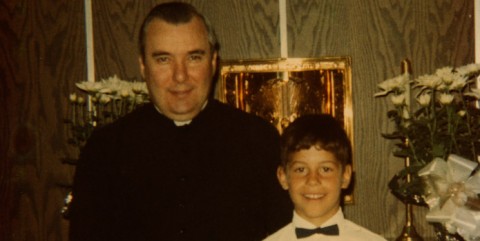
Just a couple of days into the Toronto International Film Festival this year, a curious commonality was noticeable in a number of the documentaries that I screened – re-enactments. While I only managed to see just under half of the nearly 50 documentary features in the TIFF line-up , it was surprising to see the storytelling approach — where significant past events are recreated via actors and, sometimes, animation — relatively widely employed. While some notable non-fiction films have made effective use of the practice — such as The Imposter or The Thin Blue Line — re-enactments more often feel in line with television productions of the Unsolved Mysteries variety. They remain a controversial element of documentary making, potentially challenging a film’s authenticity by introducing an outside, fictional element. It’s significant that the practice of re-enactment is the singular focus of one of the festival’s most-discussed docs, The Act of Killing , making this challenging film an appropriate place to begin. Director Joshua Oppenheimer, together with Christine Cynn and other anonymous co-directors, turn Indonesian gangsters into would-be Hollywood stars. The former death-squad leaders, responsible for the massacre of more than a million undesirables in 1965-1966, gleefully go along with Oppenheimer’s unusual plan, re-enacting the techniques they used to torture and murder suspected Communists, from off-the-cuff demonstrations of the cleanest way to strangle a victim to more elaborate set pieces involving interrogations and the destruction of a village. Verisimilitude is not the intent here. Although these over-the-top re-enactments push the limits of documentary ethics, they also shed light on the outsized personalities of the main subjects and reveal their histories and character. This conflation of a horrific reality with stylized fantasy also challenges the viewer and the perpetrators and becomes an unexpected form of therapy for the latter group. Mea Maxima Culpa: Silence in the House of God More literal examples of re-enactments are present in Alex Gibney’s Mea Maxima Culpa: Silence in the House of God , the prolific Oscar-winner’s exploration of child sexual abuse by Catholic priests. Focused around a Milwaukee priest who abused countless boys at the deaf school he ran, the film features the American Sign Language testimony of a number of men, spoken aloud by the likes of Ethan Hawke and John Slattery, but not distractingly so. Despite the forcefulness of the now-grown victims’ anger, expressed via their demonstrative signing and reinforced by the actors’ delivery (itself a form of re-enactment), Gibney decides to go one step further, recreating key sequences from their stories: silent scenes in which the priest prowls through the dorms ready to pounce on a sleeping young boy, or abuses the sanctity of the confessional booth. These sequences lack in subtlety and while they don’t undermine the strength of the film as a whole, they seem entirely superfluous. [ Editor’s Note: Gibney talks about his reasons for using these re-enactment sequences in an upcoming Movieline interview. ] Even more conventional is the use of re-enactments in Janet Tobias’ N o Place On Earth , the story of Ukrainian Jews who spent nearly a year and half living, literally, in caves to avoid capture during World War II. The majority of the film consists of actors portraying the circumstances of their flight from persecution and the conditions of their underground existence. Still-living survivors offer commentary in intermittent talking-head sequences, but the intended weight of the film is in the re-enactments which at times break from simply illustrating the story to feature actual scripted sequences. In the process, No Place on Earth ventures a step too far into docudrama. Given that the film is a production of the History Channel, it will likely connect with TV viewers, but, personally, scenes with the survivors re-visiting their cave sanctuary late in the film carried far more emotional resonance than the recreations.
Orwa Nyrabia is free. The Syrian filmmaker, whose Aug. 23 abduction by military security there prompted a long list of filmmakers to call for his release , was freed on Wednesday in “strong and good spirits,” according to his family. The filmmakers, who included Robert De Niro , Martin Scorsese , Focus Features James Schamus, Julia Meltzer, Yancy Butler, Judd Apatow and Alex Gibney , released a statement saying: On this day, we celebrate Orwa’s freedom and fervently hope that thousands of other Syrians who have been similarly detained will also be given their freedom. Nyrabia and his wife, Diana El Jeiroudi, founded the DOX BOX documentary film festival in 2008, which has been called the most influential in the Arab world. Nyrabia’s military abductors turned him over to a civilian court in Syria on Tuesday, which reviewed his case and freed him. Follow Frank DiGiacomo on Twitter. Follow Movieline on Twitter.