Last night, Snoop Dogg, along with Lucasfilm, hosted a private screening of Red Tails at the Arclight in Hollywood for about 200 of his friends and family. Many special guests came out to support Snoop and Red Tails , including the film’s cast members Terrence Howard, Tristan Wilds and more, in addition to Aaron McGruder (screenplay). Check out the video of the party: We know you’re going to check it out this week right?! We invite fans to Twitpic their Red Tails ticket stub and tag us in your uploaded photo for a chance to win an exclusive Red Tails Prize Pack. There will be two grand prize winners and three runners up. Two (2) Grand Prize Pack: Autographed Red Tails Trailer poster (signed by Cuba Gooding, Jr., Terrance Howard, and Ne-Yo, and other cast members) Limited Edition Red Tails Comic Con film poster – created by comic legend Kubert Red Tails backpack Red Tails Key chain Red Tails Dog tags Red Tails T-shirt (XL) Red Tails hat Red Tails pen Red Tails paper airplane Three (3) Runner Up Prize Pack Limited Edition Red Tails Comic Con film poster – created by comic legend Kubert Red Tails backpack Red Tails Key chain Red Tails Dog tags Red Tails T-shirt (XL) Red Tails hat Red Tails pen Red Tails paper airplane Make sure when you go see Red Tails this week, you twitpic your ticket stub. In addition to your picture, make sure you include these 3 in your tweet: #occupyredtails @redtailsmovie @Bossip Example: ” I just went to go see @redtailsmovie #occupyredtails @bossip (twitpic link here) “ The contest ends January 27th at 11:59pm PST! We will contact the winner via DM so make sure to look out for them! Check out the trailer for the movie:
Mr. Skin’s been a fan of busty Kiwi act-chest Melanie Lynskey ever since she took a lesbian bubble bath with Kate WInslet in Heavenly Creatures (1994). But unfortunately Melanie has spent most of her career as a character actress and hasn’t been able to spread her wings as a leading lady…until now! Melanie’s starring in the new movie Hello I Must Be Going , which premieres this week at the Sundance Film Festival. She plays a 35-year-old divorcee who moves back in with her parents after being suddenly dumped by her husband; at first she’s wallowing in her misery, but ends up wallowing in the sexual attentions of her father’s 19-year-old business colleague. Cougarrific! Melanie reportedly has several scandalous sex scenes in the film, as reported in Entertainment Weekly : Melanie Lynskey strips naked and sings the Canadian national anthem to a 19-year-old lover during a playful skinny-dip in the family swimming pool.There were more passionate scenes where that came from: late-night sex in her parents’ car, a tryst on a couch at a family party, sneaking into her young boyfriend’s room when his folks (who mistakenly think he’s gay) are away… To get a sneak peek of Melanie’s sweet teats, check out our Melanie Lynskey page right here at MrSkin.com!
‘I didn’t have any issue [doing] this fight scene with a woman, because I was the underdog,’ Ewan McGregor tells MTV News. By Kara Warner Gina Carano in “Haywire” Photo: Claudette Barius / Five Continents Imports If you like your movies with a lot of action, kick-ass fight sequences and actors who do their own stunts, look no further than this week’s new thriller “Haywire” to satisfy those needs. The concept for the film was born after director Steven Soderbergh saw footage of MMA fighter Gina Carano in the cage, which inspired the Oscar winner to build a film around her. “Haywire” revolves around a black-ops supersoldier (Carano) who seeks the ultimate revenge after she is betrayed by her colleagues, played by the very capable Ewan McGregor, Channing Tatum, Michael Fassbender, Antonio Banderas and Michael Douglas. MTV News recently caught up with Carano, Tatum and McGregor to discuss the very realistic fight sequences and how the guys were more than game for getting their butts kicked by a woman. “The physicality, that was fun to me. I didn’t have to hurt anybody,” Carano said of the difference between the film’s choreographed fights versus her MMA matches. “I didn’t have to worry about getting choked out, and there were no egos with any of the actors. They all wanted to do all their own stunts, and a lot of people around me were like, ‘Gina, that’s not normal. You’ve got some beautiful people to work with and a beautiful first experience.’ ” “To be totally honest, she’s better than every guy I’ve ever fought, really, other than one, and he was a strike force fighter as well,” Tatum admitted of his co-star, with whom he shares an intense bone-breaking exchange during the first five minutes of the film. “I can say this without any amount of trying to say it for the movie: I challenge anyone to come and fight her or even move with her. She’s by far the best athlete I’ve ever gotten a chance to move with. She’s so strong and in control, it’s just ridiculously unprecedented in my opinion.” McGregor added that he didn’t even think about the man-vs.-woman factor, only that it was the most appropriate scenario for his manipulative, weasel-like character. “There was a slight difference in our fight scene together. For me, I didn’t ever have any issue with the fact that I was having to do this fight scene with a woman, because I was the underdog,” he said. “There was no question that I was going to get killed if I didn’t manage to get away.” Check out everything we’ve got on “Haywire.” For breaking news, celebrity columns, humor and more — updated around the clock — visit MTVMoviesBlog.com .
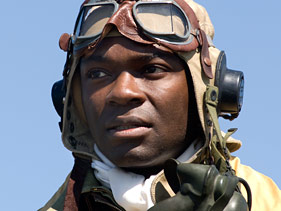
‘They were there to validate and chastise our decisions at the same time,’ Elijah Kelley said of airmen’s role. By Kevin P. Sullivan David Oyelowo in “Red Tails” Photo: Jiri Hanzl There was a lot of pressure on the cast of the upcoming true-life World War II drama, “Red Tails.” Not only did they have to honor the legacy of the Tuskegee Airmen, the first African-American air regimen in the U.S., but they also had to appease the actual airmen who worked as consultants on the film. MTV News sat down with Tristan Wilds , Elijah Kelley and Ne-Yo to discuss the relationship between the actors and the real-life historical figures. Wilds explained that having some of the real Tuskegee Airmen on the set of “Red Tails” made things both easier and harder. With the added pressure came a real sense of insurance. “It’s hard. It definitely is pressure because you’re holding the historical importance of these guys basically in your hands while you’re creating this film,” Wilds said. “But I think having them on set and being there with us and helping us with everything, it kind of made everything so much easier.” Kelley summarized the airmen’s dual role on the film, saying, “they were there to validate and chastise our decisions at the same time.” Ne-Yo learned the hard way that when you want to portray real-life figures, you’re responsible to them for even the smallest of details. “A few of the existing Tuskegee Airmen were on set making sure that everything was as genuine and authentic as possible to the point where they would grab you and shake you and straighten your tie and pull your pants up and pull your belt,” Ne-Yo said. “They would go that far, and you basically just had to take it.” All the men agreed that when it came to taking orders from the real deal, you had little choice but to accept their tips. “An 80-plus-year-old man grabs you and fixes your belt, you might just want to let him do it,” Ne-Yo said. Wilds agreed, saying, “It’s a lot of years of strength.” Are you planning on seeing “Red Tails”? Let us know in the comments. Related Videos MTV Rough Cut: Red Tails
South Korea’s 2012 contender for a foreign language Oscar feels more like a war movie than a movie about the Korean war, right up until its pitilessly bleak final frames. Though the American presence in that war is peripheral to its story, Hollywood clichés pervade The Front Line , from its slate and sepia tones to its stock company of characters and dialogue that translates macho posturing into present-day slang. And yet the movie has its startling moments, moments with the spark of specificity and the bitter clarity of perspective. Those stabs of the unexpected culminate in an ending that refuses to raise even the mildest or most melancholy flag of redemption. Is it worse for history to downplay a war as pivotal as this one or for the culture to overlook it entirely? Roughly based on true events, the film gives a grunt’s eye view of a conflict that some feel has been forgotten in popular retellings of the 20th century, despite the efforts of Don Draper and co. Perhaps this under-representation drove director Jang Hun to go for broke in telling the story of the end of the Korean civil war in 1953. The genre poaching begins with the flimsy hook of a mole investigation: An officer named Kang Eun-Pyo (Shin Ha-Kyun) is sent to the front to explore the apparent assassination of the famed Alligator Company’s commander. There he finds a group of men poised on the border of insanity, and among them an old friend name Kim Soo-Hyuk (Ko Soo). Since Kang last saw him Kim has been transformed from a frightened naïf into a soulless killer — the ruthless soldier who’s too cool to die, too hot to live. A rivalry seethes between the two friends about who has seen the worst of the war. Through their philosophical divide — for Kang there are only orders, for Kim there is nothing left to obey — the film explores the worth of a single life in a balance too steep for anyone to bear. Hun takes pains to emphasize the futility of the war; again and again the men ask why they are fighting. That question might seem a little curious to anyone who has paid even the most fragmented attention to the plight of North Korea over the last sixty years. Every inch withheld from Kim Il Sung and his heirs is an inch free from despotic rule and decades of mass starvation. But The Front Line focuses on the muddled, desperate view from the ground, and the absurdist terms on which war is actually fought. The bulk of the film is set in the Aerok Hills, mountainous territory on the embattled Eastern border. North and South exchange possession of one particular hill so many times that they begin leaving notes and gifts for each other in a bunkered cubbyhole. Hun is careful not to demonize the North Korean fighters, spreading the stereotypes out evenly: The Reds get the grizzled leader with the bitchin’ facial scar and the legendary sniper who turns out to be a foxy woman. The battle scenes, like most shot in the wake of Saving Private Ryan , feel derivative when they’re not quoting that film directly. A sequence recounting a frenzied insurrection during a failed amphibious landing is horrific on its own terms, however, as is the depiction of an overwhelming assault led by the Chinese. But The Front Line , at almost two and a half hours, develops its own case of battle fatigue. By the time the “one last job” trope is deployed in the wake of an armistice, the point has been made bloodily and well that war is same everywhere — appalling — and everyone sounds the same screaming for their mother. We don’t know what they’re fighting for any better than they do, and the dialogue is too thick with treacle for archetype to clarify into character. What ultimately makes the film compelling is the extent to which it uses the shared language of cinema to telegraph the caustic feelings of a people toward their own history. The Front Line was a smash in South Korea, which is more remarkable given the absolute nihilism of its finale. What secrets lay in that response? Are they just tougher than we are, with clearer memories? Was it not worth it, after all? Though the movie’s coda is not enough to lift the film out of its genre-bound shackles, in finally rejecting formula it feels defiant in more ways than one. Follow Michelle Orange on Twitter . Follow Movieline on Twitter .
Might November 16, 2012 not mark the beginning of the end for The Twilight Saga after all? While we’re still nearly a year away from the release of Breaking Dawn Part 2 , Lionsgate President Jon Feltheimer is already looking at life beyond the final installment of Stephenie Meyer’s novels – and he has an idea for how to milk the franchise for all it can produce. “It’s hard for me to imagine a movie that does $700 million-plus doesn’t have ongoing value,” Felthemier said of the possibility that another film could be made. “It’s an amazing franchise that they have done a great job of maintaining with absolutely no deterioration.” But the source material is tapped out. How could the studio back another Edward and Bella-based saga? “Maybe go back into some of the back stories,” Feltheimer suggested. “There’s been talk of shorts and different new media, too.” Only time, and screaming Twihard reaction, will tell. But what do you think of this plan? Do you want to see Twilight extended beyond Breaking Dawn ?
The great Fifth Generation filmmaker Zhang Yimou has gone from having films like Ju Dou and Raise the Red Lantern banned in his homeland of China to directing the lavish opening and closing ceremonies of the Beijing Olympics, his more recent work taking place in the safer territory of the grandiose historical melodrama of Curse of the Golden Flower and the Nicholas Sparks-worthy sentimentality of Under the Hawthorn Tree . Zhang has insisted that he’s not interested in politics, a tack that certainly seems to have its benefits: With an estimated budget of around $90 million, The Flowers of War is one of the most, if not the most, expensive Chinese production to date, it stars Christian Bale and it’s China’s Oscar submission. But that doesn’t mean that Zhang’s latest output should be dismissed offhand as nationalist propaganda. That the accusation’s been tossed at The Flowers of War , a big, button-pushing, brutally effective World War II-era drama, may be due to unfamiliarity with the atrocity during which it’s set — the Nanjing Massacre, during which hundreds of thousands of civilians were killed and tens of thousands raped by Japanese soldiers after the capturing of the city in December of 1937. It’s a horrific incident that remains relatively unexplored in popular culture, though Iris Chang’s bestselling book The Rape of Nanking , Bill Guttentag and Dan Sturman’s 2007 documentary Nanking , and Lu Chuan’s excellent City of Life and Death , which played in a few U.S. theaters last year, have brought it recent attention. Given that the massacre remains a painful point in China-Japan relations, and that certain far-right Japanese ultranationalists (like Tokyo governor Shintaro Ishihara) like to claim the massacre never took place and was invented to tarnish the image of Japan, it’s surprising that the Japanese soldiers don’t come off even less one-dimensional in Zhang’s film. The Flowers of War starts off with less context than I’ve given above, offering up a title card about “an especially dark chapter in human history” before dropping right into a destroyed Nanjing through which a scattering of schoolgirls runs, looking for shelter. Also scurrying through the wreckage and the piles of bodies is John Miller (Bale), an American mortician hired to bury the head of the local Catholic cathedral. While the ragged remains of the Chinese forces, led by Major Li (Tong Dawei), exchange fire with the Japanese troops, John discovers to his dismay that only students remain at the church — a group of adolescent convent girls and George (Huang Tianyuan), the orphan boy trying to serve as their caretaker. Finding no money for his fee, John settles into the late Father Engleman’s quarters to get trashed on Communion wine when a group of prostitutes arrives at the gates, having been promised sanctuary by the church’s cook, long since fled. Bale’s presence in the film is a kind of misdirect, a calculated element intended to better its international commercial prospects — his character makes a clumsily predictable journey from cynical drunken expat to hero willing to sacrifice a chance to escape the country in order to care for the children who’ve ended up in his charge. It’s the relationship between the famous “women of the Qinhuai River” and the frightened, sheltered girls that’s the stealthy heart of the film, the prostitutes sauntering in like brightly plumed birds and taking over the basement despite the protests of the cathedral’s scandalized remaining inhabitants, settling in to gamble and gossip. Yu Mo (Zhang discovery Ni Ni), the “top girl,” sets out to seduce John, knowing that as a Westerner he’ll be spared by the invading troops and might be able to help them escape. Meanwhile, the girls’ experience is filtered through Shujuan (Zhang Xinyi), who refused to leave the city without her schoolmates, and whose father (Cao Kefan) is now working for the Japanese in order to stay nearby. Despite the church’s supposedly being protected, Japanese soldiers break down the door (“We’re got virgins!” one yells), and it’s only due to the intervention of Major Li, hiding nearby, that the girls are spared gang rape and that only two are left dead. The Flowers of War never errs on the side of the overly nuanced — a soaring chorus accompanies moments of grace, and beyond a setup based on the looming threat of sexual violence to 12-year-old girls, the film features multiple characters sacrificing themselves to protect the youngsters, from Major Li, who fends off a platoon singlehandedly in an over-the-top but masterfully shot action sequence, to John, in his trek toward redemption, to the prostitutes, who end up offering themselves in the place of the children. A particularly harsh digression in which two of the latter travel back to their brothel to retrieve precious items they left there seems included only to reinforce the terrible fate awaiting any women who fall into the hands of the Japanese soldiers. Colonel Hasegawa (Atsuro Watabe), is the lone Japanese officer who’s not portrayed as a complete savage, though he’s still bound to follow orders, no matter how distasteful. But while it’s as blunt as any typical big-budget war epic would be, the film finds plenty of moments in which Zhang’s skill as a filmmaker and his deft handling and interest in female characters shines, from the way Shujuan serves as a far-too-young witness to these horrors, the camera often closing in on her gaze through a fracture in the cathedral’s rose window, to a sequence in which John cuts the prostitutes’ hair as they sleep (he knows how to work on people only when they’re lying down), so that they rise fresh-faced, with schoolgirl bobs. The enchantment with which the film views the Qinhuai ladies goes beyond any simple hookers-with-hearts-of-gold conceit — an imagined moment in which they sing while strolling through the church finds in them a magic that circumvents the victimization of their circumstances, a vision of lost decadence amidst the devastation. Follow Alison Willmore on Twitter . Follow Movieline on Twitter .
Valentine’s Day is a little less than a month away, and much like you trawling the supermarket for last-minute goodies to romantically rain down on your perennially disappointed significant other, Hollywood has cobbled together not one but two faintly savory last-minute options for the lovers out there. Fox announced late Wednesday that thanks to “outstanding test screenings and strong word of mouth,” it would release the Reese Witherspoon/Tom Hardy/Chris Pine-starring, McG-directed spy-love triangle rom-com This Means War on Feb. 14 proper — a Tuesday, three days ahead of the film’s original Feb. 17 release date. “Starting Valentine’s Day, we’re making WAR, not love,” said distribution boss Bruce Snyder in a statement. “We’re armed and ready with the perfect movie. This is a picture that that has it all – humor, charm, wit and action – and it plays through the roof.” Forsooth! Hath thy loins bestirred? OK, fine. How about this, then: The Catherine Zeta-Jones/Justin Bartha rom-com The Rebound , shot in 2008 at the apex of the whole “cougar” movement. This was the one bankrolled by the defunct studio/distributor The Film Department, on whose shelf it sat domestically for years while doing reasonably well on the international circuit. Now it, too, is under the Fox label, but straight to video, alas. So what could keep a Catherine Zeta-Jones rom-com in limbo all these years? Was No Reservations so bad? What’s it all about? Here’s Fox’s sell (via press release): Upon discovering her husband’s infidelity, Sandy (Zeta-Jones) and her two kids move from the suburbs to pursue a new life in the big city. There she meets Aram (Bartha), a local coffee shop employee whose wife only married him as a means to getting her green card. The two strike up a friendship which eventually evolves into something more. But it isn’t long before they’re faced with the big question – “Is this real or just a rebound?” Arriving just in time for Valentine’s Day and featuring electrifying chemistry between Zeta-Jones and Bartha, The Rebound also features fantastic supporting performances from Lynn Whitfield ( The Women, Madea’s Family Reunion ), John Schneider ( The Dukes of Hazzard, Lake Placid 2 ) and music legend Art Garfunkel. AHEM. John Schneider and Art Garfunkel? Hardy and Pine don’t stand a chance! Neither do you! Just break up already, seriously.
And/or be able to tell time: “Odeon Liverpool One can confirm it has issued a small number of refunds to guests who were unaware that The Artist was a silent film. The cinema is happy to offer guests a refund on their film choice is they raise concern with a member of staff within 10 minutes of the film starting.” [ The Telegraph ]