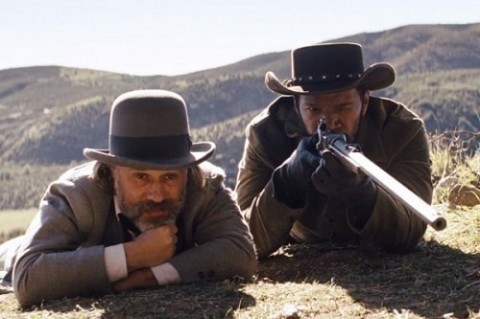
Django Unchained may be receiving attention for its excessive use of the N-Word , and the body count in this Quentin Tarantino thriller may be as high as anything the director has ever helmed, but neither of those issues gets to the heart of the film: Two men, one friendship and the way Christoph Waltz was pretty much born to recite words written by Tarantino. Waltz portrays Dr. King Shulz, essentially the same character that earned him an Oscar in Inglourious Basterds . He’s a loquacious, laid back killer who smiles through the most tense situations. Tarantino penned the part for Waltz, and the best parts of the 166-minute movie feature Shulz simply talking: to residents of a town after he kills their sheriff; to Foxx’s slave-turned-bounty-hunter, Django; to Leonardo DiCaprio’s evil plantation owner. Waltz brings Tarantino terrific dialogue to entertaining life. And Foxx is also strong, evolving from a quiet slave to “the fastest draw in the South,” obliterating foes along the way and tracking down his wife (Kerry Washington), who has been purchased by DiCaprio’s Calvin Candle. The movie is Tarantino through and through, from the unusual combination of history and absurdity… to the drawn out scenes (one involving a group of white men complaining about the holes in their KKK-like hoods)… to his need to violently murder almost everyone on screen. Due to the latter point, the film is about 30 minutes too long. Without giving anything away, it easily could have ended around the time of a certain handshake, but Tarantino just can’t resist. He had to up the body count, he had to use up all his red dye budget. Indeed, the closing handful of scenes are cartoon-like in their violence. They’re just examples of Tarantino having fun with fake bullets and slow motion and shredded corpses. But these aren’t the difficult ones to watch. There’s one moment where a man is torn apart by dogs that even Michael Vick from a few years ago would have trouble watching. Overall? Django Unchained is exactly what anyone familiar with Tarantino’s work would expect. It may push the boundaries of good taste at times, and it definitely runs longer than necessary, but it’s a fun two-plus hours. You’re in for impressive visuals, unique characters and a series of fantastic exchanges between great actors. Sound off now with your take and visit Movie Fanatic for another Django Unchained review .
“I witnessed the genesis,” Christoph Waltz says of this season’s hot awards contender, Django Unchained . ” Quentin [Tarantino] l et me have twenty-thirty pages as he finished them !” Looks like Waltz and Tarantino have become true creative partners. But the actor, whose performance is one of the highlights of Django Unchained , would love to get even more involved. He lamented that he wasn’t able to be around for post-production when the film takes shape and “it really becomes interesting,” he said. In a one-on-one interview, I also asked him about foreign actors being stereotyped in Hollywood as villains, and he agreed that — as a good guy in Django Unchained — it always “feels good to break the cliche”. Plus he spills a secret about working with Uggie , Tinseltown’s top pooch, on Water for Elephants . Check out the full interview below: Get more on Django Unchained , in theaters Christmas Day. Follow Grace Randolph on Twitter . Follow Movieline on Twitter .
Bethenny Frankel may now be single, but she is far from alone. Following her separation from Jason Hoppy , which the reality star announced yesterday, the former Real Housewife has taken to Twitter to thank her 1.1 million fans for their support. “You give me so much love, and I am so grateful,” Frankel wrote last night in response to an outpouring from followers. “It feels like your words could get someone through anything.” Bethenny and Jason were married for two-plus years, after meeting in 2008 and having their relationship chronicled on Bravo’s Bethenny Getting Married . Still, shockingly, it all fell apart. Do you think these two are over for good? Might they reconcile? Yes, they are meant to be! No, it’s over! View Poll »
Do not count Spike Lee as one of the millions of movie goers who will be seeing Django Unchained this holiday season. Or any season, for that matter. The famous director went off on the film – which stars Jamie Foxx as a freed slave who teams up with a bounty hunter to rescue his wife from an evil plantation owner – and Quentin Tarantino in a recent interview with Vibe. Django Unchained Trailer “I’m not gonna see it,” Lee told the magazine. “All I’m going to say is that it’s disrespectful to my ancestors.” Lee then expounded via Twitter: “American Slavery Was Not A Sergio Leone Spaghetti Western.It Was A Holocaust.My Ancestors Are Slaves.Stolen From Africa.I Will Honor Them.” The action movie has made a few headlines for its excessive use of the N-word, something Lee also took Tarantino to task for in 1997 after the release of Jackie Brown . Said Lee at the time: “Let the record state that I never said that he cannot use that word – I’ve used that word in many of my films – but I think something is wrong with him.”
He ain’t never told no lie, he ain’t never told no lie Samuel L. Jackson Says His D’Jango Unchained Character Is Most Hated Negro In Cinema Via Essence Samuel L. Jackson has made a career of playing sinister characters. But none is quite as unlikeable, or controversial, as his character Stephen in Quentin Tarantino’s Django Unchained. As the Candyland plantation’s oldest and more revered slave, Stephen, as Jackson puts it, “is the power behind the throne,” who throws a wrench in Django’s plans to rescue his wife—while providing a bevy of hearty laughs at the expense of Django and company. Peep what “Uncle Sam” had to say about his character. ESSENCE.com : What was it like to play an evil, but extremely funny, character? SAMUEL L. JACKSON : It’s great to have a character that has that kind of agenda. [Stephen] throws those great lines and [has those] relationships with people and has tons of conflicts. It’s great to be that. ESSENCE.com : Did you have any hesitation about taking on the role? JACKSON : No, Quentin called me and said he had this movie he wanted me to be in. I read the script and thought this was great. I could be as evil as I want to be and be the most hated Negro in cinematic history. I was there! ESSENCE.com : Was there any part of you that slightly resented Stephen because he ruined things for Django? JACKSON : No, I like all my characters. You can’t play a villain and think of yourself as a villain. It’s not the thing to do. You have to go about the business of doing what he does and being who he is. I like Stephen. I like the fact that Stephen knows who he is and he’s comfortable in the skin he’s in. ESSENCE.com : How do you go about preparing to play a house slave, if there is a way? JACKSON : How do you prepare? Well, you know he is. You know where he came from. You know he’s a product of his environment and he’s been there forever. He runs the plantation, he can read and write. He writes the checks. He does more than everybody knows he does. He’s essentially the power behind the thrown in the plantation. He’s got a lot of power. He’s the freest slave on the plantation. He’s not burden by any of things that all the other slaves are. He doesn’t have to go out in the fields and work. He tells people what to do. He has a position of authority. He’s authority. He’s a business man. [Laughs] Bossip was fortunate enough to be invited to the Atlanta screening of D’Jango Unchained last week and despite the repetitive use of the N-word, we were very impressed by the film. Again, Sam Jackson isn’t lying when he says you are going to HATE his character! Image via D’Jango
Judd Apatow knows that in casting his real life wife and children in his latest film, the seriocomic Knocked Up spin-off/sequel This Is 40 , he’s inadvertently invited the world to peek into his own life, marriage, issues, and neuroses. Still, despite the many parallels one might draw between Paul Rudd ‘s Pete (now a struggling indie record label owner) and Leslie Mann ‘s Debbie (whose own small business and marital woes are nothing compared to impending big 4-0), Apatow insists most of This is 40 is fictionalized. Okay, much of it. Well, he doesn’t escape to the bathroom to play games on his iPad like Pete does. “I’m more about reading the Huffington Post ,” Apatow joked. Apatow may have built his comic empire on R-rated man-child tales rife with fart and dick jokes (not to mention sweet, sweet bromance) but with This is 40 the writer-director takes a considered look inward at marriage and relationships. They’re never perfect — even between Hollywood creatives like Apatow and Mann, whose daughters Maude and Iris play heightened versions of themselves in the film — but as Apatow mused in our conversation rife with relationship real talk, personal reflections, and necessary tangents about Maude’s real life LOST obsession and Apatow’s 1995 kids’ camp movie Heavyweights : “Imagine that you had to spend every second of the rest of your life with your best friend. How often do you think they would annoy you?” Out of all the characters you’ve created onscreen, you spun off Pete and Debbie into their own film — the two characters whose lives are closest to your own. What was the impetus for wanting to explore this particular relationship further? I have two interests; I’m trying to make funny movies and I also want to explore the human condition, and I want to be truthful about it. And the truth is in any relationship you have good times and loving times, and sometimes it goes really dark. And sometimes out of nowhere, something just blows. People bring a lot of baggage into their relationships and I think most people are pretty neurotic. Life is pretty overwhelming for most people. If you have any concern about being a good spouse and parent and having your job work out and your health — you’re just spinning too many plates. And once in a while we snap, so I was trying to show a truthful version of what happens when that occurs — sometimes that’s really funny and sometimes it’s just sad, and people’s fears come out. When you first began working up the seeds of This is 40 , was there any hesitation knowing that people out there might watch the film and wonder, ‘So that’s how it is in their family?’ about you and Leslie? For some reason I didn’t worry about because I thought we already did it with Knocked Up. And it is a mutated version of us. It’s very heightened — a lot of the moments, the worst moments, for dramatic and comedy purposes – but for the most part we’re pretty boring. Once in a while it does go the wrong way, but then you have to figure out how to get it back. That’s what a long-term commitment is about; sometimes you make mistakes and you have to apologize and be kind to each other again. I always say to my kids whenever they ask me, ‘Why do you guys fight?’ — I say, ‘Imagine that you had to spend every second of the rest of your life with your best friend. How often do you think they would annoy you?’ And, you know, that’s how we feel about it. We love each other but we’re complicated people — and it’s hard for me to know if part of it is this is why we’re in this business, because we’re sensitive, complicated, wounded people and we’re trying to get along with each other. [Laughs] But most of it is fabricated. Nothing in the movie feels specifically true, it didn’t happen to us, but the emotions are very truthful, the feelings and the conflicts are all based on things that we relate to. Even so, you know that some folks out there are going to imagine you sitting on the toilet playing Words With Friends on your iPad every morning. I’m more about reading the Huffington Post . [Laughs] I would sit on the toilet all day if my legs wouldn’t go numb. If I could create a toilet seat that didn’t lead to my legs going numb… This is 40 is also a rare opportunity to see Leslie front and center; she has this wonderful ability to play deep sadness and humor simultaneously. Do you have a favorite scene of hers from the films you’ve worked on together? My favorite scene that we’ve ever done together was the scene in Funny People where Adam Sandler’s character apologizes to her character for cheating on her when they were young, and ruining their chance at having a long-term relationship. We shot it with three cameras and it was very emotional, and I was proud of both of them. Of everything I’ve done it’s one of my two or three favorite scenes. She has a way of being very funny while also being deeply emotional, so she can be dramatic and show pain and get laughs at the same time. I’m not even really sure how she accomplishes that, it’s just some aspect of her vibe which allows her to do many different colors at once. That’s the fun of working with her. And she’s always willing to do whatever it takes to get to an honest moment. She never says, ‘I don’t want to do that,’ or ‘That would be embarrassing,’ if anything she pushes to go farther and wants to get to the core of her character. There were definitely moments when we were making [ This is 40 ] when we said, ‘What are we doing? This is crazy’ — especially if there was a day when we weren’t getting along. We’re making this movie about a couple and their love and their troubles, so on the days when we’re not liking each other it just feels like a complete waste of time. Did it also then help to be making this movie? You have entire scenes where the dialogue pokes fun at couples therapy-speak, and it’s hilarious to point out how much, in the heat of the moment in a fight with your significant other, no amount of preparedness or civility training helps. Yes! I know everything about therapy and so can break every rule of how you’re supposed to communicate in five seconds. You just have to learn to slow your brain down and be patient and not feel the need to win every moment, and I don’t know if there’s anything harder on Earth than doing that. Giving up your need to be correct is brutal, especially for me because I think I have to be very confident in my day job. All day long I’m making decisions very quickly and I have to be very strong about it, so for me to come home and be soft and open and not leap to pounce on a problem and come up with an answer and execute it is hard for me — and it’s truly annoying to Leslie. [Laughs] I can imagine! Any time a problem comes up, my thought is ‘Let’s solve this in the next five seconds and move on!’ And Leslie might want to explore the emotional life of some issue and tell me how she’s feeling for a really long time, and I just want to give her five seconds. That’s a big adjustment. This is 40 is also really about parents and children — every one of us is messed up because of our parents, and by the same token we’re great because of our parents. Pete and Debbie both deal with that burden. Whatever you didn’t get from your parents, you want more of from your spouse. So if you feel like you were abandoned, you’re going to be needy. If you feel like your parents were engulfing, you’re going to want to push your spouse away. It’s really hard to fight against that; I find that the imprinting you have when you’re a kid is really difficult to wipe away. Whenever I’m really upset about something it’s always a result of something from the past. But that’s a revelation that you really only have when you’re in your thirties, maybe. I don’t know that I would have really understood it so much when I was 20. Well, people are so busy trying to earn a living they put very little time into understanding themselves. That’s something that happens later in life, and partially what the movie’s about. I find myself embarrassed that I’m still neurotic about things that happened to me as a kid, because my memory’s disappearing so I don’t even remember the incidents, but I remember the neuroses are and they’re not going away. How do you think viewers of a younger generation will react differently to the film? A lot of it depends on what you’re looking for in a movie. Some people go to movies to escape. I like movies that make me think and feel and I don’t necessarily have to feel good the whole time. So I like movies to be as entertaining and hilarious as I can make them, but I’m also trying to stick in your craw a little bit and talk about some tougher ideas. If that’s what you want, I think it’s a movie you’d really enjoy. But if you really want to shut your brain down, then I have other movies that you can rent. [Laughs]
The Guilt Trip is a film as familiar as a mother’s voice, in more ways than one. Playing a frustrated son and his overbearing mother, Seth Rogen and Barbra Streisand elevate a formulaic script with their easygoing chemistry in this road-trip mom com. They produce as many laughs as they do cringes, but the film’s feel-good message is undermined by its ultimate purpose: As a vindication of the rights of Jewish mothers to annoy their children as much as they please. Rogen plays Andy, a schlubby organic chemist who’s having trouble selling his invention, a nontoxic cleaning spray. The product, clumsily named Scieoclean, is a would-be bestseller, but Andy makes a worse salesman than Tiger Woods shilling monogamy. With the last of his savings he plans a last-ditch effort to drive across the country pitching Scieoclean to several big box stores. Andy spends the day before his Jersey-to-Vegas trip with his well meaning but tirelessly chatty mother. Joyce (Streisand) is the kind of older widow who’s found a routine that’s nice and busy enough for her post-retirement years, but one that doesn’t include the emotional risks of dating. Over dinner, Joyce confesses to Andy that the love of her life was the boyfriend she had before meeting his father. A quick Google search shows that this long-lost beau also happens to be an advertising exec in San Francisco, a discovery that leads Andy to suggest Joyce join him on the eight-day trip. Of course, he casually leaves out the detail that their final destination has been moved to California, and that he hopes her ex-boyfriend will help him market his floundering product. Joyce and Andy’s travels lead them through some very familiar road-trip movie situations. Their car breaks down during a freak snowstorm, one of them takes up the challenge to eat a big chunk of cow in a Texas steakhouse, and they wonder aloud about how long they’re supposed to respectfully marvel at the Grand Canyon. These are pleasant diversions, made enjoyable by Rogen’s gregariousness and Streisand’s twinkling, gamine eyes, but amount to very little. Their journey finally gets into gear when Joyce stops her mindless nattering about sock sales at the Gap and confronts her son about his semi-hidden scorn for her. Again, the emotional beats are entirely predictable, but the rapport between the actors make them convincing. Rogen has more to work with: Andy’s a focused and ambitious adult who hasn’t yet realized that he has more growing up to do. He has a lot of hurt in his life, and it doesn’t help that Joyce’s idea of keeping in touch mostly consists of her (unknowingly) reminding him of his professional and romantic failures. Rogen also does the comedic heavy lifting here. His sarcastic one-liners are so spontaneously and perfectly delivered they have to have been improvised on the spot. (Streisand reportedly improvised some of her lines too, but she lacks her co-star’s effortless droll wit.) Streisand has much less to do, but manages to add spark to her limited material. She sells Joyce’s phobia of dating with just a few gestures and skillfully mines the character’s contradictions. There’s a lovely moment halfway through the trip when a handsome stranger approaches to court her. Andy watches the scene unfold from some distance and gently teases her about it afterward. Flustered by the unexpected male attention, Joyce squeaks out an admonishing but embarrassed, “Don’t be disgusting,” even though she’d shown nothing but eagerness to discuss his girl troubles. The script needs more of those intimate, role-confusing moments to pull the character out of her shell and make her more than just “Andy’s mom.” That we have no idea what Joyce has done in the three decades since meeting Andy’s father and taking this trip is a particularly glaring omission. Though Andy undergoes the bigger transformation, it’s safe to say it’s the Jewish mother — the archetype, not Joyce — who gets her revenge in the film. She fights dirty too, by appearing in the guise of a nice, attractive sexagenarian without a sadistic bone in her body. As the latest iteration of the Oedipal nightmare that is mothers who try to stuff their sons back into their wombs, Joyce is only an honorary member in that pantheon of disapproving control freaks. She isn’t a Talmudic scholar on the art of maternal passive aggression like Debbie Reynolds in Albert Brooks’ Mother or the sharp-eyed crones in Woody Allen films — she’s much too harmless and boring. But if Joyce isn’t much of a scold, the film sure is. In fact, The Guilt Trip can feel like one long, occasionally funny, occasionally haranguing reminder to love your mother. It dings Andy pretty hard for being exasperated by his mother’s penny-pinching and cluelessness, and the basic lesson he learns from their week together is that his mother has all the right answers to everything. The film even lays the source of Joyce’s most wounding behavior, her inadvertent twists of the knife already lodged deep in Andy by life and failure, at his feet. If you’d only call , the film says, I’d know not to hurt you . Oy vey. Inkoo Kang is a film critic and investigative journalist in Boston. She has been published in Indiewire, Boxoffice Magazine, Yahoo! Movies, Pop Matters, Screen Junkies, and MuckRock. Her great dream in life is to direct a remake of All About Eve with an all-dog cast. Follow Movieline on Twitter .
Jack Reacher , protagonist of Lee Child’s brilliant series of airport pulp, has sold nearly 40 million books. He’s also blonde, ugly, 6’5” and 250 lbs, which means the difference between the Reacher that fans love and Tom Cruise , who plays him in his long-awaited film debut, is literally sizable: Ten inches and 90 lbs, to be exact, and a whole lot of handsome. Child’s Jack Reacher is homeless, and for the well-coiffed Cruise, playing a guy who shops as Goodwill is as much of a stretch as hoping no one will notice his larger-than-life ex-military cop is barely taller than his co-star Rosamund Pike . (Which in real life, he’s not — Pike towers over him by two inches.) In the original novel, One Shot , Reacher spends half of the book pacing the surprisingly mean streets of a sleepy Midwestern city trying to unravel a shocking sniper attack that left five civilians dead. The flick opens with the crime — watching through crosshairs as the killer selects his targets is agonizingly tense — and in eight minutes, it’s solved and the murderer is in prison. Unlike in the book, McQuarrie shows us something the police don’t know: the face of the killer is different than the man behind bars. Yet not only is the evidence against the accused so perfect that his lawyer (Pike) merely hopes to get his sentence reduced to life in prison, here comes Jack Reacher, the accused’s old enemy, rolling into town on a Greyhound bus to make sure he gets the death penalty. Reacher is a brute with an odd moral code. When someone has what he wants — be it information he needs or a sports car he wants to borrow — he’ll twist their arms (literally) until it’s his. And he’s not just mean to men: he’ll leave women alone in dark alleys, and he’ll call a barely legal bimbo a “slut.” But if someone hurts that slut — at least, someone besides him — he turns into a heat-seeking missile of muscles, a jackal who won’t stop running until he catches his prey. So bringing Jack Reacher to the screen means Cruise has a lot to measure up to, but instead of swinging for the fences, he bunts. His Reacher is like every other character Cruise has ever played: Tough, cocky, and the smartest guy in the room. It’s the Tom Cruise paradox; he’s a great actor who’s stopped acting. He can’t vanish into a role, but then he doesn’t have to. Audiences show up to his films just to see his latest ass-kicking adventure, which makes Cruise the inverse James Bond — instead of different actors playing the same character, he’s one actor who plays the same character under a dozen different names. You could pretend his entire last decade onscreen is just Ethan Hunt going deep undercover to save the day. Luckily for director Christopher McQuarrie , Jack Reacher is also tough, cocky, and the smartest guy in the room. A former Army policeman and genius investigator, he’s always three steps ahead of his rivals and he loves making sure they know it. He’s so physically gifted that he makes his attackers look like the Three Stooges, and so mercilessly aggressive that he aims straight for his enemies’ eyes, knees and groins. Even hanging up a payphone, his elbow snaps like he’d rather be breaking someone’s neck. And yet, even this film’s last minute name change from One Shot to Jack Reacher does nothing to convince us that we’re watching a fictional Army vet named Jack Reacher — we’re watching Tom Cruise , and for fans of his, that’s enough. For fans of Child’s books, however, the pleasures are more complicated. With, oh, 100 of the book’s 376 pages occupied by Reacher’s inward deductive reasoning, McQuarrie faced the risk of a flick that was all voiceover. Instead, he flips the script; Cruise silently pads around looking smart and we’re meant to see his the gears in his head grinding. The film’s more fun when he finally opens his mouth to insult his ever-growing list of enemies, including a sour DA ( Richard Jenkins ), a cop who accuses him of murder ( David Oyelowo ), some rednecks (Alexia Fast and Josh Helman), a couple of vicious hitmen (Michael Raymond-James and Jai Courtney , co-star of the next Die Hard ) and the big boss, a four-fingered Gulag survivor named The Zec ( Werner Herzog ). Herzog is perfect for the role: he’s made a career of grimly muttering “death” and “murder.” He’s only in the movie for ten minutes — far too short — but he has one stand-out scene where he orders an underling to bite off his own thumb or get shot in the head, an at-any-cost survival instinct that Herzog’s been hunting for in his own films for decades. Alas, the weakness of the film is the weakness of the book. The Zec’s evil plan is both byzantinely complicated and pifflingly mundane. We already know the face of the killer. What we don’t know is why , and the big reveal is more of a “Huh?” McQuarrie, the writer of The Usual Suspects who also adapted One Shot himself, is still finding his legs as a director. Jack Reacher has the bright and empty look of television and is a bit unsteady as it wavers between action and laughs. But the flick is great entertainment as Reacher headbutts his way to the Zec, dutifully and casually giving nods to devotees of the books, even casting Lee Child in a cameo as a police officer who returns to Reacher the only thing he owns: a portable toothbrush. (Explains Reacher in the book Bad Luck and Trouble , “I carry a spare shirt, pretty soon I’m carrying spare pants. Then I’d need a suitcase. Next thing I know, I’ve got a house and a car and a savings plan and I’m filling out all kinds of forms.”) Beat by beat, Jack Reacher is just like Child’s paperbacks in the best possible way: it’s fast, fun, and smarter than it looks. Will it give Tom Cruise another hit action franchise? It deserves to. Hollywood has 17 other Jack Reacher books to pick from, any one of which would fit seamlessly into the Cruise canon. But for Child, the real question is, how many hit films will it take for Cruise fans to remember Jack Reacher’s name? Amy Nicholson is a critic, playwright and editor. Her interests include hot dogs, standard poodles, Bruce Willis, and comedies about the utter futility of existence. Follow her on Twitter . Follow Movieline on Twitter .
A front-runner in the Oscar race, Zero Dark Thirty received some harsh words from an unlikely source – Senator John McCain. The Arizona legislator who was a P.O.W. and endured torture during Vietnam watched the film by Kathryn Bigelow Monday night and said it left him sick and called it, “wrong.” McCain said that the controversial technique, known as water boarding, which simulates drowning, did not yield useful information from al Qaeda’s number three leader, Khalid Sheikh Mohammed, who has been in U.S. custody since 2003. The film suggests that the technique resulted in useful information that lead the CIA to al Qaeda mastermind Osama Bin Laden’s courier, Abu Ahmed. “The filmmakers fell for it hook, line and sinker,” the Republican senator is quoted as saying by A.P. Last year, McCain, who spent 5 1/2 years in captivity by his North Vietnamese captors, asked then-CIA director Leon Panetta whether the hunt for Bin Laden came from information provided from Mohammed. The lead to the courier, however, came from a detainee held in a separate country. “Not only did the use of enhanced interrogation techniques on Khalid Sheikh Mohammed not provide us with key leads on bin Laden’s courier, Abu Ahmed, it actually produced false and misleading information,” McCain said in a speech in the U.S. Senate. California Senator Dianne Feinstein, who is chairwoman of the Senate Intelligence Committee concurred that water boarding did not lead to the tip that eventually saw U.S. special forces raid a compound in Abbottabad, Pakistan. McCain said that water boarding is dangerous because it damages the U.S.’s reputation and character and might be used against Americans. “I do not believe they are necessary to our success in our war against terrorists, as the advocates of these techniques claim they are,” he said. [ Source: A.P. ]
Oscar-winning Lord of the Rings screenwriter Philippa Boyens is back for another romp in J.R.R. Tolkien’s Middle Earth playground with The Hobbit: An Unexpected Journey , and she recently sat down with Movieline to talk about the fantasy novel’s adaptation to the screen. Boyens, who is Hobbit director (and co-writer) Peter Jackson’s foremost Tolkien expert — although Stephen Colbert would beg to differ — refers to the Middle Earth creator using the honorific “Professor” and her reverence and esteem for the author are just about as infectious (in a good way, naturally) as Gollum’s “Precious” ring. By the end of the interview, she had us referring to Tolkien as Professor too, as she discussed the changes and adaptations she and her writing partners made to the text, the sad story of Balin the Dwarf, why fans should be very, very excited for 2043, when the copyright runs out on Tolkien’s Middle-Earth compendium, The Silmarillion , and more. From a technical perspective, if you’re not going to have Smaug in this movie you need a secondary antagonist. How did you decide on Azog, and what resonance did he provide for you thematically? You hit the nail on the head because when we were first looking at this as a piece of storytelling, we wanted to get to the dragon. We did try getting to the dragon in one draft, actually. But you had to lose so much along the way. We also understood that the Necromancer is too ephemeral at this moment – too much of a shadowy character that’s not fully understood. It’s a great mystery story, but there’s a big problem because there’s no actual, physical enemy. And yet the dwarves had a very natural one and he was to be found. When Peter [Jackson] talks about taking this chance to tell more of the story, that was one of the pieces that we took — that and Moria. It’s the story of the great hatred between the orcs and the dwarves, where it came from and what was informing it. And, also, I mean, Azog the Defiler. What a great name! You kind of can’t beat that as a name. Balin is telling the story of Azog and the Battle at Moria at a point in the film. I have to be honest, I half expected him to say – I must take this back someday if I ever get the chance! “It will be mine!” It brings up the question of – well, obviously, Tolkien wrote these sequentially. You’re going the other way around. The temptation for prequelitis must have been overwhelming at times. That’s a great word. And no. But you do want some level of resonance because you know the truth is we did make Lord of the Rings first. The relationship between Gandalf and Galadriel is something I particularly loved doing. People forget that Cate Blanchett and Ian Mckellen were never in a single scene together except at the very, very end. Gandalf was fallen by the time the company got to Lothlorien. Yeah, and I think that moment – kids especially are gonna come to this and [ The Hobbit] is going to be their first introduction to Middle Earth and then they will receive the rest of the story as a sequel. And that moment where she says ‘Where is Gandalf for I very much desire to speak with him’ to the Fellowship and they have to tell her that he died is going to be incredibly powerful. So…yeah, a little bit of prequelitis. Just a smidge. And Balin. Seeing Balin’s tomb in Fellowship will have more resonance as well. After two more movies especially – And Ori! Little Ori is the one who wrote “drums, drums in the deep: they are coming.'” I think probably because we’ve done Lord of the Rings it wasn’t that hard. We had Gollum . This wasn’t Gollum that you meet for the first time. We knew him. We understood how to make that internal conflict he has with Smeagal work. We had Andy Serkis the actor. Why wouldn’t you use that? It’s the great gift. The fact that Gandalf disappears, we know where he goes and what he’s dealing with. It was interesting – a lot of pure Tolkien fans loved in Lord of the Rings that, instead of a piece of reportage, we actually followed Gandalf to Isengard. And [showed his] one-on-one with Saruman instead of merely having Gandalf tell everybody what he’s been up to at the Council of Elrond. We got to see it, and we get to do the same thing this time as he goes to Dol Godur.