Jaws , Indiana Jones , Jurassic Park – Steven Spielberg has set the bar for the worldwide blockbuster. Sure, he’s taken praise for other genre as well, including his Best Director win for Schindler’s List (and another for Saving Private Ryan five years later). On the cusp of his Lincoln premiere for the closing night of the AFI Fest next month, the wildly successful director-producer-writer said he is “no longer attracted” to action films, even as some are on his plate. CBS’ 60 Minutes spotlighted the director and his latest Oscar-buzzed film, which had a sneak “work-in-progress” screening at the recent New York Film Festival. The filmmaker reiterated what many of those first crowds said about the film, describing it as less action-packed than many of his previous titles. “I knew I could do the action in my sleep at this point in my career,” he said. “In my life, the action doesn’t hold any … it doesn’t attract me any more.” Was that a possible moment of exuberation considering the feature is widely tipped to be a mass contender this awards season? Spielberg, however, is set to direct Sci-Fi thriller Robopocalypse , which is set in the aftermath of a robot uprising and a quick check of his IMDb page has him set to direct a possible Indiana Jones 5 . Also during the segments on the popular long-running Sunday night news program that his latest, about the 16th President of the United States, focusing on the last months of his Administration when he and abolitionists labored to pass the 13th Amendment soon after his re-election on the waning days of the Civil War, was partly inspired by a reconciliation with his father. “[President Lincoln] was the father of the nation in need of repair,” said Spielberg. “And in a sense, the movies I’ve made recently have reflected the positive relationships that my dad and I have enjoyed for 20 [to] 25 years.” “I was an outsider. The kid that played clarinet at band, which I did,” said Spielberg, who shared that he was bullied at school. He dealt with severe anti-Semitic attacks at school and said he denied his Jewishness for “a long time.” While his mother noted during the interview that he and his father were not close, it was in fact his dad who gave him something that would change his life – a camera. Though his parents later divorced when his mother left after falling for her husband’s friend, Spielberg didn’t know for years the circumstances of their break-up. He idolized his mother and used his sentiment, channeling it to the maternal character Dee Wallace in E.T. In Schindler’s List , Spielberg said, “I did everything I needed to do to tell the story the way I thought the story should be told, to give it as much integrity as I could, never expecting it to make a dollar. The film went on to deliver a worldwide box office haul of $321million and win best picture and director Oscars at the 1994 Academy Awards.” It was his turn at facing down the anti-Semitism he felt growing up. In his latest, starring Daniel Day-Lewis, Spielberg researched for the topic for 12 years. “I think the film is very relevant to today. It’s about leadership. And it’s about telling the truth. I think there was a sense of darkness for him…He had to end slavery and abolish the war. And there was darkness in his personal life.” [ Sources: The Guardian , CBS 60 Minutes ]
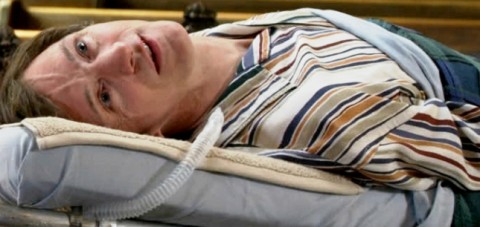
Ben Lewin’s The Sessions (formerly The Surrogate ) emerged as the undisputed hit of Sundance 2012, landing a $6 million sale with the unlikeliest of subjects: A paralyzed man’s quest to lose his virginity, based on the life and writings of Bay Area poet Mark O’Brien. Thanks to Lewin’s sensitive and honest script and an impressive turn by indie favorite John Hawkes — who shines with wit and grace in a physically demanding performance as O’Brien, who has no use of his limbs due to polio but begins to explore his sexuality with the help of a hands-on sex therapist (Helen Hunt) – The Sessions earned consecutive standing ovations and got critics buzzing with the possibilities for next year’s Academy Awards. Movieline sat down with Hawkes after the film’s Sundance debut to discuss the indie labor of love, why O’Brien’s story resonates so powerfully, and how opportunities have expanded for him since breaking out two years ago in Park City with his Oscar-nominated turn in Winter’s Bone . I grew up close to Berkeley and was a little familiar with Mark O’Brien before seeing the film, but it captured that sense of place for me – especially with little touches like Pink Man to set the atmosphere. Yes, of course! That’s good, because we shot in Los Angeles because we couldn’t afford to shoot up there. We had to make our own Pink Man and everything. [Laughs] Luckily there are a couple of Victorian streets in Los Angeles that we were able to utilize. How familiar were you with O’Brien’s story beforehand? I was minutely aware of Mark because I had heard of Jessica Yu’s amazing, Academy Award-winning short doc about Mark, called Breathing Lessons . I’d just vaguely kind of remembered that, and I may have seen an article about him at that time, but it was a new kind of story to me when I picked up the script and read it. I was pretty taken with the script itself, by Ben Lewin, and knowing he was going to direct the film which is often a wonderful thing – it’s the person who wrote the script, directing the movie. I just thought he was an extraordinarily interesting man, a polio survivor himself and very uniquely qualified to tell the story. When the project came to you – a very challenging role, to say the least – what made you decide you had to do it? My first question to Ben, as we sat down to meet before he’d offered the role and before I’d accepted the role, was ‘Why not a disabled actor?’ And he assured me that he had taken the last couple of years, he’d put out feelers to disabled groups, and had auditioned several people – a couple of them are in the film – and just felt like he hadn’t found his Mark. So with that huge question answered, I talked to Ben a lot about how he saw the film as a whole, how he saw the character of Mark; I had my ideas, we chatted and seemed to get along really well, so it was a good fit. We went forward from there. And this is a very small project. Ben raised the money by appealing to friends, basically, and so this tiny little script suddenly attracting William H. Macy, Helen Hunt, and a bunch of other wonderful actors – it’s vindicating to read something and think, ‘This is really good!’ And then you realize other people think so too. I’m not insane, it is a great script! How challenging was the shoot itself, physically? It was very challenging – again, a minute amount of the challenge that a disabled person faces, moment to moment, but certainly it was physically challenging. I helped invent a device that we used to curve Mark’s spine, basically a large piece of foam that we nicknamed ‘The Torture Ball’ because it would lay under the left side of my body and curve my spine for every shot in the movie. Sometimes I’d have to lay on that for an hour at a time, and it was hard – it apparently displaced my organs. [Laughs] My chiropractor told me that my organs were migrating and to hopefully finish the movie soon. I have minor health issues that may relate to laying on that thing, but nothing compared to what many people suffer daily, and it’s a small price to pay for what’s turned out to be a really beautiful film. To paraphrase Mark himself in the film, it may have hurt – but it was worth it? Yes! Definitely. It’s an interesting choice that Ben made to present Mark’s story here not as a straight biopic but with a focus on his relationship with his sex surrogate. What do you think that shifted angle brings, as opposed to a more conventional portrayal? Interesting. I think Ben originally had seen the movie as a biopic and then began to realize that the part of Mark’s life that interested him the most was his quest to learn his sexual possibilities as a disabled man. I think it’s a really wise choice; biopics are interesting, but I’d rather see a documentary of a person’s whole life, and I’d much rather see a narrative feature focused on a small piece of their life. And if you can focus on a small piece of someone’s life and tell it well enough, I think it informs the whole of their life. And there’s a real interesting story there – there’s a relationship that develops, certainly heightened in our film, but with the blessing of the real surrogate, Cheryl Cohen Green, to heighten and complicate their relationship a bit and to make it a love story of sorts. The subject matter, as you describe it, doesn’t have wide appeal but I think it has so much humor and so much truth, it’s a breath of fresh air. Mark’s voice really comes through – the same painfully honest, witty spirit you can see in his writings. It was important to me to fight self-pity at every turn, and for the film as a whole to fight sentiment as much as possible. He certainly never wanted people to feel sorry for him . No! The idea that he was a courageous person and stuff, he thought was bullshit. Like, how do you presume to know what I feel, what I go through? I think through his articles he was very interested in the political and social aspects of his disability. One thing that’s striking about Jessica Yu’s film, and I believe I also read something Mark wrote about it, is that to the taxpayer – to those of us who help support disabled people by paying taxes – it was half or maybe one-third of the cost of him being in an institution and live on his own, to pay rent, to hire attendance, way less of a strain on the taxpayer than keeping him an institution, where he was sadly stuck for a few years of his life when his parents were too old to take care of him. Luckily, the University of California, Berkeley in the ‘70s said, we’ll take care of any student who qualifies, who can pass our admission – it doesn’t matter what their disability. There’s an amazing photograph of his iron lung, 800 lbs. of it, hanging from a crane right outside his dorm room window as they’re trying to get it inside. So I know Mark always had a really felt beholden to Berkeley and felt a wonderful debt to that college and that town. They opened up his life, he was kind of reborn in his 30s in Berkeley. Sex and love are central to Mark’s journey in this film, and it’s such a fascinating terrain to explore – the relationship between disability and sexuality, and sexuality and manhood, and what they all might have meant to him. I can’t exactly speak in exact detail to his innermost thought, but he was quite effusive in his writings. In Jessica Yu’s film there is a brief mention of his surrogate time. Bill Macy’s made the point that he worked with a group, and disabled people, like able-bodied people, want to be independent as much as possible and live their lives that way, and they also want to love and be loved. Those are commonalities among people everywhere, and certainly disabled people are no exception. I think that Mark mainly was interested in sex because he was more largely interested in love and in a relationship with someone, and I think that he felt that if he ever met someone he could love, that he would want to have explored his possibilities, sexually. So that’s where the surrogate comes in. The minute that the first screening here ended, folks were buzzing about next year’s Oscars. It’s a little early! [Laughs] It’s a lot early. I mean, there may be twenty more amazing films that come out in the next year. I hope so! So who knows? It’s way too early and it doesn’t exactly make me nervous, I just turn a deaf ear to it because low expectations have always been the key to happiness for me. I don’t want to expect things to happen as much as hope, and if those Oscar predictions come true, fantastic – because it will bring more people to this film. After the success of Winter’s Bone , perhaps, how much did things change for you? Has the way that you’ve chosen projects in the last few years evolved at all? No, though I’ve certainly been afforded the opportunity to choose what I might be a part of. It’s not like every director in every movie is seeking me out by any means, there are a lot of things I’m not suited for, a lot of things I’m not interested in, and a lot of things that directors wouldn’t be interested in me for. What are you interested in? I’m interested in amazing stories told by talented people, and to get to play a terrific role. The three things I try to find are story, parts, people. Has it gotten easier to find the great characters? You know, I think it maybe is. It’s certainly changed for me because when I first got to Los Angeles 20 years ago, I had worked a lot of my life and was still working regular jobs. Acting was more fun to me, and paid better when I could get the gigs, so in order to avoid any further carpentry and restaurant work and things I’d been doing for many years, I just took whatever came my way. I was happy to be able to pay rent and eat. Certainly I’m freer now; I don’t get to do everything I want to do, but I no longer have to do things I don’t want to do – so that’s good. This interview previously ran as part of Movieline’s Sundance 2012 coverage. Follow Jen Yamato on Twitter . Follow Movieline on Twitter .
Turns out that giving her baby five different names may not be the most unconventional thing Uma Thurman ‘s done lately. Uma has joined the cast of Lars Von Trier’s Nymphomaniac , which you may recall as ” the movie with all the famous people boning each other .” Billed as a “pornographic drama”, Nymphomaniac stars longtime Von Trier collaborator Charlotte Gainsbourg as the titular sex maniac in a setup straight out of a ’70s Euro-porn: “One night, an old bachelor, played by Stellan Skarsgard, finds her in an alley, badly beaten. He takes her home to nurse her back to health, while she recounts to him her life of erotic adventure.” Uma’s role in the film is as yet unclear, but she’s no stranger to erotic drama thanks to her role in the NC-17 drama Henry & June (1990), where she indulged in a little lesbian exploration with Maria de Medeiros . It’s been a while since we’ve seen Uma uncovered on the big screen, so here’s hoping she gives us something to spank the anatomy to come next year. See more pics and clips of blonde goddess Uma Thurman nude right here at MrSkin.com!
Hollywood.TV is your source for all the latest celebrity news, gossip and videos of your favorite stars! bit.ly – Click to Subscribe! Facebook.com – Become a Fan! Twitter.com – Follow Us! Flight landed at the New York Film Festival. Stars of the movie including Denzel Washington talked to Hollywood.TV about the film. Denzel is already getting Oscar buzz from his role the movie hits theaters November 2nd. Hollywood.TV is the global leader in capturing celebrity breaking news as it happens. We cover all the major Hollywood events including The Golden Globes, The Oscars, The Screen Actors Guild Awards, The Grammy’s, The Emmy’s and the American Music Awards, as well as all the red carpet movie premiers in Los Angeles and New York. HTV is on the streets 24/7, at all the industry events and invited by the stars to cover their every move in Hollywood, New York and Miami. Hollywood.TV is currently the third most viewed reporter channel on www.youtube.com YouTube with almost 400 million views, and our footage is seen worldwide! Tune in daily for all the latest Hollywood news on www.hollywood.tv and http like us on Facebook!
Calling Ben Affleck ‘s Argo a “terrific thriller,” one of the six Americans who managed to escape the U.S. embassy just as student radicals took over the compound by fleeing into Tehran’s streets has set a bit of the record straight. Mark Lijek, who’s portrayed by Christopher Denham in Affleck’s awards contender, spoke out after attending the film’s L.A. premiere, giving his detailed version of events. And while there are strong parallels with the film, which began its release last week and has garnered Oscar buzz, the timeline of real-life events had some significant departures from the film, which Affleck starred in and directed. Still, Lijek did learn one thing from the film, which surprised him all these years later. ( Caution, spoilers if you have not seen the movie ). The backbone of the story – namely, the idea of posing the six Americans as movie-makers in order to dupe Iranian officials and sneak them of the country – is in fact true. The movie version of events suggest the six “house guests,” who were holed up in hiding in the Canadian Ambassador’s residence, needed convincing to go the route of posing as Hollywood insiders. But the plan’s CIA mastermind, Tony Mendez (played by Affleck) had in fact presented three ideas, which the group accepted as the best option straight away. “We liked the idea enough, in fact, that we chose it over two other scenarios that Tony also brought to us,” said Lijek in a first-person account of their ordeal in Slate magazine. “In one of them, we would pose as businesspeople, in something petroleum-related, if I remember correctly. In the other, I think we were meant to be teachers looking for employment at an international school. But those two seemed like throwaways, and Tony did not try too hard to sell us on them.” After considering the three options, Lijek noted, the group accepted the plan whereas in Argo it seemed to split the group, with dissenters reluctantly agreeing to go along. “It was clear the organization and energy was focused on the Hollywood option. And they were right to be: While the movie presents myriad dramatic complications and last-minute twists and turns, the plan actually went off without a hitch. Lijek’s account focuses on the drama the group had going from place to place in the lead-up to Mendez’s arrival. The six managed to evade capture, going from one temporary safe space to the next before ending up in the safe hands of the Canadian compound and in the care of Canadian John Sheardown, who was critical in safeguarding them. “When Tony Mendez arrived on Jan. 26, 1980, we were ready to leave,” writes Lijek. “The hostage crisis was no closer to resolution. We had asked [Ambassador] Taylor in early January to tell Washington we wanted out. Each day we stayed in Iran added to the risk of capture.” Continuing, he gives credit to Sheardown, who didn’t make the script in the movie version of events. “It never came to that — and John Sheardown may well be the indispensable reason why. Without his enthusiastic welcome we might have tried to survive on our own a few more days. We would have failed. And so it was hard, sitting at the swanky Los Angeles premiere the other day, not to see John in the movie. I understand, though, why he couldn’t be there. Argo already had more characters than a typical thriller, and adding the Sheardowns would not have enhanced the drama.” But Lijek received a surprise at the film’s screening as the credits rolled when a voice came in talking about the crisis 32 years later. “The film’s biggest shock? The voiceover from Jimmy Carter at the end. In comments about the incident that I had never heard before, Carter says our chance of success was 50 percent. 50?! I thought it was much higher. Another gut check. Would we have gone with Tony at 50 percent? I’ll never know.” [Source: Slate ]
Calling Ben Affleck ‘s Argo a “terrific thriller,” one of the six Americans who managed to escape the U.S. embassy just as student radicals took over the compound by fleeing into Tehran’s streets has set a bit of the record straight. Mark Lijek, who’s portrayed by Christopher Denham in Affleck’s awards contender, spoke out after attending the film’s L.A. premiere, giving his detailed version of events. And while there are strong parallels with the film, which began its release last week and has garnered Oscar buzz, the timeline of real-life events had some significant departures from the film, which Affleck starred in and directed. Still, Lijek did learn one thing from the film, which surprised him all these years later. ( Caution, spoilers if you have not seen the movie ). The backbone of the story – namely, the idea of posing the six Americans as movie-makers in order to dupe Iranian officials and sneak them of the country – is in fact true. The movie version of events suggest the six “house guests,” who were holed up in hiding in the Canadian Ambassador’s residence, needed convincing to go the route of posing as Hollywood insiders. But the plan’s CIA mastermind, Tony Mendez (played by Affleck) had in fact presented three ideas, which the group accepted as the best option straight away. “We liked the idea enough, in fact, that we chose it over two other scenarios that Tony also brought to us,” said Lijek in a first-person account of their ordeal in Slate magazine. “In one of them, we would pose as businesspeople, in something petroleum-related, if I remember correctly. In the other, I think we were meant to be teachers looking for employment at an international school. But those two seemed like throwaways, and Tony did not try too hard to sell us on them.” After considering the three options, Lijek noted, the group accepted the plan whereas in Argo it seemed to split the group, with dissenters reluctantly agreeing to go along. “It was clear the organization and energy was focused on the Hollywood option. And they were right to be: While the movie presents myriad dramatic complications and last-minute twists and turns, the plan actually went off without a hitch. Lijek’s account focuses on the drama the group had going from place to place in the lead-up to Mendez’s arrival. The six managed to evade capture, going from one temporary safe space to the next before ending up in the safe hands of the Canadian compound and in the care of Canadian John Sheardown, who was critical in safeguarding them. “When Tony Mendez arrived on Jan. 26, 1980, we were ready to leave,” writes Lijek. “The hostage crisis was no closer to resolution. We had asked [Ambassador] Taylor in early January to tell Washington we wanted out. Each day we stayed in Iran added to the risk of capture.” Continuing, he gives credit to Sheardown, who didn’t make the script in the movie version of events. “It never came to that — and John Sheardown may well be the indispensable reason why. Without his enthusiastic welcome we might have tried to survive on our own a few more days. We would have failed. And so it was hard, sitting at the swanky Los Angeles premiere the other day, not to see John in the movie. I understand, though, why he couldn’t be there. Argo already had more characters than a typical thriller, and adding the Sheardowns would not have enhanced the drama.” But Lijek received a surprise at the film’s screening as the credits rolled when a voice came in talking about the crisis 32 years later. “The film’s biggest shock? The voiceover from Jimmy Carter at the end. In comments about the incident that I had never heard before, Carter says our chance of success was 50 percent. 50?! I thought it was much higher. Another gut check. Would we have gone with Tony at 50 percent? I’ll never know.” [Source: Slate ]
It’s a curious truth about Tyler Perry that, when not in drag and playing the outsized role of Madea , he’s a recessive screen presence, appearing a little uncomfortable in his own body, awkward and not particularly emotive. When he gives himself a role like the one in Good Deeds, it fits as part of the character, but anchoring a potential action franchise like Alex Cross , he looks like he’d rather be somewhere else. As the title homicide detective, the protagonist of a series of books by James Patterson and one who’s been played in earlier screen incarnations by Morgan Freeman (in Kiss the Girls and Along Came a Spider ), Perry can’t summon the charisma necessary to make a role that’s essentially a melange of police and criminal profiling clichés into something that works either in a serious or schlocky mode. His ungainliness in the action sequences even provoked the odd unintentional laugh at the screening I attended, though he’s hardly the only one involved in this film who’s on the hook for that. Alex Cross is filled with accidental comedy, and while it’s a mess in any traditional movie sense, it’s has its moments of preposterous fun that come in the form of a nonsensical plot and a fabulously competent, scenery-gnawing villain. That villain, who earns the nickname “Picasso” for his habit of leaving charcoal sketches at the scenes of the murders he’s committed, is played by Matthew Fox with a near-Tourette’s style twitchiness. The guy’s a hired gun, we know from the outset, but he’s also completely cray-cray, which Fox indicates by keeping his eyes open wide enough for us to always be able to see the full circle of his sclera. With an array of tattoos and seemingly no body fat, Picasso looks to be somewhere between a meth addict and a Marine. Whatever his background, he’s not getting paid enough for the convoluted acrobatics he goes through to take down his targets. Buying his way into underground fight rings, scuba-diving through pipes, train takeovers — the dude is not one to just run up to someone on the street and shoot them in the head. In addition to his art fetish, he also has a thing for torturing people and compulsively doing pull-ups. He is, in other words, hilarious, and Fox’s over-the-top portrayal provides a curiously fitting counterbalance to Perry’s underplaying, as the two engage in a cat-and-mouse pursuit through Detroit. Picasso is targeting members of an international corporation led by Leon Mercier (Jean Reno) that plans to revitalize the city by making it a center of nanotechnology. The only detail that’s important there is that the high-ranking members of the company are all different varieties of asshole foreigners, from the slinky sadist Fan Yau (Stephanie Jacobsen) to germaphobe German Erich Nunemacher (Werner Daehn) to the smug Frenchman Mercier, with his fancy cognac and dismissive attitude. Keep your hands off our troubled city, damn international investors! Cross lives with his wife, Maria ( Carmen Ejogo , who stole Sparkle away from Jordin Sparks but is in a thankless part here), two kids and sassy mother (Cicely Tyson), and works with his best friend since childhood Tommy (Edward Burns, in a role probably described in its entirety as “Irish-American cop”). His only distinguishing characteristic is his Sherlock Holmes-worthy psychological profiling abilities, which he shows off by listing every detail of his wife’s day based on her appearance. He doesn’t put these skills to impressive use on the case, however, misreading Picasso as someone who’d be uninterested in chasing down the cops pursuing him — a judgment call that causes him a world of grief. Alex Cross was directed by Fast and the Furious and Stealth director Rob Cohen, who approaches the film with a bewildering haphazardness. Whenever Fox’s character gets angry, the picture splinters like he’s the can’t-look-directly-at-him baddie from Danny Boyle’s Sunshine. A climactic fight scene gets so chopped up that it’s impossible to place the characters participating in it, while seemingly mundane sequences of a character researching something on a computer are livened up by the camera being shaken as if we’d get bored if something weren’t moving. And boring is something that Alex Cross , for all of its problems, is not. Despite the rebuilding-of-Detroit angle, there’s little specific to the city depicted in Cross and his team’s investigation. And there’s certainly no attempt to tie in how sorely understaffed the actual Detroit Police Department is. The film does finds a few spectacular repurposed locations that it puts to good use — a church-turned-MMA-ring and an old theater that’s been converted into a parking lot both serve as striking backdrops for mostly silly combat sequences. Alex Cross is a misfire, but it’s sometimes an entertaining one — enough to make you curious about who else Perry could go up against in another installment, and just how much overacting would take place. Follow Alison Willmore on Twitter. Follow Movieline on Twitter.
It’s a curious truth about Tyler Perry that, when not in drag and playing the outsized role of Madea , he’s a recessive screen presence, appearing a little uncomfortable in his own body, awkward and not particularly emotive. When he gives himself a role like the one in Good Deeds, it fits as part of the character, but anchoring a potential action franchise like Alex Cross , he looks like he’d rather be somewhere else. As the title homicide detective, the protagonist of a series of books by James Patterson and one who’s been played in earlier screen incarnations by Morgan Freeman (in Kiss the Girls and Along Came a Spider ), Perry can’t summon the charisma necessary to make a role that’s essentially a melange of police and criminal profiling clichés into something that works either in a serious or schlocky mode. His ungainliness in the action sequences even provoked the odd unintentional laugh at the screening I attended, though he’s hardly the only one involved in this film who’s on the hook for that. Alex Cross is filled with accidental comedy, and while it’s a mess in any traditional movie sense, it’s has its moments of preposterous fun that come in the form of a nonsensical plot and a fabulously competent, scenery-gnawing villain. That villain, who earns the nickname “Picasso” for his habit of leaving charcoal sketches at the scenes of the murders he’s committed, is played by Matthew Fox with a near-Tourette’s style twitchiness. The guy’s a hired gun, we know from the outset, but he’s also completely cray-cray, which Fox indicates by keeping his eyes open wide enough for us to always be able to see the full circle of his sclera. With an array of tattoos and seemingly no body fat, Picasso looks to be somewhere between a meth addict and a Marine. Whatever his background, he’s not getting paid enough for the convoluted acrobatics he goes through to take down his targets. Buying his way into underground fight rings, scuba-diving through pipes, train takeovers — the dude is not one to just run up to someone on the street and shoot them in the head. In addition to his art fetish, he also has a thing for torturing people and compulsively doing pull-ups. He is, in other words, hilarious, and Fox’s over-the-top portrayal provides a curiously fitting counterbalance to Perry’s underplaying, as the two engage in a cat-and-mouse pursuit through Detroit. Picasso is targeting members of an international corporation led by Leon Mercier (Jean Reno) that plans to revitalize the city by making it a center of nanotechnology. The only detail that’s important there is that the high-ranking members of the company are all different varieties of asshole foreigners, from the slinky sadist Fan Yau (Stephanie Jacobsen) to germaphobe German Erich Nunemacher (Werner Daehn) to the smug Frenchman Mercier, with his fancy cognac and dismissive attitude. Keep your hands off our troubled city, damn international investors! Cross lives with his wife, Maria ( Carmen Ejogo , who stole Sparkle away from Jordin Sparks but is in a thankless part here), two kids and sassy mother (Cicely Tyson), and works with his best friend since childhood Tommy (Edward Burns, in a role probably described in its entirety as “Irish-American cop”). His only distinguishing characteristic is his Sherlock Holmes-worthy psychological profiling abilities, which he shows off by listing every detail of his wife’s day based on her appearance. He doesn’t put these skills to impressive use on the case, however, misreading Picasso as someone who’d be uninterested in chasing down the cops pursuing him — a judgment call that causes him a world of grief. Alex Cross was directed by Fast and the Furious and Stealth director Rob Cohen, who approaches the film with a bewildering haphazardness. Whenever Fox’s character gets angry, the picture splinters like he’s the can’t-look-directly-at-him baddie from Danny Boyle’s Sunshine. A climactic fight scene gets so chopped up that it’s impossible to place the characters participating in it, while seemingly mundane sequences of a character researching something on a computer are livened up by the camera being shaken as if we’d get bored if something weren’t moving. And boring is something that Alex Cross , for all of its problems, is not. Despite the rebuilding-of-Detroit angle, there’s little specific to the city depicted in Cross and his team’s investigation. And there’s certainly no attempt to tie in how sorely understaffed the actual Detroit Police Department is. The film does finds a few spectacular repurposed locations that it puts to good use — a church-turned-MMA-ring and an old theater that’s been converted into a parking lot both serve as striking backdrops for mostly silly combat sequences. Alex Cross is a misfire, but it’s sometimes an entertaining one — enough to make you curious about who else Perry could go up against in another installment, and just how much overacting would take place. Follow Alison Willmore on Twitter. Follow Movieline on Twitter.
Also in Thursday morning’s round-up of news briefs: The National Board of Review releases details for its awards event; Tyler Perry revs up for a second Double Cross ; a Toronto heist thriller heads to U.S. theaters; And remembering Dutch actress Syliva Kristel and Japanese director Koji Wakamatsu. Meredith Vieira to Host National Board of Review Awards Gala The event will take place January 8th at Cipriani 42nd Street in New York. The NBR will announce their Award Winners on December 5th. “It’s a true honor to be reteaming with my friends at the NBR for their special night,” said Vieira in an NBR statement. “I look forward to working with Annie and the organization in the coming months to put together a fantastic evening in honor of the best films of the year.” Wasteland Heads to U.S. Theaters The film, directed by Rowan Athale, centers on Harvey Miller, a young Englishman recently released from prison, recruits his three best friends and devises a complex scheme to rob the local drug kingpin (who also happens to be the reason for Harvey’s incarceration). To complicate matters further, Harvey must balance exacting his revenge and pulling off this major score with trying to win back his reluctant but still-caring ex-girlfriend. Distributor Oscilloscope, which picked up rights to the film, plans a 2013 release. Around the ‘net… Tyler Perry and James Patterson Finalize Alex Cross Film Sequel Tyler Perry will star in a second movie based on Patterson’s crime novel Double Cross The first opens this Friday, Deadline reports . David Duchovny, Hope Davis, Timothy Hutton Undergo After The Fall The three are starring in the film being directed by Anthony Fabian ( Skin ) based on the true story of parents grieving for the unexpected death of their daughter, but use it as a motivation to build a state of the art children’s hospital where families are welcomed into the healing process, Deadline reports . Bryan Singer’s Jack Gets New Title and Release The director’s fantasy-adventure starring Ewan McGregor, Stanley Tucci and Ian McShane is now titled Jack the Giant Slayer from the previous Jack the Giant Killer . The move will give the PG-13 tale that stars Nicholas Hoult about a young mean who unintentionally opens a gateway between earth and a race of giants, a more “family friendly” title. New Line and Warner Bros. plan an August 9th release, THR reports . R.I.P. Koji Wakamatsu The Japanese filmmaker had just been honored as Asian Filmmaker of the Year at the Busan International Film Festival in South Korea. He got his film start in pornography but went on to make independent productions that won praise. The Caterpillar director, however, said he thought his films were under appreciated in Japan, Deadline reports . Emmanuelle Actress Sylvia Kristel Dies The Dutch actress starred in the 1974 erotic French film. The 60 year-old actress had been suffering from cancer and was admitted to a hospital in July after suffering a stroke. Emmanuelle , which told the story of a sexually promiscuous housewife, spawned numerous sequels and played in a cinema on the Champs-Elysees for 11 years, BBC reports .
Despite their enormous successes, the Wachowskis are known for being among the more press-shy filmmakers in Hollywood. But for their latest opus, the sprawling, soul-stirring Cloud Atlas (co-directed with Tom Tykwer), the duo have blazed a trail talking up their ambitious passion project — partly, as Lana Wachowski explains, because of the film’s deeply personal connection to her own recent transformation. The film, adapted from David Mitchell’s novel, tells six interconnected nested stories across the span of hundreds of years, following the same souls evolving through multiple lifetimes. The cast, including Tom Hanks , Halle Berry , Jim Sturgess , Jim Broadbent, Ben Whishaw , James D’Arcy, Hugh Grant, Hugo Weaving, and Doona Bae, play multiple parts often under make-up and prosthetics in the gender- and race-bending ensemble. [ GALLERY: First images from sci-fi opus Cloud Atlas ] Lana Wachowski, a bubbly and luminous presence on the Cloud Atlas press tour with her bright pink dreads and beaming smile, spoke of the privacy she and brother Andy fought for years to protect — and why it was important to trade that veil now, with the world watching. “Anonymity enables you to inhabit civic space, and that way of being in the world is very important to us,” said Lana over the weekend in Beverly Hills. “We like the access that anonymity gives you to the world. As soon as you give it up, you give up a part of your human experience, your humanity.” The decision to peel back the curtain for the first time in 13 years was a tough one, but co-director Tykwer’s experience with press was encouraging and Lana’s opportunity to raise awareness for and give voice to the LGBT experience compelled the Wachowskis to submit to interviews and appearances for their $100 million indie film (which incredibly enough given their past work on the game-changing Matrix series, is their most ambitious and challenging project to date). “When I was a kid one of the reasons that I was depressed about my life and my situation was that there weren’t people like me — there weren’t transgendered people in Hollywood,” Lana offered. “I didn’t even know a writer that was transgendered. There was this feeling that because I was the way I was I would not be able to do something that I imagined that I wanted to do. It would be closed to me, it would be denied me just because of who I was.” “By being more public I, perhaps, am fulfilling a role in my own life in terms of a sort of Cloud Atlas ian consequence, a past life and future life,” she continued. “In a way, I am a future life for that younger part of me looking for someone like me, a role model like me. And if I can suggest to younger people or other LGBT people that it is possible to be in Hollywood and be trangender or is possible to be a writer and be transgender and that gives them hope or lets them shed fear about being who they are, then it’s worth it to sit down with [journalists].” Added Andy: “It’s worth it for me to give up my anonymity as well for that young Lana out there as well. Solidarity to all of our LGBT brothers and sisters out there.” Cloud Atlas hits theaters October 26. Read more on the film here . Follow Jen Yamato on Twitter . Follow Movieline on Twitter .