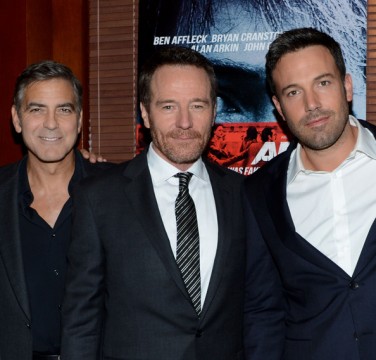
To be honest, I came up with this idea before I actually saw Argo on Tuesday night, but now that I have seen Ben Affleck’ s gripping, well-directed film, I can’t let it go. When I learned about the plot of the movie — in which a CIA agent (Affleck), a Hollywood make-up artist ( John Goodman ) and a movie producer (the wonderful Alan Arkin ) — gin up a fake movie to rescue a group of diplomats trapped in Iran during the hostage crisis — it struck me that Argo was the inverse or the flip side of another fake movie that got a lot of press this past summer: Innocence of Muslims . Argo is about the power of film harnessed for humane reasons — specifically, to extract American diplomats who would have probably faced grisly, public executions had they been caught after slipping out of the U.S. Embassy in Tehran when it was taken over by militants in 1979. Innocence of Muslims is about the dark side of that equation. It’s the power of film — still potent even when the so-called movie is little more than a collection of half-assed scenes cobbled together and thrown on YouTube — misused to incite violence and stoke mistrust and anger between Muslim nations and the United States. Argo , which is based on a true story, is about saving lives. Innocence of Muslims was linked to violent attacks on the U.S. Embassy in Libya on Sept. 11 that left four Americans dead, including Ambassador J. Christopher Stevens. When I saw George Clooney, who is one of Argo ‘s producers, at a private screening and dinner for the film at the Time Warner Center on Tuesday night, I ran my idea by him. Was there any lesson, I asked, to be learned from the controversy and the tragedy that Innocence of Muslims provoked? I’m not a big fan of asking celebrities their opinions about international or national affairs, but I’ve come to admire Clooney’s political activism and his understanding of the way the world really works, as well as his humanitarian spirit. (In March, he was arrested outside the Sudanese embassy in Washington for protesting the country’s blockage of food and aid to its own starving people.) After listening to my take on Argo and Innocence of Muslims , Clooney suggested that I was making a bit of a leap, but he did answer my question. For one thing, he said, “I’m not quite sure that those diplomats did die as a result of that movie. It seems more like that was a coordinated effort by Al Qaeda” to make a statement on the anniversary of the Sept. 11, 2001 attacks on U.S. soil. But getting to the root of my question, Clooney told me: “Freedom of speech means you have to allow idiots to speak, and that’s the unfortunate thing.” “This guy clearly wanted to create problems,” he continued referring to Nakoula Basseley , the Egyptian immigrant who appears to have masterminded the making of Innocence of Muslims . Clooney added that he saw part of the YouTube video: “It made me mad and I’m not Muslim,” he said. “It made me mad for the quality of film that it was, more than anything. But the simple truth is that in order to make [democracy] work, the idiots get to have their say, too. And that’s unfortunate.” I agree. What do you think? Please let me know in the comments section below. Follow Frank DiGiacomo on Twitter. Follow Movieline on Twitter.
Mary Elizabeth Winstead needed to prove herself. After years of hopping from genre to genre, she wanted to shed her Scott Pilgrim vs. the World dye job and bloody Final Destination 3 history and find a complex role that would be a game-changer for her career. Luckily, the stars aligned and landed her in front of Smashed director James Ponsoldt, where she not only impressed him enough that he didn’t audition anyone else for the role, but she also helped him cast her leading man, Aaron Paul . Mary Elizabeth sat down with Movieline ahead of the film’s Oct. 12 release to talk about crafting her recovering alcoholic character, Kate Hannah, preparing for the role without meeting anyone first — except for one wild night with Aaron — and sharing her modest, yet poignant, reaction to all of the well-deserved Oscar buzz. And as for all of those big blockbuster roles she’s been “passed over for” throughout the years? She spills about that, too, opening up about the truth behind failed negotiations and what she wants her career path to look like after Smashed . Smashed is a departure from your previous roles, including comedies like Scott Pilgrim and bloody gore like Final Destination 3 . Was it refreshing to play such a dynamic, dramatic character? Yeah, I mean it was such a change of pace. It was almost like changing careers because it was so different. It was great, and it was what I’ve wanted to do for a long time. I’ve needed to sort of prove myself in this capacity for a long time — I needed to show, at least to myself, that I could carry a really complex role, so I knew that I needed to do it for me. The fact that people are actually responding to it is sort of above and beyond what I even was hoping for. How did this role come to you? Did James [Ponsoldt] say, ‘Hey, I want you for this role?’ or did you audition? I had been seeking out smaller scripts. I had been really trying to find something small and intimate, so I had a meeting with Jonathan Schwartz, who is the producer of the film. I didn’t know what he was producing at the time, but I just wanted to meet him because I knew that he had some scripts in the pipeline. After he sent me this script, I just flipped out over it and called him immediately and was just like, ‘Please let me know what I can do to just get my foot in the door and be considered for it!’ So then he set up a meeting with me and James, which went really well. After that, I just sort of took it upon myself to do an audition tape; I taped probably like seven, eight scenes from the movie and sent it to James. And after he and the producers talked it over, they cast me, which was crazy! I expected them to sort of see every actress in Hollywood and go through that whole process, but they didn’t. They didn’t see anyone else. And so it was really, really, amazing. It’s hard to imagine anyone else but you in the role — you embodied Kate to a T. How did you prepare? Is there anything you did in the audition tape that made it into the film? Luckily whatever I did in the audition tape was enough to get me the part, but from my perspective, in retrospect, I feel like it’s terrible! [Laughs] I did so much more work on the character by the time I actually shot it that to me it’s like night and day. When I look at that audition tape, I feel like I’m acting , and I feel like I was able to get to a place by the time I shot the film where it wasn’t acting anymore. I was sort of scared, even after I did the audition tape and got the part, because I still didn’t feel like I had a handle on it at all. So it was scary to me almost to get the part because I was like, ‘Ooh, but I don’t know how to play this!’ So I worked really hard. I really wanted to make sure I did the part justice, and I did whatever I could. I spent a lot of time in AA meetings, I spent a lot of time with James just really carving out Kate’s backstory and becoming really, really specific about that. And just spending a lot of time on myself and my own issues emotionally. It was a lot like, just, therapy. Working through my own stuff. That ended up being the most important thing, the thing that connected me the most to the character — sort of relating my struggles to her struggles and my issues to her issues, and sort of linking those two things up. It was an amazing experience. Is there anything from Kate’s backstory that we didn’t see that you worked together with James on? We talked about her entire life. There are hints at it throughout the film — you see her relationship with her mom, you know there’s probably a lot of pain there, especially childhood pain. And so we fleshed that out quite a bit with her dad leaving and what age, what age did she start drinking and why, and what age did it become her identity to be the fun drunk girl, and how that became so much easier to be than to be herself. How it became easier to be the drunk girl than to be the girl with all of these problems. So that was the thing that we really focused in on. You said you went to some AA meetings to prepare. Was there anything else that you did? I’m sure you didn’t go on any drinking binges to get into your character… Yeah, I went on one! I went on one with James and Aaron! [Laughs] I hope you weren’t on a bike. No, not on a bike. James was our designated driver. And it was in part to get into character, but it was mostly for us to feel the dynamic with each other — what we’re like when we’re drunk. Because the couple is like that so much; it’s how they spend their lives together, is drunk. So we wanted to kind of start off with that. And also it helped because Aaron and I didn’t have any rehearsal time. We had only met each other once before. It was a good way for us to get to know each other really fast. You know, when you sort of go out and get drunk with someone, you become close pretty quickly. [Laughs] It was a nice way to sort of expedite that process. And by the time we showed up [on set], we felt close enough to be able to go to those places together. Was Aaron cast before you or after you? After me. Everyone was cast after me. It was like a total shock. It was so crazy. I had no idea that the supporting roles were going to end up being these incredible actors. I mean, that really took it to a whole new level. I knew it was an incredible script, I knew it was an incredible part I was dying to play, but I sort of thought it was a tiny movie, that it was probably going to be all unknowns, and we were kind of just going to try to get people to see it and do our best. And then when they started telling me who was going to be playing the other roles, I was like, ‘Oh, people are going to see this! This is a real movie! This is really happening!’ [Laughs] So, yeah, that was incredibly exciting. And you mentioned that you and Aaron had only met once or twice before. Did you do a chemistry read together or did you meet at all? No. I kind of knew that Aaron was everybody’s favorite. He was my favorite, he was everybody’s favorite. [Laughs] We had talked about a lot of people for that part, but he was the only one that everyone agreed on. We’d come up with other names, but it would be very polarizing. Like, one person would be like, ‘That person would be great!’ and another person would be like, ‘No! Definitely not!’ [Laughs] But Aaron was the first name that came up that everyone went, ‘Yeah! That would be great.’ I still wanted to meet him, just because I didn’t know him personally. I knew he was an incredible actor and I had such admiration for him, but I also knew that I needed to work with somebody in that role who was going to be really open and who was going to be someone I felt comfortable with, because you have to go to a lot of humiliating places doing a role like this. You don’t want it to be someone who you feel like is going to be closed off or is going to be too cool to really give anything back. From the moment I met him, he was so open and warm and genuine and lovely, and just the sweetest person. And now I feel like everybody else knows that he’s the sweetest person in the world, but I’m like, how didn’t I already know that? [Laughs] I shouldn’t have even had to have met him to find that out. But it was great, and after I met him, I sort of told everybody that he was perfect, and then he came back. Honestly, your chemistry reads like you’ve known each other for years. Although their love story is far from perfect, If you take the alcohol out, could you see their relationship continuing? For me, having learned a lot about alcoholism and AA from researching the character, I’m very much of the feeling that they can never be together, as heartbreaking as that is. Just because no matter what they have that co-dependency that they’re naturally going to want to fall back into. And it would be such a struggle for them to have a normal, healthy relationship that it would make them both really tempted to go back to alcohol. And I think as an alcoholic, you have to really keep yourself in the most healthy of environments at all times. So I think for her it would just be a mistake to put herself back into that really unstable place. But I do love the fact that the end is so hopeful for him; that he is going to figure his life out. And that one day, I do think that they could be really great friends. I think there’s a lot of love there and they will be able to be in each other’s lives, but I don’t see them ever being a couple. The craziest part for me was that you don’t really see how damaged Kate’s life is until she really hits that downward spiral. That’s the thing. It certainly isn’t a message movie by any means, but we are kind of making a point that even if you stop drinking, it doesn’t mean your life suddenly becomes easier — it actually becomes harder in a lot of ways because you have to deal with your pain. It’s better, but it’s hard. It felt like a very realistic portrayal of alcoholism, especially with Kate’s two split personalities. How did you balance the dynamic of both opposing sides of her persona? What’s great about it is that it just felt like, for the first time to me, that I was playing a really whole person. Because we all have so many different sides to our personalities, but you just never see that on screen. I think that’s why it’s so surprising that it feels so different, because we’re not used to seeing people on screen show so many different sides of themselves — we’re not usually really allowed to since characters are usually more one-dimensional. So I loved that; I loved being able to do that. I felt like I was able to bring all the different shades of my own personality to her, and there was nothing that I had to shut off. Your chemistry with the entire cast — including Nick Offerman’s offbeat character, Megan Mullally as your boss, and Octavia Spencer as your sponsor — was incredible. How did you form that dynamic? I think it was just luck, and James casting the right people. We didn’t have any rehearsal time — we didn’t even meet! Aaron was the only person I even met before we started working. Did you all even do a read through together or did you just jump into it? No, we just showed up and just did the scenes! It was just one of those lightning in a bottle things where everything just comes together and everyone was so wonderful. We were very lucky. The most surprising part was that most of the cast were comedic actors playing straight. What was that like, both in and out of character? It was just really lovely. It was such an amazing group of people who are all just lovely human beings. They’re all super funny, but not in that way that they have to constantly be telling a joke or constantly getting attention — not in that way at all. Just lovely people to be around. So it was a comfortable, relaxed environment, and it was sort of like the film. We would go from laughing together to talking about more serious things. We just felt like a family. It just felt like a place that you could really be yourself, which was the ideal environment for a film like this. Now that you’ve done such a big drama, what’s next? Rom-com? Adventure? I know you’ve seemingly been passed over for some of those big blockbuster roles, including Cobie Smulders’ role in The Avengers . But if you took that role, do you think you would be where you are now? And do you have any hopes to be that big blockbuster star? Yeah, I mean, it’s funny, because some of those roles — well, the majority of them, I was just plain passed over for them [Laughs] — but some of them I actually chose not to do as well because I don’t really just want to be the blockbuster star, and I don’t necessarily want to sign onto seven films in a role that I’m not really passionate about. That’s actually happened several times as well, where in the news it sort of seems like, ‘Oh, she lost the part,’ but in reality, it just falls apart in the negotiation process and you realize that this isn’t really something I’m passionate enough about to agree to ‘X, X, and X,’ and sign the contract on. [Laughs] So that’s happened a bunch, too. Because I do really want to do films like this. That’s the majority of stuff I want to do. But unfortunately, you don’t get paid to do films like this! [Laughs] You get enough to go to a nice dinner. That’s basically the money that you get paid. So you do have to think about your career and making a living and how you’re going to do that. Going forward, I would love to work with directors like Rian Johnson and Joss Whedon; people like that who are doing big films but do have really independent voices. That’s kind of what I want to focus on, is always working with people with at least an independent point of view, even if it’s not an independent film. Well, on that note, congratulations! For this film, you already have a lot of Oscar buzz. What, in the perfect situation, would you like to happen next whether you win an award or not? I think for most actors, because we sort of have to tell ourselves this, we always say, ‘Oh, it doesn’t mean anything to win an Oscar!’ It certainly isn’t a goal that you want to set yourself up for, because then you’re just setting yourself up for disaster. Because how many people actually win an Oscar? So I would certainly never imagine that for myself, but the thing about those kind of awards are that they are completely life-changing. You’re given a power that so few other people in the industry have. And so that’s the thing, that I would sort of just want to use … for good! [Laughs] I sound like a superhero. But to help make good movies. I would love to be in the position where my name is a name that is large enough in some capacity to make things happen in the industry. To be able to fund a small film or be able to discover a new voice and give them a platform. That’s something I would really love to to do. Smashed hits limited theaters in New York and Los Angeles on Oct. 12. Alyse Whitney is an editor at Wetpaint Entertainment. You can follow her on Twitter @AlyseWhitney .
Paul Schrader and Bret Easton Ellis ‘s indie L.A. noir The Canyons has been a curious project to track — who’s the more random star, comeback queen Lindsay Lohan or porn stud James Deen? — but a new teaser trailer offers an unexpectedly compelling preview of the film, retro-exploitation style. The tongue-in-cheek spirit works well here, even if it does make The Canyons look like one of Tarantino and Rodriguez’s fake Grindhouse trailers. Here’s hoping the actual film has this sort of knowing edge. With teaser lines introducing “a HUGE new talent” in Deen it has to, right? It is worth noting that this trailer offers no dialogue; Deen’s screen presence, shall we say, has been proven in his chosen field but his acting chops here have yet to be seen. Side note: I once overheard strangers talking excitedly about seeing Deen in this movie while waiting in line at a semi-terrible L.A. club, so The Canyons ‘ social media outreach must be working. On Facebook last week director Schrader shared an update after screening The Canyons for Lohan : “Showed LL the film tonight. She saw and she understood. What a wonderful moment for her. Some tears, some hard words, some kisses but that’s life in Lindsayland. Sometimes the movie gods smile. Sometimes you get lucky. LL and I got lucky.” Synopsis (via The Canyons on Facebook): THE CANYONS is a contemporary L.A. noir from director Paul Schrader, writer Bret Easton Ellis, and producer Braxton Pope about the dangers of sexual obsession and ambition, both personally and professionally, among a group of young people in their 20’s and how one chance meeting connected to the past unravels all of their lives, resulting in deceit, paranoia, cruel mind games and ultimately violence. [ The Canyons via The Playlist ] Follow Jen Yamato on Twitter . Follow Movieline on Twitter .
Taken 2 exploded in its opening with $50 million and a spectacular per screen average of $13,657 in wide release. The film had one of the biggest October openings ever, showing momentum that should propel it in the coming weeks. Last weekend’s box office topper, Hotel Transylvania , held strong in its second weekend, landing second in the box office ranking. Frankenweenie , meanwhile, failed to appeal to large numbers of theater-goers, only placing fifth on the box office chart in a wide open. 1. Taken 2 Gross: $50 million Screens: 3,661 (PSA: $13,657) Week: 1 Taken 2 dominated the weekend with one of October’s best openings in box office history. By contrast, the first Taken cashed in at $24.71 million in 2009 when it opened in 3,183 theaters. Not bad, and the performance helped propel the overall box office to another stellar weekend after six weeks in the doldrums, which ended last weekend spearheaded by Hotel Transylvania and Looper . Estimates had Taken 2 coming in around the mid-30 million range, but it far exceeded that low-ball figure. Taken 2 ‘s stellar result is outpaced by Paranormal Activity 3 , which took in just over $52.56 million on October 21, 2011. 2. Hotel Transylvania (3-D, animation) Gross: $26.3 million (Cume: $75,958,532) Screens: 3,352 (PSA: $7,846) Week: 2 (Change: – 38%) Last weekend’s top earner held strong in its second weekend with a decline of only about 36 – 38 per cent according to estimates. The Sony animation title added just three additional screens for its second round and its nearly $76 million cume means the title will easily match its estimated $85 million budget this week. 3. Pitch Perfect Gross: $14,736,400 (Cume: $21,582,608) Screens: 2,770 (PSA: $5,320) Week: 2 (Change: +186%) The title added 2,435 screens in its second weekend and the result was a move up the box office chart to third from its first frame at number six last week and a 186 per cent jump in revenue. Bring It On ($17.4 million) and Footloose , which opened one year ago at nearly $15.6 million suprassed Pitch Perfect . But its domestic total already surpasses its estimated $17 million production budget and it should make it to $50 million domestically. 4. Looper Gross: $12.2 million (Cume $40,300,651) Screens: 2,993 (PSA: $4,076) Week: 2 (Change: – 41%) Last week’s strong number 2 opener hell to fourth place with a 41 per cent drop in its box office after adding one more location. The title has already more than matched its $30 million production budget and will likely see northward of $70 – 80 million before it’s all said and done. 5. Frankenweenie Gross: $11.5 million Screens: 3,005 (PSA: $3,827) Week: 1 Ouch! Tim Burton’s latest stop motion pic has not caught audience attention the lead up and marketing campaigns might have suggested. His previous stop motion pic, Corpse Bride opened in much more limited release, so comparisons are a bit difficult. But that title bowed in only 5 theaters with a $77,633 average, but it went on to a $53,359,111 domestic cume in 2005 and $19.1 million in its initial wide expansion. 6. End of Watch Gross: $4 million (Cume: $32,845,946) Screens: 2,370 (PSA: $2,370) Week: 3 (Change: – 48%) The Jake Gyllenhaal and Michael Pena cop drama tumbled 48% after losing 410 theaters in its third weekend. Still, the film has done very well considering its $7 million budget, though it may struggle to reach $50 million. 7. Trouble With the Curve Gross: $3,870,000 (Cume: $29,709,823) Screens: 3,003 (PSA: $1,289) Week: 3 (Change: – 46%) Last week’s fourth placed film landed at 7th in its third round. It’s per screen average also tumbled from last week’s $2,320 even as the title shed 209 theaters. 8. House at the End of the Street Gross: $3,698,000 (Cume: $27,531,144) Screens: 2,720 (PSA: $1,360) Week: 3 (Change: – 48%) House at the End of the Street ranked fifth in its second frame last week and placed 8th over the weekend after it lost 363 theaters vs one week previously. Its cume should top $30 million in the next week, tripling the thriller’s production budget. 9. The Master Gross: $1.84 million (Cume: $12,315,329) Screens: 864 (PSA: $2,130) Week: 4 (Change: – 31%) The big Oscar contender added only 8 theaters over last week following its huge theater jump two weeks ago. When it opened with a massive $147,262 per screen average in the second weekend of September following its Venice and Toronto premieres it seemed the sky was the limit, though it appears to have arrived more or less back to earth. 10. Finding Nemo (3-D, animation) Gross: $1,555,000 (Cume: $38,969,000) Screens: 1,746 (PSA: $890) Week: 4 (Change: -61%) Likely the final stand of the re-release’s life in the top 10. The second round of Finding Nemo will be hard pressed to reach half the $94 million cume that The Lion King re-release last year. [ Sources: Rentrak , Box Office Mojo ]
Also in Monday morning’s round-up of news briefs: Bradley Cooper is to receive a Hollywood award. CNN is launching a unit for documentary distribution and The Paperboy scores in the specialty box office over the weekend. Osama Bin Laden Raid Film Seal Team Six To Air 48 Hours Before Election Seal Team Six: The Raid on Osama Bin Laden is the first high-profile dramatisation of the attack on the al-Qaida leader’s Pakistan hide-out. The incident, in May 2011, was widely regarded as a coup for the Obama administration, following former President Bush’s failed seven-year attempt to catch Bin Laden “dead or alive.” Produced by the Weinstein Company, the film will be broadcast on the National Geographic Channel on Sunday November 4th, The Guardian reports . Christian Bale Returns to David O. Russell FBI and Con Artists Film David O. Russell took over the project that was at first titled American Bullshit from Ben Affleck. Bradley Cooper and Christian Bale were attached to star, but then Jeremy Renner signed on to replace Bale and Amy Adams joined the cast. But now Bale is back and the project is untitled. It is based on a true story about an infamous con artist (Bale) and his partner/love interest (Adams) who are working with a federal agent (Cooper) to take on dirty politicians and mobsters, Vulture reports . Bradley Cooper to Receive Hollywood Film Awards Honors Cooper will be feted by the awards for his role in David O. Russell’s Silver Linings Playbook . He will receive the “Hollywood Actor Award” at the 16th annual Hollywood Film Awards at its gala taking place October 22nd, THR reports . CNN Launches Unit to Acquire Documentary Films for Theaters and Television CNN Films will secure feature-length documentaries to air on CNN and CNN International as well as for theatrical distribution. The move is part of a wider strategy to acquire original non-fiction content to complement CNN’s news programs. Girl Rising , a film which inspired a global action campaign to promote girls’ education, will air in spring 2013, Deadline reports . Specialty Box Office: Paperboy Strong in Debut; House I Live In , Wuthering Heights , The Oranges Fair Lee Daniels’ The Paperboy lead the pack of specialty newcomers with a solid $110,033 at 11 locations and an average of $10,003. That gives the Oscar-nominated director a respectable first showing for his follow-up to his lauded 2009 film Precious, although it falls short of spectacular. Even so, it bested the weekend’s other new titles in limited release. Only Abramorama’s House I Live In came close with a $9,827 average in 2 theaters, Deadline reports .
An invitation-only crowd at the Hamptons International Film Festival got schooled on”The Secrets of Schamus” — that’s Focus Features CEO James Schamus — by his former producing partner Ted Hope on Friday night. Schamus, whose career includes screenwriting credits for The Ice Storm and an Oscar nomination as producer of Ang Lee’s Brokeback Mountain , was the recipient of the festival’s Industry Toast at East Hampton Point. For A Good Time Call actress Ari Graynor emceed the event, which included toasts by Sony Pictures Classics Co-President Michael Barker and producer Christine Vachon and videotaped remarks from actor Gary Oldman , who got his first Oscar nomination starring in Focus Features’ 2011 film Tinker Tailor Soldier Spy. “He is a collaborator: an artist with his head in artists’ clouds and a business man with his business feet firmly in the box office,” Oldman said of Schamus before getting big laughs by poking gentle fun at the Focus exec’s mystique as a professorial indie-film rainmaker. (He’s not just a studio executive, he’s a Professor of Professional Practice in Columbia University’s School of the Arts.) “Did you know that he has won trophies for merely thinking?” said Oldman, adding: “He’s the only man ever to ace a Rorschach Test….Whenever he goes for a swim, dolphins appear….If he were to mail a letter without postage, it would get there.” Hope, who was honored with the festival’s Industry Toast in 2006, followed with a wry — and lengthy — recollection of his years spent working with Schamus at their seminal indie production company Good Machine. Under the guise of revealing the business “Secrets of Schamus” — which included “manufacture desire” and “make them want to pick up your phone call” — he amused the crowd with tales of how his bespectacled, bow-tie-wearing partner repeatedly managed to outshine him. “I’ve been a little competitive with James,” Hope said. “It’s hard to keep up with all those accolades.” The newly minted executive director of the San Francisco Film Society recalled how when they were bringing Nicole Holofcener’s Walking and Talking to the Sundance Film Festival in 1996, Schamus convinced him to put the $17,000 cost of a private plane flight on his credit card after their eleventh-hour commercial flight to Utah was grounded. According to Hope, when they learned that the private plane could not accomodate all of their fellow travelers, Schamus stayed behind, leaving his partner to pull an all-nighter in Sundance in order to sell the film to then-Miramax chief Harvey Weinstein. The morning after the sale, Hope said, “I pick up the paper and see that James Schamus had sold the film to Harvey Weinstein.” Hope concluded his remarks by telling the crowd that when he got his business cards from the San Francisco Film Society, they read: “former partner of James Schamus.” Follow Frank DiGiacomo on Twitter. Follow Movieline on Twitter.
If President Obama didn’t exactly dominate Mitt Romney during their debate on Wednesday night, he got a nice subliminal boost courtesy of Steven Spielberg and Daniel Day-Lewis. Following the political wrestling match, Disney ran an extended TV spot for Lincoln that finally justified all of the early Oscar talk the film has generated and and not-so-subtly established Lincoln and Obama as kindred spirits. After a series of emotionally charged scenes that depict Lincoln, played by Day-Lewis, grappling with Civil War (depicted in Saving Private Ryan -style brutality) and the politically unpopular idea of abolishing slavery, the clip closes with the two-time Oscar winner declaring, “I am the President of the United States of America…clothed in immense power!” That rousing movie moment called to mind a slightly less riveting one: President Obama’s speech at the Democratic National Convention in early September in which he said, “Times have changed, and so have I. I’m no longer just a candidate. I’m the President.” The line got plenty of media pick-up and, as the New Yorker reported , evoked a scene from the Aaron Sorkin-scripted 1995 film The American President . In the movie, Michael Douglas, who plays besieged president Andrew Shepherd, addresses attacks from a political challenger by saying: “If you want to talk about character and American values, fine. Just tell me where and when, and I’ll show up. This is a time for serious people….My name is Andrew Shepherd, and I am the President. Sorkin’s line is cool, but the one delivered by Day-Lewis, which was written by Angels in America playwright Tony Kushner carries more force. And I much prefer the idea — purely of my own imagining — that Obama had advance intelligence about the highly anticipated Lincoln movie and script and was able to use it to his political advantage. How’s that for a Left-wing Hollywood conspiracy theory? Take a look at the spot below and tell me what you think. Follow Frank DiGiacomo on Twitter. Follow Movieline on Twitter.
Indie auteur Joe Swanberg has established himself as the reigning poster child of mumblecore, for better or worse , but as the most surprising filmmaker contributing to the Sundance hit horror anthology V/H/S (in theaters Friday) he begins branching out of his comfort zone with a newfound energy; his entry, The Sick Thing That Happened To Emily When She Was Younger , was filmed using Skype — and a script! — and is also one of the more memorable and inventive shorts in the midnight crowd-pleasing omnibus. Between his V/H/S segments (he also acts in Ti West ‘s road trip gone horribly wrong) and the forthcoming Drinking Buddies , which blends his improvisational style and mainstream stars Anna Kendrick and Olivia Wilde, Swanberg says he sees 2012 as a turning point in his creative evolution. “I feel like I’m ready to be a filmmaker,” he declared to Movieline. Read on for more with Swanberg on how he and West accomplished a lot with very little for V/H/S , why acting in Adam Wingard’s Your Next reinvigorated him as a director, and how his Drinking Buddies stars took to the Swanberg method. You’re involved in two of the segments that most scared me, so well done. How did you first get recruited for V/H/S as a director and as an actor in Ti West’s short? I might venture to say that you out of the entire slate of filmmakers are not so much, or at all, thought of as a horror filmmaker. I would agree! One of the cool things about V/H/S is I think it’s one of the first times it’s actually visible how interconnected the independent film world is, and how easily it crosses genres. I think there was a perception for a long time of mumblecore being this very inclusive little group of [Andrew] Bujalski or Aaron Katz and the Duplasses and I or something, and that the horror world did its own thing and the documentary world did its own thing. But all of us have been friends for a really long time and we just make different kinds of movies. I think Simon Barrett and Adam Wingard went to bat for me as a director for V/H/S , and it helped that [producer] Roxanne Benjamin had seen some of my other films. But I acted in Ti [West]’s first, so that was my first involvement in the project. He shot his in May and I didn’t shoot mine until August, so it was a while where I feel like Adam and Simon were lobbying for me to get the chance to do one of these. Simon wrote your segment, which makes your V/H/S segment the first time you’ve directed something you haven’t written yourself. Not only is it the first time that I’ve directed something I haven’t written, it’s also the first time that I’ve directed something that was scripted. My own films are all improvised. So it was really fun for me to play with somebody else’s material. And Simon wrote it knowing that I was going to direct it and I think he expected that I would just throw the script away once we started, but I actually really loved his script and thought it was a good first chance to go ahead and do that. Your segment uses a Skype chat as its set up for tension; we watch as Emily (Helen Rodgers, pictured with Swanberg above) experiences something strange as she chats online with her boyfriend. How did you fake it, or did you? For V/H/S we actually just used Skype, we didn’t fake it. I did a bunch of research into the best way to fake it and I realized the best way was not to fake it. We were going to build this crazy, elaborate rig with multiple cameras that were connected to each other, and the more I looked at it and researched screen capture stuff I realized we could do high definition screen capturing and actually record live Skype conversations. So it’s a film made without a camera – laptops were our cameras. But you used lighting rigs and such? Adam Wingard DPed my segment and I wouldn’t describe it as a typical lighting set-up but it was modified for our purposes. Adam was usually moving with Helen – the other funny thing is because it’s a real Skype conversation, Helen was the camera operator, essentially. She not only had to act, she was in charge of what was seen and what wasn’t seen. So we had to do pretty elaborate choreography about where and when to turn the computer, when to set it on the bed, all these sorts of things, and Adam was usually following her off-camera with lights. The computer gives off a decent glow so we had some light motivated by the computer but we also had back-up lights, and the cool effect of that is, because it’s a real Skype conversation, one of the reasons we decided it had to be real Skype was that every time it gets bright on Helen’s screen you actually see that reflected on Daniel’s screen. If it wasn’t a real Skype conversation it’d be really difficult to get those lighting rigs set up right, but it’s fun to watch and it adds to the realism because when Helen turns on a light on, Daniel’s room brightens as well. It felt almost like directing dance. And we ended up editing after the fact but most of the takes are long, unbroken, four or five minute takes involving starting in the bedroom and going out to the living room, or weaving around the kitchen, so we had to light and choreograph these long 360 set-ups. That’s pretty fantastic a feat to pull off. In Ti’s segment you acted and also operated the camera, home video-style. It’s cool to see performers having to innovate and actually work with the technology, whether in laptop or camcorder form. One of the cool things about this project was the chance to do that. I’ve used Skype before in Young American Bodies , the webseries I do – we recorded a few scenes in that which were like Skype conversations – but outside of that it becomes really gimmicky if you were to do a whole feature film based around Skype or iChat. That becomes the thing. And one of the great opportunities of VHS is I feel like all the directors were liberated to play around with ideas that might not hold up for a feature running time but that work as shorts. The Skype thing was really fun when I realized that people only have to watch it for 20 minutes, and not for an hour and a half. Well, now Paranormal Activity 4 is running with the Skype thing. I’m not saying they copied you, but yours did come first… [Laughs] I know those guys, and I doubt that they’ve seen V/H/S . It’s unlikely that it influenced them. I don’t know when they shot that movie… In Ti’s segment, what did you actually shoot on and how difficult was it to be mindful of your performance and operating the camera at the same time? I forget the model of the camera we used but it was a little handheld portable – Ti did a bunch of research on cameras. We needed one with a light, because some of the real scary things about Ti’s are when the light switches on in the hotel room from the camera. As an actor it was a fun challenge to have to be mindful of that stuff, and it’s helpful in a way because one of the difficult things about acting especially when the goal is naturalism or realism is to not overthink it. You have to just be in a situation and react. So having the camera and having something to do with my hands that was occupying my brain I think made it easier for me performance wise to react to Sophia [Takal] and be in those scenes. It’s a much different experience than having a crew and a camera pointed at my face feeling like, ‘Okay, here’s the big moment – now act natural,’ with 30 people watching and we only get to do it two times so get it right. Both you and Ti seemed to pull off these segments using so few resources. These must be two of the most affordable short films ever made. Yeah, especially going to Sundance with V/H/S was really crazy – Ti’s and my segments were not the most effects-heavy of the bunch. The Radio Silence one at the end has a lot of really amazing visual effects, and David Bruckner’s, they built that monster creature and Glenn McQuaid’s has that video killer. Ours have pretty much practical effects. But all of them were really affordable. Even the super effects-heavy ones were made on moderate budgets, so it was great to go to Sundance and have the movie feel big despite the fact that it’s a low budget movie. In your career so far you’ve made so many films in such a short time – you’re one of the busiest filmmakers around, especially since you’re not only directing movies, you’re also acting in other people’s films. How do you feel like 2012 Joe Swanberg is most changed from 2005 Joe Swanberg? Starting with going to Sundance with V/H/S , I’m having the time of my life in 2012. It’s been the best, most fun year of my life as a filmmaker and it’s because I feel like I’m doing so much outside of what I’m typically known for. All the movies that I made in 2010 and 2011 when I was hyper-productive, that was sort of my last big push almost as a student; I was making a lot of work in an effort to keep getting better as a filmmaker and keep pushing myself to try things I hadn’t done before. Now I feel like with V/H/S and Drinking Buddies , which I just finished and stars Olivia Wilde and Anna Kendrick and Jake Johnson and Ron Livingston – it’s a much bigger production than I’ve done before – I feel like I’m ready to… be a filmmaker. I’m embracing being a director and what that means. Obviously I’ll be practicing and learning my whole life, but I feel like the kind of workmanlike attitude I’ve had the last couple of years is paying off now in the sense that I’m getting to put that practice into bigger productions that are being seen by more people. Do you feel like this evolution is marked in your process, or your creative choices? It’s in both, actually. A big turning point for me came when I was acting in You’re Next , Adam and Simon’s movie. Getting to be on the set of not a big budget movie, but one much bigger than the ones I make, and seeing Adam, who I’ve worked with really closely on $10,000 movies directing a much bigger movie with a full-sized crew and 20 actors and all these elaborate action sequences, I realized I’m interested in challenging and pushing myself. I don’t just want to shoot conversations in apartments. It would behoove me as a filmmaker, I realized, to know how to do that other stuff. Even if I never make an action movie it would be useful as a director to know how to shoot an action sequence. So I came away from that acting experience feeling energized as a director, to try new things. And V/H/S was the first thing I did. After that I went with an attitude of, like, cool – here’s an opportunity for me to do something I’ve never done before and to really mess it up. Not take the easy route. Figure out how to do this camera work and figure out how to do special effects and really make something that’s going to push me out of my comfort zone. And did that extend to Drinking Buddies ? The same was true with Drinking Buddies , which was still improvised but improvised on a much bigger level, with a full crew that I had to learn to work with. I basically took the process that I normally use with three actors and two crew and do it with 20 actors and a 40-person crew. I’m looking for those challenges now. I’m looking to broaden my spectrum a bit. Drinking Buddies is your biggest movie to date, and it features mainstream actors – how did they adjust to your process? You’ve practically established your own indie subgenre working in a specific style and with regular collaborators. When you were casting did you find that many mainstream actors fell into step with your sensibilities? I went into the casting with the same attitude that I’ve used to cast all of my movies with my friends, which is, who are these people? Are they easy to talk to? Do they have interesting lives and things they’re interested in outside of acting that we can use in the movie? Are they fun to be around? It really was almost the identical process, and the result was I ended up with more people who I love and who gave amazing performances and who are totally ready to show up and figure it out every day. It’s possible they were intimidated by the situation but they never let on. They were really excited to collaborate with me and create these characters. I’m deep into editing right now, and the performances are amazing. Everybody’s going to look at these actors in a new way because of this movie – they’re all really alive in an exciting way. So it’s given me confidence to keep doing this and to feel like I can work with bigger name actors, and that the process isn’t antithetical to the kind of work I’ve been doing in the past or that they’ve been doing. What did you learn about Anna and Jake and Olivia that you then integrated into their characters? All of them, the way that I like to work is that everybody is kind of playing a version of themselves. I write characters and create a very simple set-up, and with the actors I flesh it out. There’s not one specific thing I could point to other than to say when you watch this movie you’ll be watching a really interesting hybrid of my ideas that I came into the movie with and their personalities that they brought to it. There’s a lot of acting happening, and there’s a lot of real stories being told. As is always the goal, I feel like I came out of the film feeling these people were my friends and not just actors I hired for a movie. We all learned a lot about each other during the shoot because that’s how the process works. The more everybody shares, the better the movie is and also the easier it is to create these relationships that don’t actually exist in real life. Side note: I noticed that when you announced your cast for Drinking Buddies you earned a mention on Perez Hilton. Was that the moment when you realized you’d made it in Hollywood? I actually wasn’t aware of that! One of the things about making movies that people started to watch and write about is that they also write mean things a lot of the time. [Laughs] I’ve been pretty disconnected for the past couple of years from any of the press stuff surrounding the movies, so I typically hear about it via friends. I certainly never go looking for it anymore. But now I know! V/H/S is in select theaters Friday. Follow Jen Yamato on Twitter . Follow Movieline on Twitter .
Not afraid to show off his political side, Ben Affleck is giving his take on the current U.S. Presidential campaign. Hitting the road promoting his political thriller Argo , the director and star of the film compared Republican nominee to past hopefuls who did not make it to the White House. A past ardent supporter of liberal causes and a full-fledged Obama fan four years ago, Affleck only offered tepid support for the incumbent. “I think Republicans really had a chance to win,” Affleck told A.P. during an interview about Argo . And they kind of ended up with like a sort of Mike Dukakis, Al Gore, Bob Dole type – who just couldn’t get people to see him as a real person somehow. Romney just had such trouble coming off as just like the kind of person you see at the grocery store. And I truly believe that has cost him the election.” Affleck went on to add that it looks “quite unlikely” that the Republican hopeful will unseat Obama, saying “negative momentum” can at some point cause a downward spiral for a campaign. “You start making mistakes and then all your advisers tell you, ‘You’ve got to raise your arms more!’ ‘You’ve got to talk deeper.’ So people just get into becoming robotic.” Still, if Affleck shares the same enthusiasm for Obama as in the first go-around, he is clearly holding back, saying that with hindsight his opinions have changed. “”I voted for Obama last time although he got to be all things to all people then,” Affleck said. ”And now he’s got a record which makes it really different … I obviously have more complicated feelings.” Affleck has often thrown his hat in the political sphere, doing lobbying in Washington and traveling abroad for various causes. He’s also said he wouldn’t rule out a future run for an elected office in the future. And his latest film, which debuted last month at the Toronto International Film Festival has already prompted talk of possibly multiple Oscar nominations. The film recalls an international crisis that many attribute for the failed re-election bid of Jimmy Carter in 1980, ushering in the Reagan era. Directed and starring Affleck, along with Bryan Cranston, Alan Arkin and John Goodman, Argo is set as militants take over the U.S. embassy in Tehran in the aftermath of the 1979 Iranian Revolution. While 52 Americans are held, six others escape and hide in the Canadian ambassador’s residence. The film recalls a plan hatched by the C.I.A. and specialist Tony Mendez (played by Affleck) to help the six to escape Iran. [ Source: Associated Press ]
The good news: Jay Chandrasekhar , founding member of Broken Lizard and frequent helmer of the comedy troupe’s major motion picture outings, including Super Troopers , Beerfest , and the not-technically-Broken Lizard The Babymakers , has landed his biggest studio gig to date! The less exciting news: It’s Yogi Bear 2 . Well now, let’s give this a chance. Deadline reports Chandrasekhar’s hire: “The sequel is being produced by Donald Deline and Karen Rosenfelt. The Eric Brevig-directed 2010 film grossed just over $200 million worldwide.” Remember, it’s a hit property! A good move for Chandrasekhar, in theory. Maybe he can work a little blue comedy into the PG (for “mild rude humor”) franchise. I know every Broken Lizard fan out there would love nothing more than for the guys to keep making Broken Lizard movies, and maybe someday get around to doing Super Troopers 2 , already. But these dudes are indie artists at their core, and sometimes you’ve got to do a Dukes of Hazzard or a Yogi Bear 2 to keep the machine going. (And admittedly, Yogi Bear was more harmless than offensively dumb as these kiddie pics go.) Consider Yogi Bear 2 : Jay Chandrasekhar as Night at the Museum : Tom Lennon and Ben Garant and let’s just keep our fingers crossed that Kevin Heffernan gets a cameo as a goofy Jellystone Park ranger tangling with Dan Aykroyd and Justin Timberlake’s voices, which ought to be enough to keep the BL flame going. [via Deadline ]