Universal and Hasbro’s $200 million-plus Battleship has emerged overseas, prompting one Germany-based critic to gas up his flamethrower and go to town : “This thing is an Asylum movie with hundreds of millions of dollars of gloss on it. And much like that hallowed studio, Battleship also feels free to snake ideas from other flicks. In fact, all of its ideas come from somewhere else. Its alien design steals from Halo and Power Rangers as well as a highly recognizable character from Green Lantern . The plot tricks come straight from ID4 (including a “Welcome to Earth”-style line for Rihanna (who, no kidding, is one of the few actually trying hard to deliver a real performance)). By the time they copy Transformers , Terminator and Predator , it’s sad. When they copy Titanic and Space Cowboys , it’s downright depressing.” Can’t wait! [ Film School Rejects ]
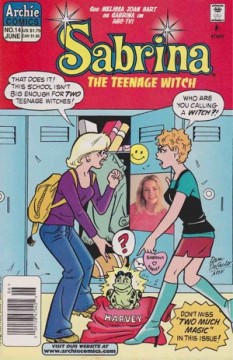
You may have heard the news that Sony plans a big-screen adaptation of Sabrina the Teenage Witch , the animated series that yielded the Melissa Joan Hart cult TV favorite from the ’90s. This time, though? She’s a superhero . “The live action film will be an origin story in the vein of Spider-Man , about a young girl coming to terms with her remarkable powers,” writes Mike Fleming at Deadline. Of course. I guess it’ll work, but I can think of at least 20 TV characters off the top of my head whom I’d sooner see grappling with hero issues: 20 . Omar Little 19 . Erica Kane 18 . Special Agent Dale Cooper 17 . The Fonz 16 . George Costanza 15 . Diane Chambers 14 . Brandon Walsh 13 . Columbo 12 . J.R. Ewing 11 . Kenny Powers ( obviously ) 10 . Butters 9 . Laura Ingalls Wilder 8 . Rudy Huxtable 7 . George Jefferson 6 . Sam the Butcher 5 . Lou Grant 4 . & 3 . Sanford & Son 2 . Carmela Soprano 1 . Squiggy Who else? [ Deadline ]
When I was in college, I once went on a weekend trip with my two roommates to Cape Cod, where someone had scrounged up a summer home belonging to a family friend who was willing to let us stay for a few days. The owners were in the middle of renovating the place, so instead of windows there were just sheets of plastic that bulged in and out with the wind. Half the rooms didn’t have electricity, and we had to go to the tap outside to get water — but hey, someone was letting us stay in their house in a scenic location far from our shabby apartment near campus, and for free. No one was complaining. Except that it got dark, and the fact that we were out in the woods down a narrow driveway removed from the road with nothing sheltering us from the outside but transparent tarps (just the thing for wrapping up dead bodies) started to seem a little spooky. We were three young women huddling around one of the few working lamps in a house in the middle of nowhere, and I started to reflect on the fact that if we were in a movie, we’d for sure get murdered in a few minutes by someone with chainsaws for hands or something. And then the friend who’d set this up, a sporty, outgoing environmentalist who’d definitely outlive me in any theoretical slasher flick, mentioned offhand (she wasn’t joking ) that the owners of the house had mentioned that if we saw a guy in the woods outside in the middle of the night, it was probably their friend Bill, who was helping with the remodeling and sometimes stayed in their shed. What’s my point? My point is that you don’t want me telling you about the premise for The Cabin in the Woods , so instead I’m inflicting on you this personal story of a cabin in some woods (spoilers: we then drove into town and ate seafood). It’s true that the film, which was written by geek demigod Joss Whedon with Drew Goddard (the latter of whom served as director) is much more fun to watch if you don’t know anything about the plot going in. But I’m concerned that all this trumpeting about how sensitive the movie is to being disrupted by oversharing will set up expectations for something filled with reversals and silly twists, when in fact your enjoyment will be derived from an appreciation for how clever its concept is. Goddard and Whedon have devised a meta-movie about horror tropes that comments on its genre without foregoing a plot or characters of its own — it’s funny and scary enough to please the deeply fannish, while being sufficiently quick and smart to entertain those less inclined to dork out on the many horror in-jokes in store. Suffice it to say, the film introduces two groups of characters. The first, made up of Bradley Whitford, Richard Jenkins, Amy Acker, Brian White and others, work in a compound somewhere seemingly official, though not so official that they don’t sexually harass each other for fun, bitch about their spouses and run office pools. The point of the film is how they fit together with the second group, which consists of five college students headed out for a weekend away at, yes, a cabin in the woods. There’s good girl Dana (Kristen Connolly), her friend Jules (Anna Hutchison) and Jules’s football-player boyfriend Kurt (Chris Hemsworth), Kurt’s studious teammate Holden (Jesse Williams) and their stoner friend Marty (Fran Kranz, who steal the show). The five fit these types from afar, but don’t up close. Kurt and Jules aren’t just a jock and his blonde bimbo girlfriend — when he teases her about bringing textbooks along, they fall into a pitch-perfect reenactment of the old “I learned it by watching you!” anti-drug PSA. Dana’s getting over a complicated break-up, Holden’s kind and perceptive, and Marty sees a lot more than you’d expect through his haze of pot smoke. The relationship of our expectations of characters and plot developments to the genre and why we keep coming back for more even when we think we know what’s going to happen is examined throughout the movie, which plays off all the old slasher standards while being about something very different. Making a film that depends on an audience’s recognition of other films is a tricky thing — not just because it presumes existing knowledge, but also because meta-humor often just stops at making a reference instead of actually going on to do something with it. When you look at Jason Friedberg and Aaron Seltzer’s _____ Movie series of (for the most part) awful spoofs, most don’t get further than a “Remember this? How about this? You saw this one, right?” Cabin in the Woods touches on everything from characters who have sex being doomed to J-horror to classic monsters, but it is also questions, for the most part not in a scolding way (the slight but discernible touch of that is the film’s only real downside), the reasons why we like watching these scenarios unfold so much that we’ve worn the ideas out like an overused record. Cabin in the Woods does what Scream only halfway managed, which was to find something new by looking back at the familiar — and at least in Whedon’s world, the geeky ones are never first on the chopping block. Follow Alison Willmore on Twitter . Follow Movieline on Twitter .
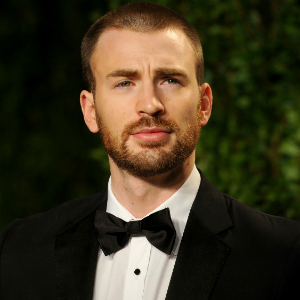
In a new interview at Prestige Hong Kong , Chris Evans , he of Fantastic Four and Captain America and the upcoming Avengers fame, admits that some — okay, a lot — of his films haven’t been very good. In fact, he’ll even give you a number: “I’ve made about 20 movies and I’m probably proud of three,” he said, admitting that press tours do a number on his nerves because he’s forced to put on a brave face to promote “piece[s] of shit.” Aww, Chris. Fret not! You’ve got some solid movies under your belt! Let’s name them and guess which trio of credits Evans is most proud of. You’ve got to give Evans points for candor; even while he was promoting Captain America he acknowledged that it took a lot of convincing for him to take on the responsibility of a ginormous superhero franchise that could make or break his career. According to his Prestige chat, he sought help from a therapist to deal with the pressures of the gig even before filming, which might be when this revelation hit: “I started to realise, I think the main reason I struggle so much in press, is because I’m usually promoting a piece of shit. It’s really difficult to find a flowery way to tell people to go see this movie, that your face is all over, that your name is all over, that you’re endorsing. And then you begin to feel like a liar, like you’re transparent. You feel undeserving and it makes the interview extremely uncomfortable, for me at least. But you know what? Sunshine , which he’s said is a favorite of his , was great (well, until the end). Captain America earned far more critical acclaim than his previous superhero stint in the Fantastic Four films. And Evans lent a fantastic injection of mocking Hollywood swagger to his Lucas Lee in Scott Pilgrim vs. the World . Hell, even Not Another Teen Movie was pretty funny, and launched Evans’ career, and despite its mixed reviews, the indie drama Puncture , in which he played a drug-addicted lawyer, was a bold move. Granted, there have been many misfires — 16 out of 19 of his films are “rotten” on Rotten Tomatoes — but they’re not all complete stinkers, are they? Surely he’s proud of his work in more than just three? Take a look at Evans’ full filmography and chime in. The Newcomers (2000) Not Another Teen Movie (2001) The Perfect Score (2004) Cellular (2004) Fierce People (2005) Fantastic Four (2005) London (2005) TMNT (2007) Sunshine (2007) Fantastic Four: Rise of the Silver Surfer (2007) The Nanny Diaries (2007) Battle for Terra (2007) Street Kings (2008) The Loss of a Teardrop Diamond (2008) Push (2009) The Losers (2010) Scott Pilgrim vs. The World (2010) Captain America (2011) Puncture (2011) What’s Your Number? (2011) [ Prestige Hong Kong via Moviefone ]
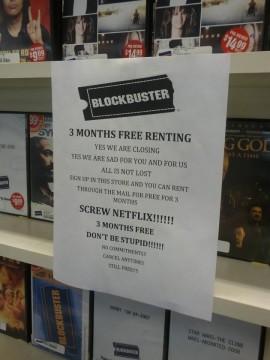
” Screw Netflix !!!!!!” ” Don’t be stupid !!!!!!” And with one final missive taped to the shelf between copies of Syriana and Shoot ‘Em Up , another doomed Blockbuster store fell to the tyranny of Netflix ‘s superior business model. Might as well screw Netflix with three months’ free rental, eh Blockbuster loyalists? (What about those Redbox bastards, with their $1.20 rentals?) All is not lost, indeed. [ Reddit via Movies.com ]
In the States, at least, it may seem odd to make a bitterly funny movie about glum working people caught in the crossfire of political upheaval and state-sanctioned murder. But Pablo Larraín pulls it off with Post Mortem , a modest, mordant little drama set in 1973 Santiago, Chile, just as a military coup is spelling the end for democratically elected President Salvador Allende and setting the stage for the ascent of dictator Augusto Pinochet. If you were a Chilean citizen in the middle of all that, you probably wouldn’t be smiling much, and sure enough, Larrain’s protagonist here, a dour coroner’s assistant named Mario, sets the tone for the movie from the beginning: He’s a gaunt, living ghost, with lank, longish blonde-gray hair – he’d almost be hip, if only he had the energy. As the movie opens, whatever problems Mario (Alfredo Castro) has seem to be of the personal sort. We see that he’s a regular at a local cabaret – the faded, crackled letters on its façade read “Bim Bam Bum” – and learn that he’s infatuated with one of the dancers, Nancy (Antonia Zegers), an enervated-looking girl with hollowed-out eyes that nonetheless know how to calculate. Nancy is Mario’s neighbor, although they meet for the first time when Mario steals backstage one day, just as Nancy is being fired by her boss for being too skinny. He introduces himself tentatively. “Hello, neighbor,” she responds, eyeing him as a cat surveys either a mouse or another cat – it’s hard to say which. Mario and Nancy don’t exactly court – it appears she has a hunky Communist activist boyfriend, which presents something of an obstacle. But Mario’s tenderness toward her is clear: He prepares plates of food for her, hoping to tempt her to eat. When her home is nearly destroyed in a mysterious raid – she’s not home at the time — he enters the wreckage and rescues her injured dog. Nancy begs for his help in finding her father and younger brother, who have been missing since the raid. But the destruction of Nancy’s home is just one element of the violence and paranoia that’s erupting all over the city: Soldiers begin dumping anonymous bodies at the morgue where Mario works, demanding that autopsy protocol be waived; the corpses pile up daily in alarming numbers. Ultimately, those soldiers make him part of their ranks, bringing him in to assist in one extremely significant autopsy — the man lying on the table isn’t just a human being, but a political turning point. Post Mortem starts out at a crawl, but it gathers emotional momentum as it pushes forward. Larraín – director of the 2008 Tony Manero , in which Castro also starred – takes his time letting the story unfold, and most of the movie’s action is implied, framed by sparse lines of dialogue. Still, Larrain manages to do a lot with a little: The picture has a pale, worn-out look, as if the blood is being drained from it even as we watch – like the characters who populate it, it looks ready for some kind of rejuvenation that may never come. That’s particularly true of Castro’s Mario: Castro is a lanky figure who looks preternaturally careworn, in the David Strathairn/Peter Coyote mold. His Mario carries so much worry that it appears to have worn grooves into his bones. What’s happening to his country? Why does this woman, whom he loves so much, torture him with her indifference? And might one be a metaphor for the other? Post Mortem asks all those questions, in a way that’s more emotional than clinical. Rather than rushing to determine the cause of death – of love, or of a country — it stubbornly keeps listening for a heartbeat, even though there may not be one. Follow Stephanie Zacharek on Twitter . Follow Movieline on Twitter .
Continuing along the theme of projects that make you feel unsafe within the confines of your own house/cabin/local bed and breakfast, Innkeepers director Ti West has been tapped to script Bedbugs , adapted from Ben H. Winters’ 2011 novel of the same name. The tale follows a woman who moves into the perfect Brooklyn brownstone with her family, only to be plagued by an infestation of bugs … that only seem to be biting her. Is your skin crawling yet? West, who also has Liv Tyler signed for his next directing project The Side Effect , previously wrote and directed 2005’s The Roost , 2007’s Trigger Man , his 2009 breakout horror House of the Devil , the disavowed Cabin Fever 2 , and his haunted hotel tale The Innkeepers , and contributed shorts to the forthcoming horror anthologies V/H/S and The ABCs of Death . The psychological horror of Bedbugs , meanwhile, drew comparisons to Rosemary’s Baby upon publishing last year. Take a look at the book trailer for Bedbugs for a general taste of the “urban paranoia” at hand. Though no director has yet been set for the film, you can at least count on West to pen better atmospherics than the infomercial-grade scares seen here. The book’s synopsis, via Amazon: FOR RENT: Top two floors of beautifully renovated brownstone, 1300 sq. ft., 2BR 2BA, eat-in kitchen, one block to parks and playgrounds. No broker’s fee. Susan and Alex Wendt have found their dream apartment. Sure, the landlady is a little eccentric. And the elderly handyman drops some cryptic remarks about the basement. But the rent is so low, it’s too good to pass up. Big mistake. Susan soon discovers that her new home is crawling with bedbugs . . . or is it? She awakens every morning with fresh bites, but neither Alex nor their daughter Emma has a single welt. An exterminator searches the property and turns up nothing. The landlady insists her building is clean. Susan fears she’s going mad—until a more sinister explanation presents itself: she may literally be confronting the bedbug problem from Hell. [via Deadline ]
The off-Broadway musical adaptation of Stephen King’s Carrie may have outlasted its 1988 stage predecessor by four times the stage run, but it died nonetheless last weekend — two weeks early! The NYT has the post-mortem: “Several theater producers contacted recently said that Carrie , no matter how well acted and sung, presented far more than the usual share of difficulties, the most insurmountable being that nearly every character is dead at the end….Several reviewers complained about certain songs and a one-note blandness in the high school scenes, but the sharpest criticism was that Carrie had been de-camped to the point of dullness.” Chloe Moretz , you’re our last hope! [ NYT via Movie City News ]
Where does Martin Scorsese stand on the enduring cultural clash between vampires and zombies? Where else? “I happen to like vampires more than zombies. A vampire, quite honestly, you could have a conversation with. He has a sexuality. I mean the undead thing… Zombies, what are you going to do with them? Just keep chopping them up, shooting at them, shooting at them. It’s a whole other thing that apparently means a great deal to our culture and our society. There are many, many books written about it and many movies. I saw one in London when I was doing Hugo. I saw one late at night one weekend. It was called Colin, by a young filmmaker [Marc Price]. He shot it, I think, digitally by himself, edited it himself. It was savage. It had an energy that took the zombie idea to another level. Really interesting filmmaking. Disturbing.” Also: He gets Raging Bull II just about as much as you and I do. [ GQ via /film ]
I hesitate to even pass along word of the luxury fashion purveyor’s ongoing litigiousness lest this site land in its hungry crosshairs, but: Have you heard about the lengths to which Louis Vuitton is going to keep its brand safe from the grubby likes of The Hangover Part II ? Or how another, recently resolved court victory has possibly shored up its case against the film’s studio Warner Bros.? Memo to Hollywood: Either get your clearances up front or do not even think of messing with these guys. This has been going on for a while , but THR Esq. now offers up the bone-chilling latest: On March 22, a judge granted a summary judgment victory to Louis Vuitton over a Super Bowl TV commercial produced by Hyundai that featured for approximately one second a basketball that bore resemblance to a flower-like symbol on chestnut-brown background design that was trademarked by Louis Vuitton. The French brand says that the judge’s decision two weeks ago shows why it should be able to go forward with its claims against Warner Bros. for infringing and diluting its trademark by showing for one brief moment in [ The Hangover Part II ] Zach Galifianakis telling someone who pushes his bag, “Be careful, that is … that is a Lewis Vuitton.” In mid-March, Warner Bros. responded to the lawsuit by telling a New York judge that it had a First Amendment right to feature trademarks and incorporate real-life references to brands without getting the consent of owners. The studio added there wasn’t any confusion, and if there was, it was de minimis and/or the responsibility of the company that had actually produced the knock-off handbag. Meanwhile, the designer isn’t backing down, arguing in a court filing (with its victory versus Hyundai in mind) that “Louis Vuitton’s ‘aggressive’ enforcement of its trademark rights and prompt action against those who misuse its trademarks are necessary concomitants of its exclusive rights in the brand.” Fine, but to what end? Is “the brand” — and apparently its business — so fragile that millions of dollars in legal expenses are themselves necessary concomitants of relevancy in 2012? Or is this just the more socially permissible way of shoring up the market share that all those knock-off merchants in Lower Manhattan have eroded in recent years? Either way, to all you screenwriters and studio legal departments alike: Maybe stick to Samsonite? [ THR Esq .] Follow S.T. VanAirsdale on Twitter . Follow Movieline on Twitter .