Tag Archives: France

World Cup 2010: I am disgusted, says France’s captain Patrice Evra | Paul Wilson

With France now needing a miracle against South Africa, their captain admitted they took a big punch from Mexico and never saw it coming Thierry Henry walked out of the Peter Mokaba stadium in Polokwane without saying a word to anyone after watching the 2-0 defeat to Mexico as a non-playing substitute. Manchester United’s Patrice Evra, as France captain, did have something to say, but he gave the distinct impression a whole lot more would be said when this sorry World Cup campaign is finally over. Barring a miracle, and Evra specifically said he is not expecting one, that will be in only four days’ time. “I’m still in shock after such a loss, we have behaved like a small football nation,” Evra said. “We have received a big punch and I couldn’t see it coming. The first goal was very painful but I thought we would be able to react, but we were not able to. We will talk about it during the following days. There is a lot to say but I’m not going to say it in public yet. I am disgusted. We have to beat South Africa now, but as for the qualification, I don’t believe in miracles. We are not a great team.” France always seem to be at one end or the other of the World Cup spectrum, with little in between. After winning the event in their own country in 1998 they were a major disappointment in South Korea-Japan 2002, leaving the tournament early, then somewhat against expectation they reached the final in Germany four years ago, where they could conceivably have beaten Italy but for Zinedine Zidane’s aberration against Marco Materazzi. Reaching the final in 2006 silenced some of Raymond Domenech’s many doubters, effectively giving the France coach a stay of execution until the next tournament, though after the manner in which Les Bleus surrendered against Mexico and the likelihood of another early departure, it appears he has little room left for argument. After leaving Henry on the bench for the whole 90 minutes, witnessing another supine display from Nicolas Anelka and wholly ineffective ones from Franck Ribery and Florent Malouda, Domenech has some questions to answer. So, for that matter, has Evra, whose part in the decisive penalty that clinched Mexico’s win was not the one of a captain willing to fight for every inch. Evra more or less waved Pablo Barrera past on his way to the penalty area, where he was clumsily fouled by Eric Abidal, the whole episode suggesting a tired and demotivated team. For that, Domenech will ultimately have to answer. “For the moment I’m searching for words,” the coach said, wearing his habitual puzzled expression. That makes a change from searching the stars – he freely admits astrology has informed some of his decisions in the past – and a disappointed nation will be hoping the dictionary might contain more sense. “We still have a match to play and there is an infinitesimally small chance we can go through. I do reproach myself, yes. But that’s my own business. Perhaps we didn’t have quite the punch we needed but there was definitely a team playing, not just a collection of individuals. Initially we were fairly calm.” France World Cup 2010 Group A Mexico Thierry Henry Paul Wilson guardian.co.uk

Read the original post:
World Cup 2010: I am disgusted, says France’s captain Patrice Evra | Paul Wilson

World Cup 2010, Mexico Vs. France: Cuauhtemoc Blanco Penalty Kick Puts Mexico Up 2-0

Cuauhtemoc Blanco has converted a penalty kick in the 79th minute against France to put Mexico up 2-0 in Polokwane. The kick was awarded after Eric Abidal took down Paulo Barrera in the penalty box. Blanco finished to the right of goalkeeper Hugo Lloris, who guessed correctly but missed the shot by inches. Blanco had come on in the 62nd minute for Guillermo Franco.

Continue reading here:
World Cup 2010, Mexico Vs. France: Cuauhtemoc Blanco Penalty Kick Puts Mexico Up 2-0

World Cup 2010, Mexico Vs. France: Efrain Juarez Picks-Up Yellow, Will Miss Uruguay Match

Mexico’s Efrain Juarez has picked-up a yellow card early in the second half and will now miss Mexico’s third Group A match. They play Uruguay on Tuesday. Juarez was carrying a yellow card into today’ match with France and picked-up another in the 48th minute for pushing Franck Ribery after a challenge. Mexico has picked up three of the four cards shown today.

See the original post:
World Cup 2010, Mexico Vs. France: Efrain Juarez Picks-Up Yellow, Will Miss Uruguay Match

France 0-2 Mexico | World Cup 2010 Group A match report

Manchester United have not seen much of Javier Hernández yet but the striker who will join them for the new season delighted the hordes of underdressed Mexican fans in chilly Polokwane by scoring the goal that set his side on the way to victory against a ragged France. Hernández came on as 55th-minute substitute and made the breakthrough nine minutes later, beating the offside trap by a matter of inches and leaving France looking at elimination. A penalty from another substitute, the veteran Cuauhtémoc Blanco made certain of victory 12 minutes from time, taking Mexico level with Uruguay at the top of Group A and leaving France and South Africa with a point each. A point is about all France deserve after two extremely underwhelming displays at this World Cup, and though they could finish their group games with a victory over South Africa, the worry will be that Mexico and Uruguay will draw to both progress. Mexico began as if they meant business, showing much more attacking desire than in their opening game against South Africa and giving France a couple of scares in the first 10 minutes. Giovani dos Santos was in an offside position when he struck a post after only two minutes, but France had been warned. Carlos Vela managed to stay onside when Mexico came forward again, though after expertly gathering Rafael Márquez’s lofted pass, he shot early and high with his left foot. Guillermo Franco, who picked up the game’s first caution for delaying the taking of a free-kick, also shot too high after easily turning Eric Abidal on the adge of the area. France weathered that storm and gradually pushed Mexico back before producing a few attacks of their own. There was no one in the middle when Franck Ribéry crossed invitingly across the face of goal from the right, and though Jérémy Toulalan sent over an even better centre a few minutes later Florent Malouda was unable to get on the end of it. There was a definite sense, missing in most of the opening round of games, that both sides wanted to win this fixture. That would make qualification almost certain, whereas to lose, with Uruguay already on four points, would make life tricky if not impossible on the final day. Carlos Salcido, Mexico’s impressive left-back, brought the first real save of the evening from Hugo Lloris with a galloping run into the box and a shot directly at the goalkeeper, but the El Tri cause was not helped when Vela disappeared after just half an hour. He went down injured after no obvious contact with an opponent and was unable to continue. Little had been seen of Nicolas Anelka until he brought a routine save from Oscar Perez with a tame shot on the stroke of half-time, though he was indirectly involved in Toulalan collecting a caution in the last act of the first half that will put him out of the next game. Anelka tried to shoot from a free-kick for a foul on Ribéry, but shot into the Mexican wall so meekly that the wall broke up and a downfield breakaway was launched. Toulalan could not get back in time and was obliged to block Franco near halfway to prevent the Mexican striker breaking into space. It was hardly the biggest of surprises when Anelka was hauled off at half-time, though Raymond Domenech chose to replace him with André-Pierre Gignac rather than Thierry Henry. PSV Eindhoven’s Salcido continued to show up well, cutting in from the left at the start of the second half and shaping to shoot before Bacary Sagna brought him down. Mexico produced a well worked free move from the free kick to get Dos Santos to the goal-line, only for the former Spurs player to waste the opportunity with a cross played behind his strikers. France came back down the pitch and Malouda brought a save from Perez with a rising shot that the goalkeeper tipped over the bar, before Dos Santos wasted a couple of free-kicks at the other end by a distance that suggested the ball was to blame. Both efforts, from a fair way out, sailed so harmlessly dead it was difficult to know what he was attempting, though the look Javier Aguirre shot him from the bench on the second occasion suggested he might be wiser trying something more reliable next time. That was rendered unnecessary by what happened next, with Hernández taking advantage of a stupendously good linesman’s call to stay onside and put Mexico in front. The substitute passed backwards to Márquez then set off upfield for the return, which was timed to perfection and left Hernández the relatively simple task of gathering in space, then rounding Lloris to score. The French appealed for offside, but the flag had stayed down throughout the move, and replays showed that Hernández was onside, though by no more than a foot, when the ball was played. France gave up without much of a fight, with neither Ribéry nor Malouda succeeding in taking the ball past opponents, and another perplexing attacking substitution by Domenech failing to make any discernible difference. Their off-night was summed up when Eric Abidal brought down Pablo Barrera for the penalty. The defender seemed to have time to pull out of the tackle when Barrera played the ball past him and drew the foul, but Abidal was either too tired or too resigned to be concerned. Contact was made, the referee was correct in pointing to the spot, and Blanco found the bottom corner. Surprisingly good last time, France are right back in the doldrums again. World Cup 2010 Group A World Cup 2010 France Mexico Paul Wilson guardian.co.uk

Read the original post:
France 0-2 Mexico | World Cup 2010 Group A match report

France vs Mexico world cup 2010

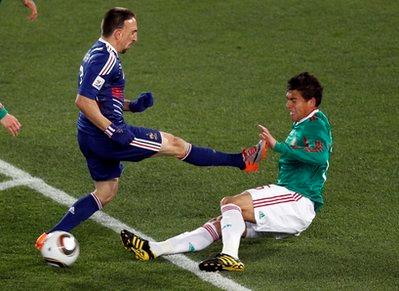
France#39;s Franck Ribery, left, challenges Mexico#39;s Hector Moreno, right, during the World Cup group A soccer match between France and Mexico at Peter Mokaba Stadium in Polokwane, South Africa, Thursday, June 17, 2010. Mexico stunned France 2-0 in a World Cup Group A match here on Thursday to leave the 1998 winners and 2006 finalists teetering on the brink of elimination. Substitute Javier Hernandez, who will play for Manchester United next season, put Mexico ahead in the 64th minute aft

Excerpt from:
France vs Mexico world cup 2010

Opta world cup 2010 data: every shot, every tackle and every goal

How does this world cup compare to previous tournaments? Take a look at the data • Get the data Well, we’re at the end of the group stage of World Cup 2010 and what have we learnt so far? Opta (this is their Twitter feed ), which covers 30 different sports in around 70 countries, has agreed to let the Datablog publish the complete statistical analysisall the games so far in the tournament. Owen Gibson writes today that “At the end of Spain’s shock defeat by Switzerland, which may actually prove to be the moment at which the tournament caught fire, there had been a total of 1.56 goals per game.” Opta’s statistics, which measure the opening round of games against the same stage at the last three World Cups, show that the goal per game ratio compares poorly. In Germany in 2006, it was 2.44, in Japan-South Korea in 2002 it was 2.88 and at France 98 it was 2.31 … Opta’s figures show that the number of shots in each game is about 10% down on 2006. They also show that the goals-to-shots ratio, at 7.9%, is also well down. In the past three tournaments, it never went below 10.8% in the opening round of matches. Shooting accuracy – the ratio of shots to efforts on target – is 33% at this World Cup so far, compared with 40% at the same stage in Germany, 43% in Japan-South Korea and 41% in France. At the top of the page is how we visualised the data in today’s paper (click on it to get the full graphic) – you can download the data below too. What can you do with it? Download the data • DATA: download the full datasheet World government data • Search the world’s government data with our gateway Can you do something with this data? Flickr Please post your visualisations and mash-ups on our Flickr group or mail us at datastore@guardian.co.uk • Get the A-Z of data • More at the Datastore directory • Follow us on Twitter Data summary World Cup 2010 Fifa World Cup 2010 Group A World Cup 2010 Group B World Cup 2010 Group C World Cup 2010 Group D World Cup 2010 Group E England Simon Rogers guardian.co.uk

Read this article:
Opta world cup 2010 data: every shot, every tackle and every goal

Chris Evans apologises for ‘Bernard Manning-style’ joke on Twitter

Radio 2 presenter outrages Twitter followers by retweeting joke about African football fans at World Cup Radio 2 presenter Chris Evans has apologised for posting a joke about poverty in Africa and the World Cup on Twitter. Evans retweeted a joke about African football fans and the noisy horns known as vuvuzelas that had been circulating on the micro-blogging site. The 44-year-old Evans, who has more than 84,000 followers on Twitter, said “You give an African £2 a month and what do they do? Buy a bloody trumpet.” The comment sparked criticism from some of his followers, with one calling it a “bit Bernard Manning”. Another wrote: “Chris Evans is a backward racist. I used to like this fool. Lets make jokes about gingers and see how he likes it!” Evans soon removed the tweet and apologised, claiming that he had not read the joke properly before retweeting it to his followers. “Apologies for last retweet didn’t read it properly,” he said. “Never meant to offend. Not funny at all.” Less than 10 minutes later he tweeted again, saying: “Sticking with my not funny verdict”. Evans, who replaced Sir Terry Wogan on Radio 2’s breakfast show in January, will return to TV to host the One Show on Fridays. The BBC is looking at the possibility of broadcasting an alternative “vuvuzela free” version of its World Cup coverage . •

Visit link:
Chris Evans apologises for ‘Bernard Manning-style’ joke on Twitter

World Cup 2010: Will attacking full-backs win the competition? | Jonathan Wilson

The last four winners relied on marauding defenders but is a tactical change under way in South Africa? Correlation is not necessarily causation. It is intriguing that the last four World Cup winners have been the sides who have had the pair of attacking full-backs in the best form (Jorginho and Branco for Brazil in 1994, Lilian Thuram and Bixente Lizarazu for France in 1998, Cafu and Roberto Carlos for Brazil in 2002 and Gianluca Zambrotta and Fabio Grosso for Italy in 2006), but that is not sufficient to state that the side with the best attacking full-backs this time round will be equally successful. There is, to start with, a troubling circularity about the argument, for the team that wins the World Cup is liable to have the player in the best form – or at least perceived to be in the best form – in any given position. Does a team win the World Cup because it has the best full-backs, or does it have the best full-backs because it wins the World Cup? It’s hard to say, but even allowing for that caveat, the link between success and attacking full-backs seems strong – Thuram, Cafu and Grosso stood out even in excellent teams. In this tournament already, it is notable that Philipp Lahm had a fine game in Germany’s 4-0 win over Australia, that Cha Du-ri was excellent for South Korea in their 2-0 win over Greece, and that it was an overlapping Maicon who finally opened the scoring for Brazil against North Korea last night. Even Chris Lochhead, operating more as a wing-back, was the source of much of New Zealand’s attacking intent in their 1-1 draw against Slovakia. Given Glen Johnson and Ashley Cole were two of their less disappointing players against the USA, even England fans could cling to the full-back theory as a source of hope. Before making any judgment on the importance of full-backs, though, it first must be established why that correlation between attacking full-backs and success exists. This is a subject I’ve dealt with in greater detail before , but essentially it comes down to the point Jack Charlton made after the 1994 World Cup, that when a back four meets a team playing 4-4-2 or 3-5-2, the full-backs are the players who tend to have the most space in front of them, and thus the most time on the ball, and the most opportunities to make relatively risk-free runs into unexpected areas. Increasingly, though, teams are not playing 4-4-2, and so the advantage Charlton highlighted no longer exists. When a back four plays a 4-2-3-1 or a 4-3-3, the full-back no longer has space in front of him, but a winger. That complicates matters for an attacking full-back. If he is playing an attacking wide player, then he can effectively fight fire with fire – as, for instance Roberto Carlos did against David Beckham when Real Madrid beat Manchester United 3-1 at the Bernabéu in 2003, or Michael Essien against Cristiano Ronaldo in the final hour plus extra-time of the Champions League final in 2008. That, though, is a risk: Theo Walcott didn’t just score a hat-trick in Zagreb in 2008, he destroyed Croatia’s entire left side by making Danijel Pranjic, a full-back so attacking he usually plays in midfield, try to defend. So it may be safer for even an attacking full-back to sit deep and try to absorb the threat, as Ashley Cole did against Ronaldo in Euro 2004. If they are going to sit back, then it probably makes more sense for the full-back to be a naturally defensive player (Arsenal’s Lee Dixon on Newcastle’s David Ginola in a League Cup tie in January 1996, Manchester United’s Gary Neville on Arsenal’s José Antonio Reyes in October 2004) in which case the hegemony of the attacking full-back may be over. That’s not to say that the attacking full-back is outmoded, but that they are not such an advantage as they once were. If that is so, then the likes of Argentina and Holland may not be so hindered by their lack of attacking full-backs as it seemed they might be. There is always the chance in tournaments that a team reverting to a formation that seems thoroughly outdated will shock the opposition by setting them a problem they have forgotten how to solve. It worked for Greece when Otto Rehhagel reintroduced man-marking at Euro 2004, and it may be that a back four of essentially defensive players is such a novelty that opponents struggle against Diego Maradona’s Argentina. Jonás Gutiérrez, of course, is not a particularly solid option at right-back, and Nigeria frequently exploited his weak positional sense, but it could be that he is dropped for Nicolás Burdisso, who looked more convincing having come off the bench on Saturday. Holland present a less extreme case, but neither Gio van Bronckhorst, because of his age, nor Gregory van der Wiel, because of his essentially defensive outlook, are likely to be pouring forward making overlapping runs. Both play, in diluted form, a version of the “broken team” that was so prevalent in Italy in the late 1990s, in which some players have a very clear attacking role, and some a very clear defensive role, with little in between. Against Nigeria, Argentina had a very obvious back four plus Mascherano, and a front four of Angel di María, Carlos Tevez, Lionel Messi and Gonzalo Higuaín, with Juan Sebastián Verón providing some sort of link as a deep-lying playmaker. The Dutch similarly had a back four and a front four plus Nigel De Jong, with Mark van Bommel linking. That is a mode of play that places great onus on individual talent, and less on the system. Perhaps that is natural in international football, in which the lack of time available to coaches, as both Valeriy Lobanovskiy and Arrigo Sacchi made clear, makes sophisticated systematisation difficult to develop, perhaps it even plays into the hands of the advertisers whose ideal is a Ronaldo step-over rather than Rafa Benítez making compact gestures, but it does suggest that the age of the attacking full-back is, if not over, then at least being challenged. If Maradona has recognised that – or if he has listened to Carlos Bilardo telling him that – then he may just be smarter than many give him credit for (and, of course, Argentina’s lack of attacking full-backs makes it a wholly logical experiment). For if it comes down to a battle not of system – which would benefit Spain with their phalanx of gifted midfield pass-and-movers – but of individual attacking talent, then there is no side better placed than Argentina, with Holland not too far behind. It worked for Bilardo and Argentina in 1986 when, to put it slightly crudely, seven players defended and Jorge Valdano, Jorge Burruchaga and, of course, Maradona attacked. If Gabriel Heinze and Gutiérrez or Burdisso can help provide a platform, then with Angel Di María, Gonzalo Higuaín, Carlos Tevez and, of course, Messi, it might just work again. World Cup 2010 Jonathan Wilson guardian.co.uk

See original here:
World Cup 2010: Will attacking full-backs win the competition? | Jonathan Wilson

World Cup 2010: France are the common enemy for Mexico and Ireland

There is an affinity between the Irish and the Mexicans, and a mutual antipathy towards France “It’s ABF for us,” says Dara Murray, a 40-year-old Dublin native married to a Mexican and living in Guadalajara, Jalisco. “Anyone but France.” Thierry Henry’s handballed goal booked France’s ticket to South Africa and broke Irish hearts in all corners of the world, so it’s hardly a revelation that Irish will be adopting the green shirt of Mexico when El Tri take on France in Polokwane today. • Follow the Guardian’s World Cup team on Twitter • Sign up to play our great Fantasy Football game • Stats centre: Get the lowdown on every player • The latest team-by-team news, features and more It won’t be the first time the Irish have come together with Mexicans though. The most notable, and incredible bonding came with the Saint Patrick’s battalion when Irish troops fighting in the US army deserted to join the Mexican army during the 1846-48 Mexican-American War. The event is still celebrated in both Mexico and Ireland today via street names, annual parades and songs. Then, in the 1860s, Irish veterans of the war helped kick out the French. “It gives us a common bond with the Mexicans,” says Paul Kenny, another Irishman living in Guadalajara with two young children with dual citizenships. “We’ve both had to try to defeat imperial might.” The story starts with the immigration of over one million poor, Catholic Irishmen to the United States and Canada between 1840 and 1850. “They got there and couldn’t get work. Job adverts said ‘No Irish, No Niggers,'” explains Dr Michael Hogan, the author of The Irish Soldiers of Mexico and the historical authority on the episode. With tensions between Mexico and the United States rising, many of the new migrants were offered citizenship and land to fight against Mexico. With little option, they accepted. “They got to Mexico and realised they were being used to invade a Catholic country and while they were on the border they could hear the church bells in Mexico,” Hogan says. The Irish made up about a third of the US army but there was not even one Catholic chaplain and soldiers were forced to go to the Protestant service every Sunday. Asked to fight and kill other poor Catholics and being denied the chance to go to mass, which would’ve been in Latin as in Ireland, around 75 Irish soldiers awaiting orders to attack trickled into Mexico and didn’t come back. And that was even before the war had begun. “Then the war started,” Hogan says. “The US artillery attacked the Catholic cathedral in Monterrey where the Mexican general had sent civilians.” Many innocent deaths later, more Irish started deserting the US army and one Irishman, John O’Riley, organised them into the Saint Patrick’s battalion. O’Riley, about whom there is a slightly cheesy Hollywood film entitled One Man’s Hero, starring Tom Berenger, rose to the rank of major in the Mexican Army and the battalion became a thorn in the side of the US army. Although the battalion consisted of ferocious fighters and had a decisive influence in some battles, the Yankee army could not be stopped and Mexico lost 55% of its land in the decidedly dodgy Treaty of Guadalupe Hidalgo in 1848. Those Irish that deserted during the war were hung, while those that had switched sides before hostilities were let off with a branding, public whipping and hard labour. Nevertheless, the battalion became heroes in Mexico and part of Mexican folklore. Every 12 September in Mexico City a military parade and mass is celebrated in the plaza where the first soldiers were hanged, and street names such as “Irish Martyrs” and “St Patrick” are found in many Mexican cities. Fourteen years after the Mexican-American War ended in 1848, the French successfully invaded and took Mexico City, leading to the crowning of an Austrian prince, Maximilian, as Emperor of Mexico. He didn’t last long and was booted out and executed in 1867. Many Irish veterans of the Mexican-American War were present. In football, the French have irked the Mexicans, too, when a journalist dubbed their team les rats verts , the green rats, at the 1966 World Cup. Mexicans seem happy to have the Guadalajara Irish community’s support against France, according to Frank Cronin, a Dubliner who runs the Irish-themed Temple Bar in Guadalajara: “A lot of Mexicans are coming into the bar and telling me that the team is going to kick France’s arse for us.” Mexico France World Cup 2010 Group A World Cup 2010 guardian.co.uk

More here:
World Cup 2010: France are the common enemy for Mexico and Ireland

The Swiss killed Bambi but Spain’s defeat is not the end of the world | Richard Williams

Victory for the artisans over the artists is integral to World Cup 2010 as it was to previous tournaments Who Killed Bambi? was the title of a film about the Sex Pistols that Malcolm McLaren and Russ Meyer, the soft-porn director, never quite got around to making, but it could have been the headline over reports of Spain’s 1-0 defeat by Switzerland on Wednesday afternoon. Spain were supposed to be the darlings of the tournament. They were the ones, we said, who would provide the 2010 World Cup with its finest exposition of the game’s most cherished arts. Their victory would be a triumph for the forces of righteousness, heralding the dawn of football’s new age of enlightenment. It was when Andrés Iniesta, one of Spain’s squadron of much-admired playmakers, left the field after 76 minutes, shaking his head in dismay, that the title of McLaren and Meyer’s movie came to mind. There was pathos, certainly, in the sight of one of the game’s true artists being utterly cancelled out, along with the rest of his team, by a group of men who, by comparison, are no more than willing artisans. But should we really be sad about this, or should we accept that football is about more than just pretty patterns? Spain’s approach is based on that of Barcelona, who arrived at the Emirates Stadium in March and played 20 minutes of the most exalted, expressive football that those of us fortunate enough to be present are ever likely to see. Their movement and their passing ravished the senses, their mutual understanding and their sheer joy in their work communicating itself even to those who feared their side were about to be on the wrong end of an historic pounding. It didn’t work out that way, because Cesc Fábregas – who had something to prove to Barcelona – came on and dragged Arsenal to a memorable 2-2 draw. But would it have been a more satisfying occasion had Barcelona won 5-0, which looked on the cards with a quarter of the match gone? Watching Spain on Wednesday was a lot like watching Arsenal in the later stages of last season: the players could not understand why their virtuous approach was not giving them the critical mass that would tip the balance of the game. They were doing what they had been schooled to do, and it was not enough to overcome an opposing team whose ambitions were not pitched at the same level of creativity. This has happened before at World Cups, even in the finals. Back in 1954 the tournament was supposed to be ready for Hungary – the Magical Magyars of Ferenc Puskas, Sandor Kocsis, Zoltan Czibor, Nandor Hidegkuti and Jozsef Bozsik, who had just beaten England 7-1 in Budapest – to confirm their position as the dominant power in the global game. As they thrashed West Germany 8-3 in their second group match, that outcome seemed a certainty. But Puskas, their figurehead, was injured in that match by a tackle from the defender Werner Liebrich. He did not reappear until the final in Berne, where they met West Germany again and lost 3-2, an equaliser from a half-fit Puskas two minutes from the end being questionably disallowed for offside. That traumatic defeat terminated a four-year, 32-match unbeaten run (Spain went 35 matches without defeat between 2006 and 2009) and heralded the end of Hungary’s golden age. Twenty years later Holland occupied a similar position in the world’s esteem, thanks to the development of Total Football under their coach, Rinus Michels, and the majesty of such players as Johan Cruyff, Johan Neeskens, Ruud Krol, Rob Rensenbrink and Wim van Hanegem. The Clockwork Orange reached the final after beating Argentina 4-0 and Brazil 2-0 in the second group stage before losing in the final to West Germany, the hosts, taking the lead in Munich with a second-minute penalty before succumbing to overconfidence and their opponents’ superior grit. Brazil were the romantic heroes of 1982. A team bursting with such ball-playing aristocrats as Zico, Sócrates, Eder, Paulo Roberto Falcão and Toninho Cerezo breezed through their opening matches in Spain but suffered a rude awakening at the hands of Italy, for whom the combination of a Paolo Rossi hat-trick and the stern defending of Gaetano Scirea and Claudio Gentile was enough to bring down the favourites in the second round. The other purists’ favourites that year were France, then building a superlative midfield around Michael Platini, Alain Giresse and Jean Tigana. In the semi-final in Seville, however, the West German goalkeeper, Toni Schumacher, committed the terrible assault on Patrick Battiston that prefaced the Germans’ victory in a penalty shoot-out after extra time finished at 3-3. Two years later, with Luis Fernandez completing the midfield quartet, France would win the European Championship, but in 1986 they would again suffer defeat to West Germany in the semis. All these results were disappointing to a certain type of football fan. But they were not the end of the world – or only to those who imagine a universe in which every game of football is a replay of Eintracht Frankfurt 3 Real Madrid 7, the nonpareil European Cup final of 1960. That isn’t going to happen – and nor should it, because football without its grinding 0-0 and 1-1 draws, without its unpredictable collisions of mind and muscle, of beauty and bruises, would be like music with nothing below middle C. Spain World Cup 2010 Group H World Cup 2010 Richard Williams guardian.co.uk

See original here:
The Swiss killed Bambi but Spain’s defeat is not the end of the world | Richard Williams






