Tag Archives: government agencies

Al Gore’s Current TV Is Struggling

Andrew Wallenstein at The Hollywood Reporter  suggests more than Al Gore’s marriage is crumbling. Gore’s cable channel Current TV is facing a dramatic makeover with an injection of MTV executives. Wallenstein tried to sugarcoat the inconvenient truths: For all the brilliance he has displayed grasping the meteorological dynamics governing the globe, Gore has miscalculated those of a slightly less complex world: the TV business. The radical ambitions he brought to the environment didn’t pan out the same way in cable; the television will not be revolutionized. Gore tried to sell off Current to his Google pals for half a billion dollars, but that didn’t take. So they’re taking the content away from small-d democracy and toward the persistent formula of other youth-culture channels, loaded with young-skewing documentaries and “reality” TV: For much of the past year, Current TV has been quietly undergoing an overhaul that will change just about everything but the struggling channel’s name. Current declined comment for this story. It’s a revitalization project Gore & Co. embarked on after exhausting a more lucrative possibility: selling the channel. Current’s founding partner, Joel Hyatt, spent much of 2009 shopping the network with a price tag that wildly overestimated the company’s worth, confirmed sources at several conglomerates. Current even had extensive sale talks as far back as 2007 with Google, where Gore serves as a senior advisor. Now the focus has shifted to fixing Current, perhaps with an eye toward a sale down the road. Last July, Hyatt was replaced as CEO by Mark Rosenthal, the former MTV Networks COO who is rebuilding the channel in the traditional mold Gore avowed to avoid, only to suffer the consequences. Rosenthal has brought in a crew of colleagues from his MTVN days including an unlikely ringer: Brian Graden, the programming genius who masterminded hit series from “South Park” to “The Osbournes,” before leaving last year. He’s on retainer as a consultant. Graden helped found the gay channel Logo and expressed joy last year at bringing documentaries to MTV with titles like “I’m Changing My Sex” and “I Work In the Sex Industry.” So here’s where the format change comes in: Forget bite-sized clips created by anonymous viewers; the new Current will consist of full-length series from the usual suspects in unscripted production who are getting the word that Current is open for business…. Several senior MTVN colleagues were brought in as consultants to engineer the turnaround including Hank Close, formerly president of ad sales. Several more key full-time hires have been made as well. But original programming is at the heart of any successful cable network, and for that he’s turned to Graden, who’s known for his knack for hits. Graden and Current make for an unusual combination. A network that has devoted significant time to serious topics ranging from AIDS in Africa to New Age spirituality is in the hands of Graden, who didn’t exactly win Peabodys for shows often criticized for corrupting America’s youth. Graden did not respond to an email seeking comment. The MTV infusion at Current is ironic considering the channel is essentially facing the same fundamental problem MTV confronted so successfully in the 1990s: a TV schedule comprised of multi-minute clips is far less advertising-friendly than the half-hours that ensure viewer tune-in isn’t so erratic. In other words, MTV “so successfully in the 1990s” dumped all the music videos in favor of “The Real World” ad infinitum, et cetera. [HT: Dan Isett]

The rest is here:
Al Gore’s Current TV Is Struggling
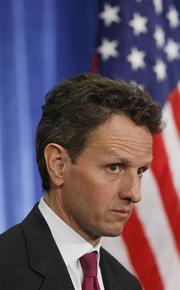
Geithner Miscasts the 1930s at the G-20 Summit; AP’s Aversa Lets Him Get Away With It

Treasury Secretary Tim Geithner is admonishing the leaders of other countries attending the G-20 summit in Toronto to keep spending like there’s no tomorrow, because if they spend like there’s no tomorrow, there will still be a tomorrow. But in the gospel according to Geithner, if they don’t spend like there’s no tomorrow, there really won’t be a tomorrow. With such blubbery logic, is it any wonder that America’s stature with the rest of the world is plummeting? Earlier this evening, Brent Baker at NewsBusters pointed to an ABC report warning that a second recession might be on the horizon if the G20 nations don’t follow the spend-spend-spend recommendations of the Obama administration. In his attempt to convince the rest of the world of the folly of being fiscally responsible, Geithner has invoked a supposed “lesson” from the 1930s. Back in mid-May, I happened to stumble on the fundamental untruth of his assertion, and will demonstrate it shortly. The Associated Press’s Jeannine Aversa let Geithner’s contention pass without challenge in her Saturday report on the summit. Here are the three relevant paragraphs from her report: Asked if the global economy could slip back into another “double dip” recession, Geithner said the answer to that question hinges on decisions made by world leaders. “It is within the capacity of the people who are going to be in those rooms together in the next few days to avoid that outcome,” he said. One of the mistakes made in the 1930s was that countries pulled back their recovery efforts too soon, prolonging the Great Depression, he said. Geithner said the United States doesn’t want to see that happen again. “What we want to do is continue to emphasize that we are going to avoid that mistake,” he said. “It’s only been a year since the world economy stopped collapsing … it will take some time to heal.” What follows is a chart showing U.S. spending and GDP from 1923 to 1940, with a partial list of unemployment rates from roughly the same time frame immediately to its right: Hoover began the federal spending ramp-up in 1931 and 1932, but Franklin Delano Roosevelt and his New Deal took spending as a percentage of gross domestic product (GDP) to the 9, well over double the level of the Coolidge years. He kept it there until 1940, after which pre-war and wartime spending kicked in. Despite all of what FDR did and tried, unemployment stayed persistently and unacceptably high. The gospel according to Geithner, as well as hard-core Keynesians like Paul Krugman at the New York Times, would tell us that FDR held up his end of the bargain by keeping the spending spigots open during the eight years that ended in 1940, and that it was the Europeans pulling back who prolonged the recession (Krugman even believes that FDR didn’t spend enough). One would therefore expect that folks living in countries that didn’t hold up their end of the spend-spend-spend bargain during that decade must have endured even more hardships than U.S. citizens did. The trouble is, as I discovered quite by accident on May 13, is that this isn’t at all what happened. In a Wall Street Journal column , Daniel Henninger quoted an eminent European economist who had passed away less than two years earlier. In the process of making a point that Henninger used about the mediocre performance of Europe during the 1990s, this historian also, when seen in the context of the graphics just presented, also made a huge point about the Europe of the 1930s: Angus Maddison, the eminent European historian of world economic development who died days before Europe’s debt crisis, wrote in 2001: “The most disturbing aspect of West European performance since 1973 has been the staggering rise in unemployment. In 1994-8 the average level was nearly 11% of the labor force. This is higher than the depressed years of the 1930s.” Whoa. Maddison’s assertion leads to these key factoids and points: Europe’s unemployment during the 1930s seldom if ever topped 11%. U.S. unemployment during the 1930s was always above Europe’s level by a few points; another source I found indicates that U.S. unemployment at one point dropped to about 12% in 1937 , but the point still stands. Europe’s “failure” to spend as Geithner thinks it should have during the 1930s doesn’t seem to have hurt it nearly as much as FDR’s insistence on continued spending hurt us. If there’s a lesson here, it’s that, absent contrary evidence, Tim Geithner is wrong and the Europeans of the 1930s were right. It would also seem that Europe’s renewed intent to rein in government spending is a wiser course than the spend-spend-spend strategy of the Obama administration (how serious the European countries are about restraining spending remains to be seen; if Europe tries to solve its problem primarily with tax increases, all bets are off). Jeannine Aversa’s relay of Geithner’s more than likely false assertion about the 1930s deserved much more skepticism that it received. Cross-posted at BizzyBlog.com .

More here:
Geithner Miscasts the 1930s at the G-20 Summit; AP’s Aversa Lets Him Get Away With It