Tag Archives: gulf

Rep. Joe Barton Apologizes to BP’s Tony Hayward for White House "Shakedown"

BP CEO Tony Hayward is in the midst of a harsh grilling today on Capitol Hill, where he is testifying House Committee on Energy and Commerce hearing on “The Role of BP in the Deepwater Horizon Explosion and Oil Spill.” But not long after the hearing began, Hayward got something not many expected from lawmakers: An apology. Rep. Joe Barton, a Texas Republican, apologized to Hayward for what he described as a “shakedown” at the White House yesterday. He was referring to the deal worked out between the Obama administration and BP to set up a $20 billion fund administered by a third party to pay for damages from the catastrophic oil spill in the Gulf of Mexico. “I'm ashamed of what happened in the White House yesterday,” Barton said. “I think it is a tragedy of the first proportion that a private corporation can be subjected to what I would characterize as a shakedown, in this case, a $20 billion shakedown.” He complained that “the attorney general of the United States, who is legitimately conducting a criminal investigation and has every right to do so to protect the interests of the American people, [is] participating in what amounts to a $20 billion slush fund that's unprecedented in our nation's history, that's got no legal standing, and which sets, I think, a terrible precedent for the future.” “I apologize,” Barton added. “I do not want to live in a country where any time a citizen or a corporation does something that is legitimately wrong is subject to some sort of political pressure that is — again, in my words, amounts to a shakedown. So I apologize.” “I'm speaking now totally for myself,” he noted. “I'm not speaking for the Republican Party.” Not long after Barton spoke, the White House released a statement calling his comments “shameful.” “What is shameful is that Joe Barton seems to have more concern for big corporations that caused this disaster than the fishermen, small business owners and communities whose lives have been devastated by the destruction,” said Press Secretary Robert Gibbs. “Congressman Barton may think that a fund to compensate these Americans is a 'tragedy', but most Americans know that the real tragedy is what the men and women of the Gulf Coast are going through right now. Members from both parties should repudiate his comments.” According to the Associated Press, Barton has taken more than $100,000 in political contributions from oil and gas interests since the beginning of 2009, more than all but one other member of the House Energy and Commerce Committee. At the hearing, Rep. Ed Markey (D – MA) said he “could not disagree more strongly” with Barton's comments. “Not only is the compensation fund that was created yesterday at the White House in an agreement reached between BP and President Obama not a slush fund and not a shakedown, rather it was the government of the United States worked to protect the most vulnerable citizens that we have in this country right now – the residents of the Gulf,” he said. “American citizens are being harmed,” Markey added. “We cannot wait, as unfortunately so many victims of the Exxon Valdez had to wait years to see those families compensated. We can't lose sight of fact that the 1984 Bhophal disaster and lawsuits related to it, were only settled last week. We have to make sure American citizens are protected.” “The families of the Gulf will be crushed financially unless this compensation fund is put in place,” said Markey, arguing that the history of Gulf families will be “permanently altered” without action. Markey added that the creation of the slush fund reflected “American government working at its best” to ensure that families do not become “roadkill” as a result of corporate practices. As Markey spoke, Barton leaned back in his chair reading what appeared to be the newspaper Investor's Business Daily. added by: TimALoftis
Fly the Really Friendly Skies..with 506 pounds…

legalize it added by: hunzedog

Oil Spill Forces Animals To Flee To Shallow Water Off Coast, Scientists Warn Of ‘Mass Die-Off’

Dolphins and sharks are showing up in surprisingly shallow water just off the Florida coast. Mullets, crabs, rays and small fish congregate by the thousands off an Alabama pier. Birds covered in oil are crawling deep into marshes, never to be seen again. Marine scientists studying the effects of the BP disaster are seeing some strange phenomena. Fish and other wildlife seem to be fleeing the oil out in the Gulf and clustering in cleaner waters along the coast in a trend that some researchers see as a potentially troubling sign. The animals' presence close to shore means their usual habitat is badly polluted, and the crowding could result in mass die-offs as fish run out of oxygen. Also, the animals could easily get devoured by predators. “A parallel would be: Why are the wildlife running to the edge of a forest on fire? There will be a lot of fish, sharks, turtles trying to get out of this water they detect is not suitable,” said Larry Crowder, a Duke University marine biologist. The nearly two-month-old oil spill has created an environmental catastrophe unparalleled in U.S. history as tens of millions of gallons of have spewed into the Gulf of Mexico ecosystem. Scientists are seeing some unusual things as they try to understand the effects on thousands of species of marine life. Day by day, scientists in boats tally up dead birds, sea turtles and other animals, but the toll is surprisingly small given the size of the disaster. The latest figures show that 783 birds, 353 turtles and 41 mammals have died – numbers that pale in comparison to what happened after the Exxon Valdez disaster in Alaska in 1989, when 250,000 birds and 2,800 otters are believed to have died. Researchers say there are several reasons for the relatively small death toll: The vast nature of the spill means scientists are able to locate only a small fraction of the dead animals. Many will never be found after sinking to the bottom of the sea or getting scavenged by other marine life. And large numbers of birds are meeting their deaths deep in the Louisiana marshes where they seek refuge from the onslaught of oil. “That is their understanding of how to protect themselves,” said Doug Zimmer, spokesman for the U.S. Fish and Wildlife Service. (Con't) http://www.huffingtonpost.com/2010/06/16/oil-spill-forces-animals-_n_615003.html added by: samantha420

Doing the Job Media Won’t Do: Fact-checking Obama’s Gulf Spill Address

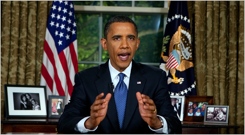
Plenty of prominent media figures were upset with President Obama over his substandard address to the nation last night ( full text ). While most are distraught, none seem to be doing what should be the essential journalistic task of the day: pointing out all of the factual misstatements the president made. So, in absence of a serious attempt at fact-checking from the legacy media, let us undertake some of our own. In all, the president misrepresented the federal government’s–and especially his cabinet’s–role in creating the conditions that led to the spill, the state of the nation’s oil reserves, and his own administration’s involvement with BP. Futhermore, his transition from discussing the Gulf spill to advocating “clean energy” legislation was a huge logical leap, and one that necessarily misrepresents the problems the nation faces with regard to energy. The latter was perhaps the president’s most subtle sleight of hand. He claimed the Gulf spill is “the most painful and powerful reminder yet that the time to embrace a clean energy future is now. Now is the moment for this generation to embark on a national mission to unleash America’s innovation and seize control of our own destiny.” Now, if the president had stated the spill is a reminder that the nation needs to get off of oil–that disasters like this are an unfortunate, if rare consequence of harvesting crude oil–he would have had a point. But that is not what he said. He claimed the disaster underscores the need for “clean” energy, which presumably does not include coal, the dirtiest of them all. But the Gulf spill has no bearing on coal energy. Also intended to promote the “clean energy” cause was Obama’s misleading statement that “Countries like China are investing in clean energy jobs and industries that should be right here in America.” In fact, as the Heritage Foundation notes , China “will account for nearly 45% of oil demand growth in the next five years, receives 70% of its energy from coal already, and is projected to nearly triple coal capacity by 2030.” Say what you will about clean energy or coal, but the president’s advocacy of his own energy agenda despite the facts was as obvious as it was unseemly. Moving forward, Obama also misrepresented the state of the oil industry itself. He claimed that Americans “consume more than 20% of the world’s oil, but have less than 2% of the world’s oil reserves. And that’s part of the reason oil companies are drilling a mile beneath the surface of the ocean – because we’re running out of places to drill on land and in shallow water.” “This howler,” writes John Hinderaker at Power Line, “is a favorite canard of Democratic politicians”:  As is so often the case, they are relying on the public’s ignorance. Most people don’t realize that in the U.S., oil isn’t counted as part of our “reserves” unless it is legally available for drilling. Thus, ANWR, to take one of many examples, isn’t counted toward the total “reserves.” The U.S. government could cause our reserves to skyrocket overnight by opening new areas, on land and in shallow water, to drilling. But the U.S. is the only country in the world that has deliberately chosen not to develop its own energy resources. No one else is that dumb. So the reason oil companies drill a mile beneath the water is not that there are not ample supplies of crude in other parts of the United States, but rather that the federal government does not permit drilling in so many of those areas. According to Kiplinger Magazine (by way of the American Thinker ), “untapped reserves are estimated at about 2.3 trillion barrels, nearly three times more than the reserves held by Organization of Petroleum Exporting Counties (OPEC) and sufficient to meet 300 years of demand-at today’s levels-for auto, aircraft, heating and industrial fuel, without importing a single barrel of oil.” Not surprisingly, the misdeeds of the oil industry were, of course, a frequent refrain in the president’s speech. But he also misrepresented that industry’s culpability by claiming “time and again, the path forward [to further regulation] has been blocked…by oil industry lobbyists.” What the president conveniently neglected to mention, however, was that BP has been an advocate of most of his energy agenda. As the Examiner’s Tim Carney reminds us : BP “has lobbied for tax hikes, greenhouse gas restraints, the stimulus bill, the Wall Street bailout, and subsidies for oil pipelines, solar panels, natural gas and biofuels… BP was a founding member of the U.S. Climate Action Partnership (USCAP), a lobby dedicated to passing a cap-and-trade bill. As the nation’s largest producer of natural gas, BP saw many ways to profit from climate legislation, notably by persuading Congress to provide subsidies to coal-fired power plants that switched to gas. Though the company left USCAP, it did not stop lobbying for cap and trade, and later “signed off” on Senate cap and trade legislation as well as explicitly lobbied for a higher gas tax. So Obama’s insistence the oil industry has opposed relevant regulations tooth and nail is less than accurate. While Obama was placing as much unearned blame at industry’s feet as possible, he was also sidestepping his own administration’s complicity in the crisis. He stated towards the beginning of his speech: A few months ago, I approved a proposal to consider new, limited offshore drilling under the assurance that it would be absolutely safe –- that the proper technology would be in place and the necessary precautions would be taken. That obviously was not the case in the Deepwater Horizon rig, and I want to know why. Well, perhaps he should ask his cabinet members–you know, the ones he just put in charge of the new commission investigating the incident. On March 31 in a speech at Andrews Air Force Base, he told the nation that Energy Secretary Steven Chu, Interior Secretary Ken Salazar, and climate czar Carol Browner had assured him that additional Gulf Coast drilling would be safe. But the president of course did not put the blame at their feet. In fact, as Byron York noted : [I]n this moment of crisis, Obama is relying on the same team that earlier gave him “the assurance that [offshore drilling] would be absolutely safe” — advice that he now openly says was wrong. And what is the “green team” telling him now? That it is impossible to stop the flow of oil into the Gulf. Politico’s Mike Allen channels West Wing thought this way: The Gulf gusher is a battle we can’t win. So we had to make this tragedy about something bigger than the liveshot of spewing oil. So having surrendered on the challenge of stopping the oil, Obama tried to redirect the public’s attention away from the spill and onto the political debate over a cap-and-trade bill. The short version of the strategy: Give up and change the subject. Like everything else Obama has tried so far in the Gulf crisis, it won’t work. Indeed. 

See the original post:
Doing the Job Media Won’t Do: Fact-checking Obama’s Gulf Spill Address

Double Shock: ABC Shows Gulf Residents Panning Obama’s Oil Spill Speech; ABC’s Katrina Focus Group Praised Bush in 2005

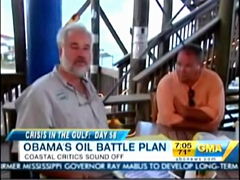
A tale of two disasters: On ABC’s Good Morning America this morning, weatherman Sam Champion’s piece included reaction from several residents of Florida, Alabama and Louisiana to President Obama’s oil spill speech, and found three outright critics and no defenders of the administration’s handling of the disaster. One woman exclaimed: “ What I would have liked to heard from him – that he actually had a plan .” The kindest review came from a man in Alabama who merely hoped the federal response would improve: “I think we’re seeing a change in how he’s handling the situation. And I hope it’s for the better.” Five years ago, after President Bush spoke in New Orleans a few weeks after Hurricane Katrina hit the Gulf coast, ABC assembled a focus group of six people displaced by the storm, and taking refuge in Houston’s Astrodome. But to the evident astonishment of ABC’s correspondent, not one member of that group would denounce President Bush, but instead leveled their criticism at local officials who failed to prepare the city ahead of time. As NewsBuster’s Brent Baker reported at the time : ABC News producers probably didn’t hear what they expected when they sent Dean Reynolds to the Houston Astrodome’s parking lot to get reaction to President Bush’s speech from black evacuees from New Orleans. Instead of denouncing Bush and blaming him for their plight, they praised Bush and blamed local officials. Reynolds asked Connie London: “Did you harbor any anger toward the President because of the slow federal response?” She rejected the premise: “No, none whatsoever, because I feel like our city and our state government should have been there before the federal government was called in.” She pointed out: “They had RTA buses, Greyhound buses, school buses, that was just sitting there going under water when they could have been evacuating people.” Not one of the six people interviewed on camera had a bad word for Bush — despite Reynolds’ best efforts. Reynolds goaded: “Was there anything that you found hard to believe that he said, that you thought, well, that’s nice rhetoric, but, you know, the proof is in the pudding?” Brenda Marshall answered, “No, I didn’t,” prompting Reynolds to marvel to anchor Ted Koppel: “Very little skepticism here.” You can read Brent Baker’s full item from 2005 here . (It’s also worth noting, ABC devoted a full hour of prime time to Bush’s 2005 speech, but — perhaps trying to help downplay expectations — provided only two minutes of analysis following Obama’s speech last night.) Coincidentally, a new poll released yesterday found Louisiana voters giving President Obama lower marks for his response to the oil spill than Bush’s response to Katrina. According to a report posted yesterday at FoxNews.com : Louisiana voters think President George W. Bush did a better job handling the aftermath of Hurricane Katrina than President Obama has done in the wake of the BP oil spill, according to a new poll. The Public Policy Polling survey showed 50 percent of state voters rated Bush’s performance in 2005 as better than Obama’s. Just 35 percent picked Obama…. Louisiana voters by no means are happy with the way the Bush administration handled the flooding in 2005. But while the PPP poll showed just a third of voters approved of the way Bush handled Katrina, the numbers were generally worse for Obama. Sixty-two percent said they disapproved of Obama’s handling of the crisis, compared with 58 percent for Bush. MRC intern Alex Fitzsimmons caught Sam Champion’s report from the Gulf this morning. Co-anchor Robin Roberts framed the reaction as one of “cautious optimism,” but the soundbites from the residents are much more negative than the reporters’ script: CO-ANCHOR ROBIN ROBERTS: People on the front lines of this spill, residents on the Gulf coast, watched President Obama’s address to the nation with cautious optimism. Sam Champion is in Pensacola, Florida and got some of their reactions. Good morning, Sam. WEATHERMAN SAM CHAMPION: Hey, good morning, Robin. Welcome back. We’ve spent a lot of time walking and talking with the people who live in this area. They’ve spent some time watching and waiting. And they really only have one course. You said it at the top of the show: action. Folks in Pensacola Beach usually come to the Flounder’s Chowder House to forget their worries. PRESIDENT OBAMA, HEARD ON THE RESTAURANT’S TV: Tonight, I’d like to lay out for you what the battle plan is going forward. CHAMPION: Tuesday, they faced him in wide-screen. UNIDENTIFIED WOMAN: What I would have liked to heard from him – that he actually had a plan. UNIDENTIFIED MAN: If we’re in a war, as he says we are, then why aren’t we bringing everybody into the picture that’s offered their help? CHAMPION: On Alabama’s Orange beach, a sense that seeing things firsthand may have made a difference for the president. UNIDENTIFIED MAN: I think we’re seeing a change in how he’s handling the situation. And I hope it’s for the better. CHAMPION: On New Orleans’ Bourbon Street, more skepticism. UNIDENTIFIED MAN: I think it’s lacking. I don’t think he’s responded to what we’re going to do about the cleanup issues. OBAMA IN SPEECH: Our top priority is to – CHAMPION: But even before the President spoke, frustration had already given way to anger. ED Valmont (sp?), Gulf coast resident: They said the inner waters were safe. We thought they were protected. CHAMPION: Ed Valmont usually harvests blue crabs off his back yard. On Tuesday, he only harvested oil. VALMONT: I mean that stuff’s like glue. All you got to do is just touch it and it’s on you forever. CHAMPION: But for people who live here, forever is too long. ALLEN PRIEST, Gulf coast resident: We’re not waiting on the government to really take over. CHAMPION: When little Sabine Bay faced a different kind of pollution ten years ago, Allen Priest’s neighbors cleaned it up themselves. Give them the tools and they say they will do it again. (To Priest) The President keeps saying that they want to leave the Gulf coast better than it is right now, after the spill. What does that mean to you? PRIEST: I don’t really think that’s totally our president’s job. I think it’s our responsibility as citizens to do that, if we care about this place. CHAMPION: I’ll tell you, Allen Priest said it. But a lot of other people said it, too. They trust the people they know. He believes his area won’t be polluted because there’s someone he knows watching the water. George. STEPHANOPOULOS: Okay, Sam.

Read the original:
Double Shock: ABC Shows Gulf Residents Panning Obama’s Oil Spill Speech; ABC’s Katrina Focus Group Praised Bush in 2005

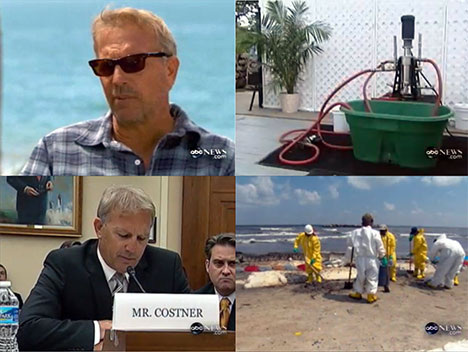
BP Buys 32 Oil Cleanup Machines from Kevin Costner (Video)

Photos: screen grabs, ABC One More Tool to Combat this Interminable Oil Spill A month ago I wrote something about Kevin Costner’s machine that can separate oil and water . Back then, most of us thought that the oil leaks in the Gulf of Mexico would soon be plugged and that this disaster would at least stop getting worse. Well, we know how that turned out… This catastrophe has been going on for so long that BP has had time to test one of … Read the full story on TreeHugger

Read this article:
BP Buys 32 Oil Cleanup Machines from Kevin Costner (Video)

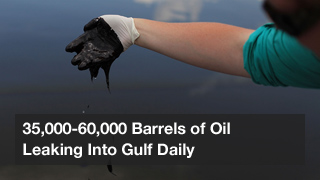
35,000-60,000 Barrels of Oil Leaking Daily

As the President offered hope that BP would get the oil spill under control, officials revised their estimate of how much oil is leaking into the Gulf of Mexico.

Read the original here:
35,000-60,000 Barrels of Oil Leaking Daily

Gallup Poll for June 16, 2010: Many Americans Say Gulf Beaches, Wildlife Will Never Recover

___ To see the various graphs, try clicking on this link. However, if it doesn't work, go to: gallup.com , and look for Poll Number 140762 _______________ June 16, 2010 Many Americans Say Gulf Beaches, Wildlife Will Never Recover Nearly all agree that full recovery will take 10 years or more by Lydia Saad PRINCETON, NJ — From what they have seen of the Gulf of Mexico oil spill rolling onto America's shores, nearly half of Americans (49%) believe that at least some of the affected beaches will never recover. Even more, 59%, believe normal levels for some animal species will never be restored. Predicted Timeline for Full Recovery of Gulf Shore Beaches, Wildlife (Including Fish and Birds) More generally, Americans foresee a very long road to recovery for both the U.S. beaches and wildlife affected by the BP oil spill. The vast majority believe it will be a decade or more, if at all, before either aspect of the Gulf environment is back to normal; few think a full recovery will happen within four years. Separately, Americans broadly agree that the oil spill will negatively affect the U.S. economy and the U.S. consumer. Roughly four in five believe the overall U.S. economy will be hurt, that gas prices will go up, and that food prices will increase. Possible Economic Effects of Gulf Oil Spill Women More Pessimistic Than Men About Undoing Oil Damage The most striking subgroup differences in views about the oil spill's impact are by gender, with women much more pessimistic than men. (Gallup has previously found women to be more concerned than men about environmental matters.) Sixty percent of women, compared with 37% of men, believe some Gulf beaches will never recover — a 23 percentage-point gap. Additionally, there is a 13-point gap between men's and women's perceptions of whether the affected wildlife will fully recover. Predicted Timeline for Recovery of Beaches Predicted Timeline for Recovery of Wildlife Women are also more likely than men to believe that gas prices will increase (83% vs. 74%), and that the U.S. economy in general will be hurt (88% vs. 78%). Bottom Line In his remarks when visiting the Gulf shoreline this week, as well as in his Oval Office address Tuesday night, President Obama has stressed the need for a long-term commitment to the oil spill cleanup. Americans may be getting impatient with BP and the federal government for not doing enough to cap the gushing oil rig and contain the leaked oil, but it appears they are resigned to a lengthy process to restore the beaches and wildlife, with perhaps limited success. Survey Methods Results for this USA Today/Gallup poll are based on telephone interviews conducted June 11-13, 2010, with a random sample of 1,014 adults, aged 18 and older, living in the continental U.S., selected using random-digit-dial sampling. For results based on the total sample of national adults, one can say with 95% confidence that the maximum margin of sampling error is

How to Travel Without Cash: Travel Tips from the Moneyless Man

Image credit: Periodista Digital From dumpster diving , to living without cash for a year , Mark Boyle—aka The Moneyless Man—has certainly inspired his fair share of debates around consumerism, sustainability, and the potential for living with less. Now he’s taking on the thorny subject of travel, sharing tips on how to get around without spending a dime. … Read the full story on TreeHugger

Read the original:
How to Travel Without Cash: Travel Tips from the Moneyless Man

Seventh Generation CIP Jeffrey Hollender Speaks Out on Chemical Reform

Image: Jason O’Halloran, Flickr Bills have been introduced in the U.S. House and Senate to reform the 1976 Toxic Substances Control Act (TSCA). Although it is barely on the radar of most news media and public awareness, this may be bigger than the gulf oil spill, health care, or even global climate change. In the words of Jeffrey Hollender, Chief Inspired Protagonist (CIP) of Seventh Generation , “this is probably the most important piec… Read the full story on TreeHugger

Follow this link:
Seventh Generation CIP Jeffrey Hollender Speaks Out on Chemical Reform