Tag Archives: health

Gold Coin Sellers Angered by New Tax Law Amendment Slipped Into Health Care Legislation Would Track, Tax Coin and Bullion Transactions

Those already outraged by the president's health care legislation now have a new bone of contention — a scarcely noticed tack-on provision to the law that puts gold coin buyers and sellers under closer government scrutiny. The issue is rising to the fore just as gold coin dealers are attracting attention over sales tactics. Section 9006 of the Patient Protection and Affordable Care Act will amend the Internal Revenue Code to expand the scope of Form 1099. Currently, 1099 forms are used to track and report the miscellaneous income associated with services rendered by independent contractors or self-employed individuals. Coin Dealers Flipping Starting Jan. 1, 2012, Form 1099s will become a means of reporting to the Internal Revenue Service the purchases of all goods and services by small businesses and self-employed people that exceed $600 during a calendar year. Precious metals such as coins and bullion fall into this category and coin dealers have been among those most rankled by the change. This provision, intended to mine what the IRS deems a vast reservoir of uncollected income tax, was included in the health care legislation ostensibly as a way to pay for it. The tax code tweak is expected to raise $17 billion over the next 10 years, according to the Joint Committee on Taxation. Taking an early and vociferous role in opposing the measure is the precious metal and coin industry, according to Diane Piret, industry affairs director for the Industry Council for Tangible Assets. The ICTA, based in Severna Park, Md., is a trade association representing an estimated 5,000 coin and bullion dealers in the United States. “Coin dealers not only buy for their inventory from other dealers, but also with great frequency from the public,” Piret said. “Most other types of businesses will have a limited number of suppliers from which they buy their goods and products for resale.” added by: im1mjrpain

Matt Lauer Turns Into Deficit Hawk, Asks Gingrich About ‘Funny Math’

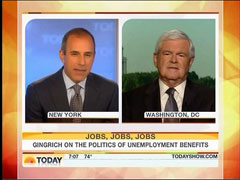
NBC’s Matt Lauer, suddenly turned into a deficit hawk, when he invited on Newt Gingrich on Tuesday’s Today show, to discuss the GOP’s refusal to extend unemployment benefits without paying for them, as he complained to the House Speaker that those same Republicans didn’t offer spending cuts to offset the Bush tax cut and pressed: “Is it funny math?” and “traditionally speaking when you cut taxes, don’t deficits go up as well?” Gingrich initially agreed that the deficit in the “short run” goes up but explained to the Today show anchor that “we proved with Reagan, with the three-year tax cuts in the 1980s” and “again with the Contract With America” that “job creating principles of cutting taxes are far better than the job killing principles of big government and regulation.” The following is the full interview as it was aired on the July 20 Today show: MATT LAUER: Alright, Savannah. Thank you very much. Former Republican Speaker of the House, Newt Gingrich, is a Fox News contributor and the author of the new book To Save America: Stopping Obama’s Secular Socialist Machine. Newt, good to see you. Good morning again. NEWT GINGRICH: Matt, good to see you. LAUER: Let, let me ask you to help me on the math here, alright? What Savannah just talked about, what the President talked about yesterday. You’ve got some Republicans coming out saying, “We’re not in favor extending, of extending these unemployment benefits that carry a price tag of about $33 billion unless there are offsetting cuts in spending.” They are the same Republicans, Newt, who didn’t ask for those offsetting spending cuts when they wanted to make permanent the Bush tax cuts with a price tag of over half a trillion dollars. Is it funny math? GINGRICH: No, I don’t think so. The second biggest concern of the American people after jobs is deficit spending and the fact that this president has been like a teenager with a credit card who has run up – he will have, if he serves eight years, under current plans, he will double the national debt. That is, that is he’ll borrow more than every previous president combined. The average American is beginning to respond with great concern about that amount of debt. LAUER: But traditionally speaking when you cut taxes, don’t deficits go up as well? GINGRICH: Only in the short run. That’s the other difference. I mean we proved with Reagan, with the three-year tax cuts in the 1980s, we proved again with the Contract with America, with the first tax cut in 16 years that, in fact, job creating principles of cutting taxes are far better than job killing principles of big government and regulation. If you look at Rick Perry, the governor of Texas, I think it was in 2007, Texas created more jobs than the other 49 states combined. And the reason was simple. It’s a much lower tax, much lower regulation state in which people found it more convenient and easier to start a business, invest in a company or create a job. [On screen headline: “‘To Save America’ Gingrich’s Formula For Fixing Country”] LAUER: Let’s talk about cutting, cutting the deficit here. You’ve said, you’re thinking more seriously now than ever about running for president. Let’s say I make you president right now. Congratulations. And I give you what a lot of people are predicting – a Republican-controlled House and Senate. That means you’ve got to make some really tough choices in terms of cutting this deficit. What are you willing to say? And name it by name, that you would be willing to cut right now to cut deficits. GINGRICH: First of all, you just may, create a nightmare for virtually every Democrat watching the show, so I apologize to them. But to, but to work out your scenario, in the four years I was Speaker of the House, the average rate of increase was 2.9 percent a year including all the entitlements. That is the lowest rate of increase since Calvin Coolidge in the 1920s. We did it by carefully setting priorities. LAUER: But- GINGRICH: Now, now just let me finish. LAUER: Okay, go ahead. GINGRICH: So, so we doubled, for example, investment in national health research at the National Institutes of Health while we were being very tough on other spending. I would start and I’d go through this budget pretty dramatically and I would eliminate a great deal of federal bureaucracy. I would reform unemployment compensation. I would reform workman’s comp at the state level. I would have a very pro-jobs, very pro-savings, very pro-take-home pay policy. When we reformed welfare, 65 percent of people on welfare either went to work or went to school and we saved billions and billions of dollars. That’s part of how we managed to balance the budget. Remember Matt… LAUER: Would, would you make cuts in Social Security and Medicare? GINGRICH: No, no. LAUER: Would you take those things on? GINGRICH: Well first, well first of all, and we’ve proven at the Center for Health Transformation with a book called Stop Paying the Crooks that there’s between $70 billion and $120 billion a year, that is paid to crooks in Medicare and Medicaid. So sure that, that, by the way, comes out to $700 billion to a trillion, two-hundred billion in savings over the next decade, just by not paying crooks in the federal health system. LAUER: This worst case scenario we just talked about for Democrats, the loss of both the House and the Senate. How likely is it, in your opinion? GINGRICH: About 50/50. It gets worse every month partly because what you just showed was the President with very shallow politics, assuming the American people are dumb enough to follow the latest headline and don’t realize the real problem with unemployment is this is a job killing administration and a job killing Democratic Congress and that’s why those people are unemployed. LAUER: Newt Gingrich. Newt it’s good to see you. Thanks for your time this morning. GINGRICH: Appreciate it. Thanks Matt.
Continue reading here:
Matt Lauer Turns Into Deficit Hawk, Asks Gingrich About ‘Funny Math’

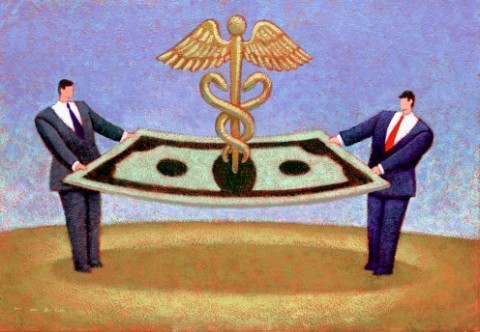
NYT: WH Defending Health Ins. Penalties As ‘Taxes’ In Court Despite Obama’s Vehement 2009 Denial

The truth comes out. Okay, it was always out there. It’s just that the Barack Obama and the folks in his administration were denying it. The issue in question is whether the individual mandate and penalties for not purchasing health insurance in the statist health care legislation commonly known as ObamaCare should rightly be considered taxes, or if they are something else. In a report dated Friday that appeared in the paper’s print edition at Page A14 on Sunday , Robert Pear at the New York Times noted that in legal proceedings, in response to litigation brought by state attorneys general, the administration is now characterizing the mandate and penalties as taxes. Note the subtle water-down that occurred between the web page’s title bar and the published article’s headline: When Congress required most Americans to obtain health insurance or pay a penalty, Democrats denied that they were creating a new tax. But in court, the Obama administration and its allies now defend the requirement as an exercise of the government’s “power to lay and collect taxes.” And that power, they say, is even more sweeping than the federal power to regulate interstate commerce. Administration officials say the tax argument is a linchpin of their legal case in defense of the health care overhaul and its individual mandate, now being challenged in court by more than 20 states and several private organizations. Under the legislation signed by President Obama in March, most Americans will have to maintain “minimum essential coverage” starting in 2014. Many people will be eligible for federal subsidies to help them pay premiums. In a brief defending the law, the Justice Department says the requirement for people to carry insurance or pay the penalty is “a valid exercise” of Congress’s power to impose taxes. Congress can use its taxing power “even for purposes that would exceed its powers under other provisions” of the Constitution, the department said. For more than a century, it added, the Supreme Court has held that Congress can tax activities that it could not reach by using its power to regulate commerce. While Congress was working on the health care legislation, Mr. Obama refused to accept the argument that a mandate to buy insurance, enforced by financial penalties, was equivalent to a tax. “For us to say that you’ve got to take a responsibility to get health insurance is absolutely not a tax increase,” the president said last September, in a spirited exchange with George Stephanopoulos on the ABC News program “This Week.” When Mr. Stephanopoulos said the penalty appeared to fit the dictionary definition of a tax, Mr. Obama replied, “I absolutely reject that notion.” Now that the legislation has passed, Team Obama has clearly changed its tune. What a surprise (not). As a refresher, what follows is the excerpt from the Obama-Stephanopoulos “spirited exchange” to which Pear referred that I posted last year (at NewsBusters ; at BizzyBlog ). In his annual exercise in legitimate journalism (the one that preceded it was when he moderated an April 2008 Democratic presidential debate and gave then-candidate Obama grief about his relationship with Jeremiah Wright), Stephanopoulos maneuvers an arrogant President into a de facto assertion that Barack Obama’s take on a word’s meaning is more important than the one found in the dictionary: STEPHANOPOULOS: …during the campaign. Under this mandate, the government is forcing people to spend money, fining you if you don’t. How is that not a tax? …. OBAMA: No. That’s not true, George. The — for us to say that you’ve got to take a responsibility to get health insurance is absolutely not a tax increase. What it’s saying is, is that we’re not going to have other people carrying your burdens for you anymore than the fact that right now everybody in America, just about, has to get auto insurance. Nobody considers that a tax increase. People say to themselves, that is a fair way to make sure that if you hit my car, that I’m not covering all the costs. STEPHANOPOULOS: But it may be fair, it may be good public policy… OBAMA: No, but — but, George, you — you can’t just make up that language and decide that that’s called a tax increase. Any… …. STEPHANOPOULOS: I — I don’t think I’m making it up. Merriam Webster’s Dictionary: Tax — “a charge, usually of money, imposed by authority on persons or property for public purposes.” OBAMA: George, the fact that you looked up Merriam’s Dictionary, the definition of tax increase, indicates to me that you’re stretching a little bit right now. Otherwise, you wouldn’t have gone to the dictionary to check on the definition. I mean what… …. STEPHANOPOULOS: I wanted to check for myself. But your critics say it is a tax increase. OBAMA: My critics say everything is a tax increase. My critics say that I’m taking over every sector of the economy. You know that. Look, we can have a legitimate debate about whether or not we’re going to have an individual mandate or not, but… STEPHANOPOULOS: But you reject that it’s a tax increase? OBAMA: I absolutely reject that notion. At time, I reacted by writing: “If you don’t think we have a problem of Orwellian proportions with Barack Obama, I’d suggest you re-read the excerpt. He thinks he’s above the dictionary, that words mean only what he says they mean.” It turns out that I understated the extent of the Orwellian problem. Not only does Team Obama want words only to mean what they say they mean, they want to be able to change the meaning of words at will to suit their purposes. Cross-posted at BizzyBlog.com .

See the original post here:
NYT: WH Defending Health Ins. Penalties As ‘Taxes’ In Court Despite Obama’s Vehement 2009 Denial

Wall Street Reform Passes–Big Banks Celebrate

(Reuters) – The Congress on Thursday approved the broadest overhaul of financial rules since the Great Depression and sent it to President Barack Obama to sign into law. By a vote of 60 to 39, the Senate passed a sweeping measure that tightens regulations across the financial industry in an effort to avoid a repeat of the 2007-2009 financial crisis. President Barack Obama will likely sign the bill into law next week, the White House said. The legislation, opposed by the banking industry, leaves few corners of the financial industry untouched. It establishes new consumer protections, gives regulators greater power to dismantle troubled firms, and limits a range of risky trading activities in a way that would curb bank profits. The Senate vote caps more than a year of legislative effort after Obama proposed reforms in June 2009. The House of Representatives approved it last month. Although Obama originally had pushed for bipartisan support for an overhaul of financial regulation, only three Republican senators voted in favor of the bill, along with 55 Democrats and two Independents. With Republicans poised for big gains in the November congressional elections, Democrats are eager to show voters that they have tamed an industry that dragged the economy into its deepest recession in 70 years. “I regret I can't give you your job back, restore that foreclosed home, put retirement monies back in your account,” said Democratic Senator Christopher Dodd, one of the bill's chief authors. “What I can do is to see to it that we never, ever again go through what this nation has been through.” Along with the health-care overhaul, Democrats can now point out that they have passed two far-reaching reform efforts that will likely shape American society for generations. It is not clear whether that will impress voters. The public's understanding of the regulatory revamp is very low, according to an Ipsos online poll released on Thursday. Of those polled, 38 percent had never heard of the reform, while 33 percent had heard of it but knew nothing about the legislation. Other polls show the public divided about its merits. The bill has also won Democrats few friends on Wall Street as wealthy donors have started to steer more campaign contributions to Republicans. Financial markets showed little reaction on Thursday. Investors said passage was already priced into banks' share prices. Bank stocks have followed the overall market lower since April, weighed down by poor U.S. economic data and the belief that more regulation could crimp profits down the road. JPMorgan Chase & Co said the bill would not compromise its business model but might hurt profitability. “We'll have some effect on revenues and margins and volumes,” its chief executive, Jamie Dimon, said on a conference call. As the largest U.S. derivatives dealer, JPMorgan could have the most to lose from the bill, which aims to curb lucrative trading in risky over-the-counter derivatives and force banks to end trading for their own profits. FEW CORNERS OF INDUSTRY UNTOUCHED Under the 2,300-page bill, mortgage brokers, student lenders and other financial firms will have to answer to a new consumer-protection authority, though auto dealers will escape scrutiny. Regulators, who scrambled to contain the damage from failing firms like Lehman Brothers in the last crisis, will have new authority to dismantle troubled firms if they threaten the broader economy. A council of regulators will monitor big-picture risks to the financial system and many large banks will have to set aside more capital to help them ride out times of crisis. Large private-equity and hedge funds will face more scrutiny from federal regulators, and credit-rating agencies could potentially see their entire business model upended. Much of the $615 trillion over-the-counter derivatives market will be routed through more accountable and transparent channels, and banks will have to spin off the riskiest of their swaps clearing desk operations. http://www.reuters.com/article/idUSTRE66E0MD20100715 added by: ScottyT

Proposed Law to Reform Use of Chemical Dispersants on Oil Spills

As of right now, oil companies engaged in cleanup operations after a spill (one particular one comes to mind) are not required to disclose which chemicals comprise the products they are using to contain or break up the oil. Therefore, BP isn’t required to reveal which chemicals make up the toxic dispersants it’s spraying in droves in the Gulf. It’s alarming that these standards don’t already exist to say the least, but at least one senator plans on doing something about it: Frank Lautenberg (D-NJ) announced he plans to introduce the Safe Dispe… Read the full story on TreeHugger

More here:
Proposed Law to Reform Use of Chemical Dispersants on Oil Spills

ABC’s Z. Byron Wolf Confused: Why Don’t Americans Support Awesome Dems?

The folks at ABC News are confused. Democrats are passing all this awesome legislation, they posit, so why are Americans acting so hostile and looking to hand Congress to the GOP? The key problems, ABC’s Z. Byron Wolf deduces , are that Democrats simply have not embraced liberalism enough and Americans have failed to perceive just how great the Democratic agenda has been. “The imminent passage of a tough new Wall Street Reform bill,” wrote Wolf, pictured right, on ABC’s website, “will cap off a wildly productive two years for Democrats in Washington – they will have passed two pieces of sweeping legislation and an enormous $800 billion stimulus bill to deal with the ailing economy.” Wolf goes on to wonder why those three pieces of legislation haven’t benefited Democrats’ electoral prospects. Let’s see: 6% of Americans believe the stimulus bill created jobs, a strong majority favors repealing the health care bill, and almost 80% of Americans polled have little or no confidence that the financial reform bill will achieve its stated objectives. Is Wolf still confused? He goes on to write that Democrats’ problems stem from the fact that they just have not embraced liberalism to a great enough degree. “Rather than energize the electoral base that helped put Democrats in control of Congress in 2006 — and President Obama in the White House in 2008,” Wolf writes, “the accomplishments have often frustrated activists, who see compromised ideals and watered-down bills instead of legislative victories.” If this is supposed to be an explanation for Democrats’ poor prospects in November, it falls well short. First of all, the districts where Dems are vulnerable are by and large ones they picked up in 2006 and 2008 from sitting Republicans that couldn’t shake the tarnished Republican name. Now that Bush is a memory, red state Dems need to court moderate Republicans, not cater to the far left. Furthermore, the number of Americans who identify themelves as “conservative” is at its highest point since 1994 , when Republicans walloped Dems in the midterm elections. Forty-nine percent of the nation believes that Democrats are too liberal, up 10 points from 2008. Only 10 percent believe they are too conservative. A shift to the left is not going to be a winning strategy. Wolf continues: While Republicans  have, since President Bush left office, instituted an almost myopic, party-wide focus on spending and debt, Democrats  have struggled to rally behind their versions of health reform and Wall Street  reform. They could barely find enough votes to pass the bills. And despite millions of jobs Democrats say were created by the $862 billon stimulus bill, the unemployment rate remains high, and is not expected to come down any time soon. “I think the public doesn’t quite perceive (the accomplishments) because they don’t see much change in their everyday lives. They’re still having trouble finding work,” said Donald Wolfensberger, director of the Congress Project at the Woodrow Wilson Center. Got it? Obama and congressional Democrats have made fantastic accomplishments, but the American people are too dumb, distracted, or removed to perceive it. These three defenses of the Democratic Party in the face of intense public opposition — that they have been politically successful, that they have not embraced the far-left elements of the party, and that Americans are generally unable to perceive just how awesome they are — are tired leftist talking points. And with liberal pundits and politicos parroting them nonstop, is it any wonder Americans are ready for some house (and Senate) cleaning?

The rest is here:
ABC’s Z. Byron Wolf Confused: Why Don’t Americans Support Awesome Dems?

Eco Chef iPhone App for 10-Minute Raw Organic "Junk" Food (Video)

Image via EcoChef When we think of raw organic foods, we usually thing of highly healthful meals. But chef Bryan Au has a new iPhone app that shows how to make favorite “junk” foods in under 10 minutes. From pizza to lasagna, from burgers to desserts, raw organic is suddenly an easy way to make things other than salads and dips. Well, things that at least seem like meals other than salads and dips. … Read the full story on TreeHugger

The rest is here:
Eco Chef iPhone App for 10-Minute Raw Organic "Junk" Food (Video)

Fight Obesity With 10 Miles of Cycle Tracks Per State

Photo Tobyotter via flickr. Harvard’s Anne Lusk is a Department of Nutrition researcher extremely interested in the ways bicycles can help our overweight society. Her most recent publication documents research she and colleagues did using data from the famous Nurses Health Study II and compared biking and fast walking and their surprising role in keeping women slimmer..for just a few minutes of exercise each day. “Adult obesity rates increased in 28 s… Read the full story on TreeHugger

Go here to read the rest:
Fight Obesity With 10 Miles of Cycle Tracks Per State

Is Overpopulation a Green Myth?

Image via Greenpacks We hear it all the time, and have heard it since Malthus : That overpopulation is the primary cause of the world’s environmental ills. It makes sense in simple logical terms: The more people there are consuming natural resources, the greater a threat humanity poses to exhausting them. Hard to argue with that. But the issue is of course more complex — and there’s an interesting back-and-forth over at Grist on the subject to prove it. O… Read the full story on TreeHugger

See more here:
Is Overpopulation a Green Myth?

We Are a Nation of Oiloholics

Image credit: Napalm filled tires /Flickr This post was written by Colin Beavan, author of No Impact Man and director of NoImpactProject.org , which helps people choose lifestyles that are better for them and better for the planet. Question: When an alcoholic leaves a bar, gets behind the wheel and drunkenly drives into his third or fourth wreck, do you blame the bartender who served the drinks or the alcoholic who drank them? Now answer this: When a society addicted to greater and greater fossil fuel use experience… Read the full story on TreeHugger

Go here to see the original:
We Are a Nation of Oiloholics