Here comes the cinephile debate of the day: After polling 846 film experts, BFI’s Sight & Sound declared Alfred Hitchcock’s Vertigo to be the #1 greatest film of all time, topping Orson Welles’ Citizen Kane , Yasujirō Ozu’s Tokyo Story , and classics from Renoir, Murnau, Kubrick, and more of your favorite all-timers. It’s a triumph long in coming for the Hitchcock pic, which only first made Sight & Sound’s once-a-decade list in 1982 and has been working its way up the ranks of critical opinion since. Does the 2012 poll finally have it right? Culled from Top Ten lists from 846 critics, academics, writers, and programmers, Sight & Sound’s GOAT survey is at its widest to date. The full ten: The Critics’ Top 10 Greatest Films of All Time 1. Vertigo (Hitchcock, 1958) 2. Citizen Kane (Welles, 1941) 3. Tokyo Story (Ozu, 1953) 4. La Règle du jeu (Renoir, 1939) 5. Sunrise: a Song for Two Humans (Murnau, 1927) 6. 2001: A Space Odyssey (Kubrick, 1968) 7. The Searchers (Ford, 1956) 8. Man with a Movie Camera (Dziga Vertov, 1929) 9. The Passion of Joan of Arc (Dreyer, 1927) 10. 8 ½ (Fellini, 1963) Somewhere out there, Kim Novak is raising her fist in victory while William Friedkin – who told Movieline Citizen Kane set the bar for cinematic greatness so high, trying to match it is what keeps him going – is probably shaking his damn head. Meanwhile, 358 filmmakers were polled for a separate director’s choice, yielding some interesting differences in opinion: The Directors’ Top 10 Greatest Films of All Time 1. Tokyo Story (Ozu, 1953) 2. 2001: A Space Odyssey (Kubrick, 1968) and Citizen Kane (Welles, 1941) (tie) 4. 8 ½ (Fellini, 1963) 5. Taxi Driver (Scorsese, 1980) 6. Apocalypse Now (Coppola, 1979) 7. The Godfather (Coppola, 1972) and Vertigo (Hitchcock, 1958) (tie) 9. Mirror (Tarkovsky, 1974) 10. Bicycle Thieves (De Sica, 1948) It’s interesting to note the divide between critics’ and filmmakers’ ranking of Vertigo , which is a more populist-romantic choice in ways than Citizen Kane ; perhaps unsurprisingly, the directors’ list is much more auteur-heavy in its leanings. But let’s open this up to discussion: Is Vertigo really the best film of all time? (Is it even the best Hitchcock of all time?) Have at it in the comments below! Follow Jen Yamato on Twitter . Follow Movieline on Twitter .
Throughout the ’70s and into the first part of the ’80s, it was hard to ignore singer/songwriter/actor/sometimes talk show host and best-friend of the Muppets Paul Williams. He won Grammys and even an Oscar for hits he wrote including “We’ve Only Just Begun,”, “Rainy Days on Mondays,” “Evergreen,” “Just an Old Fashioned Love Song” and “Rainbow Connection.” Barbra Streisand, The Carpenters and even Kermit the Frog are among the artists he wrote super-hits for. Below, Paul Williams gives us his top ten movie songs of all time and dishes insight on Stephen Kessler’s documentary about him, Paul Williams Still Alive , about his raging ascent and crashing fall and return to form… Johnny Carson first brought the artist onto the Tonight Show as the swinging ’70s were just beginning. He did television, movies, concerts. If there was a group of “It-guys” in that crazy decade, Williams would surely have been a part of that cadre of people at the center of all that spectacle. But as the ’80s wore on and into the ’90s Paul Williams all but disappeared from the center of it all. Drugs and booze did him in for a while, though he came roaring back though via a less flashy route. Enter fan and Oscar-nominated filmmaker Stephen Kessler. He had long been a fan of Williams as a teen growing up in Queens, NY and his songs which he described as about “depression, loneliness and alienation,” and set out to find Williams and make a documentary. Williams said ‘yes’ but he was hardly a willing participant, at least initially, as Williams told Movieline. “By the time I decided to go along, he had spent a lot of time and a lot of money. I didn’t want to flat out say no and didn’t know how to say no.” Williams added that he thought there was nothing worse than some older famous guy trying to reach for that last bit of notoriety. Kessler is very present in the film, which goes against most documentary standards unless you’re Michael Moore or Morgan Spurlock. With Williams reluctant initially to open up and only providing limited access, the story unfolds interweaving a treasure-trove of ’70s pop culture which Paul is at the center and Kessler’s desire to get at his core and open up. I’m an actor, I can ignore the camera if I want to. But it’s exhausting to try and pretend I don’t notice the camera,” said Williams. “I didn’t want to do that, it seemed ridiculous.” One thing cameras caught and the film surfaces, decades later, is footage of Williams, high, while doing late night talk shows. Now 22 years sober, it’s a painful reminder of his past life and he even said during the film that he didn’t want his daughter to see that. But he relents and said he hopes it will help others. “I became a shallow ride and my behavior was totally unacceptable. One of the best things I did was to say to keep that footage in the movie. I think by leaving in you get a sense of how bad it got,” he said. “[There is] a sense of real disappointment and leading edge of shame. In a certain context it’s hard to watch, but you get a sense that recovery works. You see the yin and yang of the whole deal and you see that now, my life is such a gift. I hope I can make a difference… I love my life. And I’m blown away by the reaction.” PAUL WILLIAM’s TOP 10 MOVIE SONGS: Rock Around the Clock by Bill Haley, Blackboard Jungle (1955) Main title theme by Elmer Bernstein, The Man with a Golden Arm (1955) Lose Yourself by Eminem/Bass/Resto, 8 Mile (2002) When You Wish Upon a Star by Harline/Washington Pinnochio (1940) The Man That Got Away by Arlen /Gershwin, A Star is Born (1954) With a Song in My Heart by Rodgers/Hart, With A Song in my Heart (1954) Somewhere by Bernstein/Sondheim, West Side Story Moon River by Mancini/Mercer, Breakfast at Tiffany’s (1961) Alfie by Bacharach/David, Alfie (2004) Streets of Philadelphia by Bruce Springsteen, Philadelphia (1993) Born To Be Wild by Dennis Edmonton AKA: Mars Bonfire, Easy Rider (1969) And what are your favorites? Paul Williams Still Alive opens in NYC today. Follow Brian Brooks on Twitter . Follow Movieline on Twitter .
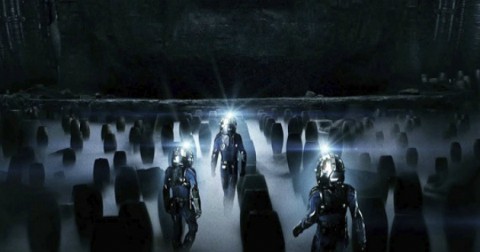
Ridley Scott’s Prometheus opens stateside today, which means no more tiptoeing around spoilers for those who’ve seen it. ( Obviously, spoilers will follow. You’ve been warned. ) The number one complaint among folks who have now seen the highly anticipated Alien kinda-prequel? So. Many. Unanswered. Questions. So let’s jump right into the spoiler goo and get to deciding (and, hopefully, answering) the biggest question prompted by Scott’s gorgeous, murky space opus that is left yet unanswered. I’ll start: WHY? Why does pretty much anyone in Prometheus make any of the decisions they make? Like… – Holloway (Logan Marshall-Green) with the helmet-taking off. Really, is sniffing (and contaminating) the alien world atmosphere on the planet you just landed on and know nothing about such a good idea? – Vickers (Charlize Theron), running in the one direction that will lead her to being squashed by a giant falling spaceship? – Millburn the dumb biologist (Rafe Spall), who just wants to reach out and make friends — even with the squishy alien penis-snakes? – Space crew guy, walking straight up to his recently deceased, re-animated fellow shipmate who has spider-crawled his way across a space desert to space-murder everyone? Most of these aren’t necessarily unanswered questions, just incredibly stupid decisions that inform and support the characters in facepalm-worthy strokes. Holloway is a risk-taker! Vickers is a sheltered, prideful ice queen with probably little field experience who would rather try to outrun death than roll, like her unassuming and practical brunette counterpart, out of its way! Crew guy is, well, a redshirt, for lack of a better term. Yes, yes. There are reasons to be found here, if not particularly great ones. The bigger questions have to do with two still-opaque entities: The Engineers and David, the increasingly creepy mayhem bot, Lawrence of Robotica. In the prologue we see one Engineer take a dose of black space goo and tumble, dead and transmorphing, into the water — thus presumably starting human life on Earth. So what is the goo? Prometheus builds a tech-driven world filled with great flying ships and alien holograms and C-section machines but is more concerned with ideas: Of creators and creation, of life and death cycling endlessly across the universe between humans and aliens, parents and offspring, scientists and their inventions. All children want to see their parents dead, according to David, who seems to be counting himself in that equation. What is the goo, then? Is it the proto-material of a xenomorph? How does it work, exactly? Why would anyone feed it to the cute Tom Hardy-looking guy? And who created the Engineers, anyway? Does it even matter when the real question is asking why we create, and in the process, destroy? The brilliance of Prometheus ‘s stubborn insistence on not feeding us the answers is that they’re not really important in the grand scheme of things, unless you require your movies to make sense. You know what else refuses to share vital information, instead choosing to provoke and see what happens? David. David, who has spent years in space flight amassing the breadth of human knowledge and yet cannot feel (or can he?), who has the answers — or, at least, the instructions the Engineers have written in their mystery language on the sides of their sweaty weapons of mass destruction like how-to manuals — and yet can’t understand why it is that Noomi Rapace’s Elizabeth Shaw MUST understand. David, played marvelously by Michael Fassbender, remains the biggest mystery . He’s tasked with one directive: Help Weyland find a way to live forever. You could build a strong case that everything David does is indeed in service of this goal. Weyland’s mistake is in trusting a machine that doesn’t think in human terms, but in practical ones; if there’s no alien magic out there to Benjamin Button old man Weyland back into handsome, young Guy Pearce, David finds another way to help his master live forever: Through his legacy, by altering the course of human history (gladly, it seems) via one or two devious deceptions. Consider the legacy of the man at the center of David’s favorite film, as seen in Prometheus ‘s sublime opening sequence. T.E. Lawrence was born in 1888, helped upset order in the Arab world in 1916, was immortalized on celluloid in 1962’s Lawrence of Arabia , and then, years later in the world of Prometheus , inspired an android to not only imitate his blond coif but instigate the beginnings of the Alien universe in 2093. Lawrence is really the key to understanding David; in helping Weyland achieve his immortality by way of launching the destruction of humanity, David is immortalizing himself, and a part of me thinks that a part of him yearns to express this measure of often foolhardy human emotion. Or maybe he’s just designed to be a close, but not close enough, imitation of the humans who built him? The more I think of David as a stand-in for Prometheus the movie at large, the less I care that Idris Elba figured out in five minutes what the Engineers were up to on this rinky dink planet, or that we’ll never know what David whispered to the last remaining Engineer, a la ScarJo and Bill Murray in Lost in Translation . Those quibbles seem minor given the vast provocations the film leaves behind. To an aggravatingly obvious extent, the gaping abyss of understanding that Prometheus leaves puts us, the viewer, in the position of Shaw — still searching, desperately, for answers, with only a soulless computer brain as her guide. We are Shaw, and maybe the internet is our David, offering knowledge and spoilers at our fingertips but, unless Ridley Scott and writers Jon Spaihts and Damon Lindelof hop on a Reddit AMA session, no ready answers and plenty to be wary of. Big things come in small packages, and that goes for space goo, blond robots, and universe-expanding ideas. So, all that said, what unsolved mysteries irked you the most in Prometheus ? Sound off in the spoiler-friendly comments below and let’s figure this sucker out. — Our colleagues at (PMC-owned) Beyond the Trailer pose a relevant question: “Is Prometheus an intellectual sci-fi thriller, or a pseudo-intellectual sci-fi thriller?” See what other real folks say in their impromptu exit poll. Follow Jen Yamato on Twitter . Follow Movieline on Twitter .
Ridley Scott’s Prometheus opens stateside today, which means no more tiptoeing around spoilers for those who’ve seen it. ( Obviously, spoilers will follow. You’ve been warned. ) The number one complaint among folks who have now seen the highly anticipated Alien kinda-prequel? So. Many. Unanswered. Questions. So let’s jump right into the spoiler goo and get to deciding (and, hopefully, answering) the biggest question prompted by Scott’s gorgeous, murky space opus that is left yet unanswered. I’ll start: WHY? Why does pretty much anyone in Prometheus make any of the decisions they make? Like… – Holloway (Logan Marshall-Green) with the helmet-taking off. Really, is sniffing (and contaminating) the alien world atmosphere on the planet you just landed on and know nothing about such a good idea? – Vickers (Charlize Theron), running in the one direction that will lead her to being squashed by a giant falling spaceship? – Millburn the dumb biologist (Rafe Spall), who just wants to reach out and make friends — even with the squishy alien penis-snakes? – Space crew guy, walking straight up to his recently deceased, re-animated fellow shipmate who has spider-crawled his way across a space desert to space-murder everyone? Most of these aren’t necessarily unanswered questions, just incredibly stupid decisions that inform and support the characters in facepalm-worthy strokes. Holloway is a risk-taker! Vickers is a sheltered, prideful ice queen with probably little field experience who would rather try to outrun death than roll, like her unassuming and practical brunette counterpart, out of its way! Crew guy is, well, a redshirt, for lack of a better term. Yes, yes. There are reasons to be found here, if not particularly great ones. The bigger questions have to do with two still-opaque entities: The Engineers and David, the increasingly creepy mayhem bot, Lawrence of Robotica. In the prologue we see one Engineer take a dose of black space goo and tumble, dead and transmorphing, into the water — thus presumably starting human life on Earth. So what is the goo? Prometheus builds a tech-driven world filled with great flying ships and alien holograms and C-section machines but is more concerned with ideas: Of creators and creation, of life and death cycling endlessly across the universe between humans and aliens, parents and offspring, scientists and their inventions. All children want to see their parents dead, according to David, who seems to be counting himself in that equation. What is the goo, then? Is it the proto-material of a xenomorph? How does it work, exactly? Why would anyone feed it to the cute Tom Hardy-looking guy? And who created the Engineers, anyway? Does it even matter when the real question is asking why we create, and in the process, destroy? The brilliance of Prometheus ‘s stubborn insistence on not feeding us the answers is that they’re not really important in the grand scheme of things, unless you require your movies to make sense. You know what else refuses to share vital information, instead choosing to provoke and see what happens? David. David, who has spent years in space flight amassing the breadth of human knowledge and yet cannot feel (or can he?), who has the answers — or, at least, the instructions the Engineers have written in their mystery language on the sides of their sweaty weapons of mass destruction like how-to manuals — and yet can’t understand why it is that Noomi Rapace’s Elizabeth Shaw MUST understand. David, played marvelously by Michael Fassbender, remains the biggest mystery . He’s tasked with one directive: Help Weyland find a way to live forever. You could build a strong case that everything David does is indeed in service of this goal. Weyland’s mistake is in trusting a machine that doesn’t think in human terms, but in practical ones; if there’s no alien magic out there to Benjamin Button old man Weyland back into handsome, young Guy Pearce, David finds another way to help his master live forever: Through his legacy, by altering the course of human history (gladly, it seems) via one or two devious deceptions. Consider the legacy of the man at the center of David’s favorite film, as seen in Prometheus ‘s sublime opening sequence. T.E. Lawrence was born in 1888, helped upset order in the Arab world in 1916, was immortalized on celluloid in 1962’s Lawrence of Arabia , and then, years later in the world of Prometheus , inspired an android to not only imitate his blond coif but instigate the beginnings of the Alien universe in 2093. Lawrence is really the key to understanding David; in helping Weyland achieve his immortality by way of launching the destruction of humanity, David is immortalizing himself, and a part of me thinks that a part of him yearns to express this measure of often foolhardy human emotion. Or maybe he’s just designed to be a close, but not close enough, imitation of the humans who built him? The more I think of David as a stand-in for Prometheus the movie at large, the less I care that Idris Elba figured out in five minutes what the Engineers were up to on this rinky dink planet, or that we’ll never know what David whispered to the last remaining Engineer, a la ScarJo and Bill Murray in Lost in Translation . Those quibbles seem minor given the vast provocations the film leaves behind. To an aggravatingly obvious extent, the gaping abyss of understanding that Prometheus leaves puts us, the viewer, in the position of Shaw — still searching, desperately, for answers, with only a soulless computer brain as her guide. We are Shaw, and maybe the internet is our David, offering knowledge and spoilers at our fingertips but, unless Ridley Scott and writers Jon Spaihts and Damon Lindelof hop on a Reddit AMA session, no ready answers and plenty to be wary of. Big things come in small packages, and that goes for space goo, blond robots, and universe-expanding ideas. So, all that said, what unsolved mysteries irked you the most in Prometheus ? Sound off in the spoiler-friendly comments below and let’s figure this sucker out. — Our colleagues at (PMC-owned) Beyond the Trailer pose a relevant question: “Is Prometheus an intellectual sci-fi thriller, or a pseudo-intellectual sci-fi thriller?” See what other real folks say in their impromptu exit poll. Follow Jen Yamato on Twitter . Follow Movieline on Twitter .
The 10 years that we are told at the beginning of Wrath of the Titans have passed since Perseus (Sam Worthington) defeated the Kraken may not seem like long enough, especially when you consider that it’s only been two since the Clash of the Titans remake was released, Kraken-like, on an unsuspecting populace. It was sufficient time, anyway, for Worthington to grow out his hair, so that in Wrath of the Titans he sports a soft cap of curls to go with his peaceful life among the humans. He’s lost a wife but gained a son and another pretext to propel a franchise whose fate was sealed once Avatar ’s numbers started rolling in. That it was going to happen was certain; how it happened was of secondary concern. Greek mythology feels particularly ill-used as a framework for narrative standards this low. Wrath (and who knows the source of the titular rage, they’re just mad , OK?) uses some of the names we now know third- or fourth-hand (I’m not sure where I’d be without The Mighty Hercules , which feels like an AP Classics course by comparison) and adds a few faintly recognizable accoutrements — Zeus’s thunderbolt, Pegasus — in what plays out as a generic “save the world” plot. Demigod Perseus is being called back to the realm of the gods by his father, Zeus (Liam Neeson) to help stem the weakening of his powers caused by waning human devotion. Perseus’s jealous brother Ares (Édgar Ramírez, from Carlos ) had turned to the dark side and Hades (Ralph Fiennes) is still rotting in hell, along with his (and Zeus’s) father, Kronos, who is threatening to unleash his wrath on the world, presumably because his “voice” is indistinguishable from that of an 8-year old burping the alphabet. I’d be mad too. The set-up is put across in the strictest expositional terms. The real progression here is one of firepower — specifically the movement from fireballs that streak across the screen to fire clouds that fill the heavens and everything below. Director Jonathan Liebesman ( Battle: Los Angeles ) brings his signature frenetic pacing to the table, starting the CGI thrashings immediately and growing less and less concerned about whether the story keeps up. The animating theme — Perseus’s ambivalence about his father and his powers — is dispatched in perfunctory doses between disorienting battles with fire-breathing beasts. When he expresses doubts about helping his father, the raffish Agenor (Toby Kebbell), son of Poseidon (played, briefly, by Danny Huston), clears them up with this reply: “Yesterday I was in chains, today I’m here, trying to save the universe. Jump in.” An action/effects showcase like this one is not the place to turn for nuanced characterization, but the script (by Dan Mazeau and David Leslie Johnson, story by Greg Berlanti) seems to defy even the few opportunities it has to make us care. Even the occasional swipes at campy self-awareness (“Don’t give me the big speech,” Agenor says at a critical moment; “Eh, I wasn’t planning to,” Worthington replies) feel tossed off, rather than part of developing an actual tone. It would be a real shame, with this much money and this many effects artists, if there were not a few purely visual wows. Wrath manages exactly two, and not where you might expect. The first is in the form of Rosamund Pike, who plays Andromeda (re-cast since the previous film), warrior queen of the whatever. With her bluebird eyes and regal bearing, Pike manages to telegraph human warmth and pull off a sculpted boob plate at the same time. And it is a welcome surprise that rather than the usual stamping, earth-shuddering, many-mouthed thingies inevitably dreamed up in computer bays to terrorize heroes like this one, the most frightening is basically a giant, one-eyed dude. A showdown with a Cyclops and his pals is genuinely thrilling and proceeds with relative coherence. After that the gang finds the dotty fallen god Hephaestus (Bill Nighy), a sort of vintage arms dealer, and for a few minutes Wrath starts to cruise along like it’s actually going somewhere. That feeling is brief, and before long we’re back to a few anodyne exchanges (Neeson and Fiennes seem particularly glib, swinging their beards around in a movie they’ll never watch) between fetishized explosions. “This is where people used to come to worship the gods,” Perseus says to his franchise-extending young son (John Bell) as they pick through a temple in disarray. Yeah, my thoughts exactly. Follow Michelle Orange on Twitter . Follow Movieline on Twitter .
Homeless Hotspots features profiles of some of the people carrying wi-fi signals, along with a suggested fee to be paid for the service. Screenshot from http://homelesshotspots.org We love to be connected. Thanks to wireless 3G networks, it’s easier than ever to check email and Twitter, talk on the phone, pay your bills, watch videos and post pictures from virtually anywhere and at any time. But it’s… Broadcasting platform : Vimeo Source : core77.com Discovery Date : 22/03/2012 17:52 Number of articles : 2
Joseph Gordon-Levitt and his friend (and 500 Days of Summer co-star) Zooey Deschanel are adorable together. Want proof? Broadcasting platform : YouTube Source : Gossip Cop Discovery Date : 28/12/2011 18:05 Number of articles : 2
In a video that has recently hit the Web, one clever kitty shows how he can swipe at the flying fruit in Halfbrick’s Fruit Ninja HD faster and more accurately than most humans. The video, which Halfbrick recently mentioned in a Twitter update, proves that while curiosity might have killed the cat, it can also serve to slam one’s Game Center friends when it comes to the Fruit Ninja leaderboard. Video:… Broadcasting platform : YouTube Source : Apple iPhone Apps Discovery Date : 28/12/2011 21:27 Number of articles : 2
In a video that has recently hit the Web, one clever kitty shows how he can swipe at the flying fruit in Halfbrick’s Fruit Ninja HD faster and more accurately than most humans. The video, which Halfbrick recently mentioned in a Twitter update, proves that while curiosity might have killed the cat, it can also serve to slam one’s Game Center friends when it comes to the Fruit Ninja leaderboard. Video:… Broadcasting platform : YouTube Source : Apple iPhone Apps Discovery Date : 28/12/2011 21:27 Number of articles : 2
A mom's concern about a racy chant erupts from complaint to controversy. Daughter booted from the squad after mom voices concerns about the chants. http://news.yahoo.com/video/entertainment-15749636/mom-complains-about-racy-chee… added by: MotherForTruth