Tag Archives: ideas

‘Prometheus’: Could There Be A Sequel?

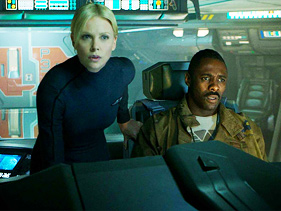
Co-writer Damon Lindelof tells MTV News if there were a follow-up, ‘it wouldn’t be ‘Alien.’ ‘ By Kevin P. Sullivan Charlize Theron and Idris Elba in “Prometheus” Photo: 20th Century Fox In the wake of the mind explosion that was Ridley Scott’s ” Prometheus ,” both fans and haters have been curiously posturing about what it could all mean and whether a sequel is likely or even possible. Though after a solid opening weekend, the fate of a “Prometheus” sequel may now lie in the hands of a Fox executive instead of the creative talent, we spoke with co-writer Damon Lindelof about whether the events and ideas in “Prometheus” leave an opening for a follow-up. Spoilers ahead. Much of the philosophy in “Prometheus” revolves around the unsatisfying nature of ultimate answers, and the film purposely avoids resolving some of the story’s lingering questions. So could a sequel exist without contradicting the ideas of the original? Lindelof told us that “Prometheus” was always intended to be a stand-alone film, but there is the possibility for more story. “The conversations that we had about the story of ‘Prometheus’ and how it would end were always predicated on the idea that there would not be a sequel, that a sequel was not a foregone conclusion, and that the movie itself had to have a feeling of being complete,” Lindelof said. “That being said, we also wanted the audience to feel that, like, if there were a sequel to ‘Prometheus,’ it wouldn’t be ‘Alien.’ ” That idea of a separate narrative arc from “Alien” led to the loose end of Shaw flying off to find the Engineers, so that if a sequel were to happen, it would take the audience to unfamiliar territory. “Something needed to happened at the end of this movie that clearly steered and announced that the direction of the trajectory of this story moving forward was not going to head toward LV-426 and a crashed, derelict ship with a Space Jockey with an exploded chest surrounded by eggs, that Shaw and David were headed in a different direction that was probably not going to result in that,” Lindelof said. “Those two things were sort of simultaneous to each other, so you’re both saying, ‘We want this movie to stand on its own, but we also acknowledge that it needs to end in a way that is very clear that if the story were to progress (if there were a sequel) ‘ We tried to thread the needle between the two ideas.” If the concept of no sequel to “Prometheus” upsets you because of the remaining mysteries, Lindelof suggests you look toward Scott for your answers, because he has them. “Then, of course, for all this talk of unanswered questions or the characters theorizing but not really getting their theories proved or, more importantly, for getting their makers to answer for the condition of the movie, Ridley and I and Jon [Spaihts] all discussed what we felt those answers were and came to agreement on them, so despite whatever slings and arrows come our way, this is not a case of, ‘Well, we didn’t know, so we didn’t bother trying,'” Lindelof said. “We definitely knew, and Ridley decided that the more interesting movie was one where we didn’t explicitly spell that stuff out.” So because Scott designed the movie to be the way that it is, those questions should drive you want more, just like Shaw at the end of the film, but Lindelof promised that the answers you might be searching for could be hidden inside “Prometheus.” “I really believe — and this is not shamed hucksterism — that upon multiple viewings of the movie or just entering into conversation with people who have seen it, there are a lot more answers there than people think there are and room for theories, but the movie needed to end in a way that is Shaw still searching,” he said. “She is not satisfied with the answers that she got. I think that’s very indicative, hopefully, if Shaw is supposed to be the audience proxy, they’re supposed to be feeling the same way that she is at the end of the movie.” For all the “Lost” fans out there, this might all sound like a familiar song and dance, especially coming from Lindelof, and the writer knew he was in for that comparison when he took on Scott’s orders. “To be completely candid, I knew that I’d eat some s— for that for the rest of my career, if there is no sequel to ‘Prometheus,’ but did it anyway, and had Ridley asked me to do it the other way, I would have done that too,” Lindelof said. “This movie is about realizing his vision. He’s only directed three science-fiction films, and now ‘Prometheus’ is one of them, and if he told me to jump off a bridge, I would.” Check out everything we’ve got on “Prometheus.” For breaking news, celebrity columns, humor and more — updated around the clock — visit MTVMoviesBlog.com . Related Videos Experts React To The ‘Prometheus’ Trailer
Read the rest here:
‘Prometheus’: Could There Be A Sequel?

‘Prometheus’: Is There A ‘Lost’ Connection?

Film’s co-writer Damon Lindelof talks to MTV News about similarities between film and TV series and the cosmic questions they ask. By Kevin P. Sullivan Michael Fassbender in “Prometheus” Photo: Twentieth Century Fox Damon Lindelof is no stranger to controversy. The writer/producer rose to stardom thanks to “Lost,” the mystery-filled television series he co-created with J.J. Abrams. This weekend, ” Prometheus ” — a new film from Ridley Scott set in the “Alien” universe, which Lindelof co-wrote — opens in theaters, and it has already become a divisive topic of discussion among filmgoers. Many have voiced complaints about “Prometheus” that echo the ones heard in 2010 after “Lost” aired its series finale. Scott’s new film, like “Lost,” does not offer explicit answers to all of the cosmic questions it poses, but adopts the idea of “definitive answers” as a central theme. We spoke with Lindelof about the connections between “Prometheus” and “Lost,” and whether the similarities are there purposefully or by coincidence. Made to Divide? Despite the consistently polarizing nature of Lindelof’s work both on “Lost” and “Prometheus,” the writer said that divisiveness is not expected but understood. “I do think that it’s possible to make something that’s empirically awesome and that everybody loves, just as it’s possible to make something that’s a piece of sh– and everybody hates,” Lindelof said. “For me, my goal is to make something that everybody loves.” As a fan of the sci-fi franchises he’s become involved with, including “Alien” and “Star Trek,” Lindelof understands that to work in those arenas means not making everyone happy. “I think that I know and accept that the price of admission for me to basically crash those parties is that I’m not going to be able to please everybody, in some cases including myself,” he said. “But I wouldn’t change it for the world because these stories mean so much to me.” Finale Fallout In interviews, Lindelof has never tried to pretend that the “Lost” finale was anything but divisive, and he has spoken openly about how fan outrage has negatively affected him. The fans’ demand for answers caused much of their frustration, and it’s that same need that drives the main characters in “Prometheus.” When you pair the ideas behind “Prometheus” and Lindelof’s writing credit, it’s difficult to avoid trying to connect the dots and provide your own explanation for the reasoning behind them. While it could never be as simple as “A led to B,” Lindelof did explain that he took the job for “Prometheus” just weeks after the “Lost” finale aired. “We acknowledge [that] asking questions you’re not going to answer explicitly can lead to frustration and backlash, but Ridley knew all of that when he hired me,” he said. “This was my first writing gig after ‘Lost,’ and it was ground zero of what I would say was the level of discontent surrounding the finale of the show and how well it wrapped everything up and answered people’s burning questions to the point where Ridley and I talked actively about that a number of times in the first week that we met each other.” According to Lindelof, Scott appreciated the way “Lost” ended. “He was kind of delighted by it, and not delighted in the sense of that I was purposely withholding the answers,” Lindelof said. The Answers The crew of the spaceship Prometheus has to learn a lesson that’s as old as science fiction itself. Definitive answers to life’s toughest questions come at a cost that they may not be willing to pay, and for Lindelof, answering those questions in the film would have been even more unsatisfying. “If you’re going to write a movie about people who essentially want the following questions answered: ‘Who made me and why?’ ‘What is the meaning of my life?’ ‘What happens when we die?’ and ‘Do we have to die?,’ putting the answers to those in black and white on the page is a recipe for disaster because even had we tried to definitively answer those questions, there’s no way that they would have been satisfying in any way,” Lindelof said. That isn’t to say that “Prometheus” doesn’t answer any questions. Lindelof said that he feels there are sufficient explanations for many of the film’s biggest mysteries. “The movie had to be content with when the audience sees the trailer, and there are questions being asked in the trailer, and the trailer is asking the question of, ‘We’re going to meet our makers.’ Does the movie answer the question of ‘Are these people our makers?’ Yes, I believe it does, definitely,” he said. Lindelof contends that when you’re exploring ideas this large, you have to prepare yourself for a lack of a truly satisfying answer. “I wouldn’t say, ‘Lower your expectations,’ but I also feel like there is a little bit of a sense of buyer beware going into a movie that is asking questions that are as ginormous as this.” Check out everything we’ve got on “Prometheus.” For breaking news, celebrity columns, humor and more — updated around the clock — visit MTVMoviesBlog.com .

Continue reading here:
‘Prometheus’: Is There A ‘Lost’ Connection?

India to Get Amazing Spider-Man First

Opening early overseas helped this week’s Battleship quietly amass $215 million before its domestic debut, and a few international markets (including Japan, Hong Kong, and New Zealand) may similarly see emphatic pre-U.S. openings for Sony’s July 3 tent pole The Amazing Spider-Man when it opens in countries like India days before hitting theaters stateside. Shall we call it, as one Sony Pictures India rep suggests, the “neener-neener” bump? “Each of the Spider-Man franchise films has broken records on its release in this territory. We are very confident that Indian audiences will enjoy the new reboot of the franchise even more because they are watching it before the U.S.” [ THR ]

Read more:
India to Get Amazing Spider-Man First

Les Miserables Trailer Leak Reveals Anne Hathaway Singing

A trailer for Tom Hooper’s upcoming Les Miserables film leaked onto the interwebs today, revealing looks at Hugh Jackman in action in the musical adaptation. But nevermind the handsome, jaunty period stylings of 19th century France in turmoil as envisioned by Hooper; get an earful of Anne Hathaway’s warbly voice singing a tearful rendition of “I Dreamed a Dream”… and sound off on her Fantine. Are you excited or worried, theater nerds? To be completely fair, this is the worst-quality video you could imagine for a trailer, which appears to have been filmed off of a computer. Even so, the footage looks great to me — sweeping shots, dynamic camera moves, Jackman’s Jean Valjean disappearing into the shadows. What’s most concerning is also the most important element of the film: The singing. According to reports from CinemaCon (where similar footage from the film was screened, including portions of Hathaway’s “I Dreamed a Dream” number), Hooper’s plan was to film most of the musical numbers with his cast singing live, which might explain why Hathaway’s voice sounds a bit unpolished. Or maybe that was intentional. Or maybe it’s just me. [Video removed at studio’s request.] Perez Hilton first posted the video today, along with fawning words for Hathaway’s performance: “If we had any doubts about this, they are GONE now!!!” Over at The Atlantic Wire , Richard Lawson called it “unsettling,” a reaction more in line with my own. My theater nerd pal (and Popular Mechanics editor) Erin McCarthy immediately sent over this video of stage goddess Lea Salonga singing the same number with a much stronger, yet still deeply emotional voice, but perhaps the comparison — or any comparisons, as the entire film’s cast is bound to suffer scrutiny — is unfair. Hathaway is a strong singer in her own right (see: The Oscars) but she’s probably deep in character as the desperate Fantine and her vocal interpretation may reflect that. Was it wise to film the largely sung-through story with live singing? That’s the biggest question so far as we await better looks at Hooper’s Les Mis , due in theaters December 14. [ Perez Hilton , Atlantic Wire ]

View post:
Les Miserables Trailer Leak Reveals Anne Hathaway Singing

REVIEW: Sacha Baron Cohen Says the Things Most of Us Are Afraid to Say in The Dictator

Sacha Baron Cohen and Larry Charles’ The Dictator is indefensible and hilarious, an unruly thing that invites you to laugh at things you feel you shouldn’t. I’ve heard people — even some who like the picture — referring to The Dictator as offensive, and one of the guys sitting behind me at the screening laughed at some jokes and remained awkwardly mute during others. After one of these pauses — the vibrations of his uneasiness were traveling right through my seat back — I heard him say to his pal, “I’m not sure how I feel about this.” But as the end credits rolled he announced joyously, “That was great!” as if he’d endured an enema cleansing that made him feel a whole lot better afterward. Cohen has many gifts as a performer, and with The Dictator he reveals yet another one: He knows how to flush stuff right out of you. Cohen’s invented character du jour is a despot named General Admiral Haffaz Aladeen, ruler of the equally made-up North African state of Wadiya. Aladeen hates the West, hates Jews and regularly calls for the execution of anyone who undermines his authority, by, say, questioning his firm belief that nuclear missiles should be pointy and not rounded. His chief adviser is his Uncle Tamir (Ben Kingsley), who chafes under Aladeen’s authoritarian rule and seeks to undermine him. After Aladeen survives an assassination attempt, Tamir persuades him to go to New York to address the United Nations, which has been sticking its nose into his sordid doings. Once he gets to the city — he makes his grand entrance on the back of a decorated camel — he’s kidnapped, stripped of his protruding steel-wool beard and medal-and-scrambled-egg-encrusted uniform, and forced to live as an anonymous immigrant with a tenuous grasp of the English language. It’s at this point that he meets Zoey (Anna Faris), a peacenik mighty-mite who runs a whole-foods store and who, in her desire to be fair and generous to all peoples, attempts to understand his motivations as he spouts all sorts of racist and sexist invective. Meanwhile, Aladeen — who has adopted the name Alison Burgers, for reasons so ridiculous that they’re better left unexplained until you see the film — attempts to reclaim his stature with the help of scientist and Wadiyan exile Nadal (Jason Mantzoukas), who agrees to help him regain his mojo by bulking up in the nukes department. Cohen’s targets here include people who fly planes into buildings for religious reasons, people who hate Jews, and women with hair under their arms. As they used to say on Sesame Street , one of these things is not like the others, but those of you who like to cultivate fragrant jungles in your armpits will just have to deal. The satire in The Dictator is sharp but not exquisitely pointed, and the movie is better for it: It’s clear enough where Cohen’s sympathies lie — his jokes have a kind of sick buoyancy, instead of hammering you with their politics. Cohen’s humor is political, though in the end it may really only be humanitarian. At home in Wadiya, amongst his riches, his servants and his high-cost prostitutes (one of whom is Megan Fox, gamely playing herself), Aladeen likes to play video games, including a Wii-style amusement called “Munich Olympics.” I groaned, along with much of the audience, when he hit the “play” button, but there’s anger in the joke as well as audacity. Cohen doesn’t suffer bullies gladly, which makes a character like Aladeen an irresistible canvas for him. The Dictator is a written-and-rehearsed picture, unlike the extended prank Borat: Cultural Learnings of America for Make Benefit Glorious Nation of Kazakhstan , and it’s probably the better film. As he did on that picture (and the more wayward Brüno ), Cohen again pairs with director Larry Charles, who’s acutely in tune with his rhythms. Charles — who has worked extensively in TV as a producer and/or writer on shows like Seinfeld , Entourage and Curb Your Enthusiasm , and who also directed the gloriously woolly 2003 Bob Dylan fever dream Masked and Anonymous — has by this point proved to be a great midwife for the ideas of oddball intellects. He gives some shape and heft even to Cohen’s silliest gags, like the one in which it’s explained that Aladeen amended the Wadiyan language so that “negative” and “positive” are the same word — this bit of silliness occasions a great little cameo for Aasif Mandvi as a doctor who’s trying to give a patient the result of his AIDS test. Add to that the pleasure of watching Cohen in all his long-legged, language-mangling glory: The Dictator works both as satire and as comedy, and the two don’t always mingle so easily. Cohen has a way of slinging lines that’s as casual as a cook flipping meat patties in a burger joint. “The police here are such fascists!” he says, aghast at the behavior of New York City cops, but he’s really just setting us up for the kicker: “And not in the good way!” By the time Aladeen has been in in New York for a while, his sartorial choices have been unduly influenced by crunchy-granola Zoey, to the point where he thinks nothing of wearing Crocs in public. When Nadal uses this footwear choice as evidence of how far Aladeen has fallen, the has-been tyrant can only agree: “Crocs,” he says dejectedly, “the universal symbol of men who have given up hope.” Cohen may be playing an autocrat, but he doesn’t let his ego run roughshod over his fellow actors. Anna Faris gets less screentime than Cohen does, but she stands up to him admirably, maybe because she’s willing to go just as far as he is for a laugh, even a painful one. As Zoey, a no-makeup martinet with firm ideas about equality among all peoples, she captures perfectly the tyrannical smugness of the tiny but powerful nation of white people known as Park Slope, Brooklyn. The Dictator , for all its liberal leanings, doesn’t let anyone off the hook, not even well-intentioned liberals. Cohen comes right out and says things that most of us, in polite conversation, wouldn’t dare. He knows it’s the impolite conversation that really gets things moving. Follow Stephanie Zacharek on Twitter . Follow Movieline on Twitter .

Go here to read the rest:
REVIEW: Sacha Baron Cohen Says the Things Most of Us Are Afraid to Say in The Dictator

Alec Baldwin to Play Himself at Cannes

Alec Baldwin will reportedly head off to Cannes as part of James Toback’s next project, an unscripted slice of life featuring the actor as himself, doing all the things Alec Baldwin might do at the world’s most venerated, glamorous film festival. Neve Campbell, who will not travel with the team, is said to star as Baldwin’s wife; she shot material in New York last week. Sounds great! Though if this just turns out to be a long-form Capital One commercial , I’m going to be pretty pissed. [ Forbes via VF ]

Link:
Alec Baldwin to Play Himself at Cannes

Jean-Luc Godard Will Make a 3-D Film, Naturally

Jean-Luc Godard may not care about Hollywood or its Oscars , but we have apparently found some hardware he is into: The 3-D camera. This calls for a comeback! The celebrated auteur, who was thought to have retired from filmmaking with his polarizing 2010 effort Film Socialisme , has reportedly undertaken another “last” project that he will shoot in three dimensions. Farewell to Language ( Adieu au Langage ), which he teased two years ago but only now has commenced production on, tells the story of “a man and his wife who no longer speak the same language. The dog they take on walks then intervenes and speaks.” Naturally. Héloise Godet, Zoe Bruneau, Kamel Abdelli, Richard Chevalier and Jessica Erickson star; European sales and production powerhouse Wild Bunch will take the project to the Cannes market next week. Here’s a not-very-good working version of its poster . Keep an eye on Movieline for more on when Farewell to Language might yield to a defective 3-D viewing experience near you. [ The Film Stage ]

Continued here:
Jean-Luc Godard Will Make a 3-D Film, Naturally

Edgar Wright’s Trilogy-Ender The World’s End Gets Start Date, Synopsis

Rejoice, Shaun of the Dead / Hot Fuzz faithful! At long last, the eagerly anticipated threequel in Edgar Wright ‘s “Three Flavours Cornetto Trilogy” (AKA “The Blood and Ice Cream Trilogy” — Wright’s version of Kieślowski’s Colors series) is on its way. Deadline reports that The World’s End , to be directed by Wright with collaborators Simon Pegg and Nick Frost starring, is set to begin filming this September with fingers crossed for a spring 2013 release. But wait, there’s more! Get a taste of the trio’s upcoming shenanigans from the film’s synopsis, which promises adventure, friendship, and — what else? — pubs. The only catch: According to the report, Universal “hasn’t yet green lit the film.” But Wright and Co. are charging ahead anyway with the fall start anyway! Good luck to ’em. (And good luck holding your breath, Ant-Man -watchers…) The set-up: 20 years after attempting an epic pub crawl, five childhood friends reunite when one of them becomes hell bent on trying the drinking marathon again. They are convinced to stage an encore by mate Gary King, a 40-year old man trapped at the cigarette end of his teens, who drags his reluctant pals to their home town and once again attempts to reach the fabled pub, The World’s End. As they attempt to reconcile the past and present, they realize the real struggle is for the future, not just theirs but humankind’s. Reaching The World’s End is the least of their worries. [ Deadline ]

Read this article:
Edgar Wright’s Trilogy-Ender The World’s End Gets Start Date, Synopsis

REVIEW: What If Women Ran the Middle East? Sanctimonious If Entertaining Where Do We Go Now? Has the Answer

It’s dangerous business to begin a movie with a voice-over monologue introducing “a long tale of women dressed in black.” Run, while there’s still time! Yet it’s a testament to director and actress Nadine Labaki’s gracefulness she pulls off this story as well as she does in Where Do We Go Now? , a fable set in a fictional town, presumably in Lebanon, where Christians and Muslims live together in bumptious accord, if not in complete harmony. Actually, the women – those aforementioned creatures dressed in black – get along famously, gathering regularly at the same café for all manner of gossip and chitchat. It’s the men who can’t hold it together: They’re always on the brink of fisticuffs and worse, each group expecting only the worst from the other. Don’t look now, but somebody filled the church holy water fonts with blood – must be the Muslims! Goats and chickens running amok in the mosque? Got to be those pesky Christians! The women are always suffering because of the men: As the movie opens, they stride toward the local cemetery en masse, their procession orchestrated as if it were a Pina Bausch routine, with somber, stiff leg movements and rhythmic breast-beating. The graves – Christians on one side of the burial ground, Muslims on the other – all bear pictures of the women’s lost men, people who have caused them a great deal of sorrow. The problem, as Labaki and her co-writers Jhad Hojeily and Rodney Al Haddad make clear, is that the men just can’t stop fighting. The village also happens to be located in an area riven by violence – it’s surrounded by land mines, which, in an early scene, kill a hapless goat. (The event is played for laughs, not pathos.) Meanwhile, a tentative romance brews between doe-eyed café proprietress Amale (Labaki, a sultry and winning presence) and local handyman Rabih (Julien Farhat), who’s doing some renovation work in her establishment. She’s Christian, he’s Muslim, and their union will be symbolic if it ever gets off the ground. But again, those men! They just won’t listen. The women eventually hatch a plan to keep peace in the village, but tragedy strikes regardless, making their lot even more challenging and wearying. You can see where Labaki is going with all this: If women ruled the world, there’d be no more war. It’s a darling idea, and Labaki does all she can to keep the proceedings entertaining – the picture is dotted with whimsical comedic touches and even includes a smattering of spontaneous Umbrellas of Cherbourg -style musical numbers. It also features an ensemble cast made up largely of nonprofessional actors, and they can be quite charming to watch. For a picture about centuries-old infighting and suffering, Where Do We Go Now? really is pretty cheerful. But its occasional entertainment value aside, the picture is also blithe to the point of being flimsy. This is Labaki’s second feature: The first was the 2007 Caramel , an engaging and visually lush picture set in a Beirut beauty shop, the perfect setting for a very different sort of story about the complications of women’s lives. Caramel is a delightfully fizzy picture, but oddly enough – or perhaps not – it cuts much deeper than Where Do We Go Now? It’s far less sanctimonious, and it defines some of the very real challenges modern women face in the Middle East: Even though its characters feel they’re free to shape their own futures, there are certain restrictions – put in place by men, of course – that threaten to hold them back. One character in Caramel is engaged to be married and has to find a solution to prevent her fiancé from learning that he isn’t her first. You could argue that her plight is nothing compared with massive wars fought on religious grounds. Then again, it’s a man’s pride she’s trying to protect, and she’ll do what it takes to preserve his illusions. Labaki clearly understands the connection between the larger battles and the small ones – it’s just that her ideas come through more subtly and effectively in the beauty-shop movie than in the war-zone movie. She doesn’t need exploding land mines to get her point across. Follow Stephanie Zacharek on Twitter . Follow Movieline on Twitter .

See the original post:
REVIEW: What If Women Ran the Middle East? Sanctimonious If Entertaining Where Do We Go Now? Has the Answer

REVIEW: What If Women Ran the Middle East? Sanctimonious If Entertaining Where Do We Go Now? Has the Answer

It’s dangerous business to begin a movie with a voice-over monologue introducing “a long tale of women dressed in black.” Run, while there’s still time! Yet it’s a testament to director and actress Nadine Labaki’s gracefulness she pulls off this story as well as she does in Where Do We Go Now? , a fable set in a fictional town, presumably in Lebanon, where Christians and Muslims live together in bumptious accord, if not in complete harmony. Actually, the women – those aforementioned creatures dressed in black – get along famously, gathering regularly at the same café for all manner of gossip and chitchat. It’s the men who can’t hold it together: They’re always on the brink of fisticuffs and worse, each group expecting only the worst from the other. Don’t look now, but somebody filled the church holy water fonts with blood – must be the Muslims! Goats and chickens running amok in the mosque? Got to be those pesky Christians! The women are always suffering because of the men: As the movie opens, they stride toward the local cemetery en masse, their procession orchestrated as if it were a Pina Bausch routine, with somber, stiff leg movements and rhythmic breast-beating. The graves – Christians on one side of the burial ground, Muslims on the other – all bear pictures of the women’s lost men, people who have caused them a great deal of sorrow. The problem, as Labaki and her co-writers Jhad Hojeily and Rodney Al Haddad make clear, is that the men just can’t stop fighting. The village also happens to be located in an area riven by violence – it’s surrounded by land mines, which, in an early scene, kill a hapless goat. (The event is played for laughs, not pathos.) Meanwhile, a tentative romance brews between doe-eyed café proprietress Amale (Labaki, a sultry and winning presence) and local handyman Rabih (Julien Farhat), who’s doing some renovation work in her establishment. She’s Christian, he’s Muslim, and their union will be symbolic if it ever gets off the ground. But again, those men! They just won’t listen. The women eventually hatch a plan to keep peace in the village, but tragedy strikes regardless, making their lot even more challenging and wearying. You can see where Labaki is going with all this: If women ruled the world, there’d be no more war. It’s a darling idea, and Labaki does all she can to keep the proceedings entertaining – the picture is dotted with whimsical comedic touches and even includes a smattering of spontaneous Umbrellas of Cherbourg -style musical numbers. It also features an ensemble cast made up largely of nonprofessional actors, and they can be quite charming to watch. For a picture about centuries-old infighting and suffering, Where Do We Go Now? really is pretty cheerful. But its occasional entertainment value aside, the picture is also blithe to the point of being flimsy. This is Labaki’s second feature: The first was the 2007 Caramel , an engaging and visually lush picture set in a Beirut beauty shop, the perfect setting for a very different sort of story about the complications of women’s lives. Caramel is a delightfully fizzy picture, but oddly enough – or perhaps not – it cuts much deeper than Where Do We Go Now? It’s far less sanctimonious, and it defines some of the very real challenges modern women face in the Middle East: Even though its characters feel they’re free to shape their own futures, there are certain restrictions – put in place by men, of course – that threaten to hold them back. One character in Caramel is engaged to be married and has to find a solution to prevent her fiancé from learning that he isn’t her first. You could argue that her plight is nothing compared with massive wars fought on religious grounds. Then again, it’s a man’s pride she’s trying to protect, and she’ll do what it takes to preserve his illusions. Labaki clearly understands the connection between the larger battles and the small ones – it’s just that her ideas come through more subtly and effectively in the beauty-shop movie than in the war-zone movie. She doesn’t need exploding land mines to get her point across. Follow Stephanie Zacharek on Twitter . Follow Movieline on Twitter .

Follow this link:
REVIEW: What If Women Ran the Middle East? Sanctimonious If Entertaining Where Do We Go Now? Has the Answer