Woody Allen , whose Midnight in Paris is competing at this Sunday’s Academy Awards , will be bringing his Oscar-nominated 1994 comedy Bullets Over Broadway to the Great White Way in 2013, reports the New York Times. The adaptation has long been rumored to be in the works; Allen himself is writing the book, with songs culled from existing 1920s-era music. Cue obligatory Dianne Wiest quotes! [ NYT ]
Well, it finally happened. The line separating America from America: The Movie found a way to arrange itself into a stick figure and walk off the scene in disgust. In Act of Valor , an elaborate branding exercise for the U.S. Navy SEALs in the form of a Hollywood action blowout, the two mingle freely and openly at last. The movie opens with a statement from directors Mike McCoy and Scott Waugh. They describe the importance of casting real Navy SEALs — “the greatest action heroes of them all,” according to the film’s press notes — to give the film that much-desired feeling of “authenticity.” It was all for us, McCoy and Waugh agree. They wanted to show the audience what it really feels like to fire an automatic weapon and burst someone’s head open from 50 feet away. And so they dragged two chiseled specimens (uncredited, they appear as “Dave” and “Rorke”), out of active duty and in front of the camera and forced them to perform in a really bad war movie. Act of Valor was produced with an unprecedented level of Pentagon cooperation. Four years ago, when the film was conceived, the Navy was looking for 500 new recruits, and a movie seemed like just the thing. Top Gun famously boosted recruitment by 500 percent, and the military now uses popular entertainment vehicles to make its pitch as a matter of course. America’s Army , the 2002 video game created by the military to mimic war games like Call of Duty , now seems like a strategic part of the run-up to the Iraq war. So by “the audience” McCoy and Waugh mean American boys. And the goal of showing them how it feels to be a SEAL means combining the aesthetics of war they know from movies and gaming with the exhilaration of showing off actual American might. And yet there is a larger “us” addressed by the thickly written narration (the script, by 300 screenwriter Kurt Johnstad, gives new meaning to the phrase “fog of war”). All of Valor is designed to emphasize the direct impact of military action on American safety, from the opening rescue of a female CIA agent (Roselyn Sanchez) who is being tortured to within an inch of her life (and the integrity of her tank top) in the Costa Rican jungle to the interception of high-tech suicide vests making their way to major American cities. The plot might be summed up this way: America’s having a war, and everybody’s invited! Everybody, oddly enough, except Iraq and Afghanistan. After an unexplained explosion kills an American diplomat and a whole mess of children in Manila, we meet a SEAL platoon on a San Diego beach, where they are preparing for deployment. “Chief Dave” has already passed his Tom Brady genes on to five kids; “Lieutenant Rorke” is about to have his first child. Being a dad comes up a lot. They never turn to each other between kill shots and swap parenting tips, but if they did it would fit right into the script’s awkward attempt to jam characterization into these two beefy avatars. You can’t help thinking these guys got hosed: All that lethal know-how and they’re bested by dopey dialogue. A lack of continuity, both within and between scenes, makes a fairly simply set-up weirdly difficult to follow. The bad guys are childhood friends Abul Shabal (Jason Cottle), a Ukrainian convert to Islam who is mad about Chechnya, and Christo (Alex Veadov), an arms dealer with unclear motivations. But they are desultory villains, there to provide minimal narrative hinge action. The bigger story is that we are battling a global enemy with weapons connections and no respect for their own lives or the lives of anybody else. From the Philippines and Costa Rica we stop in Somalia, Mexico, and parts of Eastern Europe, and they hate us everywhere. We also have a couple of enemies within our borders: “the media” and “the economy” are cited as key allies in any terrorist plan to take down the United States. Each location provides a stage for some serious military peacocking: The opening rescue has some thrilling shots of an amphibious operation — boats dropped from helicopters! — and the surfacing of a nuclear submarine is so colossally breathtaking it’s hard to believe it’s not an act of nature. Much gadgetry is wielded to no discernible purpose, and at almost every stop live ammunition discharges like a five-cent slot machine on somebody’s lucky night. But there is little sense of how these teams work and strategize together, all the stuff that might actually make for an interesting story. The finale is a first-person-palooza on the Mexican border, a crescendo of incoherent carnage that requires one of the SEALs to perform his own death. The sacrifice and ceremony of that performance is most sickening when it penetrates the protective layer of numbness that builds up over the course of any movie with a body count this high. To feel something means the ignoble plan is working. Yeah, it’s just another movie with things blowing up in highly realistic fashion, and yet it embodies the insidiousness of a culture seduced by sensation and jingoism. Because although the last decade of war has done much to convince us otherwise, this country is not a movie we are watching, and people really do die in the end. Follow Michelle Orange on Twitter . Follow Movieline on Twitter .
Fingers are crossed that Pixar bounces back from the uncharacteristic critical disappointment that was Cars 2 with their next effort, Brave — a foray into Disney princess territory about a headstrong young Scottish lass (voiced by Kelly Macdonald) who defies tradition in her parents’ kingdom. A new trailer for the animated adventure promises no small measure of spunky girl power as our heroine Merida upends an archery contest where doofus candidates are vying for her hand in marriage. It’s not a traditional trailer so much as it is a scene from the film, but it conveys a sense of what to expect, tonally. (Watch the first full trailer here .) From what’s been released so far it seems Brave ‘s story will be its strength; the round, cartoony CG-animated character design doesn’t appeal much to me, but Merida’s spirit is infectious in this twist on the familiar medieval archery scenario. (That’s Billy Connolly voicing her father and Emma Thompson as her mom, in case you were curious.) Brave hits theaters June 22; leave your impressions below!
Maybe you’re the kind of person who wakes up in the morning and says, “What can I learn today about the psychological effects of blood feuds in contemporary Albania?” But I doubt it. Who even thinks about these things, or cares about them? The strange miracle of Joshua Marston’s modest, well-constructed drama The Forgiveness of Blood — which really is about blood feuds in contemporary Albania — is that once you’ve watched it, you might find that you actually do care. It’s the kind of movie that makes the world feel like a smaller place, suggesting that the similarities connecting us across continents and cultures are more resonant than the things that divide us. The Forgiveness of Blood is set in northern Albania — it was also filmed there, using local, nonprofessional actors. Eighteen-year-old Nik (Tristan Halilaj) is a senior in high school, with his eye on the prettiest classmate and ambitions to open his own Internet café. But one day his father, Mark (Refet Abazi), becomes involved in a land dispute: Mark makes a living for himself and his family by delivering bread to local homes and businesses — his mode of transport is a horse-drawn cart — and he habitually takes a shortcut across land that used to belong to his grandfather. The current owners take umbrage, and an altercation breaks out in which one of them is stabbed to death; implicated in the murder, Mark immediately goes into hiding. But according to codes of law that have been in place for centuries, the aggrieved family is entitled to take the life of a male from the aggressor’s family. Nik is forced into a kind of house arrest, along with his younger brother and two sisters. But because the female members of the household aren’t in danger, Nik’s younger sister, Rudina (Sindi Laçej), must leave school and temporarily take over her father’s business, just to keep the family afloat. This is a vivid, tough little story that enfolds lots of dramatic subthreads: Nik and Rudina live, as most of us do, in a world of cell phones and satellite TV, yet they find themselves bound by antiquated rules of conduct. Nik is just learning his way around the adult world — he preens in front of the mirror, Tony Manero-style, hoping to look good for the girl he’s set his sights on — only to be imprisoned at home, as if grounded by an especially strict parent. It’s a particularly painful kind of cultural emasculation, and he lashes out. And Rudina, a bright girl who seems to enjoy school (it’s hinted that she may have a future outside this rather restrictive community), suddenly has to play the role of the male breadwinner. She’d rather go shoe-shopping with her friends, of course, but the point is that her very sex both protects her and makes her life harder: Her life is of lesser value under the arcane rules governing the blood feud, which means that when the males in her family are compromised, she has to step up to the plate and act like a man. She seems to have the worst of both worlds. Marston’s gift as a filmmaker — he also co-wrote the script with Albanian screenwriter Andamion Murataj — is that he makes us care about these characters without forcing us to eat the knobby, dirt-encrusted root vegetables of cross-cultural awareness. You know what I’m talking about: The world of independent filmmaking is full of movies designed to congratulate well-informed, literate liberals on how well-informed and literate they are — we watch as peasants and otherwise “compromised” people, who live in countries outside North America (or even the poorer communities within it), suffer through their daily lives. Then we’re allowed to pat ourselves on the back for allowing our eyes to be opened to their plight. Marston doesn’t play that game here, and he didn’t play it in his first feature, Maria Full of Grace , either: That picture told the story of a young Colombian woman who becomes a drug mule to raise money for her family. The picture could have been a pile-up of the most tense horrors imaginable, but Marston has the rare gift of knowing when to ease up on the clutch: He focuses on individuals, on their faces and their feelings, sometimes at the expense of your garden-variety dramatic buildup. His movies have their own kind of narrative intensity, but they’re not thrillers masquerading as human-interest stories. With Marston, the interest is all human. That’s especially true in The Forgiveness of Blood . In the movie’s early moments, when I saw that horse-drawn bread cart rambling across a scrubby-yet-beautiful semi-rural landscape, I groaned. Was this going to be one of those good-for-you movies that’s pure punishment to watch? The picture does have its unnerving moments, points at which you find yourself inside the head of a particular character and you’re not sure you want to be there. But Marston doesn’t overreach dramatically. Mostly, he simply trusts the faces of his actors: Halilaj’s Nik has a gawky-charming teen-scarecrow look — he’s all long limbs and awkward pauses, particularly when he’s in the presence of that pretty classmate. And even though Rudina isn’t really the movie’s main character, as Laçej plays her, she’s its quiet, somber soul. Rudina observes the proceedings around her with resigned exasperation: Just when her life should be moving forward, it’s being pulled backward through hundreds of years of tradition. That tension is gentle but potent, and it’s what keeps The Forgiveness of Blood coursing along. By the end, you’ll care more about Albanian blood feuds than you ever thought you could. Follow S.T. VanAirsdale on Twitter . Follow Movieline on Twitter .
Maybe you’re the kind of person who wakes up in the morning and says, “What can I learn today about the psychological effects of blood feuds in contemporary Albania?” But I doubt it. Who even thinks about these things, or cares about them? The strange miracle of Joshua Marston’s modest, well-constructed drama The Forgiveness of Blood — which really is about blood feuds in contemporary Albania — is that once you’ve watched it, you might find that you actually do care. It’s the kind of movie that makes the world feel like a smaller place, suggesting that the similarities connecting us across continents and cultures are more resonant than the things that divide us. The Forgiveness of Blood is set in northern Albania — it was also filmed there, using local, nonprofessional actors. Eighteen-year-old Nik (Tristan Halilaj) is a senior in high school, with his eye on the prettiest classmate and ambitions to open his own Internet café. But one day his father, Mark (Refet Abazi), becomes involved in a land dispute: Mark makes a living for himself and his family by delivering bread to local homes and businesses — his mode of transport is a horse-drawn cart — and he habitually takes a shortcut across land that used to belong to his grandfather. The current owners take umbrage, and an altercation breaks out in which one of them is stabbed to death; implicated in the murder, Mark immediately goes into hiding. But according to codes of law that have been in place for centuries, the aggrieved family is entitled to take the life of a male from the aggressor’s family. Nik is forced into a kind of house arrest, along with his younger brother and two sisters. But because the female members of the household aren’t in danger, Nik’s younger sister, Rudina (Sindi Laçej), must leave school and temporarily take over her father’s business, just to keep the family afloat. This is a vivid, tough little story that enfolds lots of dramatic subthreads: Nik and Rudina live, as most of us do, in a world of cell phones and satellite TV, yet they find themselves bound by antiquated rules of conduct. Nik is just learning his way around the adult world — he preens in front of the mirror, Tony Manero-style, hoping to look good for the girl he’s set his sights on — only to be imprisoned at home, as if grounded by an especially strict parent. It’s a particularly painful kind of cultural emasculation, and he lashes out. And Rudina, a bright girl who seems to enjoy school (it’s hinted that she may have a future outside this rather restrictive community), suddenly has to play the role of the male breadwinner. She’d rather go shoe-shopping with her friends, of course, but the point is that her very sex both protects her and makes her life harder: Her life is of lesser value under the arcane rules governing the blood feud, which means that when the males in her family are compromised, she has to step up to the plate and act like a man. She seems to have the worst of both worlds. Marston’s gift as a filmmaker — he also co-wrote the script with Albanian screenwriter Andamion Murataj — is that he makes us care about these characters without forcing us to eat the knobby, dirt-encrusted root vegetables of cross-cultural awareness. You know what I’m talking about: The world of independent filmmaking is full of movies designed to congratulate well-informed, literate liberals on how well-informed and literate they are — we watch as peasants and otherwise “compromised” people, who live in countries outside North America (or even the poorer communities within it), suffer through their daily lives. Then we’re allowed to pat ourselves on the back for allowing our eyes to be opened to their plight. Marston doesn’t play that game here, and he didn’t play it in his first feature, Maria Full of Grace , either: That picture told the story of a young Colombian woman who becomes a drug mule to raise money for her family. The picture could have been a pile-up of the most tense horrors imaginable, but Marston has the rare gift of knowing when to ease up on the clutch: He focuses on individuals, on their faces and their feelings, sometimes at the expense of your garden-variety dramatic buildup. His movies have their own kind of narrative intensity, but they’re not thrillers masquerading as human-interest stories. With Marston, the interest is all human. That’s especially true in The Forgiveness of Blood . In the movie’s early moments, when I saw that horse-drawn bread cart rambling across a scrubby-yet-beautiful semi-rural landscape, I groaned. Was this going to be one of those good-for-you movies that’s pure punishment to watch? The picture does have its unnerving moments, points at which you find yourself inside the head of a particular character and you’re not sure you want to be there. But Marston doesn’t overreach dramatically. Mostly, he simply trusts the faces of his actors: Halilaj’s Nik has a gawky-charming teen-scarecrow look — he’s all long limbs and awkward pauses, particularly when he’s in the presence of that pretty classmate. And even though Rudina isn’t really the movie’s main character, as Laçej plays her, she’s its quiet, somber soul. Rudina observes the proceedings around her with resigned exasperation: Just when her life should be moving forward, it’s being pulled backward through hundreds of years of tradition. That tension is gentle but potent, and it’s what keeps The Forgiveness of Blood coursing along. By the end, you’ll care more about Albanian blood feuds than you ever thought you could. Follow S.T. VanAirsdale on Twitter . Follow Movieline on Twitter .
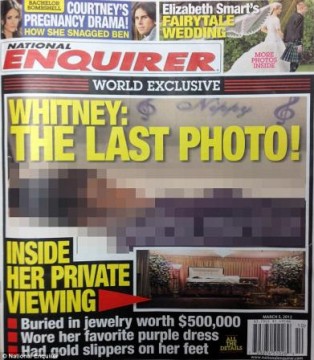
The National Enquirer refuses to let Whitney Houston rest in peace. The latest issue of this notorious tabloids screams “WHITNEY: THE LAST PHOTO!” and purports to depict a picture of the late singer in her casket. It was allegedly taken inside Whigham Funeral Home in Newark, New Jersey on Saturday and shows a woman wearing a dark dress, with “Nippy” (Houston’s nickname), along with two treble clefs, written in blue script on the lining of the casket cover. The image – blurred out above – has invoked outrage across the Internet, with Sarah Anne Hughes of The Washington Post referring to it as “shocking and disturbing.” A similar uproar took place in July 2009 when a British tabloid covered an issue with a photo of a dying Michael Jackson being wheeled out on a stretcher. What do you think of the Enquirer publishing this picture?
Happy Oscar week! Time for another one of Movieline’s virtual awards roundtables , this time featuring nominated filmmakers behind this year’s contenders for Best Foreign-Language Feature. Meet our distinguished panel:
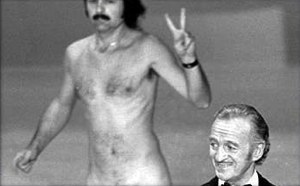
In the grand tradition of the late, great Robert Opel : “It’s long been rumored that Opel’s streak across the screen was not necessarily a unilateral act of transgression by Opel, and that he may have had a co-conspirator or two. The facts that he gained access to the backstage area in order to stage the streaking, and that he was given a post-show press conference, give rise to the suspicion that the event was set-up by the producers of the broadcast, maybe to give the long-venerated institution a little jolt.” [ The Awl ]
Next month brings the launch of The Hunger Games , one of the most-anticipated releases of the 2012 calendar and the first installment of a hopeful franchise based on Suzanne Collins’s bestselling young-adult adventure trilogy. In selling their film, studio execs at Lionsgate have ramped up all manner of marketing to immerse fans in the experience — and, in doing so, have made the least-populated jursdiction on the planet a financial beneficiary. The Hunger Games series features teenaged heroine Katniss Everdeen and concerns a North America remade into a dystopian dictatorship, renamed Panem and ruled by the governing body called The Capitol. As Lionsgate has expanded its promotional campaign, a wide array of affiliated websites has sprung up in an effort to make Panem as real as possible, many of those bearing obscure web addresses (e.g. www.Capitol.pn) to imply that the sites originate in the nation depicted in the film. This unique designation is not a studio fabrication, however. The .pn modifier is the domain offered up by the very real government of the Pitcairn Islands, a collection of four land masses comprising 18 square miles in the middle of the southern Pacific Ocean. This British territory rests over a thousand miles west of Easter Island and just as far east of Tahiti. So how did Pitcairn, with barely over 50 residents and intermittent electrical services, become the Internet home of a major Hollywood franchise? “It’s a happy coincidence,” Bill Haigh, governmental registrar for the island’s domain offices, told me in an e-mail correspondence. “Lionsgate have found .pn useful to them, and it has been helpful for bringing benefit to the island.” As the movie studio looked into creating an online presence for the film’s fictional nation, a functional domain was already in place. The Pitcairn government offers up these domains primarily for corporations to establish and/or protect their brand, and Haigh explained that the proceeds go a long way toward the islands’ infrastructural upkeep. “The sale of domain names is of great benefit to the 50 or so inhabitants of Pitcairn Island,” he said, “because revenue thus gathered is used to bring modern telecommunications to this extremely remote spot on the globe via satellite. This is quite an expensive process. And it is not only for telecommunications but generally for supply shipping, children’s education, medical care etc.” The result is that The Hunger Games has become a boon for this tiny territory, one that lacks a movie theater and receives but two cable channels — CNN and Turner Classic Movies. While Haigh declined to divulge the number of Web addresses purchased by the studio (Lionsgate reps did not respond to requests for comment), he did direct me to an online registry where one can inquire about the availability and ownership of various selections. Along with already established Capitol.pn, and CapitolCouture.pn, there are registrations for Panem’s various districts (District1.pn, through District13.pn), and each of the main characters have their own addresses (e.g. PresidentSnow.pn). Ultimately it’s impossible to deduce exactly how many Hunger Games characters, phrases and permutations thereof have staked a .pn claim. After browsing the registry for a while, however, it seems safe to assume that Lionsgate may have vastly more addresses collected than there are Pitcairn residents. And based on the fee of $100 NZ (appx. $75 US) per registered address, Hunger brings in revenues well into the thousands of dollars — a tidy supplement to the islands’ steady tourism business. As geographically remote as the Pitcairn Islands are, this Hunger Games dalliance does not make for their sole involvement with Hollywood. Most of the surnames found on the island are shared by characters from the oft-adapted novel Mutiny on The Bounty ; the book and numerous films are based on historical events that occurred on and around Pitcairn. For this reason cruise ships are a common sight in Bounty Bay, where visitors will find the outpost isle’s own capitol. However, as much of a windfall as Hunger Games may prove for the islands, it is doubtful “Everdeen” will appear anytime soon in the area phone books. Read Movieline’s full Hunger Games coverage here . Brad Slager has written about movies and entertainment for Film Threat, Mediaite, and is a columnist at CHUD.com . His less insightful impressions on entertainment can be found on Twitter .
First-ever festival is set for March 15 at South by Southwest and will lead up to the awards themselves. By James Montgomery Chiddy Bang Photo: Patrick Ford/Redferns The 2012 mtvU Woodie Awards will return to Austin, Texas, on March 15, during South by Southwest, and they’re definitely getting in the spirit of the annual festival. First, they announced this year’s nominees , an epically diverse field that includes everyone from Jay-Z and Kanye West, the Black Keys and Skrillex to up-and-comers like Frank Ocean, Childish Gambino and Cloud Nothings. Then they announced the first round of performers for the first-ever Woodies Fest , a (grammatically adventurous) list topped by Fun., Wallpaper. and A$AP Rocky. And on Wednesday (February 22), the Woodies announced even more performers for that festival: Chiddy Bang (whom, as you might recall, previously set a Guinness World Record for Longest Freestyle during the inaugural O Music Awards), Gary Clark Jr., Kimbra (of “Somebody That I Used To Know” fame) and British singer Ed Sheeran. The 2012 mtvU Woodie Awards Festival will take place March 15 down at SXSW and is open to both badge-holders and uncredited music fans alike. The entire fest will also stream live on Woodies.mtvU.com and leads up to the awards themselves. On Sunday, March 18, the best moments from the Woodies will be broadcast in a 30-minute special airing on MTV and mtvU at 8 p.m. ET. Voting is also under way in all Woodies categories — including Woodie of the Year and the coveted Best Video Woodie — and will remain open until March 9. Voting in the Breaking Woodie category will continue during the live show March 15. Fans can cast ballots in all categories through the Woodies’ website , on their mobile phones at M.MTV.com or by texting VOTE to 66333. Standard message and data rates may apply. The 2012 mtvU Woodies invade SXSW on March 15 with the Woodies Festival. The best of the 2012 mtvU Woodies will air on MTV and mtvU on March 18 at 8 p.m. ET. Related Photos 2012 mtvU Woodie Awards Nominees Related Artists Chiddy Bang