It’s only Monday and James Franco is already having a good week. And that could translate to a good week for Florida rapper Dangeruss, too. Despite Franco’s much-maligned performance in Oz The Great and Powerful , the movie was the top performer at the box office this past weekend, earning $42.2 million domestically, and the blogosphere is already championing him for a Best Supporting Actor Oscar for his work as the drug dealer Alien in Harmony Korine’s Spring Breakers . Meanwhile, that picture, which opens wide this weekend, racked up the best per-screen average of the year so far — $90,000 — in limited release at three theaters. So, how is that good for Dangeruss ? For one thing, the tattooed and dreadlocked rapper inspired the actor’s meth-dealing Alien character in Spring Breakers, which is a big reason the actor is in the spotlight again. Better yet, Franco directed Dangeruss’ “Hangin’ With Da Dopeboys” video below, which is featured on the movie’s heat-seeking soundtrack, and that could mean that the media soon stops referring to the rapper as an “underground” artist no matter how crusty he looks. Granted, the track and the video don’t exactly break new ground, but in this digital world, good enough is more than enough to blow up. Check out “Hangin’ With Da Dopeboys,” then compare Dangeruss to Franco’s Alien, who’s featured in the second clip. [ Huffington Post ] Follow Frank DiGiacomo on Twitter. Follow Movieline on Twitter.
‘I thought it was shot beautifully,’ actress tells MTV News of threesome with James Franco, Vanessa Hudgens By Amy Wilkinson, with reporting by Kara Warner Ashley Benson in “Spring Breakers” Photo: A24
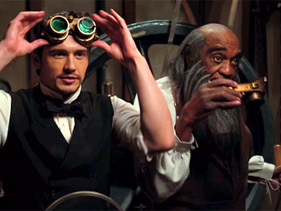
Who’s coming back? Who won’t return? MTV News looks foward to the follow-up to the weekend’s box-office hit. By Kevin P. Sullivan James Franco and Bill Cobbs in “Oz The Great And Powerful” Photo: Walt Disney Pictures
I’d love to see a graphic representation of the intersection of two subsets: moviegoers who saw The Avengers , directed by Joss Whedon , and those who plan to see his interpretation of William Shakespeare’s Much Ado About Nothing . I wouldn’t be surprised if there was no intersection at all, just one big circle ( The Avengers ) and one little circle ( Much Ado ) sitting next to each other, but I give Whedon credit for taking time out of his blockbuster career — 12 days, to be exact — to make this labor of love and present the Bard in a contemporary setting. And yet, based on a handful of viewings of this trailer, Much Ado looks self-conscious and pretentious. Shot in black-and-white and — at least on this trailer — adorned with a jazzy soundtrack, the movie looks like Whedon’s interpretation of a Woody Allen film, and a lot of the actors do their scenes with a look in their eyes that says, I’m doin’ Shakespeare, bitches! The cast includes The Cabin In The Woods star Amy Acker as Beatrice, Alexis Denisof as Benedick, late S.H.I.E.L.D. Agent Phil Coulson, Clark Gregg , playing Leonato, Nathan Fillion , of Serenity , in the role of Dogberry, and Sean Maher as Don John. Follow Frank DiGiacomo on Twitter . Follow Movieline on Twitter .
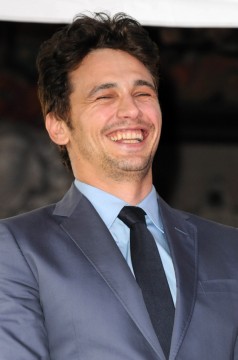
If James Franco reads his reviews, he should avoid David Edelstein ‘s critique of Oz The Great and Powerful at Vulture.com . “Franco is unconvincing generally, tamping down the passion, ironicizing everything out,” wrote Edelstein. “It’s possible Franco’s modern-sounding stammers and shrugs opposite actors playing it straight are meant in the spirit of Bob Hope’s hipster cowards — or those of Woody Allen , who cited Hope among his inspirations for Sleeper and Love and Death . But Franco doesn’t have the comebacks. He’s playing a noncommittal character in a noncommittal way, so that you want to scream, “This isn’t a performance-art project! You’re carrying a movie!” Ouch, though I’m with Edelstein on this one. It’s weird to see Franco giving such a modern performance in a movie that functions as a prequel to the 1939 classic The Wizard of Oz , and is supposed to be taking place in the early 1900s. I guess that tornado didn’t just transport Franco from Kansas to Oz, it messed with the time-space continuum, too. Well, while we wait to see if the weekend box-office results will vindicate Franco’s performance, I’ve noticed something about Franco that is fully committed: his smile. Watching him promoting Oz over the last few weeks and the films he brought to Sundance in January, Kink , which he produced, and Interior. Leather Bar , which he co-directed, I’ve discovered that Franco does for beaming what Futurama’ s Hypnotoad does for staring. He’s all in — teeth, gums and crinkled eyes — and the effect kind of mesmerizing in a man-he’s-really-going-for-it way. Check out these photos: So, bad reviews be damned. Keep smiling James….I…await…your final…orders. [ Vulture ] Follow Frank DiGiacomo on Twitter . Follow Movieline on Twitter .
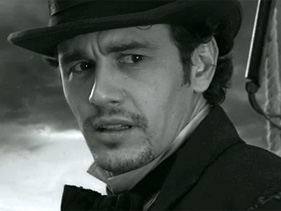
Consciously evoking the structure and iconography of MGM’s classic The Wizard of Oz without attempting to rival its impact, Disney’s Oz the Great and Powerful can be enjoyed, up to a point, on its own colorful, diverting but finally rather futile terms. Offering an eye-tickling but gaudily depersonalized Land of Oz populated by younger, sexier versions of well-known characters (most incongruously the Wicked Witch of the West), this elaborate exercise in visual Baum-bast nonetheless gets some mileage out of its game performances, luscious production design and the unfettered enthusiasm director Sam Raimi brings to a thin, simplistic origin story. The smash success of Wicked , the stage tuner adapted from Gregory Maguire’s much more intricate and morally complicated Oz prequel, showed that L. Frank Baum’s richly imagined universe still holds significant interest for audiences worldwide. With its culturally resonant imagery, state-of-the-art technology and strong family appeal, Disney’s first excursion into this realm since Walter Murch’s Return to Oz nearly 30 years ago should enjoy a hefty yellow-brick load in theatrical release that will only be amplified by 3D ticket premiums and bountiful ancillary opportunities. Abundant indicators of commercial success and faultless production values aside, there’s a persistent sense of artifice here, something admittedly not lost on a story that’s very much about the power of technology and the magic inherent in a skillfully executed illusion. Yet it still rings hollow in a way that prevents full surrender, leaving the viewer with an immediate desire to revisit the still-wondrous 1939 film and, to a lesser extent, the original Baum novels credited as the inspiration for Mitchell Kapner and David Lindsay-Abaire’s screenplay. (The filmmakers had to navigate a veritable poppy field of legal issues to steer clear of copyrighted and trademarked elements from the MGM film, now owned by Warner Bros.) Although Dorothy is nowhere in sight, attentive listeners will catch a fleeting reference to her origins in the film’s exquisite prologue, which, a la The Wizard of Oz , unfolds on a windy strip of Kansas prairie. Rendered in black-and-white and framed in Academy ratio, the sequence works as a luminous standalone tribute to the wonders of old-fashioned trickery and showmanship as practiced by traveling circus magician Oscar Diggs ( James Franco ), whose vaudeville-style act is a marvel of wires, trapdoors, faux hypnosis and do-it-yourself sound effects. Oscar is a handsome rogue, a sly con artist, and an expert levitator and seducer of women, qualities that will prove at once crucial and dangerous when a twister blows his hot-air balloon off course and deposits him in the vibrant-colored Land of Oz, where no fewer than three beautiful and powerful witches wind up vying for his attention. These include the naive, emotionally susceptible Theodora (Mila Kunis); her older, colder sister, Evanora (Rachel Weisz); and their sworn nemesis, Glinda (Michelle Williams), a beauteous blonde whose motives are initially shrouded in secrecy. Crucial to these women’s competing agendas is the question of whether Oscar is the all-powerful wizard who, as prophesied, will ascend to the throne of the Emerald City and deliver Oz from evil. Disney’s marketing campaign has worked to generate some suspense over the question of who will eventually become the Wicked Witch of the West, although even modestly Oz-savvy viewers will have no trouble guessing which witch is which before the truth is revealed halfway through. Suffice it to say that the transformation is poorly motivated at best, and the unlucky girl in question, sporting not only the requisite green skin but also an eyeful of cleavage, seems a better candidate for top honors at a West Hollywood Halloween bash than for the mantle of Margaret Hamilton. Such comparisons to The Wizard of Oz are not only unavoidable but actively invited by Raimi’s film, which, within its legal restrictions, carefully mimics its 1939 forebear — from the early monochrome-to-color shift signaling that we’re not in Kansas anymore to the device of having key supporting characters pop up on both sides of the proverbial rainbow. To their credit, scribes Kapner and Lindsay-Abaire have taken pains to incorporate previously unfilmed elements from Baum’s original work. Pointedly in this version, Glinda hails from the South, not the North; the (racially diversified) Munchkins are joined by the similarly friendly but lesser-known Quadlings; and a key role is played by the fragile, all-porcelain China Girl (Joey King), who joins Oscar and his benign winged-monkey companion, Finley (voiced by Zach Braff), on their journey. Quite apart from the question of whether the picture lives up to its various inspirations, however, Oz the Great and Powerful finally falls short by dint of a too-timid imagination. In straining for an all-ages simplicity, the script comes off as merely banal, full of flat, repetitive dialogue about who’s good, who’s wicked and, most incessantly, whether Oscar is a real wizard, an opportunistic scoundrel or perhaps both. Not until the third act does the film start to jell, with a couple of arresting setpieces that neatly demonstrate how pluck, resourcefulness and an endless supply of tricks can equal, and even overcome, real magic. Raimi’s genre credentials made him as ideal a match for this production as any, and he attacks the material with palpable vigor, countering the thinness of the story with visuals that can feel by turns excessive and transporting. Gary Jones and Michael Kutsche’s lovingly detailed costumes and Robert Stromberg’s multihued sets take on an almost radioactive glow in Peter Deming’s widescreen cinematography, and the use of tracking and crane shots is inspired, the camera pulling back on occasion to observe the action at a painterly remove. This marks the first time Raimi has worked with the stereoscopic format, and he’s applied it with abundant care and precision. Bob Murawski’s editing meshes seamlessly with the 3D-lensed imagery to produce a fluid, genuinely multidimensional experience whose eye-popping effects — a swirl of fog rolling out of the frame; blossoms that turn out to be butterflies — are executed with an enchanting dexterity and playfulness. In a real sense, Oz the Great and Powerful has a certain kinship with George Lucas’ Star Wars prequels, in the way it presents a beautiful but borderline-sterile digital update of a world that was richer, purer and a lot more fun in lower-tech form. Here, too, the actors often look artificially superimposed against their CG backdrops, though the intensity of the fakery generates its own visual fascination. The indie experiments with which Franco has been recently preoccupied lend an interesting subtext to his casting as a genial humbug, and the actor fills the Wizard’s shoes, vest and top hat with slippery, ingratiating charm. Among the three witches, Kunis’ Theodora is a bit lacking in dramatic stature; Weisz’s Evanora strikes the right notes of icy ambition; and Williams, who has rarely looked more radiant onscreen, is a bewitching presence indeed, making Glinda more than just another bubblehead.
‘He’s sort of a combination of a Clark Gable type and a Charlie Chaplin type,’ Franco tells MTV News. By Josh Wigler, with reporting by Alicia Malone James Franco in “Oz: The Great And Powerful” Photo: Disney
It’s Feb. 14, when men and women across this land bend over and submit to that cruel Hallmark dominatrix known as Valentine’s Day — enduring exorbitantly priced flowers, overbooked restaurants and unreasonable expectations for the sake of love and romance. And that means it’s the perfect time to check out what filmmaker Christina Voros has to say about human bondage. Voros is the director of Kink , a documentary produced by longtime collaborator James Franco that takes a mesmerizing behind-the-scenes look at Kink.com, the San Francisco-based company that operates a number of websites devoted to BDSM porn. (That stands for “Bondage and Discipline, Sadism and Masochism” if you haven’t read Fifty Shades of Grey .) Voros, who screened the film at the Sundance and Berlin film festivals, takes a subtle show-don’t-tell approach to the BDSM web porn business and lets moviegoers draw their own conclusions. Among her interview subjects is Kink.com founder Peter Acworth, who got into the Internet BDSM business in the late 1990s while a PhD student at Columbia University and, after relocating to San Francisco, purchased the cavernous San Francisco Armory in 2006 where Kink.com is based. The filmmaker (she’s pictured at right, with Franco) also spends quality time with the dominants — such as Princess Donna — submissives and directors who produce Kink.com’s content and the documentary juxtaposes the extreme scenarios being played out on camera with the level-headed and even creative work that goes into producing the shoots. In the interview below, Voros says Kink.com’s operations are like “the Starbucks of pornography.” (The the company even has a 401(k) plan for its employees.) Although the graphic scenarios depicted in the documentary — a man is bound and flogged, a woman is hung upside down from the ceiling with a saddle-like vibrator between her legs — mean the film won’t be seen in Ohio cineplexes, Kink is about much more than extreme sex. As Voros explains in the interview below, “There’s an element of dominance and submission in almost every aspect of human interaction.” Happy Valentine’s Day, slaves. Movieline: What led you to take on this project? Christina Voros: It’s funny to do something that so many people are talking about and to have found my way to it so serendipitously and organically. James [Franco] spent a day at the [Kink.com] armory when he was filming About Cherry , and he called me and said, “You’ve got to see this shit. It’s crazy.” He wasn’t just referring to the armory and the porn. I think what really struck him was the energy in the space: He watched a shoot and was struck by the juxtaposition of the crazy intense nature of what was being filmed with the very chill, laid back, comfortable nature off screen. There is a “just-another-day-at-the-office” vibe that you show in the film. So, James was like, “We have to make this movie.” And he and I have been working together for a long time in all sorts of iteration as collaborators. And my first response was, “I don’t know if I want to make a movie about a porn factory, you know.” I can understand that. There was a bit of time between the first time he mentioned it and when we actually started making it happen. In between, he went on Conan and announced that he was making this film. And at that moment I was like, “Okay, I guess we’re doing this.” James said to me, “ Just go up there, see the place, meet the people and set up the project. If you’re still not comfortable then we’ll get somebody else to film.” So, I walked in and spent a day not watching any porn being made — just talking to directors. By the end of that day, I was sold. What convinced you? Most of the people I found were smart and funny and driven — and incredibly relatable. A lot of them were also women: I never really thought about women as directors of pornography. And I became aware almost immediately of how many misconceptions I had about the industry. In fact, everything that I thought I knew about porn I’d gotten from narrative film portrayals of what the porn industry was supposed to be. So it was at that moment that I got really, really excited about doing this film. And that’s how it came about. I didn’t wake up one morning and think, the world needs a film about BDSM pornographers. I’m not the only person who’s got misconceptions about how this world is, which is not to say Kink is a template for all pornography that’s out there. There are good pornographers and bad pornographers, and I’m sure there’s plenty of shady, dark, nasty, evil, ugly stuff that happens in other places. This place is kind of like – it almost feels like the Starbucks of pornography. Despite the extreme stuff happening there? You know, apart from the vibe in the building and the 401(k) plan and profit sharing, if you’re an Indie filmmaker and you want to come in and use the sets to shoot your music video on the weekend, the owner’s totally cool with that. I love that they have a 401(k) . And yet, as you get farther into the film, I feel like you are revealing that, despite the Starbucks vibe, it’s not all fun and games and pleasure. The woman who’s being disciplined in the final scenes of the movie does not look like she’s enjoying herself. What kind of a statement are you making there? I think BDSM is a complicated subject, and I think porn is a complicated subject. One of the challenges of making this film was how do you present these subjects in a way that introduces a first-time viewer to how this world works without boring someone who actually comes from the scene? Kink ’s editor Ian Olds, and I struggled with finding that balance — because it’s not all sunshine and roses. It’s tricky and sticky, and, at times, dark. It blurs what is pleasurable and what is beautiful and what is healthy and what is not. So it was important for us to not ignore the fact that it’s not always awesome. But then again, no career is. I can’t argue with you there. You can be an investment banker and have days when you feel trapped and used and your bosses have got you bent over doing things you don’t want to do because you need to pay the rent. In a lot of ways, this film is a metaphor for bigger questions and a more accessible universe. You know, we always had final cut, but because the people at Kink.com had been so generous with their access, we showed it to them [in advance] and there was a part of me wondering, I hope they think this is fair. And they did. They didn’t take issue with any of the content that was in the film, including scenes where we reveal the fact that it’s not always a purely positive experience. Another thing I thought was interesting was how you reveal that there’s a certain amount of stagecraft involved in these BDSM scenarios. The scene where the director is telling the male dom how to pull his punches on the submissive was fascinating. That’s another thing we tried to do in the film: allow contradictions. So you hear someone saying, “It’s got to be real; it’s got to be authentic.” And then there’s a scene where the director shows the trick of stomping on a guy’s penis without actually injuring him. Even with non-porn S&M, there’s an art to it. There are ways to hurt someone the right way and there are ways to hurt someone the wrong way. And there are ways to administer pain that are stimulating and allow you to proceed over a longer period of time. If you talk to the models and directors who work there, it’s less about sex and more like a cross between circus arts and some sort of extreme sport. Sounds like a future ESPN channel. There was not enough time to get into it in the film, but they’re not just going in and wailing on someone with a flogger. There’s a way to build the sensuality of it. It reminds me of when I go to a Russian bathhouse and they do an oak platza on you. They’re heating up the air and doing some softer strokes so when it does come down, you really feel something. On one hand, yes, there are moments when people play it up a little bit. Absolutely. But the authenticity of what they’re doing is always there. So in that scene about the punches that you described — that was more about allowing the scene to build in a way that it is more satisfying to everyone. A number of your interview subjects from both sides of the camera have a hard time articulating why they’re involved in this BDSM porn site. Why do you think that is? I’m loathe to make any statement that would attempt to encompass all of the directors because they’re each so different. I would say that, for each of them, it was a different journey, but they all began in a place where they didn’t necessarily understand the origins of it themselves. For instance, [the director] Van talks about growing up on a farm and having these fantasies of tying up ball players in the barn. He didn’t know where those feelings and ideas came from, but it was something inside of him that felt organic and real. And it wasn’t like he could express those feelings in society. Right. He grew up in a world in which those feelings were so anti-normative that it was a real struggle for him to find his identity. And that’s one thing that with all of the directors I interviewed: They each struggled with these desires and felt isolated and that something was wrong with them. So, to be able to create sexual content that celebrates and caters to these desires, and then to have an audience that is hungry for it is incredibly gratifying to them. Not only have they realized that, you know, I’m not the only crazy one — it turns out there are a lot of people out there who enjoy this stuff — but they also feel like they’re providing an important service to people. People who go to Kink.com are not talking about it at work or in the locker room. The business meeting where the directors and management are going over the revenues for the various sites is pretty fascinating. It’s a reminder that Kink.com is a business. What are the biggest challenges facing that business? The biggest issue they’re dealing with right now is piracy, which is why the live web stuff has become so important. We shot 115 hours of footage, so we have everything, and the stuff we have on the Webcam girls could be its own mini-doc. That’s where things are going and watching the interactions between them and the things coming up online, is really surreal. Are you seriously considering doing a separate film on the Webcam girls? There’s some footage that we didn’t use in this film that could be interesting to revisit, whether it’s in terms of extras on the DVD or stuff we put up on the website. There’s one piece of negative pushback I got from [the dominatrix] Princess Donna. She said, you know, I was a little bit bothered by the fact that you included this woman talking about how she would never want her daughter to go into porn and you didn’t include the footage where you sat down with my mother and me and she talked about being okay with [my work]. Donna said she thought it would have been much more interesting to juxtapose those two differing views. And I said, well, there were a lot of reasons that decision was made, but it’s a good point and I would love to put that in a place where people could see it in the context of the film. That brings me to the larger question of how you’re going to release this film. It’s very graphic. That’s a really good question. We’ve got wonderful sales agents who really believe in it. When we first made the movie there was a moment where we’re like, all right, how do we do this? And once we do it, how do we ever make sure it gets seen? We finally decided that we had to shoot first and ask questions later. And you can’t shoot around the nudity, although I don’t think there’s much that’s gratuitous in the film. A good friend of mine told me that the scene that she thought was the most manipulative is one where you see the director Tomcat’s hand and you see the fucking machine and the camera pans up and you think you’re going to see the woman’s crotch but instead the shot is of her face. My friend said she completely felt like a puppet at that moment because I tricked her into realizing that she wanted to see what was at the other end of that machine. So, I think this will have a strong life in some sort of VOD capacity, especially if you look at the success of Fifty Shades of Grey , which, I think, became what it was because people were able to access it anonymously. They didn’t have to go in to Barnes & Noble. Obviously, I’d love for it to go some place mainstream, although I don’t know what that means. I don’t have a television. I don’t know what’s out there. You don’t own a television? I don’t have a television. But I think a lot of the people who want to see this movie and who need to see this movie are not people who are going to say hey, hon, let’s watch the BDSM porn doc on HBO at midnight, or go out to see it in a movie theater. It’s really interesting. At the first showing, I leaned over to James halfway through the movie and said, “Did we make a comedy?” Everyone was laughing their ass off for the first 20 minutes. And you don’t realize that when you’re sitting in a room with your editor. Then, on the flip side, James leaned over to me 20 minutes after that and said to me, “This is a lot more intense with 200 people in the room.” Because it is. Not only is it graphic but it’s being watched by a bunch of strangers in a public setting, instead of privately. I think we had about five people leave the theater, one of whom was our friend, Tim Blake Nelson, who just had to be up early in the morning for a flight. What’s the most surprising thing that you learned while you were making this film? I met a woman who told me off camera that she had been in a cycle of abusive relationships until she discovered BDSM. By compartmentalizing her need to feel dominated in this world of rules and negotiation, it allowed her to start making healthier choices in her exterior life. Now I don’t know this woman very well, so I don’t know how true this is. But it raised some interesting questions for me. BDSM is a continuum. A lot of what you see in the film is really extreme, but there are a lot of people who would never consider themselves into BDSM who may like slightly rougher sex or having somebody spank them in the bedroom. There are these more subtle beginning points on that continuum that are things we see in mainstream representations of sex. You may not be able to relate to being hung upside down and chained to the floor by your neck with a vibrator between your legs, but maybe there’s something in the bedroom that falls in the earlier stages of that continuum that you can relate to. It is all part of that same instinct that has been in human beings since the first evidence of sadomasochistic activity, which is like in 6 B.C. in like Tarquinia. So that was important, and on the flip side, BDSM is a metaphor for our non-sexual interpersonal relationships. There’s an element of dominance and submission in almost every aspect of human interaction. And that raised questions for me about my own personal life, in a non-sexualized way, about the choices we make to be submissive or dominant and what that says about our own human nature. Would you say you’re a dom or a sub your professional and artistic life? Depending on the scenario, probably a little bit of both. When I’m not directing, I’m a cinematographer, and I certainly know what I want and know how to ask for it. I was just thinking that to be a director, too, you have to be dominant. But then as an artist I’m also very sensitive to praise or criticism. And at the end of the day, I’m maybe not as thick skinned as I might appear to be when I’m directing traffic in front of 80 people on the movie. Frankly, I think there’s both of those things in all of us, in different capacities, and I think you can shift. My relationship with you might be one thing and my relationship with James might be another. It’s a constantly moving target. Follow Frank DiGiacomo on Twitter . Follow Movieline on Twitter .
Dare I say that, based on this trailer, Melissa McCarthy looks like she could actually be funnier in The Heat than she was in Bridesmaids ? Okay, so I’m one of the minority who didn’t think that the latter film was as hilarious as everyone found it, so I was pleasantly surprised when this international trailer for Paul Feig and McCarthy’s latest collaboration made me laugh out loud a few times. The plus-sized actress plays a “bad-ass” maverick Boston cop who teams up with “tight-assed” FBI agent Sandra Bullock . If you guessed that this is one of those movies where McCarthy’s character shows Bullock’s character how to walk on the wild side, you’d be right, but I’m willing to overlook the formulaic conceit based on the scene in which McCarthy proceeds to look for her captain’s “little girl balls” and the one in which she discovers Bullock is wearing Spanx. (As if!) “They hold everything together,” Bullock tells McCarthy. “Why? What’s going to come fuckin’ popping out?” sputters McCarthy. My thoughts exactly. Follow Frank DiGiacomo on Twitter. Follow Movieline on Twitter.