Tag Archives: legal

MSNBC Mosque Double-Standard: Went Crazy Over Kostric Bearing Arms On Church Property

When people seek to build a mosque near Ground Zero, the consensus among MSNBC liberals seems to be that their exercise of First Amendment rights to freedom of religion cannot be questioned. But it was a different story at MSNBC when, hours before and blocks away from where Pres. Obama was scheduled to speak, a man exercised his Second Amendment right to bear arms. Readers will recall the case of William Kostric.  He was the New Hampshire man who was part of a protest group in Portsmouth, New Hampshire in August 2009 when Pres. Obama came to town for a health care town hall. Ironically, given the mosque controversy, Kostric was standing on . . . church property.  But that made no difference to the wise men of MSNBC.   Host Carlos Watson was sure there must be some kind of “emergency injuntion” available to have the man removed.  And Chris Matthews, in the memorable interview embedded here, got testy when Kostric tried to cite his legal rights. “I know the law,” snapped Matthews, choosing instead to query Kostric on why he was carrying “a goddam gun.” Can we expect to see MSNBC hosts subjecting the mosque-builders to similarly sharp inquiry about their motives?

More here:
MSNBC Mosque Double-Standard: Went Crazy Over Kostric Bearing Arms On Church Property

More on How Physicians Became Torture Doctors for CIA – Kevin Gosztola – Open Salon

A good amount of documentation on the involvement of psychologists in the torture and abuse of detainees or “terror suspects.” And, a new study( http://rawstory.com/rs/2010/0805/study-cia-doctors-gave-green-light-torture/ ) provides even more revelations on the involvement of physicians making it increasingly clear that medical professionals put limits on ethical standards they were expected to follow in order to help the CIA interrogate detainees. The study, titled “Roles of CIA Physicians in Enhanced Interrogation and Torture of Detainees,( http://www.wepapers.com/Papers/117511/Roles_of_CIA_Physicians_in_Enhanced_Interr… )” authored by Leonard S. Rubinstein, the president of Physicians for Human Rights, and Brigadier General (ret.) Stephen N. Xenakis, a former Army psychiatrists (who is now with the Center for Public Health and Human Rights), utilizes a previously secret document from 2004 and lays out the “guidelines for detainee interrogation” that physicians, psychologists, and other health care professionals developed and followed so they could serve the CIA. Guidelines indicate the doctors, who were working for the CIA’s Office of Medical Services, conducted medical evaluations [experimentations] on detainees “before and during interrogations” and waterboarding “required the presence of a physician.” Physicians documented the effects of “enhanced interrogation techniques” [torture] like waterboarding and decided waterboarding “created risks of drowning, hypothermia, aspiration pneumonia, or laryngospasm.” They ignored “clinical experience/research” and assured lawyers “there was no ‘medical reason’ to believe that waterboarding [would] lead to physical pain.” It was established that “cramped confinement could result in deep vein thrombosis” and death could result from “lengthy exposure to cold water.” And, the physicians, psychologists, and other health care professionals working for the CIA developed “limitations” so that techniques like waterboarding, cramped confinement, sensory deprivation, stress positions, etc could be used on detainees. Limitations included: “exposure to specified temperature either up to time of hypothermia would develop or on evidence of hypothermia,” dietary restrictions up to “body weight loss of 10% or evidence of significant malnutrition,” “exposure to noise just under decibel levels associated with hearing loss,” up to 48 hours of exposure to stress positions “provided hands were no higher than the head” of a detainee, and no more than eight consecutive hours or eighteen hours per day of “confinement in a box.” Much of this took place after 2003, after a CIA Inspector General investigation of “enhanced interrogation techniques” [torture], OMS physicians were asked to provide “opinions to the agency and lawyers on whether techniques used would be expected to cause severe pain or suffering and thus constitute torture.” Slowly, OMS physicians’ work for the CIA transformed into work, which violated “ethical standards,” prohibiting physicians from using “medical skills to facilitate torture or be present when torture is taking place.” The physicians consulted directly with Department of Justice lawyers and were asked to provide legal cover by supporting “legal decisions” that “interrogators who applied enhanced interrogation techniques neither inflicted sever mental or physical pain or anguish and thus did not commit torture.” For techniques like sleep deprivation, they claimed the use thereof “could not lead to profound disruption in the detainees’ senses or personality (the legal definition of psychological torture).” As suggested in the opening paragraph, it has been evident that physicians and psychologists have been involved in torture for some time, especially since Wikileaks leaked the Guantanamo Standard Operating Procedures Manual in November 2007( http://www.wikileaks.org/wiki/Guantanamo_document_confirms_psychological_torture ). The manual indicated that, “incoming prisoners were to be held in near-isolation for the first [four] weeks to foster dependence on interrogators and `enhance and exploit the disorientation and disorganization felt by a newly arrived detainee in the interrogation process.’” It outlines how isolation was to be used on detainees, a technique Physicians for Human Rights said can lead to symptoms of “`bewilderment, anxiety, frustration, dejection, boredom, obsessive thoughts or ruminations, depression, and, in some cases, hallucination'” and, if prolonged, could result in “increased stress, abnormal neuroendocrine function, changes in blood pressure and inflammatory stress responses.” Then, it was known those involved understood how they could be prosecuted for violating international law. As an April 16, 2003, memo from Defense Secretary Donald Rumsfeld explained “Caution: the use of isolation as an interrogation technique requires detailed implementation instructions, including specific guidelines regarding the length of isolation, medical and psychological review, and approvals for extension of the length of by the appropriate level in the chain of command. This technique is not know to have been generally used for interrogation purposes for longer than 30 days. Those nations that believe that detainees are subject to POW protections may view use of this technique as inconsistent with the requirements of Geneva III, Article 13 which provides that POWs must be protected against acts of intimidation; Article 14 which provides that POWs are entitled to respect for their person; Article 34 which prohibits coercion and Article 126 which ensures access and basic standards of treatment. Although the provisions of Geneva are not applicable to the interrogation of unlawful combatants, consideration should be given to these views prior to application of this technique.” The report is yet another indication of the need for more investigation, accountability, and reform from the Obama Administration. Yet, as demonstrated by a comprehensive report (“Establishing the New Normal”)( http://www.aclu.org/national-security/establishing-new-normal ) from the ACLU, the Obama Administration has avoided its obligation to accountability for torture and chosen to follow the dangerous mantra of “looking forward, not back,” a false choice because, as the ACLU states in the report: “a strong democracy rests not on the goodwill of its leaders but on the impartial enforcement of laws. Sanctioning impunity for government officials who authorized torture sends a problematic message to the world, invites abuses by future administrations, and further undermines the rule of law that is the basis of any democracy.” added by: toyotabedzrock

"A Father’s Rights" is based upon a real life story.

“A Father’s Rights” is based upon a real life story. It depicts the situation of an unwed father and his child’s struggle with the legal system predominant in American society today. “A Father’s Rights” is hard hitting, factual, and potentially embarrassing to some in high places. It is meant to expose the system that treats children differently across this country and the world: a system that needs to change. We should all be looking at and working for one thing, getting equal rights for our children. It should not matter if a child is born out of wedlock. It's not the child’s fault, and that child should have the same rights as a child from a happily married couple. Stop the fighting over who gets custody and what he/she receives for the privilege of raising that child. The system that all of us face as parents, and/or grandparents is broken. No matter if you are mother, father, or grandparent, we all must acknowledge this basic fact. Thousands of emails have been received over the past year about this project asking for help, or parents telling their own horror stories with the system. One major problem is that fathers, mothers, and grandparents all seem to be fighting for their own rights. We should all be able to come together and fight for our children's rights. The right to be treated equally, no matter if their parents are married, were married, or never married. If that goal is obtained, then a lot of the problems in the system will go away. This movie was made to bring attention to and educate the public about a corrupt system that is not taking care of the future: making sure children are well taken care of. Based on a true story and filmed in Dickson, TN. Starring: Robbie Davis, Christian Pitre, Ed Bruce, Jay Davis, Karen Carlson, Deborah Allen and Mark Collie. http://www.a-fathers-rights-movie.com/story.html added by: MotherForTruth

Is America More Aware of Media Liberalism Now Than it Was Five Years Ago?

See the article here:
Is America More Aware of Media Liberalism Now Than it Was Five Years Ago?

Todd Quotes Emma Lazarus Poem As If It’s The Law

The liberal lionization of Emma Lazarus’ poem [which Rush has brilliantly demolished ] has reached laughable new heights.  On this evening’s Hardball, guest host Chuck Todd cited the Lazarus lines from the base of the Statue of Liberty . . . as if they had some authority in law! Todd was debating former GOP congressman Ernest Istook on the proposal some Republicans have floated to recast or clarify the 14th Amendment so as not to grant automatic citizenship to children born in the United States to illegal immigrants. ERNEST ISTOOK:  The Supreme Court precedent on this, which was in 1898, was the case of Wong Kim Ark.  And in that case, he was the child of parents who were here legally, and lawfully.  The Supreme Court has not ruled on the case of children of parents who are here illegally. CHUCK TODD: But here’s the issue you have.  Let me read you–and it’s a very familiar phrase to a lot of folks–that greets people when they came to Liberty Island and Ellis Island.  It says: “give me your tired, your poor, your huddled masses yearning to breathe free.  The wretched refuse of your teeming shores. Send these the homeless tempest [tossed] to me. I lift my lamp beside the golden door.”  There was no mention of whether these folks had to be legal citizens. Istook took it easy on Todd.  Instead of chuckling at Chuck, he mild-manneredly observed “my grandparents came through Ellis Island.  My father’s parents were immigrants from Hungary.  So I know the Emma Lazarus poem that you were quoting. But that’s not the same as quoting the provisions of the Constitution. ” Can our ingenious readers provide examples of other poems that the legal lights of the MSM might like to cite?

Link:
Todd Quotes Emma Lazarus Poem As If It’s The Law

CBS’s Dickerson Questions ‘Claim’ That California Judge in Prop 8 Ruling Openly Gay

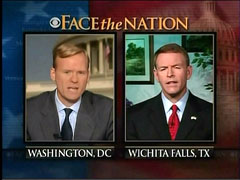
During a discussion of California’s Proposition 8 being overturned on CBS’s Face the Nation on Sunday, fill-in host John Dickerson questioned Family Research Council President Tony Perkins’s assertion that the federal judge who made the ruling was openly gay: “You mention this claim that he’s openly homosexual. I’m not sure if that’s, in fact, the case.” Perkins replied by citing his source on Judge Vaughn Walker’s sexual orientation: “Well, that, according to The San Francisco Chronicle, that he is openly homosexual, one of two federal judges.” Thursday’s Good Morning America on ABC reported that fact as well, even while NBC’s Today and the CBS Early Show failed to mention it. Dickerson followed his doubt of Perkins by arguing: “…whether [Walker] is or isn’t, what basis – what bearing does that have on the case?” Perkins responded: “…had this guy been a – say, an evangelical preacher in his past, there would have been cries for him to step down from this case. So I do think it has a bearing on the case.” Dickerson countered: “You think it’s made his ruling skewed?”   An examination of the kind of language used in Walker’s opinion demonstrates a clear bias against supporters of Proposition 8: “The evidence at trial regarding the campaign to pass Proposition 8 uncloaks the most likely explanation for its passage: a desire to advance the belief that opposite-sex couples are morally superior to same-sex couples. The campaign relied heavily on negative stereotypes about gays and lesbians…” As attorney Ed Whelan explained in a February 7 post for National Review Online : “Walker’s entire course of conduct has only one sensible explanation: that Walker is hellbent to use the case to advance the cause of same-sex marriage. Given his manifest inability to be impartial, Walker should have recused himself from the beginning, and he remains obligated to do so now.” While Dickerson was quick to question a completely accurate statement from Perkins, he allowed a glaringly misstatement from left-wing attorney David Boies to go unchallenged. Boies, who along with attorney Ted Olsen lead the lawsuit against Proposition 8, ranted against Perkins and others opposed to the judge’s ruling: “Well, it’s easy to sit around and debate and throw around opinions, appeal to people’s fear and prejudice….it’s very easy for the people who want to deprive gay and lesbian citizens of the right to vote to make all sorts of statements and campaign literature…” While it seems clear that Boies simply misspoke and meant to say “right to marry” instead of “right to vote,” Dickerson made no effort to correct the record for viewers. Boies concluded his rant by sanctimoniously proclaiming: “We put fear and prejudice on trial, and fear and prejudice lost.” Perkins began to respond: “That is absolutely not true-” But Dickerson just moved on to the next question, pressing Perkins: “The judge in this case said that the state has to find some kind of harm created by same-sex marriage. There has to be empirical evidence. Mr. Boies says, and the judge says, there was no evidence on that case. So what harm – give us some evidence, in terms of the harm that would be created by allowing same-sex marriages?” As NewsBusters’ Noel Sheppard earlier reported , the segment that followed, with CBS legal analyst Jan Crawford and Washington Post writer Dan Balz, was remarkably balanced on the issue. Crawford noted that it would be an “enormous stretch” for the U.S. Supreme Court to agree with Walker’s ruling. Here is a full transcript of the August 8 segment with Boies and Perkins: 10:38AM JOHN DICKERSON: Joining us now to discuss the California ruling on same-sex marriage: from San Francisco, David Boies, one of the lead attorneys for the plaintiffs; and Tony Perkins, the head of the Family Research Council, he is in Wichita Falls, Texas. Mr. Boies, I want to start with you. After the judge ruled in your favor, he put a stay on marriages going forward. I want to know, with so much legal fighting ahead on this issue, why should marriages be reinstated immediately? DAVID BOIES [CHAIRMAN, BOIES, SCHILLER & FLEXNER]: I think the issue is not whether they ought to be reinstated immediately, but whether you ought to have marriage equality. I think that courts can differ in terms of whether this goes into effect immediately or after an appeal. I think the critical issue here is that what you have is a district court finding after a full trial, everybody had an opportunity to be heard, an opinion that demonstrates that there is simply no basis whatsoever to continue discrimination against gay and lesbian citizens who want to marry. DICKERSON: Tony Perkins, you said this ruling, this decision left you speechless. What’s your reaction going to be now? TONY PERKINS [PRESIDENT, FAMILY RESEARCH COUNCIL]: Well, this is not without political parallel. I mean, you go back to the 1970s and abortion was nowhere near the political issue that it is today when the court interjected itself in 1973 to this issue. And this issue is not going to go away. I think what you have is one judge who thinks he knows – and a district level judge, and an openly homosexual judge at that, who says he knows better than not only 7 million voters in the state of California, but voters in 30 states across the nation that have passed marriage amendments. This is far from over. DICKERSON: You mention this claim that he’s openly homosexual. I’m not sure if that’s, in fact, the case. But whether he is or isn’t, what basis – what bearing does that have on the case? PERKINS: Well, that, according to The San Francisco Chronicle, that he is openly homosexual, one of two federal judges. And I think, you know, had this guy been a – say, an evangelical preacher in his past, there would have been cries for him to step down from this case. So I do think it has a bearing on the case. But this is not without precedent- DICKERSON: But you think it’s made his – you think it’s made his ruling skewed? PERKINS: This is not without precedent. Well, I mean, you look at – he ignored a lot of the social science in – in his opinion. But in Nebraska, in 2005, there was a similar ruling by another federal district level judge. It was overturned in the Eighth Circuit unanimously. So there is certainly, not only based upon the social empirical data that’s out there, but on the legal basis, this is a flawed decision. And as I said, it’s far from over. DICKERSON: David Boies, the one thing you mentioned, that the judge spent a great deal of time on the facts of the case here. What’s your response to Mr. Perkins? BOIES: Well, it’s easy to sit around and debate and throw around opinions, appeal to people’s fear and prejudice, cite studies that either don’t exist or don’t say what you say they do. In a court of law, you’ve got to come in and you’ve got to support those opinions. You’ve got to stand up under oath in cross-examination. And what we saw at trial is that it’s very easy for the people who want to deprive gay and lesbian citizens of the right to vote to make all sorts of statements and campaign literature, or in debates, where they can’t be cross-examined, but when they come into court and they have to support those opinions and they have to defend those opinions under oath and cross-examination, those opinions just melt away. And that’s what happened here. There simply wasn’t any evidence. There weren’t any of those studies. There weren’t any empirical studies. That’s just made up. That’s junk science. And it’s easy to say that on television. But a witness stand is a lonely place to lie. When you come into court, you can’t do that. And that’s what we proved. We put fear and prejudice on trial, and fear and prejudice lost. DICKERSON: Mr. Perkins, I want to- PERKINS: -that is absolutely- DICKERSON: Well, let me ask you- PERKINS: That is absolutely not true- DICKERSON: The judge in this case said that the state has to find some kind of harm created by same-sex marriage. There has to be empirical evidence. Mr. Boies says, and the judge says, there was no evidence on that case. So what harm – give us some evidence, in terms of the harm that would be created by allowing same-sex marriages? PERKINS: Well, a lot of the discussion was about the issue of children and how children are impacted by this. This is so relatively new that there is not conclusive evidence to suggest that children who grow up with two moms or two dads fare as well as children who grow up with a mom and a dad. Now, we do have an abundance of evidence over the last 40 years, from the social sciences, that show us that public policy that has devalued marriage, through laws such as no-fault divorce, has truly impacted children and impacted the institution of marriage. And the judge, in his ruling, actually over – just ignored all of that and said that there is no evidence that any of the policy that’s been adopted on no-fault divorce and other liberal-leaning policies has impacted marriage. And I think anybody with a half a brain can see that the policies that have been adopted in the last 40 years have impacted marriage and, as a result, have impacted the well-being of children. DICKERSON: Mr. Boies, let me ask you a question about where this case goes from here. There is a view among a lot of legal scholars- BOIES: Let me – let me just respond. DICKERSON: Quickly, if you could? BOIES: Let me just respond to that, okay? Okay, very quickly. Look it, the judge did deal with it. And he pointed out, which is obvious, is that no-fault divorce doesn’t have anything to do with the issue that’s here. The empirical studies that do exist – and they’re based on what’s happened in Canada and Sweden and Spain and other countries and other states where you are able to have marriage equality – demonstrate that there is no harm. There are studies going back for 20 years that demonstrate this. The problem here is that, unlike a court, people don’t stick to the facts. DICKERSON: OK, let me ask you, on the question of the Supreme Court, where this may end up one day, there is a view that the court doesn’t like to get too far out in front of where the law is now. Isn’t this a big leap for the Supreme Court to side with you, Mr. Boies, in this case? BOIES: It really isn’t. Remember, unlike abortion, the court is not creating a new legal right. This is a right that has been well-recognized for 100 years, in terms of the right of individuals to marry. And all that’s at issue here is, can the state of California take away that right depending on the sex of your intended partner? And that issue depends exactly on what you said before. Is there a rational basis for that distinction? Can you prove that it harms heterosexual marriage, children? Can you prove it harms anybody? Why do you make these people suffer if it doesn’t help anybody? And what we proved at trial is that there simply isn’t any basis, no evidence at all, to indicate that this has any harm to anybody. And, indeed, all of the evidence is to the contrary. That it makes those relationships more stable. Even the defendant’s own witnesses admitted that there was no evidence of harm to heterosexual marriage or to children as a result of gay and lesbian marriage. Even the defendant’s own experts admitted that there was great harm to homosexual couples and the children they’re raising by depriving them of the stability and love of marriage. DICKERSON: Mr. Perkins, I want to ask you about the Republican Party. Usually – often in cases like this, you hear Republican politicians jump to decry these kinds of rulings. It’s been pretty muted so far. Why do you think that is? PERKINS: Well, there’ll be a ruling – there’ll be a resolution introduced in Congress this coming week when the House is pulled back in by Nancy Pelosi. But I want to address, you know, David knows better than this, I mean, he is a constitutional lawyer. He knows that the findings of the court over the last hundred years have dealt with traditional marriage, marriage between a man and a woman. And the whole issue of civil rights that is drawn into this, you know, the court in Brown versus Board of Education and the civil rights cases in the ’50s and ’60s, were based upon constitutional amendments on the issue of racial equality which were adopted by the states. That hasn’t happened on same-sex marriage. This is an activist decision by a district-level court who is interjecting his view over the view of not only millions of Americans who have voted on this issue, but literally the history of the human race. So this is far from over. And we hope that sanity will reign when it does make its way to the United States Supreme Court. DICKERSON: Okay. Tony Perkins, thank you so much. David Boies, thank you for being with us. BOIES: Thank you.
Follow this link:
CBS’s Dickerson Questions ‘Claim’ That California Judge in Prop 8 Ruling Openly Gay

Kagan’s Confirmation Makes ABC and NBC as Giddy as Liberal Democrats

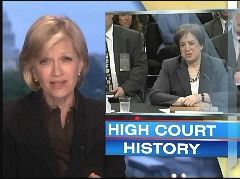
“The number that really excited Democrats is three: Think Ginsburg, Sotomayor and Kagan,” NBC’s Kelly O’Donnell excitedly announced Thursday night while leading into a clip of Democratic Senator Patrick Leahy, who exclaimed as he bounced on his heels on the Senate floor: “Three women will serve together on the United States Supreme Court for the first time in our nation’s history!” The news equally excited the TV network journalists. “History was made in this country today when the Senate confirmed Elena Kagan to the U.S. Supreme Court,” declared fill-in NBC Nightly News anchor Lester Holt as viewers were treated to a “Making History” on-screen graphic. “Tonight on World News, a day of high court history. Elena Kagan confirmed. For the first time ever, three women will be part of deciding the law of the land,” spouted a giddy Diane Sawyer in matching NBC by making Kagan her lead story. Sawyer could hardly contain her excitement: We are here in Washington on the day a new voice joins the Supreme Court. Elena Kagan, the third woman currently on the court, a woman with a reputation for holding her own in any room. And our Jonathan Karl is right here to tell us about the big vote right over there on Capitol Hill. And I want to know what happens when a new justice dons the robe for the first time, Jon? Karl confirmed: “Well, it’s a big day here. I mean, in all of American history, the Senate has confirmed only 112 justices, and, even if you include retired Justice Sandra Day O’Connor, only four of them have been women.” One sour note for Karl, a certain Republican who voted no: “There was one surprise. Scott Brown, I mean, this is the liberal, or moderate Republican from Massachusetts, introduced her at the confirmation hearings, defended her leadership of Harvard Law School. But in the end, he voted no.” (Back on January 31, 2006, when the Senate confirmed President George W. Bush’s second Supreme Court nominee, Samuel Alito, ABC’s World News held itself to a short item read by anchor Elizabeth Vargas.) On NBC Thursday night, Holt fretted that “today’s confirmation vote fell largely along party lines, seen by many as another symbol of Washington’s ever-deepening partisan divide.” But that “ever-deepening” is actually slightly less so than with Alito. Five Republicans voted to confirm Kagan, one more than the four Democrats who backed Alito. On the January 31, 2006 NBC Nightly News, Pete Williams noted: “The vote, 58-to-42, was one of the most deeply partisan ever for a Supreme Court nominee, with just four Democrats voting to confirm.” The MRC’s Brad Wilmouth corrected the closed-captioning against the video to provide these transcripts of the Thursday, August 6 stories: ABC’s World News: DIANE SAWYER, IN OPENING TEASER: Tonight on World News, a day of high court history. Elena Kagan confirmed. For the first time ever, three women will be part of deciding the law of the land. … SAWYER: We are here in Washington on the day a new voice joins the Supreme Court. Elena Kagan, the third woman currently on the court, a woman with a reputation for holding her own in any room. And our Jonathan Karl is right here to tell us about the big vote right over there on Capitol Hill. And I want to know what happens when a new justice dons the robe for the first time, Jon? JONATHAN KARL: Well, it’s a big day here. I mean, in all of American history, the Senate has confirmed only 112 justices, and, even if you include retired Justice Sandra Day O’Connor, only four of them have been women. SENATOR AL FRANKEN (D-MN): The tally is 63-37. KARL: Elena Kagan was easily confirmed in a vote the President hailed as historic. PRESIDENT BARACK OBAMA: For nearly two centuries, there wasn’t a single woman on our nation’s highest court. KARL: Kagan faced last-minute attacks from Republicans who branded her a liberal activist with absolutely no judicial experience. SENATOR PAT ROBERTS (R-KS): Her lack of judicial experience, striking. MITCH MCCONNELL, SENATE MAJORITY LEADER: -is not suited- SENATOR JEFF SESSIONS (R-AL): -does not have the gifts- SENATOR JOHN MCCAIN (R-AZ): She is unlikely to exercise judicial restraint. KARL: It was highly partisan. All but five Republicans voted no. All but one Democrat voted yes. With Kagan, the court will now have, for the first time, three women serving at once, one third of the justices. It’s a huge sea change for an institution that has been dominated by men. As recently as last year, there was just one woman on the court. JUSTICE RUTH BADER GINSBURG, U.S. SUPREME COURT: Now there I am all alone, and it doesn’t look right. It’s lonely for me. There’s life experience that a woman has simply because she’s grown up inside a woman’s body. KARL: Ronald Reagan nominated Sandra Day O’Connor as the first woman in 1981, but it wasn’t until 12 years later that the court installed a woman’s restroom near the room where they deliberate. JOAN BISKUPIC, SUPREME COURT HISTORIAN: For years, they would just have a men’s bathroom back there. It just goes to show what a male-dominated place the Supreme Court had been for many years. KARL: Kagan will, of course, be the most junior justice, and the others will make sure she knows it. By tradition, the junior justice must take notes when the nine of them deliberate. And, Diane, if somebody knocks on the door, it is her, the most junior justice, that has to go up to answer the door to bring in papers, a message, or even coffee. SAWYER: Pretty mild form of hazing, though. Tell me about the vote itself. Any surprises who voted for and against? KARL: There was one surprise. Scott Brown, I mean, this is the liberal, or moderate Republican from Massachusetts, introduced her at the confirmation hearings, defended her leadership of Harvard Law School. But in the end, he voted no. SAWYER: So he voted with the Republicans? KARL: He voted with the rest of the Republicans, all but five of them, against her nomination. SAWYER: Okay, thanks, Jon. Good to be here with you tonight. NBC Nightly News: LESTER HOLT: Good evening. Brian is on assignment tonight. I’m Lester Holt. History was made in this country today when the Senate confirmed Elena Kagan to the U.S. Supreme Court. Once she’s sworn in this weekend, she’ll become the current court’s third woman member and the fourth ever named. Tonight President Obama calls Kagan’s confirmation “an affirmation of her character and her temperament.” Still, today’s confirmation vote fell largely along party lines, seen by many as another symbol of Washington’s ever-deepening partisan divide. NBC’s Kelly O’Donnell is on Capitol Hill with more. Kelly, good evening. KELLY O’DONNELL: Good evening, Lester. When you look at today’s vote, you can see history. Justice Kagan will give women a greater voice – making up one-third of the court – and you can see politics. Five Republicans crossed over to support Kagan while one Democrat was among the no votes. SENATOR AL FRANKEN (D-MN): The tally is 63-37. The nomination is confirmed. O’DONNELL: Elena Kagan did get five fewer votes than Sonia Sotomayor last summer, but the number that really excited Democrats is three: Think Ginsburg, Sotomayor and Kagan. SENATOR PATRICK LEAHY (D-VT): Three women will serve together on the United States Supreme Court for the first time in our nation’s history! O’DONNELL: At 50, Kagan becomes the youngest justice, succeeding the oldest, 90-year-old John Paul Stevens. Congratulations from President Obama late today. PRESIDENT BARACK OBAMA: She knows that the Supreme Court’s decisions shape not just the character of our democracy, but the circumstances of our daily lives. O’DONNELL: Kagan’s unexpected sense of humor charmed Senators of both parties at her confirmation hearings. JUSTICE ELENA KAGAN, U.S. SUPREME COURT: It means I’d have to get my hair done more often, Senator Specter. O’DONNELL: New York born, first woman dean of Harvard Law. Her policy to limit military recruiters access there gave Republicans their strongest criticism. SENATOR JOHN CORNYN (R-TX): Dean Kagan, I believe, showed a willingness to bend the law and facts to advance her own political goals of protesting the Don’t Ask, Don’t Tell policy. O’DONNELL: Kagan worked for Presidents Obama and Clinton. She will be the only justice on the current court who has never been a judge. LEAHY: She earned her place at the top of the legal profession. No one gave it to her. She earned it. O’DONNELL: And it’s been 40 years since the newest member of the Supreme Court has had no previous experience as a judge. And the plan for Elena Kagan is that she will be sworn in this Saturday afternoon by her new colleague, Chief Justice John Roberts.

See more here:
Kagan’s Confirmation Makes ABC and NBC as Giddy as Liberal Democrats

CBS ‘Early Show’ Ignores Accusations of Bias Against Judge Behind Prop 8 Ruling

While Thursday reports on both ABC’s Good Morning America and NBC’s Today featured Proposition 8 supporters questioning the impartiality of California Federal Judge Vaughn Walker’s decision to strike down the state’s referendum defending traditional marriage, CBS’s Early Show failed to provide any such arguments. On Good Morning America, correspondent Terry Moran explained: “Opponents of same-sex marriage vowed to fight on and blasted the judge for, they said, letting personal interests trump his legal duty.” A clip was played of one Proposition 8 supporter: “The judge has imposed his own agenda upon the voters and the children and the parents of California.” On Today, legal correspondent Pete Williams noted: “But opponents of gay marriage, who supported Proposition 8, denounced the ruling and began preparing to fight back.” Supporter Randy Thomasson explained: “The judge has shut the Constitution, imposed his own agenda. He’s made a lot of people happy in the gay community in San Francisco, but he is the most dangerous type of judge in America.”   The Early Show report by correspondent Priya David-Clemens only featured a couple brief sound bites of gay marriage opponents in “outright disbelief” of the ruling, but no specific criticisms of the judge being biased. In contrast, three sound bites in favor of the ruling were featured. Of the three network morning shows, only Good Morning America noted that Judge Walker was himself openly gay. Introducing the segment, co-host George Stephanopoulos mentioned: “The judge, Vaughn R. Walker, a Republican first nominated for the bench by Ronald Reagan, he is also openly gay.” Both the Early Show and Today skipped over that detail.      Following David-Clemens’s Early Show report, co-host Harry Smith discussed Judge Walker’s decision with legal correspondent Jan Crawford, who proclaimed: …this is a devastating opinion for opponents of same-sex marriage. 136 pages, he has 80 findings of fact that basically amount not only to a defense of same-sex marriage but to a defense of gay people. He says same-sex couples are identical to straight couples and that religious beliefs that homosexually is a sin harms gays and lesbians. On point after point after point he knocks down all of the arguments that were put forth by opponents of same-sex marriage and says gays and lesbians have a fundamental right to marriage under the constitution, just like straight people do. Smith then wondered if Walker’s ruling amounted to settled law: “…there are plenty of people still opposed who want to mount lawsuits against it. What kind of a chance do they have with – is this enough to set a precedent?” Crawford responded: “If this ruling stands and is affirmed by higher courts, it could affect the laws in 45 states, forcing them to redefine how they look at marriage…this is really the first federal court test and it could definitely, as it goes forward, set a precedent that will affect every person across the country.” Raising the possibility of the case going to the U.S. Supreme Court, Smith asked: “[if] the Supreme Court stays on the same side, based on the legal issues that you just outlined, will same-sex marriage become the law of the land?” Only then did Crawford acknowledge the temporary nature of the ruling: “Now, if the court agrees with that, absolutely. But that is a huge gamble that – the people who brought this case are making a huge gamble the Supreme Court is ready to do that. You know, it’s pretty closely divided, Harry, as you well know, up there.”

See the rest here:
CBS ‘Early Show’ Ignores Accusations of Bias Against Judge Behind Prop 8 Ruling

‘Inception’: Dream Warriors, By Kurt Loder

Leonardo DiCaprio’s on the case in Christopher Nolan’s latest brain-tease. Joseph Gordon-Levitt in “Inception” Photo: Warner Bros. Are they handing out joints at the box office for “Inception”? That would make the movie considerably more fun. Christopher Nolan’s latest is a terrific-looking picture that bounds around the globe from Paris to Tangiers to Tokyo (among places that actually exist) in the wake of a freelance dream thief named Dom Cobb (Leonardo DiCaprio). Cobb’s specialty is infiltrating the dreams of corporate big shots and extracting their most valuable secrets. His latest assignment, however, is a little different — a Japanese industrialist named Saito (Ken Watanabe) has hired him to implant an idea in someone’s head that will allow Saito to take over a rival titan’s business empire. Cobb’s reward for achieving this goal: an end to his exile from the United States, where he’s currently a wanted man, and a yearned-for reunion with his two children. Right here you may wonder why anyone in search of secret information would break into someone’s dreams, which are so often distortions of waking life, rather than their memories, which could be more straightforward recollections. But Cobb is not a memory man, so … whatever. Gearing up for his mission, Cobb assembles an A-team of dream-work specialists. There’s an “architect” named Ariadne (Ellen Page), whose job is to structure dreams; a “forger” named Eames (Tom Hardy), who can pass for any other person in a dream world; and a “chemist” named Yusuf (Dileep Rao), whose drug concoctions allow penetration not only into dreams, or into dreams within dreams, but into dreams within dreams within dreams. There’s also a fixer named Arthur (Joseph Gordon-Levitt), whose purpose is to handle details and look sharp in skinny suits. As we see, the movie all but nudges us to notice that some of these characters’ names refer to celebrated figures outside the story. But this is sometimes cute to no purpose. Eames displays none of the talents of a famed architectural designer, and an industrial heir named Robert Fischer (Cillian Murphy) offers no indication of a chess-master’s cunning. Then there’s Cobb’s estranged wife, Mal (Marion Cotillard), who haunts his dreams and does her best to screw up his every plan: as her name unnecessarily denotes, she be bad. And what about Dom Cobb himself? Is his unlikely moniker meant to suggest Dummkopf , the German word for a dope? That would seem counterintuitive. * Many of the movie’s effects and digital manipulations are spectacularly imaginative, especially a sequence of weightless action in a rotating hotel corridor, the unexpected arrival of a huge train in a scene without tracks, and the startling sight of a long boulevard peeling up off the ground and rising to double over on itself. These eye-popping amazements are much-appreciated in a story that goes on and on for two and a half hours, with Cobb and his team flashing back and forth disconnectedly from one dream level to another, occasionally touching down in reality (whatever that is). Each of the dream-invaders carries a “totem,” an everyday, real-world tchotchke that tips them off as to whether or not they are in fact in a dream, either their own or someone else’s. As the dream levels and their far-flung locales piled up and intermingled — a collapsing Japanese mansion, a bullet-pocked snowscape, an exploding Parisian street — I wished I had a totem myself to keep track of what was going on. Unlike Nolan’s exceedingly clever 2000 film, “Memento,” which was a devilishly complex mystery, “Inception” is basically a complicated heist flick — there is no mystery to ponder and penetrate. Cobb’s goal is clear from the beginning; we spend the rest of the movie attempting to parse its many confusions as he attains it. Nolan says he spent 10 years obsessing over this story (the script is only the second one he has written on his own), which may explain its central problem. Despite its technical brilliance, and its fine cast (Hardy is clearly a star, and DiCaprio brings an emotional depth to the tale that is nowhere else in evidence), the picture is a puzzle palace with far too many rooms. The director himself may have gotten lost in it. (* This paragraph has been amended to delete two errors. As a few readers have noted, the Ariadne of Greek mythology is associated with the tale of the Minotaur’s labyrinth, which makes her name an appropriate fit for the maze-making character played here by Ellen Page. This is a fact so well-known that even I know it, although only on some deep sub-basement level of my brain, clearly. Critic Kyle Smith also points out that the name Browning, which I mistook for a poetry reference, could relate to Brownian motion. After a necessary Google consultation, I see that this is plausible and possibly probable. Thanks to all more eagle-eyed than me.) Check out everything we’ve got on “Inception.” For breaking news, celebrity columns, humor and more — updated around the clock — visit MTVMoviesBlog.com . Related Videos ‘Inception’ Clips MTV Rough Cut: ‘Inception’ Related Photos Leonardo DiCaprio, Ellen Page, More Premiere ‘Inception’ In L.A. ‘Inception’ World Premiere

Read more:
‘Inception’: Dream Warriors, By Kurt Loder

Lindsay Lohan Complains About Media To German GQ

‘If I sneeze, photos are published in which I am said to be weeping bitterly,’ actress says. By Kyle Anderson Lindsay Lohan on the cover of the German edition of GQ Photo: Ellen von Unwerth It was thought that Lindsay Lohan’s last public statement before reporting to a Los Angeles correctional facility to serve a 90-day sentence on Tuesday (July 20) was the message she sent on her fingernail last week. But the German edition of GQ just published their latest issue, which features Lohan on the cover and an interview with the troubled actress inside. (The magazine’s website also features a behind-the-scenes video of her photo shoot.) In the interview, which took place during the Cannes Film Festival and has been translated by Crushable , Lohan doesn’t discuss her legal troubles. Instead, she talks about why she still wants to act and how the media makes that complicated. “When I started working in the industry, I wanted to get to the very top — and I was painted as something completely different from what I really was,” she told the magazine. “Nowadays in Hollywood, it is so much more about celebrities and gossip, which can distract many great actors from their actual ability. The public comes to know so much about these people that it gets superimposed upon on their work in movies. I love what I do, so I have to be able to handle it.” Lohan also expressed frustration at the way she is perceived by the public. “The media creates its images in just seconds, so they can interpret reality as they imagine it,” she said. “If I sneeze, photos are published in which I am said to be weeping bitterly. And if I keep my hand in front of my mouth and nose, it’s the same; I was hungover and had a hard night of heavy partying behind me. You can’t imagine to what extent this has been accepted.” The latest “media image” of Lohan came on Thursday , when gossip site X17 posted a video of the actress apparently entering the sober-living facility Pickford Lofts, which was started by celebrity lawyer Robert Shapiro. Lohan is also said to be hiring Shapiro to represent her after attorney Shawn Chapman Holley quit last week. X17 also posted a video of Shapiro visiting the facility, but the lawyer would not say whether he was representing Lohan. How much do you feel the media is to blame for Lindsay Lohan’s problems? Share your opinions in the comments below. Related Photos Lindsay Lohan Goes To Court The Highs And Lows Of Lindsay Lohan Related Artists Lindsay Lohan

More here:
Lindsay Lohan Complains About Media To German GQ