Tag Archives: liberal

HuffPo Celebrates ‘Great’ Novels Giving Teens Gay Role Models

Do you know what your teens are reading? The folks at the Huffington Post do, and they’re happy to report the emergence of gay role models in teen-focused literature.  In a July 19 post, contributors Jessie Kunhardt and Alexandra Carr highlighted 13 “great” novels for gay teens who want to explore teen homosexuality or find “fictional role models.” Kunhardt and Carr praised the books as “worth a read” despite many of the books having generated complaints from parents and bans from schools and libraries. The list included brief summaries and, in some cases, excerpts of positive reviews from mainstream publications including Publisher’s Weekly and Booklist. The reviews praised the books for themes like “celebration of human differences,” “be proud of who you are” and “love can lead to acceptance.” One highlighted book, “Kissing Kate,” was written by Lauren Myracle, an author whose “TTYL” series topped the American Library Association’s list of Most Challenged Books in 2009. The books, written in “instant message” format, have been criticized for offensive language and nudity, according to the ALA. Another book, “The Perks of Being a Wallflower” by Stephen Chbosky, was celebrated as a teen literature “classic” by the HuffPo writers. “Perks” was the ALA’s third most-challenged book for its depictions of “homosexuality, sexually explicit, anti-family, offensive language, religious viewpoint, unsuited to age grou, drugs, [and] suicide.” The Huffington Post is a vocal advocate for the mainstreaming of homosexuality through teen literature. Last June, the liberal blog posted an Associated Press article noting that there were “finally” books offering gay role models to teens. And despite the ALA’s list of Most Frequently Challenged Books, the organization has repeatedly shown its approval of the LGBT agenda in children and young adult novels. A report by the Culture and Media Institute found that in 2009 alone, more than 40 pro-gay books were given ALA awards.

Is All This ‘Conservatives Are Racist’ Talk Designed to Save Dems in November?

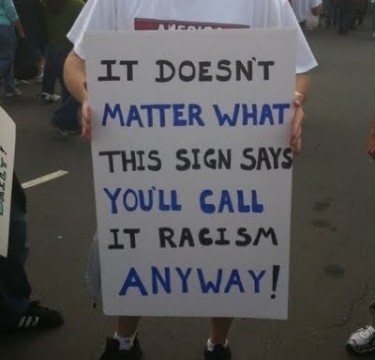
Have you noticed that you can’t swing a dead cat these days without hitting some television host claiming the Tea Party or a conservative is racist? Turn on ABC and there it is. Ditto CBS , CNN , and MSNBC . Can’t get away from it, can you? Think it’s just a coincidence, or could this be a response to President Obama’s plummeting poll numbers and the panic in the liberal media that November could be a realigning election that results in a massive Republican sweep of Congress? Before you answer, consider the following written Wednesday by Gina Loudon, the founder of Buycott Arizona: With no way to win on the issues, Democrats would need some way to energize their base. So in 2010, they began playing the race card as hard as they could. In a very rare move, the president of the United States rushed out to tell the world that he had a racist state that had gone rogue and needed to be punished. Adding to the narrative, Democratic congressional leaders invited a foreign leader to excoriate millions of Americans from the floor of Congress…While assailing white voters in Arizona, the Obama administration got caught in an Orwellian scenario that makes it appear the policy of this Chicago machine administration is that some people really are “more equal” than others.   On Tuesday, the Los Angeles Times reported : Democratic strategists looking to stave off major losses in the upcoming midterm election have devised a precise and targeted role for President Obama: recapturing the enthusiasm he generated as a fresh-faced candidate vying to become the nation’s first black president.  This seems crucial for Democrat success, as according to a recent survey by the Pew Research Center, Republicans are far more energized: Fully 56% of Republican voters say they are more enthusiastic about voting this year than in previous elections – the highest percentage of GOP voters expressing increased enthusiasm about voting in midterms dating back to 1994. While enthusiasm among Democratic voters overall is on par with levels in 2006, fewer liberal Democrats say they are more enthusiastic about voting than did so four years ago (52% then, 37% today). The Republican Party now holds about the same advantage in enthusiasm among its party’s voters that the Democratic Party held in June 2006 and the GOP had late in the 1994 campaign. Moreover, more Republicans than Democrats are now paying close attention to election news (64% vs. 50%). Coincidentally as the Times noted, the President is changing his approach:  More and more, Obama is taking on a partisan tone. He is weaving a story line peopled with villains and heroes, fools and leaders. In a speech Thursday in Las Vegas, he mocked Sen. Harry Reid’s election opponent, Republican Sharron Angle, saying she “favors an approach that’s even more extreme than the Republicans we got in Washington. That’s saying something.”  It sure is saying something: Obama and Company, realizing November looks like a disaster, are beginning to demonize the opposition. And, as midterm elections are often about turnout, the key right now for the Left is to figure out a way to energize those that helped Obama get elected in the first place. The solution: play the race card. Nothing gets the ire up in liberals more than racism.  After all, you might still be unemployed, and this administration may not have brought about all the Hope and Change they campaigned on, but Republicans are all racists. This includes many of their elected officials, their surrogates at Fox News, the radio personalities they love like Rush Limbaugh and Glenn Beck, and, of course, those awful Teabaggers. The NAACP just put that red letter on THEIR backs, don’t you know? With the strategy in place, all that’s needed is a compliant media stoking the fire of discontent. Just try swinging a dead cat without hitting someone that fits THAT bill. 

Read more:
Is All This ‘Conservatives Are Racist’ Talk Designed to Save Dems in November?

Today Show Job Search Segment Turns Into Ad for Obama Agenda

A segment that was billed as a guide to help some of Today’s unemployed viewers find work, on Wednesday’s show, turned into a platform for the president of the liberal National Urban League to attack those who opposed the President’s plans, as he railed against those in Congress who have been filibustering extension of the unemployment benefits. Today co-anchor Matt Lauer, who hosted the segment, even prompted Morial to address how his organization was going to address the obstruction of the Democratic agenda in Congress, in the upcoming midterm elections, as he asked: “How much do you target candidates who have bad job policies…and support candidates who have good ones?” NBC’s Ann Curry, at the top of the 8:30am half hour of Today’s July 14 show, teased viewers that “Americans, on average, took about 17 weeks to find a job. Well today the number has actually doubled. It’s twice that. So the question is where should you be looking for work? We’ve got some answers this morning.” However when viewers tuned in for those answers they also got a not so veiled anti-Republican diatribe from the National Urban League’s Marc Morial as he chastised those who opposed Democratic measures. MATT LAUER: Marc, let me start with you. I mean 9.5 percent, that’s where the unemployment rate stands right now. It’s been stubborn, it’s not going down nearly fast enough and apparently this job crisis is not an equal opportunity unemployer. It’s striking minorities much harder, isn’t it? MARC MORIAL: African-Americans, the, the rate is more like 16 percent, for Latinos it’s 12 percent. There is no doubt that this recession has been tough for everyone but it’s been especially tough for communities of color. People are hurting. They’re hurting in a very significant fashion and many, many people who’ve worked their entire lives find themselves without work. The new unemployed, it’s a lavender recession. It’s white collar, blue collar, pink collar, it’s across the board, Matt, but especially tough for people of color. LAUER: When you talk about minority communities and you talk to the people in those communities, are you telling them you think the jobs are coming back or are they gone for good? MORIAL: We’re saying that steps have to be taken. And I think our message has been consistent throughout the year that it’s not gonna happen serendipitously. There’s gotta be public policy steps. There’s gotta be a concerted effort. In this nation we can’t tolerate the new normal of a nine percent unemployment rate. That’s not, that’s not acceptable. And right now Congress has been stalling, really the Senate through the use of the filibusters, been stalling an up or down vote on the extension of unemployment benefits, an expansion of the home purchase tax credit, summer jobs. LAUER: Right. MORIAL: These measures, while small, could help many, many people. Lauer then turned to Today’s financial editor Jean Chatzky who, finally, did offer the job seeking advice teased at the top of the half-hour, as she highlighted the best cities to look for new jobs. However Lauer then quickly returned to Morial who finished the segment with a pitch for the National Urban League and its efforts to help elect candidates in the midterms who will help advance the President’s agenda. LAUER: And you know Marc, let me ask you this. I mean we’re coming up to midterm elections here in a couple of months. How political does the National Urban League get with this? How much do you target candidates who have bad job policies, in your opinion, and support candidates who have good ones? MORIAL: I think we’ve got to highlight that there’s been a lot of stalling. The use of the filibuster in the Senate troubles me the most because what it’s done, it’s blocked legislation that would help the economic picture, while on the same time, the very same people who use the filibuster accuse the President and others of not doing enough. So we’ve got to highlight the fact that there’s sort of an inconsistency in that type of message. And jobs, jobs, jobs, are the most important issue we think this fall. LAUER: Marc Morial, Jean Chatzky. Folks thanks very much.

More:
Today Show Job Search Segment Turns Into Ad for Obama Agenda

NBC’s Chuck Todd Trumpets Flawed Election Poll, Parrots Democratic Talking Points

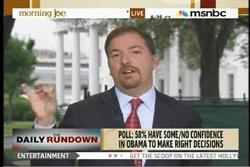
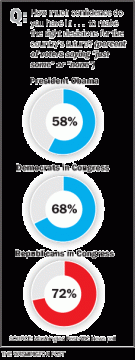
NBC Political Director Chuck Todd cherrypicked a recent Washington Post-ABC News poll to dismiss the possibility that Republicans will regain control of Congress in the November election. He did this despite evidence within the same poll that the political landscape in 2010 resembles 1994, when Republicans picked up 54 seats to take control of the House. On the July 13 “Morning Joe,” Todd emphasized the finding that 72 percent of the country has either “just some” or no confidence at all in the ability of congressional Republicans to “make the right decisions for the country’s future.” “This wild card about this election cycle which makes it different from ’06, which makes it different from ’94, is this issue of the public’s view of the Republican Party,” insisted Todd. The poll is misleading for a number of reasons, none of which Todd acknowledged. First, measuring public confidence in President Barack Obama, congressional Democrats, and congressional Republicans, the pollsters grouped respondents who reported “a great deal of confidence” with “a good amount,” and “just some” confidence with “none at all.” This aggregation resulted in a higher percentage of Americans expressing some or no confidence at all in Republicans than in Obama. But grouping “just some” respondents with “none at all” respondents does not make sense because expressing some confidence is much different from expressing “none at all.” If the pollsters had grouped those who reported “a good amount” of confidence with those who reported “just some” confidence, Republicans in Congress would have received 61 percent support, 14 points higher than Obama. Second, Todd’s insinuation that the public preferred congressional Republicans to congressional Democrats in 1994 but not in 2010 contradicts the same poll he cited to advance the argument that Republicans will not maximize their gains in November. As of July 11, 2010, voters prefer congressional Republicans 47 percent and congressional Democrats 46 percent, a negligible difference. By contrast, on August 8, 1994, 49 percent of the public preferred congressional Democrats while only 42 percent of the public preferred congressional Republicans, a seven point edge. In fact, the public preferred congressional Democrats over congressional Democrats in every Washington Post-ABC News poll taken through the November election. MSNBC host Joe Scarborough challenged Todd on the preference issue, asking, “Aren’t these off-year elections really just an opportunity for Americans to vote up or down for the most part on the party in power, the party that’s running Washington?” Todd, seemingly uninterested in demonstrable trends, insisted that the White House and Democrats are capable of turning the election into something other than a referendum on their liberal agenda. An obstinate Todd continued to rain on the GOP’s parade. “Joe, I think it’s the difference between picking up 25 or 30 seats and picking up 40 seats,” he insisted. NBC’s chief political junkie was all too eager to report the results of a poll forecasting sobering prospects for Republicans without scrutinizing the data or researching relevant historical trends. A transcript of the relevant portion of the segment can be found below: MSNBC Morning Joe July 13, 2010 7:24 A.M. E.S.T. JOE SCARBOROUGH: Hey Chuck, let me ask you something. Of course let’s put up the polls really quickly again from the Washington Post and then I’m going to follow it up with some news you say may not as good for Republicans. First of all, let’s look at the polls. Sixty-eight percent of Americans have little confidence in Democrats; Seventy-two percent, Republicans. Of course we talk about 58 percent, Barack Obama. Now let’s go to the four reasons why you say Republicans may not take back the House in the fall. You wrote about this yesterday and it’s very fascinating. You said the favorable ratings the same as the Democrats. And you are exactly right. In fact, in this case it’s even worse for Republicans than Democrats. But I guess the bigger question is – and I want to get Mark’s thoughts on this as well – aren’t these off-year elections really just an opportunity for Americans to vote up or down for the most part on the party in power, the party that’s running Washington? CHUCK TODD, MSNBC political director: Most of the time they are, and for many voters, this will be the case. This wild card about this election cycle which makes it different from ’06, which makes it different from ’94, is this issue of the public’s view of the Republican Party. And the reason you have to sit there and not ignore it is look at what the message the White House is trying to drive. Look at the message that Democratic candidates in congressional races are trying to drive, which is saying, “okay, you may be mad at us, but look at them.” And look, when you already have 70 percent of the public having a negative view, you can sell that story – you have a better chance of selling the story. SCARBOROUGH: Does that work when Democrats – it’s a monopoly though in Washington though. I guess that’s why it’s so much harder to sell. Listen in ’94 the Republicans actually had a plan. We haven’t seen that yet from this group of Republicans. I guess the bigger question, Chuck is, can you beat something with nothing?    TODD: Joe, I think it’s the difference between picking up 25 or 30 seats and picking up 40 seats and 10 seats in the Senate. Do you see what I’m saying? I think the difference between having a good election night and the majority is somehow starting to improve their favorable rating, and starting to go out there and saying, “we have a plan.” And right now they don’t have that and I think that’s what’s keeping them from getting the entire enchilada here. –Alex Fitzsimmons is a News Analysis intern at the Media Research Center. Click here to follow him on Twitter.

Here is the original post:
NBC’s Chuck Todd Trumpets Flawed Election Poll, Parrots Democratic Talking Points

WaPo Insists GOP Lacks Confidence of 72 Percent; But 43 Percent Said They Had ‘Some’

The Washington Post announced bad news for its largely liberal readers in its poll Tuesday morning. The headline said “6 in 10 Americans lack faith in Obama: Congress still held in lower esteem, but poll shows gap narrowing.” Those who read the story would wait until the end of paragraph six (just before the jump) to get this liberal-haunting number: “Those most likely to vote in the midterms prefer the GOP over continued Democratic rule by a sizable margin of 56 percent to 41 percent .” But if the Post reader skipped the gray text and went just for the graphics, they’d get the impression that Republicans are worse off than the Democrats: they’d see asked “how much confidence do you have” in the parties, they showed Obama’s “lack faith” number at 58 percent, Democrats in Congress at 68 percent, and Republicans at 72 percent. But wait: in parentheses it says “percent of voters saying ‘just some’ or ‘none'”. (That wasn’t bolded in the paper, as it is on the website.) Here’s the rub: deep in the Post’s data (question 3), it shows Republicans “just some” number was 43 percent and “none” was 29 percent, while Democrats “just some” number was 35 percent and “none” was 32 percent. So portraying the Republican standing as “worse” than the Democrats (complete with trouble-red emphasis) is misleading at best. Post reporters Dan Balz and Jon Cohen simply blurred the numbers together, without a breakdown: “About seven in 10 registered voters say they lack confidence in Democratic lawmakers and a similar proportion say so of Republican lawmakers.” But the networks took that misleading impression and hardened it, with NBC’s Matt Lauer proclaiming ” just slightly more than 7 in 10 Americans don’t have faith in Republicans in Congress.” That quick-and-dirty formulation has zero room for 43 percent of Americans saying “just some.” The real problem here is the news judgment of the Post: the first question isn’t “How much confidence?” It’s “Who are you voting for?” If the Republicans are up 56-41 among likely voters, clearly the “just some” confidence is presently more than enough. Near the bottom of the poll story, it gets even darker for Democratic prospects: Obama’s overall standing puts him at about the same place President Bill Clinton was in the summer of 1994, a few months before Republicans captured the House and Senate in an electoral landslide. President Ronald Reagan, who also contended with a serious recession at the outset of his first term, was a little lower at this point in 1982, with a 46 percent to 45 percent split on his approval ratings. Republicans went on to lose about two dozen seats in the House that fall. The Post projected its poll as bad for Democrats, but not happy news for Republicans. Inside the paper, the headline was “Obama viewed slightly better than lawmakers.” The text box on A6 acknowledged “Democrats nationally remain on the defensive as they seek to retain both houses of Congress this fall.”

See the article here:
WaPo Insists GOP Lacks Confidence of 72 Percent; But 43 Percent Said They Had ‘Some’

Japanese Voters Reject Ruling Party and Doubling ‘VAT Tax’; AP Calls It a ‘Sales Tax,’ Ignores U.S. Implications

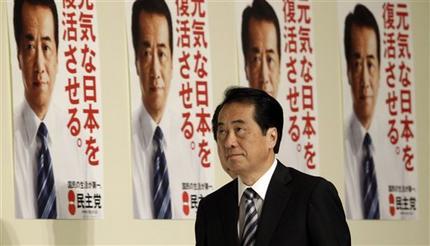
An outraged electorate has just handed Japan’s ruling party its hat in elections for half of the seats in the upper house of that country’s parliament in a direct reversal of election results from a year ago. Opposition parties made major gains. The results constitute a resounding rejection of a massive value-added tax increase proposed by a guy whose immediate predecessor of the same party sounded an awful lot like the U.S. President Barack Obama when he led his party to a historic victory a year ago. But, as will be shown later, you wouldn’t know that from reading the Associated Press’s coverage of Sunday’s returns. But first, a bit of background: The 2010 version of Naoto Kan (pictured at top right in an AP photo) is round two of an attempt by the country’s Democratic Party (no direct relation that I know of, but philosophically they’re nearly clones) to “remake” the island nation. If that sounds depressingly familiar, it should. The parallels of Kan’s same-party predecessor’s victory to Barack Obama’s 2008 electoral win are eerie, as this August 2009 election night report from Eric Talmadge the Associated Press will demonstrate (bolds are mine): Japan opposition wins landslide victory Vote seen as a barometer of frustrations over high unemployment, falling exports Japan’s opposition swept to a historic victory in elections Sunday, crushing the ruling conservative party that has run the country for most of the postwar era and assuming the daunting task of pulling the economy out of its worst slump since World War II. A grim-looking Prime Minister Taro Aso conceded defeat just a couple hours after polls had closed, suggesting he would quit as president of the Liberal Democratic Party, which has ruled Japan for all but 11 months since 1955. “The results are very severe,” Aso said. “There has been a deep dissatisfaction with our party.” Unemployment and deflation – and an aging, shrinking population – have left families fearful of what the future holds. Fed up with the LDP, voters turned overwhelmingly to the opposition Democratic Party of Japan, which ran a populist-leaning platform with plans for cash handouts to families with children and expanding the social safety net. … The Democrats’ plan to give families 26,000 yen, or $275 (U.S.), a month per child through junior high is meant to ease parenting costs and encourage more women to have babies. Japan’s population of 127.6 million peaked in 2006, and is expected to fall below 100 million by the middle of the century. The Democrats are also proposing toll-free highways, free high schools, income support for farmers, monthly allowances for job seekers in training, a higher minimum wage and tax cuts. The estimated bill comes to 16.8 trillion yen ($179 billion) if fully implemented starting in fiscal year 2013 – and critics say that will only further bloat Japan’s already massive public debt. Adjusted for relative population size, the stated $179 billion amount would be the equivalent of about $435 billion in the U.S. That may not seem like much compared to the Obama and the Democrats’ $800 billion-plus “stimulus” of last year, but keep in mind that Japan spent the better part of the 1990s trying to make government stimulus work with little success. Also note that Japan’s Liberal Democratic Party (LDP), as the author of the Lost Decade’s stimulus, has hardly been deserving of the “conservative” label the AP’s Talmadge applied to it. Of course, after Japan’s Democrats came to power, they had to deal with the annoying question of how to close the obvious budget deficits they were building. Their answer, as has all too often been the case with U.S. Democrats, was to raise taxes, despite the tax-cut pledge cited in Talmadge’s AP report. In a Monday, July 12 story , the AP’s Jay Alabaster gave readers many of the details on how that idea was received by voters, but left out a really, really important one: Japan braces for gridlock after ruling party loss Japan’s ruling party faced the prospect of political gridlock Monday after an election setback that could undermine its attempts to reduce a ballooning budget deficit and revive growth in the world’s second-largest economy. Half of the 242 seats in the upper house of parliament were up for grabs Sunday. The ruling Democratic Party of Japan won only 44 seats – far below its stated goal of 54 – while opposition parties made major gains. That leaves the Democrats and their tiny coalition partner with 110 seats, well below their majority of 122 before the vote. The conservative Liberal Democratic Party won 51 seats, bringing its total to 84. … the results are a dramatic contrast to the Democrats’ landslide victory just a year ago, when they seized control of parliament and ended the rival Liberal Democrats nearly unbroken 55-year rule. Losing the majority in the upper house will make it more difficult for the Democrats to move ahead on their agenda, which includes cutting wasteful spending, making government more open and creating a solid social security system for a rapidly aging and shrinking population. … I n office just a month, Kan has warned that Japan’s finances could face a Greece-like meltdown if it doesn’t cut back on soaring debt – twice the country’s GDP – and suggested raising the sales tax as a solution. But voters, already suffering from the economic downturn, rejected that idea. … Kan acknowledged defeat early Monday morning, saying he failed to fully explain his proposal to raise the sales tax from 5 percent to as much as 10 percent in coming years. … Kan, a former finance minister with roots in grass-roots activism, enjoyed support ratings of more than 60 percent when he took office in early June. “Sales tax”? What is this “sales tax”? It turns out that Alabaster was really referring to a de facto value-added tax, as shown here in this description of Japan’s tax structure: Japan Consumption Tax The tax is similar to value added tax and is, in fact, imposed on most sales and services provided in Japan and on imports. A taxpayer may offset the consumption tax paid on expenses against the tax he has to pay on his income. Consumption tax is 5%. Companies whose sales per year are less than 10 million yen are tax exempt. Imagine that. Yes Virginia, the “consumption tax” is effectively a VAT tax, as it is imposed on “consumption” by both individuals and companies. Every time “consumption” occurs, i.e., at every stage of production and distribution, the tax kicks in. The 10 million yen exemption is the U.S. equivalent of about $114,000, meaning that only the very small businesses are exempt. It seems that the AP and Mr. Alabaster didn’t want to give their U.S. audience the impression that voters elsewhere have rejected a steep increase in VAT taxes. Why, accurate and responsible reporting might have made American readers more resistant to allowing this dangerous idea to get started. Apparently, Alabaster and the AP want to see a VAT tax come to pass in the U.S. so badly that they are willing to blatantly misrepresent events overseas in the name of that cause. Beyond the self-evident deception just described, if what has just transpired in Japan’s elections had taken place at the expense of a conservative government trying to cut taxes while a conservative or Republican president occupying the Oval Office was trying to do the same thing, we would never have heard the end of it. As it is, you can virtually take it to the bank that the establishment press will fail to identify the obvious comparison between what Japanese voters have rejected to what the Obama administration both is doing (letting the Bush tax cuts expire, an action I like to refer to as “repealing the tax system that grew the economy for almost six years”), and wants to do more of, including the VAT tax. Raising taxes in a debt-drenched nation during a flat or allegedly recovering economy, in addition to being economically dumb, is an electoral loser. What part of “no” don’t these people understand? Cross-posted at BizzyBlog.com .
Original post:
Japanese Voters Reject Ruling Party and Doubling ‘VAT Tax’; AP Calls It a ‘Sales Tax,’ Ignores U.S. Implications

Behar: Liberal Opinions Come from Being Smart; Conservatives Closed-Minded

It’s patently obvious HLN host Joy Behar has a disdain for the conservative point of view. But is it because she is ideologically liberal, or perhaps does she just think it is “cooler” to be liberal?  On CBS’s July 11 “Sunday Morning,” CBS correspondent and sometime fill-in “Evening News” anchor Russ Mitchell interviewed the HLN host of “The Joy Behar Show.” He asked her about views and where this view came from. “Her unabashed liberal opinions often lead to some heated debates with her ‘View’ co-hosts … especially with the politically conservative Elisabeth Hasselbeck,” Mitchell said. “Where did this liberal streak come from?” Turns out, it isn’t because of a particular issue or set of reasons she is a self-proclaimed liberal, but because Behar suggests there’s a higher intellect if you’re a liberal. “It comes from being smart,” Behar said. And Behar has paraded this “smartness” on “The View” and her HLN show. She has attacked prayer as a substitute for thinking , accused former Alaska Gov. Sarah Palin of intentionally making her children media targets and exhibited irrational hatred for Rep Michele Bachmann, R-Minn. , not unlike most of those “smart” people on the left that seem to think a backbencher congresswoman from Minnesota is a threat to civil society . Mitchell reacted to Behar’s response by asking what her “The View” co-host would have to say about her conclusion. Behar response: Conservatives are just closed-minded.

Guess Which Liberal TV News Host This Is

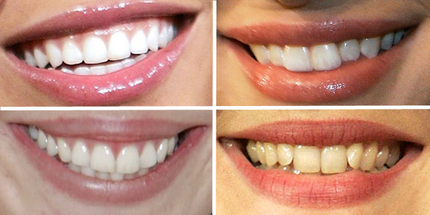
This is a high school picture of a perilously liberal television news host:   Can you guess who it is? (answer follows, h/t TVNewser): Tough to believe that’s Rachel Maddow:  The “before” picture apparently comes from her high school yearbook. For those interested, Maddow grew up in Castro Valley, California, which is a town a few miles away from Oakland across the Bay from San Francisco. Exit question: would Maddow’s program be more popular if she was still a blond, or would her liberal views still interfere with her success? 

See the rest here:
Guess Which Liberal TV News Host This Is

MSNBC Fill-In Host Absurdly Claims Again: Obama a ‘Republican President’

For the second day in a row, liberal talk show host and MSNBC guest anchor Cenk Uygur pushed the outlandish notion that President Obama is a conservative. Filling in on July 7 for Dylan Ratigan on his 4 p.m. show, Uygur exclaimed, “I didn’t realize we voted for a Republican president!” Uygur preceded this statement with a rant on how ridiculous it is for Obama to express concern about the ever-growing deficit when “60 percent of Americans favor additional government spending to create jobs and stimulate the economy.” Uygur and liberal guest Ryan Grimm of “The Huffington Post” could not understand President Obama’s rationale for focusing on deficit concerns. Grimm argued that, “when people say they are concerned about the deficit” they are just really saying that, “they are nervous about the economy. That’s all they mean. So if you solve the economic problems, you’re going to solve the deficit concerns.” Of course, Uygur and Grimm agreed that the only way to improve the economy was for the president to spend more, neglecting the fact that President Obama has already spent some $3.5 trillion in his first year in office, which more than exceeds any other first-year president. If Obama were a truly fiscally responsible statesman, he would recognize that our nation has a spending problem.  However, with unemployment close to double digits, and in need of a scapegoat, the hosts at MSNBC are growing restless, asking, “when will our president stop adopting Republican talking points and start giving us real change instead of pocket change?”

Left-wing Media Regulation Group Sees ‘Astroturf’ Everywhere Except in Mirror

Advocacy groups have increasingly labelled their opposition as “astroturf,” or corporate-funded fake grassroots, groups in order to demean them and lessen the fact that both sides enjoy some measure of public support. Many of the organizations throwing around accusations of astroturfing, such as the Marxist net neutrality advocacy group Free Press and the liberal ThinkProgress not only engage in astroturf strategies, but are financially supported in ways they decry as astroturf. The media, unsurprisngly, has often chosen to ignore leftist astroturfing and focus on accusations of rightist astroturfing. The Daily Caller reported Wednesday on a pro-neutrality letter circulated around Capitol Hill by Free Press which was a product of the same astroturfing tactics Free Press has decried. The “signatories” of the letter had no recollection of the letter and had no idea they had signed it. One of the signatories, the Juvenile Diabetes Research Foundation wrote to the Federal Communications Comission, The Hill reported , asking to be removed from the list of signatories. Tellingly, a Free Press spokeswoman suggested that they were pressured to do so. Presumably by the Satan-worshipping board of directors of some telecommunications company. Mike Riggs, of The Daily Caller, wrote: “Interestingly, groups like Free Press and NTEN like to publicly denounce letters with questionable signatories. In 2009, Ars Technica pointed to a letter that was supposedly authored by a group of senior citizens who supposedly had written Congress to oppose net neutrality. The group ‘forgot to strip out the “XYZ organization” and replace the text with its own name,’ reports Ars Technica, which caught wind of the letter from Free Press. ‘It’s unclear who was behind the letter, but it certainly looks like evidence of anti-neutrality forces rounding up an odd collection of allies on this issue,’ wrote Ars’ Matthew Lasar.” Free Press has shown a similar indifference to ethics in the past, with campaign director Timothy Karr quick to accuse anyone and everyone who opposes net neutrality of being a corporate tool, much of the time sans any sort of evidence, whatsoever. Michael Turk of Digital Society offered Karr $1,000 for proof that he was an astroturfer. One June 30, The Daily Caller reported that Free Press had outright lied regarding the FCC preventing them from attending closed-door meetings on net neutrality when they had, in fact attended. Similarly, they said they had been invited to attend a Congressional meeting on the issue and then told reporters they had been denied access. The same Daily Caller story pointed out that Free Press is a member of the Open Internet Coalition , a pro-net neutrality group. Amazon, Google, eBay, PayPal, Twitter, Earthlink are members, as are several marketing firms. Not only that, but Free Press’s own lobbying efforts are coordinated by a firm called the Glover Park Group, of which anti-net neutrality company Verizon is also a client. Many of the accusations of astroturfing by telecommunications companies in other blogs and publications ultimately come from Free Press. When PBS’ Media Shift experienced a large number of anti-net neutrality comments, Free Press campaign director Timothy Karr was quick to offer his expertise in throwing around astroturfing accusations for them. Wrote Mark Glaser: “While I have seen a lot of evidence pointing toward certain individuals who post time and again against Net neutrality, I haven’t found a ‘smoking gun’ that proves without a doubt that this campaign is paid for by telecom companies.” So Free Press denounces certain tactics as astroturfing, but when they engage in them, it’s grassroots advocacy. That’s a sharp contrast to the Tea Parties, which were heavily accused of being astroturf last year, by several media outlets. Wrote Julia A. Seymour of the Business & Media Institute: “ABC’s Dan Harris repeated criticism from the left that the tea parties were ‘a product’ of Fox News and lobbyist organizations.” House Speaker Nancy Pelosi has been one of the more visible figures reitterating the charge. Well, as long as Free Press provides the media with “information” and the corporate-funded liberal activists continue to be “grassroots,” there won’t need to be a smoking gun because any center-right organization will be astroturf.

Read more:
Left-wing Media Regulation Group Sees ‘Astroturf’ Everywhere Except in Mirror