Also in Wednesday morning’s round-up of news briefs, theater chains are OKing Peter Jackson ‘s Hobbit technology; Sundance Channel is developing programs by Robert Redford and Michael Fuchs; And the MPAA gives Obama a congratulations. MPAA Chief Chris Dodd Congratulates Barack Obama “I congratulate Barack Obama on his victory tonight. President Obama has demonstrated a great understanding of the importance of intellectual property to the fundamental strength of the American economy. In an era of partisan discord, there is bipartisan agreement that protecting American creativity and innovation is critical to our competitive edge in the global marketplace. I look forward to continuing to work closely with the Obama Administration to ensure the creative industries have every opportunity to thrive.” Around the ‘net… Theater Chains OK High Frame-Rate Hobbit Despite Format Challenges “Major exhibitors Regal and AMC lined up Tuesday to support Warner Bros. as it readies for the Dec. 14 U.S. release of Peter Jackson’s The Hobbit: An Unexpected Journey in the high frame rate of 48 frames per second. Meanwhile, the studio moves cautiously with its plans to introduce the theater technology, which has encountered a number of problems as it goes through a testing phase,” THR reports . Skyfall Results ‘Beyond Studio’s Wildest Dreams’ So far, Skyfall has exceeded the wildest dreams of even Eon, MGM and Sony, with a stunning £53.44m ($85.36 million) in just 10 days. Previously, no film had grossed £50m in 10 days in the UK. The final Harry Potter film managed an impressive £44.3m at that stage of its run, while Toy Story 3 stood at £39.8m after two weekends, The Guardian reports . Sundance Developing Dramas from Robert Redford, Michael Fuchs, More The AMC-owned network is developing five scripted dramas to join its legal entry from Oscar winner Ray McKinnon ( The Accountant ) hailing from producers including Sundance co-founder Robert Redford, THR reports . Donald Trump Has Twitter Meltdown After Election The Apprentice host said, “We can’t let this happen. We should march on Washington and stop this travesty. Our nation is totally divided!” he wrote. “Lets fight like hell and stop this great and disgusting injustice! The world is laughing at us. We can’t let this happen. We should march on Washington and stop this travesty. Our nation is totally divided!” Other celebs reacted via Twitter, including Alec Baldwin who wrote: “You trust the voters when they choose The Apprentice . But not now?” Yahoo reports .
AFI Fest has been underway for nearly a week with a mixture of Galas, free screenings and other events, but last night it slowed its heavy rotation of movies and activities to watch returns in what can be best described as a mostly liberal party at the festival’s Cinema Lounge at the Roosevelt Hotel in Hollywood. Shouts, applause and flailing victory high-fives mounted as returns came in on a big screen first tuned to CNN, but then changed to NBC when the news network seemed to be behind in their projections. Outside the hotel, a lone anti-Obama protestor made his passions against gay marriage, “that Muslim Obama ” and liberals in general as festival-goers headed in for the mostly open party. Inside, the political equation, perhaps not surprisingly, leaned left though there were noticeably mostly quiet individuals politely sitting with long faces as Obama’s victory seemed assured. Instead of trying to compete with what was a big night in the making, the festival decided to capitalize on it and turn it into a big event, complete with mostly open bar, sliders, pigs in a blanket, desserts and other treats. “When we set our dates last year, we knew the election would fall during the festival and we’re not going to try and compete with the election,” AFI Fest Director Jacqueline Lyanga told ML Tuesday night at the Roosevelt. “We’re all movie lovers, but at the same time, we’re all passionate citizens and so we wanted to find a way that people can come to the festival and see movies, but still be a part of the process. So we wanted to encourage people to get out to vote, so we didn’t have as packed of a film schedule today – we screened far fewer films today.” In keeping with the festival’s mostly egalitarian approach – for the fourth year running, all festival screenings are free – anyone including patrons on down to free ticket holders were invited into the evening to watch the returns and enjoying sponsored free of charge food and drink. The event last night appeared to be a hit and the final victory sent most people into a group cheer. A group of filmmakers and festival organizers from Ohio, which gave Obama the final win, were especially elated. “We invited in pass holders but also anyone who has a ticket from a movie from this week,” said Lyanga. “It’s great because it brings together filmmakers, pass holders, our patrons and the free ticket holders and celebrate the electoral process together. But while we’re here talking about politics, I’m also getting into conversations about cinema and getting to know our audience in a way that I wouldn’t be able to do otherwise.” Lyanga plugged this year’s event saying attendance has been strong across the board. The event opened last week with Hitchcock and the festival has played host to a wide-range of Galas including On the Road from Walter Salles, Olivier Assayas’ Something in the Air , Jacques Audiard’s Rust and Bone and more. It will close out Thursday night with the premiere of Steven Spielberg’s Lincoln . And while the big Grauman’s Chinese premieres have, as might be expected, drawn crowds and gawkers, smaller more challenging content have also been well attended, no doubt encouraged by the free ticketing. “For Kim Ki-duk’s Pieta we had to turn people away,” noted Lyanga “As a programmer, that’s extraordinary to see people be as excited as you’ve been about them for the past eight or nine months. We’re really building an audience of cinephiles. It’s a blending of older fans and newer younger fans.” Continuing, Lyanga added: “I think New York has always been a city that has had a vibrant art house audience and it’s great to now see that L.A. also has that. It encourages more filmmakers and distributors to take a chance on LA. It’s still a tough market, but this festival has given encouragement to the art house in Los Angeles.”
AFI Fest has been underway for nearly a week with a mixture of Galas, free screenings and other events, but last night it slowed its heavy rotation of movies and activities to watch returns in what can be best described as a mostly liberal party at the festival’s Cinema Lounge at the Roosevelt Hotel in Hollywood. Shouts, applause and flailing victory high-fives mounted as returns came in on a big screen first tuned to CNN, but then changed to NBC when the news network seemed to be behind in their projections. Outside the hotel, a lone anti-Obama protestor made his passions against gay marriage, “that Muslim Obama ” and liberals in general as festival-goers headed in for the mostly open party. Inside, the political equation, perhaps not surprisingly, leaned left though there were noticeably mostly quiet individuals politely sitting with long faces as Obama’s victory seemed assured. Instead of trying to compete with what was a big night in the making, the festival decided to capitalize on it and turn it into a big event, complete with mostly open bar, sliders, pigs in a blanket, desserts and other treats. “When we set our dates last year, we knew the election would fall during the festival and we’re not going to try and compete with the election,” AFI Fest Director Jacqueline Lyanga told ML Tuesday night at the Roosevelt. “We’re all movie lovers, but at the same time, we’re all passionate citizens and so we wanted to find a way that people can come to the festival and see movies, but still be a part of the process. So we wanted to encourage people to get out to vote, so we didn’t have as packed of a film schedule today – we screened far fewer films today.” In keeping with the festival’s mostly egalitarian approach – for the fourth year running, all festival screenings are free – anyone including patrons on down to free ticket holders were invited into the evening to watch the returns and enjoying sponsored free of charge food and drink. The event last night appeared to be a hit and the final victory sent most people into a group cheer. A group of filmmakers and festival organizers from Ohio, which gave Obama the final win, were especially elated. “We invited in pass holders but also anyone who has a ticket from a movie from this week,” said Lyanga. “It’s great because it brings together filmmakers, pass holders, our patrons and the free ticket holders and celebrate the electoral process together. But while we’re here talking about politics, I’m also getting into conversations about cinema and getting to know our audience in a way that I wouldn’t be able to do otherwise.” Lyanga plugged this year’s event saying attendance has been strong across the board. The event opened last week with Hitchcock and the festival has played host to a wide-range of Galas including On the Road from Walter Salles, Olivier Assayas’ Something in the Air , Jacques Audiard’s Rust and Bone and more. It will close out Thursday night with the premiere of Steven Spielberg’s Lincoln . And while the big Grauman’s Chinese premieres have, as might be expected, drawn crowds and gawkers, smaller more challenging content have also been well attended, no doubt encouraged by the free ticketing. “For Kim Ki-duk’s Pieta we had to turn people away,” noted Lyanga “As a programmer, that’s extraordinary to see people be as excited as you’ve been about them for the past eight or nine months. We’re really building an audience of cinephiles. It’s a blending of older fans and newer younger fans.” Continuing, Lyanga added: “I think New York has always been a city that has had a vibrant art house audience and it’s great to now see that L.A. also has that. It encourages more filmmakers and distributors to take a chance on LA. It’s still a tough market, but this festival has given encouragement to the art house in Los Angeles.”
As Bella Swan goes, so goes Kristen Stewart . The Twilight saga star appeared on Today on Wednesday to talk a bit about her evolution from passive heroine to ass-kicking vampire in Breaking Dawn – Part 2 , and ended the interview with a quote which suggests that, like Bella, Stewart has learned to be more of a bad-ass when it comes to her fans’ and the media’s prying into her personal life. Stewart looks typically uncomfortable self in the clip below, and awfully tired. When the Today cameras first zoomed in on her, I thought the dark circle beneath her right eye looked like a shiner. But what made an even bigger impression was the way in which the actress handled the inevitable question about her off-screen relationship with Robert Pattinson . Keep in mind that, in the clip. Stewart is facing three interviewers by her lonesome: Savannah Guthrie, Matt Lauer and Natalie Morales. That’s not easy, though four people took part in Stewart’s 2009 Today interview for Eclipse . Guthrie gets the RPatz question in just as the Today theme music begins signaling that the interview segment is ending. “Kristen, you have so many fans, and they will be mad at us for not asking,” she says before asking if Stewart and Pattinson are back together. Watch Stewart’s face as she processes the question. She flashes a split-second expression of annoyance before responding with an answer that would probably meet the new Bella’s approval: “Funny you mention that,” Stewart replied in a deliciously deadpan manner before putting a nice sharp stake in heart of the off-screen romance story. “I’m just going to let people watch whatever little movie they think our lives are and go for it. Keep them guessing, I always say.” A little mystery goes a long way. Follow Frank DiGiacomo on Twitter. Follow Movieline on Twitter.
As Bella Swan goes, so goes Kristen Stewart . The Twilight saga star appeared on Today on Wednesday to talk a bit about her evolution from passive heroine to ass-kicking vampire in Breaking Dawn – Part 2 , and ended the interview with a quote which suggests that, like Bella, Stewart has learned to be more of a bad-ass when it comes to her fans’ and the media’s prying into her personal life. Stewart looks typically uncomfortable self in the clip below, and awfully tired. When the Today cameras first zoomed in on her, I thought the dark circle beneath her right eye looked like a shiner. But what made an even bigger impression was the way in which the actress handled the inevitable question about her off-screen relationship with Robert Pattinson . Keep in mind that, in the clip. Stewart is facing three interviewers by her lonesome: Savannah Guthrie, Matt Lauer and Natalie Morales. That’s not easy, though four people took part in Stewart’s 2009 Today interview for Eclipse . Guthrie gets the RPatz question in just as the Today theme music begins signaling that the interview segment is ending. “Kristen, you have so many fans, and they will be mad at us for not asking,” she says before asking if Stewart and Pattinson are back together. Watch Stewart’s face as she processes the question. She flashes a split-second expression of annoyance before responding with an answer that would probably meet the new Bella’s approval: “Funny you mention that,” Stewart replied in a deliciously deadpan manner before putting a nice sharp stake in heart of the off-screen romance story. “I’m just going to let people watch whatever little movie they think our lives are and go for it. Keep them guessing, I always say.” A little mystery goes a long way. Follow Frank DiGiacomo on Twitter. Follow Movieline on Twitter.
In his half-century of cinematic existence, James Bond has been cast and recast, refined, reinvented and rebooted. He’s been declared a “sexist, misogynist dinosaur” and gotten his heart broken, and he’s been dragged into the present, where he’s had to find a new perch somewhere between gritty and ridiculous, between being a stoic modern action hero and a deliberately outsized fantasy remnant of, as one unamused minister puts it in Skyfall , a long gone “golden age of espionage.” Skyfall is American Beauty director Sam Mendes ‘ first turn at the wheel of this venerable spy franchise, and he and screenwriters Neal Purvis, Robert Wade and John Logan have managed what feels like the best possible thing that could have happened to Bond: They’ve made him fun again. When Daniel Craig was put in the lead role and the character was brought back to his beginnings in Casino Royale , it brought a vividly contemporary jolt to the character — this Bond wasn’t going to be off gathering information on al-Qaeda or anything, but his job was just as likely to involve messy killings as suave seductions, and the possibility of death and pain were much more real. It was a welcome revamp, if one that shifted the films into the orbit of the Bourne trilogy and risked stripping them of an essential element of Bond-ness. Chilly, rough-edged and not yet settled into his place at MI6, Craig’s Bond was a little busy with love and revenge to make quips. In Skyfall , Bond is literally reborn. During a mission-gone-wrong, he takes a hit that leaves everyone thinking he’s dead. It’s a misconception he’s happy to let stand while he takes a potentially permanent sabbatical involving beachside booze, sex and brooding over a vague sense of betrayal. He’s lured back by an attack on MI6 and on M ( Judi Dench ) masterminded by a computer genius named Silva (a terribly entertaining and menacingly flirtatious Javier Bardem). Bond ends his retirement because he knows he’s needed. And, oh, he is. Skyfall acknowledges that Bond isn’t a paragon of physical or martial arts perfection, or technologically savvy. In contrast to the newly minted agent he played in Casino Royale, he’s an old hand in this film, neither the fastest nor the youngest but still the best. Skyfall acknowledges our need for some humanity in Bond without overloading him with angst. The film fondly brings back familiar franchise elements, including an entertainingly young Q (a sly Ben Whishaw) and another character whose reveal is best left discovered, along with an exotically beautiful paramour named Sévérine (Bérénice Marlohe) who’s part victim and part femme fatale. Bond gets fewer silly gadgets these days, but he does have his awesomely fly car and a customized gun. And though he travels to such exotic locations as Shanghai, Macau and Istanbul, he also spends an unprecedented amount of time in his homeland, where he reintegrates himself with MI6, which is under political scrutiny, and returns to his native Scotland where a just-enough sliver of backstory is revealed. Skyfall makes explicit that Bond is a child of the United Kingdom. His only consistent relationship is with his country, even though that country is willing to sacrifice him for the greater good should it be necessary. It’s why, despite Bond’s dalliances with Sévérine and fellow field agent Eve (Naomie Harris), the film’s true Bond girl is M. The MI6 director’s complicated role as stern taskmaster and surrogate maternal figure gets played out as Silva, who shares a past with M, targets her and Bond tries to protect her. Like Bond, M is as much a concept as a character, but, beneath their bickering, Dench and Craig find a credible tenderness that suggests their is immense mutual affection behind the bone-dry sniping. Mendes isn’t an exceptional director of action, and many of the set pieces are lavish and forgettable. The car chases through crowded streets and pursuits across rooftops look a lot like other blockbuster sequences that recently graced screens. He’s better with character interactions and small touches: Bond straightening his cuffs after an improbable landing in a train; Bond watching a foe face a Komodo dragon and book-ending his adventure with unwilling dips in bodies of water. Working with the great cinematographer Roger Deakins, Mendes also presents some stunning sequences of beauty in a film where you might not expect such a thing. A fight high atop a Shanghai skyscraper takes place in the dark against the neon advertising backdrop of a shifting jellyfish projected on the building’s glass skin and ends with Bond meeting the gaze of someone in the building across the way, hundreds of feet up. Silva’s high-tech lair is set on an island that’s home to an abandoned city, while MI6 retreats with all its sleek gear to a historical location deep in London. The old and the new, the past and the ever-accelerating present — despite the body count, it’s not death that Bond has to worry about, it’s remaining recognizable and relevant. Skyfall manages to balance both in an uncommonly entertaining fashion. Related: Check out Movieline’s extensive coverage of Skyfall and the 50th anniversary of James Bond here. Follow Alison Willmore on Twitter. Follow Movieline on Twitter.
In his half-century of cinematic existence, James Bond has been cast and recast, refined, reinvented and rebooted. He’s been declared a “sexist, misogynist dinosaur” and gotten his heart broken, and he’s been dragged into the present, where he’s had to find a new perch somewhere between gritty and ridiculous, between being a stoic modern action hero and a deliberately outsized fantasy remnant of, as one unamused minister puts it in Skyfall , a long gone “golden age of espionage.” Skyfall is American Beauty director Sam Mendes ‘ first turn at the wheel of this venerable spy franchise, and he and screenwriters Neal Purvis, Robert Wade and John Logan have managed what feels like the best possible thing that could have happened to Bond: They’ve made him fun again. When Daniel Craig was put in the lead role and the character was brought back to his beginnings in Casino Royale , it brought a vividly contemporary jolt to the character — this Bond wasn’t going to be off gathering information on al-Qaeda or anything, but his job was just as likely to involve messy killings as suave seductions, and the possibility of death and pain were much more real. It was a welcome revamp, if one that shifted the films into the orbit of the Bourne trilogy and risked stripping them of an essential element of Bond-ness. Chilly, rough-edged and not yet settled into his place at MI6, Craig’s Bond was a little busy with love and revenge to make quips. In Skyfall , Bond is literally reborn. During a mission-gone-wrong, he takes a hit that leaves everyone thinking he’s dead. It’s a misconception he’s happy to let stand while he takes a potentially permanent sabbatical involving beachside booze, sex and brooding over a vague sense of betrayal. He’s lured back by an attack on MI6 and on M ( Judi Dench ) masterminded by a computer genius named Silva (a terribly entertaining and menacingly flirtatious Javier Bardem). Bond ends his retirement because he knows he’s needed. And, oh, he is. Skyfall acknowledges that Bond isn’t a paragon of physical or martial arts perfection, or technologically savvy. In contrast to the newly minted agent he played in Casino Royale, he’s an old hand in this film, neither the fastest nor the youngest but still the best. Skyfall acknowledges our need for some humanity in Bond without overloading him with angst. The film fondly brings back familiar franchise elements, including an entertainingly young Q (a sly Ben Whishaw) and another character whose reveal is best left discovered, along with an exotically beautiful paramour named Sévérine (Bérénice Marlohe) who’s part victim and part femme fatale. Bond gets fewer silly gadgets these days, but he does have his awesomely fly car and a customized gun. And though he travels to such exotic locations as Shanghai, Macau and Istanbul, he also spends an unprecedented amount of time in his homeland, where he reintegrates himself with MI6, which is under political scrutiny, and returns to his native Scotland where a just-enough sliver of backstory is revealed. Skyfall makes explicit that Bond is a child of the United Kingdom. His only consistent relationship is with his country, even though that country is willing to sacrifice him for the greater good should it be necessary. It’s why, despite Bond’s dalliances with Sévérine and fellow field agent Eve (Naomie Harris), the film’s true Bond girl is M. The MI6 director’s complicated role as stern taskmaster and surrogate maternal figure gets played out as Silva, who shares a past with M, targets her and Bond tries to protect her. Like Bond, M is as much a concept as a character, but, beneath their bickering, Dench and Craig find a credible tenderness that suggests their is immense mutual affection behind the bone-dry sniping. Mendes isn’t an exceptional director of action, and many of the set pieces are lavish and forgettable. The car chases through crowded streets and pursuits across rooftops look a lot like other blockbuster sequences that recently graced screens. He’s better with character interactions and small touches: Bond straightening his cuffs after an improbable landing in a train; Bond watching a foe face a Komodo dragon and book-ending his adventure with unwilling dips in bodies of water. Working with the great cinematographer Roger Deakins, Mendes also presents some stunning sequences of beauty in a film where you might not expect such a thing. A fight high atop a Shanghai skyscraper takes place in the dark against the neon advertising backdrop of a shifting jellyfish projected on the building’s glass skin and ends with Bond meeting the gaze of someone in the building across the way, hundreds of feet up. Silva’s high-tech lair is set on an island that’s home to an abandoned city, while MI6 retreats with all its sleek gear to a historical location deep in London. The old and the new, the past and the ever-accelerating present — despite the body count, it’s not death that Bond has to worry about, it’s remaining recognizable and relevant. Skyfall manages to balance both in an uncommonly entertaining fashion. Related: Check out Movieline’s extensive coverage of Skyfall and the 50th anniversary of James Bond here. Follow Alison Willmore on Twitter. Follow Movieline on Twitter.
Just the words South Central will conjure up an image of mean streets and gangs, even by people who don’t live in Los Angeles. The neighborhood is infamous for its hardened criminals and its gang-banger imagery has permeated the popular culture everywhere. Director David Ayer returns to the neighborhood he knows well in his latest film End of Watch , starring Jake Gyllenhaal (who is also an executive producer) and Michael Peña who give gripping performances as LAPD cops Brian Taylor and Mike Zavala tackling a better armed group of very tough group – both guys and gals. Ayer grew up in the neighborhood and knows the people he’s brought to the big screen well. South Central was the setting for his first directorial feature, Harsh Times back in 2005. And LAPD cops were at the heart of his 2008 pic Street Kings . Ayer told ML that he initially wanted to move away from the cop-crime scenario after working on those films, but headed back to the genre even as he was trying to talk himself out of it. In the feature that opens wide Friday, Gyllenhaal and Peña play LAPD officers Brian Taylor and Mike Zavala. The action plays out on screen through the P.O.V. of hand-held cameras implanted on police officers with more footage “shown” by gang members, surveillance cameras, dish cams and citizen-caught images in the line of fire. While there are moments peppered throughout the feature showing moments of levity between the their characters that prompted outbursts of laughter during the film’s premiere in Toronto, the scenes quickly turn to present a mosaic of dark violent streets, human trafficking, gang confrontation and a barrage of shoot-outs. Just try and fall asleep in this movie – aint gonna happen… David Ayer chatted with ML the day after the premiere of End of Watch in Toronto the other week and gave shared why he decided to return to the cop story, they unique visual style he’s going for in the pic, and just how real all the seemingly outrageous dramas the two officers face in the film are… [ Related: Jake Gyllenhaal’s Life-Changing End Of Watch Prep: ‘Someone Was Murdered In Front Of Me’ and End Of Watch Star Michael Peña Sees Racial Barriers Coming Down In Hollywood ] I heard you wrote the script for End of Watch in six days, how did that play out? Yes, I did. It just kind of exploded out of me. It was six days by way of twenty years, you know what I mean? It’s a world I’ve spent a lot of time in. I grew up in South Central L.A. I have a lot of friends in law enforcement, so a lot of things that happen in the script happened to a close friend of mine. I have been writing down stories he told me. So the challenge of writing this story lead me to do this pseudo-documentary style that makes it really natural and not just using the usual story landmarks that you might intuitively feel. Were there certain documentaries that informed some of your style choices for End of Watch ? This one friend of mine takes cameras to work and guess what – he films things just like we all do with our phones etc anywhere. It can be riveting and it seemed like a fantastic device to tell a story, but at the same time, the “found footage” aspect can become a bit tedious if it’s not from a place of total reality. It can become like a gimmick and the allusion alters. So we brought in conventional coverage to augment that and the movie is a hybrid. There was a point where you went away from telling the Cop Stories, what made you do that and what brought you back? I really want to direct. Whenever you want to start over in Hollywood, you have to start from the bottom. I did Street Kings and it was for a studio which is a different process as a director. I tried mounting up some projects afterward including a science fiction movie and nothing was working out. The surest way I could get back on set was to do another cop movie. A friend of mine in the studios said I should do a found-footage cop [story] but I thought that I should not do that. But as I was talking myself out of it, I talked myself into it. But you didn’t want to do it from the “corrupt cop” viewpoint? No, the corrupt cop story is so freaking played out. I mean, it’s so 2003. The real challenge becomes, if you don’t have that dramatic engine of the corruption, what is the dramatic engine? What is the story? I made this movie about the friendship and the journey these guys are going through. The bad guy stuff is sort of an appendage to that story. They’re not investigators solving crimes, they’re just guys doing their jobs who end up way over their heads and that’s how it is for real cops. There’s a whole world they’re not privy too, yet they keep running into it, they keep sighting the shark fin in the water. That’s the one thing that struck me – that great rapport between Jake Gyllenhaal and Michael Peña’s characters. There’s of course all this fantastic crazy tough shit going on in this film with the shoot-outs and grim discoveries that make for great viewing, but there’s also these hilarious moments of banter between their characters that really draw you into their lives. To write the way people talk and not just make movie dialog and to get them to pull off a breezy, natural style together and live in the history of that friendship was the real challenge as a director. It’s ironic because what appears so easy is insanely difficult as a filmmaker and insanely difficult as an actor. And it took the three of us a long time in the trenches to get them to the point to pull it off. My favorite scenes in the movie are the two guys in the car talking. Did you have a regimen in mind for Jake and Michael off the bat in order to get them to be believable cops in the lead-up to the actual shoot? A good friend of mine does martial arts training and what that does is get the mindset down of hitting people and being hit. Often it can be hard to override the instinct of not hitting someone. You have to overcome that. You have to have that ability and understanding of violence to become a cop and it starts to change everything including your body language. And there was firearms training. They were taught by a 35 year-veteran LAPD-SWAT officer who gave them training in LAPD by the numbers shooting style. We went to the same LAPD outlets to get their equipment and uniforms because I wanted everything to be incredibly accurate. And they went on an incredible number of ride-alongs with officers and I wanted them to go with a number of different agencies so they can see just how different the LAPD itself is. I think they were shocked by the cultural differences between those departments. I had an idea of a program in mind, but obviously logistics and demands evolved. I think at first they were cursing me, but once they realized they had the real skills, they appreciated it and it just made it all the more real on set. I think audiences everywhere and even in L.A. may be surprised that the Mexican drug cartels have such direct operations in the U.S. as this movie suggests. Obviously everyone knows they’re involved with drug trafficking across the border, but I think people don’t know there’s such a direct connection to day-today operations on the U.S. side of the border. Yeah, they control the wholesale of drugs in the United States and human trafficking. Nothing moves across that border without their permission. They’ll give illegal immigrants drugs and will say, ‘you’re now a drug mule.’ It’s a busy organization and they’re incredibly efficient – drugs, human trafficking, weapons. Everything that’s happening in the movie is happening now. Friends of mine in the department pull over cartel runners all the time and do multi-kilo seizures. I know someone working in narcotics just last week who took a huge haul of cartel drugs off the street. They’re here, they’re operating…I feel like people have no idea that there’s such a huge presence of the cartels not only in Southern California, but throughout the United States, even in the northern part of the country. How were you able to get under the skin in portraying the gang members in the movie? It’s a distinct subculture and it would be very easy to mis-represent that… People not from L.A. and are not familiar with the gangsters there will look at something like this and think they’re almost cartoonish, you know? But that’s how they role. This is bang on. [ End of Watch gangster] Lala, played by Yahira Garcia, is unbelievable in the movie. She’s a rapper and was brought up in that neighborhood and her brothers are caught up in the life. And she’s seen some tragic things. And “Demon” played by Richard Cabral is from a multi-generational gang family and just recently got out of it and now working in film. The only one who wasn’t a former gang-banger was Maurice Compte who plays “Big Evil.” He’s incredibly soft-spoken, incredibly smart and such a nice guy and somehow he pulled off this alter-ego “Big Evil” persona out.
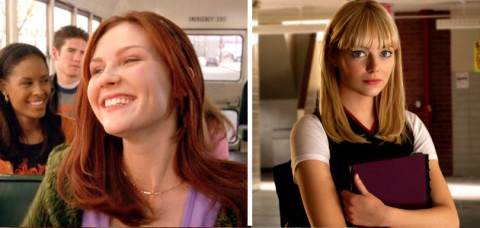
It seems like only yesterday comic book fans were all excited about the very first Spider-Man movie — Sam Raimi’s 2002 take on the webslinging superhero, starring Tobey Maguire and Kirsten Dunst. With Andrew Garfield and Emma Stone stepping in to lead Marc Webb’s high school-set The Amazing Spider-Man , a lot of people are wondering if the reboot is any different at all. Time will tell if fans decide Amazing is better or worse, or maybe just the same as Raimi’s Spider-Man — but looking back on interviews from 2002’s Spider-Man junket, it turned out some of the exact same questions were asked of both sets of directors and stars. If you’re not sure whether The Amazing Spider-Man is a fresh take on the Marvel superhero tale you’ve seen before, see if the filmmakers’ answers to the same questions convince you. (Boy, Kirsten Dunst sounded so young back then!) Directors Sam Raimi and Marc Webb were both asked: How did you approach the humorous/wisecracking side of Spider-Man ? Sam Raimi: It’s just like if you go to tell a joke that you heard or if you read 40 years of Spider-Man comic books and now it’s your turn to tell the Spider-Man origin story, if you said, “Well, there was this radioactive spider that bit this kid,” if that’s how you chose to tell it, you’d be telling it a very different way than I would tell it. I would have to start with who the kid was, what his problems are and what things meant to him. So, I understood what the transformation meant to him. I think everybody just tells it differently and I didn’t have a good plan for how I was going to tell it. I just told it the way I saw it. Marc Webb: That’s something from the comics that I’ve always been really a fan of. Humor is a tricky thing because it’s very subjective. The first domino is Peter Parker getting left behind by his parents. I thought to myself, “What does that do to someone? How does that change your view of the world?” To me, it creates a little bit of a level of distrust. There is a sarcasm that comes from that and the quipiness, like in the car thief scene where that attitude comes out. That generates from this chip on his shoulder. It’s a little bit mean and he’s a little bit snarky, but that’s an attitude that we can all understand and relate to. Both Tobey Maguire and Andrew Garfield were asked: What was your physical training to bulk up? Tobey Maguire: I worked very hard. I trained for a little while before I even screen tested, or before I got the role because I knew the screen test was coming up, so I just went on a little bit of a training routine and a diet myself. Then I was cast and worked out for five months, six days a week, anywhere from an hour and a half to four hours a day, a combination of gymnastics, martial arts, yoga, weight lifting, high end cardio like cycling and running, and I had a very specific diet, worked with a nutritionist. I did do some protein shakes, but no weight gain power. I had to eat a lot of food. I’m a vegetarian so I did have to concentrate on eating enough protein and I would get that through soy and nuts and beans and shakes. A lot of the protein powders are made from animal products, so that was kind of tricky for me too. Andrew Garfield: The training is horrible, like the physical training changed my body because I’m a lazy guy. I’m vain, but I’m not vain enough to care about the gym. And Armando Alarcon was my trainer and he’s a fantastic trainer and a terrible person. [Laughs] I have very confused feelings about Armando. Wherever he is, he knows that. He’s hiding from me because he will be murdered one day. No, but we had a great time. I was thankful for him. He kept me on an even keel all the way through, and that combined with the whole stunt team was a pretty awesome experience. Both Kirsten Dunst and Emma Stone were asked: How did it feel to change your hair color? Kristen Dunst: You know, my hair wasn’t completely red. It was only red in the front. So it kinda just looked like punk rockish or something. It was cool, I liked it. It’s just like the red streak. People were like, ‘Why do you have a red streak in your hair?’ I said, ‘Well, I’m doing the movie Spider-Man and my hair is too short to dye all my hair so I have wear a wig.’ Nothing major. Emma Stone: I’ll tell you. I dyed my hair brown when I was 15 and I was first auditioning in LA. I sounded pretty much like I do now and my personality was pretty much the same, which was a little bit weird for parts for 15-year-olds. So a lot of the time it was during pilot season and I was going out for a lot of Disney Channel and stuff, and I don’t know if I exactly fit into the mold. So I dyed my hair brown and a week later I got my first role, which actually worked out so it was kind of cool. And then a couple of years went by and I was cast in Superbad. I was at the camera test for that movie and Martha MacIsaac, who played Becca in the movie, had brown hair. Judd Apatow I just remember walked in and said, “Make it red” to the hair person. So they took me to the hair salon the next day and they dyed my hair red. My mom is a redhead naturally, so I guess I have the skin tone for a redhead. So they made my hair red and I’m telling you, for five years I tried to get it back to blonde but for every role people would be like, “Oh, we want it red. We want it strawberry blonde. We need a shade of red, just something red.” So I stayed red. I love having red hair so I’m sure it’ll happen again someday. Both Tobey Maguire and Andrew Garfield were asked: Did you have any difficulties with the costume? Tobey Maguire: In the beginning I did a cast of my entire body, which was not fun because I had to stand there for a couple hours and then the stuff stuck to the hair on my body and they ripped it off. It was extremely painful. The suit was fine and by the time I got to wearing it on the set, I was fine, especially if you’re moving around and doing the action. You don’t even think about it and it would give me a freedom that I didn’t otherwise feel. I mean, if I was moving around the way Spider-Man moves without that suit on, I think I’d probably feel a little silly. If I started crawling across this table with my clothes on, I’d probably be a little embarrassed about it. Andrew Garfield: You know, I had many issues with that costume. But every actor who plays a superhero is like, ‘The costume sucked.” Like, we should just get together to talk about it because it’s so inappropriate to talk about in public. It’s like, how dare we complain? We’re the ones that get to wear it! It’s the dream. But, it was so terrible. Let me just put it this way: the fantasy of wearing those costumes is really awesome. Just enjoy that. Both Tobey Maguire and Andrew Garfield were asked: How did you identify with Peter Parker? Tobey Maguire: Quite a bit seeing as though I was playing him. I identified with the character very strongly in some ways reflecting back in my life and in some ways things that are currently going on for me. I think that he basically is dealing with becoming an adult with extreme circumstances that he has superhuman powers and that complicates things or makes him come to decisions quicker. I think he’s very relatable to everybody in that way, that it’s just like becoming an adult basically. With great power comes great responsibility and I think it’s a great power when you realize at some point that you have free will and you’ve got to make choices in how to live your life and what existence is to you and what kind of purpose do you have to your life and I think those are the things that Peter Parker struggles with, so I relate to that. Andrew Garfield: I think it’s important to me that he started with a heroic impulse, without the physical power to do anything with it. That was always how I felt growing up. You know, I felt like an underdog, and I was a skinny kid. Now, I’m not. Obviously, I’m a huge bruiser. [Joking] I got over that problem. Now I just realize that being skinny is okay. I always thought I should have been bigger for some reason because society tells you that. Everyone played rugby and I played rugby and I was good at it, but I got concussed all the time because I was a weakling. So that was something I always identified with for Peter. He always felt stronger on the inside than he did on the outside. And there’s nothing better than seeing a skinny guy beat the crap out of big guys. That was important for me. Both Kirsten Dunst and Emma Stone were asked: What attracted you to the role of Mary Jane/Gwen Stacy? Kirsten Dunst: I think it was that I could make a superhero for the girls to look up to and she had a good journey of her own. I felt the romance is one of the core emotional drives of Spider-Man during the film. I really felt it was an important part and not just the girlie-girl flying around. Emma Stone: At first I had met [Producer] Laura Ziskin really earn on, maybe two weeks after it was announced for Mary Jane. I’d always wanted to play Mary Jane. I thought Mary Jane was so great. And then a couple of months went by and they called me again and said, “We’d like you to audition, but the part’s Gwen Stacy.” So I looked into the story of Gwen and I just feel in love with Gwen’s story because it is so incredibly epic and tragic and incredible in the way that it affect Peter going forward with Mary Jane, who is another character that I love. Both Sam Raimi and Marc Webb were asked why they cast Tobey Maguire/Andrew Garfield. Sam Raimi: I was very luck to work with Tobey Maguire. I really think he’s a great Peter Parker because the strength of Stan Lee and Steve Ditko’s creation has always been that Spider-Man is one of us. I needed somebody that was identifiable to the audience, somebody whose ability to act was invisible, no artifice. Tobey’s smart. He has a high regard for the audience and the camera, and a great respect for the camera. I think he believes, without him saying so, that if he simply believes a thought or is in the moment, that the camera records it and the audience receives it. Marc Webb: I had known his work from Boy A and Red Riding . If you look at Boy A , yes, there’s a childlike quality in the way he moves and behaves in that film is pretty extraordinary versus in Red Riding , he had this incredible intensity and focus. Very different kind of character. And then when he was auditioning and we were watching him, he had a rare combination. He can do the emotional gravitas that’s required. Peter Parker has a lot of tragedy in his life but he’s also got whimsy. He’s also funny and alive and light and sarcastic. Those are the kind of attributes that I really wanted to explore in the film. So you have that and then he has an incredible physical stamina. When you’re doing a movie that requires this level of physical intensity, we tried to especially at the beginning part of the movie, do a lot of the stunts a more practical way. That requires a very, very significant amount of effort on the part of the actor and for someone to have that kind of maturity and focus is really, really tricky. All abiding in somebody who can convincingly behave like a teenager. Both Kirsten Dunst and Emma Stone were asked: Do you see yourself as a role model? Kirsten Dunst: I do in a way. I see how much movies affect people or this or that. I do feel like I have some responsibility. Yeah, I do. I’m going to be myself and I’m not going to change for anybody. It’s worked so far and luckily I’m okay. I haven’t gone off track. Emma Stone: I will say – and I’ve thought about this for a long time – I don’t in any way, shape or form think that I am any type of a role model or anything like that. But for whatever reason when you’re put in a public place, you have to figure out what that purpose is in your life, why that may have happened or what you can possibly do with something like that. There’s something that came with getting a Revlon contract, actually. They approached me for the Revlon contract and I thought, “Why in the world would I be approached for a beauty campaign?” because I’d always been the funny girl. And that’s not to put myself down, that was always the way that my brain worked. And then I thought about Diane Keaton for L’Oreal and Ellen Degeneres for Cover Girl and how sometimes real beauty gets to be celebrated, like what’s inside is what counts. You can still feel beautiful or put makeup on because it makes you feel good and not for anybody else. And that was something that I was like, “Well, if I have an opportunity to possibly reach people or reach young girls in a way that makes them feel like what they are is enough and what the balance of their personality that set them apart and that made them original, if they feel good about that in any way, if that affects one person, then that’s a game-changer.” That’s something that I’m proud to be helpful in any way of looking real or being a real person. Yeah, I do feel a slight not responsibility but privilege to be able to speak to younger girls and hopefully make them feel like it’s okay to be themselves. Are the two Spideys so different? Did each set of filmmakers and stars come from similar places with their versions of the mythology? Which did you like better? Follow Fred Topel on Twitter . Follow Movieline on Twitter .
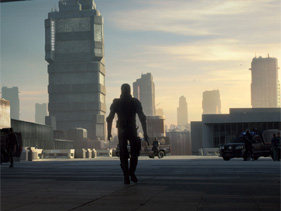
Karl Urban makes his debut as the helmeted arbiter of justice in the first official trailer for ‘Dredd,’ in theaters September 21. By Josh Wigler A scene from “Dredd” Photo: He says he’s the law — but do you believe him? Longtime “Judge Dredd” fans (heck, anyone old enough to have seen an R-rated movie in the 1990s) have plenty of reasons to be skeptical about “Dredd,” the Pete Travis-directed adaptation of the “2000 AD” comic book, judging purely on how the Sylvester Stallone film of 1995 was handled. By all accounts, “Dredd” is not that film. It takes its inspiration from sources much closer to the original text and has a leading man — Karl Urban — who takes his job very seriously. So did the “Dredd” trailer do it for you? It did it for us … mostly. Here are five key elements from the “Dredd” trailer that informed our verdict. Welcome to Mega City One (at 00:05) Gritty, impossibly huge and absolutely the last place on the planet you would ever want to live: that’s Mega City One, and from the opening moments of the trailer, all of those points are clearly established. Hooligans run amok fueled by all kinds of illicit drugs, with one in particular gaining new traction: Slo-Mo, a dangerous product that “makes the brain feel as though time is passing at 1 percent of the normal speed.” Why anyone would want to be on such a drug in the middle of Mega City One is beyond us, but it’s certain to pave the way for some fantastic action, based on the trailer alone. Big Ma-Ma’s House (at 00:32) A hero is only as worthy as his villain, and in the case of “Dredd,” the quality of the nemesis won’t be a problem. Lena Headey of “Game of Thrones” fame is the bad guy here as Ma-Ma Madrigal, ruling the roost of a drug empire with enough ruthless efficiency to make Queen Cersei Lannister blush. Her scarred visage and crystal-clear goals — “If we play this right, we can take the whole city,” she tells her underlings — make her a force to be reckoned with, and Headey seems to be having a ball in the role. Judge and Be Judged (at 00:59) We’ll get to Urban specifically in a second. In the meantime, look at all of the judges! Dredd explains their role in Mega City One thusly: “800 million people living in the ruin of the old world, and only one thing fighting for order in the chaos: the men and women of the Hall of Justice.” Though “Dredd” will center mostly on the titular judge and his new trainee Cassandra Anderson (played by a bleach-blond Olivia Thirlby), it’s nice to see some attention paid to the greater gaggle of law enforcers. Fifty Shades of “Raid” (at 01:19) If you thought the plot of “Dredd” seemed a little familiar after watching the trailer, you’re not losing it. There are undeniable similarities between this and “The Raid,” the incredible Indonesian martial arts film from Gareth Evans that debuted this past spring. Ma-Ma Madrigal has her drug operation holed up in one massive tower that she has full control over, not unlike “The Raid” drug kingpin Tama. Also not unlike Tama, Madrigal commands all the tenants of her building to seek and destroy Dredd and Anderson. So, yes, the similarities are there, but there are more than enough differences in the setting, genre and characters — not to mention the action-dictating Slo-Mo — that we’re more than happy to look the other way. (Besides, we’ll take another “Raid” movie however we can get it, even if it’s called “Dredd.”) Is He the Law? (at 01:50) That’s the big question, isn’t it? On paper, Karl Urban is a fantastic choice for Judge Dredd. In motion? That might be another story. His Dredd spits out a few too many one-liners for some folks’ tastes — “negotiations are over,” “the sentence is death,” etc. — but he’s got the look, the voice and the attitude down by our estimation. Whether or not that all adds up to a fully formed Dredd remains to be seen, but the trailer leaves us cautiously optimistic, if not fully sold, on Urban’s performance. “Dredd” is set to hit theaters on September 21. What do you think of the “Dredd” trailer? Tell us in the comments below! Check out everything we’ve got on “Dredd.” For breaking news and previews of the latest comic book movies — updated around the clock — visit SplashPage.MTV.com . Related Photos ‘Dredd’ Key Scenes