After being denied by several New Jersey towns , Snooki & JWoww have found a new place to live, and the residents of their new town aren’t pleased. 495 Productions, the producers of Jersey Shore as well as Snooki & JWoww , had trouble finding a location to film Season 2 of the duo’s reality show. The small town of Manchester stepped up to the plate, though … much to the chagrin of the Manchester natives who have to live next to them. Some of their close neighbors say they had no idea Snooki and JWoww were rolling into the small Garden State town 80 miles south of N.Y. City. When they called the town to complain, they were told the mayor already signed off, so too bad … for him, the next time he runs for reelection. Concerned residents were told 495 would go door-to-door to “address the situation,” but several neighbors tell us that hasn’t actually happened. What would they say anyway? Meanwhile, with pregnant Snooki ready to pop any second, crew members have been seen setting up equipment. Say a prayer for Manchester.
A new survey shows most numbers are up when it comes to teens and that mary jane , drinking, and more. Looks like that stick-icky is being bought by teenager’s more often than we thought. While Mayor Bloomberg is trying to make the whole city healthy, our kids are going to pot! The percentage of city teens who get high on weed jumped to 17.7 percent last year — by far the highest rate during Hizzoner’s 10-year tenure, according to a new health survey obtained by The Post. The blunt figure is up from the 12.3 percent who smoked weed in 2005. “Every kid my age does it, but it is not a good thing,’’ said Catherine Reyes, 16, of Brooklyn. “They can end up in bad situations.” The boost in marijuana use was just one of the alarming findings in the biannual youth-risk behavior survey put out by the Centers for Disease Control and Prevention… The same report also found that nearly a third of underage teens drink booze. In another blow to the health-conscious “Nanny’’ Bloomberg, the statistics show that many city kids are big couch potatoes, too. More than one in four — 28 percent — are overweight or obese, and 21 percent still drink sugary soda, although that’s down from 28 percent in 2005… Part of teens’ problem is 80 percent don’t get the recommended 60 minutes of daily exercise. Nearly six in 10 kids said they don’t have daily gym class in school. In New York, it’s not a requirement in high school. Half of the teens surveyed don’t even ride a bike. Instead, 44 percent play video games or surf the Web for fun on school days, and 38 percent watch more than three hours of TV daily…For many teens, sex seems to be their only physical activity. Nearly 38 percent said they’ve already had sexual intercourse — almost half before age 13. Despite the findings, a Health Department rep insisted, “New York City youth remain in better shape than their peers around the country when it comes to physical education and obesity, as well as rates of alcohol and illicit drug abuse.” Tell us what you think about youngins these days tokin’ at such an early age? Soucre Images via littleny / Shutterstock.com
Count Michael Bloomberg as someone who doesn’t think any lives would have been saved inside an Aurora, Colorado movie theater last Friday if MORE people had been carrying guns. During an appearance on Face the Nation , the NYC Mayor was asked about remarks made by a Texas Congressman in which Louie Gohmert speculated that James Holmes could have been stopped and fewer people killed/injured if only movie goers had been “carrying.” Bloomberg’s responded by basically making like Seth Meyers and asking: REALLY?!? You really think it will be safer to create a “wild west” like country where every other person is holding a weapon?
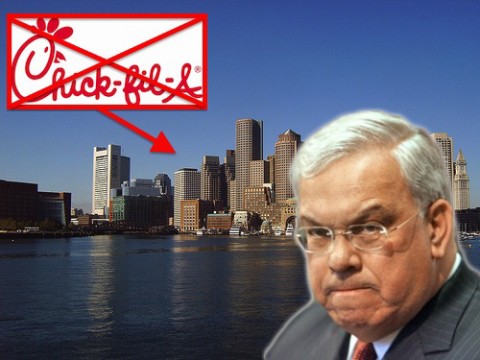
Boston residents will not be eating more chicken any time soon. At least not from Chick-fil-A. Following that company’s President coming out and admitting he’s against gay marriage , Boston Mayor Mayor Thomas Menino has halted plans for Chick-fil-A to open in his city and said in a statement: “Chick-fil-A doesn’t belong in Boston. You can’t have a business in the city of Boston that discriminates against the population. We’re an open city, we’re a city that’s at the forefront of inclusion. That’s the Freedom Trail. That’s where it all started right here. And we’re not going to have a company, Chick-fil-A or whatever the hell the name is, on our Freedom Trail.” Actor Ed Helms first brought attention to Chick-fil-A’s practices in a Tweet. Since then, other stars and organizations, such as Jim Henson Company, have also cut ties with the restaurant chain.
Let the boycotts begin The mayor of Boston is vowing to block Chick-fil-A from opening a restaurant near the city’s “Freedom Trail” because of the company’s stance on gay marriage . “Chick-fil-A doesn’t belong in Boston. You can’t have a business in the city of Boston that discriminates against a population. We’re an open city, we’re a city that’s at the forefront of inclusion,” Mayor Thomas M. Menino told the Boston Herald Thursday. “That’s the Freedom Trail. That’s where it all started right here. And we’re not going to have a company, Chick-fil-A or whatever the hell the name is, on our Freedom Trail,” he added. Chick-fil-A President Dan Cathy told the Baptist Press this week that his privately owned company is “guilty as charged” in support of what he called the biblical definition of the family. Will you still be supporting Chick-fil-A?
The Batman brand is in the toilet at the outset of The Dark Knight Rises , the third and most self-consciously ornate pillar of Christopher Nolan’s caped crusader resurrection trilogy. The four years since The Dark Knight have passed as eight within the city state of Gotham — one of the neater doublings in a movie inlaid with prismatic tiling — and even the mayor condemns Batman as “a murderous thug.” The late Harvey Dent, by contrast, has been canonized as a civic hero; something called the “Dent Act” has ushered in an era of safe streets and soft despotism. Bruce Wayne (Christian Bale), meanwhile, is still heartbroken over the murder of Rachel Dawes and said to be peeing in Mason jars and polishing his curly fingernails in some shuttered wing of Wayne Manor. As a memorial for Dent drones and tinkles smugly on, the movie’s animating question flickers across Commissioner Gordon’s (Gary Oldman) face: Batman died for this ? The this at the heart of The Dark Knight Rises is a city whose predicament is conceived broadly enough to accommodate any number of thematic readings, but too hedged to explore any one of them well. In winding up at casual cross-purposes, the film’s perspective on governing power structures and mass psychology (to name only two) feel like Nolan playing ideological peek-a-boo. Despite heavy provocation, it’s a movie that can only supply embarrassment to those who look beyond the gleaming chaos and heroic suffering for meaning. What it amounts to is a frantic set of distractions from an uncommonly thrilling ride on the old Gotham express. Bruce Wayne’s first warning of what’s to come, and what’s happening beyond the manor gates — the Catwoman in the coalmine — arrives in the figure of a burglar named Selina Kyle (Anne Hathaway, tart but sexless). Selina draws Bruce out of hiding — something a philanthropist on the clean energy tip played by Marion Cotillard couldn’t manage — and warns him of a coming storm that will level the elite and the commoner. When the faithful Alfred Pennyworth (Michael Caine) implores him to focus on deploying his dwindling resources and building a better (or any) personal life, Wayne takes it as a challenge to his alter ego’s honor and his failing body. Meanwhile, Commissioner Gordon is paying more attention to his gut than the crime statistics, and it’s telling him something is rotten in Gotham. What that might be is considered from several angles — computer chaos, corporate greed, social inequality, nuclear threat, economic terrorism—and we wait to see which will prevail. Nolan never quite chooses, though, opting for a little bit of each whenever it’s convenient. Bending over all of them, in an arc extended from The Dark Knight (there are even more direct connections to Batman Begins ), is the obsessive pursuit of Batman’s “true” identity. “The idea was to be a symbol,” Wayne sighs to a hotfooted cop played by Joseph Gordon-Levitt. But there’s no place for symbols in a search-engined society; nothing so delicate can survive in cold, data-based climes. The city clamors for Batman, wanted for the death of their hero, on a plate: This Gotham seems destined for slow-motion self-destruction; our villain’s arrival is framed as more of a helping hand. They may have forsaken Batman, but the city’s need for viable symbols is borne out in the heavily spackled image of Dent, and, from his first appearance in the bravura prologue, the intransigent evil embodied by Tom Hardy’s Bane. “No one cared who I was until I put on the mask,” Bane gurgles (not true Tom Hardy! Not true!) in vocoder tones I’d put somewhere between Yoda post-testosterone patch and Sean Connery on appletinis. Batman’s comeback is hamstrung at every turn — by his vicious new opponent, by the police (led by Matthew Modine’s canine would-be commissioner), and by an app-loading tablet that the superhero considers in the universal stance of tech-befuddlement. Consigned, after a colossal ass-whipping, to a vaguely Arab hellmouth with handy cable news access, Wayne spends the middle chunk of the movie striving for the spiritual strength to escape in time to keep Bane from his plan to “feed the people hope to poison their souls” before blowing the whole city to pieces. A sub-tangle with nuclear power, which is framed as both the savior of the world and its destroyer, provides the movie’s ultimate double. But Bane’s motives are obscured too long and too provocatively to succeed in drawing us into the wildly nettled political revolution he comes to represent. We’re told his power derives from his fanatical belief — something a privileged playboy can’t buy — but in what? His is a psychology of convenience and comic-book dogma, which is only a problem insofar as the film insists he have a psychology at all. Bane’s proselytizing about social equality and death by moral complacency inspires real dread, but again Nolan isn’t prepared to stand behind the incendiary postures he strikes. There’s always an out, in this case the fact that Bane’s politics are just a theatrical prelude to less complicated darkness. Undeniable is Hardy’s menace: Less a man than a masculine experiment gone awry, he seems to be strutting naked even in boots and crust punk combat gear. What Bane is most clearly is a terrorist, from his vaguely plotted assault on Gotham’s stock exchange, to the fondness for human shields and Taliban-tinged sports stadium executions, to the plan not to rule or capture the city with a grand gesture but to wipe it out. Though it was filmed in several locations, including Pittsburgh, in this installment that island city is most obviously New York, from the glimpse of the scaffolded Freedom Tower to the crippled Brooklyn Bridge to the richies dragged out of their Fifth Avenue penthouses. If anything the pretense of Gotham adds a certain gratuitousness to the clear references — symbols pulled out of their context for sheer, emotion-zapping effect. Beyond that a scrappy city all its own emerges, where Batman is just another part of the steeply vertical landscape and it wouldn’t be all that odd to find him slugging it out in the streets, as in his climactic, cleanly drawn confrontation with Bane. Beginning with a thrilling underground, multi-vehicle chase and through a series of old fashioned brawls, Nolan, director of photography Wally Pfister and editor Lee Smith restore a baseline of coherence to the action that in some instances has the feeling of a many-paneled page, with levels and layers of action — a ka-pow over here, a thwack over there. If New York is Gotham’s most obvious touchstone this time out, the Windy City asserts itself in Nolan’s script (co-written with his brother Jonathan, working from a story by Nolan and David S. Goyer). The dialogue is inflated to regulation turgidity and then some. Hathaway does her best, but without Heath Ledger’s Joker there’s no one to let the air out now and then, which makes this week’s cinematic rendering of the apocalypse more terribly earnest but also more genuinely terrifying than most. Along with making the most prominent case for the continued relevance of the auteur theory, with this trilogy the British director reminds us that well-built brands never really die. Certainly one elegiac current running under the The Dark Knight Rises is that they don’t make them like Batman anymore, either in Gotham City or your local cineplex. During its more didactic lapses, episodes of shocking darkness and overwhelming density, you can practically make out the silhouette of Nolan looming behind the screen, appraising us with folded arms: Do they deserve this movie? Are we worthy of it? The Dark Knight aspires to the epic and reaches it on a number of impressive and less impressive levels. That it is a frequently, unnervingly glorious triumph of brawn over brains is not despite but in spite of Nolan’s admirably stubborn — if persistently, risibly serious — insistence that the modern superhero can have it all. Follow Michelle Orange on Twitter . Follow Movieline on Twitter .
Pixar Animation storyboard artist Emma Coats took to Twitter last month to share the storytelling tips she’s gleaned during her time at the Oscar-winning animation house, and taken together they comprise one of the most comprehensive, sensible, must-follow rules for writing you can find. ( Ridley Scott , Damon Lindelof , whoever’s working on the next Prometheus — are you listening?) Among Coats’ best tips, as collected by blog The Pixar Touch (via i09): “Coincidences to get characters into trouble are great; coincidences to get them out of it are cheating.” Amen to that. #1: You admire a character for trying more than for their successes. #2: You gotta keep in mind what’s interesting to you as an audience, not what’s fun to do as a writer. They can be v. different. #3: Trying for theme is important, but you won’t see what the story is actually about til you’re at the end of it. Now rewrite. #4: Once upon a time there was ___. Every day, ___. One day ___. Because of that, ___. Because of that, ___. Until finally ___. #5: Simplify. Focus. Combine characters. Hop over detours. You’ll feel like you’re losing valuable stuff but it sets you free. #6: What is your character good at, comfortable with? Throw the polar opposite at them. Challenge them. How do they deal? #7: Come up with your ending before you figure out your middle. Seriously. Endings are hard, get yours working up front. #8: Finish your story, let go even if it’s not perfect. In an ideal world you have both, but move on. Do better next time. #9: When you’re stuck, make a list of what WOULDN’T happen next. Lots of times the material to get you unstuck will show up. #10: Pull apart the stories you like. What you like in them is a part of you; you’ve got to recognize it before you can use it. #11: Putting it on paper lets you start fixing it. If it stays in your head, a perfect idea, you’ll never share it with anyone. #12: Discount the 1st thing that comes to mind. And the 2nd, 3rd, 4th, 5th – get the obvious out of the way. Surprise yourself. #13: Give your characters opinions. Passive/malleable might seem likable to you as you write, but it’s poison to the audience. #14: Why must you tell THIS story? What’s the belief burning within you that your story feeds off of? That’s the heart of it. #15: If you were your character, in this situation, how would you feel? Honesty lends credibility to unbelievable situations. #16: What are the stakes? Give us reason to root for the character. What happens if they don’t succeed? Stack the odds against. #17: No work is ever wasted. If it’s not working, let go and move on – it’ll come back around to be useful later. #18: You have to know yourself: the difference between doing your best & fussing. Story is testing, not refining. #19: Coincidences to get characters into trouble are great; coincidences to get them out of it are cheating. #20: Exercise: take the building blocks of a movie you dislike. How d’you rearrange them into what you DO like? #21: You gotta identify with your situation/characters, can’t just write ‘cool’. What would make YOU act that way? #22: What’s the essence of your story? Most economical telling of it? If you know that, you can build out from there. Coats, who has written and directed her own short, Horizon , and is a credited storyboard artist on Brave , is still engaging in storytelling talk over at Twitter and on Tumblr . [ The Pixar Touch via i09 ]
Fans of the Broadway musical Rock of Ages may throw tomatoes when they see the big screen version; director Adam Shankman , screenwriter Justin Theroux and even Tom Cruise himself made some major changes to the plot of the stage show. Some make the edgy musical more family friendly, but others sharpen the story. Will fans embrace their toned-down Rock of Ages movie? In the film version Cruise stars as Stacee Jaxx , a legendary hair metal rocker with existential issues. Meanwhile, at The Bourbon Room, where Jaxx is performing his last show before going solo, Sherrie ( Julianne Hough ) and Drew (Diego Boneta) are falling in love. Sherrie just moved to L.A. to pursue her dreams; Drew has been paying his dues and gets the chance to open for Jaxx, but the rock n’ roll world splits up the young lovers. But exactly how Rock of Ages unfolds from there differs notably from the Tony-nominated stage musical. Movieline spoke with director Shankman, writer Theroux, and star Hough about five major changes in the Rock of Ages movie, for better and worse. 1. Sherrie and Stacee no longer, uh, do it A major plot point in the stage musical is that Sherrie sleeps with Stacee during the “I Wanna Know What Love Is” number and that’s what leads to her split from Drew. In the movie, the incident is reduced to a misunderstanding involving a spilled bottle of scotch — Drew gets the wrong idea when he sees Stacee zipping up his pants in close proximity to Sherrie — which kinda makes Drew look like a moron. In the stage version, Stacee later comes back to Sherrie when she is working at a gentleman’s club, where she gives him a lap dance. Oddly, Shankman went ahead and shot the lap dance scene with Hough and Cruise, but took it out of the movie. “‘Rock You Like a Hurricane’ was the duet that I did with Tom and it is bad frickin’ ass,” Hough revealed at the Rock of Ages press day. “I mean, literally ass . No literally, this was the sexiest but roughest performance in the movie and I think it was a little bit too much for people. I think that people, especially women, didn’t really like Sherrie after that.” It wasn’t just women, but a very specific group of women, said Shankman. “Super easy to explain,” Shankman said of the scenes that didn’t test well pre-release. “It really upset mothers. The mothers literally turned against her character because her character sold out so much and she was such an animal in the scene. On top of which, where that scene was placed, it was at the top of the third act and you just want her to get to the Bourbon with those records. It was this huge deviation from the story in order to just do this number.” It also makes sense as a story omission because without their sex scene, what’s the point of a lap dance? Shankman said empowering teenage girls in the audience was the most important factor. “The number, frankly, it is on the extended version and will be on Netflix and all that, you’ll understand why it got cut because it really upset mothers,” Shankman said. “I was like, I can’t have mothers saying to their teenage daughters, ‘No, you can’t go see this movie because Julianne Hough is lap dancing Tom Cruise in a G-string — [and doing it] very well.’” 2. Stacee Jaxx’s redemption On stage, Jaxx remains a creep and flees the country dodging statutory rape charges. Not only would this ending be irrelevant to the new story, it would also be a lame and creepy move for a Tom Cruise movie. Now the climax of the film involves Jaxx reading an article written by a reporter (Malin Akerman) in Rolling Stone. For the first time, Jaxx sees how he and his management screwed over hard-working music promoters like the owners of The Bourbon Room. To make amends, Jaxx returns to the Bourbon for a free benefit show, thus paving the way for a real finale where Sherrie and Drew join Jaxx on tour — and giving Cruise’s Jaxx a means of redemption. Screenwriter Justin Theroux credited Cruise himself with the new ending. “That was actually an invention of Tom,” Theroux said. “He was like, ‘This guy needs to connect somewhere at the end of the movie.’ He treats it like it’s a dramatic part and he says, ‘No matter what, you still need to have these motivating factors and you need to have this. There needs to be a beginning, middle and an end to this guy. It can’t just be a guy who’s just floating around being funny. He actually has to have something to perform.’ The character of Stacee Jaxx was looking for something and being so famous that he couldn’t even identify it. That thing is, in our movie, love and someone telling the truth. And then also how do we resolve that in a comedic way? [After] that scene where he’s walking and makes out with a girl on his way to make out with the girl — how would that guy find love? That was really the fun part of creating that.” 3. New songs added, some songs gone Of course, it would be hard for any movie adaptation to keep every single song from its stage iteration, so a few rock classics had to go. Rock of Ages had the unusual problem of obtaining even MORE music than the stage show, and having to make sure to find places for them in the story. “Well, the movie couldn’t be two hours and 40 minutes long, which is basically the show,” Shankman said. “I also had the opportunity that the play didn’t have — Def Leppard, Joan Jett and Guns n’ Roses opened up their catalogs to the movie, which I would have to attribute to Mr. Cruise’s involvement. I never talked to the guys but I would think that that is what sort of did it. On top of which, the Hairspray cred, people knew that I wasn’t going to make fun of anything.” Thanks to that, we now get to hear Cruise sing “Pour Some Sugar On Me.” Worth it. 4. A whole new family values subplot The plot of the stage show involves two developers battling a city planner over a Sunset Strip land deal, a pretty convoluted angle involving the politics of historical landmarks and zoning districts. The movie invents the character of the mayor’s wife (Catherine Zeta Jones), who is protesting The Bourbon Room on moral grounds, as a Christian crusader against rock n’ roll. It’s clean, simple and pays off when the reasons for her repression are revealed. In the film, the mayor’s wife steals the song “Hit Me With Your Best Shot” from her land developer counterparts in the musical; it becomes the anthem for her church protest group. 5. Goodbye, Fourth Wall The biggest change musical buffs will notice is that the movie Rock of Ages has no narrator. The stage show not only had a character narrating the story, but it also broke the fourth wall and addressed the audience. The climax of the stage show had the characters realize some playwright gave them a sad ending, so they go and change it. Meta humor is all well and good but in a movie that might have felt like a cheap cop out. Shankman decided to tell the story linearly, so it has a traditional, feel-good movie plot. The characters succeed because of their own actions, not thanks to some clever meta-device. In taking out the narrator, Shankman decided to make it Sherrie’s story (which also makes it more important that she not lose the audience with her sexual exploits — see #1.). “By taking out the narrator I had to give it the point of view of somebody, and I thought it would be best to give it to the person who’s new to Los Angeles,” Shankman said. Stay tuned for more on Rock of Ages , which opens this Friday. Follow Movieline on Twitter .
Obama campaign spokesman Ben LaBolt was caught in a deviation from the truth when asked whether anyone from the White House or the 2012 [Obama] campaign had reached out to Mayor Booker, to make him reel his words. LaBolt answered, “We did not.” When the incredulous reporter immediately gave LaBolt another chance, he doubled down on his prevarication Shortly thereafter, Mayor Booker threw Labolt under… Broadcasting platform : YouTube Source : Red State Discovery Date : 23/05/2012 00:51 Number of articles : 2
Eliot Spitzer questioned the legal skills of Eric Schneiderman. East siders are upset that Mayor Mike Bloomberg is apparently violating the city’s helicopter curfew. Andrew Cuomo said that a minimum wage hike won’t pass this year. Mike Gianaris made a very funny video about independent redistricting. Charlie Rangel opened up about his Hispanic heritage. He has been reluctant to talk about it because… Broadcasting platform : YouTube Source : The Politicker Discovery Date : 23/05/2012 01:29 Number of articles : 3