Tag Archives: mexico

Thick Layer Of Oil Discovered on Gulf of Mexico Seafloor

Satellite photo taken May 24th, 2010, by NASA. Photo: NASA , CC. This Story is Far From Over! The bad news about the BP oil spill aren’t over. Researchers have taken soil samples from the bottom of the Gulf of Mexico and discovered that a lot of the oil that some thought had evaporated or dissipated has actually just settled on the sea floor. Samples taken by the science vessel Oceanus show that the oil can be found for dozens of miles in all directions around the busted well location…. Read the full story on TreeHugger

Continued here:
Thick Layer Of Oil Discovered on Gulf of Mexico Seafloor

Mexico Mayor Has Been Gunned Down Inside His Own Office

Mexican mayor gunned down inside own office By the CNN Wire Staff September 8, 2010 9:29 p.m. EDT Mexican President Felipe Calderon condemns the “criminal and cowardly” killing. STORY HIGHLIGHTS * The mayor of El Naranjo was killed in his office * Four gunmen arrived at the city hall * Two stayed outside and two entered to shoot the mayor, authorities say (CNN) — The mayor of El Naranjo, Mexico, in the central state of San Luis Potosi was gunned down and killed inside his office Wednesday, officials said. Witnesses say that four armed and hooded men stepped out of a white truck at city hall, the San Luis Potosi government said in a statement. Two of the men posted themselves outside, and two went inside and to the top floor of the building, where they entered the mayor's office and shot him, the statement said. The attack happened in broad daylight, at about 1:30 p.m. (2:30 p.m. ET), and was brazen even by the standards of Mexico's violent drug cartel wars. At least seven mayors in various Mexican states have been assassinated in 2010. Mexican President Felipe Calderon condemned the “criminal and cowardly” killing of the mayor. “The federal government reiterates that it will continue working for the security of the citizens, with all the available resources of the state,” Calderon said. Alexander Lopez Garcia assumed office in October of last year as a candidate for an alliance between the Revolutionary Institutional Party (PRI), and the Ecologist Green Party. CNN's Mariano Castillo and Nick Valencia contributed to this report. added by: EthicalVegan

After Nearly Five Months, BP Scheduled to Release Findings of Inquiry Into Its Oil Rig Disaster

BP to release results of investigation into oil spill disaster By the CNN Wire Staff September 8, 2010 2:49 a.m. EDT The BP oil spill in the Gulf of Mexico released an estimated 205 million gallons of oil during an 87-day period. STORY HIGHLIGHTS * BP report comes nearly five months after oil rig explosion in the Gulf * Deep-water oxygen levels are down but not deadly, a federal report concludes * The federal study tracked dissolved oxygen levels from May to August (CNN) — BP on Wednesday is expected to release findings of an internal investigation into the Gulf oil disaster, the oil giant said. The report comes nearly five months after an April 20 explosion aboard an oil rig left 11 men dead and spewed millions of barrels of oil into the Gulf of Mexico over an 87-day period. A federal task report on Tuesday said scientists have found a decline in oxygen levels in the Gulf following the BP spill, but no “dead zones.” Levels of dissolved oxygen in deep water have dropped about 20 percent below their long-term average, according to data collected from up to 60 miles from the well at the center of the worst oil spill in U.S. history. But much of that dip appears to be the result of microbes using oxygen to dissolve oil underwater, and the decline is not enough to be fatal to marine life, said Steve Murawski of the National Oceanic and Atmospheric Administration and the head of the Joint Analysis Group studying the spill's impact. “Even the lowest observations in all of these was substantially above the threshold,” Murawski said. The samples were collected from 419 points at varying distances from the ruptured well at the heart of the disaster and at depths as far down as 4,800 feet, the group reported. The task force is made up of NOAA, the Environmental Protection Agency and the White House Office of Science and Technology Policy. The undersea gusher erupted in April, releasing an estimated 4.9 million barrels (205 million gallons) of crude before being temporarily capped in July. The volume of oil — and the amount of chemical dispersants used to break it up — have created concerns about the long-term health of the Gulf. The spill also delivered an economic blow to the region, where fisheries and beach resorts are major employers. Early findings from a mid-August survey led by the University of South Florida indicated oil had settled to the bottom of the Gulf farther east than previously suspected and at levels toxic to marine life. At about the same time, a team from Georgia Sea Grant and the University of Georgia released a report that estimates that 70 to 79 percent of the oil that leaked from the well “has not been recovered and remains a threat to the ecosystem.” The latest study “does not discuss the broad ecosystem consequences of hydrocarbons released into the environment,” NOAA said. But it concludes that the oil is continuing to break up and disperse underneath the surface, making the emergency of a major oxygen-poor dead zone unlikely. In early August, the federal government estimated that three-quarters of the oil spilled had either evaporated or been dispersed, or had been skimmed or burned off the surface. The well has been temporarily capped and operations are under way to permanently seal it. BP, rig owner Transocean and well cement contractor Halliburton have blamed one another for the disaster. http://www.cnn.com/2010/US/09/08/us.gulf.oil.disaster/index.html?hpt=T1 added by: EthicalVegan

Kate Beckinsale — Bikini Sun Block

Filed under: Kate Beckinsale , Hot Bodies , Paparazzi Photo , Beauty , Stars In Heat , Hot Mamas Kate Beckinsale tried to cover up her face from the blazin’ sun in shades and a floppy hat, but luckily showed off her sexy bod in a bikini in Mexico this weekend. Even without a tan, Kate’s golden. Read more

See original here:
Kate Beckinsale — Bikini Sun Block

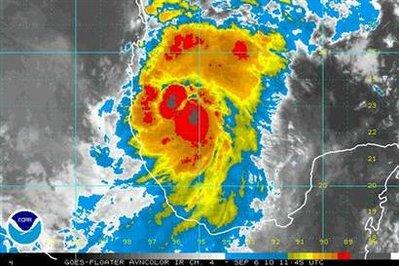
Tropical Storm Hermine 2010

Tropical storm Hermine is seen in this satellite image courtesy of the National Hurricane Center. Hermine, the eighth named storm of the Atlantic hurricane season, may reach hurricane strength before it makes landfall on Monday night, the U.S. National Hurricane Center said. Tropical Storm Hermine strengthened in the Gulf of Mexico on Monday as it approached landfall near the U.S.-Mexico border, but oil and gas operations in the Gulf were unaffected. The storm#39;s forecast path kept it away

View original post here:
Tropical Storm Hermine 2010

Miley Cyrus’ Bloated Face Partying in Paris of the Day

You can drink at the age of 12 in Paris and that’s not even exclusive to people who are famous. Everyone drinks because they realize that drinking is not only fun, but it helps annoying kids chill the fuck out and fall the fuck asleep, so they aren’t up all night getting in the way of you having sex, or whatever the fuck it is that people in Paris do. Only in America does a married person, with a criminal record, on his way to go vote in his car, while smoking cigarettes and paying taxes, get rejected at the store for trying to buy a case of beer…..It’s like you can do everything, but you can’t do that…but I guess the good news is that there is always Mexico, Canada and presctiption pills. So seeing Miley getting down in a see through top at a club, isn’t a big deal to me, cuz as long as you have a vagina and enough make-up on, you’re allowed into clubs here….but I know it’s a big deal to you conservative idiots, and that’s why I am posting these… Fame is gonna eat her up like she was Lohan, and I’m pretty excited for it. Here she is doing Paris right in various states of showing off her underwear….

See the rest here:
Miley Cyrus’ Bloated Face Partying in Paris of the Day

From The Gulf Stream To The Bloodstream – The Video BP Doesn’t Want You to See

From the YouTube page: Several volatile hydrocarbons found in crude oil were detected in the blood of several residents from the Orange Beach, AL area. Among the hydrocarbons tested, several were detected at abnormally high levels including ethylbenzene, xylene, hexane. These individuals were not directly involved in BP's clean-up operations, nor had they been exposed to any industrial environment where the presence of these compounds would be of concern. Therefore, it can be assumed that residents living near the Gulf of Mexico shoreline are at risk of exposure to aerosolized VOC's moving inland from the Deepwater Horizon oil spill. The blood test performed on these individuals is called the Volatile Solvents Profile (Metametrix.com). The test can be obtained and administered by any physician with the ability to perform a simple blood draw. The test will be shipped to a laboratory for analysis and returned to your doctor for interpretation and treatment. The Gulf of Mexico is facing a significant threat to human health, which needs to be documented in a stringent and concrete manner. A multitude of symptoms have been reported ranging from subtle to severe; these include skin rashes and infections, upper respiratory burning, congestion and cough, headaches, nausea, vomiting, and neurological symptoms such as short-term loss of memory and coordination. Please report symptoms to the Project Gulf Impact health line: (504) 814-0283 Project Gulf Impact is currently raising funds to provide further testing to residents who cannot afford the associated costs. To provide assistance please donate at ProjectGulfImpact.org/donate. To send information or inquire on this effort please email ProjectGulfImpact@gmail.com . ~~~ http://theintelhub.com/2010/09/05/from-the-gulf-stream-to-the-bloodstream/ When Is Enough, Enough? For nearly five months, the BP oil disaster has consumed the minds of millions of people worldwide. In addition to the horrific impacts that the crude oil and chemical dispersants have daily on the environment and the economy, a fatal threat has quietly slipped by the public’s proverbial radar. The harm dealt by this silent enemy is beginning to creep into the lives of those living and working in the Gulf. The problem has been lurking in the Gulf since the first days of the BP oil spill and now has the potential ignite a disaster unlike any this country has ever seen. The test results can been seen here: ■Blood Test Results ■Blood Test Results Who is this masked bandit? What is this mysterious force that has the potential to outpace the spill’s catastrophic events thus far? Though it may sound like a simple answer, (and it is not easy to swallow) the truth is that this tragedy is silent, and if you live in the Gulf, it is most likely affecting you right now as you read this. What is it? Your health may be in extreme jeopardy due to the toxic effects of the dispersant Corexit and volatile organic compo unds (VOCs) from crude oil inundating the air. Through recent studies conducted under the combined efforts of Michelle Nix of Gulf Coast Oil Spill Volunteers, Jo Billups and Karen Harvill of Sassafrass, Dr. Robert Naman, Project Gulf Impact, medical professionals, and the brave Gulf residents who have agreed to be tested, the toxic health effects of the poisons in the air and in the sea have been documented for the first time. The results? This stands to become one of the greatest health tragedies The United States has ever seen. If this is such a powerful threat, why has it gone so under reported for so long? Why is mainstream media ignoring these potentially large-scale health problems? The scenario’s biggest problem is the scenario itself. Perpetrated by a corporation, the influx of relief that would ordinarily stream in after most acts of God has quietly gone elsewhere. Why is this killer so silent? Why have we not heard much about the disastrous health effects of this oil and dispersant in the air? Why are everyday citizens not catching on to what gargantuan health problems are coming in the not-so-distant future, affecting everyone, even the journalists who should be reporting on it? The answer may seem strange, and it is complex, however the biggest problem facing this mounting horrific scenario is… the BP oil spill was not a hurricane. The oil spill disaster in the Gulf of Mexico will go down in history as one of the biggest catastrophes this planet has ever seen. Books are already being written on how much we didn’t know. The cover up and the lies that led this country into the health crisis we are about to face will be documented in years to come. Acts of God, like hurricanes, are fast and furious, the damage is immediate. This, on the other hand, is a slow death. With a hurricane, we know the death toll, the devastation right away. We see the bodies, the houses underwater, and the numbers of dollars lost in real-time as all of the data floods the national spotlight in the aftermath of the disaster. With disasters like Hurricane Katrina, our heartstrings are tugged as we witness cities underwater, mothers crying out for their children, and the newly homeless wandering the streets. We are used to hurricanes. We have evacuation routes. Whether they function or not, we have plans in place for disasters like these. No such plan exists for the victims of an oil spill. Instinctively, we are aware of floods, fires, earthquakes, hurricanes, tornadoes, and other “over the counter” disasters. Most of us have never suffered an oil spill, much less have any notion of what to do in the event of one. The problem we are facing now transcends most disasters this nation has suffered in the last century. The oil spill, and our ensuing response, has created a darker and deadlier aftermath that will persist for decades. The difference is between a swift and lethal blow verses lingering end-stage cancer. Like the first stage of cancer, which often goes long-undetected, this aftermath is a slow, deadly creep. We are entering stage one of the Gulf residents’ proverbial “cancer”. What BP, Thad Allen, The Federal Government, and The EPA Don’t Want You To Know The residents of the Gulf of Mexico are entering a crisis whose scope cannot be calculated. Several symptoms have been reported, from subtle to severe: skin rashes and infections, upper respiratory burning, congestion and cough, headaches, nausea, vomiting, and neurological symptoms including short-term memory loss and coordination problems. These health problems, if acknowledged at all, are mis-diagnosed, buried, and mis-attributed. Amidst a vacuum created by the unwillingness of federal, state, and private sector medical organizations to address the growing health problems, independent, privately-funded groups like Gulf Coast Oil Spill Volunteers (GCOSV), Sassafrass, and Project Gulf Impact have taken matters into their own hands. Patterns are emerging. (con't in comments) added by: samantha420

Helicopters vs. Mustangs: A Roundup Racket? | Animal Rights Advocates Say the Methods Are Cruel

Helicopters vs. mustangs: A roundup 'racket'? Animal rights advocates say the methods are cruel, expensive and unnecessary Helicopters vs. Mustangs: Cruel, expensive and unnecessary, animal activists say More than 1,200 wild horses have been captured in the current roundup Jim Wilson/The New York Times The aim of roundups is to reduce the horse population to more sustainable levels. OUTSIDE RAVENDALE, Calif. — It is horse versus helicopter here in the high desert. On one side are nearly 40,000 horses spread over 10 states, whose presence on the range is a last vestige of the Old West. On the other is a group of crusty cowboys whose chosen method of roundup involves rotors more than wrangling, using high-tech helicopters to drive galloping mustangs into low-tech traps. “When they get in here, they know something’s going on,” said Dave Cattoor, 68, a straight-talking roundup expert who has been herding horses since he was 12. “The chips are down.” Over the last month, Mr. Cattoor and his feral quarry have been doing battle under the dry, horizon-to-horizon skies of northeastern California and a neighboring Nevada county, with humans the inevitable victor. More than 1,200 horses have been captured during the current roundup, much to the chagrin of people like Simone Netherlands, an animal rights advocate who says that the roundups — part of a nationwide push to take some 12,000 horses off public lands — are cruel, expensive and unnecessary. “They’re running at full speed for miles and miles for hours, with babies, little babies, and they don’t let up on them,” Ms. Netherlands said. “They’re stressing them out to the max.” The Bureau of Land Management, which is overseeing the roundup, disputes that, saying that the roundups are humane and that it must reduce the wild horse population to more sustainable levels, both for their health and for that of the other animals that live in this harsh terrain. “Some advocate groups would like us to leave the horses out there and let nature take its course,” said Bob Abbey, director of the bureau. “We don’t believe that’s a sound option.” Dollars and dead horses The debate over roundups dates back decades, to the passage of the 1971 Wild Free-Roaming Horse and Burro Act, a federal law that protected what was then a faltering wild horse population and made it illegal for cowboys like Mr. Cattoor to round up horses on their own for sport or profit. “A cowboy really wasn’t a cowboy if you didn’t rope a wild horse,” Mr. Cattoor said. “But they stopped that. They stopped the maintenance, which costs nothing, and turned it into a multimillion-dollar deal. It’s crazy.” Questions about the roundups have intensified in recent years as costs have mounted, both in dollars and in dead horses. Seven horses have died in the current operation, and last winter, a roundup in Nevada resulted in over 100 horse deaths, prompting more than 50 members of Congress to ask Interior Secretary Ken Salazar to look for independent analysis of the bureau’s Wild Horse and Burro Program. Late last month, the bureau did just that, asking the National Academy of Sciences to conduct a technical review of the program. Horses that are captured are offered for adoption, but with demand for horses low and the cost of feed high, the government often ends up quartering them on large private ranches, primarily in Kansas and Oklahoma. In 2009, about 70 percent of the entire program’s $40.6 million budget was spent holding 34,500 horses and burros, a system that the Government Accountability Office has concluded will “overwhelm the program” if not controlled. “They are a symbol of the American West,” said Nathaniel Messer, a professor of veterinary medicine at the University of Missouri and a former member of the federal Wild Horse and Burro Advisory Committee. “But do we need 35,000 symbols of the American West?” 'What you call a racket' For critics like Deniz Bolbol, the pattern of roundup, removal and stockpiling is an example of the bureau’s catering to private interests on public lands, namely by favoring livestock ranchers — who pay the government for the right to graze and who can sell their animals — over wild horses, which cannot be sold for slaughter. “We remove wild horses from the public lands so private livestock can graze, and then we ship the wild horses to private ranchers in the Midwest where we stockpile them and pay private ranchers,” said Ms. Bolbol, a spokeswoman for the group In Defense of Animals, which has sued to stop the roundups. “This is what you call a racket.” And while Mr. Cattoor calls Ms. Bolbol and other protesters “fanatics,” he does not think the government’s reliance on big, periodic roundups makes much sense either, saying the bureau needs more steady maintenance of the wild herds, which can double in size every four years. Perhaps the only other thing the two sides can agree on is that the horses — whose estimated populations range from about 120 in New Mexico to more than 17,000 in Nevada — are magnificent. Art DiGrazia, the operations chief for one of the bureau’s wild horse and burro offices in California, said that some of the mustangs on the range were descended from Army cavalry horses, which were bred for size, speed and strength and left here or given to ranchers. “They have the intelligence and endurance to work out in this country,” said Mr. DiGrazia, a bearded New Jersey native who speaks in a hoarse whisper. “They’ll know before you know that there’s something out there going on.” Judas horse The method of capture is simple: horses are located from helicopters, which have been used in roundups since the mid-1970s, and pushed toward the trap site, essentially a funnel shaped by two netted walls that lead into a temporary corral. Once the herd runs into the funnel, Mr. Cattoor lets loose a so-called Judas horse, which is trained to lead the rest into the trap, where — uncombed, unshod and often stomping and biting — they slowly settle into their new lives as kept animals. All of which is more humane than the old days, said Mr. Cattoor, who recalls cowboys using rope and brawn to bring in a herd, often injuring horses and horsemen alike. “You have to really put the pound on them,” he said. “You’d have to get them sore footed and tired, and there’s a lot of problems with getting them really tired. Today, at this point, this is the best we can do.” One recent morning, Mr. Cattoor and his team conducted several successful runs — 10 horses in one, a handful in another — before a small herd of four horses, their black manes and wild tails flying, came running full-tilt across the desert. The helicopter was close on their heels, whipping up curlicues of dust in the horses’ wake. They were headed straight for the trap, when suddenly the herd broke, with three horses escaping across a field, while a single stallion — the leader — galloped in another direction. The pilot, perhaps 50 feet up, chose to follow the larger group, but horse sense had its way; the three headed into a patch of trees, where helicopters cannot pursue. The stallion, meanwhile, disappeared up a ridge and back into the wild. Mr. Cattoor watched it all, standing near his Judas horse with a resigned smile, as roundup opponents watched happily from a public viewing station several hundred feet away. “These wild horse advocates love it when the horse beats the helicopter,” Mr. Cattoor said. “And they do sometimes win.” This story, headlined ” Horse Advocates Pull for Underdog in Roundups,” first appeared in The New York Times. http://www.msnbc.msn.com/id/39023276/ns/us_news-the_new_york_times/ http://msnbcmedia1.msn.com/j/MSNBC/Components/Photo/100906_NYThorseschopper.grid… added by: EthicalVegan

Cdn and American astronauts want world to start getting ready for asteroids

MONTREAL – Canadian and American astronauts say the world should already be preparing for the big one — the asteroid that could some day strike the Earth causing death and destruction. “You're just sticking your head in the sand if you think the world will live out its entire natural life until the end of our sun and never be hit by another big rock,” Canada's Chris Hadfield said in an interview. “That's just foolishness. That's just ignorance.” The Canadian Space Agency astronaut is the current president of the Association of Space Explorers (ASE), which submitted a report to the United Nations outlining a detailed plan to deal with any asteroid threat. “We're rolling the dice that the big one is not coming right away,” Hadfield warned. Hadfield, 51, will get a chance to observe asteroids first-hand during his upcoming six-month mission to the International Space Station. He is due to blast off on his third space trip in late 2012 and will also take charge of the lab for several months, becoming its first Canadian commander. During his first space flight — a visit to the Russian space station Mir in 1995 — Hadfield watched a big rock come bearing down on Earth. It eventually burned up in the atmosphere, but the 18-year space veteran admits the experience sent a shiver up his spine. “If it had been a little higher, it would have come right through us (the space station),” Hadfield said. Former U.S. astronaut Russell (Rusty) Schweickart chaired the ASE international group which issued its 54-page report on the asteroid threat in 2008. The report focuses on detection and deflection and calls for a unified global response. Schweickart told The Canadian Press new telescopes will dramatically increase the rate at which asteroids are discovered within the next 10 to 15 years. “You're going to multiply the 7,000 objects that we have in our catalogue now up to one million objects as we get new telescopes operating,” he said in an interview from Sonoma, Calif. The Space Explorers Association has been working closely with the United Nations and the world body is now holding a series of workshops on ways to prepare for threats from so-called Near Earth Objects (NEOs). The work will culminate in a recommendation to the United Nations General Assembly next year or in 2012. “There is no one in the United States or anywhere in the world who has the specific responsibility of acting and developing the technology . . to deflect an asteroid when we find one that does threaten us,” Schweickart added. The retired Apollo astronaut stresses that any effort to deflect a potentially dangerous asteroid would have to begin 10 to 18 years before the impact is predicted. But he adds the basic technology to deflect a threatening asteroid currently exists. One method involves smashing a spacecraft into the object to change its velocity enough to miss Earth. Schweickart's comments come as Canada gets ready to assume a key role in the search for any menacing NEOs. In March 2011, the Canadian Space Agency hopes to launch NEOSSat, which will be the first space telescope “totally dedicated to keep an eye out for the rest of the world.” NEOSSat (Near Earth Object Surveillance Satellite) will scan areas near the sun to pinpoint asteroids which have not yet been detected. The $15 million suitcase-sized-satellite, which will circle about 700 kilometres above the Earth, will look for potentially hazardous asteroids. “What we're looking for is advance warning,” senior project manager Bill Harvey said. “Of course those (asteroids) are the larger ones. . .anything over 50 metres that has a potential for an impact.” A 45-metre-wide space boulder exploded over a wooded area in Siberia in 1908 in what became known as the Tunguska event. About 2,000 square kilometres of trees were flattened in an uninhabited area. The Manicouagan crater in Quebec, which is 65 kilometres in diameter, was caused by an asteroid that slammed into the Earth some 200 million years ago. Harvey says he expects NEOSSat to detect several hundred new asteroids during its first year of operation and “probably up to a thousand.” NEOSSat will conduct scientific studies of asteroids and also monitor the beehive of satellites currently orbiting the Earth to make sure they don't slam into each other. Harvey says astronomers are currently keeping an eye on an asteroid named Apophis after observations in 2004 indicated there was a 2.7 per cent chance it would strike Earth in 2029. Additional observations eliminated the possibility of an impact that year, but Harvey remains cautious because another close encounter with Apophis is expected in 2036. “(If) its orbit gets altered by some event— and that event could be coming in proximity with another body like Venus or Mars — that could change the trajectory,” he said. Schweickart points out that nearly 300 asteroids have some possibility of impacting the Earth in the next 100 years. Scientists recently warned that “1999-RQ36,” an asteroid that is more than 500 metres wide, has a one-in-1,000 chance of striking the planet in 2182. Meantime, U.S. President Barack Obama has asked NASA to develop plans to visit an asteroid and the space agency is already looking at a potential human mission to visit one known as “1999-AO10” by 2025. It's estimated such a mission would take about six months with the astronauts spending about two weeks “riding the asteroid” as it blazes past the Earth. Earlier this year, the Obama administration decided on a flexible path for space exploration which favoured a visit to an asteroid instead of a return to the moon. http://www.winnipegfreepress.com/canada/breakingnews/cdn-and-american-astronauts… added by: magyver68

The Real News Claims That 7 To 10 People In Ciudad,Juarez,Mexico Are Being Murdered Everyday.

The Mexican army is a drug cartel. In part two of our interview with investigative journalist Bruce Livesey, he discusses the violence in Ciudad Juarez.A massive influx of people are drug traffickers are moving into the city on a daily basis from as far south as South America. Livesey, recently returned from Mexico's murder capital, says that the Mexican military is showing evidence that it is supporting the Sinaloa Cartel in it's bid to take out the local Juarez Cartel for this key transportation corridor. In addition to this corrupt Mexican army that supports their handpicked cartel, the Mexican Zeta Cartel were U.S. trained at Fort Benning Ga ,aka School of the Americas. We're forgetting that most of the Zeta Cartel Were Mexican army commandos that went rogue after being sent to the USA. They came back with all US/CIA training and developed a technically and efficient killing mercenary army and were hired by other cartels to kill and protect.They moved on and formed their own cartels. Once again here is another monster killing machine formed by the United States CIA. It really makes you wonder. WATCH THIS VIDEO. added by: keithponder