Tag Archives: mexico

27,000 Abandoned Gulf Oil Wells May Be Leaking

(AP) More than 27,000 abandoned oil and gas wells lurk in the hard rock beneath the Gulf of Mexico, an environmental minefield that has been ignored for decades. No one – not industry, not government – is checking to see if they are leaking, an Associated Press investigation shows. The oldest of these wells were abandoned in the late 1940s, raising the prospect that many deteriorating sealing jobs are already failing. The AP investigation uncovered particular concern with 3,500 of the neglected wells – those characterized in federal government records as “temporarily abandoned.” Regulations for temporarily abandoned wells require oil companies to present plans to reuse or permanently plug such wells within a year, but the AP found that the rule is routinely circumvented, and that more than 1,000 wells have lingered in that unfinished condition for more than a decade. About three-quarters of temporarily abandoned wells have been left in that status for more than a year, and many since the 1950s and 1960s – even though sealing procedures for temporary abandonment are not as stringent as those for permanent closures. As a forceful reminder of the potential harm, the well beneath BP's Deepwater Horizon rig was being sealed with cement for temporary abandonment when it blew April 20, leading to one of the worst environmental disasters in the nation's history. BP alone has abandoned about 600 wells in the Gulf, according to government data. added by: TimALoftis

Avoiding a BP-Style Disaster on the Bosphorus

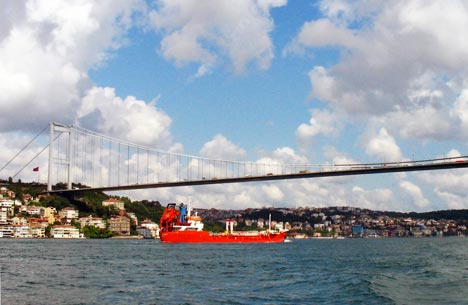
A tanker passing underneath one of the Bosphorus bridges. Photo by Jennifer Hattam The sight of dozens of mammoth tankers anchored off the coast of Istanbul, or of lone ones passing underneath the two high Bosphorus bridges as they steam their way to or from the Black Sea, is undeniably impressive. But in the wake of the Gulf of Mexico oil spill , Turkish off… Read the full story on TreeHugger

See the original post:
Avoiding a BP-Style Disaster on the Bosphorus

Iamamiwhoami: The Viral Campaign That Just Made People Sick

Mysterious videos never really turned into anything, in Bigger Than the Sound. By James Montgomery Iamamiwhoami Photo: iamamiwhoami Back in December, the Gulf of Mexico had yet to be sullied by roughly 50 kajillion gallons of crude oil, people were freaking out about swine flu, and Lady Gaga hadn’t even begun feuding with Jerry Seinfeld yet (or released the “Telephone” video, for that matter). It seems like a million years ago, doesn’t it? Anyway, while all that was going on, I had become newly obsessed with Iamamiwhoami , a mysterious, decidedly spooky viral campaign that involved strangely sexualized tree sap, sorta-gross scenes of a woman smeared in mud and definitely gross scenes of a live goat birth. Needless to say, it was pretty much required viewing. As 2009 turned into 2010, Iamami kept churning out videos, and my obsession only continued to grow. I was spending hours attempting to crack the bizarre numeric codes, neglecting work to continuously refresh Iam’s YouTube page and basically foregoing any semblance of a normal life. I was determined, come hell or high water (or my eventual unemployment) to figure out just who was behind this thing. It got so bad that I even wrote an open letter to Iamami , begging him or her to stop for the sake of my own sanity. Only, they didn’t. If anything, Iamami only ramped up his or her efforts, sending me a terrifying package filled with doll hair and wood splinters and a mysterious codex. And then, well, then nothing really happened. That’s not exactly true. We got even more videos, most of which were e-mailed to me by Iamami through a Gmail account. But, for all intents and purposes, the viral campaign that had so engrossed me stopped right there. It’s still going on right now, in fact (a brand-new clip was sent to me last week), but really, I can’t be bothered anymore. And, judging by the falloff of media coverage about the campaign, not to mention the rather dormant comments section on Iamami’s YouTube page, I’m not the only one. And that’s why I brought up December, when this whole thing began. Because while seven months certainly wasn’t “a million years ago” in reality, on the Internet, it’s practically an eternity. Most people’s attention spans don’t last seven minutes, let alone seven months, and whomever is behind this thing — for reasons I cannot even begin to comprehend — never grasped this. Or, more probably, they just didn’t care. Which is why, I suppose, will be Iamami’s legacy. It is quite possibly the first viral campaign in history that ceased to be viral and just sort of became, well, something. Whether this was due to some gross miscalculation, general lack of foresight or really, really lofty expectations (because, remember, for a while there, people truly believed Christina Aguilera was behind this), Iam will probably best be remembered for being an engrossing, if not totally satisfying trifle, a brief sensation that, ultimately, hung around too long. And sure, a lot of this is because, from the looks of things, Iamami has something to do with Swedish singer Jonna Lee (that’s definitely her in the latest video), and after months of fingering everyone from Xtina to Gaga as the woman behind the scenes, Lee wasn’t exactly a rewarding payoff. It’s sort of like what will happen if, after months of speculation and round-the-clock coverage, LeBron James just ends up re-signing with the Cleveland Cavaliers — all that hyperventilating, all those miles logged by J.A. Adande, ultimately, were for nothing. Then again, in true Iamami fashion, we’re still not clear if Lee is solely responsible for the campaign, or, really, what this campaign is intended to promote in the first place. And that — more than anything — is probably my biggest problem with the whole thing. The folks responsible spent months teasing us with clues, with numbers and animals and Swedish cakes, with strands of hair and codices. They made us believe every single detail of the videos was somehow paramount to solving the mystery of Iamami — “OK, in this scene, there are seven dogs ” — and really, none of it was. It’s kind of like the trick the folks behind “Lost” pulled with the finale (to use an aptly dated example). Six seasons spent making even the most trivial of details seem vital, only to pull the rug out from viewers at the end and say that none of it really mattered. And yes, I found it just as unsatisfying as Iamami. So, seven months in, we’re still no closer to knowing anything about the campaign, who’s really behind it or, honestly, why we should even care. Still, the Iamami machine keeps chugging along, seemingly without a resolution in sight, off into the horizon of the Internet. Some are still hanging on, but I’m happy I got off at the last stop. It was a good ride while it lasted, though. Are you still paying attention to Iamamiwhoami? Let us know in the comments!

Read this article:
Iamamiwhoami: The Viral Campaign That Just Made People Sick

Is BP’s Corexit (Dispersant) Destroying Our Food Supply?

First we lost the fish, shrimp and other marine life in the Gulf of Mexico, to the BP oil catastrophe and ensuing massive dump of the neuro-toxic dispersant Corexit. Now we appear to be losing crops from the Mississippi Gulf Coast to middle Georgia. Watch these two videos. Surely there are bugs and diseases that hit agricultural crops, but the crop damage in the two videos from hundreds of miles apart look similar, and both are claimed to have happened soon after recent heavy rainfall from the Gulf of Mexico. Do we have agriculture experts researching? Have any watched this that can offer a good explanation? Auburn University has a University Agricultural Experimentation Station in Fairhope, AL, one mile off Mobile Bay. If something were happening to crops in the area, I’d think someone there would know it and be studying/testing. It’s highly suspect, but I’m the first to admit that I am not a plant expert so can’t begin to make an assessment. Go here to see the other video: http://www.youtube.com/watch?v=tHtSXNmPq9o&feature=youtube_gdata added by: samantha420

Military Patrols Beach in Panama City

In the middle of June it was reported that BP hired private security contractor to keep the media away from sites the transnational corporation claims it is cleaning. “BP, in a move destined to go down as one of the bestest public relations moves ever, has apparently hired a private security company to help to keep pesky reporters from covering the unfolding catastrophe on the beaches of the Gulf Coast,” Adam Rawnsley writes for Wired. Last week the San Francisco Chronicle and CNN reported on the government’s effort to keep pesky journalists exercising the First Amendment from reporting on the supposed oil cleanup and the environmental impact of the worst oil disaster in history. “Under threat of a federal felony, National Incident Commander Thad Allen has banned all media access to boom operation sites and clean up sites,” writes Yobie Benjamin. “Allen’s orders effectively bans all media — print, television, radio and Internet bloggers from talking to to any clean-up worker or to even come close to take pictures or videos of booms, clean-up workers, oil soaked birds, dead dolphins, dead marine life, burned and dead endangered sea turtles.” In addition to acting as National Incident Commander Thad Allen is a retired United States Coast Guard four-star admiral. The Coast Guard is a branch of the United States armed forces and one of seven uniformed services. It operates under the Department of Homeland Security during peacetime. Allen was appointed deputy to FEMA director Michael D. Brown by Homeland Security Secretary Michael Chertoff during Hurricane Katrina. The presence of the military in the wake of Hurricane Katrina was designed to violate the Posse Comitatus Act and condition the public to accept military integration within Homeland Security and the domestic response to natural disasters (and supposed acts of terrorism). Allen’s appointment as National Incident Commander by Department of Homeland Security Secretary Janet Napolitano gives the federal response to the oil disaster a quasi-military cover. Allen’s decree banning the media has the appearance of a militarily-imposed command. It is no mistake Allen often wears a military uniform — even though he is retired from the Coast Guard — when he talks with the media. Now citizens are reporting the presence of soldiers on Florida’s beaches. In the video below, several soldiers in combat fatigues were photographed driving vehicles on the beach in Panama City, Florida. On May 4, up to 17,500 U.S. Army National Guard troops were mobilized by the Pentagon “to help various states with the oil spill,” according to the Associated Press. “Defense Secretary Robert Gates has granted requests to send troops of up to 6,000 by Louisiana, 3,000 by Alabama, 2,500 by Florida and 6,000 by Mississippi.” The military pictured in the video do not appear to be engaged in clean-up activities. It appears their presence on a crowded beach during a holiday weekend has but one purpose — to acclimate citizens to the prospect of troops patrolling public spaces. Florida has yet to experience oil washing up on beaches to the extent occurring in Louisiana and other Gulf of Mexico states. No word if they are enforcing Allen’s command that the media will be arrested for a felony if they dare report the disaster to the American people. added by: im1mjrpain

Senator Burr Pulled Out of Gulf Covered in Oil

Republican Sen. Richard Burr is the target of a new TV ad campaign that ties him to the oil industry and the Gulf of Mexico spill. A coalition of four environmental, labor and veterans groups began airing an ad today showing an oil-covered man – identified as Burr – being pulled out of the ocean like a sea bird. The man in the suit is shown being cleaned in a rescue operation, reports Rob Christensen. “We pulled one out of the water this morning completely covered in oil,” says a man. “The name is Senator Richard Burr.” added by: punman

Danger of Tsunamis From Trapped Gigantic Methane Bubble In The Gulf Of Mexico.

A new and less well known asymmetric threat has surfaced in the Gulf of Mexico oil gusher. Methane or CH4 gas is being released in vast quantities in the Gulf waters. Seismic data shows huge pools of methane gas at the location immediately below and around the damaged “Macondo” oil well. Methane is a colorless, odorless and highly flammable substance which forms a major component in natural gas. This is the same gas that blew the top off Deep water Horizon and killed 11 people. The “flow team” of the US Geological Survey estimates that 2,900 cubic feet of natural gas, which primarily contains methane, is being released into the Gulf waters with every barrel of oil. The constant flow of over 50,000 barrels of crude oil places the total daily amount of natural gas at over 145 million cubic feet. So far, over 8 billion cubic feet may have been released, making it one of the most vigorous methane eruptions in modern human history. If the estimates of 100,000 barrels a day — that have emerged from a BP internal document — are true, then the estimates for methane gas release might have to be doubled. Methane and Poison Gas Bubble The US Environmental Protection Agency (EPA) has found high concentrations of gases in the Gulf of Mexico area. The escape of other poisonous gases associated with an underground methane bubble — such as hydrogen sulfide, benzene and methylene chloride — have also been found. Recently, the EPA measured hydrogen sulfide at more than 1,000 parts per billion (ppb) — well above the normal 5 to 10 ppb. Some benzene levels were measured near the Gulf of Mexico in the range of 3,000 to 4,000 ppb — up from the normal 0 to 4 ppb. Benzene gas is water soluble and is a carcinogen at levels of 1,000 ppb according to the EPA. Upon using a GPS and depth finder system, experts have discovered a large gas bubble, 15 to 20 miles wide and tens of feet high, under the ocean floor. These bubbles are common. Some even believe that the rapid release of similar bubbles may have caused the sinking of ships and planes in the Bermuda Triangle. 50,000 to 100,000 PSI The intractable problem is that this methane, located deep in the bowels of the earth, is under tremendous pressure. Experts agree that the pressure that blows the oil into the Gulf waters is estimated to be between 30,000 and 70,000 pounds per square inch (psi). Some speculate that the pressure of the methane at the base of the well head, deep under the ocean floor, may be as high as 100,000 psi — far too much for current technology to contain. The shutoff valves and safety measures were only built for thousands of psi at best. There is no known device to cap a well with such an ultra high pressure. Oxygen Depletion The crude oil from the “Macondo” well, which is damaging the Gulf of Mexico, contains around 40 percent methane, compared with about 5 percent found in typical oil deposits. Scientists warn that gases such as methane, hydrogen sulfide and benzene, along with oil, are now depleting the oxygen in the water and are beginning to suffocate marine life creating vast “dead zones”. As small microbes living in the sea feed on oil and natural gas, they consume large amounts of oxygen which they require in order to digest food, ie, convert it into energy. There is an environmental ripple effect: when oxygen levels decrease, the breakdown of oil can't advance any further. Fissures or Cracks According to geologists, the first signs that the methane may burst its way through the bottom of the ocean would be manifest via fissures or cracks appearing on the ocean floor near the path of least resistance, ie, the damaged well head. Evidence of fissures opening up on the seabed have been captured by the robotic midget submarines working to repair and contain the ruptured well. Smaller, independent plumes have also appeared outside the nearby radius of the bore hole. When reviewing video tapes of the live BP feeds, one can see in the tapes of mid-June that there is oil spewing up from visible fissions. Geologists are pointing to new fissures and cracks that are appearing on the ocean floor. Fault Areas The stretching and compression of the earth's crust causes minor cracking, called faults, and the bottom of the Gulf of Mexico has many such fault areas. Fault areas run along the Gulf of Mexico and well inland in Mexico, South and East Texas, Louisiana, Mississippi, Alabama and the extreme western Florida Panhandle. The close coupling of new fissures and cracks with natural fault areas could prove to be lethal. Bubble Eruption A methane bubble this large — if able to escape from under the ocean floor through fissures, cracks and fault areas — is likely to cause a gas explosion. With the emerging evidence of fissures, the tacit fear now is this: the methane bubble may rupture the seabed and may then erupt with an explosion within the Gulf of Mexico waters. The bubble is likely to explode upwards propelled by more than 50,000 psi of pressure, bursting through the cracks and fissures of the sea floor, fracturing and rupturing miles of ocean bottom with a single extreme explosion. Cascading Catastrophe Scenarios 1. Loss of Buoyancy Huge methane gas bubbles under a ship can cause a sudden buoyancy loss. This causes a ship to tilt adversely or worse. Every ship, drilling rig and structure within a ten mile radius of the escaping methane bubble would have to deal with a rapid change in buoyancy, causing many oil structures in its vicinity to become unstable and ships to sink. The lives of all the workers, engineers, coast guard personnel and marine biologists — measuring and mitigating the oil plumes' advance and assisting with the clean up — could be in some danger. Therefore, advanced safety measures should be put in place. 2. First Tsunami with Toxic Cloud If the toxic gas bubble explodes, it might simultaneously set off a tsunami traveling at a high speed of hundreds of miles per hour. Florida might be most exposed to the fury of a tsunami wave. The entire Gulf coastline would be vulnerable, if the tsunami is manifest. Texas, Louisiana, Mississippi, Alabama and southern region of Georgia might experience the effects of the tsunami according to some sources. 3. Second Tsunami via Vaporization After several billion barrels of oil and billions of cubic feet of gas have been released, the massive cavity beneath the ocean floor will begin to normalize, allowing freezing water to be forced naturally into the huge cavity where the oil and gas once were. The temperature in that cavity can be extremely hot at around 150 degrees Celsius or more. The incoming water will be vaporized and turned into steam, creating an enormous force, which could actually lift the Gulf floor. According to computer models, a second massive tsunami wave might occur. added by: keithponder

Removed YouTube Video: Israeli Soldiers Dance in Hebron

This video of Israeli soldiers (Nahal Brigade's 50th Airborne Battalion) dancing in Hebron was removed from YouTube by the creator on July 5th 2010 just as it started to go viral and captured on screen by Alison Avigayil Ramer JERUSALEM (AP) — Some Israeli soldiers may have to face the music for a viral video of them dancing on duty. A video of the soldiers stopping a patrol in the West Bank to dance to American electro-pop singer Kesha's hit “Tick Tock” has been removed from YouTube. But Israeli TV stations picked it up and showed it repeatedly Monday. The YouTube user who posted it identified the dancers as Israeli infantrymen in the tense Palestinian city of Hebron. The video shows six soldiers patrolling as a Muslim call to prayer is heard. Then the music changes, and they break into a Macarena-like dance. The military called the video a “stunt” and said the troops' commanders have been informed. That could mean their next dance will be “Jailhouse Rock.” added by: punman

1 in 4 Americans Don’t Know Shit

So they did a poll to see if native born, all American citizens know why we celebrate the 4th of July. They found that about three-quarters of residents — 74% — know the U.S. declared its independence from Great Britain in 1776. The bad news for the academic system — 26% do not. This 26% includes one-fifth who are unsure and 6% who thought the U.S. separated from another nation. Countries mentioned are France, China, Japan, Mexico, and Spain. I think this is an AMAZING result. Considering that a good 10% of Americans probably have Alzheimer’s. Then another 5% are just regular crazy people. And probably 11% of Americans got offended that some annoying academic calling them up during dinner to ask inane question and answered, “The United States won its independence from the country of Bite Me.” See the complete table at sushibandit.com added by: SushiBandit

Oil Spill and the SE Florida Reef System; What’s at stake?

On April 25, 2010, just five days after the BP Deep Horizon oil rig exploded, Reef Check, The Perry Institute for Marine Science and Ocean Rehab Initiative Inc. responded to protect threatened critical wetland ecosystems. Collaboratively, these institutions of marine research and conservation developed the Pre-Oil Volunteer Survey, whose methodology is now widely used across the Gulf of Mexico and Greater Caribbean by groups including USGS, USCG, NOAA, EPA, DEP, The Audubon Society, The Nature Conservancy, Surfrider Foundation and others. Scientists agreed that the survey methodology must be easy to teach and understand, be at little or no cost to perform, and provide real and significant results for science. In fact, you may even own most of the equipment needed for the survey, like a camera, GPS, tape measure, magic marker and plastic cards. To date, hundreds of volunteers have surveyed critical habitats for oil-threatened species in their native wetlands (estuaries, sea grasses, mangroves, lagoons, rivers, inlets, reefs and beaches) along South Florida, from the Florida Keys National Marine Sanctuary to Indian River County. Just this week, teams surveyed reefs in Palm Beach and Martin County, and were pleased to discover a healthy reef system. Residents up and down the coast have volunteered their time to aid during the largest environmental catastrophe in U.S. history. Current and future volunteers are not only divers, but come from all backgrounds: children, elderly, activists, government employees, retired and working citizens. To support conservation efforts and learn more about the methodology and volunteer opportunities in Florida, contact William via email at www.oceanrehab.org or call 561-308-8848. added by: OceanRehabWilliam






