Justin Bieber finds herself in the middle of a heated debate, and not over whether or her son ought to reconcile with Selena Gomez . Yes, Pattie Mallette is promoting the film Crescendo because she hopes it will raise money for centers that assist pregnant women – but, no, she is not taking any kind of pro-choice stance. “The press has been saying that I’m producing an anti-abortion film and taking this big stance,” Mallette told The AP. “You know, I haven’t shared my stance with anyone and I’m not here to make a political statement, so there’s been a lot of assumptions made.” Mallette gave birth to Bieber at 18 and has been open about the pressure on her to terminate the pregnancy at the time. She also attempted suicide many years ago and dabbled in drugs and alcohol. But the promotion of this movie, Mallette says, is to support programs such as the one that essentially saved her life after she was kicked out of her parents’ home. “The pregnancy center that I lived in is now closed because of lack of funds, so I thought it was a really important thing that [producers are] doing to raise money.” On a lighter side, Mallette was also asked about Justin’s butt crack , which he shared last month with Instagram followers. “I don’t want to see him doing that kind of stuff,” she said. “But, you know, he’s 18. He’s making some of his own decisions and he’s going to make some mistakes and he’s going to make some good choices, too.”
Here’s a novel way to keep from getting worked up about your main Oscar rival: forget his name entirely. For Time magazine’s Great Performances video feature on this year’s Oscar nominees, Les Miserables co-stars and Oscar nominees Anne Hathaway and Hugh Jackman spend some time lauding their competition. Hathaway even praises the computer-generated tiger in Life of Pi . But watch what happens around the 2:09 when Jackman slyly raises the topic of Lincoln . If you need any further proof that Wolverine a) can act and b) possesses a wit that’s as well-developed as his pecs, keep a close eye on his poker face as he claims not to remember the name of Daniel Day-Lewis , who, according to conventional wisdom, will emerge the victor when the Best Actor Oscar is handed out on Feb. 24. ” Lincoln is the movie, but the lead guy who I always forget…,” Jackman says to Hathaway without any hint that he’s having a bit of fun. In fact, it’s Hathaway who can’t keep a straight face as she jogs Jackman’s memory and he refers to Day-Lewis as simply “Lewis” — in case, I guess, any Academy voters will be deciding how to cast their Best Actor vote after watching this video. Jackman does admit that the actor whose name he can’t seem to remember is “awesome” in Lincoln though, and he also waxes enthusiastic about Joaquin Phoenix’s performance in The Master. You can also access video interviews with Amy Adams, Jessica Chastain, Sally Field, John Goodman, John Hawkes, Philip Seymour Hoffman, Quvenzhané Wallis, Christoph Waltz and Naomi Watts at the Great Performances link above. In the meantime, here’s a compilation clip. Oh yeah, and take a close look at the photo of Hathaway resting on Jackman’s buff torso with her thumb in her mouth. Saucy. Featured Photo Photo by Paola Kudacki for Time [ Time] Follow Frank DiGiacomo on Twitter. Follow Movieline on Twitter.
Rooney Mara, Jude Law, Channing Tatum and Catherine Zeta-Jones were all on the red carpet for the premiere of Side Effects in New York City, and I asked them what it was like making a modern Hitchcock film. “It pleases me to hear you say ‘modern Hitchcock film’ because that was our hope, to do something like that” said Hollywood mega-producer Lorenzo di Bonaventura. “It’s a tradition that’s been ignored a lot in the last decade.” Rooney Mara plays Emily Taylor, a young woman whose world unravels when the anti-anxiety drug she is prescribed has some unexpected side effects, and the actress told me that signing on for the psychological thriller was an easy decision thanks to Steven Soderbergh’s involvement. “A director is the most important thing” Mara noted about choosing a project. What side effects can audiences expect after seeing the movie? Screenwriter Scott Z Burns hopes “the desire to see it two or three times” is one of them. That’s right, Side Effects is meant to be addictive. Check out my full red carpet interview below: Follow Grace Randolph on Twitter . Follow Movieline on Twitter .
Well played, Honest Trailer people . Sam Mendes makes the first James Bond movie that I’ve ever genuinely cared about, Skyfall , and, with a single four-and-a-half minute trailer you smartly deconstruct the movie in a way that makes me simultaneously laugh out loud and question my sanity. You really rocked my world when you pointed out — and then demonstrated with a comparison clip — that the picture’s climactic scenes at Bond’s ancestral home in Scotland are weirdly reminiscent of Home Alone . I bet that screenwriters Robert Wade and Neal Purvis will be staying indoors for a few days after word gets back to them on that one. The many scenes of Judi Dench frowning and the “absurdly long landscape shots,” as you put it, are also lovely. You bastards. [ Screen Junkies ] Follow Frank DiGiacomo on Twitter. Follow Movieline on Twitter.
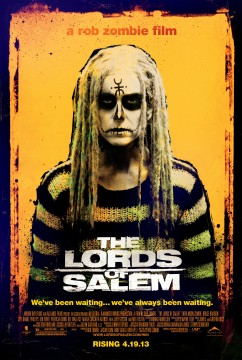
The first thing I thought when I saw this trailer for Rob Zombie’s The Lords of Salem was, oh good, someone’s finally made a movie about what it was like to live on Manhattan’s Lower East Side in the late 1980s, before things got all handcrafted and artisanal. The second thing I thought was, this clip appears to have little to do with the synopsis for the movie that accompanied the trailer. Here’s what it says: From the singular mind of horror maestro Rob Zombie comes a chilling plunge into a nightmare world where evil runs in the blood. The Lords of Salem tells the tale of Heidi (Sheri Moon Zombie), a radio station DJ living in Salem, Massachusetts, who receives a strange wooden box containing a record, a “gift from the Lords.” Heidi listens, and the bizarre sounds within the grooves immediately trigger flashbacks of the town’s violent past. Is Heidi going mad, or are the “Lords of Salem” returning for revenge on modern-day Salem? A previous synopsis described Heidi, who’s played by the writer-director’s wife, as a “blond rock chick,” and the dreadlocks telegraph that much. But I didn’t see any reference in the trailer to the creepy vinyl record that, I understand, becomes a big hit in the movie. Instead, I get more of a crust-punk Rosemary’s Baby vibe from the proceedings. (Meanwhile, the trailer’s soundtrack is reminiscent of the one used in Prometheus teasers.) As for the goat at the top of the clip, the Lower East Side had them back in the day. Live chickens, too. Follow Frank DiGiacomo on Twitter. Follow Movieline on Twitter.
The biggest upset of this year’s Oscars took place weeks before the actual ceremony, when Zero Dark Thirty helmer Kathryn Bigelow was snubbed for a Best Director nod. Conventional wisdom holds that debates about torture and political bias in the Osama Bin Laden thanato-pic, which began weeks before the film’s release, derailed Bigelow’s chances at a second statuette. But the bigger story – one that’s hardly been told – is that Bigelow’s partnership with the Central Intelligence Agency during the production of ZDT inadvertently shined an unwelcome spotlight on the military-entertainment complex: the surprisingly close and definitely reciprocal relationship between Hollywood and the Pentagon. If, as some have alleged, the CIA did share confidential information with Bigelow and ZDT screenwriter Mark Boal – or lied to them – about the role of torture in the manhunt for Bin Laden, that’s certainly cause for debate, censure, and possibly even stronger measures.(Right.) But it’s not just the isolated cases of Bigelow, Boal and their sources that merit closer political scrutiny: It’s time we took a good, hard look at how the military-entertainment complex operates. Cooperation between Hollywood and the military brass goes back to the 1920s, when the Pentagon helped produce Wings , the first Best Picture Oscar-winner. The relationship between the studios and the armed forces has waxed and waned in the decades since, but tends to get cozier in times of conflict. During World War II, for instance, the Department of Defense enlisted Hollywood as its virtual press agent: one Pentagon memo called wartime Disney shorts aimed at children – tomorrow’s recruits – “an excellent opportunity to introduce a whole new generation to the [newly] nuclear Navy.” According to The Hollywood Reporter , it wasn’t until the 1980s, after memories of Vietnam had begun to fade, that “a steady growth [occurred] in the demand for access to military facilities and in the number of films, TV shows and home videos made about the military.” Sure, the decade saw the release of a number of searing films about Vietnam, such as Platoon and Full Metal Jacket , but most of the military-themed films fed to the public were hyper-macho, bazooka-toting fantasy fare like Top Gun , Red Dawn , Rambo II , and Predator . That increasing synergy between Hollywood and the Pentagon led to the current military-entertainment complex in which studios get to use taxpayer-subsidized military locations, equipment, personnel, and expertise in exchange for giving the military script approval. In this disproportionate exchange of power, the studios get significantly reduced production budgets, while the Pentagon gets to harness the power of cinema (and television) to advance a pro-war, pro-military agenda where multiplexes, flat screens and PCs become virtual recruitment offices. A prime example of this dynamic at work was last year’s Navy SEAL porn flick, Act of Valor , which hit theaters just a few months after SEAL Team Six assassinated Bin Laden. As a film drafted within the Pentagon and pitched to studios — a reversal of standard operating procedure — Act of Valor hails back to the days of World War II, when the military enlisted Hollywood in the production of naked propaganda. (In an inspired but ultimately unsuccessful move, active-duty NAVY Seals also made up the cast.) The film was received as the propaganda that it was; the San Francisco Chronicle wrote in its review that ” Act of Valor is intended to wow audiences with high-test action while planting a giant wet kiss on the smacker of the U.S. military – and it scores at both tasks.” The Military-Entertainment Complex doesn’t just produce overt propaganda, by the way. It has also had a hand in mindless, seemingly apolitical popcorn movies. Take Battleship , director Peter Berg’s board game-based stinker from last summer. (The picture is noteworthy for practically ending the big-screen dreams of Taylor Kitsch and Rihanna .) Along with Act of Valor and the upcoming Captain Philips and Lone Survivor , Battleship was one of four films that the U.S. Navy had a hand in producing last year. U.S. Navy documents, acquired through a Freedom of Information Act request via Muckrock (where you can view them in their entirety), show that the Department of Defense’s decision to work with Berg and Universal hinged on one main question: “Do we believe that [the movie] could have a positive impact on recruiting?” The Navy concluded yes, confidently declaring, “ Battleship will certainly continue to be a conversation starter that carries our ‘brand’ to many Americans who aren’t familiar with their Navy.” Apparently unconcerned that Battleship is about naval forces battling an alien invasion, Navy officials got Universal to agree “to consult with the DoD Project Officer [the technical advisor] in all phases of pre-production, production, and post-production that involve and/or depict the U.S. military” in order to ensure that the script “positively represents our service and our Sailors” and “accurately portray[s] the Navy.” Specifically, that meant the Department of Defense had veto power over every word of the script, with any military-related changes having to go through another approval process. The DoD also mandated contractually obligated screenings of the rough cut, when changes to the film could still be made, as well as a screening of the final cut in Washington, D.C., before the film’s theatrical release. The Department of Defense also insured that its public affairs personnel were able to take pictures and videos of the film’s cast, crew, and sets and were granted full permission to use those images, as well as any of the film’s marketing materials. The Department of Defense Production Assistance Agreement states that the Navy would employ those pictures and videos solely for internal use, but doesn’t guarantee that they won’t be visible to the public. “Some of the imagery may be viewed by the general public if posted on an open DoD web site or on ‘The Pentagon Channel,’ or other publicly-accessible media source,” states the agreement, opening the door to use those backlot shots as a recruitment aid. As if life as a Navy sailor had anything to do with a mission to destroy an alien mothership hovering over Hawaii. In the case of Battleship , the Navy reportedly agreed to participate because “whether or not we supported Battleship , the film was going to be made – it was going to carry our brand and represent who we are to the American people.” That would have been an unfavorable scenario for the Navy, but also an extremely unlikely one, since Battleship ’s production budget – already $209 million with the help of the Navy’s resources, including props, backgrounds, extras, and technical expertise – would have probably been too prohibitive had Universal been forced to bear all those costs. The Navy also considered the question “Can we support a film without impacting our operations?” It answered for itself: “Because filming took place on top of already scheduled training events, it did not impair the exercise and there was no cost to the Navy or American taxpayers.” But the lack of any immediate or upfront costs in this one case doesn’t address the questions of why citizens should subsidize Hollywood films – since all the military expertise and materiel appearing in these films are paid for with taxes – or how Americans would benefit from publicly funded propaganda for state-supported violence. In an interview with the Los Angeles Times , an Army spokesman indirectly responded to those concerns, stating, “We [the military] get asked all the time, ‘Why do you market?’ We’re a nation at war going on 11 years, which is … the longest period of consistent conflict that the U.S. Army’s ever been involved in”. Given the recent news that military suicides surpassed combat deaths and surged to a record high in 2012 and that sexual assault remains a disturbingly frequent and unpunished behavior within the armed forces, you can expect Pentagon brass will be looking for more positive depictions of the lives of U.S. soldiers and sailors in the coming months. And as studio budgets continue to rise and military enlistment continues to decline, neither Hollywood nor the Pentagon has any reason to disengage from the military-entertainment complex. And if studios are going to continue to get into bed with the military then taxpaying moviegoers have a right to know when they are being bombarded with propaganda that they’ve essentially financed. A modest step toward greater transparency – one that’s easy and cost-efficient to boot – would be adding a disclosure tag at the beginning of movies that have involved the participation of the armed forces. The Department of Defense already mandates that all movies the military helps to produce must thank the relevant branch of service, but that acknowledgement typically occurs at the very end of the closing credits. Such a disclosure tag wouldn’t just provide a franker context for the film to come. Given the Pentagon’s less-than-stellar track record with film production, it would also serve as a warning to audiences that they should lower their expectations. Now that’s patriotism. Inkoo Kang is a film critic and investigative journalist in Boston. She has been published in Indiewire, Boxoffice Magazine, Yahoo! Movies, Pop Matters, Screen Junkies, and MuckRock. Her great dream in life is to direct a remake of All About Eve with an all-dog cast. FOIA battleship Follow Inkoo Kang on Twitter. Follow Movieline on Twitter.
Groundhog Day 2013 is upon us. Tens of thousands braved temperatures in the single digits last night and this morning in the Weather Capitol of the World, Punxsutawney, Pennsylvania. The occasion? That magical moment when Punxsutawney Phil rises from Gobbler’s Knob, accompanied by his tuxedo-clad handlers, to predict winter’s duration? Will it be six more weeks of snow, wind and cold before the respite of spring? Will a reprieve come sooner? Only Phil and his shadow can say for sure. And he has, just moments ago: NO SHADOW! “Not a shadow to be found. Spring is sprung. RIP Winter! #earlyspring!” That’s according to Phil’s official Twitter (gotta love modern technology)! It’s only the 16th time in 127 years that Punxsutawney Phil , who emerged from his burrow to find overcast conditions in Western Pa., has decreed such a thing. So will the great prognosticator be vindicated by a milder February/March? Debatable at best. But the accuracy of his prediction is secondary, of course. The real point of Groundhog Day is a silly excuse to get out in the elements and submit to the power, mystery and majesty of nature is what it’s all about. It’s basically humans throwing up our hands and declaring we’re not in control … and a big excuse to stay up all night drinking outside in frigid conditions. And recite Groundhog Day quotes . That movie’s hilarious.
Emily VanCamp has reportedly signed on for her first major movie role. The (gorgeous!) Revenge star will portray the female lead in Captain America: The Winter Soldier , Movie Fanatic reports, although the actual identity of her character remains under wraps. Rumors abound, however, that VanCamp will take on the role of Sharon Carter, the niece of Hayley Atwell’s Peggy Carter. The Captain America sequel hits theaters on April 4 of next year. It returns Chris Evans as the Patriotic title character and will also feature Sebastian Stan, Scarlett Johansson, Cobie Smulders, Frank Grillo, Toby Jones, and Samuel L. Jackson.
Jessica Chastain is riding high with her critically acclaimed Oscar-nominated performance in Zero Dark Thirty , but her next gig may be a bit of an about-face from her role at the center of covert operations to snuff out Bin Laden. Chastain will star in a film adaptation of August Strindberg’s play Miss Julie , which will be directed by Swedish actor-director Liv Ullmann . Colin Farrell and Samantha Morton will also star in the film, according to The Guardian. Written in 1888, Miss Julie helped pave the way in utilizing theatrical naturalism in telling its story of class and power. The story revolves around the daughter of a count who falls for her father’s footman. Originally set at a Swedish country house in 1874, it is unclear if Ullmann will set the movie version of the story there or if she’ll pick a different period and locale. The last major adaptation of the play was a Mike Figgis-directed version which starred Saffron Burrows and Peter Mullan as the leads. Ullmann starred in ten of legendary filmmaker Ingmar Bergman’s movies and took up directing in the 1992 family drama Sophie . Miss Julie will be her fourth feature, though her last film, Faithless was released in 2000. [Source: The Guardian ]
Following the path paved by fellow HBO hit Sex And the City , the pay network’s long running series Entourage has received the green light for the big screen from Warner Bros. The theatrical version of the series will be a sequel to the show, which ran on HBO for eight seasons from 2004 – 2011, according to Deadline . Entourage creator Doug Ellin will direct the movie from a screenplay he has written. Like the series, the feature will center around a rising film star and his inner circle. Deals with Entourage stars Adrian Grenier (Vincent “Vinnie” Chase), Kevin Connolly (Eric “E” Murphy), Kevin Dillon (Johnny Drama), Jerry Ferrara (Turtle), and Jeremy Piven, who plays Vinnie’s uber-agent Ari Gold, are underway. The feature-version of Entourage will open six months after the series finale and will center on Ari’s new career move. The HBO series climaxed with Piven’s character quitting the biz to fully commit to his troubled marriage with Mrs. Ari, played by Perrey Reeves. But the story was left hanging when Ari suddenly received news he’s being offered his dream job – running a studio. A start date for the project is still pending. “We’re teed up for a movie in a way that, you know, Ari has this conundrum that he’s facing,” Piven said last year according to Huff Post , adding, “Which is either to rule the world or to honor his love to his wife.” Executive producer Mark Wahlberg offered up what he’d like in the movie back in June of 2012: “I think a 90-minute movie of sheer craziness — the guys getting back to just being about the guys, you know? Lose the ladies. Go crazy. Give people what they want.” [ Sources: Deadline , Huffington Post ]