Tag Archives: movie

‘Wanderlust’: The Reviews Are In!

Critics are a bit grossed out by the raunchy comedy but still charmed by leading man Paul Rudd. By Kara Warner Paul Rud and Jennifer Aniston in “Wanderlust” Photo: Universal Fans of the big-screen pairing of Jennifer Aniston and Paul Rudd have likely been waiting for the two likable actors to reunite since their 1998 romantic dramedy “The Object of My Affection.” At long last, that wait is over with the release of “Wanderlust,” a comedy in which Aniston and Rudd play a stressed-out Manhattan couple who end up traveling through a hippie-ish community that teaches them a lesson or two about what’s really important in life. The critical response is at 55 percent “Fresh” over at Rotten Tomatoes , with some folks enjoying the awkward humor and unflappable charm of Paul Rudd and others having issues with Rudd and Aniston’s schtick. Read on as we frolic through the “Wanderlust” reviews! The Irresistible Charm of Paul Rudd “Paul Rudd is the best friend a movie comedy can have. He always delivers the goods and something extra, usually something wild and weirdly wonderful. In ‘Wanderlust,’ Rudd lets the funny fly. Like the movie he’s in, Rudd only seems normal. Inside, it’s all deliriously unhinged. Rudd plays George, an uptight Wall Street suit squeezed into a Manhattan micro-loft with his documentarian wife Linda (Jennifer Aniston) until the recession shuts them both down. Off they go to Georgia where his idiot brother (Ken Marino, the film’s co-writer) offers him a job in his porta-potty business. Unacceptable. So George and Linda take shelter in Elysium, a commune where craziness reigns along with pot, acid, dodgy hygiene and free love. When the luscious Eva (Malin Akerman) offers to get it on with him, George unravels his straight laces. Here comes the Rudd time capsule moment: In a mirror, George rehearses talking dirty to Eva, taking the word ‘dick’ and stretching it into syllables of near-pornographic hilarity. It helps that Rudd is once again working with director and co-writer David Wain, as he did in ‘Role Models’ and the immortal 2001 indie ‘Wet Hot American Summer.’ ” — Peter Travers, Rolling Stone The Comedy and Quirk Factors “In sophisticated comedy, what’s funny is the tension between proper manners and the nasty or sexy subtext. Whereas in low comedy, there are no manners, and the nasty or sexy subtext is right there on the surface. And then there’s ‘Wanderlust,’ in which the subtext is blasted through megaphones — the characters say so insanely much you want to scream. The satire is as broad as a battleship and equally bombarding. But it takes guts to do a comedy this big without gross-out slapstick, and the writers and the actors are all in. … You say it sounds like a bunch of stereotypes — and 40-year-old stereotypes? The defense concedes the point. It’s not fresh terrain. But this tribe of hippies is also a tribe of marvelously inventive comic actors doing a fair amount of inspired improvisation and grooving on the mindset.” — David Edelstein, NPR The Final Word, Pro-Con-Pro Style “The role of an uptight fish out of water is what Rudd was born for, and he plays George with the congeniality and improvisatorial brio for which he’s become deservedly famous. He and Theroux, who’s barely recognizable beneath a thatch of long hair and a beard, deliver the most well-earned laughs in ‘Wanderlust,’ which otherwise traffics in tired jokes about menstrual cycles, placenta soup and rubbing your fingers together instead of clapping. … Between this film and last summer’s ‘Horrible Bosses,’ Aniston’s coyness — starring in explicit movies without having to be explicit herself — seems to be becoming her stock in trade. It’s not a particularly commendable one, and ‘Wanderlust’ does little to disprove that she’s still a star more suited to TV rather than the big screen. As for Rudd, he still has charm to burn, even playing a type he’s long since outgrown. Like George observing the overgrown children of Elysium, it might be time for Rudd to move on.” — Ann Hornaday, The Washington Post “The production has all the style and subtlety — and, admittedly, the exuberance — of TV sketch material. A psychedelic sequence makes Madonna’s halftime show look like high art. Both the straight and hippie realms are populated by parallel groups of fevered eccentrics; the cast includes Mr. Marino, Justin Theroux, Malin Akerman, Joe Lo Truglio, Kathryn Hahn, Kerri Kenney, Lauren Ambrose and Linda Lavin. Alan Alda is the commune’s venerable founder, Carvin, whose brain long ago failed the acid test. ‘Wanderlust’ is nothing if not strenuous, strident and gross, and most of it fails the comedy test.” — Joe Morgenstern, Wall Street Journal “There are so many things to feel guilty about liking in the pure and prurient guilty pleasure that is ‘Wanderlust.’ Starring Paul Rudd and Jennifer Aniston, this is a comedy of no manners about finding your bliss and escaping the modern grind. The laughter is served up naughty and nice, and frequently au naturel, earning it an R rating when perhaps RR (really raunchy) would have been more appropriate. Appropriateness, however, has pretty much been jettisoned by the filmmakers, who have opted instead for the good-fun-found-in-bad-taste tradition of ‘The Hangover.’ Directed by David Wain and co-written with his frequent comic collaborator, Ken Marino, the film is, overall, a very wobbly affair starting with all the dangling naked body parts that greet George (Rudd) and Linda (Aniston) when the couple pulls into a free-love commune they mistake for a B&B.” — Betsy Sharkey, Los Angeles Times Check out everything we’ve got on “Wanderlust.” For breaking news, celebrity columns, humor and more — updated around the clock — visit MTVMoviesBlog.com . Related Videos MTV First: Paul Rudd & Jennifer Aniston Related Photos ‘Wanderlust’

Original post:
‘Wanderlust’: The Reviews Are In!
‘Cosmopolis’ Isn’t For ‘Team Edward Girls,’ Jay Baruchel Says

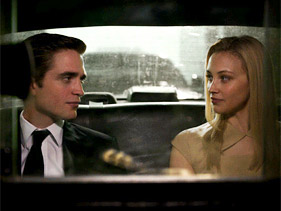
Robert Pattinson’s co-star describes the David Cronenberg film to MTV News as ‘an exceedingly strange movie.’ By Kevin P. Sullivan Robert Pattinson and Sarah Gadon in “Cosmopolis” Photo: Caitlin Cronenberg’s Twitter David Cronenberg ‘s next film, “Cosmopolis,” may have won MTV’s Movie Brawl thanks to the support of die-hard Robert Pattinson fans, but one of his co-stars told MTV News the film will be far from what Twilighters are expecting. While promoting “Goon,” a film he stars in and co-wrote, Jay Baruchel shared his experiences working for a short period of time on the Manhattan set of “Cosmopolis.” Unfortunately for the Pattinson fans out there, according to Baruchel, Cronenberg’s next movie might be too strange for them. “An exceedingly strange movie,” Baruchel said, describing “Cosmopolis.” “All the Team Edward girls won’t be seeing this one, I don’t think.” For Baruchel, working with Cronenberg — who made a name for himself with horror films — was a dream come true. “Basically, it was that Cronenberg is a hero of mine. I’m a Canadian boy. I love horror. That’s all I want to do,” Baruchel said. “If you’re a Canadian horror fan, Cronenberg’s the Holy Grail.” The opportunity for Baruchel came about in a rather mundane way, but his reaction to it was anything but. “I was in Manhattan last year, keeping my lady company, and they called up and were like, ‘Hey, do you want to do two days on this new Cronenberg?’ I said, ‘Yep!’ ‘Wait, wait. We’ll send you the script.’ I couldn’t care less; what I’m playing is a means to an end. I just want to go and film-nerd-out about ‘Videodrome’ with him for two days.” The actual experience of working with Cronenberg did not disappoint. “Not only did I get to go and be a fly on the wall for two days and watch one of my heroes do his thing, I actually had the pleasure being directed by him,” Baruchel said. “Coolest thing ever.” Check out everything we’ve got on “Cosmopolis.” For breaking news, celebrity columns, humor and more — updated around the clock — visit MTVMoviesBlog.com . Related Photos Meet Jay Baruchel, The Newest ‘Cosmopolis’ Cast Member

See the original post here:
‘Cosmopolis’ Isn’t For ‘Team Edward Girls,’ Jay Baruchel Says

Sacha Baron Cohen Addresses Oscar Ban In ‘Dictator’ Character

Admiral General Shabazz Aladeen issues ultimatum, promises ‘unimaginable consequences’ if Academy refuses to lift ban. By John Mitchell Sacha Baron Cohen in “The Dictator” Photo: Paramount Sacha Baron Cohen finally addressed the Academy of Motion Picture Arts and Sciences’ decision to ban him from attending Sunday’s Oscars , releasing a video and calling in to “Today” as Admiral General Shabazz Aladeen, his character in the upcoming film “The Dictator,” to promise “unimaginable consequences” if he is not permitted to attend. Baron Cohen was initially invited to the Oscars because he appears in one of this year’s Best Picture nominees, Martin Scorsese’s “Hugo.” The actor’s in-character appearance was intended to generate publicity for the film, a tactic with which the Academy apparently took issue. Purists believe such promotion is inappropriate, as the Academy hasn’t even allowed advertisements for films to run during the Oscar telecast until this year. “Good morning, great Satan of America. How are you? I am fine, thank you. On behalf of the nation of Wadiya, I am outraged at being banned from the Oscars by the Academy of Motion Pictures, Arts and Zionists,” Gen. Aladeen said in a video address posted to the Republic of Wadiya website . “While I applaud the Academy for taking away my right to free speech, I warn you that if you do not lift your sanctions and give me my tickets back by 12 p.m. on Sunday, you will face unimaginable consequences. … On top of all of this, I paid Hilary Swank $2 million to be my date and she will not refund a penny. My Sunday calendar is now as empty as a North Korean grocery store. “But whatever happens, I still plan to attend director Brett Ratner’s afterparty, since it is impossible to catch herpes twice,” he continued. “Death to the West. And good luck, Billy Crystal. You’re fantastic.” At the video’s conclusion, in a likely statement on what Baron Cohen believes inspired the Academy to ban him from attending in character, he concludes the video by saying, “How was that? Did I sound crazy enough?” This morning, during a call-in interview on “Today,” Cohen-as-Aladeen declared, “Normally I would be impressed by an act of cowardice by a faceless regime. But this is personal.” This isn’t the first time Baron Cohen has been shunned by the Academy after declaring his intention to show up in character. In 2007, Baron Cohen was asked to be a presenter but said he would do it only if he could be in character as Borat, the fictitious Kazakh journalist he played in the blockbuster film of the same name. Oscar execs said no, and Baron Cohen did not attend the awards — though he was not officially banned from attending the ceremony. The actor also appeared in character as Br

Interesting.

http://www.youtube.com/v/aHjpOzsQ9YI

Link:

I like fusion music. Stepping out of one’s comfort zone in music and hearing something different is worth doing. This qualifies. I don’t know if I’m going to be listening much to it, but it’s worth a listen (and a gander). Broadcasting platform : YouTube Source : Better And Better Discovery Date : 23/02/2012 17:50 Number of articles : 2

Interesting.

Second ‘Wrath of the Titans’ Trailer: So Many Monsters!

http://www.youtube.com/v/rNAo6KLIKVk

See more here:

I’ll say this for Jonathan Liebesman‘s Clash of the Titans sequel Wrath of the Titans: the movie really doesn’t look to skimp on the creatures and mythical monsters. Not only that, but it gives the returning Sam Worthington a haircut that is really worthy of the legacy of Harry Hamlin’s style from the 1981 Clash Broadcasting platform : YouTube Source : /Film Discovery Date : 23/02/2012 18:51 Number of articles : 2

Second ‘Wrath of the Titans’ Trailer: So Many Monsters!

20 Years of Crap That Opened on Oscar Weekend

As the Academy and its guests gather Sunday to enthusiastically slap congratulatory-calloused backs at the Oscars, an altogether different condition will overtake multiplexes nationwide. There, audiences will be confronted by a one-joke hippie comedy with Paul Rudd and Jennifer Aniston ( Wanderlust ), an Amanda Seyfried thriller withheld from critics before opening day ( Gone ), the Navy SEAL recruitment effort ( Act of Valor ), and frequent Oscar week performer Tyler Perry, departing from his matriarch Madea for a change ( Good Deeds ). 

 Such a weak field is hardly an anomaly; the first months on the calendar historically are the wasteland of the release schedule, sitting in sharp contrast to the Academy’s annual celebration of cinematic “greatness.” A curious paradox is normally in play — at the time Hollywood crows about its best, it often serves up some of its worst. To gauge this phenomenon — and display the movie industry’s staggering self-unawareness — here is a look back at what has been foisted on the public during the last 20 years of Academy Awards weekends:


REVIEW: The Forgiveness of Blood Will Make You Care About Albanian Blood Feuds — Really

Maybe you’re the kind of person who wakes up in the morning and says, “What can I learn today about the psychological effects of blood feuds in contemporary Albania?” But I doubt it. Who even thinks about these things, or cares about them? The strange miracle of Joshua Marston’s modest, well-constructed drama The Forgiveness of Blood — which really is about blood feuds in contemporary Albania — is that once you’ve watched it, you might find that you actually do care. It’s the kind of movie that makes the world feel like a smaller place, suggesting that the similarities connecting us across continents and cultures are more resonant than the things that divide us. The Forgiveness of Blood is set in northern Albania — it was also filmed there, using local, nonprofessional actors. Eighteen-year-old Nik (Tristan Halilaj) is a senior in high school, with his eye on the prettiest classmate and ambitions to open his own Internet café. But one day his father, Mark (Refet Abazi), becomes involved in a land dispute: Mark makes a living for himself and his family by delivering bread to local homes and businesses — his mode of transport is a horse-drawn cart — and he habitually takes a shortcut across land that used to belong to his grandfather. The current owners take umbrage, and an altercation breaks out in which one of them is stabbed to death; implicated in the murder, Mark immediately goes into hiding. But according to codes of law that have been in place for centuries, the aggrieved family is entitled to take the life of a male from the aggressor’s family. Nik is forced into a kind of house arrest, along with his younger brother and two sisters. But because the female members of the household aren’t in danger, Nik’s younger sister, Rudina (Sindi Laçej), must leave school and temporarily take over her father’s business, just to keep the family afloat. This is a vivid, tough little story that enfolds lots of dramatic subthreads: Nik and Rudina live, as most of us do, in a world of cell phones and satellite TV, yet they find themselves bound by antiquated rules of conduct. Nik is just learning his way around the adult world — he preens in front of the mirror, Tony Manero-style, hoping to look good for the girl he’s set his sights on — only to be imprisoned at home, as if grounded by an especially strict parent. It’s a particularly painful kind of cultural emasculation, and he lashes out. And Rudina, a bright girl who seems to enjoy school (it’s hinted that she may have a future outside this rather restrictive community), suddenly has to play the role of the male breadwinner. She’d rather go shoe-shopping with her friends, of course, but the point is that her very sex both protects her and makes her life harder: Her life is of lesser value under the arcane rules governing the blood feud, which means that when the males in her family are compromised, she has to step up to the plate and act like a man. She seems to have the worst of both worlds. Marston’s gift as a filmmaker — he also co-wrote the script with Albanian screenwriter Andamion Murataj — is that he makes us care about these characters without forcing us to eat the knobby, dirt-encrusted root vegetables of cross-cultural awareness. You know what I’m talking about: The world of independent filmmaking is full of movies designed to congratulate well-informed, literate liberals on how well-informed and literate they are — we watch as peasants and otherwise “compromised” people, who live in countries outside North America (or even the poorer communities within it), suffer through their daily lives. Then we’re allowed to pat ourselves on the back for allowing our eyes to be opened to their plight. Marston doesn’t play that game here, and he didn’t play it in his first feature, Maria Full of Grace , either: That picture told the story of a young Colombian woman who becomes a drug mule to raise money for her family. The picture could have been a pile-up of the most tense horrors imaginable, but Marston has the rare gift of knowing when to ease up on the clutch: He focuses on individuals, on their faces and their feelings, sometimes at the expense of your garden-variety dramatic buildup. His movies have their own kind of narrative intensity, but they’re not thrillers masquerading as human-interest stories. With Marston, the interest is all human. That’s especially true in The Forgiveness of Blood . In the movie’s early moments, when I saw that horse-drawn bread cart rambling across a scrubby-yet-beautiful semi-rural landscape, I groaned. Was this going to be one of those good-for-you movies that’s pure punishment to watch? The picture does have its unnerving moments, points at which you find yourself inside the head of a particular character and you’re not sure you want to be there. But Marston doesn’t overreach dramatically. Mostly, he simply trusts the faces of his actors: Halilaj’s Nik has a gawky-charming teen-scarecrow look — he’s all long limbs and awkward pauses, particularly when he’s in the presence of that pretty classmate. And even though Rudina isn’t really the movie’s main character, as Laçej plays her, she’s its quiet, somber soul. Rudina observes the proceedings around her with resigned exasperation: Just when her life should be moving forward, it’s being pulled backward through hundreds of years of tradition. That tension is gentle but potent, and it’s what keeps The Forgiveness of Blood coursing along. By the end, you’ll care more about Albanian blood feuds than you ever thought you could. Follow S.T. VanAirsdale on Twitter . Follow Movieline on Twitter .

Read the original here:
REVIEW: The Forgiveness of Blood Will Make You Care About Albanian Blood Feuds — Really

REVIEW: The Forgiveness of Blood Will Make You Care About Albanian Blood Feuds — Really

Maybe you’re the kind of person who wakes up in the morning and says, “What can I learn today about the psychological effects of blood feuds in contemporary Albania?” But I doubt it. Who even thinks about these things, or cares about them? The strange miracle of Joshua Marston’s modest, well-constructed drama The Forgiveness of Blood — which really is about blood feuds in contemporary Albania — is that once you’ve watched it, you might find that you actually do care. It’s the kind of movie that makes the world feel like a smaller place, suggesting that the similarities connecting us across continents and cultures are more resonant than the things that divide us. The Forgiveness of Blood is set in northern Albania — it was also filmed there, using local, nonprofessional actors. Eighteen-year-old Nik (Tristan Halilaj) is a senior in high school, with his eye on the prettiest classmate and ambitions to open his own Internet café. But one day his father, Mark (Refet Abazi), becomes involved in a land dispute: Mark makes a living for himself and his family by delivering bread to local homes and businesses — his mode of transport is a horse-drawn cart — and he habitually takes a shortcut across land that used to belong to his grandfather. The current owners take umbrage, and an altercation breaks out in which one of them is stabbed to death; implicated in the murder, Mark immediately goes into hiding. But according to codes of law that have been in place for centuries, the aggrieved family is entitled to take the life of a male from the aggressor’s family. Nik is forced into a kind of house arrest, along with his younger brother and two sisters. But because the female members of the household aren’t in danger, Nik’s younger sister, Rudina (Sindi Laçej), must leave school and temporarily take over her father’s business, just to keep the family afloat. This is a vivid, tough little story that enfolds lots of dramatic subthreads: Nik and Rudina live, as most of us do, in a world of cell phones and satellite TV, yet they find themselves bound by antiquated rules of conduct. Nik is just learning his way around the adult world — he preens in front of the mirror, Tony Manero-style, hoping to look good for the girl he’s set his sights on — only to be imprisoned at home, as if grounded by an especially strict parent. It’s a particularly painful kind of cultural emasculation, and he lashes out. And Rudina, a bright girl who seems to enjoy school (it’s hinted that she may have a future outside this rather restrictive community), suddenly has to play the role of the male breadwinner. She’d rather go shoe-shopping with her friends, of course, but the point is that her very sex both protects her and makes her life harder: Her life is of lesser value under the arcane rules governing the blood feud, which means that when the males in her family are compromised, she has to step up to the plate and act like a man. She seems to have the worst of both worlds. Marston’s gift as a filmmaker — he also co-wrote the script with Albanian screenwriter Andamion Murataj — is that he makes us care about these characters without forcing us to eat the knobby, dirt-encrusted root vegetables of cross-cultural awareness. You know what I’m talking about: The world of independent filmmaking is full of movies designed to congratulate well-informed, literate liberals on how well-informed and literate they are — we watch as peasants and otherwise “compromised” people, who live in countries outside North America (or even the poorer communities within it), suffer through their daily lives. Then we’re allowed to pat ourselves on the back for allowing our eyes to be opened to their plight. Marston doesn’t play that game here, and he didn’t play it in his first feature, Maria Full of Grace , either: That picture told the story of a young Colombian woman who becomes a drug mule to raise money for her family. The picture could have been a pile-up of the most tense horrors imaginable, but Marston has the rare gift of knowing when to ease up on the clutch: He focuses on individuals, on their faces and their feelings, sometimes at the expense of your garden-variety dramatic buildup. His movies have their own kind of narrative intensity, but they’re not thrillers masquerading as human-interest stories. With Marston, the interest is all human. That’s especially true in The Forgiveness of Blood . In the movie’s early moments, when I saw that horse-drawn bread cart rambling across a scrubby-yet-beautiful semi-rural landscape, I groaned. Was this going to be one of those good-for-you movies that’s pure punishment to watch? The picture does have its unnerving moments, points at which you find yourself inside the head of a particular character and you’re not sure you want to be there. But Marston doesn’t overreach dramatically. Mostly, he simply trusts the faces of his actors: Halilaj’s Nik has a gawky-charming teen-scarecrow look — he’s all long limbs and awkward pauses, particularly when he’s in the presence of that pretty classmate. And even though Rudina isn’t really the movie’s main character, as Laçej plays her, she’s its quiet, somber soul. Rudina observes the proceedings around her with resigned exasperation: Just when her life should be moving forward, it’s being pulled backward through hundreds of years of tradition. That tension is gentle but potent, and it’s what keeps The Forgiveness of Blood coursing along. By the end, you’ll care more about Albanian blood feuds than you ever thought you could. Follow S.T. VanAirsdale on Twitter . Follow Movieline on Twitter .

Read the original here:
REVIEW: The Forgiveness of Blood Will Make You Care About Albanian Blood Feuds — Really

Chris Pine vs. Tom Hardy: Who Would You Rather…

In This Means War , Chris Pine and Tom Hardy play CIA operatives battling for the heart of Reese Witherspoon. So it’s only natural for us to pit these actors against each in real life, too, isn’t it? Study the looks of Pine and Hardy at the Hollywood premiere of this romantic comedy (try to imagine the latter without his abundance of facial hair if that helps) and answer the pressing question that Witherspoon’s character faces in the movie: Who would you rather be interrogated by privately… if you know what we mean?

View original post here:
Chris Pine vs. Tom Hardy: Who Would You Rather…

Safe House Director’s Previous Feature Finally Hitting Theaters

It’s only taken a few years, but the success of director Daniel Espinosa’s Safe House means that Harvey Weinstein is finally ready to let the filmmaker’s Swedish-language hit Easy Money — née Snabba Cash — off his shelf on July 27. The distributor cited the eventual Stateside publication of the film’s source novel (as opposed to Safe House ‘s $83 million-and-counting domestic haul ) as his motivation: “We love the movie, but we needed the book to be out here,” he told the LAT . Right . As always with Harvey, all release dates are subject to change and/or revocation at any time, so remember to mark your calendars in pencil. [ LAT ]

Read the rest here:
Safe House Director’s Previous Feature Finally Hitting Theaters