Tag Archives: ncis

Tales Of The Military-Entertainment Complex: Why The U.S. Navy Produced ‘Battleship’

The biggest upset of this year’s Oscars took place weeks before the actual ceremony, when   Zero Dark Thirty  helmer Kathryn Bigelow was snubbed for a Best Director nod. Conventional wisdom holds that debates about torture and political bias in the Osama Bin Laden thanato-pic, which began weeks before the film’s release, derailed Bigelow’s chances at a second statuette. But the bigger story – one that’s hardly been told – is that Bigelow’s partnership with the Central Intelligence Agency  during the production of  ZDT  inadvertently shined an unwelcome spotlight on the military-entertainment complex: the surprisingly close and definitely reciprocal relationship between Hollywood and the Pentagon. If, as some have alleged, the CIA did share confidential information with Bigelow and  ZDT  screenwriter Mark Boal – or lied to them – about the role of torture in the manhunt for Bin Laden, that’s certainly cause for debate, censure, and possibly even stronger measures.(Right.)  But it’s not just the isolated cases of Bigelow, Boal and their sources that merit closer political scrutiny: It’s time we took a good, hard look at how the military-entertainment complex operates. Cooperation between Hollywood and the military brass goes back to the 1920s, when the Pentagon helped produce  Wings , the first Best Picture Oscar-winner. The relationship between the studios and the armed forces has waxed and waned in the decades since, but tends to get cozier in times of conflict. During World War II, for instance, the Department of Defense enlisted Hollywood as its virtual press agent:  one Pentagon memo called  wartime Disney shorts aimed at children  – tomorrow’s recruits –  “an excellent opportunity to introduce a whole new generation to the [newly] nuclear Navy.” According to  The Hollywood Reporter ,   it wasn’t until the 1980s, after memories of Vietnam had begun to fade, that “a steady growth [occurred] in the demand for access to military facilities and in the number of films, TV shows and home videos made about the military.” Sure, the decade saw the release of a number of searing films about Vietnam, such as Platoon and  Full Metal Jacket , but most of the military-themed films fed to the public were hyper-macho, bazooka-toting fantasy fare like Top Gun , Red Dawn , Rambo II , and Predator . That increasing synergy between Hollywood and the Pentagon led to the current military-entertainment complex in which studios get to use taxpayer-subsidized military locations, equipment, personnel, and expertise in exchange for giving the military script approval. In this disproportionate exchange of power, the studios get significantly reduced production budgets, while the Pentagon gets to harness the power of cinema (and television) to advance a pro-war, pro-military agenda where multiplexes, flat screens and PCs become virtual recruitment offices. A prime example of this dynamic at work was last year’s Navy SEAL porn flick,   Act of Valor , which hit theaters just a few months after SEAL Team Six assassinated Bin Laden. As a film drafted within the Pentagon and pitched to studios — a reversal of standard operating procedure —  Act of Valor  hails back to the days of World War II, when the military enlisted Hollywood in the production of naked propaganda. (In an inspired but ultimately unsuccessful move, active-duty NAVY Seals also made up the cast.) The film was received as the propaganda that it was; the  San Francisco Chronicle  wrote in its review that ” Act of Valor  is intended to wow audiences with high-test action while planting a giant wet kiss on the smacker of the U.S. military – and it scores at both tasks.” The Military-Entertainment Complex doesn’t just produce overt propaganda, by the way. It has also had a hand in mindless, seemingly apolitical popcorn movies. Take  Battleship , director Peter Berg’s board game-based stinker from last summer. (The picture is noteworthy for practically ending the big-screen dreams of   Taylor Kitsch and Rihanna .) Along with  Act of Valor  and the upcoming  Captain Philips  and  Lone Survivor ,  Battleship  was one of four films that the U.S. Navy had a hand in producing last year. U.S. Navy documents, acquired through a Freedom of Information Act request via Muckrock  (where you can view them in their entirety), show that the Department of Defense’s decision to work with Berg and Universal hinged on one main question: “Do we believe that [the movie] could have a positive impact on recruiting?” The Navy concluded yes, confidently declaring, “ Battleship  will certainly continue to be a conversation starter that carries our ‘brand’ to many Americans who aren’t familiar with their Navy.” Apparently unconcerned that  Battleship  is about naval forces battling an alien invasion, Navy officials got Universal to agree “to consult with the DoD Project Officer [the technical advisor] in all phases of pre-production, production, and post-production that involve and/or depict the U.S. military” in order to ensure that the script “positively represents our service and our Sailors” and “accurately portray[s] the Navy.” Specifically, that meant the Department of Defense had veto power over every word of the script, with any military-related changes having to go through another approval process. The DoD also mandated contractually obligated screenings of the rough cut, when changes to the film could still be made, as well as a screening of the final cut in Washington, D.C., before the film’s theatrical release. The Department of Defense also insured that its public affairs personnel were able to take pictures and videos of the film’s cast, crew, and sets and were granted full permission to use those images, as well as any of the film’s marketing materials. The Department of Defense Production Assistance Agreement states that the Navy would employ those pictures and videos solely for internal use, but doesn’t guarantee that they won’t be visible to the public. “Some of the imagery may be viewed by the general public if posted on an open DoD web site or on ‘The Pentagon Channel,’ or other publicly-accessible media source,” states the agreement,  opening the door to use those backlot shots as a recruitment aid. As if life as a Navy sailor had anything to do with a mission to destroy an alien mothership hovering over Hawaii. In the case of  Battleship , the Navy reportedly agreed to participate because “whether or not we supported  Battleship , the film was going to be made – it was going to carry our brand and represent who we are to the American people.” That would have been an unfavorable scenario for the Navy, but also an extremely unlikely one, since  Battleship ’s production budget – already $209 million  with  the help of the Navy’s resources, including props, backgrounds, extras, and technical expertise – would have probably been too prohibitive had Universal been forced to bear all those costs. The Navy also considered the question “Can we support a film without impacting our operations?”  It answered for itself:  “Because filming took place on top of already scheduled training events, it did not impair the exercise and there was no cost to the Navy or American taxpayers.” But the lack of any immediate or upfront costs in this one case doesn’t address the questions of why citizens should subsidize Hollywood films – since all the military expertise and materiel appearing in these films are paid for with taxes  – or how Americans would benefit from publicly funded propaganda for state-supported violence. In an interview with the  Los Angeles Times , an Army spokesman indirectly responded to those concerns, stating, “We [the military] get asked all the time, ‘Why do you market?’ We’re a nation at war going on 11 years, which is … the longest period of consistent conflict that the U.S. Army’s ever been involved in”. Given the recent news that military suicides surpassed combat deaths and surged to a record high in 2012 and that sexual assault remains a disturbingly frequent and unpunished behavior within the armed forces, you can expect Pentagon brass will be looking for more positive depictions of the lives of U.S. soldiers and sailors in the coming months. And as studio budgets continue to rise and military enlistment continues to decline, neither Hollywood nor the Pentagon has any reason to disengage from the military-entertainment complex. And if studios are going to continue to get into bed with the military then taxpaying moviegoers have a right to know when they are being bombarded with propaganda that they’ve essentially financed. A modest step toward greater transparency – one that’s easy and cost-efficient to boot – would be adding a disclosure tag at the beginning of movies that have involved the participation of the armed forces. The Department of Defense already mandates that all movies the military helps to produce must thank the relevant branch of service, but that acknowledgement typically occurs at the very end of the closing credits. Such a disclosure tag wouldn’t just provide a franker context for the film to come. Given the Pentagon’s less-than-stellar track record with film production, it would also serve as a warning to audiences that they should  lower their expectations. Now that’s patriotism. Inkoo Kang is a film critic and investigative journalist in Boston. She has been published in Indiewire, Boxoffice Magazine, Yahoo! Movies, Pop Matters, Screen Junkies, and MuckRock. Her great dream in life is to direct a remake of All About Eve with an all-dog cast. FOIA battleship Follow Inkoo Kang on  Twitter. Follow Movieline on  Twitter.  

Go here to read the rest:
Tales Of The Military-Entertainment Complex: Why The U.S. Navy Produced ‘Battleship’
Tales Of The Military-Entertainment Complex: Why The U.S. Navy Produced ‘Battleship’

The biggest upset of this year’s Oscars took place weeks before the actual ceremony, when   Zero Dark Thirty  helmer Kathryn Bigelow was snubbed for a Best Director nod. Conventional wisdom holds that debates about torture and political bias in the Osama Bin Laden thanato-pic, which began weeks before the film’s release, derailed Bigelow’s chances at a second statuette. But the bigger story – one that’s hardly been told – is that Bigelow’s partnership with the Central Intelligence Agency  during the production of  ZDT  inadvertently shined an unwelcome spotlight on the military-entertainment complex: the surprisingly close and definitely reciprocal relationship between Hollywood and the Pentagon. If, as some have alleged, the CIA did share confidential information with Bigelow and  ZDT  screenwriter Mark Boal – or lied to them – about the role of torture in the manhunt for Bin Laden, that’s certainly cause for debate, censure, and possibly even stronger measures.(Right.)  But it’s not just the isolated cases of Bigelow, Boal and their sources that merit closer political scrutiny: It’s time we took a good, hard look at how the military-entertainment complex operates. Cooperation between Hollywood and the military brass goes back to the 1920s, when the Pentagon helped produce  Wings , the first Best Picture Oscar-winner. The relationship between the studios and the armed forces has waxed and waned in the decades since, but tends to get cozier in times of conflict. During World War II, for instance, the Department of Defense enlisted Hollywood as its virtual press agent:  one Pentagon memo called  wartime Disney shorts aimed at children  – tomorrow’s recruits –  “an excellent opportunity to introduce a whole new generation to the [newly] nuclear Navy.” According to  The Hollywood Reporter ,   it wasn’t until the 1980s, after memories of Vietnam had begun to fade, that “a steady growth [occurred] in the demand for access to military facilities and in the number of films, TV shows and home videos made about the military.” Sure, the decade saw the release of a number of searing films about Vietnam, such as Platoon and  Full Metal Jacket , but most of the military-themed films fed to the public were hyper-macho, bazooka-toting fantasy fare like Top Gun , Red Dawn , Rambo II , and Predator . That increasing synergy between Hollywood and the Pentagon led to the current military-entertainment complex in which studios get to use taxpayer-subsidized military locations, equipment, personnel, and expertise in exchange for giving the military script approval. In this disproportionate exchange of power, the studios get significantly reduced production budgets, while the Pentagon gets to harness the power of cinema (and television) to advance a pro-war, pro-military agenda where multiplexes, flat screens and PCs become virtual recruitment offices. A prime example of this dynamic at work was last year’s Navy SEAL porn flick,   Act of Valor , which hit theaters just a few months after SEAL Team Six assassinated Bin Laden. As a film drafted within the Pentagon and pitched to studios — a reversal of standard operating procedure —  Act of Valor  hails back to the days of World War II, when the military enlisted Hollywood in the production of naked propaganda. (In an inspired but ultimately unsuccessful move, active-duty NAVY Seals also made up the cast.) The film was received as the propaganda that it was; the  San Francisco Chronicle  wrote in its review that ” Act of Valor  is intended to wow audiences with high-test action while planting a giant wet kiss on the smacker of the U.S. military – and it scores at both tasks.” The Military-Entertainment Complex doesn’t just produce overt propaganda, by the way. It has also had a hand in mindless, seemingly apolitical popcorn movies. Take  Battleship , director Peter Berg’s board game-based stinker from last summer. (The picture is noteworthy for practically ending the big-screen dreams of   Taylor Kitsch and Rihanna .) Along with  Act of Valor  and the upcoming  Captain Philips  and  Lone Survivor ,  Battleship  was one of four films that the U.S. Navy had a hand in producing last year. U.S. Navy documents, acquired through a Freedom of Information Act request via Muckrock  (where you can view them in their entirety), show that the Department of Defense’s decision to work with Berg and Universal hinged on one main question: “Do we believe that [the movie] could have a positive impact on recruiting?” The Navy concluded yes, confidently declaring, “ Battleship  will certainly continue to be a conversation starter that carries our ‘brand’ to many Americans who aren’t familiar with their Navy.” Apparently unconcerned that  Battleship  is about naval forces battling an alien invasion, Navy officials got Universal to agree “to consult with the DoD Project Officer [the technical advisor] in all phases of pre-production, production, and post-production that involve and/or depict the U.S. military” in order to ensure that the script “positively represents our service and our Sailors” and “accurately portray[s] the Navy.” Specifically, that meant the Department of Defense had veto power over every word of the script, with any military-related changes having to go through another approval process. The DoD also mandated contractually obligated screenings of the rough cut, when changes to the film could still be made, as well as a screening of the final cut in Washington, D.C., before the film’s theatrical release. The Department of Defense also insured that its public affairs personnel were able to take pictures and videos of the film’s cast, crew, and sets and were granted full permission to use those images, as well as any of the film’s marketing materials. The Department of Defense Production Assistance Agreement states that the Navy would employ those pictures and videos solely for internal use, but doesn’t guarantee that they won’t be visible to the public. “Some of the imagery may be viewed by the general public if posted on an open DoD web site or on ‘The Pentagon Channel,’ or other publicly-accessible media source,” states the agreement,  opening the door to use those backlot shots as a recruitment aid. As if life as a Navy sailor had anything to do with a mission to destroy an alien mothership hovering over Hawaii. In the case of  Battleship , the Navy reportedly agreed to participate because “whether or not we supported  Battleship , the film was going to be made – it was going to carry our brand and represent who we are to the American people.” That would have been an unfavorable scenario for the Navy, but also an extremely unlikely one, since  Battleship ’s production budget – already $209 million  with  the help of the Navy’s resources, including props, backgrounds, extras, and technical expertise – would have probably been too prohibitive had Universal been forced to bear all those costs. The Navy also considered the question “Can we support a film without impacting our operations?”  It answered for itself:  “Because filming took place on top of already scheduled training events, it did not impair the exercise and there was no cost to the Navy or American taxpayers.” But the lack of any immediate or upfront costs in this one case doesn’t address the questions of why citizens should subsidize Hollywood films – since all the military expertise and materiel appearing in these films are paid for with taxes  – or how Americans would benefit from publicly funded propaganda for state-supported violence. In an interview with the  Los Angeles Times , an Army spokesman indirectly responded to those concerns, stating, “We [the military] get asked all the time, ‘Why do you market?’ We’re a nation at war going on 11 years, which is … the longest period of consistent conflict that the U.S. Army’s ever been involved in”. Given the recent news that military suicides surpassed combat deaths and surged to a record high in 2012 and that sexual assault remains a disturbingly frequent and unpunished behavior within the armed forces, you can expect Pentagon brass will be looking for more positive depictions of the lives of U.S. soldiers and sailors in the coming months. And as studio budgets continue to rise and military enlistment continues to decline, neither Hollywood nor the Pentagon has any reason to disengage from the military-entertainment complex. And if studios are going to continue to get into bed with the military then taxpaying moviegoers have a right to know when they are being bombarded with propaganda that they’ve essentially financed. A modest step toward greater transparency – one that’s easy and cost-efficient to boot – would be adding a disclosure tag at the beginning of movies that have involved the participation of the armed forces. The Department of Defense already mandates that all movies the military helps to produce must thank the relevant branch of service, but that acknowledgement typically occurs at the very end of the closing credits. Such a disclosure tag wouldn’t just provide a franker context for the film to come. Given the Pentagon’s less-than-stellar track record with film production, it would also serve as a warning to audiences that they should  lower their expectations. Now that’s patriotism. Inkoo Kang is a film critic and investigative journalist in Boston. She has been published in Indiewire, Boxoffice Magazine, Yahoo! Movies, Pop Matters, Screen Junkies, and MuckRock. Her great dream in life is to direct a remake of All About Eve with an all-dog cast. FOIA battleship Follow Inkoo Kang on  Twitter. Follow Movieline on  Twitter.  

Go here to read the rest:
Tales Of The Military-Entertainment Complex: Why The U.S. Navy Produced ‘Battleship’

Tales Of The Military-Entertainment Complex: Why The U.S. Navy Produced ‘Battleship’

The biggest upset of this year’s Oscars took place weeks before the actual ceremony, when   Zero Dark Thirty  helmer Kathryn Bigelow was snubbed for a Best Director nod. Conventional wisdom holds that debates about torture and political bias in the Osama Bin Laden thanato-pic, which began weeks before the film’s release, derailed Bigelow’s chances at a second statuette. But the bigger story – one that’s hardly been told – is that Bigelow’s partnership with the Central Intelligence Agency  during the production of  ZDT  inadvertently shined an unwelcome spotlight on the military-entertainment complex: the surprisingly close and definitely reciprocal relationship between Hollywood and the Pentagon. If, as some have alleged, the CIA did share confidential information with Bigelow and  ZDT  screenwriter Mark Boal – or lied to them – about the role of torture in the manhunt for Bin Laden, that’s certainly cause for debate, censure, and possibly even stronger measures.(Right.)  But it’s not just the isolated cases of Bigelow, Boal and their sources that merit closer political scrutiny: It’s time we took a good, hard look at how the military-entertainment complex operates. Cooperation between Hollywood and the military brass goes back to the 1920s, when the Pentagon helped produce  Wings , the first Best Picture Oscar-winner. The relationship between the studios and the armed forces has waxed and waned in the decades since, but tends to get cozier in times of conflict. During World War II, for instance, the Department of Defense enlisted Hollywood as its virtual press agent:  one Pentagon memo called  wartime Disney shorts aimed at children  – tomorrow’s recruits –  “an excellent opportunity to introduce a whole new generation to the [newly] nuclear Navy.” According to  The Hollywood Reporter ,   it wasn’t until the 1980s, after memories of Vietnam had begun to fade, that “a steady growth [occurred] in the demand for access to military facilities and in the number of films, TV shows and home videos made about the military.” Sure, the decade saw the release of a number of searing films about Vietnam, such as Platoon and  Full Metal Jacket , but most of the military-themed films fed to the public were hyper-macho, bazooka-toting fantasy fare like Top Gun , Red Dawn , Rambo II , and Predator . That increasing synergy between Hollywood and the Pentagon led to the current military-entertainment complex in which studios get to use taxpayer-subsidized military locations, equipment, personnel, and expertise in exchange for giving the military script approval. In this disproportionate exchange of power, the studios get significantly reduced production budgets, while the Pentagon gets to harness the power of cinema (and television) to advance a pro-war, pro-military agenda where multiplexes, flat screens and PCs become virtual recruitment offices. A prime example of this dynamic at work was last year’s Navy SEAL porn flick,   Act of Valor , which hit theaters just a few months after SEAL Team Six assassinated Bin Laden. As a film drafted within the Pentagon and pitched to studios — a reversal of standard operating procedure —  Act of Valor  hails back to the days of World War II, when the military enlisted Hollywood in the production of naked propaganda. (In an inspired but ultimately unsuccessful move, active-duty NAVY Seals also made up the cast.) The film was received as the propaganda that it was; the  San Francisco Chronicle  wrote in its review that ” Act of Valor  is intended to wow audiences with high-test action while planting a giant wet kiss on the smacker of the U.S. military – and it scores at both tasks.” The Military-Entertainment Complex doesn’t just produce overt propaganda, by the way. It has also had a hand in mindless, seemingly apolitical popcorn movies. Take  Battleship , director Peter Berg’s board game-based stinker from last summer. (The picture is noteworthy for practically ending the big-screen dreams of   Taylor Kitsch and Rihanna .) Along with  Act of Valor  and the upcoming  Captain Philips  and  Lone Survivor ,  Battleship  was one of four films that the U.S. Navy had a hand in producing last year. U.S. Navy documents, acquired through a Freedom of Information Act request via Muckrock  (where you can view them in their entirety), show that the Department of Defense’s decision to work with Berg and Universal hinged on one main question: “Do we believe that [the movie] could have a positive impact on recruiting?” The Navy concluded yes, confidently declaring, “ Battleship  will certainly continue to be a conversation starter that carries our ‘brand’ to many Americans who aren’t familiar with their Navy.” Apparently unconcerned that  Battleship  is about naval forces battling an alien invasion, Navy officials got Universal to agree “to consult with the DoD Project Officer [the technical advisor] in all phases of pre-production, production, and post-production that involve and/or depict the U.S. military” in order to ensure that the script “positively represents our service and our Sailors” and “accurately portray[s] the Navy.” Specifically, that meant the Department of Defense had veto power over every word of the script, with any military-related changes having to go through another approval process. The DoD also mandated contractually obligated screenings of the rough cut, when changes to the film could still be made, as well as a screening of the final cut in Washington, D.C., before the film’s theatrical release. The Department of Defense also insured that its public affairs personnel were able to take pictures and videos of the film’s cast, crew, and sets and were granted full permission to use those images, as well as any of the film’s marketing materials. The Department of Defense Production Assistance Agreement states that the Navy would employ those pictures and videos solely for internal use, but doesn’t guarantee that they won’t be visible to the public. “Some of the imagery may be viewed by the general public if posted on an open DoD web site or on ‘The Pentagon Channel,’ or other publicly-accessible media source,” states the agreement,  opening the door to use those backlot shots as a recruitment aid. As if life as a Navy sailor had anything to do with a mission to destroy an alien mothership hovering over Hawaii. In the case of  Battleship , the Navy reportedly agreed to participate because “whether or not we supported  Battleship , the film was going to be made – it was going to carry our brand and represent who we are to the American people.” That would have been an unfavorable scenario for the Navy, but also an extremely unlikely one, since  Battleship ’s production budget – already $209 million  with  the help of the Navy’s resources, including props, backgrounds, extras, and technical expertise – would have probably been too prohibitive had Universal been forced to bear all those costs. The Navy also considered the question “Can we support a film without impacting our operations?”  It answered for itself:  “Because filming took place on top of already scheduled training events, it did not impair the exercise and there was no cost to the Navy or American taxpayers.” But the lack of any immediate or upfront costs in this one case doesn’t address the questions of why citizens should subsidize Hollywood films – since all the military expertise and materiel appearing in these films are paid for with taxes  – or how Americans would benefit from publicly funded propaganda for state-supported violence. In an interview with the  Los Angeles Times , an Army spokesman indirectly responded to those concerns, stating, “We [the military] get asked all the time, ‘Why do you market?’ We’re a nation at war going on 11 years, which is … the longest period of consistent conflict that the U.S. Army’s ever been involved in”. Given the recent news that military suicides surpassed combat deaths and surged to a record high in 2012 and that sexual assault remains a disturbingly frequent and unpunished behavior within the armed forces, you can expect Pentagon brass will be looking for more positive depictions of the lives of U.S. soldiers and sailors in the coming months. And as studio budgets continue to rise and military enlistment continues to decline, neither Hollywood nor the Pentagon has any reason to disengage from the military-entertainment complex. And if studios are going to continue to get into bed with the military then taxpaying moviegoers have a right to know when they are being bombarded with propaganda that they’ve essentially financed. A modest step toward greater transparency – one that’s easy and cost-efficient to boot – would be adding a disclosure tag at the beginning of movies that have involved the participation of the armed forces. The Department of Defense already mandates that all movies the military helps to produce must thank the relevant branch of service, but that acknowledgement typically occurs at the very end of the closing credits. Such a disclosure tag wouldn’t just provide a franker context for the film to come. Given the Pentagon’s less-than-stellar track record with film production, it would also serve as a warning to audiences that they should  lower their expectations. Now that’s patriotism. Inkoo Kang is a film critic and investigative journalist in Boston. She has been published in Indiewire, Boxoffice Magazine, Yahoo! Movies, Pop Matters, Screen Junkies, and MuckRock. Her great dream in life is to direct a remake of All About Eve with an all-dog cast. FOIA battleship Follow Inkoo Kang on  Twitter. Follow Movieline on  Twitter.  

Go here to read the rest:
Tales Of The Military-Entertainment Complex: Why The U.S. Navy Produced ‘Battleship’

Tales Of The Military-Entertainment Complex: Why The U.S. Navy Produced ‘Battleship’

The biggest upset of this year’s Oscars took place weeks before the actual ceremony, when   Zero Dark Thirty  helmer Kathryn Bigelow was snubbed for a Best Director nod. Conventional wisdom holds that debates about torture and political bias in the Osama Bin Laden thanato-pic, which began weeks before the film’s release, derailed Bigelow’s chances at a second statuette. But the bigger story – one that’s hardly been told – is that Bigelow’s partnership with the Central Intelligence Agency  during the production of  ZDT  inadvertently shined an unwelcome spotlight on the military-entertainment complex: the surprisingly close and definitely reciprocal relationship between Hollywood and the Pentagon. If, as some have alleged, the CIA did share confidential information with Bigelow and  ZDT  screenwriter Mark Boal – or lied to them – about the role of torture in the manhunt for Bin Laden, that’s certainly cause for debate, censure, and possibly even stronger measures.(Right.)  But it’s not just the isolated cases of Bigelow, Boal and their sources that merit closer political scrutiny: It’s time we took a good, hard look at how the military-entertainment complex operates. Cooperation between Hollywood and the military brass goes back to the 1920s, when the Pentagon helped produce  Wings , the first Best Picture Oscar-winner. The relationship between the studios and the armed forces has waxed and waned in the decades since, but tends to get cozier in times of conflict. During World War II, for instance, the Department of Defense enlisted Hollywood as its virtual press agent:  one Pentagon memo called  wartime Disney shorts aimed at children  – tomorrow’s recruits –  “an excellent opportunity to introduce a whole new generation to the [newly] nuclear Navy.” According to  The Hollywood Reporter ,   it wasn’t until the 1980s, after memories of Vietnam had begun to fade, that “a steady growth [occurred] in the demand for access to military facilities and in the number of films, TV shows and home videos made about the military.” Sure, the decade saw the release of a number of searing films about Vietnam, such as Platoon and  Full Metal Jacket , but most of the military-themed films fed to the public were hyper-macho, bazooka-toting fantasy fare like Top Gun , Red Dawn , Rambo II , and Predator . That increasing synergy between Hollywood and the Pentagon led to the current military-entertainment complex in which studios get to use taxpayer-subsidized military locations, equipment, personnel, and expertise in exchange for giving the military script approval. In this disproportionate exchange of power, the studios get significantly reduced production budgets, while the Pentagon gets to harness the power of cinema (and television) to advance a pro-war, pro-military agenda where multiplexes, flat screens and PCs become virtual recruitment offices. A prime example of this dynamic at work was last year’s Navy SEAL porn flick,   Act of Valor , which hit theaters just a few months after SEAL Team Six assassinated Bin Laden. As a film drafted within the Pentagon and pitched to studios — a reversal of standard operating procedure —  Act of Valor  hails back to the days of World War II, when the military enlisted Hollywood in the production of naked propaganda. (In an inspired but ultimately unsuccessful move, active-duty NAVY Seals also made up the cast.) The film was received as the propaganda that it was; the  San Francisco Chronicle  wrote in its review that ” Act of Valor  is intended to wow audiences with high-test action while planting a giant wet kiss on the smacker of the U.S. military – and it scores at both tasks.” The Military-Entertainment Complex doesn’t just produce overt propaganda, by the way. It has also had a hand in mindless, seemingly apolitical popcorn movies. Take  Battleship , director Peter Berg’s board game-based stinker from last summer. (The picture is noteworthy for practically ending the big-screen dreams of   Taylor Kitsch and Rihanna .) Along with  Act of Valor  and the upcoming  Captain Philips  and  Lone Survivor ,  Battleship  was one of four films that the U.S. Navy had a hand in producing last year. U.S. Navy documents, acquired through a Freedom of Information Act request via Muckrock  (where you can view them in their entirety), show that the Department of Defense’s decision to work with Berg and Universal hinged on one main question: “Do we believe that [the movie] could have a positive impact on recruiting?” The Navy concluded yes, confidently declaring, “ Battleship  will certainly continue to be a conversation starter that carries our ‘brand’ to many Americans who aren’t familiar with their Navy.” Apparently unconcerned that  Battleship  is about naval forces battling an alien invasion, Navy officials got Universal to agree “to consult with the DoD Project Officer [the technical advisor] in all phases of pre-production, production, and post-production that involve and/or depict the U.S. military” in order to ensure that the script “positively represents our service and our Sailors” and “accurately portray[s] the Navy.” Specifically, that meant the Department of Defense had veto power over every word of the script, with any military-related changes having to go through another approval process. The DoD also mandated contractually obligated screenings of the rough cut, when changes to the film could still be made, as well as a screening of the final cut in Washington, D.C., before the film’s theatrical release. The Department of Defense also insured that its public affairs personnel were able to take pictures and videos of the film’s cast, crew, and sets and were granted full permission to use those images, as well as any of the film’s marketing materials. The Department of Defense Production Assistance Agreement states that the Navy would employ those pictures and videos solely for internal use, but doesn’t guarantee that they won’t be visible to the public. “Some of the imagery may be viewed by the general public if posted on an open DoD web site or on ‘The Pentagon Channel,’ or other publicly-accessible media source,” states the agreement,  opening the door to use those backlot shots as a recruitment aid. As if life as a Navy sailor had anything to do with a mission to destroy an alien mothership hovering over Hawaii. In the case of  Battleship , the Navy reportedly agreed to participate because “whether or not we supported  Battleship , the film was going to be made – it was going to carry our brand and represent who we are to the American people.” That would have been an unfavorable scenario for the Navy, but also an extremely unlikely one, since  Battleship ’s production budget – already $209 million  with  the help of the Navy’s resources, including props, backgrounds, extras, and technical expertise – would have probably been too prohibitive had Universal been forced to bear all those costs. The Navy also considered the question “Can we support a film without impacting our operations?”  It answered for itself:  “Because filming took place on top of already scheduled training events, it did not impair the exercise and there was no cost to the Navy or American taxpayers.” But the lack of any immediate or upfront costs in this one case doesn’t address the questions of why citizens should subsidize Hollywood films – since all the military expertise and materiel appearing in these films are paid for with taxes  – or how Americans would benefit from publicly funded propaganda for state-supported violence. In an interview with the  Los Angeles Times , an Army spokesman indirectly responded to those concerns, stating, “We [the military] get asked all the time, ‘Why do you market?’ We’re a nation at war going on 11 years, which is … the longest period of consistent conflict that the U.S. Army’s ever been involved in”. Given the recent news that military suicides surpassed combat deaths and surged to a record high in 2012 and that sexual assault remains a disturbingly frequent and unpunished behavior within the armed forces, you can expect Pentagon brass will be looking for more positive depictions of the lives of U.S. soldiers and sailors in the coming months. And as studio budgets continue to rise and military enlistment continues to decline, neither Hollywood nor the Pentagon has any reason to disengage from the military-entertainment complex. And if studios are going to continue to get into bed with the military then taxpaying moviegoers have a right to know when they are being bombarded with propaganda that they’ve essentially financed. A modest step toward greater transparency – one that’s easy and cost-efficient to boot – would be adding a disclosure tag at the beginning of movies that have involved the participation of the armed forces. The Department of Defense already mandates that all movies the military helps to produce must thank the relevant branch of service, but that acknowledgement typically occurs at the very end of the closing credits. Such a disclosure tag wouldn’t just provide a franker context for the film to come. Given the Pentagon’s less-than-stellar track record with film production, it would also serve as a warning to audiences that they should  lower their expectations. Now that’s patriotism. Inkoo Kang is a film critic and investigative journalist in Boston. She has been published in Indiewire, Boxoffice Magazine, Yahoo! Movies, Pop Matters, Screen Junkies, and MuckRock. Her great dream in life is to direct a remake of All About Eve with an all-dog cast. FOIA battleship Follow Inkoo Kang on  Twitter. Follow Movieline on  Twitter.  

Go here to read the rest:
Tales Of The Military-Entertainment Complex: Why The U.S. Navy Produced ‘Battleship’

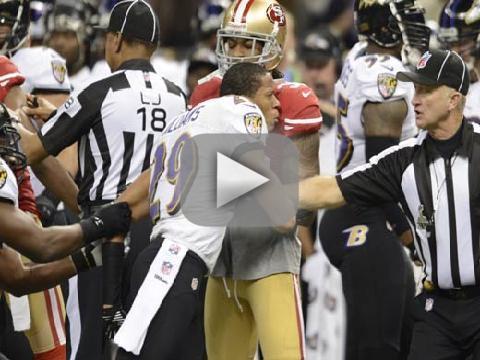
Ravens’ Cary Williams Shoves Ref in Super Bowl Melee

A scuffle broke out between the Baltimore Ravens and San Francisco 49ers during Super Bowl XLVII after the Ravens intercepted a pass in the second quarter. Raven Shoves Ref After Ed Reed picked off a Colin Kaepernick pass, players were pushing and shoving … mostly each other. Except the Ravens, Cary Williams, who took on a ref. Unnecessary roughness penalties were awarded to San Francisco’s Joe Staley and Baltimore’s Corey Graham. Williams, however, escaped being penalized. Purposeful contact with an official typically results in an ejection, and many felt that Williams should have been ejected from the game after the move. It’s all irrelevant now, though. Baltimore won its second Super Bowl title Sunday, holding off a furious San Francisco comeback to eke out a 34-31 victory.

Excerpt from:
Ravens’ Cary Williams Shoves Ref in Super Bowl Melee

Super Bowl 2013: Who Ya Got?

We’re just three hours away from Super Bowl 2013 (or Super Bowl XLVII to be more accurate), and the NFL title game does not lack for storylines. A replacement quarterback who became a star. A sibling rivalry among coaches. The grandest of exits for one of the NFL’s greatest players. Oh, and even a little deer-antler spray for good measure. There’s also a chance for history. A win over Ray Lewis and Baltimore Ravens gives the San Francisco 49ers six titles, tying Pittsburgh’s record. Unlike the Steelers, the Niners have never lost the Super Bowl. Neither have the Ravens, who won their only previous appearance 12 years ago. San Francisco hasn’t won since 1995, when star QB Colin Kaepernick was seven years old. Can he write a new chapter for the franchise tonight? The 49ers are four-point favorites, but that means little to the Ravens, who made it here by shocking Denver and New England on the road. You tell us: Who will win Super Bowl XLVII?   The 49ers The Ravens View Poll »

Visit link:
Super Bowl 2013: Who Ya Got?

Knocked Up: Tracy Morgan’s Fiancée Jawn Toting A Gut Full Of Funnyman!

It must be something in the water! Actor/comedian Tracy Morgan just announced that he and his bangin’ fiancée have a little one on the way too. Via People reports : His hit show 30 Rock may be saying its final goodbye Thursday night, but for Tracy Morgan, today is also about new beginnings. The actor and comedian and his model fiancée Megan Wollover are expecting their first child together early this summer, Morgan, 44, confirms to PEOPLE exclusively. “I am over the moon excited and just want a happy and healthy baby and a safe delivery for Megan,” he tells PEOPLE. Morgan, who has three grown sons, recently told Rolling Stone he hoped to have a baby daughter one day. “You know what happiness is? Happiness is a simple thing, man,” he told the magazine. “It’s having something to look forward to.” The funny man announced his engagement on the Emmy red carpet in September, and told Ryan Seacrest the two got engaged six months prior in San Francisco. Said Wollover, 26, of the traditional proposal, “It wasn’t anything crazy. He was on bended knee and everything.” Morgan, who is currently in New Orleans for the Superbowl, kicks off his “Excuse My French” tour in March. This is great news! We’re excited about the little one on the way and hope these two get hitched soon too. WENN

Original post:
Knocked Up: Tracy Morgan’s Fiancée Jawn Toting A Gut Full Of Funnyman!

There are two back to back weekends of 2012 that I will never…

There are two back to back weekends of 2012 that I will never forget. This is my fifth time meeting Justin. My best friends, Nicole (@nicolecampea), Vanessa (@belieberbabes) and I bought tickets for the Ottawa show for November 23. I was so excited because I’ve never met Justin at a meet and greet before and I wasn’t sure what to expect or how it would be. After waiting a long time in line, I met Justin and got a photo with 5 other people in the picture. This was amazing. Justin was so sweet, I introduced myself and told him I was from Toronto and ran the Toronto buyouts with Nicole & Vanessa. I wasn’t with them at the time. At first he couldn’t hear exactly what I said so I had to repeat myself and say it again. After he heard me he said, “Really, that’s amazing. Thank you so much for everything.” Alfredo was also in the tent area where we were taking pictures and standing beside Mike. He kept making funny faces to me while we were talking and taking the picture with Justin. It was pretty rushed and his security pushed me out as Alfredo was trying to say hi to me. Luckily, I recorded it as a voice note on my phone so I always have that to listen to. Then I had the most fun time at the concert, sitting front row and Justin even touched my hand half way through the concert and I melted. It was actually amazing. This was a perfect day and I wouldn’t want it any other way. DJ Tay James and Kenny saw us after the show and said hi to us and ask us how we liked the show. It was really fast though because this was as we were leaving the venue. The morning after the concert, my friends and I went on a train back home. We heard Tay was a guest DJ at Muzik night club back in Toronto that night, so we decided to go for a night out since we were heading there. We saw Tay, then all the dancers and Justin’s crew came too. After quite a while, we saw Jeremy, Alfredo, and Justin with Chaz come in and they had their own booth near the DJ up top. No one could really access Justin’s booth because it was blocked by lots of security. We saw Justin dancing and having lots of fun with his friends, and we danced with some of his dancers and they talked to us because they were on the floor level of the club. It was a fun night! We didn’t take or try to take any pictures of Justin because we wanted to respect him while he was out and didn’t wanna ruin it for him or anyone else. It was cool being in the club when ‘Beauty and a Beat’ came on and Justin was dancing right above us. This fun-filled weekend came to an end and within the next week of my concert, I was expecting to have my meet and greet photo posted on BieberFever’s website. Every single photo was posted but mine! The other 5 people in the picture with me were also wondering where our photo was. We knew we took a picture with Justin and we weren’t sure where it went or how it got lost. I tried tweeting everyone that I possibly could, asking for some help to find my picture or access the photos or have it e-mailed to me. So far, no one has found our picture with Justin. Meeting him was amazing, but I wanted my picture to remember it and have forever. Everyone that saw about it missing on Twitter was freaking out and asking how, why and who could have lost my photo. Thanks to the meet and greet, I met a fan from San Francisco, who I have been able to get to know really well and became friends with her. Unfortunately, she was one of the girls in my photo as well with Justin, so she doesn’t have our photo either. A week went by and it was the Toronto show at the Rogers Centre! We saw tons of camera crews filming for the Believe 3D movie and we had to line up for our meet and greets in an extremely long line up. A lot of Justin’s family and friends were at this show. It was crazy! We waited for over 2 hours to meet Justin and finally it was our turn! Vanessa, Nicole and I walked into the room and Nicole was pretty much pushed into Justin by his security guard. I went on the other side of him. He said “Hey sweetie, how are you?” to me and I replied and said hi, I think… I don’t really remember what I said.  I wish we recorded it. Right before we were all ready for our picture, Nicole told Justin who Vanessa was, telling him she’s My Bieber Experience and Justin like lit up and shouted out “OH MY GOD, MY BIEBER EXPERIENCE IS A SICK SITE” and again repeated, “A SICK SITE, YOU’RE INCREDIBLE!” Yup, he loves it . After the picture, Vanessa went in to give him a high five and of course, his security guard tried blocking her from him. Then Justin ignored his bodyguard and went over his arm or something to give her a high five. I don’t like how rushed both meet and greets were, but still, meeting Justin was absolutely AMAZING. The excitement continued as the concert started and I moved up to the front row of the catwalk. It was awesome seeing Drake and Cody Simpson as special guests. I saw the film crews running around the stadium all night, filming fans, doing interviews and capturing all the best moments of the show. This was the best concert I’ve ever been to in my whole life. It was the most fun experience and crazy how everything happened. I’m so blessed to have gotten the chance to meet Justin again at this sold out show. I didn’t think it would be possible. Toronto went crazy for Justin and I was able to get such good pictures and videos. Honestly, I know a lot of you think things like this won’t happen to you but if you’re patient and you just go with the flow, good things can happen and yes some day you will meet Justin and have your own Bieber experience. December 1st was my fifth time to meet Justin and was perfect. Like I said, best night of my life. Thank you for everything Justin, I love you so much. Jon Chu was also there to film Believe 3D, and he interviewed Vanessa about MBE and then I told him how we never actually got a decent picture together… so of course, we took a nice one! Such an amazing and eventful two weekends in a row. This was all thanks to Justin and his amazing crew who actually do so much for us fans! Thanks for taking the time to read this. -@juliaaa_xo See the original post: There are two back to back weekends of 2012 that I will never…

Read the original here:
There are two back to back weekends of 2012 that I will never…

Falcons Fan Stabbed in Neck Following Team’s Crushing Defeat

A difficult sports loss turned violent last night outside the Georgia Dome in Atlanta, as multiple sources confirm a 35-year old man was stabbed in the neck following his team’s 28-24 loss to the San Francisco 49ers. According to WSB-TV, the victim got into a verbal altercation with two San Francisco supporters. Toward the end of it, someone in the latter group pulled out a knife. Said a witness of the incident: “One of the falcons Fans just kept talking, telling him, “You ain’t going to come here and win and nothing,’ and he hit the man, and that’s what happened. The man went into his pocket and cut him.” Police quickly surrounded the scene and used pepper spray to calm the combatants down. The weapon was then recovered and the victim transported to Grady Hospital. He is listed in stable condition, but the attacker remains at large.

Read the original post:
Falcons Fan Stabbed in Neck Following Team’s Crushing Defeat

Star Spangled Banger: Alicia Keys Confirmed To Scream Sing The National Anthem At The Superbowl

Alicia Keys To Sing The National Anthem At The 2013 Superbowl R&B songstress Alicia Keys has been confirmed to kick off the 2013 Superbowl XLVII in New Orleans with the singing of the National Anthem. via Huffington Pos t Alicia Keys will be singing Francis Scott Key at the Super Bowl, CBS and the NFL announced Friday. The Grammy winner will belt the national anthem in New Orleans on Feb. 3, which sets the stage for a dual-divas duel: Keys at kickoff and Beyonce at halftime. It will be Keys’ third time on the Super Bowl stage, the most by any performer in the game’s history. In 2005, she sang America the Beautiful with 150 students from the Florida School for the Deaf and the Blind and returned three years later to perform as part of the pregame show. This year’s Super Bowl chanteuses will swap places this Monday at the inauguration: Beyonce is slated to belt The Star-Spangled Banner at the swearing-in ceremony, and Keys will perform at the Commander-in-Chief’s Ball alongside Jennifer Hudson. Alicia doing the national anthem and gangstaboo Bey doing the halftime show ? This should be a Superbowl to remember.

View post:
Star Spangled Banger: Alicia Keys Confirmed To Scream Sing The National Anthem At The Superbowl