youtube

Read the rest here:
Dwayne Johnson (The Rock) New Movie Trailer For “Snitch” [Video]

Posted in Celebrities, Hollywood, Hot Stuff
Tagged black celebrity gossip, black celebrity news, Celebrity News, Entertainment, Hollywood, New Movie, News, stars, video
When he wasn’t rooting out Communists, cracking down on the mob and spying on civil rights leaders, FBI head J. Edgar Hoover toiled as a one-man culture warrior battling Hollywood decadence. He prevented Charlie Chaplin from reentering the U.S. because of his leftist political views, and he condemned Frank Capra’s It’s a Wonderful Life for its “rather obvious attempt to discredit bankers.” So what did he have to say about Alfred Hitchcock , who gave American moviegoers new and strange things to fear? Not a bad word. The only questions anyone’s asking about Hitchcock these days are just how much and what kind of a creeper was he? The famed director’s wandering eye, his sexual obsessions, and less-than-decorous urges roil at the center of Hitchcock , the just-released biopic starring Anthony Hopkins and Helen Mirren , as well as last month’s The Girl , the HBO film with Toby Jones and Naomi Watts . As The Birds actress Tippi Hedren claimed earlier this fall , the Master of Suspense could be masterfully cruel and unforgiving. But as far as his popular image as an artiste-provocateur goes, there’s probably more than a little self-mythologizing — or branding, if you’d prefer — in that ironic Englishman persona, the casually sadistic remarks about actors, the pretensions to finding truth in nightmares. It’s that last detail that fuels Hitchcock , a tempting portrait of “Hitch” as a crowd-pleasing, truth-telling anti-hero — not unlike Howard Stern and Larry Flynt in their respective biopics — who shows moviegoers the dark things they didn’t know they wanted to see. But was his threat to the American psyche all smoke and mirrors? That’s certainly what Hitchcock’s FBI file, obtained via MuckRock.com , suggests. Hitchcock’s file doesn’t begin until October of 1960, four months after the successful release of Psycho , which casts serious doubt on Hitch’s claim that the FBI followed him for three months in 1945 after he discussed uranium with a Caltech professor as research for his next film, Notorious . (Donald Spoto, a four-time biographer of Hitchcock, also concluded in The Dark Side of Genius that the FBI investigation was likely apocryphal, declaring that the “extremely sensitive” director would have been “emotionally incapable” of making a film under government surveillance.) In fact, the contents of the FBI file have much more to do with Hoover’s obsessions than with Hitchcock’s. Whatever paranoia and “extreme sensitivities” Hitchcock suffered, Hoover suffered doubly so. The bulk of the file has to do with a seven-month surveillance on a single episode of Alfred Hitchcock Presents that illustrates the acute obsessiveness of the FBI’s fearsome but fearful director. Through unrelenting pressure and undeserved authority, the Bureau convinced Revue Studios, which produced A.H. Presents, to eliminate a minor character, an FBI agent who instructs a would-be kidnapper that abduction is illegal, from the episode “Coming, Mama.”

Read the original post:
A Tale of Two Directors: Alfred Hitchcock, J. Edgar Hoover, And The FBI’s Eye On The Master Of Suspense
Posted in Celebrities, Gossip, Hollywood, Hot Stuff, News
Tagged anthony-hopkins, charlie-chaplin, close reads, Genius, howard-stern, j. edgar hoover, New Movie, psych, revue-studios, tv guide
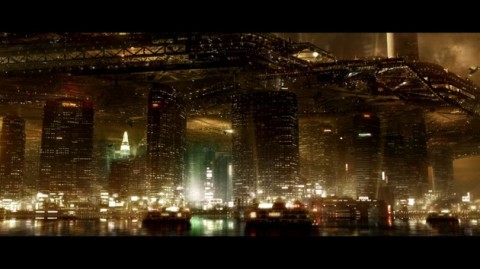
CBS Films’ announcement that it had hired Sinister director Scott Derrickson to direct a feature adaptation of the Deus Ex: Human Revolution video game is exciting news. Human Revolution was one of the greatest games of 2011. It’s a supreme science-fiction thriller and ideal movie fodder that features a highly adaptable cybernetically augmented protagonist named Adam Jensen who may be the ultimate action hero. But this is much more than a movie announcement. It could be the dawn of a new age in video-game movies. Yes, this will be CBS Films first attempt at a video-game movie and Derrickson’s previous sci-fi/horror credits are the much-maligned 2008 remake of The Day The Earth Stood Still and Hellraiser: Inferno, the first film in that franchise to go straight to video. But, hey, even though I’m Irish and don’t celebrate Thanksgiving, I do prefer to look at the bright side. So here are five reasons to be thankful Human Revolution is being adapted for the big screen. 1. Amazing Settings The dystopian world of Human Revolution makes Blade Runner look like Disneyland: A dying Detroit shot through with the shining towers of the cybernetics industry (a perfect metaphor for cyborg augmentation itself); the incredible twin-level city of Hengsha, the world-altering Arctic environmental station of Panchaea. Each location could support a movie (and three concept art books). 2. The Tension of Transhumanity The central theme and conflict of Deus Ex: Human Revolution is Adam Jensen’s ambivalence about his augmentation. His most famous line is “I didn’t ask for this,” when waking up every morning to face the mirror he broke in horror at his own appearance. But hey, since there’s no turning back, he makes the most of his technological gifts, becoming a super-cyborg assassin who exacts revenge against the murderous evildoers who altered his body and kidnapped his girlfriend. (The most exciting parts of the game are unlocking and choosing new implanted abilities.) And frankly, it’s hard to empathize with Jensen’s nano-angst since his flesh has been replaced with bulletproof skin and the ability to pose so hard it kills all enemies in a ten meter radius. It’s called the Typhoon defense system, and it’s the most lethal Tim Tebow touchdown celebration in history. 3. A Well-Developed Story For a long time games didn’t have plots, they had excuses for mass-murder. Even when there was a narrative beyond “Press X to fire” it was written in fairly broad strokes, because that’s the only kind of stroke you can make with tanks and flamethrowers. This is why a lot of video-game movies haven’t worked. The writers didn’t know how to turn their sparse plot lines into features. But Deus Ex: Human Revolution features a fully realized world. In addition to the primary plot, which has enough twists and turns to easily propel a tentpole picture, there are a number of fully fleshed backstories to be found in the dozens of optional e-mails and hidden reports that players can discover over the course of the game. Never mind the global intrigue and the murderous cybernetics company — at one point in the game you can uncover the petty machinations of your bigoted cyborg-hating apartment manager.
Read the original:
‘Deus Ex’-cellent − 5 Reasons To Be Thankful ‘Human Revolution’ Is Coming To The Big Screen
Posted in Celebrities, Gossip, Hollywood, Hot Stuff, News
Tagged Game, Hollywood, human-revolution, invalid, jensen, Movies, New Movie, Robert Pattinson
If you missed the excellent ParaNorman in theaters (or saw the similarly macabre and quirky Frankenweenie instead), catch an exclusive clip from the dark, funny, moving, and visually impressive stop-motion animation about a loner kid named Norman whose ability to see dead people first makes him an outcast, then an unlikely hero, when his small town is overrun by zombies. Movieline’s exclusive clip finds Norman (Kodi Smit-McPhee) and his Goonies-esque band of misfits — including school bully Alvin (Christopher Mintz-Plasse), sister Courtney (Anna Kendrick), reluctant BFF Neil (Tucker Albrizzi), and Neil’s jock brother Mitch (Casey Affleck, who gets one of the film’s biggest adults-only laugh) — searching the town library for a key piece of information as zombies, and more terrifyingly, parents, run amok outside. Much of what makes ParaNorman one of the best children’s films of 2012 is the writing, which doesn’t condescend to its young audience; this is a movie that knows that being a kid can really suck — especially for victims of bullying, or even just oddballs who stand out from the crowd a little too much. It embraces death as a real tangible fact of life and goes to some terrifying places while moving at a dynamic pace, lightened by a savvy sense of humor, which is what makes ParaNorman the quintessential Tim Burton film that Frankenweenie just quite wasn’t. ParaNorman hits DVD and Blu-ray November 27. Did you catch it in theaters? Let the ParaNorman lovefest unfold in the comments below. Follow Jen Yamato on Twitter . Follow Movieline on Twitter .
Read more:
WATCH: Daring, Dark ‘ParaNorman’ Channels ‘Goonies’ In Exclusive Clip
Posted in Celebrities, Gossip, Hollywood, Hot Stuff, News
Tagged Blu Ray, casey-affleck, exclusive, festival-review, films, frankenweenie, goonies-esque, Hollywood, invalid, lovefest-unfold, matthias schoenaerts, New Movie, paranorman, some-terrifying, TMZ
Ang Lee ‘s Life of Pi is a doubled-edged argument for the transcendent capabilities of film. Its central section uses the latest technological achievements to transform the fantastical, fable-like tale of Yann Martel’s award-winning novel into some of the most innovative and wondrous images to flicker across the big screen this year. And in its framing story, one it returns to periodically as if needing to keep the audience from getting too caught up in the gorgeous abstraction of its narrative at sea, it provides a reminder of why we should trust more in those images, as it ploddingly trots out its source material’s heavy-handed and unnecessary delineation of its own themes. Those themes include faith and what fuels it. And in case anyone watching is in danger of not picking that up, Rafe Spall, in the role of a fictionalized version of Martel coming to interview the title character (played by Irrfan Khan as an adult) at his home in Canada, announces that he’s been promised a story that will make him believe in God. The nature of that God is a general one — Martel, and David Magee, who wrote the screenplay, are more interested in the idea of religion rather than one in particular. As a young boy, played by Ayush Tandon, Pi Patel becomes enchanted by Hinduism, then Christianity, then Islam, practicing them all with no sense that they need clash. As a grown man sharing his extraordinary tale of survival with a stranger who has come his way by chance, Pi remains a figure of strong but vague spirituality, though the film’s ultimate assessment of why people choose to believe in a higher power seems unlikely to please the devout. Life of Pi is also, more compellingly, about storytelling: the way we choose to present and frame the events that happen to us. Long before he’s stranded at sea with a tiger for company, Pi’s life is one that’s filled with strands of magical realism. Born in Pondicherry in French India, he’s named after a swimming pool in Paris that his uncle once visited. Its clear water is presented by the film as looking like air until swimmers ripple its surface as they dart across the screen. He and his brother Ravi (Vibish Sivakumar) spend their soft-focus childhood growing up on a zoo run by their reason-loving father (Adil Hussain) and their softer, more nurturing mother (Tabu). The animal inhabitants are showcased in a delightful opening credits sequence — all except the newest arrival, a Bengal tiger with the unlikely name of Richard Parker. The tragedy that strands a teenage Pi (played by perfectly adequate first-timer Suraj Sharma) in a lifeboat with Richard Parker in the middle of the Pacific Ocean is a terrifyingly realized storm that takes down the freighter transporting the Patel family and their menagerie to a new life in Canada. Water, whether in the form of a remembered pool or an angry sea swamping the deck of a ship, is the element that buoys the film along. Lee uses it as the medium for some unparalleled instances of 3-D, first in how our protagonist is thrown onto his tiny boat with a few panicked animals, riding giant waves that bring the larger vessel down to a resting place of haunting and tragic beauty. Later, as Pi and his dangerous companion struggle to reach some kind of accord that will allow for their mutual coexistence on a very limited space, the ocean stretches endlessly around them as a force of mystical capriciousness — sometimes it’s a mirror-still reflection of the sky, another time it offers up sustenance via a school of flying fish or takes it away in a dreamily alarming brush with a whale. The sea dwarfs the odd pair of travelers, the camera sometimes swinging out above the lifeboat to show it as a small blip in a vast body of water that resembles the cosmos. Pi’s continued existence and trials may be thanks to the whims of the universe — “I give myself to you!” he yells to whatever deity might be listening, “I am your vessel! Whatever comes, I want to know!” — but it’s his relationship with Richard Parker that provides the human side to this existential crisis. A seamless blend of real tiger and CGI, Richard Parker is a fully believable creation, and while Pi searches him for some sign of a soul, of some connection between living things, Life of Pi is careful not to anthropomorphize him. He’s a formidable beast, a potential killer, and the film’s best representation of its central question of whether there’s some design to existence or if it’s just a collection of chaotic and sometimes awful events. Unfortunately, Life of Pi also prods at this question during periodic returns to the present day with the grown Pi and Martel, and the scenes create the sensation of an author leaning over your shoulder as you read to point out all of the symbolism he doesn’t want you to miss. The story of Pi and Richard Parker already has the clean simplicity of a myth and really doesn’t require significant elaboration, but following in the footsteps of the source material, the film provides elaboration anyway, demonstrating a condescension to the audience that dulls the spectacle it punctuates. The past and the present day become an example of not just the contrast between the classic poles of showing and telling but of the fundamentally cinematic and the not. Pi’s reliability as a narrator is one of the key aspects of the story, but the heightened sensibility of his account is contrasted not with some underlying sense of another reality but of a framing story that’s only there as a vehicle for authorial exposition. Lee’s movie is a grand gesture of filmmaking pushed to its furthest technical edges, but hemmed in and confined by its fidelity to words on a page. Follow Alison Willmore on Twitter. Follow Movieline on Twitter.
View original post here:
REVIEW: Crouching Tiger, Condescending Director Make For Frustrating ‘Life Of Pi’
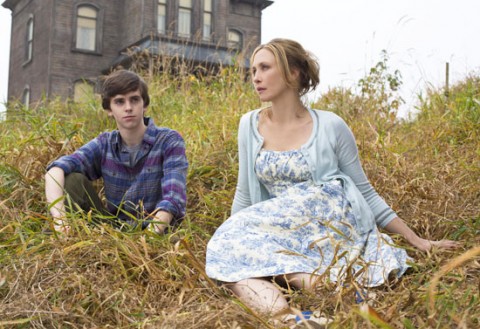
A widow (Vera Farmiga) lounges with her teenage son Norman (Freddie Highmore) in the grass near their new home. How bad could things possibly get? Since this is your first look at A&E’s Bates Motel , in which the fresh-faced Highmore plays a young Norman Bates , and Farmiga his dear mother, the answer is, well, a LOT. Bates Motel is created by Lost ‘s Carlton Cuse and Friday Night Lights ‘ Kerry Ehrin, and is also set to star Max Thieriot ( The House At The End of the Street ) as Dylan Bates, Norman’s brother and one of a few newly conceived characters joining the previously established world of Hitchcock’s Psycho . (Read Movieline’s chat with Thieriot here .) The series doesn’t hit the airwaves until next year, but it’s no surprise A&E is seizing their chance at building buzz now, with Hollywood in a period of Hitchcock mania; the Anthony Hopkins-as-Hitch dramedy Hitchcock opens in limited release this week, while HBO’s more serious, skeezy portrait of the Master of Suspense The Girl debuts this fall. What intrigues about this Bates Motel first look, meanwhile, is twofold: First, the hint of a moody-emo shadow in Highmore’s face — young Norman still seems innocent, but we know that’ll change soon enough. (Plus, he totally nails that young Anthony Perkins look.) More provocative still is the sheer distance in Farmiga’s eyes as she gazes away from her child, her new hotel, her life. That’s acting with a capital A, people. I’ll watch just to see what kind of terrible parenting skills it takes to turn little August Rush into a psychopath. [via The Hollywood Reporter ]
Read more:
‘Bates Motel’ First Image: Vera Farmiga Is Mama Bates In The ‘Psycho’ Prequel
Posted in Celebrities, Gossip, Hollywood, Hot Stuff, News
Tagged bates-motel, bennyhollywood, carlton-cuse, celeb news, empire-strikes, french, friday-night, Hollywood, House, motel, New Movie, psycho-prequel, TMZ
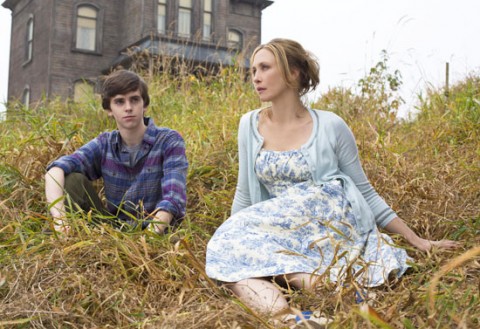
A widow (Vera Farmiga) lounges with her teenage son Norman (Freddie Highmore) in the grass near their new home. How bad could things possibly get? Since this is your first look at A&E’s Bates Motel , in which the fresh-faced Highmore plays a young Norman Bates , and Farmiga his dear mother, the answer is, well, a LOT. Bates Motel is created by Lost ‘s Carlton Cuse and Friday Night Lights ‘ Kerry Ehrin, and is also set to star Max Thieriot ( The House At The End of the Street ) as Dylan Bates, Norman’s brother and one of a few newly conceived characters joining the previously established world of Hitchcock’s Psycho . (Read Movieline’s chat with Thieriot here .) The series doesn’t hit the airwaves until next year, but it’s no surprise A&E is seizing their chance at building buzz now, with Hollywood in a period of Hitchcock mania; the Anthony Hopkins-as-Hitch dramedy Hitchcock opens in limited release this week, while HBO’s more serious, skeezy portrait of the Master of Suspense The Girl debuts this fall. What intrigues about this Bates Motel first look, meanwhile, is twofold: First, the hint of a moody-emo shadow in Highmore’s face — young Norman still seems innocent, but we know that’ll change soon enough. (Plus, he totally nails that young Anthony Perkins look.) More provocative still is the sheer distance in Farmiga’s eyes as she gazes away from her child, her new hotel, her life. That’s acting with a capital A, people. I’ll watch just to see what kind of terrible parenting skills it takes to turn little August Rush into a psychopath. [via The Hollywood Reporter ]
View post:
‘Bates Motel’ First Image: Vera Farmiga Is Mama Bates In The ‘Psycho’ Prequel
Posted in Celebrities, Gossip, Hollywood, Hot Stuff, News
Tagged Blu Ray, Hollywood, New Movie, night, norman, psycho-prequel, simon kinsberg, skills-it-takes
Readers of Stephenie Meyer ‘s Twilight books know what happens at the end of Breaking Dawn … or do they? Movieline sat down with director Bill Condon for an all-out, no-holds-barred, spoilery chat about the shocking changes at the end of Breaking Dawn Part II that had fans gasping in theaters around the globe over the weekend — including how the filmmakers decided who lived and who died, and why if you blinked you may have missed the most earth-shattering character fates of them all. Spoilers abound from this point on! Now that you’ve all had a chance to see Breaking Dawn in theaters, it’s time to dive into the bounty of spoilery riches that Bill Condon left us with when he spoke with Movieline about all things Twilight . Such as: — Deciding who lived and who died in Breaking Dawn ‘s horrific, head-rolling, jaw-tearing bloodbath of a (dream) battle sequence. — Walking the fine line between Uncle Jacob being just protective enough of Renesmee and being totally creepy. — Which character’s battlefield speech was left on the cutting room floor — and which scenes will we see on the DVD? — How much real world political commentary can viewers read into Aro’s weapons of mass destruction-seeking, warmongering ways? (Also — if Condon used the “smaller” take of Aro’s gleefully campy cackle, what in the world did it sound like when Sheen cranked it all the way to 11?) — And, most shocking of all: Did you realize that Edward and Bella were meant to die ? PHOTOS: Stars Hit The Premiere Of Breaking Dawn – Part II You had just finished the last of the effects prior to release, working on the Renesmee CG. Hers stand out because it’s a kind of CG effect we haven’t seen before — applying Mackenzie Foy’s face to her character from birth to adulthood. How challenging was it to achieve the desired effect? Bill Condon: You’re building on stuff that was done on The Social Network and Benjamin Button , but it had challenges beyond what they had. She is a special creature — she’s not entirely human — so that helps us, a little bit. It is a bit uncanny, that CG baby face. Condon: Yes, I agree. We briefly see a flash forward to the grown Renesmee, living happily ever after with Jacob once she reaches her full maturity a few years down the road — when Jacob finally gets to date Renesmee. Condon: Finally, yes! On La Push. What was the trick to figuring out how to include that happy romantic ending for Jacob and Renesmee without it being creepy? Condon: Well the thing is, obviously it was controversial the minute it was written. But as a filmmaker you have a great ally in Taylor Lautner, and Taylor was concerned about it. But Taylor is a pure soul. He is able to look at her with love and it doesn’t have another component to it, and I think another actor couldn’t have done that. I think there’s something so essentially sweet about him that it’s a generous love. The humor element throughout the entire film helps relieve the pressure and the far-fetched nature of much of the mythology — what spurred you folks to add in more levity for the finale? Condon: Any time you can add humor it’s great, because it makes something more real. You take Billy Burke; he had to play a scene which is so incredibly hard I called him “The Miracle Worker,” in which a father has to accept that his daughter has become a vampire, but he also has to accept that she can’t tell him anything about it. He can’t ask questions, but he’s a cop. Billy went through a hundred changes through that scene, and you see it all on his face – and he’s funny the whole time he’s doing it. That deadpan, “Are you kidding me?” look really gets you through some of this strange stuff. You filmed Parts 1 and 2 simultaneously, sometimes having Kristen Stewart play weak, dying Bella in the same afternoon as strong vampire Bella. Condon: I really do think that Kristen Stewart is amazing, but I feel like in terms of this series she doesn’t get credit for how much she accomplishes. I think if someone were to sit and watch these two movies that we made together at the same time and realize that Kristen shot that all together, it’s just another level of her gift. She was stepping out of her comfort zone, because there was so much Kristen in teenage Bella — and now this was someone who she was just creating. I think Kristen, who’s tough on herself, was able to step out of all that stuff and just really own everything. Readers of the books have been defending Twilight for years now, understandably; Bella is a passive character early in the franchise, and we only see her grow into her strength in Breaking Dawn . Condon: That’s right — and she always had this latent power. In the beginning it was the thing that made her remote, but I love the last scene in the movie; it’s such a beautiful idea. It’s the reason he was interested in her the moment that he met her, but it’s such a metaphor for love, that you trust a person enough to let them see inside of you. You inherited much of your primary cast from the previous films’ directors, but in Breaking Dawn Part II you got to cast a number of colorful new additions. Like Lee Pace… Condon: Dreamy, right? Yes, and so funny with such limited screen time. Condon: I know! These actors all have a couple of scenes to establish these characters, and we have 25 of them, so we had to get actors who really pop. And they also had to know how to mine as much comedy as you can possibly get out of something. Did you feel a lot of pressure to deliver with the action sequence? Condon: I did! I loved it. It was like making one big musical number, because it’s all about rhythm in an action scene. It’s all about the way it’s like, my god, this is happening so we’ll slow it down for a bit, and you take a moment to really take it in – then things are going well, then they’re going badly. It’s like a roller coaster. I loved working on that, but it was the hardest thing. It was a two-year effort. We had an editor who just concentrated on that. Once we stopped shooting it started all over; we put it in a different order and rearranged things, reshot a little bit of it, to really make it work. I didn’t realize it right away, but the battle scene ends on a much darker note than I thought, so please set the record straight — after killing Aro in that alternate future-flash, do Bella and Edward die? Condon: Yes. There’s a hint of it; it’s about to happen. Edward gets surrounded and they’re coming right at her with the fire. It’s very subtle and there’s the switch. I didn’t want to spend too much time in there; it’s just a little hint in there if you can see it. What do you expect fans will be most shocked by? Condon: The moment when Carlisle’s head comes off, I’d think. I’ve seen it with an audience and I love it. The collective gasp in the theater in that moment is pretty fantastic. Condon: I know — it’s fun, isn’t it? I love that. NEXT: Deciding who would live and die Breaking Dawn Part II ‘s big battle, DVD deleted scenes, and more
See the rest here:
Bill Condon On That ‘Twilight’ Twist And The Shocking Character Fates Of ‘Breaking Dawn – Part 2’
Posted in Celebrities, Gossip, Hollywood, Hot Stuff, News
Tagged bella, bill condon, books, celeb news, coppola, films, mma, New Movie, party, renesmee, stephenie-meyer, the movieline interview, women
Martin Scorsese turned 70 on Nov. 17, which makes it an ideal time to look at some of the best cinematic gifts he’s given to the world. This list could go on well past the eight clips I’ve chosen. For instance, Joe Pesci’s chilling “Do I amuse you in some way?” scene in GoodFellas could easily be included, but I wanted to feature one clip for each of Scorsese’s seven decades (and, in birthday tradition, one to grow on) without repeating any films. 1. Robert De Niro’s “You talkin’ to me?” scene in Taxi Driver (1976) — One of the most quoted, imitated and parodied scenes in the last 50 years of filmmaking. And look how young Bobby D looks. 2. The Copacabana Steady-cam shot from GoodFellas (1990) — This shot makes me practically giddy every time I watch it. It’s a beautiful, seamless depiction of how power and influence can be bought and sold on the streets of New York City.
Read more from the original source:
Happy 70th Birthday Week, Martin Scorsese! Celebrate With His Finest Scenes
Posted in Celebrities, Gossip, Hollywood, Hot Stuff, News
Tagged awards, birthdays, cinematic-gifts, feature-one, goodfellas, Hollywood, joe pesci, look-at-some, martin-scorsese, mma, New Movie, parodied-scenes, past-the-eight, raging-bull, taxi-driver
If Quentin Tarantino ‘s demonstrative hand gestures don’t distract you too much, here’s an interesting clip in which the Django Unchained director discusses the influence that crime novelist Elmore Leonard had on his formative years as a screenwriter and filmmaker, as well as his appreciation of actress Pam Grier. Rolling Stone posted this exclusive video , which is part of the bonus material included in Tarantino XX , a 10-disc Blu-Ray box set that collects the eight movies from the first 20 years of his career: Reservoir Dogs , True Romance, Pulp Fiction , Jackie Brown , both Kill Bill films, Death Proof and Inglourious Basterds . In what appears to be a Film Independent Q&A on Tarantino’s 1997 film Jackie Brown , which was adapted from a Leonard novel, the filmmaker explains that he used to read the writer’s books and “adapt them into movies in my mind,” asking himself: “How would I turn this into a movie?” He adds that engaging in that mental exercise, “years before I could ever afford to make a movie, really..helped me with my structure.” There’s also a curious moment at the end of the clip where Tarantino talks about wanting “to be Josef von Sternberg” to Pam Grier’s “Dietrich.” While I appreciate Tarantino’s appreciation of Grier’s talent, I think that line says more about him than her. Von Sternberg made the little known Marlene Dietrich a star when he cast her in The Blue Angel and then worked with her for five more films. Grier was hardly an unknown when Tarantino began working with her. Thanks to her roles in Coffy and Foxy Brown , Grier was already a cult icon. Tarantino merely reminded us of that. He also didn’t exactly make her a star. [ Rolling Stone ] Follow Frank DiGiacomo on Twitter. Follow Movieline on Twitter.
Excerpt from:
Tarantino On Pam Grier In ‘XX’ Retrospective: ‘I Wanted To Be Josef Von Sternberg To Her Dietrich’
Posted in Celebrities, Gossip, Hollywood, Hot Stuff, News
Tagged celeb news, cobain, from-the-first, Hollywood, jackie-brown, marlene dietrich, mma, morgan, Music, New Movie, reservoir-dogs, sternberg, writer



 Breaking Sports Video




Pac-12 NCAA Sports
Justin Bieber Fan Site Breaking News