Tag Archives: orleans

New Orleans: Systemic Police Brutality Exposed

Bio Jordan Flaherty is a New Orleans-based journalist and works with the Louisiana Justice Institute. He was the first writer to bring the story of the Jena Six to a national audience, and his award-winning reporting from the Gulf Coast has been featured in a range of outlets including the New York Times, Mother Jones, and Argentina's Clarin newspaper. Jordan just published released his new book called “FLOODLINES: Community and Resistance from Katrina to the Jena Six”. t's hard to believe all this took place in america, not mexico or venezuela… Transcript PAUL JAY, SENIOR EDITOR, TRNN: Welcome to The Real News Network. I'm Paul Jay. And now joining us again from our studio in Washington is Jordan Flaherty. He's the author of the book Floodlines: Community and Resistance from Katrina to the Jena Six. Thanks for joining us again, Jordan. JORDAN FLAHERTY, AUTHOR AND JOURNALIST: Thank you, Paul. It's a pleasure. JAY: So one of the things that people have talked about after Katrina is the role of the police and the Armed Forces particularly. But a lot has come to light about the role of the New Orleans police and abuses of power. Tell us a bit about what people are looking at. But also, was this an anomaly, where, you know, police went nuts in the course of a storm? Or was this kind of normal New Orleans police behavior that is just getting looked at because of the storm? FLAHERTY: The first thing to understand, Paul, is in those first days after the storm, suddenly the media coverage shifted from sympathy to the people trapped on rooftops, the victims of this disaster, to portraying people as criminals, as looters, as armed gangs roving the streets, shooting at police helicopters, raping infants. We later found out those stories were false. But they were propagated by the chief of police, who said that infants were being raped in this Superdome; by the mayor, who said that there was lawlessness on the street, that he declared martial law, even though no such thing exists under Louisiana law. The governor of the state of Louisiana—Kathleen Blanco at the time—said, I'm sending in the National Guard troops; they're locked and loaded, they've been trained to shoot to kill, and I expect they will. JAY: Now, hang on for a sec. You're saying there were no incidents? Or some incidents were exaggerated to look like it was a bigger phenomenon than it was? FLAHERTY: I'm saying those incidents that were specifically talked about that were incredibly outrageous, like infants being raped in mass numbers in the Superdome—there was no raping of infants that anyone's documented that happened in the Superdome. Shooting at rescue helicopters—again, no one's documented where that happened, although that was widely talked about at the time. Another incident that was talked about, the second-in-charge of the police department said he heard officers radioing in saying they needed more ammo, they were running out of ammo, like they were in a wartime situation. Again, this call never actually happened. So these major incidents that were talked about never happened. There were certainly people, both police officers and regular civilians, that were taking goods out of stores, mostly food and water to feed people in their community. But the massive, violent outbreak that was talked about in the news that was used to demonize people, that actually didn't happen. JAY: So why do people think the police were doing this? I mean, what's in it for them to exaggerate the issue? FLAHERTY: I think it was a time of chaos. It's hard to imagine, if you weren't in the city, what it was like there, but we never imagined this entire city would be underwater. Everything was unimaginable. Everything seemed like we were in a fantasy world. And so many of the things that actually did happen seemed like they couldn't possibly have happened. For example, one thing that really did happen is people were trying to cross out of the city over the Crescent City Bridge, and they were met by armed police from the suburb of Gretna that didn't want people of New Orleans in their city, and they shot at the people from New Orleans and forced them to turn back. This seemed like fiction when we first heard about it. Many of the police killings that happened in that period after Katrina seemed like fiction. It was hard to believe any of this. It was a time of almost mass hysteria. added by: treewolf39

The 6 Crucial Errors that Lead to the BP Spill

Photo via NY Daily News It’s beyond well-known by now that crucial mistakes and shoddy cost-cutting measures were instrumental in bringing about the tragedy at the Deepwater Horizon drill site. But it’s still rather alarming to look at them back-to-back-to-back — New Orleans Times… Read the full story on TreeHugger

See original here:
The 6 Crucial Errors that Lead to the BP Spill

30 Old pC ads

30 Old pC ads added by: neham

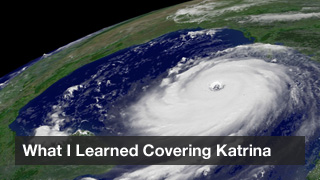
What I Learned Covering Katrina

Vanguard’s Adam Yamaguchi talks about reporting in New Orleans and what he learned from covering Hurricane Katrina.

View original post here:
What I Learned Covering Katrina

A Look At New Orleans Five Years After Hurricane Katrina

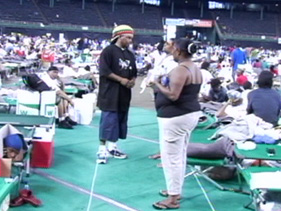
Despite many locals having permanently relocated, the city continues to recover from one of the biggest disasters in U.S. history. By Jayson Rodriguez, with additional reporting by Rahman Dukes and Steven Roberts Inside the Louisiana Superdome after Hurricane Katrina Photo: MTV News Five years ago, a New Orleans native by the name of Terrell became separated from his family — his mother, his sister, his brother and his nieces — in the aftermath of Hurricane Katrina when he volunteered to help neighbors to safety during the category 5 natural disaster. His story wasn’t unlike the ordeals experienced by many other residents in the Gulf Coast region at the time. Down and hard up on his luck, the young man was determined to reunite with his loved ones. “I haven’t slept since Monday, just transporting people through the flood to the Superdome,” he told MTV News’ Sway at the time, referring to the New Orleans Saints football stadium where survivors were temporarily housed. “It’s a boat that I found and I’m walking through the water pulling a boat of young people and elderly people just to get them out of harm’s way. Three o’clock this morning, I’m pulling the boat and I see a guy, he was holding his baby, floating in the water, they were dead. I had to take a whole ‘nother route. This is what I seen with my own eyes.” Despite the difficult challenges, two days later Terrell found his family in Houston at the Astrodome, where they had been evacuated to for safety concerns. It was only one story of hope fulfilled. But this enduring example represents what’s been going on in the city since: the resolve and persistence of those affected overcoming the odds through sheer will and pride and with a flare for the dramatic. From the Superbowl-winning New Orleans Saints to the residents of Louisiana coming together once again to fight through another setback, namely the BP oil spill, this corner of the country has proven to be the bedrock of our nation. A study released earlier this month by the Greater New Orleans Community Data Center and the Brookings Institution shows that the city’s residents are better off financially than they were five years ago, according to CNN . However, with as many as 1,800 people killed during the storm and a larger number of natives having permanently relocated to Houston, Atlanta, towns in Mississippi and other area cities, the findings may be skewed. Tourism, though, is still a key contributor to the city’s success and the pulse of the city’s economy. While nowhere near the levels it was pre-Katrina (10 million-plus visitors a year), the number of tourists arriving to the city known for his musical legacy, culinary treats and Mardi Gras festivities has grown steadily from 3.7 million the year after the storm to nearly 8 million last year, according to an ABC News report. And while corruption had been a larger part of the New Orleans government and executive leadership in the past, earlier this year, democratic mayoral candidate Mitch Landrieu was elected to lead the city, with a staggering 66 percent of the vote and carrying 365 out of 366 voting precincts. Landrieu’s speech during his swearing-in ceremony perhaps best captured the new spirit of New Orleans and may ultimately prove to be the message the city wishes to send to the world. “That first step is to declare that we are no longer recovering, we are no longer rebuilding. Now, we are creating,” Landrieu told his constituents in May. “Let’s stop thinking about rebuilding the city we were and start dreaming about the city we want to become. The world deserves a better New Orleans. So, people of New Orleans, hear this: Today is a new day. Today is a new time.”

See more here:
A Look At New Orleans Five Years After Hurricane Katrina

Federal Indictments announced against officers in New Orleans bridge deaths

(CNN) — Federal officials announced indictments Tuesday against four police officers and two supervisors in the investigation surrounding the post-Katrina deaths of civilians on New Orleans' Danziger Bridge. At least three New Orleans police officers were in FBI custody Tuesday afternoon, an attorney for one of them confirmed. Kenneth Bowen, Anthony Villavaso and Robert Gisevius surrendered to authorities. Announcement of the charges stemming from a federal civil rights investigation was made by Attorney General Eric Holder in New Orleans. “Put simply, we will not tolerate wrongdoing by those who have sworn to protect the public,” Holder told reporters. Holder promised the Justice Department will help restore the troubled New Orleans police department. “Today marks an important step forward in administering justice, in healing community wounds, in improving public safety and in restoring public trust in this city's police department,” Holder said. He was joined by the Justice Department's civil rights chief, Thomas E. Perez, and U.S. Attorney Jim Letten, the top federal prosecutor in New Orleans. The shootings occurred at the bridge on September 4, 2005, six days after Katrina slammed into the Gulf Coast. added by: TimALoftis

BP’s Tar Balls from the Gulf Disaster Have Reached the Shores of Texas and Louisiana’s Lake Pontchartrain

PART ONE… http://www.cnn.com/2010/US/07/05/gulf.oil.disaster/index.html?hpt=T1 By the CNN Wire Staff July 5, 2010 6:52 p.m. EDT New Orleans, Louisiana (CNN) — Tar balls linked to the worst oil spill in U.S. history have reached into Louisiana's Lake Pontchartrain and hit the beaches near Galveston, Texas, authorities in those states reported on day 77 of the disaster. Easterly winds and high waves that hindered skimmers drove blobs of weathered oil up into the eastern end of the lake, which sits north of New Orleans, said Anne Rheams, executive director of the Lake Pontchartrain Basin Foundation. She estimated the amount of oil that has reached the lake at less than 100 barrels, with no hydrocarbon smell. “They are about the size of a silver dollar, maybe a little bigger, kind of dispersed in long intervals. It's not as dense as it could be, so we're thankful for that,” she said. The Coast Guard reported over the weekend that a shift in weather patterns could send more oil toward sensitive shores in Mississippi and Louisiana, and bad weather over the past few days has significantly hampered cleanup efforts. Rheams said that pattern was expected to persist for at least three more days. Rear Adm. Paul Zukunft said Friday that the prospect of oil reaching up into Lake Pontchartrain “is where I'm losing the most sleep right now.” “I'm going to look, and if I see even sheen, I'm going to push to make sure that we're moving every and all available resources to respond to this particular area,” he said. Tar balls had previously been spotted in Rigolets Pass, which connects the lake with Mississippi Sound. Officials in Orleans and St. Tammany parishes have been using heavy booms, barges and skimmers to defend Pontchartrain since the early days of the disaster, but Rheams said high waves and strong easterly and southeasterly winds have complicated the effort. “The main thing is that they are an indicator that it could be coming more so this way,” she said. State officials closed a swath of the southern part of the 630-square-mile lake to fishing following the discovery, but there was no sign of an impact on wildlife as of Monday, Rheams said. And in Texas, about 400 miles west of the ruptured offshore well at the heart of the spill, Coast Guard Capt. Marcus Woodring said the total volume of tar balls found over the weekend amounted to about five gallons. And while authorities weren't sure how they made it that far, tests confirmed that at least the first batch collected came from the Deepwater Horizon spill off Louisiana, he said. None were found Monday, and the area's beaches and waterways remained open, Woodring said. The tar balls were less weathered than researchers would expect, leading to suspicions that the oil was either stuck to the side of a ship's hull or mixed in with ballast water from a passing vessel, Woodring said. Tar balls are fairly common along the Texas coast, in part because of seepage from undersea oil deposits or from sunken vessels, he said. CONTINUED… http://media.nola.com/2010_gulf_oil_spill/photo/barges-rigoletsjpg-a6271db372480… added by: EthicalVegan

BP Oil Spill Causing More Gulf Dead Zones as Methane Levels Increase

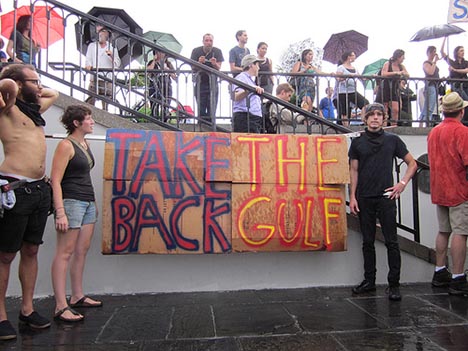
BP oil spill protest in New Orleans, photo: Infrogmation of New Orleans via flickr It’s only been a few days since NOAA-backed scientists forecasting the size of this year’s Gulf of Mexico Dead Zone –that area of ocean so deprived of oxygen than little can live in it–mentioned that it wasn’t clear yet what effect the BP oil spill would have on its size.

Read more from the original source:
BP Oil Spill Causing More Gulf Dead Zones as Methane Levels Increase

Dispatch from the Gulf Oil Spill: Damage Getting Worse Before It Gets Better

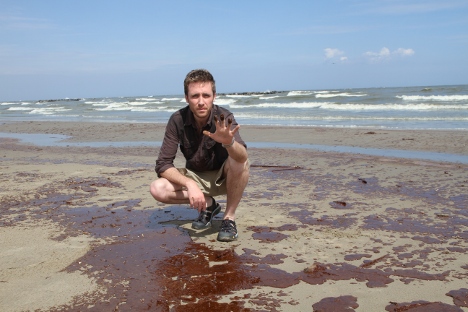
Image courtesy of Philipe Cousteau The day started early as we left New Orleans in the hot muggy morning light. The drive to Grand Isle takes about two hours, plenty of time to contemplate what I was about to see. It had been a week since I was last in Grand Isle and I had heard things were getting worse, but nothing could prepare me for what I was about to see…. Read the full story on TreeHugger

Follow this link:
Dispatch from the Gulf Oil Spill: Damage Getting Worse Before It Gets Better

NFL Star Jeremy Shockey Hospitalized

Filed under: Jeremy Shockey , TMZ Sports New Orleans Saints tight end Jeremy Shockey was rushed to a local hospital earlier today after an incident at the team’s practice facility, TMZ has confirmed. According to local reports, Shockey was suffering from “seizure-like symptoms” while inside… Read more

See the original post:
NFL Star Jeremy Shockey Hospitalized